The Red Queen Summary, Characters and Themes
The Red Queen by Philippa Gregory is a historical novel centered on Margaret Beaufort, the fiercely religious and politically determined mother of Henry VII. Set during the Wars of the Roses, the book follows Margaret from childhood into power as she works to secure the English throne for her son.
Gregory presents her as a woman shaped by faith, ambition, loss, and a relentless belief in destiny. Through Margaret’s eyes, the struggle between Lancaster and York becomes personal: a long test of patience, strategy, and survival in a world where women are used as marriage pieces but can still change history.
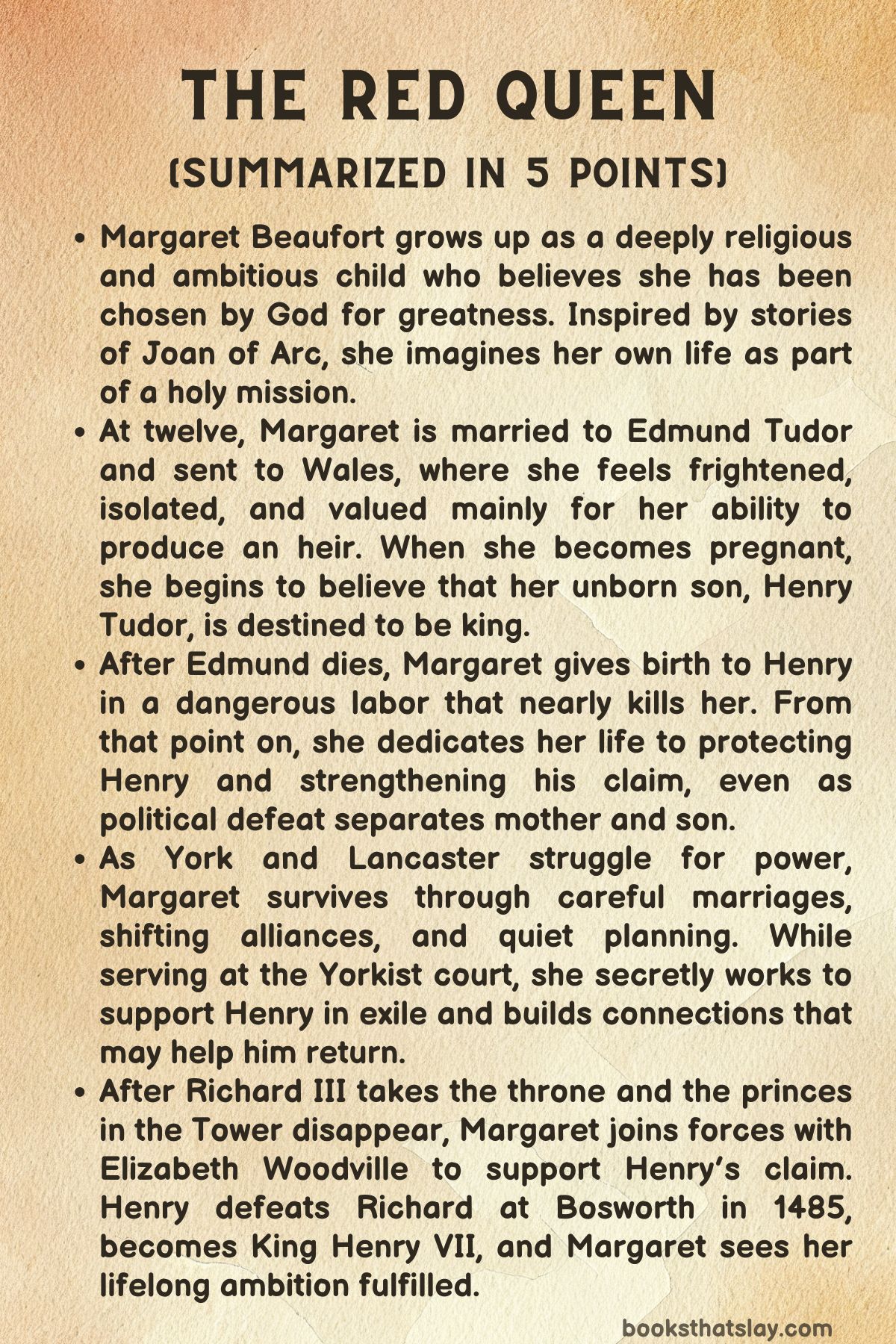
Summary
Margaret Beaufort grows up at Bletsoe as a serious, devout child who believes that God has chosen her for an extraordinary purpose. At only nine years old, she is already drawn to stories of saints, visions, sacrifice, and holy war.
The figure who captures her imagination most strongly is Joan of Arc. Margaret listens to old soldiers describe Joan’s voices, her courage in battle, her capture, and her death by fire.
Instead of hearing these accounts as distant history, Margaret treats them as signs meant for her own life. She begins to compare herself to Joan and to imagine that she too may be destined to serve God in some grand and public way.
Her hopes for a holy life are soon challenged by the hard realities of noble birth. Margaret’s mother informs her that her childhood betrothal to John de la Pole will be ended.
King Henry VI has decided that Margaret will come under the guardianship of Edmund Tudor and Jasper Tudor. Margaret thinks that court life may help reveal her spiritual importance, but she quickly learns that others see her mainly as a valuable Lancaster heiress.
Her bloodline matters because it can strengthen political claims. Her body matters because it can produce a son.
Her wishes, fears, and childhood dreams matter very little.
At twelve, Margaret is married to Edmund Tudor, who is much older than she is. She is taken away to Wales, where she feels isolated and frightened.
Edmund treats her less like a child and more like a wife whose duty is to conceive. The experience strips away much of her early certainty.
She feels abandoned and confused, unable to find the clear signs of divine favor she once believed surrounded her. Yet when she becomes pregnant, she begins to rebuild her sense of purpose.
She interprets a vision as proof that the child she carries is chosen by God. From that moment, her ambition shifts from herself to her unborn son.
She believes he is destined for greatness, possibly even the throne.
Meanwhile, England becomes increasingly unstable. King Henry VI, weak and prone to long periods of mental absence, cannot hold the country together.
Queen Margaret of Anjou fights to protect the rights of her son, while Richard, Duke of York, seeks greater power and challenges the Lancaster line. The conflict between Lancaster and York grows more violent, and Margaret Beaufort’s own life is caught in it.
Edmund Tudor is captured by William Herbert and later dies of plague, leaving Margaret widowed while still pregnant. She is young, vulnerable, and carrying a child whose lineage makes him politically important and dangerous.
Jasper Tudor comes to Pembroke and becomes one of Margaret’s few reliable allies. He promises to protect her child and helps her through the terrifying birth.
In January 1457, Margaret gives birth to Henry Tudor. The labor is brutal and nearly kills her.
She is only thirteen, and the damage done to her body is lasting. After Henry’s birth, Margaret understands that her future will not be built around ordinary marriage, comfort, or personal happiness.
Her life now has one purpose: to protect Henry and advance his claim. She sees her suffering as part of a divine plan and treats motherhood almost as a sacred mission.
Margaret’s joy in her son is soon limited by politics. The Yorkists grow stronger, and Edward IV takes the throne.
Henry Tudor is placed under the control of William Herbert, the same man connected to Edmund’s capture. Margaret is forced to watch from afar as her son is raised among people loyal to her enemies.
This separation becomes one of the central wounds of her life. She cannot openly fight for him, yet she refuses to surrender his future.
Her love for Henry is mixed with ambition, pride, and religious certainty. She believes he belongs not merely to her but to England’s destiny.
To survive, Margaret remarries. Her second husband, Henry Stafford, gives her a more stable position, but not full power.
She must learn patience and caution. The fortunes of Lancaster rise and fall around her.
Henry VI is briefly restored, Edward IV returns, Lancaster leaders are killed, and every change in power brings new danger. Margaret watches the political world carefully, understanding that open loyalty to a defeated cause can destroy her.
Still, she never stops thinking of Henry’s claim. When Jasper Tudor takes Henry into exile in Brittany, Margaret loses physical access to her son but not her influence over his cause.
Distance forces her to work through letters, allies, and plans.
After Stafford dies, Margaret marries Thomas Stanley, a powerful nobleman known for his caution and self-interest. This marriage is strategic.
Stanley’s position gives Margaret access to the Yorkist court, but his loyalty is never simple or secure. He prefers to wait, judge the strongest side, and protect himself.
Margaret understands this, but she uses the marriage for what it offers. At court, she serves Elizabeth Woodville, Edward IV’s queen, while secretly preserving Henry Tudor’s hopes.
She learns to appear obedient, useful, and harmless while quietly gathering information and building connections.
The death of Edward IV changes everything. His young son, Edward V, should inherit the throne, but Richard, Duke of Gloucester, seizes control of the boy and eventually takes the crown as Richard III.
Edward V and his younger brother are placed in the Tower, then disappear. Their fate creates fear, suspicion, and anger across England.
Margaret sees opportunity in the crisis. Richard’s rule is vulnerable, and Elizabeth Woodville, once Margaret’s enemy through the Yorkist line, now has her own reasons to oppose him.
Margaret forms a risky alliance with Elizabeth Woodville. The two women agree that Henry Tudor will marry Elizabeth of York, Edward IV’s daughter.
Such a marriage would unite Lancaster and York and give Henry a stronger claim to the throne. For Margaret, this is the political opening she has waited for.
She supports Buckingham’s rebellion against Richard III, hoping it will help bring Henry from exile and place him within reach of the crown. But the rebellion fails.
Margaret is exposed as a conspirator and placed under the supervision of her husband, Stanley. Her lands and freedom are threatened, and she must present herself as defeated.
Even under restriction, Margaret continues her work. She sends messages, money, and encouragement to Henry.
She acts carefully, knowing that discovery could ruin them both. Her public face is submission; her private life remains focused on victory.
Her faith in Henry’s destiny does not weaken. She sees setbacks as trials rather than signs that she is wrong.
For years she has prayed, endured unwanted marriages, lost direct contact with her son, and accepted humiliation. Now she believes the final test is near.
In 1485, Henry Tudor lands in Wales. His return is dangerous, because his army is uncertain and Richard III is already king.
Henry gathers support as he marches inland, while Richard prepares to crush him. Thomas Stanley and his brother hold crucial power, but Stanley delays choosing a side.
His hesitation torments Margaret because her son’s life may depend on Stanley’s decision. At the Battle of Bosworth, the future of England turns on loyalty, timing, and nerve.
Richard fights fiercely, but Stanley finally acts against him at the decisive moment. Richard is killed, and Henry Tudor is proclaimed king.
For Margaret, Henry’s victory is the fulfillment of everything she has claimed since girlhood. Her son becomes King Henry VII, founder of the Tudor dynasty.
She is no longer merely a widowed heiress, a political wife, or a mother separated from her child. She becomes the king’s mother, a woman of immense status and influence.
She signs herself Margaret Regina, asserting a queenlike dignity even though she is not queen in the usual sense. She expects honor, obedience, and recognition for the years she spent waiting, planning, praying, and risking her life for Henry’s future.
Yet Margaret’s triumph does not make her gentle. She remains shaped by pride, religious certainty, and the belief that God’s will has worked through her suffering.
She continues to think of Joan of Arc and of fortune’s wheel, seeing her own rise as proof that patience and divine favor have brought her to the height she always imagined. The Red Queen ends with Margaret standing at the center of Tudor success, convinced that her life’s mission has been fulfilled through her son’s crown.
Characters
Margaret Beaufort
Margaret Beaufort is the central character of The Red Queen, and the book presents her as deeply religious, fiercely ambitious, emotionally deprived, and politically relentless. She begins as a nine-year-old girl who imagines herself as a holy warrior like Joan of Arc, believing that God has chosen her for a special destiny.
This early belief shapes almost everything she becomes. Her faith gives her strength, but it also makes her proud, rigid, and certain that her desires are not merely personal wishes but divine instructions.
As a child, Margaret longs to be recognized for holiness and greatness, yet the world around her sees her mainly as a valuable heiress whose body can produce a politically useful son. This painful contrast between how she sees herself and how others use her creates much of her bitterness and determination.
Margaret’s marriage to Edmund Tudor at only twelve exposes the cruelty of dynastic politics. She is frightened, lonely, and treated as a means to secure an heir rather than as a child with feelings.
Her pregnancy becomes the turning point of her life because she begins to transfer her sense of divine purpose onto her unborn son. After Henry Tudor’s dangerous birth, Margaret’s identity becomes almost entirely centered on motherhood and ambition.
She loves Henry, but her love is possessive, political, and spiritual all at once. She believes his rise to the throne will prove that her suffering had meaning.
Her separation from him intensifies her obsession, making her more patient, secretive, and calculating.
As the book develops, Margaret becomes increasingly skilled at survival. She adapts to Yorkist rule, marries strategically, serves at court, forms alliances, hides her intentions, and keeps her son’s cause alive from a distance.
Her strength lies in endurance: she waits through defeat, widowhood, confinement, humiliation, and danger without abandoning her goal. Yet the same endurance can make her cold and self-righteous.
She often interprets events in ways that confirm her belief in her own chosen status. By the end, when Henry becomes king, Margaret sees his victory not only as a political triumph but as proof that God and fortune have favored her.
Her tragedy is that she gains the recognition she has craved since childhood, but her worldview remains narrow, severe, and dominated by the need to justify everything she has sacrificed.
Henry Tudor
Henry Tudor is Margaret’s son and the living center of her ambition. In the book, he is less important as an independent child than as the figure onto whom Margaret places all her hopes, prayers, and political plans.
His birth is nearly fatal for Margaret, and that suffering makes him sacred in her imagination. From the moment he is born, she sees him not simply as her child but as the future king who will restore her family’s honor and fulfill the destiny she believes God has promised her.
Henry therefore becomes both a son and a symbol.
Henry’s childhood is shaped by separation, danger, and political uncertainty. He is taken from Margaret’s direct control and raised among people loyal to her enemies, which makes him vulnerable but also valuable.
His life depends on the shifting fortunes of Lancaster and York, and later on the protection of Jasper Tudor in exile. Because he is absent for much of Margaret’s daily life, he grows in her mind into an almost ideal figure.
She does not simply miss him; she builds her entire identity around the belief that he must survive and rule. His eventual landing in Wales and victory at Bosworth give narrative shape to Margaret’s long struggle.
When he becomes Henry VII, he represents the success of patience, secrecy, and political calculation. At the same time, his triumph reveals how completely Margaret has treated his life as the proof of her own purpose.
Edmund Tudor
Edmund Tudor is Margaret’s first husband and the man through whom her role as mother to the Tudor heir begins. He is much older than Margaret, and his marriage to her shows the harshness of aristocratic marriage in the book.
Edmund’s main importance lies in his position and in his ability to father a child who can continue the Lancaster line. He does not appear as a tender or emotionally supportive husband.
Instead, he represents a system that values Margaret for her bloodline, fertility, and political usefulness.
His death from plague after being captured by William Herbert leaves Margaret widowed while pregnant, making her situation even more dangerous and isolating. Edmund’s absence after his death is almost as important as his presence before it.
He gives Margaret the son who becomes her life’s mission, but he leaves her to bear the physical, emotional, and political cost. Through Edmund, the book shows how women of noble birth could be forced into adult duties while still children, and how dynastic ambition could be built upon female suffering.
Jasper Tudor
Jasper Tudor is one of the most loyal and honorable figures in the story. He becomes the protector of Margaret’s son and a crucial defender of the Tudor cause.
Unlike many other political men in the book, Jasper is defined by steadiness and devotion. When he comes to Pembroke and swears to protect Margaret’s child, he gives Margaret something rare: a sense that someone else truly understands the importance of Henry’s survival.
His support during Henry’s birth and later exile makes him indispensable.
Jasper also functions as a contrast to more cautious or self-interested nobles. He is politically committed, but his commitment appears personal and loyal rather than merely opportunistic.
By taking Henry into exile in Brittany, he preserves the boy’s life and keeps the Tudor hope alive when England is too dangerous. For Margaret, Jasper is both an ally and a reminder of the son she cannot reach.
He acts where she cannot, protects what she values most, and helps turn her private ambition into a real political possibility.
Henry VI
Henry VI is the weak and unstable Lancaster king whose failure to rule effectively creates the political chaos that shapes Margaret’s life. His trances and passivity leave a vacuum of power, allowing rival nobles to compete for control.
He is important not because he dominates events, but because his inability to dominate them makes civil conflict unavoidable. His weakness damages the Lancaster cause and exposes those connected to him, including Margaret and her son, to danger.
In the book, Henry VI also represents the fragility of sacred kingship. A king is supposed to be divinely appointed and politically commanding, but Henry’s condition makes the throne appear vulnerable.
Margaret Beaufort’s own religious imagination is partly shaped by the idea that God chooses rulers, yet Henry VI’s failures complicate that belief. His reign shows that holiness, inheritance, and power do not always align neatly.
His weakness indirectly pushes Margaret to imagine a stronger future through her own son.
Margaret of Anjou
Margaret of Anjou is a forceful queen who fights to defend her husband Henry VI and their son. She represents a very different model of female political power from Margaret Beaufort.
While Margaret Beaufort works through patience, secrecy, prayer, and marriage alliances, Margaret of Anjou acts more openly in the violent struggle to preserve Lancaster power. She is determined, proud, and combative, refusing to let her husband’s weakness destroy her son’s inheritance.
Her presence also helps Margaret Beaufort understand the stakes of motherhood in royal politics. Margaret of Anjou’s defense of her child mirrors, in a more public and militant form, Margaret Beaufort’s later devotion to Henry Tudor.
Both women are driven by maternal ambition, but Margaret of Anjou operates as a queen defending an existing claim, while Margaret Beaufort is a mother trying to create a future one. Her eventual failure warns Margaret Beaufort that courage alone is not enough; survival requires strategy, timing, and secrecy.
Joan of Arc
Joan of Arc is not part of Margaret’s immediate political world, but she is one of the most important figures in Margaret’s imagination. Stories of Joan’s visions, battles, capture, and death give young Margaret a model through which she understands herself.
Joan represents divine calling, female courage, holy warfare, and glorious suffering. Margaret measures her own life against Joan’s and longs to believe that she too has been marked by God for greatness.
As an influence, Joan is both inspiring and dangerous. She gives Margaret courage in a world that dismisses young girls, but she also feeds Margaret’s certainty that her personal desires are sacred commands.
Margaret’s identification with Joan makes her more resilient, but it also strengthens her pride and her tendency to interpret ambition as holiness. Even near the end of The Red Queen, Joan remains part of Margaret’s mental world, showing how deeply childhood myths can shape adult identity.
Margaret Beaufort’s Mother
Margaret’s mother represents the practical, dynastic world into which Margaret is born. She does not encourage Margaret’s fantasies of holiness or heroic destiny.
Instead, she explains the realities of marriage, guardianship, inheritance, and political usefulness. Through her, Margaret learns that noble girls do not control their own futures.
Their bodies, marriages, and estates are managed by families and kings.
Her role is emotionally severe because she does not give Margaret the comfort or recognition the child wants. However, she is not simply cruel; she reflects the values of her society.
She understands that Margaret’s importance lies in her bloodline and marriage prospects, not in her private spiritual dreams. This makes her an early source of Margaret’s resentment, but also an early teacher in the politics of survival.
Margaret may reject her mother’s lack of romance, yet she eventually becomes just as practical and strategic in her own pursuit of power.
John de la Pole
John de la Pole is significant mainly as Margaret’s childhood betrothed. His connection to Margaret shows how early noble children could be placed into political arrangements before they had any real understanding of marriage.
The dissolution of their betrothal reminds the reader that Margaret’s life is controlled by larger powers, especially the king and the noble families competing around her.
Although John does not shape Margaret emotionally in the same way as Edmund, Jasper, or Henry Tudor, his role is important because he belongs to the first stage of her political use. He shows that Margaret is treated as a movable asset from childhood.
Her future can be redirected whenever a more useful alliance appears. In that sense, John represents the instability and impersonality of aristocratic marriage politics.
Richard, Duke of York
Richard, Duke of York is a major political force whose ambition threatens the Lancaster line. As Henry VI becomes increasingly incapable, Richard pushes for power and becomes the central rival to Lancaster authority.
He represents the Yorkist challenge that turns Margaret’s family identity into a dangerous burden. His rise helps create the conflict that separates Margaret from her son and places Henry Tudor’s future at risk.
Richard is not merely a villainous figure; he is part of a world where royal weakness invites noble ambition. His actions reveal how political legitimacy can be contested when a king appears unfit to rule.
To Margaret Beaufort, however, he and the Yorkists become enemies of destiny. His challenge to Lancaster power helps harden her loyalty and strengthens her belief that her son must one day reverse the family’s losses.
William Herbert
William Herbert is one of the clearest representatives of Yorkist power over Margaret’s personal life. He captures Edmund Tudor, and Edmund’s death soon afterward leaves Margaret widowed and pregnant.
Later, Henry Tudor is placed under Herbert’s control, forcing Margaret to watch her son being raised among those loyal to her enemies. Herbert therefore becomes associated with both bereavement and maternal separation.
His importance lies in the way he turns political defeat into personal suffering for Margaret. He is not only an enemy on a battlefield or in court politics; he has direct power over the people Margaret loves.
Through Herbert, the book shows how noble conflict reaches into households, nurseries, marriages, and motherhood. For Margaret, he embodies the humiliation of being alive but powerless, close enough to care and yet too weak to protect her son.
Edward IV
Edward IV is the Yorkist king whose victory reshapes Margaret’s world. When he takes the throne, the Lancaster cause collapses into danger and uncertainty.
His rule forces Margaret to become more cautious and adaptive. She cannot openly fight for her son while Yorkist power is secure, so she learns to wait, conceal her hopes, and survive within the enemy’s political order.
Edward’s importance also lies in the temporary stability he brings to Yorkist rule. Under him, Margaret must accept that her son’s claim is distant and dangerous.
Yet his death later creates the crisis that allows Margaret to act more boldly. In life, Edward blocks the Tudor future; in death, he unintentionally opens the way for Richard III’s seizure of power, Elizabeth Woodville’s desperation, and Margaret’s alliance with the Yorkist queen.
His character therefore marks both the height of Yorkist strength and the beginning of its fracture.
Henry Stafford
Henry Stafford, Margaret’s second husband, represents a period of political adjustment and guarded survival. Through this marriage, Margaret remains connected to noble power while trying to preserve her Lancaster hopes.
Stafford is important because he belongs to the middle stage of Margaret’s life, when open ambition would be dangerous and careful endurance becomes necessary.
His death leaves Margaret once again needing to secure her position through marriage. In the larger shape of the book, Stafford’s role shows that Margaret’s personal life is repeatedly reorganized around political necessity.
Each husband changes her access to power, safety, and influence. Stafford does not dominate her destiny, but his marriage to her helps her remain placed within the aristocratic world from which she continues to watch, wait, and plan.
Thomas Stanley
Thomas Stanley is Margaret’s third husband and one of the most politically cautious characters in the book. He is powerful, practical, and difficult to trust fully because his loyalty is always uncertain.
Unlike Margaret, who is driven by a burning belief in destiny, Stanley is driven by calculation and self-preservation. He survives by delaying commitment until he can see which side is most likely to win.
This makes him frustrating to Margaret, but also extremely useful.
Through Stanley, Margaret gains access to the Yorkist court and a stronger position from which to work secretly for Henry Tudor. His caution both protects and confines her.
After Buckingham’s rebellion fails, Margaret is placed under Stanley’s supervision, making him both husband and jailer. Yet at Bosworth, Stanley’s hesitation becomes decisive.
When he finally turns against Richard III, his action helps secure Henry’s victory. Stanley’s character shows that history is not shaped only by passionate believers like Margaret, but also by cautious men who wait for the safest moment to act.
Elizabeth Woodville
Elizabeth Woodville is Edward IV’s queen and later Margaret Beaufort’s dangerous ally. At first, Margaret serves her at the Yorkist court while secretly preserving the Tudor cause.
Elizabeth represents Yorkist queenship, beauty, fertility, and influence, but after Edward’s death, her position becomes precarious. The disappearance of the princes in the Tower transforms her from Margaret’s political opponent into someone who also needs a way to survive the violence of Richard III’s rule.
Her alliance with Margaret is one of the most important political relationships in the book. It is not based on affection or trust, but on shared necessity.
Elizabeth agrees that Henry Tudor should marry her daughter Elizabeth of York, creating the possibility of uniting Lancaster and York. This makes her a practical and intelligent political actor.
Like Margaret, she understands that marriage can become a weapon of dynastic repair. Her grief and vulnerability do not make her passive; instead, they push her into a risky partnership that helps make the Tudor future possible.
Richard, Duke of Gloucester / Richard III
Richard, Duke of Gloucester, later Richard III, is the figure whose seizure of power creates the final crisis before Henry Tudor’s rise. After Edward IV’s death, Richard takes control of the young Edward V and eventually claims the throne.
His actions make him appear ruthless, ambitious, and politically dangerous. The disappearance of the princes in the Tower deepens the sense of fear surrounding his rule and creates the conditions for opposition to gather around Henry Tudor.
For Margaret, Richard becomes the final obstacle between her son and the crown. His rule is threatening, but it also gives her an opportunity.
By alienating Elizabeth Woodville and creating suspicion around the Yorkist succession, Richard weakens the very side he hopes to command. His defeat at Bosworth gives Margaret the ending she has long imagined.
As a character, Richard represents the violent instability of kingship when power is seized through fear rather than secured through trust.
Edward V
Edward V is the young son of Edward IV whose inheritance is taken over by Richard, Duke of Gloucester. His character represents innocence trapped inside political ambition.
He is born to be king, but his youth makes him vulnerable to adult control. Richard’s seizure of him shows how fragile royal legitimacy can be when a child inherits the throne.
Edward V’s importance is not based on action but on what is done to him. His removal from power and disappearance from public life create moral and political shock.
For Elizabeth Woodville, he is a lost son; for Richard III, he is an obstacle; for Margaret Beaufort, his fate becomes part of the crisis that makes a Tudor challenge more possible. He represents the human cost of dynastic struggle, especially for children born into royal claims they are too young to defend.
The Princes in the Tower
The princes in the Tower are central to the atmosphere of suspicion and crisis that surrounds Richard III’s rise. Their disappearance changes the political landscape because it makes Richard’s rule appear morally stained and unstable.
They are important not as active political players, but as symbols of innocence, vulnerability, and the brutality of succession politics.
Their fate also allows Margaret and Elizabeth Woodville to find common cause. The loss or presumed loss of the princes weakens the Yorkist line and makes Elizabeth of York more politically important.
In this way, the princes’ disappearance helps shift attention toward a marriage alliance between Henry Tudor and Elizabeth of York. The tragedy of the princes shows that royal children can become prisoners of the ambitions surrounding them, and that silence, rumor, and absence can be as politically powerful as open battle.
Elizabeth of York
Elizabeth of York is the daughter of Elizabeth Woodville and the future bride proposed for Henry Tudor. She represents the possibility of reconciliation between Lancaster and York.
Though she is not shown as the main strategist, her bloodline gives her enormous political importance. A marriage between her and Henry would turn conflict into union and transform Henry’s claim from a Lancastrian challenge into a broader settlement.
Her character is therefore shaped by symbolic value. Like Margaret in childhood, Elizabeth is treated as a dynastic figure whose marriage can determine the future of England.
She becomes the bridge through which two rival houses might be joined. Her importance reveals how women in the book are often denied direct rule but remain essential to the making of kings.
Through Elizabeth of York, marriage becomes not merely personal but national.
Buckingham
Buckingham is important because his rebellion offers Margaret one of her boldest but most dangerous chances to advance Henry Tudor’s cause. His uprising against Richard III creates hope that Richard’s rule can be broken before Bosworth.
Margaret supports the rebellion, showing how far she is willing to go in active conspiracy after years of waiting and secret planning.
The collapse of Buckingham’s rebellion also reveals the risks of political impatience. Its failure places Margaret in danger and leads to her being put under Stanley’s supervision.
Buckingham’s role is therefore double-edged: he represents opportunity, but also the consequences of failed rebellion. His defeat does not end Margaret’s hopes, but it forces her back into secrecy and dependence on hidden messages, money, and careful endurance.
Old Soldiers
The old soldiers who tell Margaret stories about Joan of Arc have a small but meaningful role in the book. They give Margaret the heroic language through which she first imagines herself.
Their stories of visions, battle, capture, and martyrdom awaken her desire to be chosen by God and remembered by history. They help create the inner mythology that guides her life.
Although they do not shape the political plot directly, they influence Margaret’s imagination at a formative age. Their tales make holiness sound dramatic, public, and victorious even when it ends in suffering.
Because Margaret hears these stories as a child, she absorbs them deeply and uses them to interpret her own hardships. They are therefore important as the voices that help turn a lonely noble girl into someone who believes she has a sacred destiny.
Themes
Faith as a Source of Power and Self-Justification
Margaret’s religious belief shapes the way she understands every major event in her life. In The Red Queen, her childhood admiration for Joan of Arc gives her a model of female holiness, courage, and public importance, but it also encourages her to see ordinary ambition as divine calling.
When she is treated as a political asset rather than a chosen servant of God, her faith becomes a way to survive humiliation and fear. Pregnancy restores her sense of purpose because she interprets her unborn son as proof that God has selected her family for greatness.
This belief gives her strength during widowhood, separation, danger, and years of waiting, but it also narrows her moral vision. Since she believes her son’s kingship is God’s will, schemes, alliances, secrecy, and even betrayal become easier for her to justify.
Faith is therefore both comfort and weapon: it sustains her through suffering, yet it also feeds pride and allows her to confuse personal desire with sacred duty.
Motherhood, Sacrifice, and Possession
Margaret’s motherhood begins in pain, danger, and near-death, so her bond with Henry is never gentle or ordinary. His birth becomes the central event that reorganizes her entire life, turning her from a frightened child-bride into a woman with a single political mission.
Because she is separated from him for much of his life, motherhood becomes an act of planning rather than daily care. She cannot raise him, protect him closely, or offer him affection in a normal domestic sense, so she expresses love through strategy, endurance, and relentless ambition.
Yet her devotion also carries a possessive quality. Henry is not only her son; he is the proof of her destiny, the answer to her prayers, and the means through which she expects history to recognize her.
Her sacrifices are real, but they are tied to her hunger for status and vindication. The theme becomes complex because maternal love and political ambition are not separate in her mind; each strengthens the other.
Women, Power, and Political Survival
Women in Margaret’s world are rarely allowed direct authority, but they still influence the course of power through marriage, childbirth, loyalty, secrecy, and negotiation. Margaret is repeatedly transferred between male guardians and husbands because of her bloodline, inheritance, and reproductive value.
Her early marriage shows how little control noble girls have over their bodies or futures. Yet she learns to use the limited tools available to her.
She marries strategically, serves at court, builds alliances, hides her intentions, and turns obedience into a public disguise. Her connection with Elizabeth Woodville shows that women who appear powerless can still make dangerous political agreements when male rule becomes unstable.
The theme reveals how survival often requires performance: Margaret must seem submissive while thinking like a rival claimant’s chief strategist. Her power does not come from armies or official command but from patience, intelligence, family claim, and the ability to move through hostile spaces without openly declaring war.
Fortune, Ambition, and the Cost of Victory
The changing fortunes of Lancaster and York create a world where loyalty, safety, and status can collapse almost overnight. Margaret grows up watching kings fall, heirs disappear, alliances shift, and noble families rise or lose everything.
This instability teaches her that ambition requires patience as much as boldness. She waits through defeat, widowhood, confinement, and her son’s exile, always reading events as signs that fortune may turn in her favor.
The image of fortune’s wheel matters because Margaret’s life is shaped by sudden reversals: she begins as a valuable heiress with little control, becomes a powerless mother separated from her child, and finally stands beside the victorious Tudor king. Yet victory does not make her humble.
Her triumph confirms the story she has always told herself: that suffering proved her chosen status. The cost is moral hardening.
By the end, she has gained recognition, but years of fear and scheming have made power feel less like grace and more like possession.