The Reluctant Reaper Summary, Characters and Themes
The Reluctant Reaper by MaryJanice Davidson is a witty and engaging novel that blends humor, supernatural elements, and a compelling coming-of-age story. The protagonist, Amara Morrigan, is no ordinary woman—she is the daughter of Death itself, with a unique and difficult legacy.
Amara struggles with her inheritance and the overwhelming responsibility of potentially succeeding her father as the new Death. As she navigates her complicated family dynamics and confronts hidden betrayals, Amara learns to embrace her power while dealing with her relationships, including her deep connection with her best friend, Graham “Gray” Gray. This quirky, fast-paced tale explores family, destiny, and the often messy process of self-discovery.
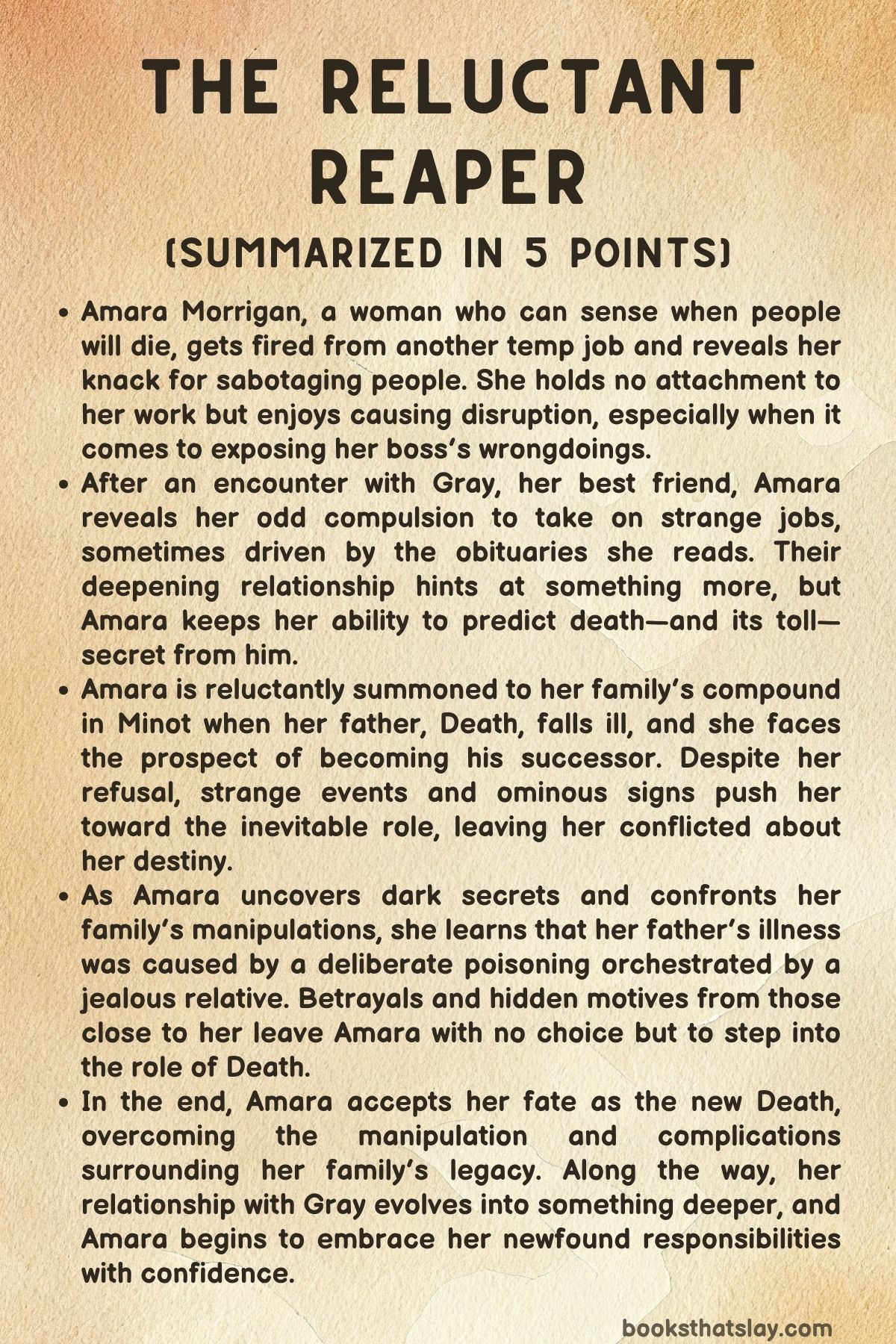
Summary
Amara Morrigan has always had a peculiar relationship with death—she can sense when people are about to die. Despite this ability, Amara has avoided embracing her true destiny as the heir to Death itself.
Throughout her adult life, she bounces from temp job to temp job, never staying in one place for long. When she gets fired from her most recent job, she celebrates it as a victory, even though her boss, William, berates her for being late yet again.
Before leaving the office, she takes one final jab at him by revealing she hacked his server, sent his emails to his wife, and potentially handed over incriminating evidence.
Later that evening, Amara meets up with her best friend and self-proclaimed nemesis, Gray, who presses her about her tendency to take on short-term jobs. They discuss how Amara sometimes feels a compulsion after reading obituaries, guiding her to certain people and situations, though she doesn’t usually act on it.
Gray wonders if Amara has ever tried warning people about their impending deaths, but she dismisses the idea, explaining that when it’s someone’s time to go, it’s their time. She avoids thinking too much about her ability to know when people are going to die, but she can’t help feeling that her connection to death has a greater purpose.
The next morning, after shutting off her phone to avoid voicemails from Minot, North Dakota, Amara ends up at the Angry Beaver RV Park, where she meets Bette Bennett, a widow who hires her to manage the park. As they talk, strange wildlife begins to gather around the park—deer, birds, and vultures—which only makes Amara uneasy.
Her worries intensify when Baron La Croix, a suave and powerful death god who works with her father, arrives and informs Amara that her father, Death, is gravely ill and wants her back in Minot.
Amara refuses to believe it, thinking La Croix is trying to manipulate her, but when she looks around and sees an ominous gathering of birds, she reluctantly agrees to meet with him. That night, at a local restaurant, La Croix explains the severity of her father’s condition.
He shows her a feathered crown belonging to her father, which confirms the truth. Amara is stunned, but she agrees to travel to Minot, with Gray accompanying her despite her protests.
Amara and Gray board a luxurious private railcar and head to Minot, where they are joined by La Croix, who continues to provoke Amara about her personal life. During the journey, La Croix hints that she should have a lover and eventually take an heir.
Amara, however, resists these suggestions, still grappling with the idea of her destiny.
Arriving in Minot, Amara is struck by the eerie emptiness of her family’s compound, which includes a large lakeside mansion. Her mother, Freyja, greets her warmly but appears exhausted, and Amara feels a sense of foreboding.
She heads to her father’s bedroom, where she finds him shockingly frail and coughing up blood. He insists that it’s time for her to take over the mantle of Death, but Amara is terrified at the prospect of succeeding him.
Her father tells her that Death itself cannot die, but his avatar—the form in which he takes on a physical presence—can. He urges her to accept the role, but Amara adamantly refuses.
Amara spends time with Gray, confiding in him about her father’s condition and the pressure to take over. The next morning, things take a bizarre turn when Penny and Hank, also death gods, arrive and argue like a normal couple.
The presence of these gods only adds to Amara’s anxiety as they all await Death’s possible passing and the consequences for the future of the afterlife.
While grappling with her father’s decline, Amara also uncovers unsettling truths about her family. Her mother hasn’t contacted Paeon, the god of medicine, and something seems off about the situation.
She soon learns that her father’s illness is not natural—he’s been poisoned by ichor, a powerful god’s blood, potentially as part of a scheme to manipulate Amara into taking over his position. Amara confronts Skye, who had been manipulating the situation and poisoning her father, with the aim of taking control of the territory herself.
Skye had even played a role in the death of Amara’s younger sister, Idun, which is revealed during this confrontation.
Amara, realizing that her family’s power dynamics have been built on deception, steps up to claim her birthright. She defeats Skye and takes control of the situation, ensuring her mother’s safety and securing her place as Death’s rightful heir.
As Amara embraces her new responsibilities, her relationship with Gray also evolves, shifting from friendship to something deeper. However, their connection is complicated by the revelation that Gray’s life was once at risk due to a condition his parents kept hidden from him.
In a twist, Amara’s father had made a deal to save Gray’s life, offering him a second chance while stepping aside for Amara to take over.
In the end, Amara fully accepts her new role, balancing the weight of her power with the emotional complexities of her relationships. With Gray by her side, she faces the future as the new Death, ready to navigate the challenges of her new responsibilities while embracing the changes in her life.
Characters
Amara Morrigan
Amara Morrigan is a complex character, one who finds herself caught between the mundane world of temporary jobs and the supernatural world of death. At the core of her character, Amara is a reluctant inheritor of a powerful legacy, and her interactions throughout The Reluctant Reaper reflect her internal struggle with this destiny.
She possesses the unique and unsettling ability to sense when and how people will die, which she refers to as a “compulsion” that often leads her to act in strange, transient jobs. This talent is both a blessing and a curse, as it isolates her from others and forces her to confront uncomfortable truths that she would rather ignore.
While she is cynical and self-reliant, there’s a vulnerability beneath her hardened exterior—especially when it comes to her father’s deteriorating health and the looming responsibility she must eventually accept. Over the course of the novel, Amara’s relationship with her best friend, Gray, evolves, and she is forced to confront not only the reality of her father’s impending death but also her own future as the potential successor to the mantle of Death.
Her journey is one of acceptance, self-discovery, and empowerment, as she must embrace the very role she initially resisted.
Graham “Gray” Gray
Graham “Gray” Gray serves as a grounding presence in Amara’s life. Though initially skeptical of her abilities, he becomes one of her most important confidants and, eventually, her emotional anchor.
Gray is introduced as Amara’s best friend and self-proclaimed nemesis, yet it becomes clear that their bond goes far beyond friendly rivalry. Gray’s backstory reveals a man who once teetered on the edge of despair, contemplating suicide before Amara intervened.
This past tragedy informs much of his character, as he battles with feelings of failure and worthlessness. However, his friendship with Amara offers him a sense of purpose, and his loyalty to her is unwavering, even when he learns of the dangerous, supernatural forces surrounding her.
Despite his skepticism about the death-related events unfolding around him, Gray remains supportive, even when Amara’s involvement with death gods and the like intensifies. As their relationship deepens, Gray’s role shifts from being merely a friend to someone who stands by Amara in her darkest moments.
Their dynamic evolves from platonic friendship to romantic affection, though it is complicated by Amara’s role in the supernatural world and the secrets that surround her. Gray is caught between his deep feelings for Amara and the strange and dangerous world she inhabits, ultimately leading him to a greater understanding of his own place in her life.
La Croix
La Croix, a suave and enigmatic death god, is an intriguing figure whose interactions with Amara reveal much about the tensions between her desire for autonomy and her inevitable role in the family legacy. La Croix is not only a messenger for Amara’s father but also a reminder of the world Amara is trying to avoid—one steeped in power, death, and responsibility.
He is charming, confident, and often playful, especially when teasing Amara about her relationship with Gray or her future as a successor to Death. Despite his flirtatious behavior and somewhat comical attitude toward food, La Croix is also a figure who forces Amara to confront her own destiny.
He is deeply connected to the supernatural world, particularly the death gods, and serves as a constant reminder that Amara’s refusal to accept her fate is becoming increasingly untenable. His presence in Amara’s life is as much about guiding her toward her inevitable path as it is about testing her resilience and determination to forge her own future.
His teasing nature and cryptic statements challenge Amara’s defiance, and his eventual assistance in the unfolding family drama adds complexity to his character, positioning him as both a potential ally and an obstacle.
Freyja “Hilly” Brunhilde
Amara’s mother, Freyja “Hilly” Brunhilde, is a vital yet mysterious character whose true intentions remain shrouded in ambiguity for much of the novel. While she comes across as warm and loving, especially toward Gray, there is a sense of calculation and desperation in her actions.
Hilly is fiercely protective of her family, and as the wife of Death, she is keenly aware of the significance of Amara’s birthright. Her handling of the situation involving Death’s illness reveals her complexity—while she pushes Amara toward accepting her role as Death’s successor, she is also hiding her own concerns and fears.
Hilly’s emotional manipulation of Amara, though rooted in love, suggests a deeper desire to ensure the family’s legacy continues, even at the cost of her daughter’s happiness. Throughout the story, Hilly’s attempts to shield Amara from the truth create a web of tension between mother and daughter, especially as Amara uncovers the darker side of her family’s machinations.
Hilly’s complicated relationship with her husband, Death, and her expectations for Amara to take on his mantle, creates a sense of emotional disarray that complicates Amara’s journey toward embracing her destiny.
Skye
Skye is a key antagonist in the story, whose hidden motivations and ambitions ultimately lead to her betrayal of Amara and her family. As a fellow death god, Skye is deeply envious of Amara’s position in the family and seeks to take control of the territory for herself.
Her manipulation is both subtle and malicious, as she uses Amara’s vulnerabilities—her inherited death powers and her emotional stress—to weaken her resolve. Skye’s resentment toward Amara, particularly regarding the death of Amara’s younger sister Idun, fuels her schemes.
Skye’s jealousy and desire for power culminate in her poisoning of Death, which is part of a larger plot to manipulate Amara into taking over Death’s role under her terms. Skye’s actions are motivated by her thirst for control, and her eventual confrontation with Amara exposes the depth of her treachery.
Skye’s betrayal highlights the lengths to which some characters will go to seize power, and her downfall serves as a turning point for Amara, who must confront not only her family’s legacy but also the people who would exploit it for personal gain.
Themes
The Burden of Family Legacy
Throughout The Reluctant Reaper, Amara’s struggle with her family legacy is a central theme that permeates both her personal and professional life. Amara is constantly reminded of her birthright as the successor to the role of Death, a responsibility that she initially wants nothing to do with.
This pressure to fulfill the expectations of her lineage is compounded by her father’s failing health and the manipulations of those around her, including her mother and Skye. The story portrays how difficult it is to escape family expectations, especially when they come with a supernatural weight.
Amara’s reluctance to accept her role is evident in her defiance and reluctance to become involved in the intricacies of death-gods’ politics. Her struggle is not just about stepping into a family business but about reconciling her own desires and fears with what is expected of her.
This tension reflects the broader concept of the burden that family legacies can impose on individuals, particularly when those legacies are tied to power and control over life and death itself. Amara’s journey is one of self-discovery and resistance, ultimately forcing her to confront the fact that she cannot escape her heritage.
In the end, she learns to accept her fate, understanding that her family’s power over death, though burdensome, is a part of who she is. The theme highlights the complexity of familial obligations and the ways in which one’s destiny can be shaped by forces outside of one’s control, especially when those forces are embedded deep in the family’s history.
The Struggle Between Duty and Personal Desire
Amara’s journey in The Reluctant Reaper is a constant battle between fulfilling her duty as Death’s successor and pursuing her personal desires. She is faced with a paradox: the more she resists her responsibility, the more it seems inevitable.
Her reluctance to embrace her role as the Reaper comes from her desire for freedom and independence, which is at odds with the immense power and responsibility that come with the role. Early in the novel, Amara’s life is characterized by temporary jobs, a desire for self-sufficiency, and an avoidance of deeper commitments, all of which allow her to avoid confronting her fate.
This desire to maintain control over her own life without being bogged down by responsibility is challenged by the reality of her powers, her family’s expectations, and the undeniable pull of her inheritance. The theme explores the internal conflict that many people face when their sense of personal identity and freedom clashes with the obligations and duties that life—or in Amara’s case, death—imposes on them.
The theme of duty versus desire is explored not just in Amara’s refusal to inherit her father’s position, but also in her strained relationship with Gray, where she is forced to acknowledge that her own feelings and actions affect others. The tension between wanting to live her life on her own terms and accepting her inevitable responsibilities as Death encapsulates the human experience of grappling with the tension between personal wishes and external obligations.
The Complexities of Power and Control
In The Reluctant Reaper, the complexities of power and control are explored through Amara’s reluctant involvement in the world of death gods and supernatural politics. The gods of death, including La Croix and Arawn, are powerful figures who manipulate the situation surrounding Amara’s father’s illness to further their own agendas.
Power in this world is not just about strength, but about influence, manipulation, and control over life and death. Amara’s growing awareness of these power dynamics forces her to navigate a world where alliances and betrayals are common, and where every move she makes has significant consequences.
As she uncovers the truth behind her father’s illness, she begins to see how power can be wielded to manipulate events for personal gain. Skye’s betrayal, attempting to seize control of Death’s territory, exemplifies the lengths to which individuals will go to acquire and maintain power.
The theme of power is not just about ruling over others, but also about the internal control Amara must learn to assert over her own fate. As she ultimately takes her place as Death’s heir, she learns that power is not just inherited—it must be claimed and wielded with purpose.
The novel delves into the moral complexities that come with power, the consequences of control, and the internal conflict that arises when power is used for selfish purposes versus when it is used for greater responsibility.
The Nature of Death and Its Inevitable Role in Life
Death is a central theme in The Reluctant Reaper, and the novel presents a unique exploration of its nature. Unlike most depictions of death as a finality, the story portrays death as a continuous and inevitable force that operates beyond individual will.
Amara’s ability to sense when people are going to die is both a gift and a curse, constantly reminding her of the inescapable nature of death in all lives. However, the novel doesn’t just focus on the death of individuals, but also on the larger cosmic role that Death itself plays.
The very concept of Death in the book is not a single entity but rather a shifting force passed down through generations, with each Reaper assuming the mantle of Death. This idea challenges the traditional view of death as a singular event and instead presents it as a role that must be filled, regardless of personal desires or emotions.
As Amara grapples with her father’s failing health and the possibility of taking over the family business, she is forced to confront her own understanding of death—not just as a cessation of life, but as an ongoing, essential part of existence. The novel emphasizes the cyclical nature of death, portraying it as both a burden and a necessary function of life that must be embraced, even if it is deeply uncomfortable.
In the end, Amara comes to accept that her role in the cycle of life and death is inevitable, and by doing so, she not only accepts her family legacy but also comes to terms with the nature of existence itself.
Friendship and Loyalty
Amara’s relationship with Gray in The Reluctant Reaper provides a significant counterbalance to the darker, more existential themes in the novel. Their friendship, rooted in shared history and mutual understanding, becomes an essential part of Amara’s journey.
Throughout the story, Gray is Amara’s anchor—her constant companion who provides both emotional support and moments of levity. The loyalty and understanding that pass between them offer a reprieve from the overwhelming responsibility and tension surrounding Amara’s life.
Their friendship evolves into something deeper, and though there are moments of awkwardness, especially as Amara grapples with her burgeoning feelings for Gray, their bond remains a source of strength for her. Gray’s unwavering loyalty is evident when he sticks by Amara’s side despite the dangers she faces and the difficult truths she must confront.
In a world full of manipulation and deceit, Gray represents the possibility of a genuine connection, one that is grounded in trust, shared experiences, and a deep emotional connection. Their relationship highlights the theme of loyalty in the face of adversity, showing that even in the most uncertain and dangerous circumstances, the bonds of friendship can offer stability and support.
Amara’s eventual recognition of her love for Gray further reinforces the theme that loyalty and connection are vital forces in navigating life’s trials.