The Road of Bones Summary, Characters and Themes
The Road of Bones by Demi Winters is a gripping tale of survival, self-discovery, and the relentless pursuit of freedom. The story follows Silla Nordvig, a young woman who is forced to flee her home in the village of Skarstad after uncovering shocking truths about her past.
With her father’s mysterious death and her life turned upside down, Silla embarks on a perilous journey through treacherous woods, dangerous cities, and hostile territories. Along the way, she must confront her own fears, navigate a world full of deadly warriors and dark secrets, and ultimately uncover the mysteries surrounding her true identity. Full of danger, intrigue, and unexpected twists, The Road of Bones explores themes of betrayal, the search for belonging, and the strength of human resilience.
Summary
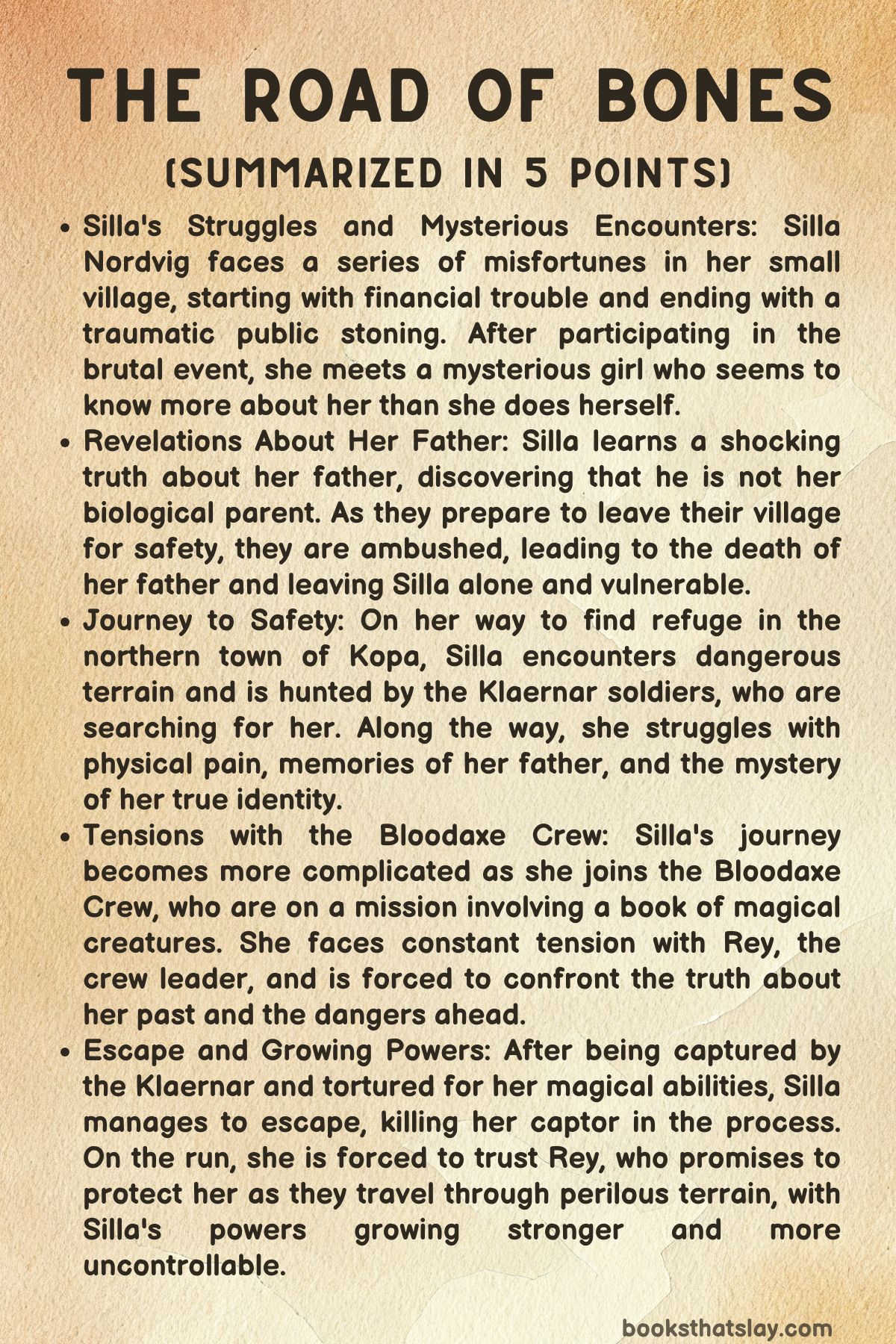
Silla Nordvig’s life in the village of Skarstad begins with a series of misfortunes, including a failed payment to Olaf the Red and a mishap in the kitchen. The bell tolls, signaling impending doom, and Silla is drawn to the central square, where she witnesses a horrifying public execution.
Women accused of practicing forbidden magic are sentenced to be stoned, and the Klaernar warriors, known as the Claws of the King, enforce the brutal punishment. The crowd demands participation, and Silla, against her will, throws a stone at the condemned women.
This event leaves her disturbed, particularly after encountering a mysterious little blonde girl who seems to know more than she should.
As the day unfolds, Silla learns a shocking truth about her father—he is not her biological father. Overhearing a conversation, she discovers that his real name is “Tómas,” not the name she has known.
This revelation sends her into a spiral of confusion, and her father, sensing danger, tells her they must leave Skarstad immediately. They plan to travel to Kopa, a distant northern refuge.
However, their journey is interrupted when they are ambushed by men who mistakenly believe her father is someone named Tómas. A violent confrontation ensues, and though her father fights bravely, Silla is captured, and her father is gravely wounded.
Upon waking, Silla finds her father dead, leaving her alone in a harsh world. Determined to survive, she sets out on her own, guided by the enigmatic little blonde girl, who urges her to head toward Kopa.
Silla gathers what little she has—some money and a letter hidden under her father’s mattress—and embarks on her journey. As she travels through dark forests, she is haunted by memories of her father and the painful reality of his loss.
The fear that Queen Signe is searching for her also weighs heavily on her mind.
In the treacherous Twisted Pinewoods, Silla is physically and emotionally drained, relying on a plant called skjöld to numb her senses. She reflects on her life, her identity, and why the queen is after her.
Her path leads her through dangerous terrain, where she becomes entangled with various groups of men. One such encounter with the Battle Thorns warband nearly leads to her death, but a massive grimwolf intervenes, killing one of the men and allowing Silla to escape.
Lost and without supplies, Silla struggles to find her way out of the forest. She is exhausted, hungry, and increasingly desperate.
Eventually, a woman named Vigdis offers Silla a ride to Reykfjord. Along the way, Silla learns of the notorious Slátrari murderer in the area, adding to her anxiety.
When they reach Reykfjord, Silla is briefly relieved, but the danger is far from over. She is aware that the Klaernar are hunting for someone who matches her description.
Silla is unable to stay in Reykfjord for long, and after learning about the dangerous Road of Bones that leads north, she meets the Bloodaxe Crew, a group of fierce warriors. Though initially skeptical of her, they decide to keep her alive when she offers her help in retrieving a book from a man named Kraki.
Silla, bound and uneasy, spends a night at their camp, determined to prove her worth.
The journey to Kraki’s home is tense, with Silla navigating the strained relationship between Rey and Kraki. At Kraki’s alpine village, Silla manages to gain his cooperation by pretending to be a cook for the Bloodaxe Crew.
Tensions rise, particularly when Kraki reveals that the book they sought, Creatures of Íseldur, has been destroyed, but he memorized its contents. As they leave Kraki’s house, Rey and Silla’s relationship grows more strained, and they continue their journey with growing mistrust between them.
Silla’s doubts about Rey intensify, especially after an encounter with a red-haired warrior who almost kills Rey. Silla intervenes and saves him, complicating their relationship further.
As they continue their journey, Rey reveals his true name to Silla, shifting the balance of power between them. They eventually reach a town called Hver, where Silla experiences a brief respite and contemplates her future.
She bonds with a woman named Hekla and participates in the Longest Day celebration, but her peace is shattered when she spots Jonas, a former member of the Bloodaxe Crew, with another woman.
The emotional turmoil over Jonas and the Bloodaxe Crew’s complicated dynamics continues to plague Silla. Despite new connections, like her brief interest in a man named Asger, Silla struggles with her past and her feelings for Jonas, realizing that her journey toward freedom is not only physical but emotional as well.
Meanwhile, Rey is preoccupied with finding Jonas and a woman who has gone missing after a violent incident. When Rey arrives at Kopa, he finds the city’s gates closed, which is unusual.
After learning of a red-haired woman passing through, Rey becomes increasingly desperate. He seeks out a secret entrance to the city, only to be ambushed by Klaernar guards.
After a deadly fight, Rey enters Kopa and learns that the woman he’s searching for is in the custody of Kommandor Valf, who intends to send her to Kunafjord. Rey’s concern grows as he fights to find the woman and uncover the larger forces at play.
Silla, meanwhile, is held captive by Kommandor Valf, who reveals that the queen is interested in her magical abilities. Silla is subjected to cruel treatment as Valf attempts to extract her powers, but Silla breaks free after using her abilities to kill him.
In her escape, she is confronted by Skraeda, a red-haired warrior who tries to steal Silla’s powers. Silla kills Skraeda and learns that the warrior was working with the queen.
As Silla is hunted by the Klaernar, Rey finds her in the woods and offers his help. She reluctantly accepts, and the two join forces, making their way through dangerous terrain.
Silla’s powers continue to grow, and Rey becomes her protector, despite his own troubled past. Together, they seek refuge in Kalasgarde, hoping to escape the forces pursuing them.
The story concludes with Silla coming to the realization that safety is not a place, but a person—someone who will stand by her side in the fight for freedom.
Characters
Silla Nordvig
Silla Nordvig, the central figure in The Road of Bones, is a young woman whose journey is defined by hardship, self-discovery, and survival. From the start, Silla’s life is marked by a series of personal and external crises, beginning with financial trouble and physical injury, which only worsen as she becomes embroiled in the violent punishment of women accused of practicing forbidden magic.
The harsh realities of her world are thrust upon her when she witnesses a brutal execution and, despite her inner conflict, becomes complicit in the crowd’s demands. This event sets the stage for the unraveling of her sense of security, particularly when she discovers that the man she called father is not biologically related to her.
This revelation, coupled with her father’s tragic death, propels Silla into a life on the run, seeking answers about her true identity while evading those who want to exploit her magical abilities.
Throughout her journey, Silla grapples with physical pain, emotional trauma, and the constant threat of danger, yet she remains determined and resilient. Her encounter with the little blonde girl, who seems to possess eerie knowledge, marks the beginning of a deeper, more complex mystery about her powers and her connection to the queen.
Silla’s relationship with her father—once a symbol of protection—shifts dramatically after his death, and she is left to navigate a world full of secrets, betrayal, and violence on her own. As she struggles through the treacherous Twisted Pinewoods and faces increasingly perilous encounters, Silla’s emotional depth comes to the forefront.
She questions her identity, the nature of her powers, and the role she must play in a larger, unknown scheme. Her personal journey, both external and internal, is one of survival, but it is also about finding her own strength and understanding the complex web of relationships and powers that shape her life.
Rey
Rey is a key character whose past and present are intricately linked to Silla’s journey. Initially presented as a somewhat antagonistic figure, Rey’s true motivations and feelings gradually unfold as the story progresses.
His relationship with Silla is marked by tension, as he initially views her as a liability but is forced to reckon with her resourcefulness and determination. As they travel together, their interactions become more complex, and Rey’s frustrations with Silla are evident.
Despite his cold exterior, Rey harbors deep fears and anxieties, particularly about the fate of those around him. His emotional journey is rooted in his past, especially the loss of his brother Ilías and his fraught relationship with figures like Kraki, his former mentor.
Rey is a character driven by a sense of duty, and as the story unfolds, his motivations become clearer. He is not only bound by his past but also by a sense of responsibility to protect Silla, even as he wrestles with his own feelings about her.
Rey’s ability to summon Galdur—mystical powers tied to his own struggles—adds another layer to his character. However, his reliance on these powers also highlights the internal conflict he faces.
His evolving bond with Silla is characterized by a delicate balance of trust and distrust, with both characters trying to navigate the complexities of their situation. As the narrative progresses, Rey’s role as a protector becomes more pronounced, and despite the emotional baggage he carries, he begins to see Silla not just as someone to be guarded, but as someone he might be able to trust.
Kraki
Kraki, Rey’s former mentor, plays a significant role in the journey of both Rey and Silla. He is portrayed as a character who embodies disdain and bitterness, particularly in his interactions with Rey.
Although Kraki is initially positioned as an antagonist, his true role in the story is more nuanced. His past relationship with Rey, filled with sarcasm and tension, reveals a history of betrayal and unresolved issues.
Kraki’s actions are guided by his own selfish motivations, which become apparent when he reveals the destruction of the book Creatures of Íseldur, yet claims to have memorized its contents. His lecherous behavior toward Silla adds to his unlikable nature, and the discomfort he causes is palpable, especially as he engages in tense exchanges with Rey.
Despite his antagonism, Kraki proves to be a pivotal figure, revealing critical information about the mission Silla and Rey are on. His eventual refusal to help and his taunting attitude towards Rey indicate his unwillingness to move past the past, making him a dangerous figure in his own right.
Skraeda
Skraeda, the red-haired warrior, emerges as one of the key antagonists in The Road of Bones. Her introduction heightens the stakes of Silla’s journey, as Skraeda’s intentions are shrouded in mystery.
Initially, she seems to be a threat to Silla’s life, and this is confirmed when she is revealed to have killed Skeggagrim, a figure Silla had hoped to find refuge with. Skraeda’s betrayal runs deep, as it is revealed that she had been working with the queen, further complicating Silla’s mission and goals.
Skraeda’s lecherous tendencies and desire to usurp Silla’s powers make her an immediate danger, and their violent confrontation highlights Silla’s growth in strength and resilience. Skraeda’s death at Silla’s hands signifies a turning point in Silla’s journey, as it marks her ability to protect herself and confront the dangerous forces that have been pursuing her.
Skraeda’s role, while brief, is crucial in illustrating the ongoing manipulation and betrayal that Silla faces from those around her.
Vigdis
Vigdis is a character who briefly accompanies Silla on her journey and provides a moment of respite for her amidst the chaos. As a woman who offers Silla a ride to Reykfjord, Vigdis presents a stark contrast to the more hostile figures Silla encounters.
Though not deeply explored in the narrative, Vigdis plays a role in helping Silla navigate the dangerous and unpredictable world she is traveling through. Her presence is marked by a calm and maternal quality, offering a rare moment of comfort for Silla.
Vigdis’s warnings about the Road of Bones highlight the treacherous nature of Silla’s journey, reinforcing the theme of survival and caution. While Vigdis does not play a major role in the overall plot, her interaction with Silla provides a brief but important connection that underscores the constant uncertainty and peril that surrounds Silla’s quest for safety.
Themes
Survival and Identity
In The Road of Bones, survival is not only a physical struggle but also an emotional and psychological one. The protagonist, Silla, finds herself fighting for survival at every turn—against physical dangers, emotional losses, and the discovery of painful truths about her identity.
Her journey begins in a town where violence is commonplace, and the punishment of accused witches serves as a stark reminder of the brutality of the world she lives in. However, her struggle intensifies when she learns that her father, the person who has protected her and provided a sense of stability, is not her biological parent, leaving her with a fractured sense of self.
As Silla embarks on her journey to escape the dangers of the world, her survival is not just about avoiding physical harm but also about navigating a world filled with lies and betrayals. She must constantly adapt, making choices that weigh on her moral compass as she tries to survive in a world that offers her little safety or certainty.
Her quest for safety is coupled with a search for answers—about her true identity, her lineage, and why the queen is after her. The tension between her desire for protection and the growing realization that no one can be trusted mirrors the complexity of her quest for self-discovery.
Silla is forced to reevaluate her understanding of herself and her place in a world that has continuously deceived her. Ultimately, survival for Silla means not just evading physical threats but confronting the truth about who she is and what her survival demands of her.
Power and Oppression
The theme of power and oppression runs deeply throughout The Road of Bones. Silla is constantly at the mercy of forces beyond her control—be it the political power of the Klaernar warriors, the manipulative influence of the queen, or the physical threat posed by the wilderness itself.
The brutal punishment of women accused of witchcraft, witnessed by Silla early on, highlights the deeply ingrained power structures that govern her society. The cruelty of the execution and the fact that the crowd demands participation underscores the way in which power is not only exercised by the ruling forces but also by society’s complicity in upholding oppressive systems.
Silla’s own power, however, is a double-edged sword. As she learns about her magical abilities, she realizes that power can be both a source of strength and a tool for her oppression.
The queen’s interest in her abilities symbolizes the way in which those in power seek to control and exploit individuals with unique capabilities for their own gain. This theme extends to the relationships between Silla and the men she encounters, such as Rey and the Bloodaxe Crew, where power dynamics play out in the form of control, manipulation, and the struggle for autonomy.
Even Silla’s own powers are something she cannot fully understand or control, making them a source of both potential salvation and danger. In this world, power is not just about physical might but about the ability to manipulate, deceive, and control others, often through fear or the promise of protection.
Loyalty and Betrayal
In The Road of Bones, loyalty is constantly tested, and betrayal is an ever-present threat. From the very beginning, Silla’s trust in her father is shattered when she learns that he is not her biological parent, and his death leaves her grappling with feelings of abandonment and confusion.
This sense of betrayal is compounded as Silla moves through a world where people she encounters, like the Bloodaxe Crew and even Rey, constantly remind her of how fragile loyalty can be. Rey’s motivations, initially ambiguous, shift as the story progresses, revealing the complexities of loyalty in a world where survival often requires making difficult and morally ambiguous choices.
Silla’s own struggle with loyalty is evident as she tries to balance her desire for companionship and protection with her instinct to remain independent and self-reliant. Her emotional turmoil surrounding Jonas, her former companion in the Bloodaxe Crew, highlights the difficulty of maintaining loyalty in a world rife with deceit.
Similarly, Silla’s experience with Rey is marked by an uneasy alliance where mutual trust is still developing, and she questions his motives as much as he questions hers. The presence of betrayal is not just in personal relationships but also in the larger societal and political structures that have shaped Silla’s life.
The constant betrayals she faces force Silla to reconsider what loyalty truly means and whether it is even possible in a world dominated by survival and deceit.
Grief and Loss
Grief is a central theme in The Road of Bones, and it profoundly shapes Silla’s journey. From the loss of her father to the various traumas she experiences along the way, grief becomes an emotional anchor that drives her actions.
The death of her father is a pivotal moment in the narrative, as it forces Silla into a position where she must confront her vulnerability and the reality of living without the protection she once had. The mourning of her father is complicated by the revelation that he was not truly her father, and the emotional toll of this discovery is profound.
As Silla navigates the harsh wilderness and encounters increasingly dangerous individuals, grief serves as both a burden and a motivator. Her pain from the loss of her father, combined with the fear of her own impending death, propels her forward.
Yet, this grief also transforms into a deeper sense of resolve. It shapes her desire to survive, not just for herself but for the memory of her father, and drives her to seek answers about the world that has betrayed her.
Throughout the book, grief is not just a passive emotion; it is an active force that influences Silla’s decisions, her relationships, and her ability to endure. The emotional weight of loss also manifests in her interactions with others, as she struggles with the idea of letting people get close to her again, knowing that loss may follow.
Grief in The Road of Bones is not just a reaction to death but a pervasive influence on every aspect of Silla’s life, pushing her to confront her past while navigating an uncertain and perilous future.
The Nature of Freedom
Freedom, or the lack thereof, is another prominent theme in The Road of Bones. Silla’s journey is not just a physical one but also a quest for freedom—freedom from the past, from the oppressive power structures that seek to control her, and from the pain of loss.
Early in the story, Silla’s life is defined by a series of constraints: financial obligations, oppressive social structures, and the looming threat of the Klaernar. As she flees from Skarstad and ventures into the wilderness, her sense of freedom is initially tied to escape—escaping the threats that have been placed upon her.
However, as she travels, it becomes clear that freedom is not simply about fleeing one danger after another but about reclaiming autonomy over her own life.
Silla’s journey through the Twisted Pinewoods and her time in Reykfjord exemplify the challenges of finding freedom in a world that constantly encroaches on personal liberty. The more she learns about the powers at play—be they political, magical, or personal—the more she realizes that true freedom requires not only the absence of physical restraints but also the ability to make choices in a world full of uncertainties.
The tension between freedom and control becomes especially apparent when Silla’s powers are revealed to be a source of both potential liberation and enslavement. As she grows stronger, she faces the challenge of mastering her abilities without being consumed by them, which is symbolic of her larger quest for personal freedom in a world that seeks to limit her.
Ultimately, freedom in The Road of Bones is not a singular destination but a continuous struggle against forces that seek to limit, control, and define one’s existence.