The Rose Bargain Summary, Characters and Themes
The Rose Bargain by Sasha Peyton Smith is a historical fantasy set in an England that never outgrew its oldest mistake. Centuries ago, King Edward IV made a desperate deal on a battlefield—and died the next day, leaving the country under the rule of Queen Moryen, an immortal monarch from the realm of the Others.
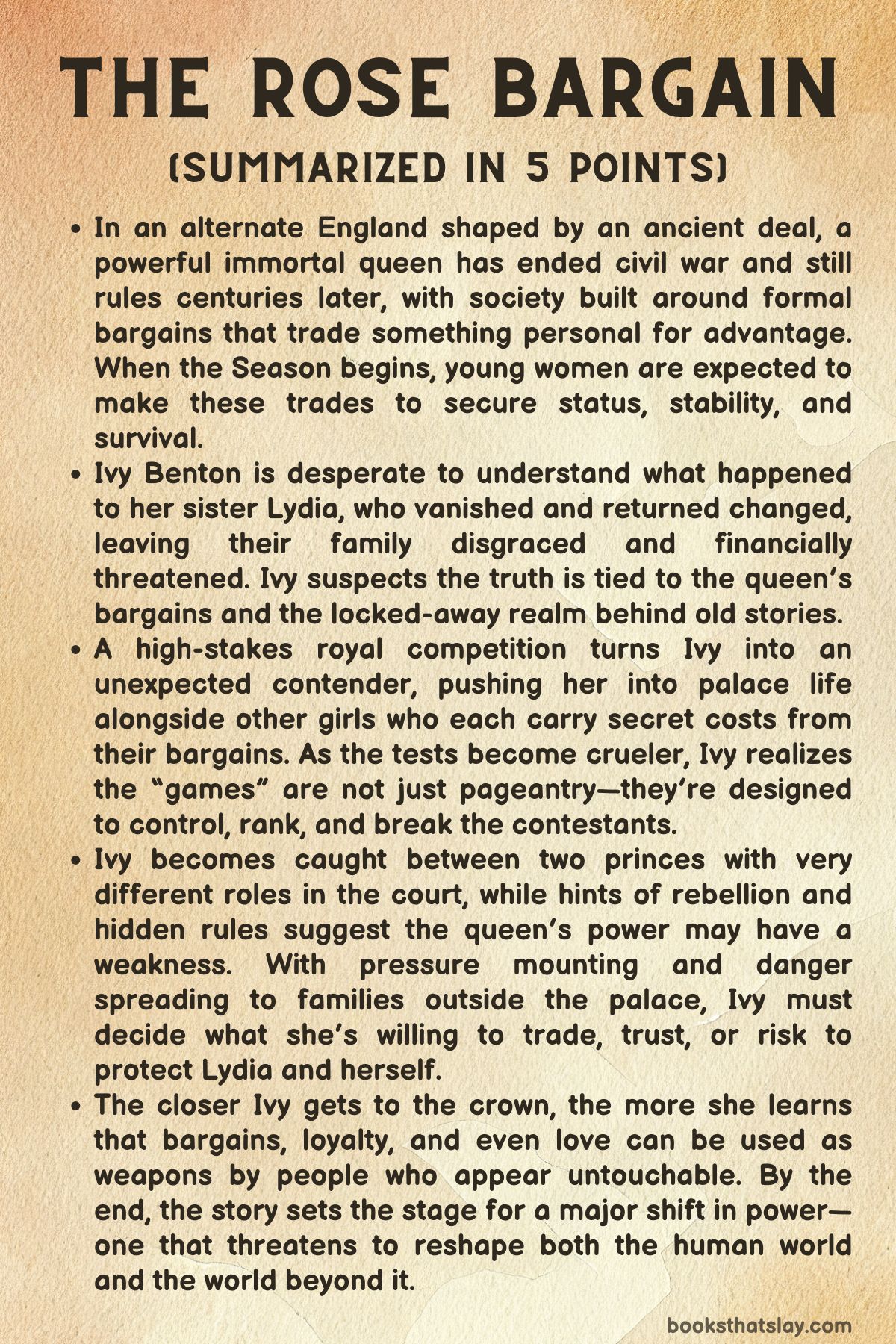
By 1848, society runs on bargains: debutantes trade pieces of themselves for beauty, talent, or advantage, and the court treats it all like fashion. Ivy Benton enters this world looking for one thing that money and manners can’t buy—her sister Lydia’s lost past—and finds herself caught in a royal contest where every promise has teeth.
Summary
In 1471, at the Battle of Barnet, King Edward IV is worn down by bloodshed and desperate for victory. A stunning woman steps into the fighting as if she owns the field.
She offers him help and seals the agreement by cutting his palm. The war ends instantly when Henry VI dies, crushing Lancaster resistance.
England celebrates, but exactly one day and a minute later Edward collapses and dies. The woman, Queen Moryen of the Others, takes the throne.
Those who resist find their bodies locked in place, unable to move. The civil war ends—not with peace, but with submission to an immortal ruler whose power runs through every corner of the realm.
Nearly four hundred years later, London in 1848 is a city where privilege still bows to that same crown. Ivy Benton has spent eight days searching for her older sister Lydia, who vanished without warning.
The police dismiss Ivy’s fears, suggesting Lydia has either run off or met a grim end, but Ivy refuses to accept either answer. As a child, Ivy learned stories of the Others from a cook named Mrs. Osbourne—stories of doors in trees, secret paths, and bargains that steal more than they give.
Ivy and Lydia once tested a tale by leaving matching baby necklaces at the base of a tree. The necklaces disappeared, convincing Ivy that something beyond ordinary life had reached out and taken them.
Later their mother forced Mrs. Osbourne to burn the old storybook, and Ivy eventually discovered Lydia’s missing necklace hidden in Lydia’s wardrobe. The mix of wonder and deceit stayed with Ivy, and now—without Lydia—those childhood stories feel less like games and more like warnings.
One cold night, Ivy sneaks toward Kensington Palace, convinced that if any hidden door exists, it would be near the queen’s residence. She places Lydia’s necklace at the roots of a tree, hoping to draw an answer.
A guard spots her, and she runs, slipping and striking her head. When she wakes, she is inside a carriage, bleeding, with a young man pressing his coat to her temple.
He tells her she fell. As lamplight shifts, Ivy recognizes him: Prince Emmett, known for scandals and for being too close to Lydia in the past.
Ivy demands to go home and refuses to explain her certainty that Lydia is still alive. Emmett studies her as if he hears more than she says.
He drops her at the back entrance to spare her reputation and offers a calling card, which she rejects. Inside, Ivy hears commotion—Lydia has returned at last, muddy, exhausted, and barely able to stand.
Three months pass, and Lydia’s return has not healed the family; it has damaged them. Society treats the Bentons as tainted.
Lydia stays locked away, eating only fruit, fragile and distant, unable—or unwilling—to explain where she went. She once whispered to Ivy that her bargain “wasn’t worth it,” but she cannot recall the details.
Their mother, who made her own bargain years ago for perfect memory at the cost of part of her pinkie, is focused on survival: they are running out of money and may lose their home. The new season is approaching, beginning with the Pact Parade on May 1, when debutantes appear at court to make bargains with Queen Moryen in hopes of improving their futures.
Ivy prepares carefully. She is not interested in a prettier face or a sharper talent.
She wants the one thing no one will discuss: Lydia’s bargain undone.
On May 1, Ivy wears Lydia’s old white debut gown, altered to fit because they cannot afford a new one. Her feet won’t fit Lydia’s slippers, so she hides sturdy boots beneath the hem.
At Kensington Palace, the debutantes are brought together in the throne room rather than seen one by one. Queen Moryen sits above them, ageless and unreadable, and presents her son, Prince Bram.
Then she announces a shock: Bram will choose a bride this season, and any girl who competes must sign a contract. If she is not chosen, she will never marry.
A scroll and dagger are laid out. The girls have ten minutes.
Ivy steps forward and signs, slicing her palm and using blood as ink. Bram binds her wound with a handkerchief and eases her pain with a touch.
Twenty-four girls commit.
In the gardens, the queen begins the first elimination: a maypole dance on wet, muddy ground. Girls in delicate slippers slip and sink, dragged away as their chance at marriage disappears with them.
Ivy’s boots keep her steady. Hours pass, and the field narrows until only Ivy, her former friend Greer Trummer, and a dark-haired girl named Faith remain.
Greer falls. Faith nearly wins, but one distracted step costs her.
Ivy is declared the May Queen and crowned with a tiara. In the crowd, Ivy sees Prince Emmett staring at her with open hostility.
When it is time for bargains, Ivy enters the throne room and makes her request: she asks Queen Moryen to undo Lydia’s bargain from May 1, 1846, restoring what was taken and returning what was given. The queen refuses.
One person cannot undo another’s deal, and bargains are private. Ivy pushes for answers, asking if Lydia was in the Otherworld.
The queen claims the door between worlds has been locked for four hundred years—though Bram is “a special case.” Ivy leaves without accepting any gift. At home, her mother is furious that Ivy passed up an advantage that could save the family.
That night, Ivy and Lydia speak more honestly than they have in months. Lydia admits she truly cannot remember and seems afraid of what the truth might be.
Ivy tells Lydia about Emmett helping her home, and together they burn Emmett’s card in the fire, as if destroying the proof could erase the complication.
As one of the season’s finalists, Ivy moves into Caledonia Cottage on palace grounds with five other selected girls under the strict oversight of Viscountess Bolingbroke. Ivy shares a room with Faith.
The girls compare bargains: Greer has altered beauty but paid for it with a strange limitation—she can never turn left. Olive traded away her fingernails for perfect teeth and a flawless smile.
Marion lost the ability to smell flowers in exchange for relief from migraines. Emmy gained painting skill but can no longer taste sweets.
Faith refuses to share anything and treats everyone as a threat. Ivy admits she made no bargain at all.
At a major ball, Ivy draws attention she does not want. Emmett corners her in a dark room, accusing her of cheating to win May Queen.
Their confrontation spills into the corridor, where Bram catches them. Bram believes Ivy’s explanation and invites her to dance, showing a gentleness that surprises her.
Later, Emmett vanishes, and Faith appears shaken, as if she knows him too well.
That night, Ivy is led through hidden tunnels to Emmett’s secret rooms. There, Emmett challenges Ivy’s hatred of him and insists he did not ruin Lydia for sport.
He says he tried to help Lydia when she panicked at a ball and that his blunt words were meant differently than they sounded. He proposes a truth-telling game, and Ivy finally reveals her goal: Lydia vanished for weeks, returned without memory, and the family has been punished ever since.
Emmett shares his own wound: his father made a bargain to legitimize him, but the cost was never being able to speak to Emmett again—though the man has been secretly communicating through marked books. Emmett believes there is a way to break Queen Moryen’s original agreement.
He hints at a phrase tied to “the one twice crowned,” and argues that if Ivy becomes Bram’s bride after already being crowned May Queen, the ancient bargain could be voided. If it breaks, all bargains could collapse.
He claims Bram cannot be told because Bram loves his mother, and because the Others are bound by rules that shape what they can say. Emmett’s plan requires one dangerous ingredient: Bram must truly love Ivy enough to marry her even if the queen forbids it.
Ivy leaves with her mind burning—because the plan could save Lydia, free England, and make Ivy queen. It could also destroy Bram, and it places Emmett at the center of everything.
From then on, the season becomes a controlled pressure cooker. Lessons turn into puzzles.
Games become traps. One night the girls are forced into a shifting hedge maze under the queen’s watch.
They face riddles, violent illusions, and choices designed to make them harm each other. Ivy refuses to injure the others and takes pain onto herself instead, smashing the tools meant to turn them into enemies.
Afterward, each girl receives a ranking, and it becomes clear that Queen Moryen is scoring them in ways no one understands. Worse, the girls find they are magically blocked from speaking openly about what the queen forces them to do.
Tensions rise between Ivy, Faith, and Emmett. Ivy learns Emmett had once been pushing Faith toward winning, and Faith’s anger suggests a history with him that Ivy doesn’t fully see.
Still, Ivy pushes forward with Bram. During an outing at the regatta, Ivy tries to divert Bram from discovering Emmett and Faith arguing about secrets they cannot name.
In her frantic effort to keep Bram away, Ivy ends up in the river, shaken and humiliated. That same night, Lydia appears publicly and collapses in distress, reigniting whispers around the family.
Ivy returns to the cottage under storm clouds and meets Queen Moryen approaching with a basket, as if this is all a private household matter. Inside, the queen refuses to discuss Lydia’s bargain but admits she knows where Lydia went, confirming Ivy’s worst fears without giving her anything usable.
Then the queen raises the stakes: the lowest-scoring girl will doom her family’s titles and land, and disobedience may be deadly. The girls, terrified, form a pact to seek mercy for each other if one of them wins.
Ivy’s relationship with Bram becomes both real and strategic. Bram defends Ivy publicly against cruel insults and even loses control in a fight when a man mocks her family’s finances.
The violence unsettles Ivy, but it also proves Bram’s attachment. Meanwhile, Ivy and Emmett travel in secret to seek evidence that could help their cause.
They reach an isolated stone house belonging to Eduart Burnhamme, an immortal man whose bargain granted eternal life at the cost of being impossible to love or even tolerate. Inside his home, Ivy feels instinctive revulsion, and only outside can she breathe normally again.
Eduart confirms what rebels before them have learned and lost their lives for: Queen Moryen erases records, controls the country through bargains, and keeps immortal servants bound to her will. He also reveals something that rattles Ivy’s assumptions—Bram visited him in the past, disturbed by what he had discovered about his mother.
Eduart confirms iron can harm the Others, but Queen Moryen has removed such weapons from reach. The trip leaves Ivy more certain that the queen must fall, but also more worried that Bram knows more than he admits.
A storm strands Ivy and Emmett overnight at an inn, forcing them to pose as a married couple for privacy. In the small room, wet clothes steaming by the fire, their partnership shifts into something harder to control.
Emmett admits guilt about manipulation. Ivy admits she wants the queen unseated, not only for Lydia but for everyone crushed by the system.
Their closeness turns physical; Emmett teaches Ivy how to kiss, and the kiss changes both of them. Yet he pulls away, afraid of what it means and what it threatens.
Back at court, Bram grows suspicious. He confronts Emmett about Ivy, cornering him for the truth.
Emmett cannot fully lie his way out, so he twists the truth, insults Ivy, and claims she was never with him. Bram accepts it with visible hurt, and Ivy is left devastated—not only by Emmett’s rejection, but by how easily the court’s rules turn affection into a weapon.
When Ivy sees her position slipping, she makes a reckless move: she wakes Bram at night and claims Queen Moryen has told her she has “lost” and is being removed from the palace. Bram refuses to accept it, furious on her behalf.
He insists he was going to choose Ivy and suggests they run away and marry elsewhere, forcing the queen to accept the match afterward. Ivy agrees.
She returns home before dawn to pack, and there she discovers something unsettling—Lydia has been drawing Bram obsessively from vivid “dreams,” pages and pages of him, as if Lydia has been watching him from inside her own mind. Before Ivy can leave, palace footmen arrive and drag her back to Kensington Palace for an audience.
In the throne room, Queen Moryen reveals the truth: the “loss” was only another test, and Ivy has actually won. Bram will propose at the Kendalls’ ball, and they will marry on the solstice.
But first, Ivy must make a formal bargain. The queen toys with her, offering trivial choices, and then presses a sharper point—suggesting Ivy might prefer Prince Emmett instead.
When Prince Consort Edgar appears, Ivy recognizes the larger danger moving behind the curtains. She realizes Emmett’s father is close to acting, and that the rebellion’s timing matters more than her heart.
Ivy asks for an hour. She writes Emmett a letter, sends him a commissioned coat, and explains her decision: she will marry Bram to keep the plan alive, and she will bargain away her memories of Emmett so she cannot betray him.
Returning to the queen, Ivy chooses her bargain—forgetting Emmett—paying with a missing molar as the cost.
Emmett receives the letter and breaks. He storms through the palace, but when he finds Ivy with Queen Moryen, Ivy looks at him as if he is a stranger.
The queen confirms the bargain with cruel satisfaction. Soon after, Bram proposes at the Kendalls’ ball, and Ivy accepts.
Emmett flees outside, sick with grief, and Faith and Marion help him back. He remains as Bram’s best man, trapped in a role that feels like punishment.
On the summer solstice, Ivy marries Bram. At the moment the vows are sealed, the world fractures.
Bargains begin to unravel everywhere: stolen beauty fades, missing pieces return, and immortal servants collapse into dust. Guards attack Queen Moryen.
Prince Consort Edgar is stabbed and dies in Emmett’s arms. Ivy spits blood as her erased memories slam back into place, the loss and love returning at once.
For a breath, it seems the plan worked.
Then the deeper betrayal reveals itself. Bram turns on Ivy and Emmett.
He admits he has known about the rebellion, and worse—he is not what he claimed to be. He reveals he is the immortal king of the Otherworld, that he has lied about the rules, and that he reopened the portal between worlds for his own end.
He has Emmett chained and dragged away. Ivy is briefly robbed of speech, then given it back, as if Bram wants her to be able to beg.
In the chaos, Lydia is seized again and disappears, waking later locked in a dusty palace room—taken back into the queen’s old grip.
Ivy gathers the remaining girls—Marion, Faith, Olive, and Emmy—and they barricade themselves in Caledonia Cottage, choosing action over panic. They go to the Tower of London, expecting to find answers, and instead discover Queen Moryen imprisoned there.
The fallen queen confirms Bram has taken Emmett and intends to restore an older, brutal order, returning the worlds to the era of hunting and cruelty. The girls are forced back to Kensington, where the palace becomes a stage for a new court.
By day it appears almost normal, but Ivy finds blood on the floor and strangers in the halls. Then she enters a reception filled with newly arrived Others, and Bram welcomes her as his bride in front of his fae court—claiming her as part of his victory while her sister is missing and the man she loves is in chains.
Characters
Ivy Benton
Ivy is the story’s emotional engine: fiercely loyal, stubbornly logical, and quietly reckless in the way only someone desperate can be. Her motivation begins as sisterly devotion—finding Lydia and repairing the damage Lydia’s disappearance caused—but that devotion hardens into a larger, more dangerous purpose once Ivy realizes the season is not merely social theatre but a battleground designed by an immortal power.
What makes Ivy compelling is her refusal to be shaped by the bargains that define her society; she chooses risk over cosmetic advantage, and she treats the queen’s magic as something to interrogate rather than worship. Ivy’s intelligence is practical and adaptive—boots under a debut gown, a refusal to accept easy gifts, a willingness to weaponize etiquette, poker tables, and public attention—yet she is also emotionally vulnerable, especially where Lydia and Emmett are concerned.
Over the course of The Rose Bargain, Ivy becomes a strategist forced to use romance as a tool, and the tragedy is that the tool becomes real: the more she manipulates affection to break a tyrant’s system, the more she genuinely attaches, until she ends up sacrificing her own memory to keep the plan alive. Even after that sacrifice is undone, Ivy’s defining trait remains: she keeps choosing action over safety, and responsibility over innocence, even when every “choice” has been engineered by someone else.
Lydia Benton
Lydia is a haunting presence long before she becomes physically present: the missing sister who returns wrong, fragmented, and socially radioactive. Her absence and ruined reputation are the wound that shapes Ivy’s life, but Lydia is not simply a plot device; she embodies the cost of the bargain economy and the way trauma can erase a person from themselves.
She is fragile in a way that reads both psychological and supernatural—eating only fruit, unable to account for missing time, clinging to a story that collapses under scrutiny—and that ambiguity is part of her role in the narrative’s tension. Lydia’s shame is compounded by the family’s financial decline and the public’s appetite for scandal, so she becomes both victim and perceived culprit, which makes Ivy’s love for her complicated and sharp-edged.
The later reveal—Lydia’s obsessive sketches of Bram sourced from “dreams,” and her eventual abduction into a dusty palace room—casts Lydia as a tether between worlds and as evidence that the Others’ influence is intimate, invasive, and persistent. Lydia’s character functions as the story’s moral warning: bargains don’t just take body parts or talents; they can take continuity, agency, and the right to a coherent self.
Queen Moryen (Queen Mor)
Queen Mor is tyranny wrapped in elegance: an immortal ruler whose power is so complete it becomes banal to her, which is far more frightening than rage. Her origin in the opening bargain frames her as a creature of contracts and loopholes, someone who conquers through precision rather than armies—she ends a civil war by turning resistance into literal immobility and turns a nation into an extended clause of her will.
In 1848, she maintains control not only through magic but through social design: she turns debutante season into a machine that converts insecurity into compliance, and she makes young women compete in rituals that blend courtship with coercion. Mor’s most chilling trait is her administrative cruelty; she does not merely punish rebellion, she erases records, dissolves footmen into dust when convenient, and ensures the consequences ripple into families through titles, land, and survival.
Yet she is not portrayed as omniscient perfection—her reliance on bargains implies constraints, and her fear of certain outcomes (and of Edgar’s influence) suggests that even immortality has pressure points. Mor’s relationship to Bram is also central: she presents him as her son and heir, but her methods reveal a parent who treats love as a lever and children as extensions of statecraft, which makes Bram’s eventual betrayal not only a political twist but the collapse of the one bond Mor appears to prioritize.
Prince Bram
Bram is introduced as the ideal prince—gentle, attentive, and seemingly incapable of cruelty—and that surface is carefully calibrated to recruit trust. His early behavior reads like relief in a hostile court: he binds Ivy’s wound, eases pain with touch, listens, defends her publicly, and appears genuinely weary of the bargain system’s collateral damage.
That tenderness is what makes his eventual reveal so devastating, because it forces a reread of everything: kindness becomes grooming, sincerity becomes performance, and the “rule” that Others cannot lie becomes a tool he exploits precisely because people believe it. Bram’s true identity—as the immortal king of the Otherworld, and someone who has already committed ancient violence, including patricide—reframes him as the story’s most dangerous kind of antagonist: one who understands human longing and uses it expertly.
He is also the narrative’s thesis about power dressed as romance; the season is framed as marriage selection, but Bram is selecting a mechanism to reopen a portal and restore an older, bloodier order. When he seizes Ivy’s voice and later restores it, the act symbolizes his entire dynamic with others: he can grant safety and take autonomy at will, and he expects gratitude for the temporary mercy.
Prince Emmett
Emmett is positioned as scandal and threat, then steadily revealed as the person most desperate to break the system—even when he does it badly. His charm is edged with resentment and loneliness, shaped by the bargain that legitimized him while severing his father’s ability to speak to him; he moves through the palace like someone born into privilege yet emotionally exiled from it.
Emmett’s defining contradiction is that he is both manipulator and protect-or: he pushes Ivy toward Bram for strategic reasons, withholds information, and treats feelings like chess pieces, but he also repeatedly shows up as the only person willing to tell Ivy the ugly truth and risk consequences to help her survive. His relationship with Ivy becomes the story’s most painful moral knot, because their intimacy grows inside a plan that requires deception; the inn night is simultaneously tenderness and trap, and the aftermath exposes Emmett’s fear that caring is a liability.
When Ivy chooses to forget him, it is not just romantic tragedy—it is proof that Emmett has become the human cost the rebellion demands, and his devastation highlights what the bargain culture does best: it turns love into collateral. Emmett’s arc ultimately embodies the theme that resistance is messy; he is not a clean hero, but he is a person who keeps trying to pry open a world sealed by centuries of carefully worded power.
Greer Trummer
Greer is what happens when survival is trained into cruelty: a girl shaped by a mother who teaches her that affection is a liability and reputation is oxygen. To Ivy, Greer initially reads as betrayal—an old friend who distanced herself when scandal hit—but her later perspective reveals that withdrawal as coerced self-preservation in a society that punishes association.
Greer’s bargain for a new face is not vanity so much as an act of panic and self-erasure, a decision made because honesty feels impossible in her home. Her romance with Joseph offers an alternative kind of love than the palace’s courtship games: private, risky, and rooted in seeing the person beneath status.
Yet even that relationship is strained by the bargain’s psychological residue; Greer needs reassurance that her new face is wanted, because she traded the old one not to be admired but to be safe. Greer’s presence broadens The Rose Bargain beyond Ivy’s central mission by showing how many forms captivity can take—some magical, some parental, some purely social—and how the hunger to be chosen can destroy the self long before any queen raises a dagger.
Faith Fairchild
Faith is guarded intensity, someone who refuses vulnerability because she understands too well how it becomes leverage. She enters the competition with a sharp, competitive posture, dismissing the others as rivals, and that defensiveness reads like arrogance until the narrative repeatedly hints at her deeper entanglement with Emmett.
Faith’s inability or refusal to share her bargain mirrors her larger role: she is a lockbox of information and emotion, and her secrecy becomes both protection and poison. When Ivy catches Faith and Emmett in moments that suggest intimacy or prior collaboration, Faith becomes a living reminder that alliances in this world are unstable and often transactional.
Her choking silence when trying to explain the queen’s forced vow shows how the system weaponizes speech itself, and Faith’s fury at Emmett suggests she has been used, perhaps promised truth or partnership and given neither. After Bram’s betrayal, Faith’s importance shifts; she becomes part of Ivy’s inner circle not because she softens, but because survival forces clarity, and her earlier hardness becomes an asset in open conflict.
Olive
Olive is the most openly ambitious contestant, and her ambition is complicated by genuine desire and genuine fear. Her bargain—trading fingernails for perfect teeth and smile—captures how this society frames women: beauty is currency, and the exchange rate is literal flesh.
Olive’s later actions, especially the revelation that she completed extra tasks and lied about something as small as a bracelet, show how quickly the competition turns girls into adversaries who cannot afford honesty. Yet Olive is not written as purely villainous; her hunger for security and attention is understandable, and her private meal with Bram and the kiss she receives destabilize the group because it proves the system rewards betrayal.
Olive embodies the story’s critique of incentive structures: when the queen makes the lowest score a family’s ruin, “friendship” becomes a luxury, and Olive is the character who most transparently responds to that pressure by choosing self over solidarity.
Marion
Marion’s role highlights that bargains can be framed as mercy as much as vanity: she trades away the ability to smell flowers to cure lifelong migraines, which reveals how the system preys not only on insecurity but on pain. She appears steadier than many of the other girls, often acting as a rational presence amid chaos, and her ranking and behavior imply someone who understands that survival requires both compliance and careful boundaries.
Marion’s willingness to join Ivy after Bram’s reveal signals an important shift: she is not merely enduring the season, she is learning that endurance alone will never protect her. In a narrative full of spectacle, Marion grounds the emotional reality of trade-offs; the things she loses are subtle, the benefits real, and the grief quiet, which makes her one of the clearest examples of how normalized exploitation becomes when it is wrapped in etiquette.
Emmy
Emmy represents the seduction of giftedness and the cruelty of what it costs. Her bargain grants painting talent but removes her ability to taste sweets, a trade that reads almost whimsical until the story’s violence escalates and the small losses add up into a portrait of systematic theft.
Emmy’s top ranking and prize dinner with Bram place her as a temporary favorite, which exposes how the queen’s scoring turns attention into a weapon: being first is not safety, it is visibility. Her participation in secret drinking with others also signals coping, a minor rebellion that remains safely contained within the palace’s rules.
After the bargains unravel at the wedding, Emmy’s presence in Ivy’s barricaded group underscores the narrative’s larger point: even the “winners” were never meant to win freedom; they were meant to serve a plan.
Viscountess Bolingbroke
Viscountess Bolingbroke is the human face of institutional control: strict, rule-obsessed, and more invested in procedure than in the girls’ wellbeing. She functions as the palace’s social immune system, preventing unsanctioned movement, policing appearances, and maintaining the fiction that this season is respectable rather than predatory.
Yet her incompetence in moments of crisis—losing track of the girls, failing to anticipate the queen’s cruelty—suggests that her authority is performative; she manages manners, not danger. The Viscountess also illustrates how systems recruit ordinary people into harm: she likely believes she is protecting order, but order here is just another name for captivity.
Mrs. Benton (Ivy and Lydia’s mother)
Ivy’s mother embodies the generational bargain: a woman who has already paid for perfection and now expects her daughters to pay too. Her bargain—trading part of her pinkie for perfect memory—symbolizes the era’s obsession with composure and recall, and it helps explain her harshness; she remembers everything, including every social slight, and she cannot forget fear.
She loves her daughters, but her love is filtered through survival logic: reputation, marriage prospects, and keeping the house are treated as moral imperatives. Her pressure on Ivy to bargain and her disappointment when Ivy refuses reveal a parent trapped inside the same machinery that traps her children.
She is not villainous so much as indoctrinated, and her character shows how quickly economic precarity turns affection into expectation and care into coercion.
Mr. Benton (Ivy and Lydia’s father)
Ivy’s father is quieter in the narrative, but his relative absence is itself meaningful. He represents the limited, often passive male role within a female-coded social battlefield: the season’s consequences hit the family finances and status, but the bargaining and court politics are largely fought through daughters.
His presence contributes to the atmosphere of pressure and dwindling options, reinforcing that the household is being squeezed by forces larger than any single person. As a character, he underscores that the bargain society does not only extract from individuals; it destabilizes families, turning them into units that must sacrifice whichever member is most “useful.”
Mrs. Osbourne
Mrs. Osbourne is the spark of forbidden knowledge, the adult who dared to give children a vocabulary for what the world denies. Her stories about the Others, and the faerie book she shares, create the earliest mystery of Ivy’s life and establish Ivy’s habit of testing reality rather than accepting it.
The forced burning of the book is significant not because of the book itself but because it demonstrates how aggressively adults suppress unsettling truths, especially when those truths could disrupt social order. Mrs. Osbourne’s influence persists as a kind of inherited resistance; she is the reason Ivy believes in doors, bargains, and hidden rules, and that belief becomes the foundation for Ivy’s later refusal to accept official explanations about Lydia.
Lottie
Lottie appears as a maid, but her role reveals how power moves through servants as much as through nobles. When she leads Ivy through tunnels to Emmett, she becomes a conduit for secret alliances and demonstrates that palace staff are embedded in the same network of favors, threats, and surveillance as everyone else.
Lottie’s actions suggest either loyalty to Emmett, fear of him, or both, and that ambiguity fits the setting: in a court ruled by an immortal queen, even small choices by staff can be acts of bravery or self-preservation. Her presence also widens the world beyond the debutantes, hinting at the many unseen lives managed by Mor’s regime.
Eduart Burnhamme
Eduart is the story’s living cautionary tale: an immortal who learned too late that eternity without love is not neutrality, it is punishment. His bargain—eternal life at the cost of being unbearable to others—externalizes loneliness as a magical law, turning a psychological truth into a physical reaction.
The revulsion Ivy feels toward him shows how bargains can warp perception itself, forcing people into cruelty they did not choose. Eduart’s isolated house, covered in names of failed rebels, functions as an archive Mor tried to erase, and his survival makes him both witness and warning.
He adds depth to the politics by confirming the existence of other immortals, the queen’s record-erasure, and the long history of resistance, which reframes Ivy and Emmett as the latest iteration of a cycle that has devoured many.
Prince Consort Edgar
Edgar is the absence at the center of Emmett’s life: a father who pursued legitimacy for his son and paid with silence, turning parenthood into a locked room. His secret communication through marked books shows a man trying to parent from behind a spell, and the method itself suits the story’s obsession with language and loopholes—when speech is stolen, meaning finds other routes.
Edgar’s death during the wedding chaos is not only emotional tragedy for Emmett; it is a brutal punctuation mark on the costs of rebellion and on the way Mor’s court converts family bonds into bargaining chips. Edgar also deepens Mor’s characterization by revealing she feared his influence enough to enforce distance, implying that the queen’s most protected weakness may have always been the loyalties within her own household.
Joseph
Joseph offers Greer a vision of life outside the palace script: unpolished, dangerous, and real. As a stable worker, he represents a world where value is not dictated by titles, and his relationship with Greer challenges the season’s core assumption that marriage is primarily a transaction for power.
His love for Greer’s original face exposes the cruelty of the bargain she made; the problem was never her appearance, it was the threat of being punished for truth. Joseph’s importance is thematic: he is proof that tenderness exists without magic, which makes the bargain society’s manufactured romance look even more grotesque by comparison.
Sara Middlebrook
Sara functions as a sharp example of the social cruelty the season rewards. Her taunting of Ivy during the maypole contest is less about personal hatred than about hierarchy enforcement; she sees Ivy as a convenient target because Ivy is linked to scandal and financial instability.
Sara’s elimination after slipping is narratively fitting because it shows how quickly confidence collapses under the queen’s engineered conditions. She is a reminder that many girls are not uniquely evil—they are playing the only game they were taught, and the game devours them anyway.
Lord Hambleton
Lord Hambleton represents the predatory entitlement of the elite: someone who feels authorized to humiliate Ivy publicly and to treat her family’s hardship as entertainment. His cheating at cards reinforces his character’s moral laziness; he assumes rules are for others, and that status will protect him.
The violence he triggers—Bram’s savage defense and Emmett’s intervention—becomes a turning point because it reveals how possessive Bram can be when his desired image is threatened. Hambleton matters less as an individual than as a catalyst: he exposes the ugly instincts beneath princely charm and shows how quickly men’s conflict can eclipse women’s agency in public spaces.
Pig
Pig, Emmett’s small dog, is a tiny pocket of uncomplicated affection in a court where affection is usually currency. The dog’s presence softens Emmett without excusing him; it signals that Emmett craves loyalty that cannot be bargained for and that he seeks comfort in something that cannot be politically manipulated.
Pig also quietly underlines the story’s broader contrast between natural attachment and engineered attachment, making the palace’s relationships feel even more precarious by comparison.
Themes
Power Bought With Blood
Edward IV’s battlefield bargain sets the moral rules of The Rose Bargain immediately: political outcomes are no longer earned through strategy, lineage, or popular support, but purchased through a private transaction that turns human bodies into currency. That first deal is not merely a plot trigger; it establishes a governing model that persists into 1848, where the Pact Parade looks festive but functions as a public market for social advantage.
The same logic that crowns an immortal queen through a cut palm also trains young women to treat self-erasure as normal—fingernails for a smile, directionality for beauty, taste for talent, even teeth for memory. The system’s cruelty lies in how it disguises coercion as “choice.” Families on the edge of ruin, girls trying to survive reputational collapse, and men trapped by court politics are all “free” to bargain, yet the consequences show that consent is distorted by pressure, fear, and scarcity.
This theme deepens because the bargains do not merely take things; they rearrange who people are allowed to become. The queen’s rule is stabilized by thousands of small amputations—physical, sensory, emotional—that keep society compliant and preoccupied.
When Ivy refuses to bargain, it reads as defiance not because she is morally pure, but because she refuses to let her body become a ledger entry. Her refusal exposes that the system depends on participation: once people accept the idea that giving up parts of themselves is reasonable, the queen’s dominance looks like order rather than occupation.
The mass unraveling at the wedding reveals the true scale of that stolen power. The moment bargains collapse, bodies return, servants disintegrate, and the palace loses its careful performance of stability.
In that instant, power is revealed as contingent and fragile—propped up by ongoing extraction—while the blood used to seal agreements becomes a record of exploitation that cannot stay hidden forever.
Social Survival as a Performance of Respectability
Respectability in The Rose Bargain behaves like a currency that can be lost overnight and almost never earned back honestly. Lydia’s disappearance and return create a social stain that spreads to Ivy, their mother, and even their home, turning ordinary interactions—dress fittings, polite greetings, invitations—into verdicts.
The sharpest cruelty is how quickly society rewrites the family’s reality: the police assume Lydia is either dead or scandalous, the constable’s insinuations frame the Bentons as suspect, and acquaintances like Greer learn that loyalty is punished. Reputation becomes a kind of public trial in which evidence is irrelevant, because the goal is not truth but sorting: who is safe to associate with, who might contaminate one’s standing.
The season’s rituals intensify this pressure by staging femininity as spectacle. The Pact Parade, maypole selection, and balls force girls to present themselves as composed while being judged in ways they cannot challenge.
Ivy’s boots under her dress are a small but telling act: she must look like a debutante while preparing like a survivor. Even the palace’s “lessons” operate as a test of performance—smiling through fear, obeying rules that cannot be questioned, maintaining charm while being threatened with family ruin.
The ranking parchments literalize what society has already been doing informally, and Mor’s escalation—titles and land at risk, death for disobedience—makes explicit the violence behind etiquette.
What makes this theme especially potent is that performance does not simply protect; it reshapes relationships. Ivy’s mother clings to bargains and social appearances because she believes dignity can be engineered, yet that belief also makes her capable of sacrificing her daughters’ autonomy for a chance at stability.
Greer’s narrative shows the same mechanism from another angle: she is trained to treat friendship as optional, truth as dangerous, and appearance as survival equipment. In that world, love and loyalty become luxuries.
The novel’s tragedy is not only that people lie to society, but that society trains them to lie to themselves until they no longer know where performance ends and identity begins.
Sisterhood, Memory, and the Violence of Not Knowing
Ivy’s bond with Lydia is the emotional core of The Rose Bargain, and it is built around a wound that cannot close because it has no clear shape. Lydia returns alive but unreachable, stripped of memory and human warmth, and the absence becomes its own kind of presence in the household.
Ivy’s anger is inseparable from devotion: she resents Lydia for the disgrace, grieves her as if she is gone, and still treats her as the person worth breaking rules for. The story treats missing memory as a form of violence, not only because it hides what happened, but because it isolates the victim from her own experience.
Lydia cannot testify even to herself. That makes her easy to dismiss, easy to shame, and easy to reframe as the author of her own downfall.
The theme expands as memory becomes a battlefield controlled by power. The queen’s insistence that bargains are confidential protects the regime by preventing shared narrative; if no one can compare terms, no one can prove wrongdoing.
The magical difficulty of speaking about the “lessons” produces the same effect—people cannot coordinate their fear into resistance. This is not just censorship; it is social fragmentation.
Everyone suffers privately, so everyone assumes they are alone, and loneliness keeps them compliant. Ivy’s request to undo Lydia’s bargain is therefore a demand for more than reversal; it is a demand for knowledge, accountability, and restoration of a coherent story.
The most brutal expression arrives when Ivy chooses to forget Emmett. It is a voluntary self-harm shaped by necessity: she weaponizes her own mind to keep the plan alive, making her body pay for an outcome she cannot emotionally survive otherwise.
When the erased memories slam back during the wedding’s collapse, it shows how unstable forced forgetting is. Memory returns with violence because it was never truly resolved—only suppressed.
Lydia’s later capture, and the revelation that her “dreams” of Bram were not random, recontextualize her earlier fragility as something done to her rather than a personal failing. The theme argues that control of memory is control of personhood: whoever decides what you can recall decides what you can resist, what you can love, and what you can name as wrong.
Love Under Manipulation and the Ethics of Desire
Romance in The Rose Bargain is never purely personal; it is always entangled with strategy, surveillance, and leverage. Ivy approaches the season with a practical goal—save Lydia, stabilize her family—and that goal immediately contaminates every tender moment.
Bram’s kindness, his healing touch, his defense of Ivy in public, and his willingness to run away read like genuine affection, yet they also function as steps toward a political outcome others are pushing. Emmett’s plan requires Ivy to secure Bram’s devotion, turning flirtation into a tool and emotional closeness into a resource.
The ethical tension is constant: if love is induced through calculated attention, is it still love, or a crafted dependency? Ivy’s discomfort—blurting nonsense when told to flirt, feeling torn between duty and attraction—signals that she senses how easily desire can become a trap.
Emmett embodies a sharper version of this tension because he both cares and manipulates. He provides information, protection, and intimacy, while also managing Ivy’s movements and perceptions.
His guilt after the storm and his later rejection of Ivy show a man trying to hold onto morality while playing a game that punishes moral hesitation. Their night at the inn tests the boundary between real connection and the logic of the plan.
The kiss lesson is intimate, but it occurs in a context where Ivy’s feelings might endanger the strategy, and Emmett’s sudden withdrawal suggests fear of what desire will cost them both. When Ivy chooses the bargain to forget him, it is a romantic tragedy but also an ethical pivot: she refuses to let her love become the reason the rebellion fails, even if that means destroying the love itself.
The later twist reframes Bram’s tenderness as part of a longer con. His claim that fae cannot lie becomes a moral shield that protects him from suspicion, and Ivy’s trust grows inside that false safety.
When he reveals himself as a calculating ruler who has been staging innocence, it turns the romance plot into a critique of how charm and apparent vulnerability can be used to recruit loyalty. Love becomes a weapon wielded by the powerful against the hopeful.
The theme is not cynical about feeling—Emmett’s grief, Ivy’s returning memories, Lydia’s protective urgency show love as real—but it insists that in a system built on bargains, love is always at risk of becoming another contract where one party never truly had equal power.
Bodily Autonomy and the Normalization of Self-Sacrifice
The bargain economy in The Rose Bargain makes the body the primary site of negotiation, and the horror is how ordinary that becomes. Girls compare losses the way others compare ribbons: a direction you can no longer turn, nails you no longer have, sweets you can never taste again.
These are not symbolic sacrifices; they are daily disabilities that reshape movement, pleasure, and identity. The society around them treats these costs as tasteful and even admirable, which reveals a collective numbness.
When harm is rewarded with beauty or status, people learn to call harm “discipline” or “investment.” Ivy’s family finances intensify the coercion, making it clear that bodily autonomy is a privilege. Her mother’s pinkie bargain, framed as a practical choice, also becomes a lesson she imposes on Ivy: if you want safety, you pay in flesh.
The palace’s games push this theme into overt violence. The maze with riddles, monsters, weapons, and jars of pain turns competition into torture, then insists on secrecy.
The point is not simply to eliminate candidates but to teach them that suffering is entertainment for authority. Ivy smashing the marbles rather than using them against others is an act of bodily solidarity: she refuses to externalize her fear by inflicting pain on another girl.
Later, Mor’s new rule—your family loses land and title if you score lowest—makes female bodies into hostages for family property, formalizing what society already implies: your value is measured by what you are willing to surrender.
The unspooling of bargains at the wedding is the thematic payoff because it restores bodies in a way that is both liberating and terrifying. People regain what they lost, but the sudden return also reveals how deeply the bargain system had colonized daily life.
The disappearance of immortal footmen into dust clarifies that some “people” were built out of stolen time and forced service. The theme therefore links bodily autonomy to political freedom: when bodies are owned, politics is theater; when bodies return to their owners, the regime loses its quiet infrastructure.
Even Ivy’s missing molar becomes an emblem of how power extracts without leaving obvious wounds—until the moment it all comes due.
Control Through Rules That Cannot Be Challenged
The queen’s dominance is maintained less by constant force than by a carefully engineered environment where rules are absolute and contesting them is impossible. The contract that bars non-chosen girls from marriage is a perfect example: it is offered as a voluntary signature, yet it carries life-long consequences enforced by magic.
The ten-minute deadline eliminates reflective choice, pushing panic over consent. Later, the magical inability to speak about the queen’s “lessons” shows that the regime’s most effective control is not punishment but pre-emption: if people cannot even describe what happened, they cannot organize a response.
That silence is contagious. Faith’s choking attempt to warn Bram is not merely frustrating; it is a demonstration that language itself can be confiscated.
The court structure also turns everyone into an enforcer. Viscountess Bolingbroke polices movement.
Social elites police reputation. Even the girls police each other because the scoring system encourages suspicion.
The pact the girls make—promise to petition for mercy—briefly creates mutual protection, but the broader design still forces them to compete under threat of family destruction. The rules are designed to appear orderly while producing chaos, fear, and isolation, which are easier to govern than solidarity.
When Bram takes power, the theme transforms rather than disappears. His revelation that he can lie punctures the ideological foundation that kept him trusted.
It shows that control is not only about rules but about what people believe is possible. If everyone believes a prince cannot lie, then the prince’s words become law without scrutiny.
The reopening of the portal and the return of the Others signal a shift from disguised domination to open conquest, yet it is enabled by the same mechanism: people followed rules they could not interrogate, trusted constraints that were never real, and treated compliance as safety. By the end, Ivy’s choice to barricade the cottage and act with the remaining girls suggests the only counter to such control is collective action built on shared truth—spoken, remembered, and defended even when the system punishes speech.