The Sea Witch Summary, Characters and Themes
The Sea Witch by Eva Leigh is a historical fantasy adventure set in the early eighteenth century, blending witchcraft, piracy, and rebellion against oppressive systems. The story follows Alys Tanner, a woman accused of witchcraft who escapes persecution in Puritan Massachusetts and transforms into the feared captain of the pirate ship Sea Witch.
Alongside a crew of women—many witches like herself—Alys navigates treacherous seas, powerful magic, and the might of the British Navy. As she seeks freedom and justice, she must confront betrayal, forbidden love, and a monstrous weapon born of dark sorcery that threatens both her world and her soul.
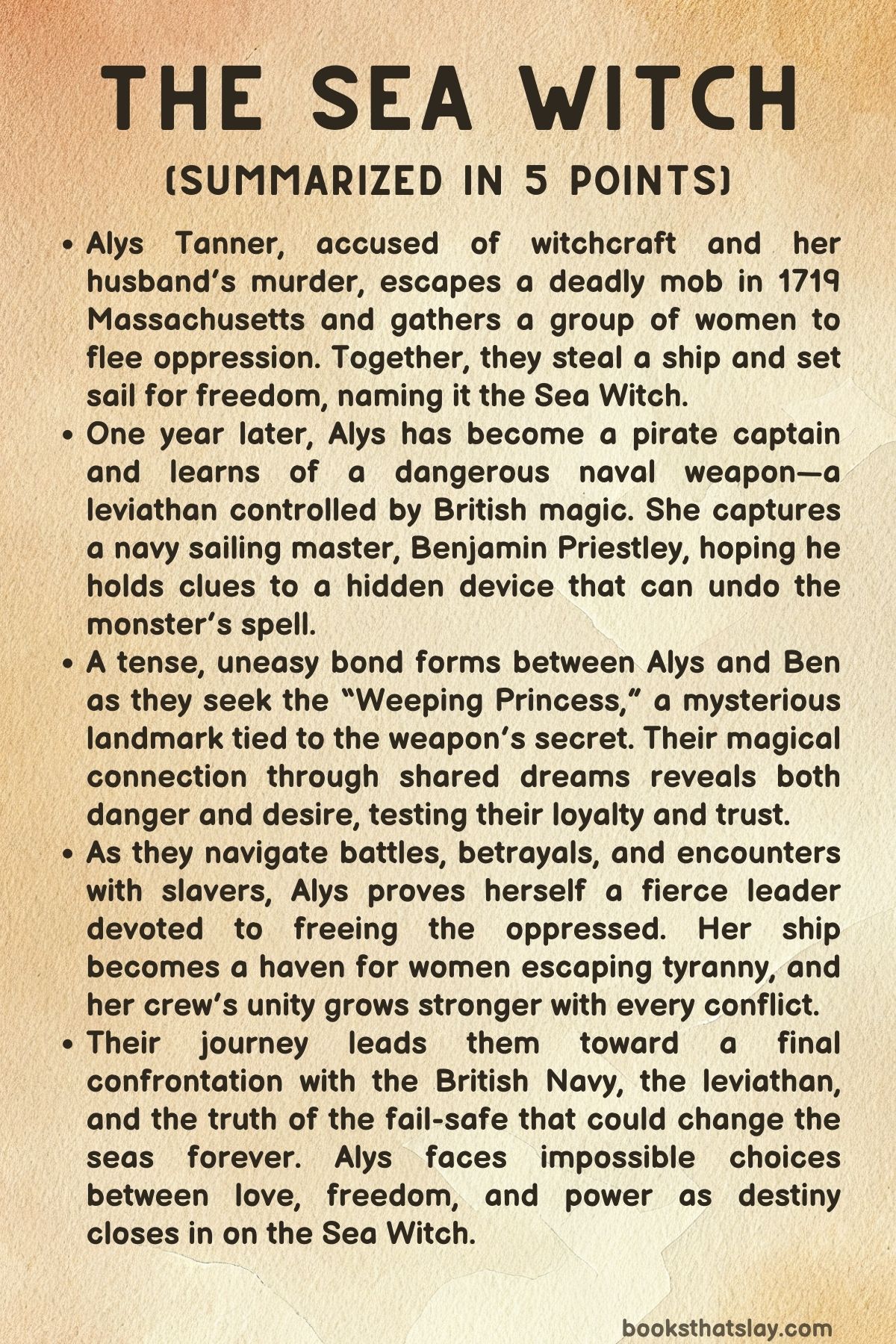
Summary
In 1719 Massachusetts, Alys Tanner flees through the woods under cover of darkness, escaping men who accuse her of witchcraft and murder. Her husband, Samuel, had died of a weak heart, yet the villagers blame her powers.
When she overhears plans to hang her and others like her, Alys rushes to warn her companions—Cecily and Polly Gower. Together, they decide to flee before dawn.
Alys, haunted by her sister Ellen’s execution for witchcraft, vows she will not share her fate.
Alys gathers twelve women—some witches, others simply desperate for freedom—and leads them to the harbor. Under the cloak of fog and magic, they steal a merchant brigantine.
Despite their lack of sailing experience, they work together with courage and determination. As torches flare behind them and angry shouts echo across the docks, Alys channels the sea’s power to raise a massive wave that wrecks the villagers’ boats, ensuring their escape.
Declared captain by her new crew, Alys names their ship Sea Witch and sets course for the Caribbean, where freedom for women and witches may still exist.
A year later, on the island of St. Gertrude, Captain Alys Tanner commands her ship with confidence and fearsome reputation.
She attends the wake of the pirate Little George Partridge, where his final letter reveals a secret: the British Navy has bound a sea leviathan through dark magic to destroy pirate ships. Hidden somewhere in the Caribbean lies a fail-safe capable of freeing the beast.
Before Alys can learn more, the island is attacked by Admiral Strickland’s fleet. Amid the chaos, Alys encounters Benjamin Priestley, a disciplined naval officer driven by vengeance against pirates.
Their confrontation ends with Alys escaping, using her powers to leap from a cliff and flee across the sea. Priestley pursues, and their battle continues aboard the Sea Witch, where he is finally captured and taken prisoner.
Alys debates his fate with her loyal quartermaster, Stasia Angelidis. Stasia mistrusts him, but Alys sees value in his knowledge, especially since he might hold clues to the fail-safe.
The crew, all women united by survival and sorcery, distrusts their captive. As they interrogate him, Alys and Ben clash—both proud and defiant—but an undeniable attraction grows between them.
When Alys attempts to use dream magic to read his mind, she inadvertently binds their spirits together. They begin to share dreams, emotions, and memories, forcing them to see each other’s hidden pain.
Through their bond, Alys learns that “The Weeping Princess” from Little George’s riddle refers to a legendary waterfall on a distant island. Together, they agree to seek it, their destinies entwined.
Meanwhile, Alys’s former lover, the treacherous pirate Jacob Van der Meer, learns of their quest and sets out in pursuit. Alys uses illusion and cunning to trap him, ensuring her crew’s escape.
As the Sea Witch sails on, Alys and Ben’s fragile trust deepens into mutual respect and forbidden desire.
Their journey takes them to the island of Domingo, where Alys hopes to uncover records identifying a man linked to the fail-safe. Disguised as an engaged couple, she and Ben infiltrate the church archives.
With the aid of glamour spells, they locate a hidden parish register that reveals the connection to a notorious pirate, Charles “Lethal” Lambert, who holds gatherings in the Bahamas. Before leaving, they are attacked by a magical creature but manage to escape and return to the Sea Witch.
There, the presence of a Royal Navy ship forces Alys to imprison Ben again, fearing betrayal despite her feelings for him.
Seeking to protect her crew and finish the mission, Alys sails toward the Bahamas. Ben, determined to shield her from the Navy’s wrath, returns to Admiral Strickland’s fleet, pretending to have escaped captivity.
He feeds the Navy false information to mislead them, but his deception is discovered. The Navy’s mage, Warne, uses the lingering bond between Alys and Ben to track the Sea Witch and brutally severs their connection, leaving Ben imprisoned and Alys in agony.
The Sea Witch reaches a small island believed to hide Little George’s fail-safe. Before they can explore, Strickland’s fleet appears, accompanied by monstrous sea creatures enslaved through magic.
A fierce battle erupts. Alys leads a small landing party while the rest of her crew fights at sea.
Amid the chaos, Ben breaks free from the Jupiter’s brig, dives into the ocean, and reunites with Alys on the island. Together they seek the fail-safe deep in the forest, guided by a mystical force that responds to their reawakened bond.
They discover a stone hut guarded by ancient magic. When Alys drives a golden knife into the hut’s keyhole, it transforms into a massive stone giant.
Working together, they defeat it, and a vial of glowing blue liquid emerges—the true fail-safe. The accompanying note reads: “The storm will set them free.
Returning to the beach, Alys uncorks the vial and channels its power through a storm, drenching the sea in enchanted rain. The enslaved leviathans turn on their masters, tearing apart the Royal Navy’s ships.
The Sea Witch joins the fray, her witches unleashing elemental fury—fire, wind, and water combining in defiant unity. Ben duels Strickland to the death while Alys kills Warne, ending the mage’s control.
But as Warne’s dying curse spreads, sailors begin transforming into monstrous sea creatures. Ben is among them.
As his body mutates—gills, scales, and claws overtaking his human form—he looks at Alys one last time before the beast within consumes him. Stasia drags a devastated Alys away as their ship retreats from the burning bay.
The Sea Witch sails into stormlight and ruin, her crew bloodied but alive. Alys, hollow yet resolute, vows to continue fighting—to reclaim Ben’s humanity and to ensure no one, witch or man, is ever enslaved again.
Characters
Alys Tanner
Alys Tanner stands at the fierce and unyielding heart of The Sea Witch, embodying both defiance and compassion in a world that condemns her for her power and independence. Once a wife in a suffocating marriage, Alys transforms into the captain of her own fate—literally and figuratively—by leading a band of women to freedom.
Her command of witchcraft, particularly her affinity with the sea, mirrors her emotional journey: turbulent, vast, and impossible to contain. She is a woman shaped by grief—her sister Ellen’s execution haunts her—but she turns that pain into resolve.
As captain of the Sea Witch, she is protective of her crew, ruthless toward her enemies, and unwavering in her belief that women deserve self-determination. Her interactions with Benjamin Priestley reveal a softer, conflicted side; despite her hardened exterior, she grapples with desire and trust.
When she dreamwalks into his mind, it binds her to him in ways she neither wanted nor foresaw, forcing her to confront her own capacity for intimacy and forgiveness. By the novel’s end, even after unimaginable loss, Alys stands as a symbol of survival, her strength as eternal as the sea itself.
Benjamin Priestley
Benjamin Priestley is the embodiment of loyalty strained by conscience and circumstance. A disciplined naval sailing master, his rigid sense of duty initially defines him, shaped by a harsh father and a life under the British crown.
Yet when he meets Alys, his carefully ordered world fractures. Captured and confined among the witches he has been taught to despise, he begins to see beyond propaganda—to the humanity, pain, and courage of the women aboard the Sea Witch.
His intellect and skepticism contrast with Alys’s instinctive magic, yet the two are drawn together by both conflict and curiosity. The dream-bond between them exposes Benjamin’s deepest traumas: the weight of command, the loss of innocence, and his buried magical nature.
As the story unfolds, his transformation from a loyal officer to a man reborn through love and empathy mirrors the novel’s larger theme of liberation from oppressive systems. His final metamorphosis into a sea creature is both tragic and poetic—a punishment for his past and a testament to the inescapable link between man and nature, reason and magic.
Stasia Angelidis
Stasia Angelidis, the Greek witch and quartermaster of the Sea Witch, is Alys Tanner’s stalwart ally and moral anchor. A survivor of male violence and exile, Stasia channels her trauma into loyalty, intellect, and pragmatic ferocity.
She is both the ship’s conscience and its blade, constantly challenging Alys to temper compassion with caution. Her protective instincts toward the crew and her deep bond with Alys form one of the novel’s emotional cores.
Stasia’s magpie familiar, Eris, reflects her cunning and sharp personality—clever, bold, and unafraid to peck at the truth. Her skepticism toward Benjamin Priestley adds tension to the story, serving as a counterbalance to Alys’s growing empathy.
Yet beneath her gruffness lies immense tenderness; she fights not for vengeance but for freedom. Stasia represents resilience without romanticism, a woman hardened by betrayal but sustained by sisterhood.
Cecily and Polly Gower
Cecily and Polly Gower are among the first to join Alys in her desperate flight from persecution. Their courage is born of fear, yet it evolves into fierce determination as they help steal and sail the brigantine that becomes the Sea Witch.
Cecily’s quick wit and charm make her invaluable in moments requiring deception, while Polly’s steady presence offers quiet strength. They symbolize the ordinary women swept into extraordinary rebellion—individuals who, though not as magically gifted as Alys or Stasia, embody bravery through action.
Their presence grounds the story in reality, reminding readers that revolution is not only led by the powerful but sustained by those who dare to act despite fear.
Olachi
Olachi emerges later in The Sea Witch as a mirror to Alys—another leader born from bondage and loss. Once a councilor and now a liberator of enslaved women, she commands respect through moral authority and courage.
Her partnership with Alys transcends alliance; it reflects solidarity across cultures and shared suffering. Through Olachi, the novel widens its scope beyond witch trials to the broader horrors of slavery and colonialism, uniting women of different worlds in a common struggle for freedom.
Her vision of building a fleet to fight slavers complements Alys’s mission, suggesting that liberation is not only personal but collective. Olachi’s calm dignity contrasts beautifully with Alys’s tempestuous fire, and their meeting marks a turning point where rebellion becomes purpose.
Admiral Strickland
Admiral Strickland embodies the cold machinery of empire and patriarchy. A man of unyielding authority and belief in hierarchy, he represents the oppressive power structures that Alys and her crew seek to dismantle.
His use of magic—specifically the enslavement of the leviathan—exposes the hypocrisy of those who condemn witches while exploiting supernatural forces for domination. Strickland’s obsession with control makes him both formidable and blind to his own destruction.
His death at Benjamin’s hands is poetic justice, symbolizing the collapse of tyranny under the weight of its own corruption.
Warne
Warne, the navy’s mage, serves as the dark mirror to Alys’s natural magic. Where her sorcery springs from emotion and communion with nature, his is born of blood, control, and pain.
He personifies the corruption of power through knowledge untempered by empathy. His experiments and his eventual curse upon Ben show the grotesque consequences of using magic as a weapon rather than a gift.
Warne’s death at Alys’s hands is cathartic—an exorcism of the world’s cruelty—but his lingering curse ensures that even victory comes with sacrifice.
Ellen Tanner
Ellen, though dead before the novel begins, casts a long shadow over Alys’s life and choices. Her execution for witchcraft becomes the trauma that ignites Alys’s rebellion.
Appearing in dream sequences and visions, Ellen represents innocence destroyed by intolerance and the spiritual cost of survival. Her presence in Benjamin’s dreams underscores the entwined nature of memory, guilt, and redemption.
Ellen’s gentle wisdom and tragic fate embody the countless silenced women whose deaths fuel Alys’s resolve to live and fight freely.
Jacob Van der Meer
Jacob Van der Meer, Alys’s treacherous former lover, adds depth to the novel’s themes of betrayal and self-reclamation. A pirate by trade and opportunist by nature, he symbolizes the dangers of desire without respect.
His pursuit of Alys and the fail-safe is less about love and more about dominance—a reminder of the toxic dynamics Alys escaped from. Her eventual triumph over him signifies her rejection of her past self and of male control.
Jacob’s presence sharpens Alys’s growth; through confronting him, she solidifies her identity not as a fugitive or a lover, but as a captain and a leader.
Themes
Power and Rebellion
The narrative of The Sea Witch is driven by the tension between oppressive authority and the defiance of those who refuse to be subdued. From its earliest scenes in Puritan Massachusetts, the story situates female power as something both feared and condemned by patriarchal institutions.
Alys Tanner’s use of magic is not portrayed as a threat to order but as a response to cruelty and injustice. Her witchcraft represents autonomy — the one form of control she can exert in a world determined to cage her.
The act of stealing a ship and transforming it into the Sea Witch becomes a reclamation of power, not only personal but collective. The women who sail with her are not merely running from execution; they are rejecting the roles forced upon them by men who used law, religion, and superstition to dominate.
This defiance extends across oceans and years as Alys confronts new forms of control — the British Navy’s use of enslaved monsters, the hierarchies of pirate society, and the violence of empire. The book portrays power as fluid and morally complex.
Alys’s magic, while a symbol of liberation, can be destructive and dangerous, echoing how any power, when born from trauma, carries the capacity to wound as well as heal. The rebellion at the heart of the story is not one of vengeance alone; it is a demand for the right to exist freely and without apology.
In that sense, the power of the witches is not about domination but survival — the will to claim life, even when the world insists on their extinction.
Sisterhood and Solidarity
At its core, the novel celebrates the unity of women who have been cast out, silenced, or brutalized by patriarchal systems. The crew of the Sea Witch embodies this theme in every scene — a gathering of witches, outlaws, and freed captives bound not by blood, but by shared pain and defiance.
Each woman carries her own story of exile or abuse, yet together they form a new family that thrives on mutual respect and shared purpose. Alys’s relationship with Stasia, in particular, stands as the emotional heart of this solidarity.
Their bond grows from survival to trust, and eventually to the deep understanding that leadership is meaningless without loyalty. Their ship becomes a sanctuary and a revolution — a space where women define their own laws and ethics.
The rescue of enslaved women later in the story extends this theme beyond witchcraft, linking their struggle to broader forms of oppression based on race, class, and gender. The sense of community aboard the Sea Witch reveals that freedom cannot exist in isolation; it depends on collective strength and empathy.
The novel also avoids idealizing this unity. Disagreements, jealousy, and fear threaten to divide them, especially when Alys’s decisions blur moral lines.
Yet, despite these fractures, their solidarity endures, proving that true sisterhood is forged not in perfection but in shared endurance. Through these relationships, The Sea Witch constructs a vision of female kinship that defies both the patriarchal world and the myth of the solitary hero.
Freedom and the Sea
The sea in The Sea Witch functions as both literal setting and metaphor for liberation. It is the element that gives Alys power and the only place where her magic feels natural rather than cursed.
Every significant act of defiance — her escape, her command of the ship, and her confrontation with the British Navy — is shaped by the sea’s unpredictable nature. The ocean mirrors her own transformation: vast, volatile, and untamable.
Yet, freedom in this world is never pure or simple. The ocean that grants autonomy also holds danger, isolation, and moral uncertainty.
Alys and her crew trade the certainties of land for the unknown, and in doing so, they redefine what it means to live freely. Their voyage through storms, battles, and mystical creatures becomes a spiritual passage from repression toward self-determination.
The contrast between the constrained world of Norham and the boundless horizon of the Caribbean emphasizes this shift. Even the Sea Witch itself is more than a vessel; it is a manifestation of their collective will to resist control.
The sea’s dual nature — its beauty and its brutality — reminds the reader that freedom always carries a price. Alys’s connection to the sea culminates in her final act of unleashing the storm that frees the enslaved leviathans.
In that moment, the ocean ceases to be merely a backdrop and becomes a living force of emancipation, echoing the central truth of the story: that freedom, though perilous, is worth every sacrifice.
Love, Trust, and Transformation
The relationship between Alys Tanner and Benjamin Priestley introduces the theme of love as both danger and salvation. Their connection begins in hostility, shaped by mistrust and opposing loyalties, yet it evolves into something that challenges both of their beliefs about power and vulnerability.
The magical bond that ties their dreams and emotions together forces them to confront not only their feelings but their shared humanity. Through Ben, Alys faces the possibility of intimacy after years defined by betrayal and violence; through Alys, Ben confronts the moral blindness of the empire he serves.
Their love, however, is never romanticized as easy or redemptive. It is fraught with fear, guilt, and the ever-present threat of loss.
The dream sequences, in which Alys witnesses Ben’s traumas and her own desires, blur the boundary between magic and emotion, showing how love can become a form of transformation. This transformation is literal in the story’s conclusion, when Ben’s body is twisted by a curse and Alys refuses to abandon him.
Love here is not about possession or rescue but recognition — the refusal to let the world’s cruelty define one’s capacity to care. The bond between them stands as a challenge to every structure that deems witches, women, or enemies unworthy of compassion.
In the end, love becomes both the story’s most fragile and most enduring magic, capable of surviving even when flesh and spirit are torn apart.
Oppression, Revenge, and Redemption
Throughout The Sea Witch, Eva Leigh explores the cycle of oppression and the human hunger to break or avenge it. The novel opens with Alys fleeing a world that condemns her merely for existing outside its moral codes, and it concludes with her standing against an empire that enslaves both humans and mythical creatures.
Every act of rebellion in between carries the question of how to confront injustice without becoming consumed by it. Alys’s hatred for those who burned her sister and enslaved others is righteous, but it is also corrosive.
The narrative traces her journey from vengeance to purpose — from fighting merely to survive to fighting for something greater. Her mercy toward Ben, her refusal to execute prisoners or enslavers without thought, and her final act of freeing the leviathans mark the evolution of a woman who learns that liberation cannot be built on cruelty, even against one’s enemies.
Redemption in this story is not granted by divine authority but earned through choice — the willingness to act differently despite one’s scars. In that sense, Alys’s final vow to continue fighting for Ben is not only an act of love but also a declaration of faith in transformation.
Oppression has defined her life, but it no longer defines her purpose. Through her, the novel argues that redemption lies not in erasing the past but in facing it — wielding the power once used to destroy as a means to heal and to free.