The Serpent and the Wolf Summary, Characters and Themes
The Serpent and the Wolf by Rebecca Robinson is a political fantasy novel that intertwines themes of power, betrayal, and survival. The story follows Vaasa Kozár, a woman trapped in an arranged marriage to Reid of Mireh, a ruthless warrior, as part of a political maneuver orchestrated by her brother, Dominik.
As she navigates the complexities of her life, Vaasa discovers her magical powers, a dangerous gift inherited from her mother, and uncovers dark secrets about her family’s ambitions. Caught between manipulation, magic, and her desire for freedom, Vaasa faces a complex journey of self-discovery, survival, and defiance.
Summary
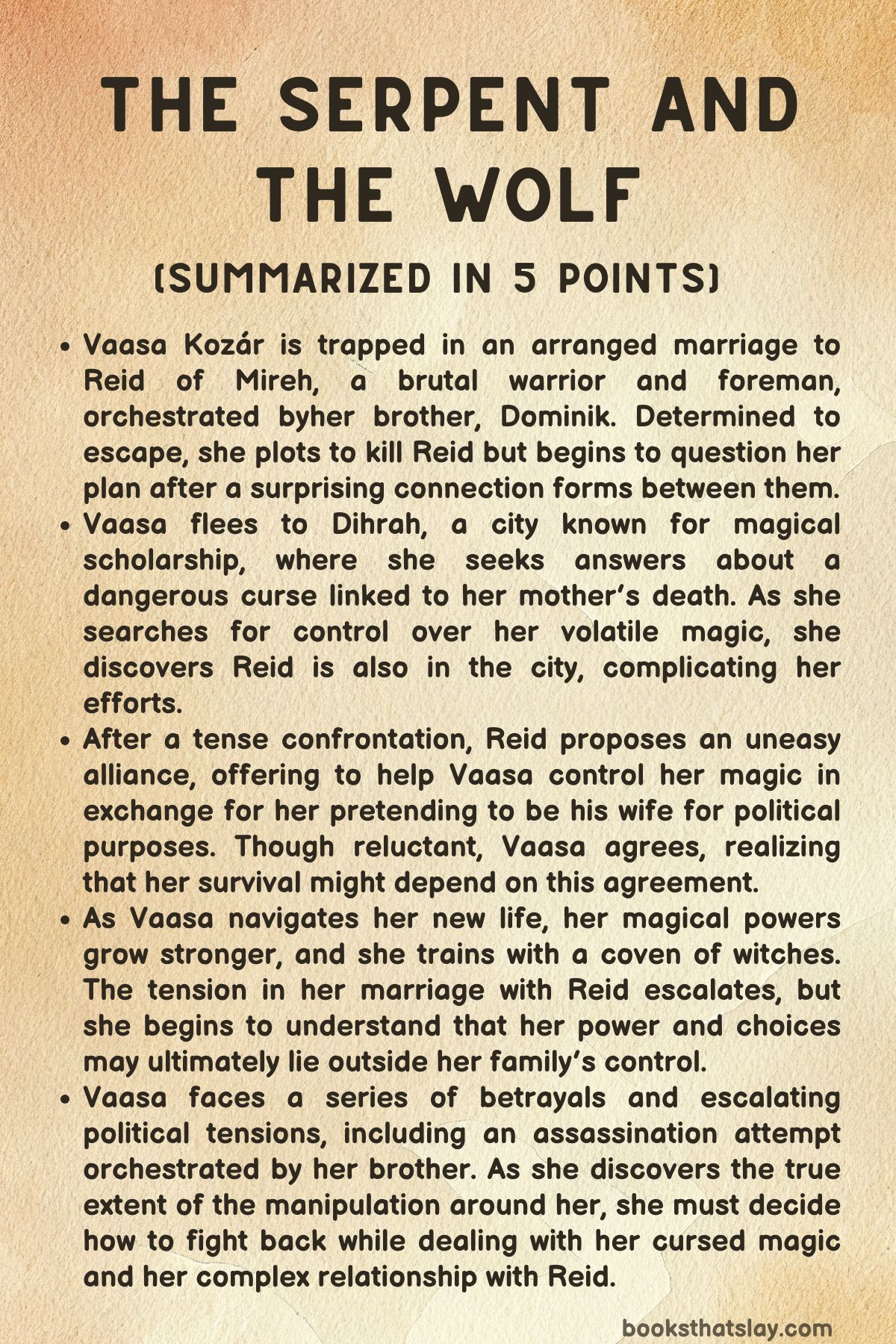
Vaasa Kozár is trapped in an arranged marriage to Reid of Mireh, a violent and calculating warrior whose role as a foreman of the region makes him a powerful figure. Her brother Dominik, who is seeking to increase his own influence, arranged the marriage soon after their parents’ deaths.
Vaasa despises her brother for his ruthless ambition and views Reid as another pawn in his political games. Determined to escape her fate, Vaasa plans to kill Reid on their wedding night, using a hidden blade and rope to end his life.
However, when she attempts to manipulate him, she finds that Reid is not as easy to control as she had hoped.
Reid’s calm and composed response to her advances throws her off balance. Though she initially prepares to kill him, Vaasa hesitates and ultimately decides to flee rather than follow through with her plan.
She escapes the High Temple of Mireh and heads toward Dihrah, a city renowned for its magical scholarship, where she hopes to find answers about the curse she believes is slowly consuming her. This curse, linked to her mother’s mysterious death, is something Vaasa has spent years trying to understand and control.
In Dihrah, Vaasa adopts a false identity, Aneta, and immerses herself in the study of magic. She learns that her mother’s death was not natural, and her brother had covered it up to avoid suspicion.
Vaasa is convinced that her mother’s death is connected to an ancient goddess named Veragi, whose power may be tied to the curse that haunts her. While in Dihrah, Vaasa meets Brielle, a fellow student who offers her help.
But her peace is disrupted when she learns that Reid is in the city, further complicating her efforts to escape her past.
Reid, determined to find Vaasa, confronts her in the library, and the two have a tense and awkward meeting. Instead of resorting to violence, Reid proposes a deal.
He offers to help Vaasa control her magic, while she agrees to pretend to be his wife for political purposes. This uneasy alliance marks the beginning of a complicated relationship, where trust is scarce, and both parties are driven by their own desires for power and survival.
Vaasa, still wary of Reid, agrees to the arrangement, realizing that it might be her only chance to survive and free herself from the curse.
Vaasa and Reid return to Mireh, where Vaasa finds herself struggling to adapt to life in a city filled with painful memories. Reid’s villa, where they are supposed to live together, is unguarded and vulnerable, which unsettles Vaasa.
She is introduced to Kosana, a stern woman who is Reid’s commander, and the tension between them is immediate. As Vaasa continues to play the role of a dutiful wife, her mind remains focused on controlling the dangerous magic within her.
At the villa, Vaasa begins training with the witches of Veragi, including the high witch Melisina, who recognizes the power Vaasa has inherited from her mother. Vaasa’s magic, known as the “void,” is volatile and difficult to control, and she fears its destructive potential.
Melisina and the coven teach her how to harness the magic, though the fear of losing control lingers.
Meanwhile, Reid uses their marriage for political purposes, forcing Vaasa to participate in public events and maintain the illusion of a united front. As their marriage becomes more complicated, Vaasa begins to see the true dynamics between Reid, Kosana, and the coven.
She realizes that her personal desires are secondary to the political games at play, and the pressure of her family’s expectations weighs heavily on her.
The tension between Vaasa and Reid intensifies as they continue to play their respective roles. Vaasa’s training with Kosana becomes more rigorous, and she begins to prove herself as a capable fighter.
Her internal conflict grows, as she struggles to reconcile her growing connection to Reid with her need for independence and freedom. Though her feelings for him remain complex, she begins to understand that their alliance is her only hope for survival.
In the midst of these struggles, Vaasa’s brother Dominik makes a move to gain more power by seeking Reid’s cooperation in trade and military negotiations. Dominik’s true motivations become clearer as Vaasa realizes that she holds leverage in the situation.
Dominik’s manipulations push Vaasa into a corner, and she must decide where her loyalties lie. The stakes are raised when an assassination attempt is made on Vaasa’s life, revealing the deep-seated betrayals that surround her.
In the aftermath of the attack, Vaasa learns that her brother had orchestrated the plot to test her loyalty. With her growing power and control over her magic, Vaasa begins to make her move against those who seek to use her.
Her bond with Reid strengthens, and she realizes that he might be the only person who can help her break free from the web of political intrigue that entangles them.
The tension reaches its peak when Vaasa’s brother is killed in a confrontation with her. However, this victory comes at a high cost.
Ozik, an advisor with dark magical abilities, manipulates the situation and forces Vaasa into a desperate bargain. In exchange for Reid’s life, Vaasa agrees to give up her magic, leaving her vulnerable and powerless.
This deal sets the stage for the final confrontation, where Reid must fight to reclaim his wife and restore peace to Icruria.
The story culminates in a fierce battle, as Reid’s forces clash with those loyal to Ozik. Vaasa’s fate, as well as the future of Icruria and Asterya, hangs in the balance.
Reid, determined to fight for Vaasa, embraces his dual role as the headman of Icruria and the emperor of Asterya, ready to confront the forces that threaten their future. As the battle unfolds, Vaasa’s strength and her magical power may be the key to reclaiming her life, her love, and her destiny.
Characters
Vaasa Kozár
Vaasa is the strong-willed and determined protagonist of The Serpent and the Wolf. She finds herself caught in the brutal political game orchestrated by her family, particularly her brother, Dominik.
From the outset, Vaasa is portrayed as a woman desperate to escape an arranged marriage to Reid of Mireh, a powerful and violent warlord. However, her journey is far more complex than a simple escape.
Her desire to control her destiny is intertwined with a dark curse inherited from her mother, a legacy that manifests as terrifying visions of black mist. As Vaasa navigates her world, she discovers that her strength lies not just in her beauty or her cunning, but also in the magic that binds her to the ancient goddess Veragi.
Her internal struggle is one of survival, as she attempts to balance her quest for freedom with the overwhelming pressure of family obligations and political maneuvering. Throughout the narrative, Vaasa’s relationships are central to her development—her complicated connection with Reid shifts from manipulative and antagonistic to a begrudging alliance, while her emotional and magical turmoil drives much of the story.
Ultimately, Vaasa’s evolution is a journey of empowerment, as she learns to wield her power and navigate the treacherous political landscape, confronting both her brother’s manipulations and the dark forces that seek to control her.
Reid of Mireh
Reid of Mireh is a key figure in The Serpent and the Wolf, and his role is integral to the political and personal conflicts that Vaasa faces. On the surface, Reid appears to be a traditional warrior: tough, stoic, and driven by a desire for power.
However, as the narrative unfolds, it becomes clear that Reid is far more than just a brute force. His marriage to Vaasa, initially a political tool, develops into a much more complex relationship, particularly as he navigates the intricacies of his own ambitions and the shared struggles with his wife.
Reid is a man of strategic patience, often holding his cards close to his chest. He approaches Vaasa with a calm demeanor that disorients her, making it difficult for her to manipulate or control him as she originally intended.
Over time, this dynamic between them shifts from mutual distrust to a more cooperative relationship, as Reid proposes a deal to Vaasa, offering to help her control her curse in exchange for her cooperation in their marriage. Despite his role as a political figure and a potential future leader, Reid is shown to have a deeper understanding of the complex forces at play, including his relationships with figures like Kosana and his mother’s coven.
His personal journey involves reconciling his political ambitions with the emotional realities of his relationship with Vaasa, ultimately evolving from a distant and calculating figure into one who is genuinely invested in their partnership.
Dominik Kozár
Dominik, Vaasa’s brother, plays the role of the primary antagonist in The Serpent and the Wolf. His character is defined by ambition, manipulation, and a cold disregard for family loyalty.
Dominik’s motivations are rooted in his desire to expand Asterya’s influence, and he is willing to use any means necessary to achieve his goals, including sacrificing his sister. His strategic use of Vaasa as a pawn in his power games is central to the tension of the story, as he arranges her forced marriage to Reid to secure political alliances and control.
Throughout the narrative, Dominik is portrayed as calculating and ruthless, with little concern for the emotional or physical toll his plans take on those around him. His manipulations are not just confined to Vaasa; they extend to other key figures, including Reid and his allies.
In the end, Dominik’s role as a villain is cemented when he orchestrates an assassination attempt on Vaasa, testing her loyalty and pushing her toward a confrontation with him. However, his overconfidence in his control ultimately leads to his downfall, as Vaasa’s growing awareness of her own power allows her to defy him.
His death marks the end of his sinister influence, though his legacy of manipulation continues to haunt Vaasa.
Kosana
Kosana, introduced as Reid’s commander in The Serpent and the Wolf, is a character defined by her stern, no-nonsense attitude and her formidable combat skills. Initially, Kosana seems to be another obstacle in Vaasa’s path, especially given the physical and emotional tension that develops between the two women.
Kosana’s harsh training methods push Vaasa to her limits, forcing her to confront her physical strength and endurance, but also to grapple with her own vulnerabilities. Despite the outward coldness Kosana projects, her loyalty to Reid and her belief in the necessity of discipline suggest a deeper layer to her character.
Over time, as Vaasa trains under her supervision, there is a noticeable shift in their relationship, moving from adversarial to one of mutual respect, though still filled with tension. Kosana’s role is important not just as a mentor, but also as a symbol of the rigid structures of power and control within Reid’s circle.
She embodies the martial strength and discipline that Vaasa needs to survive in a world that values power and influence above all else.
Melisina
Melisina, the high witch of Veragi, plays a significant role in Vaasa’s development in The Serpent and the Wolf. As the leader of a coven of witches, Melisina represents both wisdom and power.
Her magical abilities, and those of her coven, are integral to Vaasa’s journey as she struggles to control the dangerous magic coursing through her veins. Melisina’s relationship with Vaasa is one of mentorship, as she teaches Vaasa how to harness her volatile magic and understand its true potential.
Unlike the male figures in Vaasa’s life, Melisina provides a source of comfort and guidance, offering Vaasa a sense of belonging and empowerment. However, Melisina’s motivations are not entirely altruistic, as she and her coven have their own interests in the political dynamics of Icruria and Asterya.
As Vaasa’s magical training progresses, her bond with Melisina deepens, and the coven becomes a pivotal ally in her fight against the forces threatening her and her future.
Ozik
Ozik is a shadowy figure whose manipulations lie at the heart of the darker political and magical forces in The Serpent and the Wolf. As a powerful advisor to Vaasa’s family, Ozik is a master of dark magic and subterfuge, using his skills to control those around him and further his own ambitions.
His sinister presence looms over the story, particularly as he becomes a key antagonist in the latter half of the novel. Ozik’s role is one of betrayal, as he emerges as a greater threat than Dominik, using his dark magic to manipulate both Vaasa and Reid.
His control over Vaasa’s magic is a significant plot point, as she is forced into a bargain with him that renders her powerless. Despite his evil nature, Ozik is not a one-dimensional villain; his ability to manipulate the characters around him shows the depth of his power and his role in shaping the story’s conflict.
In the end, Ozik’s machinations force Vaasa into a desperate situation, leaving her to confront the consequences of her deal with him in order to save Reid and her own life.
Themes
Survival and Power
In The Serpent and the Wolf, survival is not just about physical endurance; it is intricately tied to power—political, magical, and personal. Vaasa’s journey reflects her struggle to survive in a world where the power dynamics constantly shift around her.
Forced into an arranged marriage with Reid, she navigates the turbulent waters of familial expectations, political maneuvering, and her own personal desires. The marriage, though initially a means to an end for her, becomes a battleground for control over her future.
Vaasa’s escape from her brother’s manipulative grasp and her eventual reluctant alliance with Reid signify her desire to retain autonomy while gaining leverage over her life.
Power in the novel isn’t just external but internal as well. Vaasa’s magical abilities, which she struggles to control, represent a form of power that she both fears and yearns to understand.
Her magic is a dual-edged sword; it is a source of immense strength, but also a curse that threatens her very existence. As Vaasa seeks to harness her magic, she understands that the more control she exerts over it, the more she can use it to her advantage.
However, the real power lies in her ability to manipulate the people around her, particularly Reid, as she forms a delicate balance between submission and resistance. The theme of survival intertwined with the pursuit of power becomes a driving force throughout Vaasa’s journey, influencing her every decision, from the choices she makes in her marriage to the ways she interacts with the coven of witches and her family.
In the end, power becomes not just a means of survival, but a tool for reclaiming control over her destiny.
Loyalty and Betrayal
Loyalty and betrayal are constant undercurrents in The Serpent and the Wolf, and the story explores the complexities of these emotions against the backdrop of familial and political intrigue. Vaasa is torn between her loyalty to her family and her growing realization that her brother Dominik’s ambitions are only a guise for his ruthless pursuit of power.
Her feelings of betrayal are compounded by the manipulations of her family, particularly her brother, who arranges her marriage as a mere political tool. Vaasa’s bitterness toward her family grows as she uncovers the dark secrets of their machinations, including her mother’s tragic death and the curse that haunts her.
Her internal struggle between familial loyalty and self-preservation is a key aspect of her character development.
On the other hand, Reid’s involvement in the story brings another layer of loyalty and betrayal. Initially, Vaasa views Reid with suspicion, believing him to be another piece in her brother’s game.
However, as the narrative progresses, she begins to see his loyalty to her as genuine, even if it is entangled with his own political ambitions. The dynamics between Reid and Vaasa shift as they navigate their forced alliance, testing both their loyalty to one another and the extent to which they can trust each other.
Despite the manipulation that defines much of their relationship, Vaasa begins to understand that true loyalty, even in the most unlikely of circumstances, can exist. The theme of betrayal becomes more pronounced as the story unfolds, particularly in the shocking revelations about Dominik’s role in orchestrating attempts on Vaasa’s life.
Vaasa’s eventual betrayal of her brother, culminating in his death, marks the point where she finally takes control of her fate, reclaiming her autonomy and her power.
Identity and Self-Discovery
In The Serpent and the Wolf, Vaasa’s journey of self-discovery is intricately tied to her identity, which is constantly shifting in response to the challenges she faces. The theme of identity is explored through her internal conflict and her struggle to reconcile the person she is with the role others expect her to play.
From the moment she is forced into a marriage to Reid, Vaasa resists the identity imposed upon her by her family and society. She refuses to be just a pawn in a political game and strives to carve out her own path, one that reflects her strength, autonomy, and intelligence.
Her magical abilities, a significant part of her identity, also play a major role in this theme. At first, Vaasa fears the power within her, seeing it as a curse.
However, as she learns to control her magic, it becomes a means of asserting her true self in a world that constantly tries to define her. Her relationship with the coven of witches, who teach her to harness her power, is central to her process of self-discovery.
Through her bond with them, Vaasa learns to trust herself and her abilities, growing into someone who can not only survive but thrive despite the adversities stacked against her.
The theme of identity also extends to Reid, whose relationship with Vaasa is initially defined by political and strategic considerations. Yet, over time, Reid’s own sense of self begins to change as he grows closer to Vaasa.
Their dynamic shifts, and he, too, faces a journey of self-realization, as he grapples with his role in the power struggles of Icruria and his evolving feelings for Vaasa. The theme of identity is thus not only about personal growth but also about understanding and accepting the fluid nature of relationships and power in a world that is ever-changing.
The Cost of Ambition
Ambition in The Serpent and the Wolf is portrayed as both a driving force and a destructive power. Vaasa’s ambitions, shaped by her desire to escape her brother’s control and free herself from the burdens of her arranged marriage, often collide with the ambitions of those around her.
Her brother, Dominik, represents the darker side of ambition. His relentless pursuit of power, at any cost, serves as a warning about the corrupting influence of unchecked ambition.
He is willing to sacrifice his sister and manipulate those around him to achieve his goals, showing the lengths to which individuals will go when ambition becomes the sole guiding force in their lives.
Reid, too, is driven by ambition, though his motivations are more complex. His desire to become the headman of Icruria and gain political control is tied to his need to protect his family and his city, but it also places him in direct opposition to the people he must navigate to achieve his goals.
Vaasa, initially resistant to becoming a pawn in his game, comes to understand that Reid’s ambitions are not entirely self-serving. In fact, the cost of ambition for both Reid and Vaasa is high—while they each pursue their respective goals, they are constantly faced with the consequences of their actions.
Vaasa’s ambition to break free from her brother’s grip and control her own destiny ultimately leads to the destruction of her family, but it also empowers her to become a force to be reckoned with. The theme of ambition in the novel is a reminder of its potential to both uplift and destroy, depending on how it is wielded.
The Role of Magic
Magic plays a pivotal role in The Serpent and the Wolf, not just as a fantastical element, but as a symbolic representation of control and chaos. Vaasa’s magical abilities are initially portrayed as something dangerous and uncontrollable, tied to the mysterious death of her mother and the curse that haunts her.
However, as she learns more about her powers and the history of the magic within her, she begins to understand that it is both a gift and a burden. The witches of Veragi, who guide Vaasa in harnessing her magic, teach her that true power comes from balance and control.
The magic in the story also symbolizes the unpredictable nature of power itself. While Vaasa’s magical abilities provide her with strength, they also place her in danger, as the forces that seek to control her recognize the potential threat she poses.
Magic, in this context, represents not just an external force, but an internal struggle—a battle to control one’s own fate and desires. Vaasa’s growing understanding of her magic parallels her journey toward self-empowerment, as she learns to trust in her abilities and use them to her advantage.
The theme of magic is a reminder of the duality of power—it can both protect and destroy, depending on how it is wielded and understood.