The Serviceberry Summary, Analysis and Themes
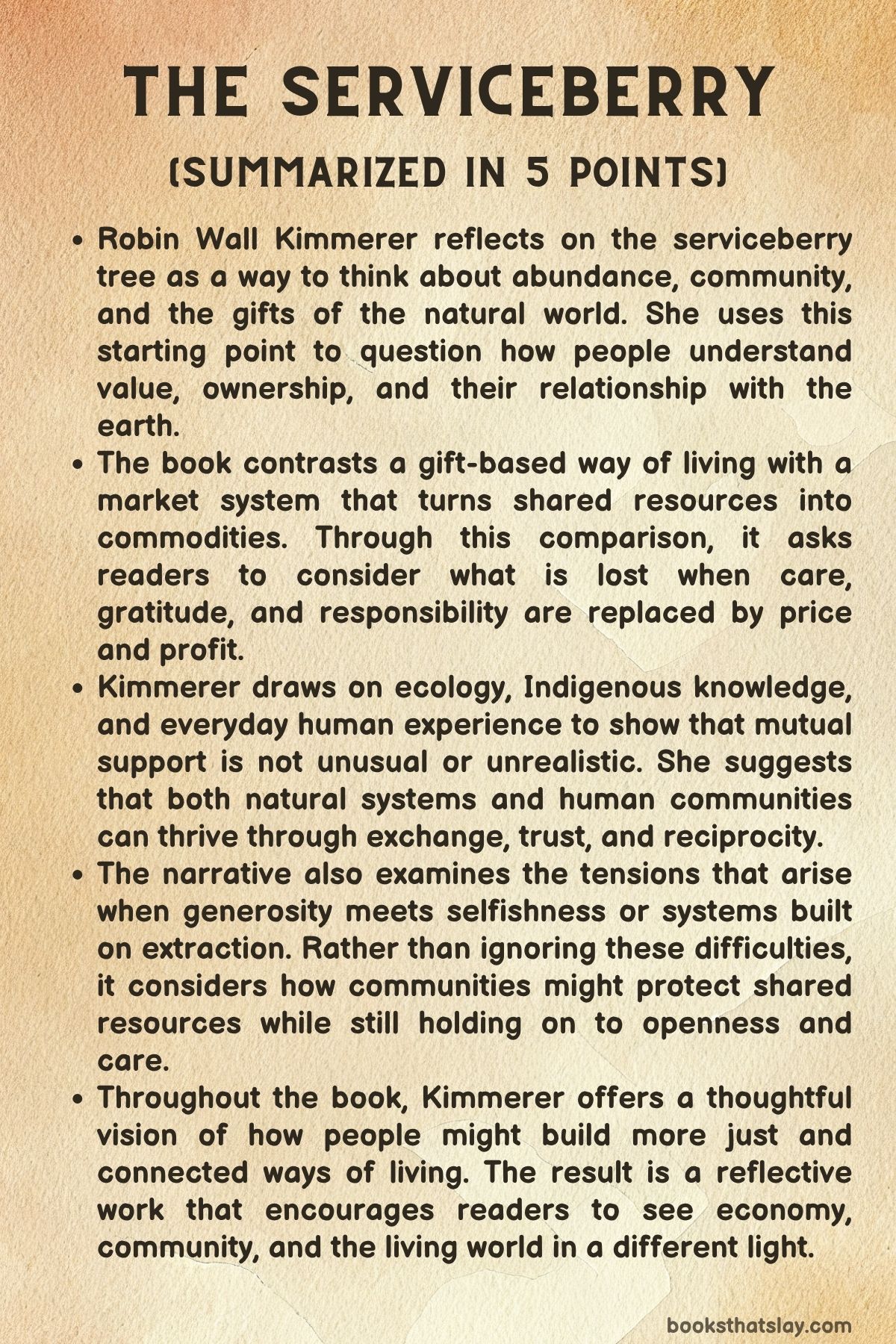
The Serviceberry: Abundance and Reciprocity in the Natural World is a short work of nonfiction in which Robin Wall Kimmerer uses the serviceberry tree to think about how people might live differently with one another and with the earth. Drawing on ecology, Indigenous knowledge, personal experience, and moral reflection, she argues that the natural world is shaped less by endless competition than by exchange, care, and shared flourishing.
The book questions the habits of a market culture that treats land, water, food, and even relationships as commodities. In its place, Kimmerer offers a vision of reciprocity, gratitude, responsibility, and community grounded in both observation and lived practice.
Summary
Robin Wall Kimmerer begins with the serviceberry itself, a modest tree whose fruit has long nourished humans, birds, insects, and mammals. She shows that this tree is never acting alone.
Its berries are made possible by sunlight, water, soil, pollinators, and the many living systems around it. In return, the fruit feeds others, and the seeds are carried outward so new trees can grow.
From the start, Kimmerer presents the serviceberry as more than a plant. It becomes a living example of a world organized through exchange, where life is sustained by circulation rather than by possession.
This opening idea leads her to an important claim: many of the earth’s offerings are gifts, not products. In Potawatomi thought, the language around the serviceberry connects berries and gifts, and Kimmerer treats that connection as a way of understanding the world.
A gift is not just an object handed from one person to another. It carries a relationship with it.
It creates obligations of gratitude, care, and future generosity. In this sense, the natural world is full of gifts that move through cycles.
Water, food, shelter, and beauty all pass through many hands and forms. Their value is not fixed in a price.
Their value lies in the lives and bonds they make possible.
Kimmerer then compares gifts with commodities. A commodity is bought and sold.
Once money changes hands, the relationship often ends. The seller and buyer owe little to each other beyond the transaction.
A gift works differently. It remains connected to giver and receiver, and it often asks the receiver to respond, not by paying back the original giver in a strict sense, but by joining a larger pattern of care.
This difference matters deeply to her. When something is treated as a gift, people are more likely to protect it, respect it, and use it with restraint.
When it is treated as a commodity, the main question becomes how much can be taken from it, sold, or owned.
To show the consequences of this difference, Kimmerer turns to examples from the natural world and from everyday life. A spring that offers clean water may be cherished and protected when people think of it as a gift.
But once water becomes a commercial asset, the logic changes. The goal becomes extraction, efficiency, and profit.
What had once inspired care may now invite overuse and damage. Kimmerer argues that modern economies often turn living relationships into market transactions, and in doing so they weaken the sense of mutual responsibility that healthy communities require.
From there, she broadens the discussion to economics itself. In many mainstream accounts, economics is defined by scarcity: limited resources, unlimited wants, competition, and individual gain.
Kimmerer challenges this framework by placing it beside Indigenous ways of thinking that center community well-being. In these traditions, wealth is not measured only by what one person stores or controls.
Prosperity depends on the flourishing of the whole community. To keep food in the belly of a neighbor can be a wiser form of security than hoarding it for oneself.
Shared abundance builds trust, and trust becomes a form of real wealth.
She emphasizes that such economies are not fantasies or relics. They have existed, and in many places they still exist in small and large ways.
She notes that colonial systems often worked to suppress them because gift-based exchange did not fit neatly into systems of taxation, property, and profit. That history matters because it helps explain why many people now see market logic as natural or inevitable.
Kimmerer insists that it is neither. It is a cultural construction, one that has been enforced, rewarded, and normalized over time.
At the same time, she pays close attention to ordinary acts of sharing that still survive within modern life. A neighbor with extra vegetables gives them away.
Communities gather and redistribute resources when disaster strikes. Students, activists, and online networks create informal systems where goods and help circulate without fixed prices.
These practices are often small, but for Kimmerer they reveal something basic about human nature. People are capable of pleasure in giving.
They often want to share when they feel secure, connected, and trusted. The problem is not that generosity is unnatural.
The problem is that many institutions train people away from it.
Kimmerer also explores how gift economies can appear in public forms. She points to libraries, especially small neighborhood book exchanges and larger public libraries, as examples of systems where resources are held in common for shared benefit.
These spaces are not outside all structure. They depend on norms, participation, and collective care.
Yet they show that nonmarket systems can live alongside market ones. They remind readers that not everything valuable has to be priced in order to be respected.
Still, she does not pretend that gift economies are free of risk. Shared resources can be abused.
She recounts the story of a farm stand where produce was made available in a spirit of trust, only for the entire stand to be emptied by someone who took everything. That act damaged the possibility of shared use for others.
Kimmerer faces this problem directly. She knows that selfishness, fear, and greed are real.
But she refuses to accept the conclusion that common goods must therefore always fail. Instead, she argues that the failure often comes from a culture that teaches people to think like takers.
The answer is not to abandon the commons. It is to rebuild the values and relationships that sustain it.
This is where the serviceberry returns as a model. Kimmerer discusses biomimicry, the practice of learning from nature’s systems.
The serviceberry tree flourishes through mutual benefit. It gives fruit; animals eat; seeds are spread; new growth follows.
Fungi, roots, soil, and surrounding species all participate in exchanges that support life. These systems are not based on ruthless competition alone.
They are full of cooperation, adaptation, and reciprocal support. Kimmerer offers this ecological pattern as a guide for human economies.
A healthy system does not depend on endless extraction. It depends on circulation, balance, and renewal.
Her critique of capitalism becomes sharper here. She argues that many modern systems do not simply respond to scarcity; they create it.
By enclosing common goods, concentrating wealth, and rewarding accumulation, they manufacture lack where there could be enough. In her account, this leads to spiritual and material damage alike.
People become separated from one another, from the land, and from any sense of enough. She links this condition to the Windigo, a figure from Potawatomi teaching that represents destructive hunger, the sickness of taking more and more without satisfaction.
This figure becomes a moral image for an economy driven by consumption without limits.
Even so, Kimmerer does not end in despair. She looks for practical ways forward.
Through the example of farmers who build relationships with their customers and neighbors, she shows how market activity can be reshaped by generosity and long-term thinking. A gift may not bring immediate financial return, but it can strengthen community, loyalty, and shared purpose.
Such efforts will not erase the market overnight, and Kimmerer does not claim they will. Her point is that different values can be planted within existing systems and slowly change them.
By the close of the book, Kimmerer turns toward invitation rather than argument alone. She asks readers to consider what they receive from the earth and what they might offer in return.
That return need not be identical to what was taken. It may be care, political action, teaching, art, stewardship, or help given to another person.
The important thing is to enter the circle of reciprocity consciously. In that choice, Kimmerer sees the beginning of another kind of economy, one rooted in gratitude, justice, and the belief that shared abundance is possible.
Key People
Robin Wall Kimmerer
Robin Wall Kimmerer stands at the center of the book not as a distant narrator, but as a thinker, observer, teacher, and moral witness. Her presence gives the work its shape because every idea passes through her lived experience, her scientific training, and her Indigenous worldview.
She does not present herself as someone standing outside the systems she critiques. Instead, she admits that she too lives within a market culture shaped by extraction and commodification.
This honesty makes her voice persuasive. She is not speaking from purity or superiority, but from self-awareness and responsibility.
Her character is defined by the effort to imagine a better way of living while still acknowledging how difficult such change can be.
Her role is especially important because she unites forms of knowledge that are often kept apart. She pays close attention to ecology, naming the actual processes by which plants, animals, fungi, water, and soil sustain one another.
At the same time, she treats these processes as carrying ethical meaning. For her, nature is not only something to be measured.
It is also something to learn from. This makes her character both intellectual and relational.
She studies the world, but she also listens to it. She reflects on material systems, but she never separates them from gratitude, care, or obligation.
That combination allows her to challenge economic thinking at its roots. She asks readers not only what works efficiently, but what kind of person an economy teaches them to become.
Kimmerer is also marked by generosity of imagination. She does not reduce people into heroes and villains in a simple way, even when she is sharply critical of greed and private accumulation.
She remains interested in the possibility of moral change. She believes that people are capable of reciprocity, trust, and communal responsibility, and that this capacity has not disappeared even under capitalism.
This hopefulness is not naive. It is disciplined, practical, and grounded in observation.
Her character gives the book its emotional force because she writes with conviction while refusing cynicism. In The Serviceberry, she becomes the clearest example of what the work asks of the reader: attention, humility, gratitude, and the willingness to act differently.
The Serviceberry
The serviceberry functions as far more than a plant. It is the book’s central symbolic character, a living model of the values Kimmerer wants readers to notice and recover.
The tree matters because it embodies an economy of circulation. It receives sunlight, water, minerals, and pollination, then gives fruit that nourishes birds, animals, and people.
In turn, the seeds are spread and life continues. The serviceberry therefore represents abundance as relationship rather than stockpiling.
Its existence depends on exchange, and its fruit becomes a visible sign that giving is not loss. In ecological terms, the tree survives by participating in a larger system.
In moral terms, it shows a way of understanding wealth that is based on shared flourishing.
What makes the serviceberry such a rich symbolic presence is its quietness. It is not grand, rare, or spectacular in the conventional literary sense.
It is ordinary, seasonal, and rooted in place. That ordinariness is part of its meaning.
Kimmerer uses it to suggest that the most important truths about economy and ethics may already be present in common forms of life that people ignore. The tree carries nourishment, medicine, memory, and seasonal knowledge.
It feeds more than one species, and it is useful without asking for domination or ownership. In this way, the serviceberry stands against the market habit of measuring value only through sale and scarcity.
It is valuable because it sustains a world of relationships.
The serviceberry also acts as a corrective to human arrogance. It becomes a teacher without speaking, instructing through pattern rather than command.
Its presence reminds readers that humans did not invent reciprocity. They belong to a world where mutual dependence has always existed.
By making the serviceberry such a central figure, Kimmerer displaces human self-importance and asks readers to see economic life from an ecological perspective. The plant becomes a moral standard.
It does not shame human beings, but it exposes how far many modern systems have moved from balance, enoughness, and care. As a character, the serviceberry is gentle, sustaining, and instructive, yet it also carries quiet judgment through the contrast it creates with extractive culture.
Sandy
Sandy appears briefly, yet she is one of the most revealing human figures in the work because she shows how gift economies survive through ordinary conduct. As a neighbor who grows vegetables and shares her excess produce, she represents abundance translated into everyday life.
Her actions are not dramatic. She does not found a movement or offer a formal theory.
Instead, she gives from gladness, and that gladness matters. Kimmerer presents her as someone who experiences sharing not as sacrifice, but as pleasure and social connection.
Sandy’s character demonstrates that generosity often begins in the local and familiar. A neighborhood can become a site of redistribution, trust, and mutual care when someone chooses to act as though resources are meant to circulate.
Sandy’s importance lies in how normal she is. She is not idealized as a saintly figure beyond ordinary life.
She is a person embedded in the rhythms of home, garden, season, and neighborly exchange. Because of that, she gives the book practical credibility.
She shows that the values Kimmerer describes are not only philosophical or historical. They are still available in small acts of giving that create durable social meaning.
Her produce is not just food. Once shared, it becomes an affirmation that one person’s abundance can strengthen communal life rather than personal status.
That is why her character carries more force than her limited page space might suggest.
Sandy also helps define the emotional logic of reciprocity. Her giving does not demand an exact return, and that is precisely what makes it powerful.
The exchange remains open, relational, and human. Someone may answer with gratitude, with another gift, or with care offered elsewhere.
Through her, Kimmerer shows that a gift economy depends on spirit as much as structure. Institutions matter, but so do habits of feeling.
Sandy gives because she finds joy in sharing, and that joy resists the coldness of purely transactional life. She becomes an example of how ethical economies begin in character: with trust, pleasure in others’ well-being, and the refusal to treat surplus as private entitlement.
Kimmerer’s Daughter
Kimmerer’s daughter plays an important role through the story of the farm stand, and she represents the vulnerability and possibility involved in trying to create systems of trust. Her work with the produce stand shows a practical attempt to make food available in a spirit of common use rather than strict sale.
This is important because it moves the book from theory into experiment. The daughter’s effort illustrates what happens when someone tries to build a local structure guided by openness and reciprocity.
She is associated with initiative, labor, and belief in communal fairness. Through her, readers see that alternative economies require people willing to risk disappointment in order to make another form of social life possible.
Her significance also lies in the fact that the stand is violated. When someone takes everything, the damage is not only material.
The theft wounds trust. It attacks the idea that people can share resources without exploitation.
Because the stand is connected to Kimmerer’s daughter, the event gains emotional weight. It is not an abstract case study.
It affects a person who tried to sustain a communal resource and saw that effort undermined. This gives her character a quiet moral importance.
She becomes linked to the fragility of gift-based systems in a culture shaped by extraction. Her presence shows that generosity is not sentimental.
It is exposed to harm, and those who practice it often bear the cost of others’ selfishness.
At the same time, she is not presented as foolish for having trusted. The point of her character is not that openness is naive, but that social values determine whether openness can survive.
Her experience sharpens Kimmerer’s argument that the problem lies not in common goods themselves, but in the habits encouraged by a commodity-centered society. The daughter therefore represents both hope and injury.
She is part of the book’s vision of change, yet her experience reminds readers that real alternatives demand cultural transformation, not just isolated good intentions. Her role helps the work maintain moral seriousness because it refuses to hide the risks of generosity.
Darren
Darren is one of the most striking figures in the book because he is less an individual than a type. Kimmerer invents him as a representative name for the person who takes without reciprocity, and she links him to the CEO of ExxonMobil to connect small acts of taking with large systems of corporate extraction.
This makes Darren symbolically powerful. He is not merely the person who emptied a farm stand.
He stands for the mindset that sees available goods as things to seize, own, convert, and consume. His character is shaped by appetite without restraint and by a failure to recognize relationship.
Where the serviceberry represents circulation and mutual benefit, Darren represents interruption, enclosure, and one-way gain.
What makes Darren effective as a character is that Kimmerer does not cast him as a monster wholly outside society. She points out that systems are made of individuals.
This matters because it prevents readers from blaming abstraction alone. Capitalism is not only a structure floating above daily life; it is enacted by choices, habits, rationalizations, and values held by real people.
Darren becomes the face of those choices. He reflects what happens when the idea of enough disappears and every shared resource becomes an opportunity for capture.
His importance lies in how ordinary that mentality can become. He is troubling not because he is uniquely evil, but because he is culturally recognizable.
Darren also carries allegorical weight through his connection to the Windigo image. He represents hunger that cannot end because it is detached from gratitude and community.
In this sense, his character is spiritually empty. He takes, but he does not belong.
He extracts, but he does not reciprocate. This makes him the clearest embodiment of the moral disorder Kimmerer is trying to name.
Yet even here, the analysis is not simplistic. Darren is a warning about what an economy can produce in people when accumulation is praised and mutual obligation is dismissed.
He is less important as a psychological portrait than as an ethical diagnosis. Through him, The Serviceberry gives extractive culture a human face.
Paulie and Ed
Paulie and Ed serve as examples of how economic life can be reshaped from within existing social structures. As farmers, they are not positioned outside commerce, yet Kimmerer presents them as people who understand that a successful livelihood depends on more than selling goods.
They invest in community. They build relationships.
They recognize that giving berries or building goodwill may not produce an immediate payment, but it creates forms of trust and solidarity that matter over time. Their character is grounded in patience and practical wisdom.
They see that an economy can be strengthened by reciprocity rather than weakened by it.
What makes Paulie and Ed especially important is that they are not romantic figures detached from labor, survival, or business pressures. They work within material realities.
Because of that, they help Kimmerer avoid presenting reciprocity as something possible only in small private circles untouched by the market. These men show that values of gift and relationship can exist alongside selling, farming, and public exchange.
Their example suggests that transformation may come not only through rejection of the market, but through the steady insertion of other values into economic life. Community, for them, is not decoration.
It is infrastructure.
They also stand for the long view. A market transaction often seeks instant equivalence: product, price, payment, completion.
Paulie and Ed accept a more open logic. A gift today may return later in forms that cannot be fully predicted.
Someone may come back to buy produce, support local farmers politically, or strengthen communal bonds in another way. This does not make them calculating in the narrow sense.
Rather, it shows that they understand human life as relational and cumulative. Their character reflects maturity, steadiness, and civic imagination.
They are among the clearest signs that Kimmerer’s argument is not only critical but constructive. Through them, The Serviceberry imagines how another economic ethic might actually be practiced.
Themes
Gift Economy and the Ethics of Reciprocity
Exchange in this book is not treated as a neutral act. It becomes the ground on which moral life is built or distorted.
Kimmerer’s central concern is the difference between taking something as a commodity and receiving it as a gift. That distinction shapes how people understand their obligations to land, water, food, and one another.
A commodity can be detached from relationship. It can be priced, owned, and consumed without gratitude.
A gift creates a lasting bond. It asks the receiver to recognize dependence, to care for the source, and to continue the movement of generosity.
This is why reciprocity becomes the governing ethical principle of the work. It is not a sentimental ideal but a practical condition for sustaining life.
Kimmerer develops this theme by showing that reciprocity is already the rule in ecological systems. Plants, fungi, pollinators, animals, water, and soil exist within patterns of exchange.
No being is fully self-made, and no life form stands apart from the wider world that supports it. Human beings, however, often pretend otherwise.
Modern economic culture encourages the fantasy of autonomy, possession, and deserved entitlement. Kimmerer counters that fantasy by grounding value in relationality.
To receive food from the earth and offer nothing back is not simply rude. It is a form of imbalance that weakens the system on which life depends.
Reciprocity therefore becomes a mode of justice. It restores proportion between what is taken and what is returned.
An important strength of this theme is that Kimmerer expands the idea of return beyond direct payment. A gift from the earth cannot always be repaid to the exact source in material form.
Return may instead mean stewardship, political action, teaching, community work, art, gratitude, restraint, or care extended to others. This makes reciprocity both flexible and demanding.
It cannot be reduced to a fixed formula, yet it insists that receiving carries responsibility. The theme also changes the meaning of wealth.
Wealth is no longer what one isolates and accumulates, but what circulates in life-giving ways. Abundance becomes visible not in private stockpiles but in the health of relationships.
Through this argument, The Serviceberry offers a vision of economy rooted in moral maturity, where the good life depends on participation in a larger circle of giving and receiving.
Critique of Commodification and Extractive Capitalism
At the heart of the book is a sustained challenge to the habits of mind that turn living systems into marketable objects. Kimmerer is concerned not only with capitalism as a formal economic system, but with commodification as a way of seeing.
Once something is defined primarily by its sale value, its meaning narrows. Water becomes a resource to package.
Land becomes a unit of property. Food becomes inventory.
Even care and relationship can be shaped by transactional logic. Kimmerer argues that this way of seeing damages both ecosystems and human character because it encourages detachment from source, from consequence, and from communal obligation.
Her critique is powerful because it refuses the comforting claim that scarcity is always natural. The book shows how scarcity is often manufactured through enclosure, hoarding, and private accumulation.
What could circulate is withheld. What could nourish many is converted into advantage for a few.
In this system, taking more than one needs can appear rational, even admirable, because profit and possession are treated as proof of intelligence or success. Kimmerer exposes the violence hidden inside that norm.
Extraction is not merely efficient use. It is often the draining of shared life into private control.
By making this visible, she changes the emotional and moral meaning of familiar economic practices.
The image of Darren is crucial here because it personalizes the system without simplifying it. Greed is not presented as a flaw of one villainous person alone.
It is shown as a cultural pattern reproduced from the local farm stand to the highest corporate level. This creates continuity between everyday acts of selfish taking and global structures of environmental destruction.
Kimmerer’s use of the Windigo idea deepens the critique by giving it spiritual dimension. Extractive capitalism appears as a hunger that cannot be satisfied because it has lost all sense of enough.
Its crisis is therefore moral as much as material. It consumes the conditions of life while promising endless growth.
What makes this theme especially forceful is that Kimmerer does not merely condemn. She diagnoses the emotional emptiness behind commodification.
A world reduced to objects for use becomes a world stripped of gratitude, wonder, restraint, and responsibility. The critique therefore reaches beyond economics into questions of human formation.
What sort of self is produced when value means price? What happens to democracy, neighborliness, and ecological balance when the dominant lesson is to maximize private gain?
The book answers by showing a culture at risk of severing the very relationships that sustain it. In that sense, the attack on commodification is also a defense of life’s deeper forms of meaning.
Community, Trust, and the Practice of Shared Abundance
The book insists that abundance is not simply a matter of material plenty. It is also a social condition made possible by trust.
Food, water, labor, and care can circulate in nourishing ways only when people believe that others matter and that shared life is worth protecting. Kimmerer returns again and again to examples of neighbors, small public exchanges, farms, and libraries because these are places where trust becomes visible.
A person gives extra produce away. Books are left in a common box.
Farmers build relationships that exceed the sale itself. These moments show community as an active practice rather than a vague ideal.
It must be built, maintained, and renewed through habits of generosity.
Trust in the book is never treated as easy. Kimmerer is fully aware that common resources can be abused.
The farm stand story is essential because it reveals how quickly a communal arrangement can be damaged when one person decides to take everything. Yet the work refuses to draw the cynical conclusion that trust is therefore foolish.
Instead, it asks what kind of society trains people to break trust in the first place. This is a crucial shift.
The failure of a common resource is not interpreted as proof that sharing is impossible. It is interpreted as evidence that cultural values matter.
If people are raised to think in terms of extraction and entitlement, then shared systems become fragile. If they are formed by reciprocity and gratitude, common goods become durable.
This theme gives the book much of its practical energy because it moves from ecological principle to civic life. Community is presented as the place where abstract values are tested.
It is one thing to praise reciprocity in theory. It is another to share food, maintain public goods, care for a watershed, or act politically for the sake of collective well-being.
Kimmerer makes clear that community requires effort before crisis arrives. People cannot wait for disaster to discover mutual dependence.
They must practice it in ordinary times so that the social fabric is strong enough to hold under pressure.
Shared abundance also reshapes the meaning of security. In an individualistic framework, security comes from ownership and personal reserves.
In Kimmerer’s framework, security is found in reliable relationships. To know that one lives among people who share, care, and respond is to possess another form of wealth.
This does not eliminate the need for material resources, but it changes the basis on which survival is imagined. The isolated self appears less stable than the connected community.
By foregrounding this idea, The Serviceberry presents trust not as a soft virtue, but as a serious social resource without which no humane economy can endure.
Learning from the Natural World as a Model for Human Renewal
Nature in this book is not scenery, background, or moral decoration. It is a teacher.
Kimmerer’s ecological thinking gives the work its deepest structure because she argues that human societies can study natural systems for guidance about balance, circulation, and mutual support. The serviceberry tree becomes the clearest example of this.
It thrives by receiving and giving within a web of relations. Its fruit feeds others, and those others help continue the life of the tree.
This is not charity in the human sense, nor is it market exchange. It is a living pattern of mutual benefit.
Kimmerer treats this as a model worth studying because it reveals that thriving does not require domination.
This theme matters because it challenges a long-standing cultural habit of separating humanity from the rest of life. Modern industrial thinking often assumes that nature is raw material and that human intelligence stands above ecological order.
Kimmerer rejects that hierarchy. She suggests that humans are late learners in an already sophisticated world of exchange.
Forests, watersheds, and plant communities have developed ways of sustaining complexity without relying on endless accumulation. To attend to those systems is to recover humility.
Human beings are not inventors of reciprocity but participants in it. This shift in perspective has major consequences.
It means economic life should be judged not only by profit or output, but by whether it resembles living systems in resilience, regeneration, and fairness.
The idea of biomimicry is central here, yet Kimmerer uses it in a richer sense than technical design alone. She is not merely proposing that people copy efficient natural structures.
She is asking for ethical imitation. Human economies should resemble ecological systems in their capacity to circulate nourishment, limit waste, support diversity, and create conditions for renewal.
This makes the natural world a source of both practical and moral instruction. It is not a perfect utopia, and Kimmerer does not erase real scarcity such as drought or loss.
But she distinguishes these realities from artificial scarcity generated by hoarding and extraction. Nature shows that limits exist, yet life can still be organized through reciprocity rather than greed.
This theme finally becomes a call for human transformation. Kimmerer suggests that colonizing societies must undergo changes as substantial as those seen in evolving plant communities.
Old systems do not last forever. They can be replaced by new arrangements more suited to survival and justice.
That idea gives the book its closing force. Nature does not merely offer comfort.
It offers standards, warnings, and possibilities. By treating ecological life as a source of instruction, the work imagines renewal as something grounded in the real world rather than in abstract theory.
Human beings are asked to become students again, to observe more carefully, and to build societies that reflect the reciprocity already visible all around them.