The Shadow Friends Summary, Characters and Themes
The Shadow Friends by Tess Gerritsen is an espionage thriller about retired intelligence officers who discover that the dangers of their former careers have followed them into a quiet Maine community.
The story connects an unresolved CIA disaster in Provence with a modern assassination campaign involving Russian defectors, radioactive poison, stolen identities, and professional killers. At its center is Ingrid, a former operative forced to confront the guilt and unfinished business she has carried for nearly three decades. Around her, old colleagues, family, local police, and former enemies are drawn into a conflict that tests loyalty, marriage, friendship, and the possibility of truly leaving the intelligence world behind. It’s the 3rd book of the Martini club series.
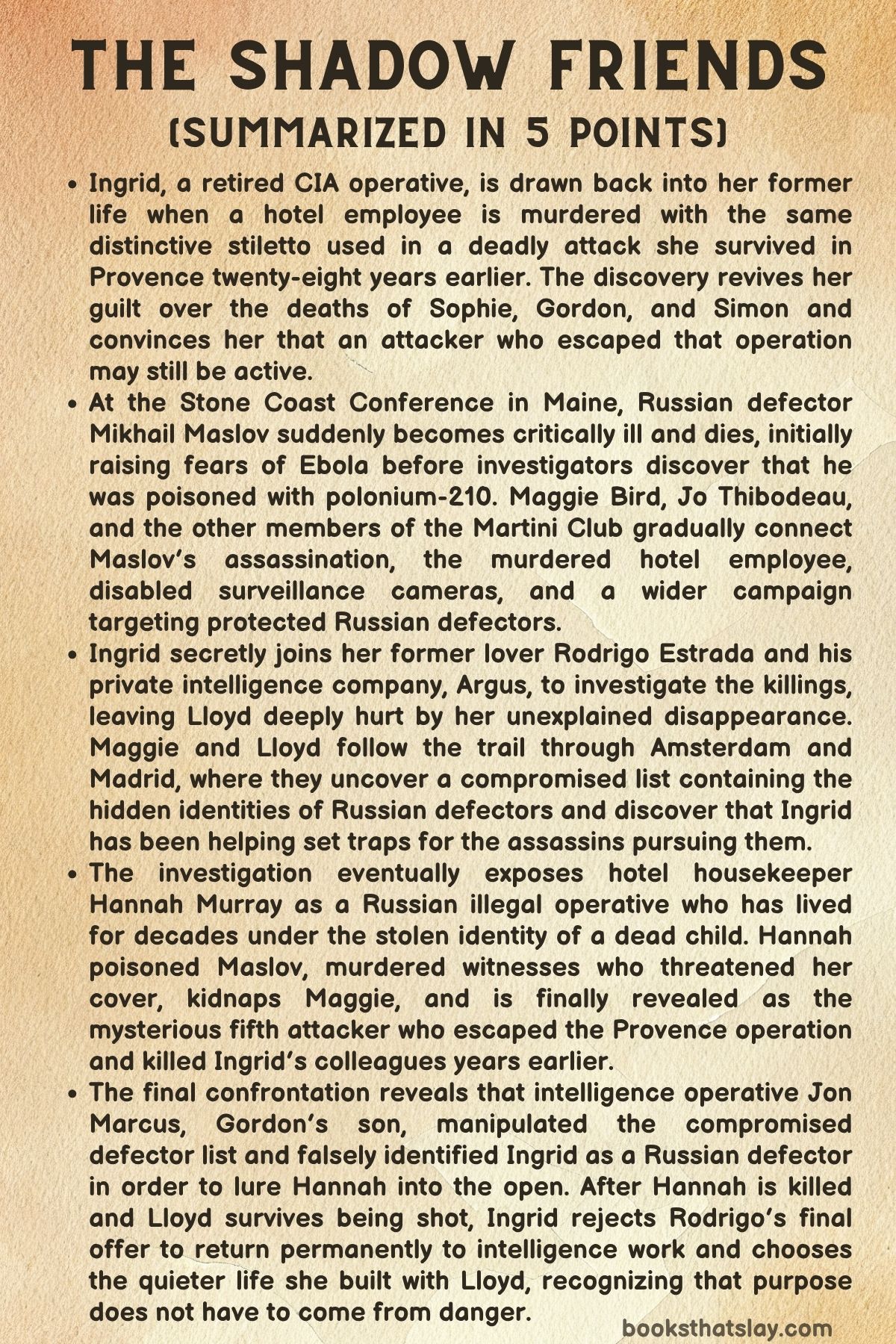
Summary
Twenty-eight years before the main events, CIA operative Ingrid is assigned to protect Sophie Benoit, a young informant who has gathered dangerous evidence against a Russian criminal organization. Their safe house in Provence is attacked after communication with the guards outside suddenly disappears, and Ingrid sees what she believes are five people arriving in an SUV.
The assault becomes catastrophic. Sophie is fatally shot, guards Gordon and Simon are murdered, and Gordon is found with a distinctive stiletto driven through his eye, its handle marked with a circle-and-dot symbol. Although four attackers are accounted for, Ingrid remains convinced that a fifth person escaped.
The tragedy changes Ingrid’s priorities. She decides that surviving dangerous assignments is no longer enough and leaves behind both fieldwork and her passionate relationship with fellow operative Rodrigo Estrada. Instead, she chooses Lloyd, an intelligence analyst who offers stability, devotion, and the possibility of a life outside constant danger.
Decades later, Ingrid and Lloyd are retired in Purity, Maine. Ingrid helps organize the Stone Coast Conference, an event bringing intelligence specialists and national-security experts together at the Cod Cove Resort. Her old CIA friends Maggie Bird, Declan Rose, and Ben Diamond are also present, forming the close-knit group known locally as the Martini Club.
The conference focuses partly on biological warfare. Virologist Cornell Stamoran speaks about the danger of deliberate smallpox release, while Russian defector Dr. Mikhail Maslov is scheduled to discuss his knowledge of Soviet bioweapons programs. At the same time, Rodrigo unexpectedly appears after nearly three decades, unsettling both Ingrid and Lloyd.
Rodrigo now runs Argus, a private intelligence company with worldwide operations. He tries to recruit Ingrid, arguing that retirement wastes her abilities, and his offer reminds her of the sense of purpose she once found in fieldwork. Although she refuses, the meeting reopens memories of their relationship and of the unresolved deaths in Provence.
The conference soon becomes the center of two disturbing incidents. Maslov is found critically ill in his hotel room, apparently suffering from symptoms associated with Ebola after having recently worked around an outbreak in Uganda. Maggie attempts to save him and is exposed to his bodily fluids, forcing doctors to place her in isolation while they determine whether she has been infected.
At almost the same time, resort employee Karen O’Brien disappears. Police chief Jo Thibodeau and Ingrid discover Karen’s body inside the trunk of her car. She has been killed with a stiletto driven through her left eye in exactly the manner used to murder Gordon years earlier.
The weapon immediately convinces Ingrid that the past has returned. Rodrigo’s private intelligence resources reveal that similar killings have occurred internationally, often involving people considered enemies of Moscow. The method appears connected to Russian criminal contractors used for assassinations that governments can deny ordering.
Karen seems unlikely to have been an intended geopolitical target. The more probable explanation is that she encountered someone conducting a different operation and was killed because she saw something she should not have seen.
Maslov’s illness also proves more complicated than expected. Specialists eventually discover evidence consistent with acute radiation poisoning rather than Ebola. The suspected substance is polonium-210, a rare and highly dangerous radioactive material associated with sophisticated assassination operations.
Maslov dies, making his presence at the conference even more significant. Karen had been working near his part of the hotel shortly before her death, strengthening the suspicion that she witnessed some aspect of his poisoning.
Then Ingrid disappears.
Her abandoned car is located at a municipal airport, and surveillance footage indicates that she voluntarily boarded a private aircraft. Lloyd is devastated, especially when evidence suggests that the plane is connected to Rodrigo’s company. Because Ingrid has revealed little about her actions, even her closest friends cannot immediately determine whether she has left on an intelligence mission or rekindled her relationship with Rodrigo.
Maggie receives an encrypted message from Ingrid asking her to protect Lloyd. Lloyd then discovers a deleted photograph on Ingrid’s computer showing a mysterious man in Amsterdam. Determined to find his wife, he travels there with Maggie.
The man in the photograph is eventually identified as Willem Dekker, but this identity is false. After Maggie and Lloyd are kidnapped by Russian criminals and rescued by an intelligence team, they learn that Dekker is actually Dmitry Surikov, a former Russian illegal operative who defected to the West and has lived under a protected identity for years.
The discovery exposes a wider crisis. Someone with access to highly classified information is leaking the identities and locations of relocated Russian defectors. Several people on a secret assassination list have already been killed, and another surviving target is living in Madrid under the identity Beatriz Guerrero.
Maggie and Lloyd travel to Madrid, believing Ingrid may have followed the same trail. There they see what appears to be an attempted kidnapping and rush to intervene, only to discover that the supposed Beatriz is Ingrid wearing an elaborate disguise.
The real Beatriz has already been moved to safety. Ingrid and Rodrigo have been using the false appearance of vulnerability to attract the Russian contractors sent to assassinate defectors.
The reunion between Ingrid and Lloyd is emotionally painful. Ingrid explains that the stiletto murder in Maine convinced her that the person who escaped Provence might still be active. She accepted Rodrigo’s help because she wanted justice for Sophie, Gordon, and Simon, but she also admits that returning to intelligence work made her feel useful and alive in a way retirement sometimes did not.
Lloyd recognizes that Ingrid’s motives were not romantic, but he remains hurt that she excluded him completely. Their conflict becomes about more than Rodrigo: it concerns whether marriage can survive when one partner believes secrecy and protection justify denying the other any role in important decisions.
After Ingrid decides to return home, the danger unexpectedly follows her. The assassination list is altered to include the name Lilia Kuraskaya, supposedly another Russian defector, but the photograph and location attached to the name belong to Ingrid.
The real Lilia is later discovered to have died in California. Someone has deliberately inserted Ingrid into the system used to expose genuine defectors, making her bait for another assassin.
The Martini Club prepares a trap at Ingrid and Lloyd’s house, expecting a Russian operative to arrive. Instead, they capture FBI Special Agent Tanner Minnihan, who has independently been investigating the suspicious activity surrounding Ingrid, Maslov, and the conference.
Meanwhile, Jo begins reconsidering one person who has escaped serious scrutiny: Hannah Murray, a quiet hotel housekeeper. Hannah had access to Maslov’s room, knew Karen, and left the resort soon after the murders.
A search of Hannah’s former Massachusetts residence reveals sophisticated communications equipment, weapons, and a collection of stilettos identical to those used in the murders. Investigators then discover that the real Hannah Murray died as an infant. The woman using her name has been living for decades under the stolen identity of a dead child.
Hannah is a Russian illegal operative whose greatest protection has been her apparent ordinariness. As a housekeeper, she has repeatedly gained invisible access to private rooms, personal belongings, and sensitive guests without attracting attention.
Investigators reconstruct the murders. Hannah likely contaminated something in Maslov’s room with polonium and later returned as part of the cleaning staff to remove evidence. Karen probably saw Hannah somewhere she was not supposed to be and was killed to eliminate a witness.
Hannah then abducts Maggie. She has also murdered Andrei Petrov, another resort employee who accidentally saw Cyrillic writing on her phone and realized she might have Russian connections. Hannah admits that she cared about Andrei but killed him because operational security mattered more than affection.
Maggie is kept alive as leverage. Hannah sends Ingrid a photograph of her battered face with location data pointing toward a remote cottage, intending to draw rescuers away from Blackberry Farm, where Ingrid is hiding.
The deception succeeds. A tactical team reaches the cottage and frees Maggie, but Hannah is not there. She has secretly entered Blackberry Farm.
As Hannah confronts Ingrid, the truth about Provence finally becomes clear. Ingrid had been correct that there was a fifth attacker, but she had made one mistaken assumption: the fifth person was not a man.
It was Hannah.
Hannah had been the young woman who killed Gordon and Simon before escaping while the other attackers occupied Ingrid’s attention. Nearly three decades later, the mystery that has haunted Ingrid is standing directly in front of her.
Hannah also reveals that she knows Ingrid is not Lilia Kuraskaya. Both women now realize that an unknown person has manipulated intelligence channels, using Ingrid as bait and sending Russian assassination teams into prepared traps.
Lloyd rushes in to protect Ingrid and is shot, although body armor saves his life. A sniper then wounds Hannah. Intelligence operative Jon Marcus arrives, but rather than preserve Hannah for questioning, he executes her.
The final explanation reveals that Marcus is Gordon’s son. He was a child when his father was murdered in Provence and grew up carrying the consequences of that loss. Years later, he entered the intelligence world and gained the means to pursue those responsible.
Marcus was involved in manipulating the leaked-defector system. Intelligence officials already knew protected identities were being passed to Moscow, so false information was inserted into the compromised channel to attract and eliminate Russian assassination teams. Ingrid was deliberately assigned Lilia’s identity because Marcus hoped the operation would eventually draw out his father’s killer.
His plan succeeds, but only by placing Ingrid, Lloyd, Maggie, and others in mortal danger. Ingrid is furious to discover that she was treated as a disposable instrument in someone else’s private pursuit of justice, even though her own decision to pursue Hannah had similarly endangered people she loved.
After Lloyd recovers, Rodrigo makes Ingrid one final offer to join Argus for another operation. She remains tempted by the challenge and by the knowledge that she is still capable of doing the work that once defined her.
Yet she now understands the cost more clearly. Lloyd nearly died because she returned to the field without considering how completely danger would spread beyond herself.
Ingrid says goodbye to Rodrigo and returns home. Lloyd is waiting with the familiar comforts of their life together, and Ingrid finally chooses those ordinary pleasures without viewing them as lesser alternatives to adventure. Instead of looking back toward danger, she accepts that meaning can exist in the life she has already built.
Characters
Ingrid
Ingrid is the emotional and narrative center of The Shadow Friends, defined by the conflict between the dangerous identity she developed as a CIA operative and the domestic life she consciously chose afterward. Her decision to leave fieldwork after the Provence disaster is not an act of fear but an attempt to build a future after witnessing how easily intelligence work destroys both operatives and innocent people around them.
Her deepest unresolved burden is the death of Sophie, Gordon, and Simon. Ingrid never fully accepts the explanation that confusion caused her memory of a fifth attacker, and Karen’s murder gives physical form to a suspicion she has carried for twenty-eight years.
That unresolved guilt also makes Ingrid vulnerable to Rodrigo’s offer. She tells herself she is pursuing justice, and that motive is genuine, but the mission also restores a sense of competence, excitement, and usefulness that retirement no longer provides.
Her treatment of Lloyd exposes one of her greatest flaws. Ingrid loves him deeply, yet she repeatedly assumes that protecting him means making decisions without him, failing to recognize that secrecy can become its own form of betrayal even when romantic infidelity is absent.
By the end, Ingrid learns that choosing Lloyd does not require denying who she once was. Her growth lies in understanding that capability and courage do not obligate her to keep returning to danger, particularly when those choices expose the people she loves to consequences they never agreed to face.
Maggie Bird
Maggie is one of the strongest stabilizing figures in The Shadow Friends, combining professional instincts with an increasingly personal awareness of what friendship and romantic attachment cost. Even after retirement, she remains quick to detect suspicious patterns, as demonstrated when she connects Karen’s murder, Maslov’s illness, and the disabled surveillance system while still confined in hospital isolation.
She repeatedly acts for other people before herself. She risks exposure while trying to save Maslov, postpones personal plans when Lloyd appears lonely, accompanies him to Amsterdam despite knowing how dangerous the trip may become, and later becomes the person Ingrid trusts to protect him.
Maggie’s relationship with Declan introduces a quieter conflict. Intelligence work taught her to manage danger through training and emotional control, but loving Declan means accepting that another person can now be used against her emotionally.
Her kidnapping by Hannah makes that truth unavoidable. Maggie survives not because she remains detached but because she has people urgently trying to find her, and her eventual acceptance of Declan’s fear shows that vulnerability is not necessarily weakness.
Lloyd
Lloyd’s journey in The Shadow Friends transforms him from the apparently safer partner in Ingrid’s life into someone determined to share risks she has always kept separate from him. As an intelligence analyst, he spent his career supporting dangerous operations from a distance, which initially allows Ingrid to assume that he neither understands nor belongs in her old world.
His insecurity regarding Rodrigo is therefore understandable. Rodrigo represents not simply a former lover but an entire part of Ingrid’s identity that Lloyd cannot reproduce, and Ingrid’s unexplained disappearance seems to confirm his fear that a quiet marriage may no longer be enough for her.
Traveling to Amsterdam and Madrid changes his role. Although his lack of field experience nearly gets him and Maggie killed, he refuses to remain a passive husband whose protection depends upon ignorance.
Lloyd eventually recognizes that Ingrid’s bond with Rodrigo is not primarily the threat to their marriage. The deeper problem is her habit of deciding what Lloyd can handle and excluding him from choices whose consequences directly affect his life.
His willingness to confront Hannah completes that development. He cannot become Ingrid or Rodrigo, nor does he need to, but he establishes that love gives him the right to stand beside Ingrid rather than remain protected at a distance.
Rodrigo Estrada
Rodrigo embodies the life Ingrid might have lived had she never abandoned intelligence work. Charismatic, capable, restless, and comfortable with moral ambiguity, he represents a world in which operational success often matters more than institutional rules.
His creation of Argus shows how fully he has embraced private intelligence. Rodrigo has converted the skills and contacts of government service into a business that can operate across borders with freedoms official agencies may not possess.
His interest in Ingrid is both professional and personal. He genuinely believes her talents are being wasted, but he also continues to feel the attraction that once linked them.
Rodrigo is not presented simply as a romantic rival. In many ways, he understands Ingrid’s appetite for danger more naturally than Lloyd does, yet he cannot offer the emotional security that caused her to choose Lloyd decades earlier.
His willingness to accept covert manipulation also distinguishes him from Lloyd. Rodrigo instinctively thinks in terms of targets, traps, sources, and operational advantages, while Lloyd repeatedly asks what those calculations do to individual human beings.
Hannah Murray
Hannah is the concealed threat at the center of The Shadow Friends, and her effectiveness depends almost entirely on being ignored. She does not behave like a theatrical assassin; she becomes a middle-aged housekeeper whose work requires her to enter private spaces while remaining socially invisible.
Her stolen identity demonstrates extraordinary patience. She has spent decades maintaining an ordinary American existence under the name of a child who died in infancy, allowing the false identity to mature until it appears completely legitimate.
Her relationship with Andrei complicates her portrayal. Hannah genuinely seems to care for him, yet when he discovers evidence that threatens her cover, she murders him despite that affection.
This reveals the principle governing her entire life: personal feeling is permitted only until it conflicts with the mission. Karen, Maslov, Andrei, and eventually Maggie are all evaluated according to operational usefulness rather than ordinary morality.
The revelation that Hannah was the fifth attacker in Provence gives her an especially powerful connection to Ingrid. She is not merely a new enemy but the living embodiment of Ingrid’s oldest unresolved trauma, proving that the memory Ingrid doubted for decades was fundamentally correct.
Jo Thibodeau
Jo provides the perspective of conventional law enforcement inside The Shadow Friends, repeatedly finding herself surrounded by former intelligence professionals who believe secrecy and necessity justify ignoring ordinary procedures. Her frustration with the Martini Club is justified because they constantly possess relevant information while deciding for themselves what she deserves to know.
At the same time, Jo gradually develops respect for their instincts. She recognizes that Karen’s murder does not resemble an ordinary homicide and eventually understands that the case extends into international intelligence networks far beyond the usual responsibilities of a small-town police chief.
Her most important quality is independence of judgment. When federal investigators focus heavily on Andrei, Jo remains willing to examine weaknesses in their theory rather than accepting suspicion based on nationality, travel history, and circumstance.
That same independence leads her toward Hannah. Because Jo notices who has been overlooked, she becomes essential to exposing the operative who has successfully hidden behind social invisibility.
Declan Rose
Declan initially appears as one of the calmer members of the retired intelligence circle, but his relationship with Maggie gives him greater emotional importance. He and Maggie have known each other since their training years, yet romance develops only after both have already lived through long careers shaped by secrecy and danger.
His presence illustrates how relationships formed among intelligence professionals carry unusual burdens. Declan understands risks intellectually and professionally, but Maggie’s disappearance strips away that trained composure.
His distress reveals the difference between facing danger personally and knowing that someone he loves may be suffering beyond his ability to help. The book uses that reaction to show that experience does not eliminate fear when emotional stakes become personal.
Ben Diamond
Ben functions as one of the Martini Club’s most practical investigators. He helps examine the hotel surveillance failure, studies the broader assassination network, and contributes to the group’s attempts to identify the professional killer connected to Ingrid.
Unlike Lloyd, Ben is generally more willing to consider disturbing possibilities without allowing personal loyalty to close off inquiry. When questions arise about Ingrid’s behavior, he is prepared to examine explanations that Lloyd finds emotionally intolerable.
His pragmatism can also become ethically dangerous. During preparations to capture Ingrid’s expected assassin, Ben participates in plans that move far beyond ordinary civilian investigation, demonstrating how easily retired operatives can revert to habits formed in environments where legal boundaries were sometimes secondary to mission goals.
Jon Marcus
Jon Marcus initially appears to be an American intelligence professional participating in the effort to protect defectors and counter Russian assassination operations. Only later does the story reveal that his connection to the case is intensely personal.
Marcus is Gordon’s son, and his father’s murder in Provence shaped the direction of his entire adult life. He enters the intelligence world and eventually gains enough access to construct an operation capable of drawing out the person responsible.
His plan is strategically sophisticated but morally troubling. By exploiting the compromised defector list and attaching Ingrid to Lilia Kuraskaya’s identity, Marcus deliberately turns human beings into bait.
His execution of Hannah reveals that revenge has always existed beside his professional objectives. Once Hannah is incapacitated, saving her could provide intelligence value, but Marcus chooses to kill her because his true goal is not merely stopping an operative; it is avenging his father.
Andrei Petrov
Andrei initially becomes suspicious largely because circumstances make him convenient to suspect. He comes from Belarus, traveled through Moscow, served Maslov shortly before his collapse, and obtained employment at the resort after the conference speakers were announced.
These facts attract federal attention, yet they also demonstrate the danger of constructing guilt from coincidence. Jo recognizes that the physical evidence does not strongly support the theory that Andrei handled radioactive material.
His private life makes him even more vulnerable because secrecy surrounding his relationship initially appears suspicious to investigators. In reality, his concealment reflects fear of judgment rather than espionage.
His death becomes particularly tragic because he discovers Hannah’s secret accidentally. A brief glimpse of Cyrillic writing is enough to make him a threat to an operative he trusted, proving that innocence offers little protection once someone possesses dangerous knowledge.
Tanner Minnihan
FBI Special Agent Tanner Minnihan approaches the case from the institutional perspective that the Martini Club often rejects. His background in physics makes him particularly useful once Maslov’s death is linked to radioactive poisoning.
Minnihan is suspicious because suspicion is his job. Andrei’s background, Ingrid’s disappearance, Lloyd’s sudden international travel, and the retirees’ secretive behavior all reasonably demand investigation from his perspective.
His accidental capture by the Martini Club creates one of the clearest demonstrations of how far the retirees have moved outside normal boundaries. Minnihan arrives while conducting his own investigation and finds himself restrained by private citizens who mistakenly believe he is a foreign assassin.
His criticism of Jo is also important. He forces her to acknowledge that personal familiarity with the Martini Club may be affecting her professional judgment, even though his own suspicions do not always lead him toward the correct person.
Cornell Stamoran
Cornell Stamoran is significant because his expertise unintentionally helps conceal the truth about Maslov’s death. His knowledge of infectious disease makes the Ebola explanation immediately plausible when Maslov collapses after recently working in Uganda.
The fear surrounding Ebola directs medical staff, hotel employees, and investigators toward an infectious explanation. That interpretation creates quarantine procedures and panic while the real cause, radioactive poisoning, initially remains undetected.
Stamoran therefore illustrates how accurate information can still produce a false conclusion when circumstances are deliberately arranged to encourage it. Hannah does not need everyone to behave foolishly; she only needs them to follow the most reasonable explanation available.
Dr. Mikhail Maslov
Maslov is a Russian defector whose specialized knowledge of biological weapons makes him both valuable and dangerous to people who want certain secrets contained. His scheduled conference appearance places him in a public environment where his presence is known in advance.
His murder is designed to resemble disease rather than assassination. The choice of polonium produces severe symptoms while his recent exposure to an Ebola outbreak supplies investigators with an immediate alternative explanation.
Maslov becomes important even though he dies relatively early because his assassination establishes the scale of the conspiracy. His death proves that the violence in Purity is connected to professional intelligence operations rather than an isolated local murder.
Karen O’Brien
Karen appears to be an ordinary resort employee, which makes the professional nature of her murder initially confusing. Her personality and strained relationships offer possible local motives, but none explain the specialized stiletto execution used against her.
The likely truth is much simpler and more frightening. Karen becomes dangerous because she sees Hannah in circumstances connected to Maslov’s murder.
Her death therefore demonstrates how intelligence violence affects people with no meaningful involvement in espionage. Karen does not need to understand what she has witnessed; merely witnessing it is enough to make her expendable.
Sophie Benoit
Sophie’s death shapes Ingrid’s life long after Sophie herself is gone. As a young informant willing to gather evidence against a violent Russian criminal organization, she accepts extraordinary danger despite lacking Ingrid’s professional training.
Her murder creates the guilt that Ingrid carries into retirement. Ingrid was assigned to protect Sophie, and although the safe house was compromised through forces beyond Ingrid’s control, surviving when Sophie dies leaves Ingrid feeling that something remains unfinished.
Sophie consequently becomes part of Ingrid’s motivation for pursuing Hannah decades later. Justice for Sophie is inseparable from Ingrid’s desire to prove that her memory of Provence was correct.
Gordon
Gordon’s murder is the first appearance of the distinctive stiletto method that later connects Karen’s death to the events in Provence. His death becomes a clue preserved in Ingrid’s memory long after official investigations have moved on.
His importance increases dramatically when Jon Marcus is revealed as his son. Gordon’s death does not end with one casualty; it shapes Marcus’s childhood, career, and eventual pursuit of revenge.
That generational consequence reflects one of the novel’s central concerns. Intelligence operations create effects that continue long after governments have classified, forgotten, or officially closed the missions involved.
Simon
Simon is one of the guards killed during the Provence attack and, like Gordon, becomes part of the group Ingrid believes she failed to save. His death contributes to the emotional force behind her decision to abandon fieldwork.
Although he receives less individual development, his role matters because the attack is not remembered by Ingrid as an abstract failed operation. It is remembered through specific people whose deaths remain attached to her survival.
Themes
The Past That Refuses to Stay Buried
Retirement, distance, and time do not erase unresolved consequences in The Shadow Friends. Ingrid has spent twenty-eight years building a life with Lloyd, yet the murder of Gordon, Simon, and Sophie remains unfinished because she never learned who escaped the Provence attack.
Karen’s murder transforms private memory into present danger. The identical execution method confirms that an event Ingrid tried to place in the past still has living participants and continuing consequences.
The same principle governs Jon Marcus. Gordon’s death becomes the defining event of his childhood, eventually shaping his career and his willingness to manipulate intelligence systems to find the killer.
Hannah also survives by carrying the past forward under another identity. She does not abandon her earlier life; she simply hides it beneath decades of ordinary behavior until another assignment requires action.
The story therefore treats the past as something active rather than fixed. Events believed to be finished continue influencing marriages, careers, loyalties, and acts of revenge because the people involved have never fully resolved what happened.
Ingrid’s final decision differs from simple forgetting. She can move forward only after facing the truth of Provence, recognizing Hannah, understanding Marcus’s manipulation, and deciding that closure does not require continuing the cycle of dangerous work.
Secrecy, Trust, and the Cost of Protection
Nearly every major relationship in the story is damaged by secrecy presented as protection. Ingrid hides her mission from Lloyd because she believes keeping him uninformed will keep him safe, but her disappearance instead causes emotional devastation and sends him directly into danger.
Lloyd’s journey shows why protection without consent can become a form of control. He does not object simply because Ingrid undertakes dangerous work; he objects because she decides on his behalf that he should have no knowledge, no choice, and no role.
The Martini Club repeats the same pattern with Jo. They repeatedly withhold information while expecting her to manage the consequences of events occurring within her jurisdiction.
Intelligence institutions operate similarly. Protected defectors depend upon secrecy for survival, yet someone with access to those secrets turns confidentiality into a weapon by exposing identities to Moscow.
Marcus goes even further by deliberately manipulating classified information. He controls what Ingrid and others know because he believes the success of his operation justifies using them without their informed participation.
The story repeatedly asks whether good intentions excuse deception. Its answer is complicated: secrecy can save lives, but secrecy also damages trust when those being protected become objects within someone else’s plan rather than participants in their own futures.
Identity, Invisibility, and Hidden Lives
Identity operates as both protection and weapon throughout The Shadow Friends. Dmitry Surikov, Beatriz Guerrero, and other defectors survive by living under fabricated identities, while Hannah uses a stolen identity not to escape danger but to conceal herself until she is needed for covert work.
Hannah’s disguise succeeds because it exploits assumptions about who deserves attention. A housekeeper can enter rooms containing private documents, medicine, valuables, and personal information while guests barely register her presence.
Her invisibility is therefore social as much as operational. She understands that people often overlook middle-aged service workers, and she turns that neglect into one of her strongest defensive tools.
Ingrid experiences a different form of constructed identity when she is falsely labeled Lilia Kuraskaya. Suddenly, a name attached to a secret database becomes more consequential than her actual biography.
The Madrid operation develops the idea further when Ingrid physically impersonates Beatriz. Appearance, documentation, and intelligence records repeatedly prove capable of creating realities powerful enough to determine who is protected and who is marked for death.
The novel ultimately shows that identity is partly personal but also institutional. Governments, databases, witnesses, and enemies can define a person through records and assumptions, sometimes with deadly consequences regardless of who that person truly is.
Purpose, Aging, and the Desire to Remain Useful
Ingrid’s return to intelligence work is driven by more than revenge. Retirement has given her safety and love, but it has also forced her to confront the possibility that the abilities that once made her important may no longer be needed.
Rodrigo understands this vulnerability immediately. His offer of work with Argus is attractive because it promises not only excitement but confirmation that Ingrid remains capable, relevant, and professionally valuable.
The Martini Club displays similar tendencies. When danger appears, Maggie, Ben, and Declan rapidly return to surveillance, investigation, coded communication, and operational planning.
Their competence is real, but so is the temptation to treat competence as permission. Capturing Minnihan exposes how easily confidence developed during active service can lead retired operatives to exceed legal and ethical boundaries.
Lloyd offers another model of usefulness. As an analyst rather than a field operative, he initially feels inferior to Rodrigo’s physical courage and shared history with Ingrid, yet his intelligence, persistence, and emotional commitment repeatedly prove valuable.
Ingrid’s final choice therefore does not suggest that aging requires surrendering purpose. Instead, she recognizes that usefulness need not depend on danger, secrecy, or constant proof that she can still perform the work of her younger self. The harder choice is accepting that an ordinary life can be meaningful without needing another mission to validate it.