The Shrouded Queen Summary, Characters and Themes
The Shrouded Queen by Ashley Tropea is a dark fantasy novel built around two women whose lives have been shaped by the same divine lie from opposite ends of power. Samira is an enslaved palace maid trained to believe obedience is sacred, while Amunet is a feared princess raised to believe she is the chosen daughter of the death god Shaya.
When war forces Samira to impersonate Amunet, both women are separated from the identities that once defined them. Their journeys expose political deception, religious manipulation, dangerous magic, buried history, and the cost of surrendering personal judgment to authority.
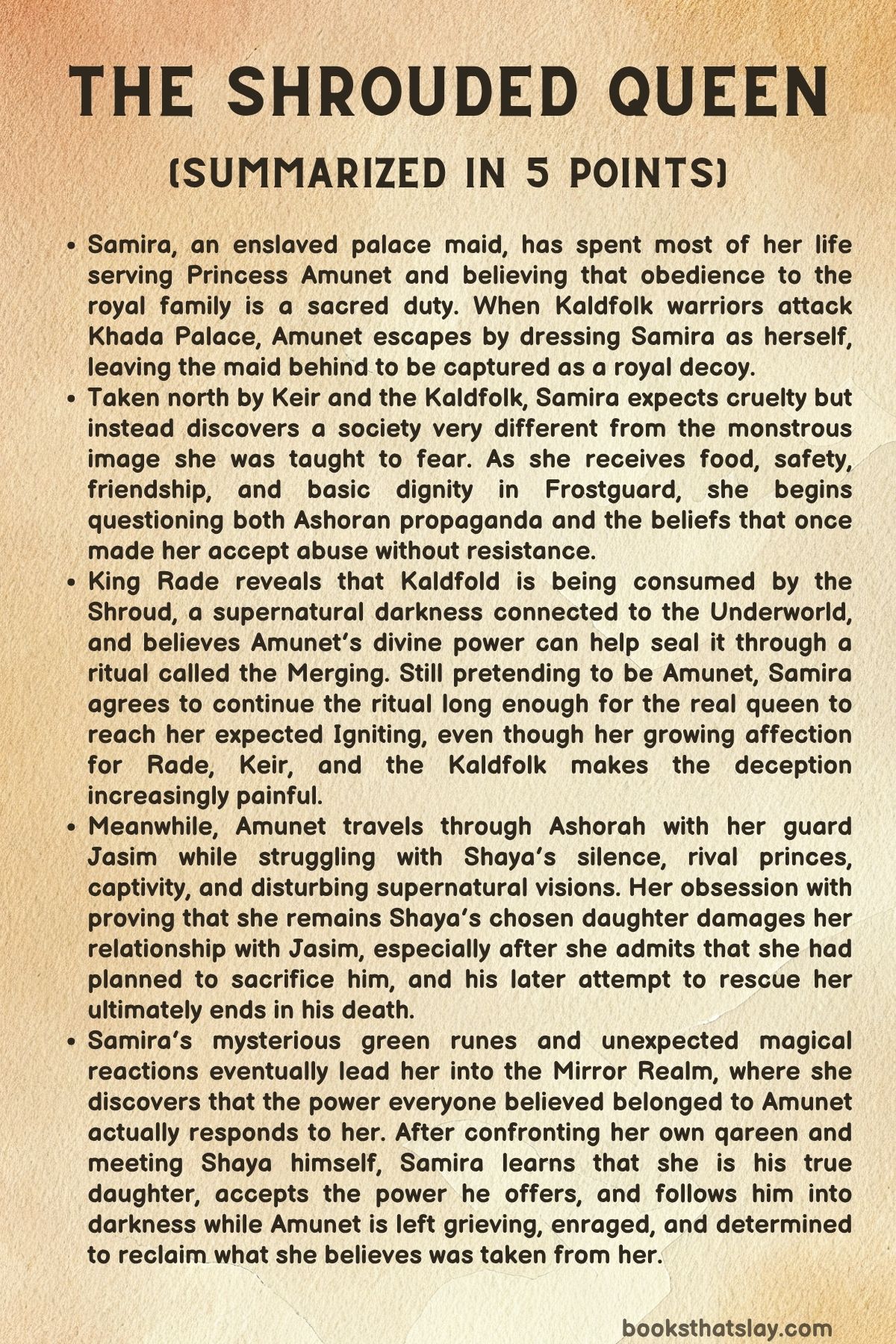
Summary
Samira has spent sixteen years serving Princess Amunet inside Khada Palace, where hunger, punishment, and unquestioning obedience have become ordinary parts of her existence. Taken from her parents at six, she has been taught that serving the royal family is a religious honor and that Amunet, believed to be the daughter of the Underworld god Shaya, will one day save Ashorah.
Samira’s faith remains strong even after witnessing Amunet nearly drown a young maid named Nailah as punishment for swimming in the sacred Lotus River. She has become so conditioned by palace life that she considers stealing discarded bread sinful even while starving.
Everything changes when Kaldfolk warriors secretly enter the capital through the river and attack Khada Palace. Samira has been raised to believe that these northern people are cannibals, witches, monsters, and enemies of the gods.
Amunet experiences the invasion from an entirely different position. She is already troubled because Shaya has stopped answering her prayers, while a strange scratching inside her mind grows steadily worse as her twentieth birthday and expected Igniting approach.
During the attack, King Zaid and Hamadi are killed. Amunet becomes queen, but rather than remain to face the invaders, she escapes with her guard Jasim.
To protect herself, Amunet orders Samira dressed in her clothes and leaves her behind as a decoy. Samira accepts the command because she has been taught that dying for the Gods-Chosen would be an honor.
The Kaldfolk, however, do not kill her. Their warrior Keir believes she is Amunet and takes her prisoner, carrying her north toward Kaldfold.
Samira expects torture and death. Instead, she begins witnessing things that contradict everything Ashorah taught her.
The Kaldfolk mourn fallen companions, care for one another, share food, and worship the same gods Samira does. Keir is frightening and often cruel, but even he shows grief over the death of Alarik and displays unexpected concern for Samira.
When they reach Frostguard, King Rade is furious to discover that Keir kidnapped Amunet without permission. Rather than imprison Samira, Rade removes her chains, provides food and shelter, and promises that she will not be abused.
For Samira, simple comforts become revolutionary. Eating until she is full, bathing freely, sleeping in a proper bed, and being treated as a person force her to reconsider whether Khada Palace was ever the righteous place she believed it to be.
Meanwhile, Amunet and Jasim flee through Ashorah. With the throne vulnerable and rival princes eager to take power, Amunet is hunted while also struggling with Shaya’s continued silence.
Her relationship with Jasim becomes increasingly complicated. He has served her for years and knows the cruel, frightened, angry woman beneath her divine reputation, yet Amunet repeatedly pushes him away whenever emotional intimacy threatens the identity she has constructed around being Shaya’s daughter.
In Kaldfold, Rade eventually shows Samira why he needed Amunet. A supernatural darkness called the Shroud is spreading across the northern lands, consuming settlements and threatening to eventually reach Ashorah.
Rade believes the Shroud is a wound between the mortal world and the Underworld. Ancient records suggest that his magic can be combined with Shaya’s daughter’s power through a ritual called the Merging, potentially sealing the breach.
The Merging is also a marriage ceremony. Because Samira has no reason to believe she possesses magic, she knows she cannot complete it.
Still pretending to be Amunet, she agrees to participate. Her plan is to delay long enough for the real Amunet to reach her twentieth birthday and receive the power everyone expects Shaya to give her.
As preparations continue, Samira becomes emotionally attached to the people she was raised to hate. She rescues a young girl named Milena from the advancing Shroud, develops friendships with members of the Kaldfolk community, and begins understanding Rade as a ruler genuinely desperate to protect his people.
Keir remains the greatest threat to her secret. He notices that this supposed queen is frightened by violence, possesses a servant’s calluses, obeys too easily, and behaves nothing like the arrogant warrior he expected.
Their relationship nevertheless changes. Keir protects Samira, comforts her awkwardly, notices the scars created by her abuse, and gradually becomes one of the first people to treat her suffering as something unjust rather than deserved.
The Merging leads Samira into the Shroud to meet Zarqa, a supernatural Seer. Zarqa immediately calls her by her real name and gives her a prophecy concerning fire, water, greed, and destruction.
Even more strangely, Samira receives green magical runes. Ordinary mortals should receive black markings, Shifters blue, and those blessed by gods red.
Nobody understands what green means.
Samira’s mystery deepens during another Merging trial with Rade in the White Horn Mountains. Although she believes herself powerless, her runes begin reacting to danger, and when she touches them to Rade’s markings, a genuine magical connection forms between them.
At the same time, Amunet’s journey becomes increasingly destructive. Her desperation to regain Shaya’s attention grows alongside the mysterious voice of King Zaid inside her head.
She begins considering Jasim as a sacrifice to Shaya, believing that a death important enough to her may restore her connection to the god. Yet her feelings for Jasim continue deepening, and the two eventually become lovers.
Jasim tells Amunet that he loves her as a person rather than as queen or Gods-Chosen. She cannot return the words because she knows she has secretly planned his death.
After being captured by Prince Anwar and escaping, Amunet and Jasim enter Dead Man’s Forest. There they encounter a jinni capable of granting a request.
Rather than ask for safety, Amunet asks to experience the divine power she expects to receive at her Igniting. She briefly feels immense strength and interprets the experience as proof that Shaya has not abandoned her.
Her choice has consequences. The jinni normally grants an annual request to a tribe whose survival depends upon using it to bring rain, meaning Amunet has unknowingly taken away their water.
When Jasim confronts her selfishness, Amunet finally admits that she had planned to sacrifice him. The confession destroys his trust, and he leaves her.
Back in Frostguard, Samira’s deception approaches collapse. Keir tests her supposed combat training and quickly proves she has never learned to fight.
After tasting Samira’s blood from his weapon, Keir realizes something is seriously wrong with the identity she has presented. Rade imprisons him for disobedience before he can expose the truth.
The final Merging ceremony begins on Amunet’s twentieth birthday. Samira expects the ritual to reveal her as an ordinary slave and possibly kill her, which she accepts as the price of protecting Amunet.
Instead, the ritual sends her into the Mirror Realm, where participants are supposed to confront dark doubles called qareens. Because Keir recently tasted her blood, he is accidentally pulled into the realm with her.
Samira and Keir find themselves in a mirrored version of the Wastelands. Their survival forces Samira to confront both her deception and the psychological damage created by years of slavery.
She eventually confesses that she is not Amunet at all. Keir is furious that she allowed his people to place their hope in her, but Samira admits that her affection for them was genuine and that being valued became almost impossible to surrender after spending most of her life treated as disposable.
Three jinn offer assistance in exchange for something Samira will possess in the future. She accepts, and she and Keir eventually discover the legendary Buried City.
Amunet has entered the Mirror Realm as well. Guided by her own qareen, she discovers ancient evidence showing Shaya’s defeat and imprisonment in the Underworld.
Rather than seeing his imprisonment as a warning, Amunet decides that freeing him is her true destiny. At last, she believes she understands why she was chosen.
Samira and Amunet finally meet again inside the Buried City. Their reunion exposes how completely Samira has changed.
The slave who once obeyed every command now sees Amunet without the religious reverence that protected her authority. When Amunet commands Samira to surrender control of a mysterious supernatural discovery, Samira refuses.
The power they find belongs to Samira’s qareen, not Amunet’s. Samira kills her double, causing immense magical energy to awaken inside her.
The revelation destroys Amunet’s certainty. The divine strength she believed was her inheritance has answered Samira instead.
Amunet is expelled from the Mirror Realm and returns to Dead Man’s Forest, where the tribe she harmed captures her. Jasim returns despite everything she confessed and attempts to save her.
He is killed by an arrow through the throat. Amunet then falls into the hands of Prince Sen Almassi, carrying her grief and fury into another captivity.
Samira remains in supernatural darkness and finally encounters Shaya himself. She expects him to punish her for taking what she assumes belongs to Amunet.
Instead, Shaya calls her Samira Makara and names her as his daughter.
Amunet, he explains, was never the true child he had been seeking. Someone hid Samira from him, leaving Amunet as a false trail while the real connection remained undiscovered.
The strange runes, Zarqa’s prophecy, Samira’s attraction to darkness, her connection with the Mirror Realm, and the power that answered her suddenly acquire a new meaning. The enslaved woman who believed she deserved nothing has unknowingly stood at the center of the divine conflict all along.
Samira still remembers Zarqa’s warning about greed and understands that accepting Shaya may carry terrible consequences. Yet she also recognizes how thoroughly other people have used morality to convince her that wanting food, freedom, dignity, or power was selfish.
With Keir and Rade still in danger and the Shroud continuing to spread, Samira chooses action rather than obedience. She takes Shaya’s hand and follows the god she has just discovered is her father into the darkness.
Characters
Samira Makara
Samira is the emotional and psychological center of The Shrouded Queen, largely because her transformation involves much more than discovering hidden magical power. Her deeper struggle is learning that obedience, suffering, humility, and goodness are not automatically the same thing.
Sixteen years of enslavement have trained Samira to interpret cruelty as discipline and deprivation as virtue. She does not merely obey Amunet because she is afraid; she has internalized the belief that Amunet’s authority is divinely justified and that Samira’s own wishes possess almost no moral value.
Her behavior after being taken to Kaldfold shows how completely this belief controls her. Even when she has a chance to escape her shackles, she puts them back on voluntarily because remaining imprisoned seems like a sacred duty.
Frostguard gradually exposes the artificial nature of that obedience. Food, warmth, choice, friendship, and ordinary kindness appear almost dangerous to Samira because they reveal that the misery of Khada Palace was not necessary.
Her deception also becomes morally complicated. Initially she impersonates Amunet entirely to protect her queen, but later she admits that part of her wants to remain important because being valued feels extraordinary after years of being treated as insignificant.
That admission is essential to her development because Samira has been taught to regard desire itself as corruption. Her growing willingness to acknowledge hunger, affection, anger, attraction, resentment, and ambition marks the beginning of an independent identity.
Her relationship with Keir encourages this development because he refuses to accept her belief that abuse was deserved. His horror toward the scar Amunet carved into her forces Samira to see her suffering through someone else’s moral framework.
Rade affects her differently. His trust gives Samira the experience of being treated as someone whose existence matters, but that same trust increases her guilt because she knows the Merging is based on a lie.
The discovery of her magical identity does not erase these conflicts. Her green runes and relationship to Shaya may give her enormous significance, but the final danger is whether Samira will simply replace one form of submission with another.
By taking Shaya’s hand, she chooses power and agency, but she also enters a relationship with a god whose motives remain uncertain. Her closing smile therefore represents liberation, temptation, and danger simultaneously.
Amunet Khada
Amunet is the principal counterpart to Samira in The Shrouded Queen. Where Samira has been trained to believe she deserves nothing, Amunet has been raised to believe that divine destiny places her above nearly everyone around her.
Her cruelty is real and cannot be dismissed as simple misunderstanding. She mutilates servants, uses Samira as a disposable decoy, treats ordinary lives as lesser than her spiritual purpose, and later admits that she intended to sacrifice Jasim even after accepting his love.
At the same time, the book reveals how her identity was constructed through manipulation. Zaid brought her into a chamber of sacrificed bodies as a child, demanded that she pledge herself to Shaya, and raised her within a system where she was simultaneously worshipped, feared, controlled, and harmed.
Amunet therefore has very little identity outside being Gods-Chosen. When Shaya stops responding, her panic is not merely religious disappointment; she feels as though the foundation of her existence is disappearing.
Her arrogance often functions as psychological protection. Anger allows her to avoid grief, superiority prevents emotional dependence, and cruelty keeps others far enough away that they cannot easily expose her vulnerability.
Jasim becomes dangerous to those defenses because he claims to love Amunet rather than her titles. She desperately wants that love but cannot accept the emotional responsibility that accompanies it.
Her decision to ask the jinni for divine power instead of safety reveals the scale of her obsession. The request harms an entire tribe, yet she initially values confirmation of her destiny more than the lives that depend upon the tribe’s annual rain.
The revelation that Samira possesses the power Amunet expected is devastating because it threatens more than her political position. If Samira is Shaya’s true daughter, Amunet must confront the possibility that years of suffering and sacrifice were built around a false identity.
Jasim’s death could become a turning point, but by the end she converts grief into vengeance. Rather than questioning the system that shaped her, she initially decides that Samira has taken something that belongs to her.
Amunet is therefore tragic without being morally innocent. She has been manipulated, but she repeatedly chooses to extend that manipulation and violence toward others.
Keir
Keir initially appears to confirm nearly every terrifying story Samira has heard about the Kaldfolk. He is physically enormous, threatening, sarcastic, violent, and capable of transforming into a bear.
His early treatment of Samira is intentionally frightening. Yet his behavior gradually reveals emotional depth beneath the aggression, especially through his grief for Alarik and his complicated connection with the Shroud.
Keir is intensely perceptive because his Shifter senses allow him to detect emotions through scent. This ability makes Samira’s false identity particularly difficult to maintain because her fear, sadness, humility, and attraction continually contradict the person Keir believes Amunet should be.
His suspicion is not simple hostility. He becomes increasingly concerned that the woman presented as queen is hiding something capable of harming his people.
Keir’s plea that Samira not give the Kaldfolk false hope shows the responsibility beneath his harshness. He knows the Shroud intimately and understands what desperation can do to people who are offered salvation.
His relationship with Samira evolves from captor and prisoner into mutual fascination, conflict, protection, and emotional dependence. Importantly, he becomes one of the people who challenges her habit of turning punishment inward.
The Lunar Feast also exposes the dangerous part of Keir’s personality. His Shifter instincts can overwhelm his control, and his later confrontation with his qareen suggests that his violence cannot be reduced to harmless roughness.
Keir therefore stands between tenderness and danger throughout the book. His ability to care deeply does not erase his capacity for brutality, but his willingness to restrain himself and confront his own damage separates him from characters who use power without self-questioning.
King Rade
Rade is introduced through Samira’s expectations as a northern king she assumes must be barbaric. His actual leadership quickly challenges that assumption.
He is furious that Keir kidnapped Amunet because he recognizes the political and moral consequences of taking another ruler by force. His immediate decision to remove Samira’s chains and provide her with safety establishes a sharp contrast with the treatment she received in her own homeland.
Rade’s leadership is defined by responsibility rather than personal glory. The spreading Shroud has placed him under impossible pressure, and much of his behavior comes from the knowledge that his entire nation may disappear.
His magical gift from Eira is equally revealing. He possesses impressive abilities of finding and restoration, but those powers have strict limits, reinforcing the idea that even divinely favored rulers cannot simply command reality.
Rade also understands that fear is an unstable foundation for government. His discussion of leadership after Hedin’s death shows that he would rather be loved than merely obeyed through supernatural authority.
His relationship with Samira is especially tragic because his trust makes her deception increasingly painful. He interprets every strange sign as evidence that she may still be capable of completing the Merging.
Rade’s compassion does not make him perfect. He permits violent customs, makes severe judgments, and intends to banish Keir into the Shroud after what he sees as treason.
Still, he consistently attempts to place the survival of his people above his own comfort. His bond with Samira becomes one of the clearest demonstrations of how dignity can transform someone who has never previously been granted it.
Jasim
Jasim serves as Amunet’s guard, companion, lover, moral challenge, and eventually one of the greatest casualties of her choices. His defining quality is loyalty, but the book gradually questions whether loyalty without limits is always virtuous.
For years, Jasim accepts Amunet’s commands because she is his queen and Gods-Chosen. Even when she insults or strikes him, he remains close.
His relationship with her changes when he begins speaking as someone who loves her rather than merely serving her. He challenges her decisions, worries about her mental deterioration, and insists that Amunet contains more humanity than she allows others to see.
That belief becomes both beautiful and dangerous. Jasim sometimes interprets Amunet generously even when her actions deserve direct moral criticism.
The greatest betrayal occurs when Amunet admits that she planned to kill him as a sacrifice to Shaya. Jasim finally recognizes that love cannot excuse what she intended.
His decision to leave is therefore an important act of self-respect. Yet his later return proves that emotional separation has not erased his attachment.
Jasim dies while trying to rescue Amunet from the consequences of her earlier choices. His death becomes especially painful because he returns after learning exactly how badly she betrayed him.
His character demonstrates both the strength and danger of devotion. He sees Amunet more clearly than most people do, but he also spends too long believing that love can redeem another person without requiring that person to change.
King Zaid
Zaid’s influence remains powerful even after his death. He represents political authority, parental love, religious manipulation, and abuse within the same figure.
Amunet remembers him as a loving father who once wanted to give her every happiness. Those memories prevent him from becoming a simple villain in her mind.
Yet the later Zaid is controlling and violent. His bargain with Shaya and his treatment of Amunet shape the entire political and supernatural crisis.
The childhood ritual in which he forces Amunet to pledge herself to Shaya is especially important because it transforms religion into something imposed through fear. Whether Zaid believed he was protecting Ashorah or serving a divine plan, he made a child carry consequences she could not understand.
His political decisions also damage the surrounding principalities. Territorial control over water contributes to suffering elsewhere while strengthening Khada power.
Even after death, Amunet continues hearing his voice attacking her weaknesses. Whether supernatural or psychological, that voice shows how thoroughly Zaid’s judgment has become part of her inner life.
Prince Nasir
Nasir initially appears awkward and somewhat easy for Amunet to dismiss, but he proves much more politically capable than she expects. His willingness to assist her depends upon concessions that benefit Reeda rather than unquestioning loyalty to the Khada dynasty.
His inherited jinn ability to detect lies also limits Amunet’s usual political manipulation. She cannot simply promise him a place at court without intending to honor the agreement.
Nasir’s care for the families mourning people who died from heat and dehydration reveals that his political demands are connected to real suffering. The restoration of territory along the Lotus River is not merely personal ambition when his people lack basic resources.
He therefore challenges Amunet’s assumption that every resistance to her authority comes from selfishness or betrayal. Through Nasir, the novel demonstrates that the Khada dynasty’s control has consequences beyond palace politics.
Prince Anwar
Anwar is especially dangerous because his jinn-descended ability allows him to manipulate emotion. His power attacks the part of Amunet she relies on least comfortably: emotional stability.
By increasing fear, despair, and helplessness, he temporarily deprives Amunet of the rage she normally uses as protection. He does not merely imprison her body; he interferes with her ability to trust her own internal reactions.
His political interest in Amunet also demonstrates how vulnerable she is before the Igniting. With Zaid dead and the throne unstable, controlling the future Gods-Chosen could reshape Ashorah.
Amunet’s eventual resistance to him becomes significant because she begins escaping without waiting for divine rescue. Anwar therefore unintentionally forces her to recognize abilities that exist independently of Shaya.
Prince Sen Almassi
Sen enters the story late but represents a new political threat at the moment Amunet is most vulnerable. His forces seize her after Jasim’s death, preventing grief from becoming an opportunity for freedom or reflection.
As a prince connected with the Dry Lands and hostility toward the Khada dynasty, Sen represents political resistance that extends beyond personal rivalry. Amunet’s captivity under him indicates that Zaid’s death has created a broader struggle over Ashorah’s future.
His arrival also prevents Amunet from controlling the consequences of the Buried City revelation. She now knows Samira may possess the divine identity she expected, yet she cannot immediately act on that knowledge.
Velka
Velka provides Samira with one of her earliest experiences of ordinary kindness among the Kaldfolk. Food, conversation, explanations, and companionship gradually make her one of the people who undermine Samira’s inherited prejudice.
She helps Samira understand the Shroud and explains that its influence may work through internal vulnerability rather than simple physical attack. Her willingness to discuss frightening subjects openly contrasts with the rigid control of information inside Khada Palace.
Velka also serves as an emotional bridge between Samira and the Seven. Through her, Samira begins seeing the feared northern warriors as people with humor, loyalty, flaws, grief, and affection.
Bain
Bain embodies the most intimidating side of Kaldfolk culture. His immense strength, hostility toward Samira, and violent behavior make her early fears appear justified.
The revelation that Hedin was a traitor complicates Samira’s judgment of Bain’s actions. What first appears to be pointless murder becomes part of the Seven’s severe system of punishment.
His confrontation with Samira during the Lunar Feast demonstrates that violence within Kaldfold remains real even after she learns that Ashoran propaganda was false. The northern society is not secretly harmless simply because it was misrepresented.
Bain therefore prevents Samira’s moral awakening from turning into another simplistic worldview. Discovering that the Kaldfolk are human does not require pretending that everything they do is good.
Sillia
Sillia is observant, practical, and closely connected to the military culture of the Seven. Her examination of Samira’s palms becomes one of the moments when the disguise begins failing under physical evidence rather than political knowledge.
She understands what a warrior’s hands should look like and immediately recognizes that Samira’s body tells a different story. Her role highlights how class leaves physical marks that cannot easily be disguised with clothing or titles.
Sillia also participates in a group where loyalty is inseparable from suspicion. Her willingness to test Samira reflects the Seven’s responsibility toward Rade and the survival of Kaldfold.
Dalla
Dalla belongs to the Seven and helps create the sense that this elite group functions as something closer to a damaged family than a conventional military unit. Her presence contributes to the social structure Samira gradually learns to understand.
Although she receives less individual focus than Keir, Bain, or Velka, Dalla helps demonstrate that the Seven’s strength comes partly from shared loyalty and accumulated loss. Alarik’s death therefore affects the group as a personal wound rather than merely a change in command.
Cano
Cano is another member of the Seven whose importance lies largely in the collective identity of Rade’s closest warriors. He helps represent the communal bonds that contradict Samira’s belief that the Kaldfolk are incapable of ordinary human attachment.
His participation in rituals, travel, protection, and mourning reinforces the Seven’s central function. They are warriors, but they are also the people through whom Rade exercises trust and maintains authority.
Alarik
Alarik dies during the invasion of Khada Palace, but his absence becomes important almost immediately. Samira expects the Kaldfolk to celebrate victory and instead witnesses genuine mourning for him.
The empty place left for Alarik becomes one of the first cracks in her belief that the Kaldfolk are monsters. Their grief forces her to acknowledge that people she has been taught to dehumanize are capable of love and loss.
His death also creates the vacancy that leads to Hedin’s challenge and Bain’s violent response. In that sense, Alarik continues affecting events despite having little direct presence after the opening attack.
Hedin
Hedin initially appears to be the victim of a brutal culture when Bain kills him during a public challenge. Samira understandably interprets his death as evidence that Kaldfold remains fundamentally savage.
Later, she learns that Hedin had betrayed his people and that the Seven already intended to punish him. This new information does not make the killing gentle, but it changes the moral circumstances surrounding it.
Hedin’s story becomes especially important for Samira because Bain uses it as a warning about betrayal. Since Samira is deceiving Rade and the entire Kaldfolk nation, Hedin’s fate becomes an image of what she believes may eventually happen to her.
Milena
Milena represents the ordinary civilians threatened by the Shroud. She gives Samira a personal reason to care about Kaldfold beyond abstract arguments about history or religion.
Samira’s decision to risk herself to save Milena is significant because it is spontaneous. She does not act because Amunet commanded her, because religion demands it, or because she expects reward.
The rescue therefore demonstrates that Samira already possesses an independent moral instinct even before she consciously accepts that independence. Her affection for Milena also makes the possibility of abandoning Kaldfold increasingly painful.
Zarqa
Zarqa serves as one of the first supernatural figures to recognize Samira rather than the identity Samira is performing. She immediately calls her by her real name and introduces the possibility that forces larger than the political conflict have been following Samira specifically.
Her prophecy concerning fire, water, greed, and destruction creates uncertainty rather than reassurance. Unlike characters who insist that Samira’s destiny is obvious, Zarqa warns that power and desire may carry serious consequences.
The green runes she gives Samira become the first undeniable physical evidence that Samira is not what she believes herself to be. Zarqa therefore begins the destruction of both Samira’s slave identity and Amunet’s divine identity.
Shaya
Shaya exists for most of the story through belief, silence, fear, and expectation. His absence controls Amunet almost as strongly as direct communication might have done.
Amunet builds her entire identity around being his daughter. Every period of silence therefore becomes psychologically devastating because she has never learned to separate her value from his approval.
Samira approaches Shaya from the opposite direction. She believes she has no connection to him until the final revelation.
When Shaya finally appears and calls Samira his daughter, the entire religious structure surrounding Amunet is overturned. Yet his offer of strength should not automatically be treated as benevolent simply because it validates Samira.
Shaya represents the dangerous attraction of power to someone who has been denied agency. His promise gives Samira exactly what she has never possessed, making her final decision understandable while leaving his ultimate purpose uncertain.
Athar
Athar operates as a supernatural guide whose motives remain difficult to judge. His association with mischief and dreams makes his interventions inherently uncertain.
He helps redirect Amunet after her escape and eventually leads her toward the Mirror Realm. When he tells her that Shaya wants her to understand why she was chosen, he strengthens the belief system that continues driving her forward.
Whether Athar is helping Amunet discover truth or guiding her toward Shaya’s larger purpose remains unresolved. His presence demonstrates how divine guidance in the novel frequently creates new dangers rather than clear moral answers.
Ketet
Ketet represents the religious ideal Samira has trusted since childhood. Her imagined approval provides comfort while Samira accepts hunger, punishment, and enslavement as morally necessary.
The moment Samira lies beneath what she believes is Ketet’s gaze becomes a spiritual crisis. When she can no longer feel the goddess afterward, she assumes she has been abandoned for her dishonesty.
This silence exposes how dependent Samira has become upon external religious validation. Her later growth requires her to make choices without certainty that a divine figure approves of them.
Ketet therefore functions as both spiritual comfort and part of the moral structure Samira must learn to question.
Eira
Eira, Goddess of the Lost, is primarily important through Rade’s blessing. His ability to find and restore what has been lost reflects her divine domain.
The limitations of that gift are important. Rade can guide broken bones back toward wholeness, for example, but cannot simply create missing flesh.
Through Eira’s magic, divine power is presented as powerful but bounded rather than absolute. That limitation contrasts with the expectations placed upon Amunet and later Samira.
Ayeen
Ayeen is associated with the moon, the Shifters, and the supernatural order surrounding Kaldfolk life. Her influence is particularly visible through the Lunar Feast and Zarqa’s protected existence within the Shroud.
The celebration associated with her reveals a culture where instinct and restraint exist in constant tension. Shifters temporarily move closer to their animal nature, exposing both communal joy and serious danger.
Ayeen’s presence therefore broadens the religious world beyond the Ashoran focus on Shaya and Ketet. The gods belong to different cultures in different ways rather than fitting the simplified religious categories Samira learned in childhood.
Sara
Sara becomes important through her betrayal of Amunet’s traveling group. Her hostility toward the queen is political rather than merely personal.
She sees Amunet’s expected divine power as a threat to the independence of the principalities. From her perspective, preventing Amunet from becoming an overwhelmingly powerful ruler may be necessary for everyone else’s survival.
Her actions are still dangerous and destructive, but they demonstrate that opposition to Amunet cannot automatically be treated as evil. The political world contains legitimate fear of what a fully empowered Khada monarch could become.
Tabia
Tabia appears during Samira’s final moments in Khada Palace before the Kaldfolk capture her. She cleans Samira, comforts her, and repeats the belief that dying for Amunet will guarantee spiritual reward.
Her behavior illustrates how systems of oppression can be maintained by people who are themselves trapped within them. Tabia is not presented as deliberately cruel; she sincerely offers the religious framework that has taught both women to accept Samira’s death.
Her presence shows that indoctrination does not depend only on rulers. It survives because its values become part of ordinary relationships between the people subjected to it.
Nailah
Nailah’s punishment near the beginning establishes the reality of Amunet’s cruelty before the reader sees Amunet’s private suffering. Her offense is relatively minor, yet she is repeatedly held underwater until she nearly drowns.
The scene is important because Samira initially interprets the punishment through her conditioned loyalty rather than recognizing its injustice. Nailah therefore helps establish the moral distance Samira must travel before she can reject Amunet’s authority.
Nadia
Nadia shares the servants’ quarters with Samira and helps establish the ordinary conditions of palace slavery. Her presence connects Samira to a larger servant population rather than allowing her suffering to appear exceptional.
Although Nadia has limited direct influence on later events, she represents the life Samira leaves behind when the invasion removes her from Khada Palace. That background becomes increasingly important as Samira realizes how abnormal the servants’ deprivation truly was.
Hamadi
Hamadi appears as part of King Zaid’s political world and dies during the Kaldfolk assault. His death contributes to the sudden collapse of the authority structure surrounding Amunet.
With both Zaid and Hamadi gone, Amunet is pushed into queenship without the protection or political machinery she expected to inherit. Hamadi’s loss therefore helps turn the invasion from a military crisis into a succession crisis.
Queen Neema
Queen Neema is largely absent from the present action, but the abandoned chambers associated with her contain the passage that allows Amunet and Jasim to escape Khada Palace. Her physical absence creates a sense of unresolved history within the royal family.
The survival route hidden in her rooms also symbolically connects Amunet’s escape to a past she does not fully understand. Like many parts of the Khada dynasty, Neema remains evidence that important truths existed before Amunet understood the world around her.
Themes
Freedom, Conditioning, and the Recovery of Self
The Shrouded Queen repeatedly asks whether a person can be considered free when the beliefs controlling that person have been placed inside the mind so deeply that external chains are no longer necessary. Samira provides the clearest example because she has been trained since childhood to interpret obedience as virtue.
Her decision to replace her own shackles after escaping them perfectly captures this problem. The physical restraint can be removed, yet the beliefs created by Khada Palace continue controlling her choices.
Freedom therefore develops gradually rather than arriving the moment Samira leaves Ashorah. Food, warmth, friendship, privacy, attraction, anger, and personal preference all become experiences through which she learns that she possesses a self independent of service.
Her difficulty answering Rade when he asks what she enjoys demonstrates the extent of the damage. Samira has spent so long organizing herself around Amunet’s needs that even identifying a personal preference requires effort.
Her eventual refusal to obey Amunet in the Buried City becomes one of the most important moments in this development. The word “no” matters because Samira is no longer merely disobeying a queen; she is rejecting the entire moral system that convinced her Amunet’s wishes should automatically outrank her own existence.
Yet freedom also introduces responsibility. Once Samira recognizes that she can choose, she can no longer explain every action through obedience, making her deception of Rade and the Kaldfolk morally more complicated.
The novel therefore presents freedom as both liberation and burden. Becoming a person requires Samira not only to escape domination but also to accept ownership of her desires, mistakes, loyalties, and decisions.
Divine Identity and the Danger of External Validation
Both Samira and Amunet struggle with identities built around what higher authorities supposedly think of them. Their positions appear opposite, but both women have been taught to measure their worth through powers outside themselves.
Samira believes she is valuable only when serving correctly. Amunet believes she is valuable because Shaya has supposedly selected her for greatness.
That difference produces opposite behaviors. Samira minimizes herself until pain seems deserved, while Amunet enlarges herself until the suffering of others appears acceptable when placed beside her destiny.
The underlying dependency, however, is remarkably similar. Neither woman begins the story with a stable sense of worth independent of divine approval.
Shaya’s silence therefore becomes devastating to Amunet. Without his response, she cannot simply continue as herself because she has never learned who that self might be without the title of Gods-Chosen.
Samira experiences a parallel crisis when she believes Ketet has stopped answering her after she lies to Rade. She immediately assumes that one morally compromised act may have destroyed her relationship with the goddess and condemned her.
The supernatural revelations complicate the theme because divine power is real in this world. The problem is not whether gods exist but whether their existence should automatically determine morality, identity, and personal value.
By the end, Samira discovers that she truly is Shaya’s daughter, but that revelation does not automatically resolve her identity. It creates a new test: whether she can accept divine power without once again allowing another being to define what she should become.
Propaganda, Prejudice, and the Construction of Enemies
Samira enters Kaldfold carrying a complete explanation of the people who live there. The Kaldfolk are supposedly cannibals, heretics, monsters, and enemies of civilized society, leaving little room for her to interpret anything they do outside that framework.
Direct experience gradually destroys these beliefs. She sees them mourn Alarik, care for refugees, worship familiar gods, feed strangers, protect children, joke with one another, and grieve their dead.
The transformation does not depend upon discovering that the Kaldfolk are morally perfect. Bain is violent, their customs can be brutal, and the Seven are capable of terrifying acts.
That complexity is essential because replacing one stereotype with another would leave Samira’s basic thinking unchanged. She must learn to judge people through evidence rather than through categories handed to her by authority.
The political purpose of propaganda becomes clearer as she understands Ashorah’s history. Portraying the northern population as inhuman makes war, territorial control, neglect, and hostility easier to justify.
Samira’s changing relationship with Keir becomes a personal version of the same process. He begins as the physical embodiment of everything she has been taught to fear, yet over time she discovers grief, loyalty, trauma, humor, desire, and protectiveness beneath that image.
The theme also extends beyond Samira’s prejudice. Amunet repeatedly interprets political opposition as personal betrayal because her upbringing has taught her that resistance to Khada authority is morally suspicious.
The story ultimately argues for the danger of inherited certainty. Once governments, religions, or families control the explanation of who an enemy is, cruelty can be made to appear like duty.
Power, Desire, and the Morality of Wanting More
Desire is treated very differently depending upon who possesses it. Samira has been trained to believe wanting food, comfort, love, freedom, or recognition is selfish, while Amunet has been encouraged to see enormous ambition as the natural consequence of divine importance.
Samira’s relationship with desire therefore becomes a major part of her growth. She initially feels guilty over discarded bread even while starving because deprivation has been turned into evidence of moral discipline.
Later, she admits that she enjoyed being treated as important in Frostguard. The confession frightens her because she immediately interprets the wish to matter as greed.
Zarqa’s warning gives this tension supernatural importance. Greed may genuinely threaten Samira’s future, but the word itself becomes difficult to interpret when she has spent her life being told that almost any personal desire is excessive.
Amunet represents the opposite danger. She rarely questions whether wanting something gives her the right to obtain it.
Her request to feel divine power costs the Cirra Tribe its annual source of rain, yet she refuses to surrender what she received. Her desire for reassurance therefore becomes destructive because other lives become secondary to proving her destiny.
The contrast between the two women prevents the story from presenting desire as either automatically good or automatically corrupt. Wanting food after starvation is not morally equivalent to sacrificing another community for personal validation.
The real question is whether desire acknowledges the humanity and freedom of others. Samira’s final acceptance of Shaya’s power therefore remains deliberately uncertain: claiming strength may be necessary after a lifetime of enforced powerlessness, but power becomes dangerous the moment possessing more begins to justify taking everything.