The Sins of Summer Daughters Summary, Characters and Themes
The Sins of Summer Daughters by Lo Patrick is a psychological family drama and crime novel centered on the dangerous ways fear, secrecy, trauma, and loyalty can repeat across generations.
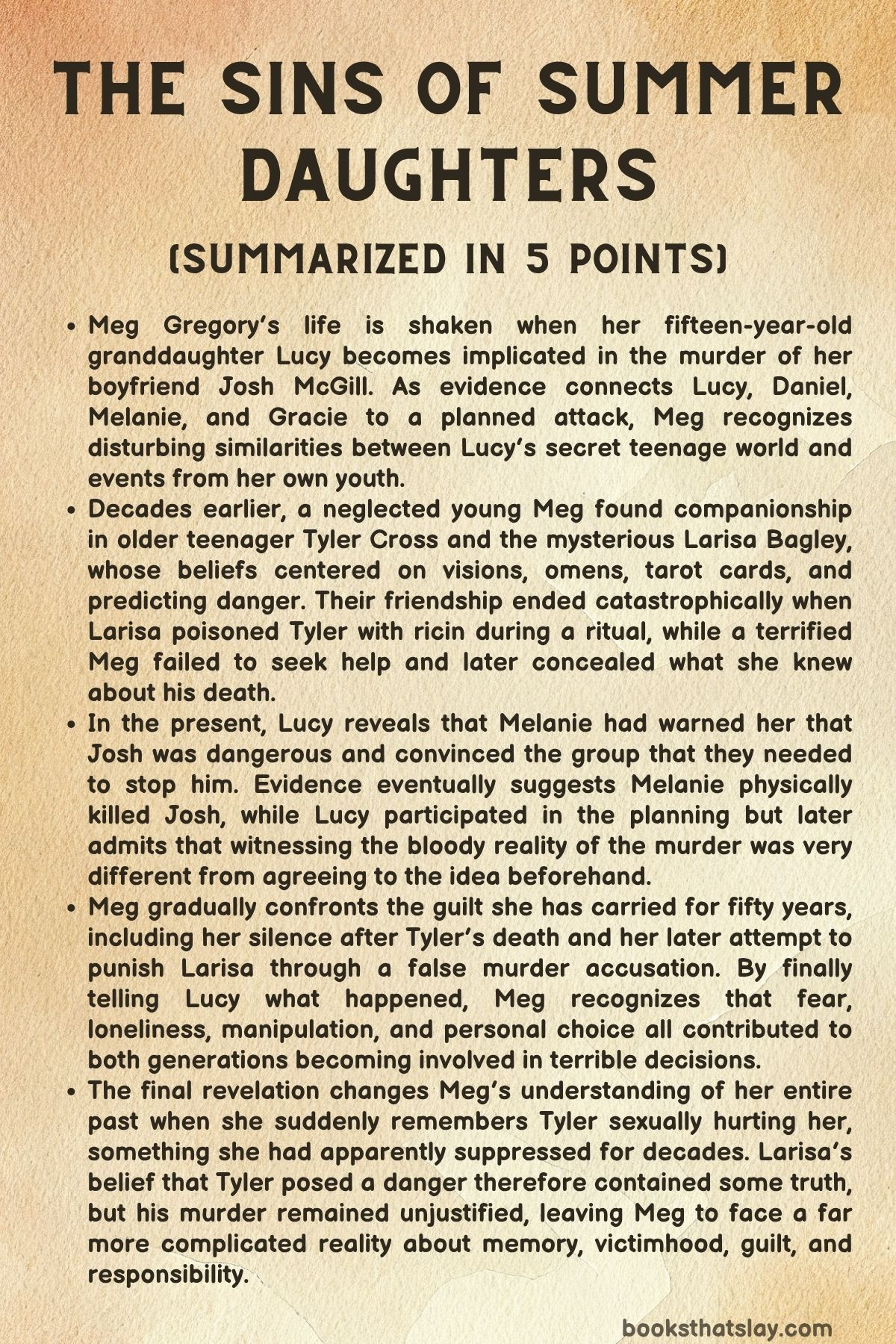
The story follows sixty-four-year-old Meg Gregory after her teenage granddaughter Lucy becomes involved in a murder investigation, forcing Meg to confront a death she helped conceal fifty years earlier. Moving between Meg’s troubled adolescence and the crisis surrounding Lucy, the novel examines how people reconstruct painful memories in order to survive. Its final revelation challenges Meg’s understanding of victimhood, responsibility, manipulation, and the past she believed she understood.
Summary
In 2024, sixty-four-year-old Meg Gregory learns that Josh McGill, the teenage boy recently dating her fifteen-year-old granddaughter Lucy, has been murdered. The news immediately frightens her, partly because Lucy has shut herself in her bedroom and partly because Meg senses that the situation is awakening memories she has spent most of her life refusing to examine.
Lucy had previously dated Daniel Farmer, a quiet boy Meg considered harmless, but recently left him for the more confident Josh. At Josh’s funeral, Lucy appears strangely detached, and Detective Adam Rinaldi repeatedly watches her, making Meg increasingly suspicious that police already consider her more than a grieving girlfriend.
That fear is confirmed when Lucy is taken to the police station. Investigators have a witness placing her at Josh’s home around the time of the murder, and Ferrol Highfield, Meg’s former husband and Lucy’s grandfather, arranges for defense attorney Deirdre Mansell to represent her.
Lucy is temporarily released, but Deirdre orders her not to speak with police, attend school, contact friends, or use electronic devices. Lucy refuses to explain herself to Meg, and her unusual calmness makes Meg increasingly certain that something far more serious has happened.
The crisis begins reviving Meg’s childhood in Tuskin. In 1973, thirteen-year-old Meg lives in a chaotic home with her emotionally inconsistent mother Heather, while her older sister Rainy moves in and out of the household and Heather’s boyfriend Lon becomes an uncomfortable presence.
Meg repeatedly dreams of escaping. She has already attempted to run away and hitchhike, and the adult who offers her the most reliable care is Johnna Martin, an old family friend who treats her with attention and stability that are largely absent at home.
Meg soon meets seventeen-year-old Tyler Cross. Tyler is older, adventurous, and unusually attentive to Meg, promising to give her rides so she will not hitchhike with strangers and presenting himself as someone capable of helping her leave Tuskin.
Around Tyler is another teenager, Larisa Bagley, a disturbing dark-haired girl with damaged teeth, an unsettling family reputation, and a strong belief in signs, visions, tarot cards, omens, and supernatural warnings. Meg initially feels jealous of Larisa because Tyler seems fascinated by her, but the three gradually become a close group.
Back in 2024, Lucy suddenly disappears from home and later stands nearly unresponsive outside Daniel’s house. As Meg, Nina, and others try to communicate with her, Lucy says, “We’re going to kill him,” a statement Meg immediately tries to reinterpret as confusion or trauma rather than an admission.
Soon Deirdre reveals that police are preparing to charge Lucy with murder. Daniel and two other teenagers are implicated as well, and investigators have discovered a secret gathering place near Pirkle Road containing Lucy’s DNA.
The location terrifies Meg because Pirkle belongs to the geography of her own buried past. Instead of simply worrying about Lucy’s legal danger, she begins recognizing similarities between Lucy’s secret teenage world and the hidden friendships she herself maintained decades earlier.
Meg searches for answers and eventually discovers that Lucy has been secretly visiting Melanie Pollard, another girl involved in the investigation. Lucy claims that Josh was a bad person and that Melanie can “see things,” predicting dangers before they occur.
The language immediately reminds Meg of Larisa. Melanie apparently warned Lucy about Josh and convinced her that something terrible was going to happen, while Lucy insists that the group “had to do something.”
Meg increasingly views Melanie as a modern version of Larisa, someone who has gained power over frightened teenagers by convincing them that she possesses special knowledge. Lucy, however, remains fiercely loyal to Melanie and insists that the warnings were real.
As the investigation continues, information emerges suggesting that Josh had sexually harmed or threatened Lucy. Lucy’s abrupt behavioral changes, withdrawal, and fear suddenly acquire another possible explanation, although she still refuses to give her family a clear account of what happened.
The group had apparently discussed killing Josh before his death. Daniel seems to have acted primarily as a driver, while Lucy, Melanie, and Gracie Bailey were more deeply involved, and evidence gradually points toward Melanie as the person who physically killed Josh.
Meg struggles to accept that Lucy could agree to such a plan even if Josh had hurt her. Her instinct is to explain the crime through manipulation, yet psychologist Dr. Cheek warns her that reducing Lucy’s behavior to outside influence prevents her from confronting Lucy’s own choices.
When Dr. Cheek asks what could lead a person toward such an extreme act, Meg identifies two forces she understands personally: fear and loneliness. These emotions become the clearest connection between Lucy’s crisis and Meg’s adolescence.
The memories Meg has avoided finally return in greater detail. In 1974, Larisa became increasingly obsessed with signs, dangerous people, snakes, spiritual knowledge, and the idea that frightening events could be predicted before they occurred.
She convinced Tyler and Meg to participate in a ritual involving a rattlesnake and substances she had prepared. Tyler soon became violently ill, vomiting, experiencing severe pain, and turning blue.
Tyler begged for medical help, but Larisa refused to call an ambulance. She treated his suffering as part of a spiritual event and pulled the terrified Meg away from him while he was still alive.
Meg eventually returned and found Tyler unresponsive. A tall man from Larisa’s property carried Tyler away while a woman drove the vehicle, and young Meg desperately convinced herself they were taking him to a hospital.
Instead, Tyler’s body was moved and abandoned elsewhere. Meg returned home frightened and soaked, but when Tyler’s family and later the police began searching for him, she claimed not to know what had happened.
Johnna eventually told Meg that Tyler had been found dead and gave her an opportunity to explain everything. Meg remained silent because telling the truth would require admitting that she had abandoned Tyler while he was dying.
Authorities ultimately treated Tyler’s death as suicide or accidental poisoning. Larisa later admitted privately to Meg that she had given Tyler ricin made from castor beans.
Larisa claimed she had killed Tyler to protect Meg because he was going to hurt her. Meg reacted furiously, insisting Tyler had never done anything to her and concluding that Larisa had projected her own experience of abuse onto an innocent boy.
Meg’s hatred of Larisa continued afterward. Larisa planted or hid suspicious poisonous substances around Meg’s house, leaving Meg terrified that she might be manipulated, implicated, or harmed next.
Meg eventually moved in with Johnna and then ran away from Tuskin entirely. She reached Atlanta, built an independent life, eventually married Ferrol and became Nina’s mother, but she never emotionally resolved what happened to Tyler.
Years later, in 1980, another woman was discovered murdered beneath the Bagley house. Meg returned to Tuskin planning to falsely tell police that she had seen Larisa commit that murder.
Her motive was revenge. She wanted Larisa punished for Tyler’s death without exposing her own role in concealing the circumstances of his final hours.
Before Meg could make the false accusation, however, Larisa confessed after police informed her that Meg was coming to make a statement. Meg then refused to testify and left, while Larisa remained imprisoned and eventually died there.
Meg’s actions further damaged her relationship with Heather. Rather than explain Tyler’s death honestly, she preserved a version of herself in which Larisa was entirely responsible and Meg’s own guilt remained hidden.
In the present, Lucy’s legal situation begins to improve somewhat. Evidence increasingly identifies Melanie as Josh’s actual killer, while Lucy is offered a plea agreement for conspiracy to commit murder and is expected to remain within the juvenile system.
Lucy nevertheless continues defending Melanie and maintains that Josh needed to be stopped. Meg sees in this loyalty the same attachment she once felt toward Larisa, although she still cannot fully separate Lucy’s experience from her own.
Eventually Meg takes Lucy to Tyler’s grave and tells her the truth she has concealed for fifty years. She explains that Larisa poisoned Tyler, that she watched him dying, and that she did not contact police or tell anyone what really happened.
Lucy responds by describing her own role in Josh’s death. She told Melanie about Josh, participated in discussions about killing him, and agreed to the plan, but seeing the blood inside Josh’s car made her understand that agreeing to an idea was very different from witnessing an actual death.
Meg and Lucy therefore share a painful recognition. Both became involved in destructive group decisions, and both discovered too late that imagined violence and real violence are completely different things.
Lucy eventually returns home under restrictions and begins therapy, particularly art therapy. Meg also starts repairing her strained relationship with Nina, finally apologizing for some of her failures as a mother and revealing part of what happened to Tyler.
Yet Meg remains convinced that Larisa fundamentally misunderstood Tyler. She continues insisting that he never hurt her, even as Lucy’s inability to speak plainly about Josh makes Meg increasingly uncomfortable.
Then Meg suddenly recovers a memory she has apparently suppressed for decades. She sees Tyler on top of her in a bed, his hand covering her mouth while she cries.
The memory changes the meaning of everything she has believed about him. Tyler, whom Meg preserved as an entirely innocent protector, had apparently sexually harmed her.
Larisa’s belief that Tyler posed a danger was therefore not wholly invented, although that does not justify murdering him. Meg must finally confront the possibility that her mind erased Tyler’s abuse because acknowledging both his affection and his violence would have been unbearable.
The novel ends with Tyler’s old phrase, “No funny business,” once understood by Meg as reassurance. After the recovered memory, those words become deeply disturbing, leaving Meg with a past that can no longer be divided neatly between innocent victim, evil killer, and frightened witness.
Characters
Meg Gregory
Meg Gregory is the central consciousness of The Sins of Summer Daughters, and nearly every major question about truth, guilt, memory, and responsibility is filtered through her unstable understanding of her own past. At sixty-four, she appears fiercely protective of Lucy, but that protectiveness is inseparable from the secrets she has carried since adolescence.
Young Meg grows up emotionally neglected and desperate to escape Tuskin. Her mother’s unstable relationships, her father’s absence, Rainy’s partial departure, and the constant arrival of new men leave Meg craving anyone who makes her feel deliberately chosen.
That hunger explains much of her attachment to Tyler and Larisa. Tyler provides companionship and apparent safety, while Larisa offers mystery, certainty, and the intoxicating belief that hidden dangers can somehow be identified before they strike.
Meg’s defining defense mechanism is denial. She refuses for decades to admit the full truth about Tyler’s death, then constructs a moral framework in which Larisa is the monster, Tyler is innocent, and Meg herself is guilty mainly because she was too frightened to save him.
Her behavior in Lucy’s case reveals how deeply that framework governs her life. She repeatedly interprets Melanie through memories of Larisa and Lucy through memories of herself, sometimes noticing real similarities but often forcing the present to conform to the past.
The final recovered memory transforms Meg without absolving her. Tyler’s apparent abuse explains why her memories became fragmented and why Larisa’s claims contained a truth Meg could not consciously accept, but Meg must still live with abandoning Tyler, concealing his poisoning, and later planning to fabricate evidence against Larisa.
Meg is therefore neither simply unreliable nor dishonest. Her character shows how a person can sincerely believe a false or incomplete version of the past because that version once made survival possible.
Lucy
Lucy becomes the second major emotional center of The Sins of Summer Daughters, functioning both as Meg’s beloved granddaughter and as a younger person whose crisis forces buried family history into the open. Initially presented as quiet and familiar, Lucy begins behaving in ways Meg and Nina cannot recognize after her relationship with Josh.
Her emotional detachment following Josh’s death is easily mistaken for coldness. In reality, Lucy appears overwhelmed by trauma, guilt, fear, and the enormous difference between discussing violence and witnessing its consequences.
Lucy’s attachment to Melanie is especially important. Melanie gives her a language for interpreting danger and persuades her that Josh’s future actions can be predicted, creating a sense that violence is not merely possible but necessary.
At the same time, Lucy cannot be treated as someone without agency. She participates in discussions about killing Josh, joins the group’s plans, and continues defending Melanie afterward, even when the consequences become undeniable.
Her eventual confession to Meg is one of the clearest expressions of the novel’s moral complexity. Lucy hated Josh and participated in the idea of stopping him, but once she saw the blood inside his car, she realized that imagining a death and experiencing its reality were completely different.
Lucy also mirrors Meg without duplicating her. Unlike Meg, she eventually receives psychological treatment, legal representation, family involvement, and an opportunity to speak about her experience before fifty years of silence can harden around it.
Nina
Nina is Meg’s daughter and Lucy’s mother, positioned between two generations carrying forms of pain they have never fully explained to her. Her confusion throughout the story comes partly from discovering that both her mother and daughter possess hidden lives far larger than she had imagined.
As Lucy’s mother, Nina responds primarily through fear, practical concern, and a desire to regain control. She wants Lucy safely home, wants legal clarity, and struggles to understand how her apparently ordinary daughter could secretly associate with Melanie, Gracie, Daniel, and Josh in ways the adults around her failed to notice.
Her relationship with Meg is equally significant. Nina has inherited the consequences of Meg’s unresolved trauma without knowing its origin, experiencing her mother as protective but emotionally difficult and sometimes unavailable.
Nina’s anger toward Meg is therefore understandable. She cannot comprehend why Meg failed to notice Lucy’s secret friendships, while Meg privately understands that teenagers can create entire worlds outside adult awareness because she once did exactly that.
Their eventual reconciliation is deliberately modest rather than complete. Meg apologizes for some of her failures, reveals a portion of the Tyler story, and shares a natural hug with Nina, suggesting that honesty may finally replace at least some of the distance that has defined their relationship.
Larisa Bagley
Larisa is the novel’s most disturbing and difficult figure because she cannot be reduced to either supernatural eccentricity or simple villainy. She is introduced through damaged teeth, strange behavior, family rumors, and claims that she can sense dangers other people cannot perceive.
Her childhood appears to have been marked by severe violence and abuse. The death of her sister, the behavior of her father, and the Bagley family’s reputation all suggest that Larisa has developed her belief system within an environment where danger is real and ordinary institutions have failed.
Larisa becomes attached to Meg and Tyler while increasingly interpreting relationships through prophecy, omens, tarot, snakes, and private signs. Her beliefs give her a sense of authority, particularly when she decides that she can identify dangerous people before they act.
Her killing of Tyler is the horrifying result of that certainty. By poisoning him with ricin and claiming she acted to save Meg, Larisa converts fear into permission for irreversible violence.
The final revelation complicates this judgment because Tyler apparently did sexually harm Meg. Larisa may therefore have recognized something Meg herself could not remember, but recognizing abuse does not justify deciding privately that another person deserves death.
Larisa ultimately represents the danger of turning partial truth into absolute moral authority. She may perceive genuine danger, but she grants herself the right to decide another person’s fate without restraint, accountability, or any possibility that her interpretation could be wrong.
Tyler Cross
Tyler occupies two radically different positions in Meg’s memory. For most of the story, he is remembered as the older boy who noticed a lonely thirteen-year-old, warned her against dangerous hitchhiking, spent time with her, encouraged her imagination, and seemed capable of helping her escape Tuskin.
His kindness matters because Meg receives so little dependable attention at home. Tyler fixes practical problems, talks to her seriously, treats her as a companion, and becomes the person she most strongly associates with safety.
His death therefore becomes the central tragedy around which Meg organizes her adult identity. She believes for decades that Larisa murdered an innocent boy because of imagined danger, and her guilt over leaving him dying strengthens her need to keep him morally perfect.
The final recovered memory destroys that certainty. Meg remembers Tyler restraining and sexually hurting her, forcing the reader to reconsider the difference between how Tyler behaved publicly and what he may have done privately.
That revelation does not make his poisoning deserved. Instead, Tyler becomes an example of how victimhood and wrongdoing can exist in the same person: he can have harmed Meg and still have been unjustly murdered.
Melanie Pollard
Melanie is Lucy’s closest parallel to Larisa and initially appears through Meg’s frightened perception as evidence that history is repeating itself. She claims unusual powers of perception, warns Lucy about Josh, and becomes influential within the group that eventually discusses and carries out his killing.
Her role is especially powerful because she enters Lucy’s life after Lucy has apparently been harmed or frightened by Josh. By positioning herself as someone who understands what will happen next, Melanie transforms Lucy’s fear into certainty.
Evidence eventually indicates that Melanie is the person who actually kills Josh. This separates her legal responsibility from Lucy’s while also revealing how far the group’s private logic has gone.
Yet Melanie should not be understood only as a copy of Larisa. Much of what readers know about her comes through Meg, whose perceptions are distorted by unresolved memories, and even Deirdre has to remind Meg that no literal Bagley connection exists in Lucy’s case.
Melanie therefore serves both as a real dangerous influence and as a screen onto which Meg projects the unresolved terror of her adolescence.
Daniel Farmer
Daniel begins as the boyfriend Meg approves of because he seems quiet, harmless, and predictable. Lucy’s decision to leave him for Josh marks one of the changes that Meg notices only after the murder forces her to reconsider the months leading up to it.
His refusal to come outside when Lucy stands in his yard suggests that he knows considerably more than the adults around them. Later evidence confirms that Daniel was involved in the group’s activities and helped transport them, although his role in the actual killing appears more limited.
Daniel is important because he prevents the crime from being understood as the work of a single influential girl and several passive followers. Multiple teenagers made choices that allowed the plan to move forward.
His comparatively limited role also demonstrates how group wrongdoing can contain different levels of knowledge, intention, and participation without leaving any participant completely untouched by the consequences.
Heather
Heather is a deeply flawed mother whose instability shapes Meg’s entire emotional development. She moves through relationships with men, works difficult night jobs, and repeatedly fails to give Meg the consistent attention and safety she requires.
Yet Heather is not completely unaware of danger. She recognizes that the Bagley family is dangerous, distrusts Larisa’s influence, and tries to warn Meg about situations that genuinely deserve concern.
Her tragedy as a parent is that she has weakened her own authority so thoroughly that Meg has little reason to trust those warnings. When a child repeatedly experiences adults as unreliable, even accurate advice may arrive too late to matter.
Heather’s later conversation with adult Meg is one of her strongest moments. She refuses to let Meg explain every terrible choice through Larisa’s influence and insists that dangerous people exist everywhere while individuals remain responsible for what they do.
Her relationship with Meg therefore combines neglect, resentment, insight, and failed attempts at connection. She contributes greatly to Meg’s loneliness but also voices truths Meg spends decades avoiding.
Johnna Martin
Johnna represents the closest thing Meg has to a stable parental figure during childhood. She provides practical care, gives Meg a comfortable place to stay, takes her shopping, discusses ordinary needs, and treats her as someone worthy of attention.
Her influence matters because it shows that Meg does experience genuine adult care, even if it is inconsistent and cannot fully compensate for her home life. Johnna repeatedly provides opportunities for Meg to tell the truth without forcing or humiliating her.
After Tyler’s death, Johnna directly asks whether Meg knows what happened. Meg nearly confesses but chooses silence because admitting that she left Tyler dying feels unbearable.
Johnna later helps Meg when she leaves Tuskin, arranging a safer living situation through her brother. She cannot heal Meg’s trauma, but she repeatedly offers the kind of practical compassion that distinguishes support from control.
Deirdre Mansell
Deirdre Mansell functions as the legal counterweight to the family’s emotional reactions. She is practical, impatient, and focused on protecting Lucy through procedures rather than comforting Meg or Nina.
Meg frequently dislikes Deirdre’s clinical manner because she wants someone to see Lucy primarily as a frightened child. Deirdre, however, understands that investigators and prosecutors will focus on evidence, planning, motive, and legal responsibility.
Her advice prevents Lucy from damaging her own defense through uncontrolled conversations with police or friends. She also gradually clarifies the distinctions between Melanie’s alleged role as the killer, Lucy’s involvement in the conspiracy, and Daniel’s more limited participation.
Deirdre therefore keeps the novel grounded in consequences. Trauma and manipulation may help explain behavior, but legal responsibility does not disappear simply because a defendant was frightened or influenced by others.
Dr. Cheek
Dr. Cheek becomes important because she challenges Meg’s preferred explanation for Lucy’s actions. Meg wants to believe that Melanie manipulated Lucy so completely that Lucy can be understood mainly as a victim of another person’s influence.
Dr. Cheek refuses that simplification. She acknowledges that trauma can profoundly alter behavior while also insisting that Lucy remains a person capable of making choices.
Her question about what could lead any person to participate in extreme violence forces Meg to stop thinking only in terms of uniquely evil individuals. Meg’s answer—fear and loneliness—becomes an important insight into both her own adolescence and Lucy’s experience.
Dr. Cheek consequently represents a healthier approach to trauma than the one Meg has practiced. Rather than denying responsibility or assigning absolute blame, she creates space for harm, influence, choice, fear, and accountability to exist together.
Rainy
Rainy is Meg’s older sister and another product of their unstable household. Because she is older, she has experienced many of the family’s failures before Meg and appears to have carried responsibilities Meg only gradually begins to recognize.
Rainy sometimes provides useful warnings, especially concerning Tyler’s unusual closeness with a much younger girl and Larisa’s disturbing reputation. Meg largely dismisses these concerns because her emotional attachment to Tyler is already stronger than her trust in family judgment.
Her presence also highlights the different ways siblings can respond to the same dysfunctional environment. Meg repeatedly escapes outward toward new people, while Rainy moves between independence and return.
Ferrol Highfield
Ferrol, Nina’s father and Meg’s former husband, appears mainly in the present-day family crisis. His most important contribution comes when he immediately recognizes the seriousness of Lucy’s legal position and arranges competent representation through Deirdre.
His response contrasts with Meg’s denial. While Meg initially insists that Lucy could not possibly need a lawyer because she has done nothing wrong, Ferrol understands that innocence, guilt, and legal vulnerability are separate questions.
Although he occupies less narrative space than Meg, Nina, or Lucy, his presence reflects the broader family structure Meg created after escaping Tuskin. The life she built elsewhere did not erase her earlier trauma, but it gave later generations resources she never possessed as a frightened teenager.
Detective Adam Rinaldi
Adam Rinaldi initially appears as the detective whose attention to Lucy alarms Meg. His professional suspicion makes him seem threatening because Meg views almost every authority figure through the experience of having concealed Tyler’s death.
His significance increases when Meg meets Adam’s father and recognizes him as the tall man who carried Tyler’s body away from Larisa’s property. This connection demonstrates that Tuskin’s past has survived not only inside Meg’s memory but through people and families who continued living there.
Adam himself is not responsible for what happened decades earlier. Meg’s reaction to him nevertheless shows how unresolved trauma can transform present relationships by attaching old meanings to people who belong to a different generation.
Themes
Memory, Trauma, and the Stories People Tell Themselves
Memory in The Sins of Summer Daughters is not presented as a perfect record waiting to be retrieved. Meg’s recollections are selective, emotionally shaped, and sometimes so heavily defended that she genuinely cannot recognize what she has removed from her own understanding.
For fifty years, Meg organizes Tyler’s death around a simple moral structure: Tyler was good, Larisa was dangerous, and Meg’s great failure was abandoning an innocent friend. This interpretation contains truth, but it excludes the sexual harm Tyler apparently inflicted on Meg.
The suppressed memory changes the meaning of many earlier events without erasing them. Larisa still poisoned Tyler, Meg still abandoned him while he was dying, and adults still failed to discover the full circumstances of his death.
What changes is Meg’s certainty about why everything happened. Trauma has allowed her to preserve Tyler as the safe person she desperately needed him to be, even when another part of her mind apparently remembered something incompatible with that image.
Lucy’s crisis forces those defenses to weaken because her situation recreates too many familiar emotional conditions. Through Meg, the novel suggests that surviving an experience and accurately understanding it may be two completely different processes.
Fear, Loneliness, and Vulnerability to Influence
Fear and loneliness repeatedly create the conditions in which young people accept dangerous forms of certainty. Meg grows up feeling neglected and powerless, making attention from Tyler and Larisa unusually valuable because both make her feel seen.
Lucy experiences a different family environment, yet after her relationship with Josh becomes harmful, she also appears frightened, isolated, and uncertain about how to respond. Melanie enters that emotional space offering protection and confidence.
Both generations are drawn toward people who claim to understand hidden dangers. Larisa reads signs and predicts threats, while Melanie tells Lucy that terrible events can be foreseen and prevented.
The attraction is not simply superstition. Certainty becomes comforting when ordinary adults have failed to recognize what is happening.
Meg eventually identifies fear and loneliness when Dr. Cheek asks what could make someone participate in extreme violence. That answer applies to Meg, Lucy, Larisa, and perhaps Melanie in different ways.
The theme does not excuse anyone’s actions. Instead, it explains how vulnerable people can become receptive to destructive ideas when those ideas arrive disguised as protection, loyalty, or special understanding.
Responsibility, Influence, and Moral Choice
The story repeatedly resists the comforting idea that one evil person causes everyone else to behave badly. Meg wants Larisa to explain Tyler’s entire tragedy and later wants Melanie to explain Lucy’s participation in Josh’s death.
Both interpretations contain some truth. Larisa poisons Tyler, and Melanie apparently kills Josh, but other people still make choices that allow the violence to occur.
Meg leaves Tyler without summoning help and later lies about what she witnessed. Lucy participates in planning Josh’s death even if she does not carry out the killing herself, while Daniel assists the group by driving.
Dr. Cheek and Heather both challenge Meg’s desire to locate responsibility entirely outside the vulnerable person. Heather argues that dangerous individuals exist everywhere, while Dr. Cheek refuses to describe Lucy as merely brainwashed.
The novel therefore separates explanation from absolution. Trauma, youth, manipulation, fear, and loneliness can help explain why someone acted as they did without making the consequences disappear.
This moral framework also applies to Tyler. His apparent abuse of Meg does not make his murder acceptable, just as Josh’s alleged abuse of Lucy does not automatically justify a planned killing.
Generational Secrecy and the Possibility of Breaking the Pattern
Meg spends much of her life believing that silence protects people. As a teenager, she hides the truth about Tyler because she cannot bear the shame of admitting that she left him dying, and as an adult she continues withholding that history from Nina and Lucy.
The silence does not contain the damage. Instead, it shapes Meg’s parenting, contributes to distance between her and Nina, and makes her excessively protective of Lucy without being able to explain the source of her fear.
Lucy then develops secrets of her own. Her family does not understand her relationship with Josh, her connection to Melanie and Gracie, the gatherings near Pirkle, or the discussions that eventually lead to murder.
The major difference between the generations is that Lucy’s secrecy is interrupted earlier. She receives legal representation, psychiatric treatment, family attention, and eventually Meg’s confession.
Meg taking Lucy to Tyler’s grave represents more than an admission of guilt. It is the first significant attempt to stop a family pattern in which unbearable experiences are hidden until secrecy becomes part of another generation’s emotional inheritance.
The novel does not promise that confession erases harm. It suggests instead that telling the truth may prevent trauma from controlling people through what remains unspoken.