The Song of Salt and Shadow Summary, Characters and Themes
The Song of Salt and Shadow by Seren Rose is a fantasy romance set across dangerous supernatural seas, where pirates, sirens, witches, curses, and ancient ocean magic shape the lives of its characters.
At its center is Eryse, the daughter of a siren and a pirate, who has spent most of her life believing she is incomplete because she cannot transform like other sirens. Her accidental arrival aboard the pirate ship Noctis begins a journey that changes her understanding of identity, power, love, and belonging while drawing her into the desperate struggle of a cursed crew seeking freedom from the sea itself.
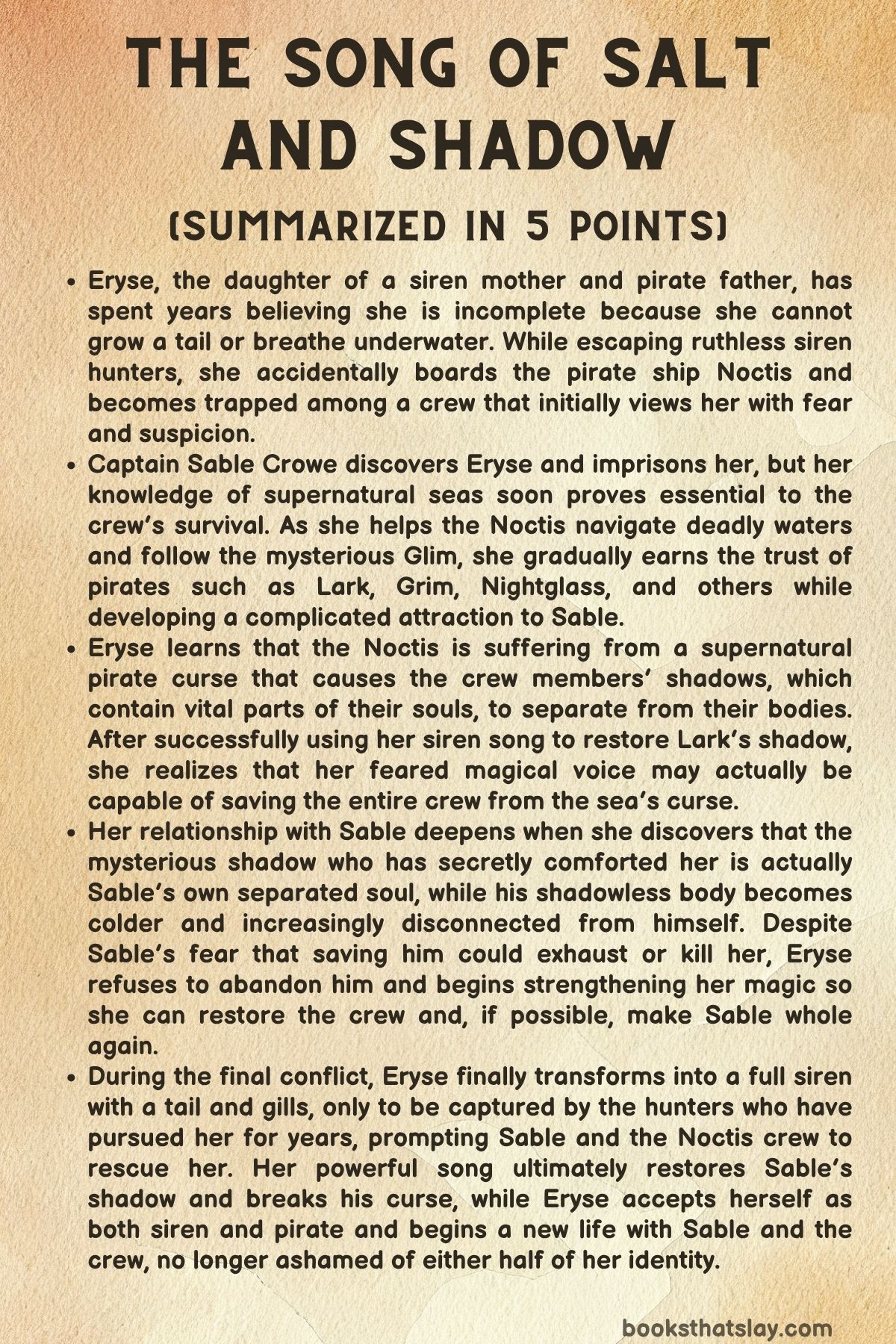
Summary
Eryse has spent years trying to become the siren she believes she was meant to be. Born to a siren mother and pirate father, she possesses scales and traces of siren magic but no tail, leaving her caught between two worlds and accepted by neither.
Her mother disappeared when Eryse was seven, while her father was publicly executed as a pirate. Left alone on Aurelith, Eryse grows up hiding from hunters who value siren bodies for their magical scales, blood, and other properties.
One evening, Grimsbane and his hunters corner her in Cantora. Eryse escapes by boarding a large black ship, only to discover that she has unknowingly hidden aboard the Noctis, a pirate vessel commanded by Captain Sable Crowe.
She initially conceals herself below deck with the unwilling assistance of Lark, a young cabin boy whom she influences with her limited siren compulsion. When the ship leaves harbor, Eryse becomes trapped aboard and soon learns that the Noctis is following a mysterious silver light called the Glim.
Her hiding place does not remain secret for long. After injuring her foot and moving around the ship in search of food and water, she is discovered by Sable, who quickly becomes suspicious of her claim that she is a sea witch.
Eryse is imprisoned while Sable tries to discover her identity. A strange shadowlike figure begins visiting her and tells her that Sable hates dishonesty more than he hates sirens, eventually persuading her to reveal the truth.
When Eryse finally admits that she is a siren, Sable reacts with hostility because he cannot understand how a siren could exist without a tail. Yet his treatment of her is inconsistent: he threatens her, but he also ensures that Harrow treats her injured foot and later allows her opportunities to prove her usefulness.
Eryse soon gains such an opportunity when the Noctis approaches the Intermaria, a dangerous meeting point between supernatural seas. She knows that the maelstroms there must be navigated through their shifting edges rather than directly resisted.
Sable reluctantly follows her instructions after the Glim indicates the same route. The Noctis survives, but Eryse is touched by the Sea of Renewal, whose waters heal her injured foot while taking one of her memories in return.
She later realizes that she can no longer remember how she boarded the Noctis. The lost memory damages her credibility during a pirate tribunal held to determine her fate, and despite arguments from crew members who acknowledge that she saved them, the pirates sentence her to walk the plank.
Eryse accepts the sentence partly because she still hopes the sea will force her long-awaited transformation. Instead, she sinks and begins to drown, proving once again that she cannot naturally breathe underwater.
Sable dives after her and saves her, openly defying the tribunal. By doing so, he creates tension among his own crew, particularly with the hostile pirate Eryse calls Rat, but he declares that she is now his responsibility.
Freed from the cell, Eryse gradually becomes involved in life aboard the ship. She forms stronger connections with Lark, Grim, Nightglass, Harrow, Match, and others while continuing to struggle with Sable’s unpredictable behavior.
The mysterious shadow continues visiting her as well. It speaks to her with unusual kindness and challenges her belief that the absence of a tail makes her defective, suggesting that the sea may have reasons for creating her exactly as she is.
Eryse eventually succeeds in calling the Glim herself. This proves that the mysterious light is connected to her rather than simply to the Noctis, and the ship follows it deeper into dangerous supernatural waters.
In the Sea of Bones, Eryse learns the truth about the curse affecting pirates. The sea punishes pirate crews for taking what does not belong to them, giving each crew a task or path toward possible freedom before eventually calling them into the water to die.
The crew of another ship demonstrates the horrifying end of that curse when its sailors willingly walk into the sea. Eryse now understands why the Noctis has followed the Glim with such desperation and realizes that Lark and the people she is beginning to care about may have little time remaining.
The ship later reaches a pirate island where Sable takes Eryse to his sister Cailia, a powerful sea witch. Cailia concludes that the Glim may actually be guiding Eryse, with the Noctis merely traveling along the path meant for her.
Through Cailia, the sea itself communicates with them and declares that Eryse is Sable’s fate. They are directed toward the Sea of the First Song, a legendary place associated with sirens, beginnings, endings, and ancient magic.
Eryse and Sable continue growing closer. They share painful details about their childhoods, including the fact that both of their fathers were hanged, and Eryse begins recognizing that Sable’s frightening changes may be connected to his curse.
Her own inner conflict also intensifies. She fears the violent instincts associated with her siren nature, but Sable repeatedly argues that possessing dangerous impulses does not make her evil when she still has empathy and the ability to choose.
That distinction becomes critical when Rat attacks Eryse and tries to harvest her scales. Under the threat, Eryse releases a far stronger siren song than she has ever used before and compels him to fall into the sea.
The killing horrifies her. Sable does not excuse what happened, but he helps her understand that Rat intended to mutilate and murder her and that her remorse reveals an essential difference between cruelty and desperate self-defense.
Soon afterward, the Noctis enters the Sea of Shadows. There, Eryse discovers that the strange figures she believed were ghosts are actually the pirates’ shadows separating from their bodies because of the curse.
When Lark’s shadow detaches, Eryse uses her voice to draw it back into him. Her song restores the boy’s missing part, suggesting that her siren magic may be the cure the crew has been seeking.
Eryse then discovers the truth about Sable’s mysterious visitor. The compassionate shadow that spoke to her, gave her the emerald dress, and comforted her is Sable’s own detached shadow.
When the shadow leaves him, Sable becomes increasingly empty, cruel, and disconnected from himself. His shadow is effectively his soul, and each separation makes returning to his body more difficult.
This revelation explains the conflicting versions of Sable that Eryse has known. It also strengthens her determination to save him, although Sable fears that restoring his badly separated soul would require enough magical power to kill her.
Their growing trust finally leads to a kiss. Sable immediately retreats because he believes Eryse deserves someone who is whole, but she refuses to accept his hopelessness and tells him not to approach her again romantically unless he is willing to fight for his own future.
The Noctis next becomes trapped in the Sea of Dreams, where the crew falls into a shared nightmare. Eryse and Sable experience events that feel completely real, including intimacy and the apparent murder of Lark, only to wake and discover that none of it physically occurred.
Eryse eventually identifies a hidden underwater current capable of moving the windless ship. As the Noctis escapes, she learns from Sable’s shadow that he has privately kept journals documenting memories he fears losing whenever his soul remains separated too long.
The entries show that Sable understood Eryse far earlier than she realized and had tried to protect her even when he could not openly reveal his feelings. They also expose the severity of his condition: he has repeatedly written down his own name because the curse can make him forget who he is.
Eryse promises to restore the crew before attempting to save Sable. To build enough strength, she spends long periods immersed in salt water while the Noctis follows the Glim beyond known maps.
Eventually they enter the Sea of the First Song, an ancient cavern that seems connected to the origins of the sea itself. There, Sable admits that his time is almost over because the sea has begun calling him home.
Believing they may have only one night left, Eryse and Sable stop hiding their feelings. Their relationship becomes fully intimate, but Eryse refuses to treat the moment as a farewell and continues planning for a future in which both survive.
The following day, Eryse begins restoring the crew’s shadows. Her amplified song forces one shadow after another back into its owner, but the effort weakens her severely.
Before she can finish, Grimsbane’s hunters attack the Noctis. Saint is killed, and Eryse realizes that the hunters have used stolen siren magic to reach waters that should have prevented ordinary humans from following them.
Already exhausted, Eryse fights back using newly emerging siren abilities. Her nails become talons, and she uses her song to compel several attackers into the sea, drawing power from their deaths.
The effort causes her to collapse into the water. As hunters capture her in a net, the transformation she has wanted all her life finally occurs: her legs become a powerful pink-scaled tail, gills open at her throat, and she can breathe underwater.
Yet her triumph immediately becomes captivity. The hunters take her back to Aurelith, where she is displayed at a market and prepared for sale or dismemberment.
Sable refuses to abandon her. With Cailia, Grim, Nightglass, Match, and other members of the crew, he enters the dangerous market despite the threat of royal capture and launches a rescue.
When Grimsbane touches Eryse’s tail, Sable cuts off his hand. The Noctis crew fights the hunters while Cailia frees Eryse, and Sable carries her away as royal forces close in.
Eryse fears that she has failed to save Sable’s soul, but he reveals that his shadow is now permanently attached. When Eryse screamed while being captured, the full force of her song reached him and restored his missing soul without her realizing it.
Grim is badly wounded during the escape, and Eryse willingly gives one of her new scales so Cailia can create the magic needed to save him. This act shows how completely Eryse’s relationship with her siren identity has changed: what was once a source of shame can now become something she chooses to use.
Cailia explains that Eryse and Sable could have become either each other’s beginning or each other’s destruction. Their willingness to trust each other changed the meaning of that fate.
After returning safely to the pirate islands, Sable’s restored memories return along with his soul. Eryse, meanwhile, is finally comfortable in the body she spent years longing for and no longer treats her human and siren sides as competing identities.
She now understands herself as both siren and pirate. Sable, free from the curse and able to remember every moment they share, promises to sail with her toward whatever future they choose, turning what once seemed like an unavoidable ending into the beginning of a shared life.
Characters
Eryse
Eryse is the emotional and narrative center of The Song of Salt and Shadow, and almost every major conflict in the book grows from the gap between what she believes she should be and what she actually is. Her lack of a siren tail has convinced her that she is unfinished, while years of abandonment, persecution, and loneliness have strengthened the belief that acceptance must be earned by changing herself.
Her greatest struggle is therefore not simply acquiring a tail but learning to stop treating difference as failure. Early in the story, she repeatedly risks drowning because transformation matters more to her than survival, demonstrating how deeply shame has shaped her relationship with her own body.
Eryse’s siren instincts create a second layer of conflict because she associates power with monstrosity. Her voice can control others, her instincts respond violently to danger, and eventually she discovers that death can replenish her magic, making her afraid that embracing her true nature will destroy her morality.
Yet Eryse consistently shows that morality depends on choice rather than harmlessness. She feels guilty after compelling Lark, mourns the consequences of killing Ash even after he attacks her, risks herself to restore the pirates’ shadows, gives a scale to save Grim, and repeatedly places other lives ahead of her own comfort.
Her development is completed when she no longer divides herself into incompatible pieces. Receiving a tail matters, but her true resolution comes from accepting both her siren inheritance and her pirate heritage without requiring either side to erase the other.
Sable Crowe
Sable initially appears to embody nearly everything Eryse has learned to fear about pirates. He is threatening, suspicious, capable of violence, and willing to imprison her, yet the book gradually reveals that his harshness is inseparable from a supernatural condition that is literally dividing his identity.
The central complexity of Sable in The Song of Salt and Shadow lies in the separation between his body and his shadow. His detached shadow retains compassion, memory, affection, and much of the emotional self that the physical Sable gradually loses, making his apparently inconsistent behavior part of a larger struggle over whether a person remains responsible for actions committed while pieces of the self are being stripped away.
Sable’s instinct is always to convert emotional vulnerability into control. He protects Eryse but calls it responsibility, saves her but says he needs her because of the Glim, and resists their romantic connection because deciding that he is unworthy feels safer than allowing himself to hope.
His relationship with Eryse changes him because she refuses to accept decisions made on her behalf. When he tries to protect her by denying her the chance to save him, she insists that choosing her risks belongs to her, forcing Sable to recognize the difference between protection and control.
His ultimate restoration is therefore emotional as well as magical. Once his shadow returns permanently, Sable regains not only his soul and memories but also the ability to imagine a future instead of organizing his life around an expected death.
Lark
Lark functions as one of the clearest measures of Eryse’s changing relationship with the Noctis. Their connection begins through coercion when she uses her compulsion to make him hide her and forget their encounter, but she quickly regrets interfering with his will and becomes increasingly careful about earning rather than controlling his trust.
His youth adds emotional urgency to the pirate curse. Once Eryse learns that the sea will eventually call the entire crew to their deaths, the presence of a child aboard makes the threat especially difficult for her to accept.
Lark’s relationship with Nightglass also reveals that the pirates are not merely criminals or supernatural victims but a community containing families, loyalties, and ordinary affection. His fear during dangerous crossings reminds Eryse that bravery and vulnerability can exist together.
The moment in which his shadow separates becomes one of the story’s greatest turning points. Eryse restores him through controlled siren song, proving that the power she feared as a means of domination can also return a damaged person to wholeness.
Later, Lark gives Eryse a fish to thank her for saving his soul. The gift is simple, but its meaning is substantial because it comes from genuine gratitude rather than fear, confirming that the relationship begun through compulsion has become voluntary affection.
Grim
Grim is one of the stabilizing forces aboard the Noctis. He enters Eryse’s life while she is still imprisoned and distinguishes himself through practical kindness, giving her water and speaking to her without the immediate cruelty she expects from pirates.
His loyalty to Sable is strong, but it is not mindless obedience. Grim repeatedly intervenes when Sable’s behavior becomes dangerously extreme, challenges him when the captain appears to gamble with the crew’s lives, and helps maintain order when conflict threatens to become mutiny.
This balance makes Grim significant because he represents loyalty guided by judgment. He can support Sable while still confronting him, and he can remain cautious about Eryse without allowing prejudice to determine every decision.
His evolving attitude toward Eryse is similarly measured. He does not promise his tribunal vote merely because she bargains for it, but he allows her actions to influence his view, gradually accepting that she has become important to the crew.
Eryse later pushes herself dangerously hard to restore Grim’s separated shadow and ultimately sacrifices one of her own scales to help save his life after he is wounded. Their relationship therefore moves from guarded cooperation to mutual loyalty earned through repeated choices.
Nightglass
Nightglass initially approaches Eryse with understandable suspicion because she belongs to a species feared for using supernatural influence against humans. His distrust becomes more complex once Eryse protects Lark, because Nightglass must reconcile his fear of sirens with the fact that this particular siren has repeatedly helped his son.
As Lark’s father, Nightglass gives the Noctis a strong familial dimension. His love for the boy raises the stakes of every supernatural threat and helps Eryse see the crew as individual people rather than a single hostile group.
Nightglass also becomes an important voice of fairness. During Eryse’s tribunal, he points out her connection to the Glim and later publicly supports her attempt to restore the crew because she has already proven that her power can save Lark.
His gradual trust is important precisely because it is not immediate. He does not abandon every fear once Eryse performs one good action; instead, his opinion changes through observation, gratitude, and evidence.
By the time Eryse chooses to restore Nightglass early so Lark will not lose his father, their connection illustrates one of the book’s strongest ideas about chosen community. Care grows through actions that make old categories such as pirate, human, and siren less important than the relationships created between individuals.
Cailia
Cailia expands the supernatural world of the story while also providing insight into Sable that he cannot easily offer himself. As his sea-witch sister, she possesses a deep understanding of ocean magic and immediately recognizes that Eryse’s connection to the Glim may be different from what the Noctis assumes.
Her interpretation changes the direction of the voyage. Instead of viewing Eryse as a useful passenger connected to the crew’s salvation, Cailia proposes that the Glim may have appeared specifically for Eryse and that the pirates have been following her path rather than the reverse.
Cailia also serves as an intermediary between human characters and the sea itself. When the sea speaks through her, the declaration that Eryse is Sable’s fate gives language to a connection neither of them fully understands.
Despite her extraordinary magical role, Cailia remains firmly connected to her family. She aids Sable’s attempt to rescue Eryse despite the danger, uses her coral magic against royal forces, and later works to save the badly wounded Grim.
Her explanation that Eryse and Sable could have become either each other’s beginning or end gives the prophecy an important element of choice. Fate establishes possibilities, but Cailia makes clear that trust and action determine which possibility becomes real.
Saint
Saint receives less narrative attention than several other members of the crew, but his role becomes increasingly important because his ordinary presence helps establish the Noctis as a functioning community. As the ship’s carpenter, he belongs to the practical structure of pirate life rather than its supernatural mysteries.
His early near-discovery of Eryse occurs when she is still hiding in the hold, placing him among the crew members she initially views primarily as threats. Over time, however, that distant perception changes as she lives among the pirates and begins recognizing them as individual people.
Saint’s death during the hunters’ attack therefore carries meaning beyond the loss of a minor crewman. By that stage, Eryse no longer sees the Noctis as a temporary refuge populated by dangerous strangers, so watching Saint die beside her makes the attack personal.
His death also prevents the conclusion from becoming consequence-free. Even though the curse can be broken and many characters survive, saving the crew cannot reverse every loss, and Sable’s restored memories later ensure that Saint is remembered rather than erased by the happiness of survival.
Match
Match represents the quieter process through which Eryse earns acceptance aboard the Noctis. During the period surrounding her tribunal, he is willing to acknowledge that many pirates want her dead or sold while also recognizing that she deserves credit for helping save the ship.
His willingness to distinguish collective fear from individual judgment makes him one of the crew members capable of reconsidering Eryse without ignoring the danger traditionally associated with sirens. That quality supports the gradual transition from hostility to cooperation aboard the ship.
Match later becomes particularly significant when Sable selects him as the first pirate whose shadow Eryse will attempt to restore. As the youngest adult crew member, he is placed at the beginning of an experiment whose pain and outcome remain uncertain.
His restoration becomes proof that Eryse can repeat what she previously accomplished with Lark. Through Match, her ability moves from a miraculous isolated incident toward a genuine method of saving the entire crew.
Match therefore occupies a modest but structurally important role. His character helps demonstrate how trust can grow through evidence and how one person’s willingness to go first can transform an uncertain possibility into collective hope.
Harrow
Harrow is among the first members of the Noctis to offer Eryse care without demanding an emotional debt in return. As the elderly bonesetter, he treats the infected wound in her foot with professional concern and provides a form of gentleness she has rarely experienced during years of solitary survival.
The significance of this encounter lies partly in its ordinariness. Eryse is accustomed to protecting herself, treating her own injuries, and assuming that vulnerability will be exploited, so allowing another person to tend to her requires a small but meaningful surrender of control.
Harrow’s reaction to the emerald dress also shows that his kindness does not prevent him from taking supernatural danger seriously. When Eryse says that a ghost gave it to her, he warns her about communicating with spirits, revealing the cultural beliefs surrounding the strange world of the Noctis.
His role does not dominate later events, but that does not make him unimportant. Characters such as Harrow help explain why Eryse eventually becomes emotionally attached to the crew: her sense of belonging develops through repeated moments of ordinary care as much as through dramatic rescues.
Ash, Also Known as Rat
Ash is initially known to Eryse only through the hostile nickname Rat because his behavior immediately signals danger to her. Unlike crew members whose suspicion gradually softens, his resentment toward her intensifies as her position aboard the Noctis becomes more secure.
His hatred is connected to fear, prejudice, and desperation created by the pirate curse. Believing that the crew may already be doomed, he decides that harvesting Eryse’s valuable scales could provide some advantage, reducing her from a person to a magical resource.
That decision makes Ash an important embodiment of the exploitation Eryse has feared throughout her life. The threat presented by hunters is reproduced inside the supposedly safer community of the Noctis when he attempts to cut into her body for profit.
His death also becomes a defining moral crisis for Eryse. She uses a full siren song to command him overboard and is horrified by how natural and powerful the act feels.
Ash therefore functions as both antagonist and catalyst. His attack confirms that Eryse’s fears are not irrational, but her reaction afterward proves that possessing lethal power does not eliminate conscience or automatically make its wielder cruel.
Grimsbane
Grimsbane represents the organized exploitation of sirens that has shaped Eryse’s life long before she boards the Noctis. He views her body primarily in terms of its commercial and magical value, making his pursuit different from simple personal hatred.
His hunters force Eryse into the journey that changes her life. By cornering her in Cantora, Grimsbane unintentionally drives her aboard the Noctis, meaning the antagonist attempting to reduce her to an object indirectly begins the process through which she finds identity, companionship, and freedom.
He returns near the end after Eryse has grown stronger, making the confrontation a measure of how much she has changed. Earlier she survives him through flight, but after gaining her tail she confronts a system that openly displays siren bodies as merchandise.
Grimsbane’s decision to touch Eryse’s tail during the rescue also allows Sable to make his opposition unmistakable. By severing Grimsbane’s hand, Sable violently rejects the hunter’s assumption that Eryse’s body belongs to anyone who can capture or purchase it.
Grimsbane consequently represents objectification in its most literal form. His defeat coincides with Eryse gaining control over the very identity that people like him have tried to exploit.
Sable’s Shadow
Although Sable’s shadow is ultimately revealed to be part of Sable rather than an independent person, it functions for much of the story as a distinct character. Eryse meets it without understanding its identity and develops trust in it because it offers the emotional openness that physical Sable often cannot provide.
The shadow gives Eryse the emerald dress, speaks gently about her body, calls her Risa, and repeatedly encourages her to reject the belief that she is defective. Because Eryse believes she is speaking to a ghost, their conversations temporarily exist outside the tension surrounding captain, captive, pirate, and siren.
Its eventual identity changes the reader’s understanding of Sable. The kindness Eryse attributed to a separate being is revealed to be part of him, while the increasingly empty man left behind when the shadow departs represents a body losing access to its soul.
The shadow’s reluctance to return also makes the curse more complicated than a simple external punishment. Reunion is painful for it, meaning saving Sable requires forcing two parts of one person through suffering in order to become whole again.
Through the shadow, the novel turns internal emotional division into a literal supernatural condition. Sable’s struggle with memory, identity, tenderness, violence, and hopelessness becomes physically visible rather than merely psychological.
Eryse’s Mother
Eryse’s mother is absent from most of the present-day action, but her influence is central to Eryse’s understanding of sirenhood. Eryse remembers her scales, songs, and connection to the sea, making her both a source of longing and an impossible standard against which Eryse measures herself.
Her departure when Eryse was seven creates one of her daughter’s deepest wounds. Because Eryse cannot transform, she interprets abandonment through the belief that her mother left because she was an inadequate siren.
As Eryse matures, that interpretation becomes less absolute. She begins considering the possibility that her mother loved her but could not safely raise a tail-less child within a siren swarm governed by expectations and dangers Eryse did not understand as a child.
The mother’s old lullaby later becomes especially important when Eryse uses it to bring Lark’s shadow back into his body. Something associated with maternal memory and siren heritage becomes the foundation of Eryse’s ability to heal rather than control.
Her influence therefore survives through Eryse’s magic. The heritage Eryse once associates with abandonment eventually provides one of the tools through which she saves her chosen family.
Eryse’s Father
Eryse’s father represents her connection to piracy before the Noctis ever becomes part of her life. His execution left Eryse with grief, fear, and a heritage she learned to hide alongside her siren nature.
Her memories of him are complicated by the Sea of Renewal. After witnessing his hanging, Eryse surrendered the memory because the pain was unbearable, but she later regrets having lost one of the final pieces of her father.
This regret introduces an important distinction between escaping pain and healing from it. Removing a memory can reduce suffering, but it also removes part of the relationship connected to that suffering.
The dance Eryse remembers learning from him becomes an especially gentle form of inheritance. When she dances among pirates years later, an activity linked to childhood briefly reconnects her with a part of herself she has spent years suppressing.
His relationship with Eryse’s siren mother also gives her a model in which supposedly opposing worlds were once capable of loving each other. As Eryse eventually accepts herself as both pirate and siren, she becomes living evidence that the identities embodied by her parents never needed to cancel one another.
The Siren on the Pirate Island
The unnamed siren Eryse meets on the beach acts as a warning about the dangers of trusting humans. She immediately recognizes Eryse as one of her own kind and cannot understand why a siren would willingly remain among pirates.
Her suspicion is supported by real historical violence rather than simple prejudice. Humans hunt sirens, sell their scales, exploit their magic, and place enormous commercial value on their bodies, making her warning about pirates difficult for Eryse to dismiss completely.
At the same time, the siren’s worldview leaves little room for individual exceptions. Eryse has already begun distinguishing between hunters who want to harvest her and pirates who have risked themselves for her, so the warning forces her to decide whether inherited hostility should outweigh personal experience.
The encounter also triggers Eryse’s fear of becoming monstrous. Faced with another full siren, she confronts the instincts she has spent years suppressing and wonders whether receiving a tail would mean losing control over herself.
The unnamed siren therefore represents both cultural memory and limitation. Her fears are understandable, but Eryse’s journey requires building an identity that cannot be dictated completely by either siren expectations or human assumptions.
Themes
Identity, Difference, and Self-Acceptance
Eryse’s desire for a tail initially appears to be a physical goal, but it is actually tied to a far deeper belief that her body determines whether she deserves to belong. In The Song of Salt and Shadow, she has spent so long imagining a complete siren as something different from herself that transformation becomes a condition she places upon her own worth.
That mindset explains why she repeatedly enters the water even when previous attempts have nearly killed her. She is not simply curious about whether she can transform; she is trying to prove that her existence was not a mistake.
The story gradually separates self-acceptance from physical transformation. Eryse begins enjoying swimming without demanding that the sea change her, allows the pirates to see her eating according to siren instinct, uses her voice openly, and learns that people can value her before she possesses the body she has always wanted.
Her eventual tail therefore does not create her identity from nothing. By the time it appears, much of the deeper transformation has already occurred because Eryse has started accepting her existing scales, instincts, powers, human experiences, and pirate inheritance as equally legitimate parts of herself.
The ending completes this idea by allowing Eryse to identify as both siren and pirate. Belonging is no longer achieved by choosing one inheritance over another but by rejecting the assumption that a person must fit a single inherited category in order to be whole.
Power, Choice, and the Meaning of Monstrosity
Siren power is repeatedly associated with fear because it can remove another person’s freedom. Eryse can compel people through song, and her first uses of that ability leave her ashamed because survival requires manipulating Lark without his genuine consent.
As her strength increases, the moral problem becomes more severe. She learns that she can command people toward death and that sacrifice can replenish her magic, creating the frightening possibility that greater power might also bring her closer to the monster she fears becoming.
The story refuses to define morality according to whether someone possesses dangerous abilities. Instead, it repeatedly asks how those abilities are used, why they are used, and whether the person wielding them remains capable of recognizing the humanity of others.
Ash’s death becomes central to this distinction. Eryse kills a man who is attempting to harvest her body, yet her horror afterward matters because she does not treat lethal power as entertainment or entitlement.
Her later use of song to restore separated shadows transforms the same ability into an instrument of healing. The voice that can strip away free will can also return a person’s soul, showing that power itself cannot fully determine moral identity.
Sable faces a parallel struggle with violence and his shadowless state. Both characters learn that fearing their capacity for harm is not proof that they are monsters; what matters is whether they surrender responsibility or continue making conscious choices about the people they want to become.
Belonging, Trust, and Chosen Family
Eryse enters the Noctis believing that pirates are another category of people from whom she must escape. The crew likewise sees her primarily as a siren, a creature associated with manipulation, death, and valuable magical materials, so both sides initially reduce each other to inherited reputations.
Trust develops slowly because the story does not treat fear as something erased by a single heroic act. Saving the Noctis in the Intermaria gives Eryse value but does not prevent the tribunal from sentencing her to death, just as individual acts of kindness from pirates do not immediately make her forget a lifetime of human persecution.
What changes the relationships aboard the ship is repetition. Lark chooses to trust her after she regrets compelling him, Nightglass revises his judgment after she repeatedly protects his son, Grim allows actions to influence his opinion, and Sable eventually recognizes a person where he once saw primarily a dangerous supernatural stranger.
Eryse undergoes the same process. Harrow’s treatment of her injuries, Lark’s affection, Grim’s steadiness, Nightglass’s gratitude, Cailia’s assistance, and the crew’s eventual decision to risk capture while rescuing her gradually transform the Noctis from a prison into a home.
The rescue at Aurelith confirms that belonging has become reciprocal. Eryse repeatedly risks herself to save the pirates, and they later risk themselves to save her, creating a family based not on blood or species but on chosen loyalty demonstrated through action.
Fate, Hope, and the Choice to Fight
Fate constantly influences the characters without completely determining their actions. The Glim establishes a path none of them fully understands, the sea declares that Eryse is Sable’s fate, and the pirate curse places the entire crew beneath a deadline that appears impossible to escape.
These supernatural forces could make the characters passive, yet the story repeatedly emphasizes that knowing a possible outcome is different from choosing how to respond to it. Sable initially treats death as effectively settled, and his hopelessness becomes one of the strongest barriers between him and Eryse.
His refusal to hope protects him from disappointment but also limits his ability to imagine himself as someone worth saving. Eryse challenges this attitude because she refuses to accept that uncertainty is a reason to surrender before every possibility has been exhausted.
Cailia’s final explanation gives the idea its clearest expression. Eryse and Sable could have become each other’s beginning or each other’s end, meaning the prophecy does not guarantee salvation simply because they are connected.
What determines the outcome is the series of choices made under uncertainty. Sable rescues Eryse despite the tribunal, Eryse refuses to abandon his soul, the crew follows the Glim beyond known maps, and both continue fighting even when success appears unlikely.
Hope in the story is therefore not confidence that everything will work out. It is the decision to keep acting toward a desired future even when fate offers no promise that the future will exist.