The Story Keeper Summary, Characters and Themes
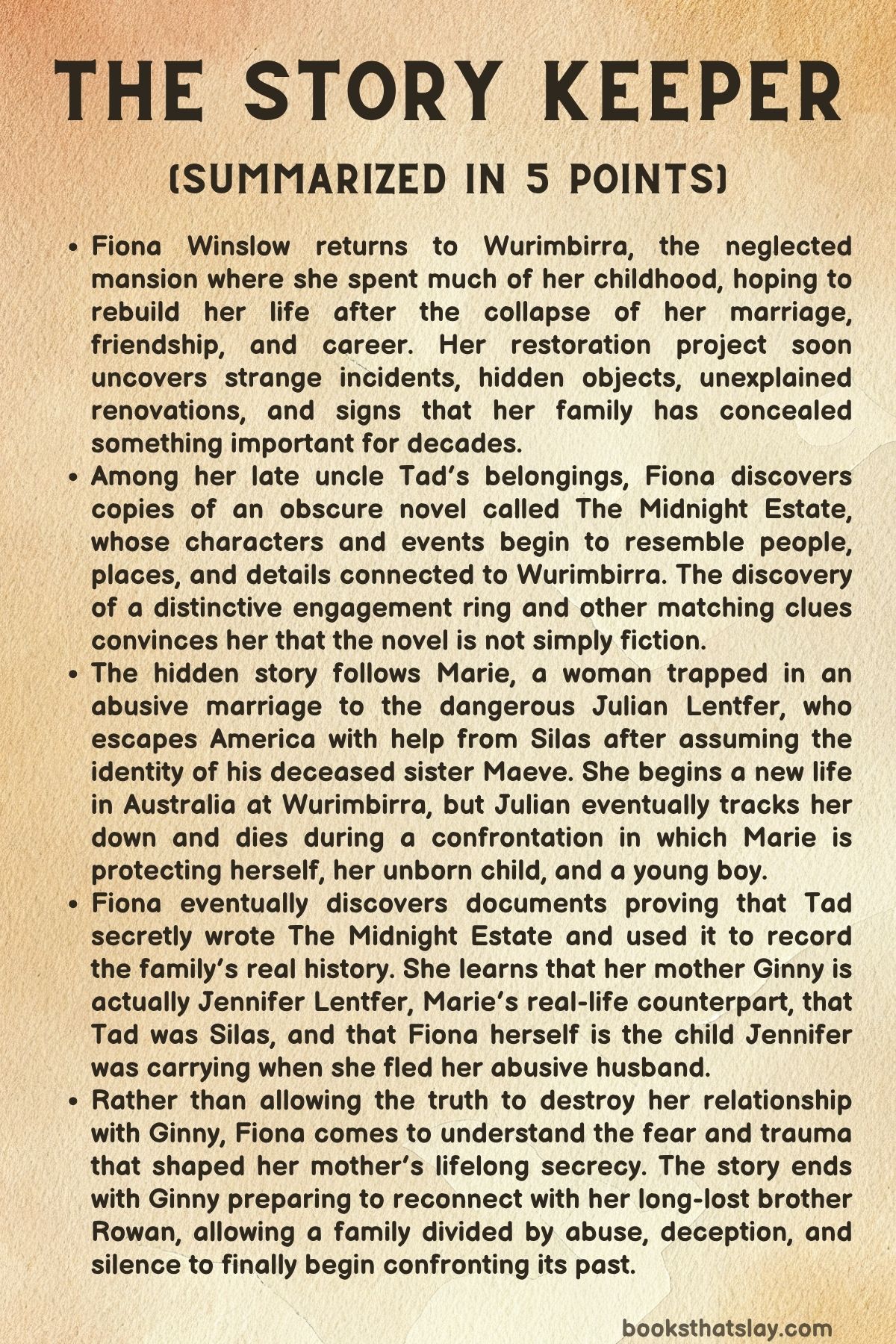
The Story Keeper by Kelly Rimmer is a family mystery centered on Fiona Winslow’s return to Wurimbirra, the neglected country mansion that shaped her childhood.
Recovering from the collapse of her marriage and career, Fiona expects the restoration of the house to give her a new purpose, but instead she discovers a hidden novel, unexplained renovations, concealed documents, and evidence that her family history is radically different from what she has always believed. As past and present begin to mirror each other, Fiona must confront inherited fear, domestic abuse, buried identities, and the consequences of protecting painful secrets for generations.
Summary
In May 2010, Fiona Winslow returns to Wurimbirra, a grand but deteriorating Victorian mansion near Forbes, New South Wales. The property once belonged to her uncle Taddeus “Tad” Winslow, a celebrated novelist who played an important role in her childhood, and Fiona has purchased it from her cousin Jon with plans to restore it.
The move comes at a moment when Fiona badly needs to rebuild her life. Her husband Lucas has left her after falling in love with Keira, Fiona’s closest friend and business partner, and the resulting professional settlement prevents Fiona from working in heritage architecture for five years.
Wurimbirra therefore represents independence, refuge, and a practical project on which Fiona can focus. Her mother, Virginia “Ginny” Winslow, reacts with anger when she learns Fiona has bought the house, insisting that Tad never wanted it sold or changed while Ginny was alive and warning Fiona that she does not understand what the house contains.
Jon soon gives Fiona another reason to question the family’s past. Shortly before Tad died in 1999, Jon overheard Tad and Ginny having a vicious argument in which Tad insisted Fiona deserved to “have something,” while Ginny strongly resisted him.
Jon had once been suspicious enough about Tad’s death to request an autopsy, although it confirmed that Tad died naturally from a cerebral aneurysm. He also remembers seeing a terrifying man standing over his bed at Wurimbirra when he was a child, an image so vivid that the house has frightened him ever since.
While cleaning the mansion, Fiona finds a parcel containing twelve copies of an obscure British novel called The Midnight Estate, written by someone named Charity Wilkie. She begins reading and encounters the story of Silas, an American who settles in Australia, and Marie Knightly, a young woman trapped in a controlling marriage to a dangerous policeman named Rupert.
The mysteries inside Wurimbirra continue to accumulate. Electricians tell Fiona that the supposedly old electrical system was completely replaced roughly twelve years earlier, apparently after a serious electrical fire, even though Tad never mentioned the expensive work.
Fiona also experiences disturbing incidents inside the house. An oil heater appears to switch itself off, glasses are mysteriously smashed, doors and objects seem to move, and strange nighttime sounds make her increasingly uncomfortable.
Among Tad’s belongings, Fiona finds an old article about Gertie Lentfer, whose remains were identified years after her disappearance. Police had wanted to question Gertie’s missing husband, Julian Lentfer, not only about Gertie’s suspected murder but also about the later disappearance of his second wife, Jennifer.
Fiona then discovers a valuable daisy-shaped diamond engagement ring hidden behind an upstairs bathroom vanity. The discovery becomes far more important when she notices that The Midnight Estate contains a ring matching the one she has just found.
Other details inside the novel also resemble Wurimbirra and Forbes with suspicious precision. When Fiona searches for Charity Wilkie, she finds almost no trace of the supposed author, strengthening her suspicion that the novel is connected directly to Tad.
The fictional story gradually exposes Marie’s terrible situation. Rupert controls her money, movements, clothing, food, communications, and relationships, leaving her with almost no independent life.
Silas recognizes what is happening partly because he grew up around abuse himself. He encourages Marie to seek help from her younger brother Irving, but Irving initially fails her by dismissing the seriousness of Rupert’s behavior and betraying her confidence, after which Rupert physically attacks her.
Silas is also carrying his own guilt. His sister Maeve becomes gravely ill from diabetes complications and influenza, and she dies before Silas can repair their damaged relationship.
When Silas later sees the injuries Rupert has inflicted on Marie, he realizes leaving her behind could mean her death. Because Marie resembles Maeve closely enough to use Maeve’s unused passport, Silas devises a plan for Marie to assume his dead sister’s identity and escape with him to Australia.
Meanwhile, Fiona’s life in Forbes begins to broaden beyond the mystery. She reconnects with Jack, an old school friend she once secretly loved, now a veterinarian who has returned to care for his father, whose health is declining because of dementia.
Jack introduces Fiona back into the local social world through a reader’s group at Turn the Page. Her renewed relationships with Marilyn, Stefanie, Patience, and others help her recognize that she does not have to respond to Lucas and Keira’s betrayal by remaining emotionally isolated.
Fiona and Jack also discuss what should happen to Wurimbirra once it is restored. Fiona is conscious that the estate carries difficult historical associations, including racism, violence, and deaths connected to First Nations people, and she believes restoration must preserve uncomfortable history rather than erase it.
Ginny continues trying to stop Fiona from investigating. She even reports Fiona to the council over concerns about the private cemetery and secretly instructs Erin, a young woman helping clean the house, to steal Fiona’s copy of The Midnight Estate.
The strange happenings inside the mansion eventually receive a partly ordinary explanation when Fiona discovers two black cats living secretly in the house. She names them Hocus and Pocus, and their presence explains some of the footsteps, broken glasses, and displaced objects, although not every unsettling experience is resolved so easily.
The Midnight Estate now carries Marie directly into a recognizable fictional version of Wurimbirra. In Australia, Silas presents Marie as his estranged sister Maeve, and his wife Christine accepts the story without realizing that the real Maeve has died.
Marie settles into the household and grows particularly close to young Ernest. Her new identity offers safety, work, and independence, but it also means that her entire future depends on hiding the truth about who she is.
Fiona eventually finds decisive physical evidence beneath a loose floorboard in Tad’s office. A hidden metal container holds identity papers, photographs, Maeve’s belongings, and the passport and wallet of Julian Lentfer.
Tad’s former agent, Rita, provides the next crucial revelation. Charity Wilkie never existed: Tad himself wrote The Midnight Estate under that name and deliberately arranged for the book to appear only in Britain so that Ginny would not easily discover it.
The final part of Tad’s novel reveals why he needed secrecy. After Marie becomes pregnant and begins building a safer life at Wurimbirra, Rupert eventually tracks her to Australia and enters the mansion carrying a knife.
Rupert threatens Ernest and confronts Marie near the staircase. While defending herself, her unborn child, and Ernest, Marie pushes Rupert away, causing him to fall down the stairs and die.
Silas decides that contacting the authorities could expose Marie’s false identity and return her to danger. He therefore helps her conceal Rupert’s body in the private cemetery, while Ernest’s encounter with Rupert becomes the terrifying childhood memory that later survives in Jon’s mind as an unexplained nightmare.
Confronted with Tad’s book and the hidden documents, Ginny finally admits the truth. She is Jennifer Lentfer, the woman represented as Marie; Tad was Silas; Jon was Ernest; Daphne was Christine; and Fiona herself is Cynthia Maeve, the child Jennifer was carrying when she escaped America.
Julian Lentfer, represented as Rupert, was Fiona’s biological father. Tad’s final argument with Ginny was not about leaving Fiona the mansion but about whether Fiona and Jon should ever learn the history their family had spent decades concealing.
Fiona does not respond by condemning her mother. Understanding Ginny’s history instead helps her recognize the source of the fear, emotional distance, and determination that shaped Ginny’s adult life.
Fiona then searches for Ginny’s younger brother Rowan, the real Irving. Rowan spent decades believing his sister Jennifer had died, and eventually founded Jennifer’s Voice, an organization intended to educate people about coercive control and protect abuse survivors.
The discovery forces Ginny to reconsider the past once more. She finally recognizes Julian’s treatment of her as abuse and learns that Rowan never stopped caring about what happened to her.
After half a century of hiding, Ginny agrees that secrecy has lasted long enough. With Fiona beside her, she prepares to contact Rowan, bringing the story to a close not with the destruction of the past but with the possibility that acknowledging it can end the fear that has governed the family for generations.
Characters
Fiona Winslow
Fiona is the central character of The Story Keeper, and her return to Wurimbirra places her at the intersection of personal reinvention and inherited family history. At the beginning of the book, she has recently lost several foundations of her adult identity at once: her marriage to Lucas, her friendship with Keira, and her professional role in the heritage firm they built together.
Her decision to restore Wurimbirra shows both independence and an instinct to preserve rather than discard difficult things. The same quality governs her investigation into her family, because she refuses to accept Ginny’s warnings as sufficient reason to leave the past untouched.
Fiona is rational enough to search for ordinary explanations for the house’s disturbances, yet open-minded enough to change her conclusions when evidence accumulates. Finding the hidden novel, the ring, the Lentfer article, and Tad’s concealed documents gradually transforms the restoration project into a search for personal identity.
Her compassion becomes especially important after she discovers that Ginny is Jennifer Lentfer. Fiona chooses understanding over judgment, recognizing that the deception surrounding her birth developed from fear, abuse, and a desperate need for safety rather than simple dishonesty.
Virginia “Ginny” Winslow / Jennifer Lentfer / Marie Knightly
Ginny is one of the most psychologically important figures in The Story Keeper because almost every mystery surrounding Wurimbirra can ultimately be traced to her need to keep her former identity hidden. Her anger toward Fiona’s restoration project initially appears controlling and unreasonable, but the eventual revelations completely change the meaning of her behavior.
As Jennifer Lentfer, she survived a coercive and dangerous marriage to Julian Lentfer. Tad transformed her experiences into Marie Knightly’s story, showing how completely her husband controlled her finances, movement, clothing, communications, and contact with other people.
Her escape required assuming the identity of a dead woman and permanently abandoning her former life. Even after reaching Australia, she remained vulnerable because exposure could reveal false documents, a concealed death, and the violent circumstances from which she had escaped.
Ginny’s emotional restraint therefore functions as self-protection. Her later opposition to Tad telling Fiona and Jon the truth shows that surviving danger never fully freed her from expecting catastrophe if her past became known.
Her eventual willingness to contact Rowan marks an important change. For perhaps the first time, she accepts that secrecy is no longer the only means of staying safe and that acknowledging what Julian did to her can reconnect her with the brother she believed she had permanently lost.
Taddeus “Tad” Winslow / Silas
Tad is physically absent from the present-day story because he died in 1999, yet his decisions control much of what Fiona eventually discovers. His transformation of real events into The Midnight Estate makes him both participant and record keeper, using fiction to preserve truths that Ginny desperately wanted forgotten.
As Silas, he is presented as fundamentally compassionate but imperfect. He recognizes Marie’s abuse because of his own childhood experiences and ultimately risks a great deal to help her escape, yet his obsessive devotion to writing also damages his marriage to Christine.
His guilt over Maeve also influences his actions. Having failed to recognize how badly his sister needed him before her death, he refuses to make the same mistake when confronted with Marie’s danger.
Tad’s greatest ethical conflict appears after Julian’s death. Rather than involve the police, he helps conceal the body, placing Ginny’s safety above legal transparency.
His hidden novel is ultimately an attempt to correct decades of silence. Tad understands that Fiona and Jon have been shaped by events they do not know, and he wants them to inherit the truth even though Ginny believes knowledge will only renew the danger.
Jack
Jack provides Fiona with an alternative emotional future that develops gradually rather than replacing her broken marriage overnight. He is an old school friend whom Fiona secretly loved when they were young, but by the time they reconnect, both have accumulated adult responsibilities and losses.
His presence is reassuring partly because he does not demand anything from Fiona. He invites her into social life, talks honestly about his father’s dementia, and gives her space to discuss her uncertainty about Wurimbirra and her future.
Jack also helps reconnect Fiona with Forbes as a community rather than merely a location associated with childhood. Through him, the town becomes a place where relationships can be renewed instead of only a backdrop for family secrets.
His role in the story represents cautious possibility. Fiona’s growing attraction to him matters because she is learning that Lucas and Keira’s betrayal does not have to determine every future relationship.
Jon Winslow / Ernest
Jon initially appears mainly as Fiona’s cousin and the person who sold her Wurimbirra, but his childhood memories become vital evidence. His recollection of a threatening man standing over his bed sounds supernatural until Tad’s novel reveals the real source of the trauma.
As Ernest, Jon was present when Julian reached Wurimbirra and threatened Marie. The frightening image that remained with him into adulthood was therefore not an imagined haunting but a fragmented memory of genuine danger.
Jon’s experience shows how children can carry the emotional consequences of secrets they do not consciously understand. The adults protected him from the facts, but they could not erase the fear stored in his memory.
His earlier decision to request an autopsy after Tad’s death also demonstrates that he has long sensed unresolved tension in the family. He may not initially know what happened, but he recognizes that Ginny and Tad’s final conflict was serious enough to raise disturbing questions.
Lucas
Lucas is Fiona’s estranged husband and one of the major causes of her present-day crisis. His decision to leave Fiona after falling in love with Keira does more than end a marriage because Fiona loses her spouse, business partner, home life, and professional stability within the same period.
Lucas is important less for his direct involvement in the historical mystery than for the consequences of his choices. His betrayal removes the future Fiona expected to have and indirectly drives her toward Wurimbirra.
The breakdown of their relationship also shapes Fiona’s caution around Jack. She is attracted to Jack but understandably reluctant to trust another romantic possibility so soon after discovering that two of the people closest to her had built a relationship behind her back.
Keira
Keira’s betrayal is particularly damaging because she was not merely Fiona’s colleague but her closest friend and partner in the heritage architecture firm. Her relationship with Lucas therefore destroys two central relationships in Fiona’s life simultaneously.
Keira represents the loss of trust beyond marriage. Fiona cannot separate her personal heartbreak from professional upheaval because both Lucas and Keira belonged to the same business she helped create.
Although Keira is not involved in the historical mystery, the consequences of her actions influence Fiona’s behavior throughout the book. Fiona’s need to establish something that belongs entirely to her helps explain why restoring Wurimbirra becomes so important.
Rowan / Irving
Rowan is Ginny’s younger brother and appears in Tad’s fictional account as Irving. During Jennifer’s original crisis, his failure is serious: when she tells him she wants to leave Julian, he dismisses the danger because Julian has not yet inflicted the level of violence Rowan associates with abuse.
He then betrays her confidence, allowing Julian to learn that Jennifer wants to escape. From Jennifer’s perspective, this makes Rowan another person she cannot safely trust.
Yet the later revelation prevents Rowan from remaining defined by that youthful failure. After Jennifer disappears, he spends decades believing she is dead and eventually establishes Jennifer’s Voice to educate others about coercive control and support survivors.
His life becomes a form of long-term response to what he failed to recognize when he was younger. The possibility of reunion allows both siblings to reconsider a relationship that violence and misunderstanding interrupted for half a century.
Julian Lentfer / Rupert
Julian is the principal human threat behind the family’s hidden history. In Tad’s novel he appears as Rupert, a policeman whose position gives him additional power while he systematically controls Marie’s life.
His abuse is not presented only as physical violence. He controls money, clothing, food, correspondence, movement, telephone access, and personal relationships, creating an environment in which Marie loses almost every ordinary form of independence.
His danger increases when he tracks Marie all the way to Australia despite her assumed identity. By arriving at Wurimbirra armed with a knife and threatening Ernest, he demonstrates that Marie’s fear was justified.
Julian’s death occurs while Marie is defending herself, her unborn child, and Ernest. Even after his death, however, the fear he created continues through secrecy, nightmares, concealed identities, and Ginny’s lifelong resistance to exposing the past.
Daphne / Christine
Daphne is represented in Tad’s novel as Christine, Silas’s wife. Her position is complicated because she welcomes the woman introduced as Maeve without realizing that the real Maeve is dead and that the newcomer is actually Marie using a false identity.
Christine is not presented as responsible for the central deception. Instead, she becomes another person whom Silas and Marie must mislead in order to protect Marie from Julian.
Her marriage to Silas also provides a more critical view of Tad. Silas can be generous and courageous when responding to Marie’s crisis, but his absorption in writing repeatedly leaves Christine emotionally neglected.
Daphne therefore prevents Tad from being treated as flawless. His ability to rescue someone in extraordinary circumstances exists alongside his failure to maintain attentiveness within his own marriage.
Maeve
Maeve is Silas’s estranged sister, and her illness and death have consequences far beyond her own storyline. She suffers serious complications from diabetes while also dealing with influenza, eventually dying after falling into a coma.
Silas is devastated because he realizes too late that she had concealed her difficulties and that he failed to recognize how much she needed him. Her death becomes one of the reasons he refuses to ignore Marie’s situation.
Maeve also becomes central to Marie’s escape because Marie can pass for her using Maeve’s passport, clothing, glasses, and other personal items. In this sense, Maeve’s identity unexpectedly gives another woman the possibility of survival.
Her role also creates an uncomfortable moral dimension. Marie’s freedom depends on adopting the identity of a dead woman whose own relationship with Silas ended without reconciliation.
Caitlin
Caitlin is one of Fiona’s daughters and is responsible for unintentionally revealing Fiona’s move to Ginny. This seemingly small act triggers Ginny’s furious arrival at Wurimbirra and the first direct warning that Fiona does not understand the house’s history.
Her role is limited within the supplied material, but she helps establish the generational structure of the Winslow family. Fiona is simultaneously a daughter uncovering secrets about her own origins and a mother whose children belong to a generation farther removed from those hidden events.
Mia
Mia is Fiona’s youngest daughter and has recently left for university when Lucas announces his relationship with Keira. Her departure marks the end of a major period in Fiona’s domestic life and helps explain why the collapse of the marriage feels especially destabilizing.
With her children becoming independent, Fiona was already entering a transitional stage. Lucas’s betrayal transforms what might have been a gradual adjustment into a complete restructuring of her personal and professional identity.
Erin
Erin is a young backpacker living on the family farm who is sent to help Fiona clean Wurimbirra. Her apparently practical involvement takes on a more significant role when Fiona discovers that Ginny ordered her to steal The Midnight Estate.
Erin eventually confesses rather than continuing to deceive Fiona. Her admission confirms that Ginny is actively trying to obstruct the investigation rather than merely expressing disapproval.
Alan
Alan is Ginny’s husband and part of the stable Australian life she constructed after escaping her former identity. Fiona thinks of Ginny and Alan’s marriage as practical and restrained, and this observation encourages her to question whether her mother’s suspicion of romantic love may have originated in experiences Fiona knows nothing about.
Once Ginny’s past becomes known, that emotional caution gains a different meaning. Her earlier marriage to Julian taught her that intimacy could become a means of control, making emotional restraint understandable as part of the life she built afterward.
Rita
Rita is Tad’s former literary agent and the person who provides Fiona with one of the investigation’s decisive confirmations. She reveals that Charity Wilkie was not a real author and that Tad himself wrote The Midnight Estate.
Her information changes Fiona’s understanding of the novel. What initially seemed like an obscure fictional work connected somehow to Wurimbirra becomes Tad’s deliberate record of events he believed Fiona and Jon should eventually know.
Marilyn
Marilyn is part of the Forbes reader’s group and helps Fiona reconnect socially after her return. Her familiarity with books becomes useful when she confirms that she has never heard of Charity Wilkie and recognizes Fiona’s copy of The Midnight Estate as an unusual British edition.
Her role also supports Fiona’s gradual movement away from isolation. The reader’s group becomes one of the first places where Fiona begins participating in a community again after the breakdown of her marriage.
Stefanie
Stefanie is another member of the social circle Fiona encounters through the reader’s group. The supplied material gives her relatively little individual development, but her presence contributes to the sense that Fiona is returning to a network of people connected with her earlier life.
Characters such as Stefanie are important to Fiona’s recovery because they represent ordinary companionship. Not every relationship in Fiona’s renewed life must be connected with betrayal or family mystery.
Patience
Patience is likewise part of the group that welcomes Fiona back into local social life. Although the supplied material does not provide substantial information about her personal history, her presence helps turn Forbes from a place Fiona has merely returned to into a community she may again belong to.
Her role therefore operates collectively with the other reader’s group members. Through these renewed connections, Fiona begins to discover that rebuilding a life involves relationships as well as restoring a house.
Carmen
Carmen owns the diner where Silas regularly encounters Marie. She becomes an important outside observer because she confirms Silas’s suspicions about Rupert, identifying him as a corrupt and dangerous policeman involved in extorting local businesses.
Her knowledge demonstrates that Rupert’s behavior is not confined to his marriage. His abuse of Marie exists alongside a wider pattern of intimidation and misuse of authority.
Carmen also helps validate what Silas has sensed from Marie’s frightened behavior. Her information removes any remaining possibility that his concerns are based only on assumption.
Gertie Lentfer
Gertie Lentfer is Julian Lentfer’s first wife, whose remains are identified decades after she disappears. Police want to question Julian about her suspected murder, creating a deeply disturbing background to Jennifer’s later fear of him.
Although Gertie never participates directly in Fiona’s present-day story, her fate strengthens the evidence that Jennifer had legitimate reasons to believe Julian was capable of killing her. Her disappearance also shows that the danger surrounding Julian existed before Jennifer entered his life.
Themes
The Cost of Family Secrecy
Secrecy protects Ginny from immediate danger but creates consequences that continue for decades. She survives by abandoning the identity of Jennifer Lentfer, becoming someone new, and allowing almost everyone from her former life to believe that Jennifer is dead.
The protection works physically, but it leaves Fiona and Jon living inside consequences they cannot understand. Jon carries a terrifying childhood memory without knowing what produced it, while Fiona grows up unaware of her biological father, the circumstances of her birth, and the reasons her mother reacts so strongly to Wurimbirra.
Tad eventually decides that silence has become more harmful than disclosure. His response is to convert the family’s hidden history into The Midnight Estate, giving Fiona and Jon a route toward understanding even though Ginny strongly opposes his decision.
The Story Keeper ultimately treats truth as something that can become necessary even when secrecy once served a legitimate purpose. Fiona does not uncover the past in order to punish Ginny; she uncovers it so that fear no longer controls relationships among people who were never responsible for the original violence.
The final possibility of Ginny contacting Rowan shows what secrecy has cost both siblings. Fifty years of presumed death, guilt, misunderstanding, and separation cannot be erased, but acknowledging the truth finally creates the possibility of repairing what concealment preserved in a frozen state.
Coercive Control and the Recognition of Abuse
Jennifer’s experience demonstrates that abuse can operate through control long before or beyond visible physical injury. Julian regulates her money, movement, clothing, food, telephone use, mail, and personal relationships, systematically reducing her ability to act independently.
Irving’s initial response reveals why such abuse can be difficult for outsiders to recognize. Because Julian has not yet inflicted the degree of physical violence Irving expects, he minimizes Jennifer’s fear and treats her desire to leave as an overreaction.
That failure has immediate consequences when Irving reveals her intentions and Julian attacks her. The book therefore challenges the assumption that danger becomes real only after extreme physical violence occurs.
Silas recognizes the pattern more quickly because his own childhood has taught him how fear operates inside abusive households. His decision to help Jennifer comes from understanding that waiting for unmistakable proof could mean waiting until she is dead.
Ginny’s later recognition of Julian’s behavior as abuse is equally important. Even the survivor herself has spent decades interpreting the experience primarily through secrecy and survival, and Rowan’s work with Jennifer’s Voice finally gives her language for understanding what happened.
Identity, Reinvention, and the Right to Begin Again
Several characters are forced to rebuild identities after their expected lives collapse. Jennifer does so under the most extreme conditions, becoming another person in order to escape a husband she believes will eventually kill her.
Her new identity as Maeve initially begins as a practical deception involving a passport, clothing, glasses, and altered appearance. Once she reaches Australia, however, that borrowed identity becomes the foundation of an entirely new existence.
Fiona experiences a less dangerous but still profound reinvention. Lucas and Keira’s relationship destroys the marriage, friendship, and professional future around which she had organized her adulthood, leaving her to decide what remains when those roles disappear.
Her restoration of Wurimbirra parallels her own reconstruction. She does not erase damage or pretend that nothing has happened; instead, she works with what remains and determines what can still be preserved.
The contrast between mother and daughter is important. Jennifer’s reinvention depends on concealing the past, while Fiona’s eventually depends on understanding it.
By the end, both women move toward identities that are less controlled by other people. Ginny can acknowledge Jennifer without surrendering the life she later built, while Fiona can see herself as Cynthia Maeve without allowing the revelation about Julian to redefine the person she has already become.
Memory, History, and the Responsibility to Preserve Truth
Wurimbirra functions as a physical repository of history. Its rooms contain the hidden ring, unexplained renovations, concealed documents, the private cemetery, Tad’s books, and traces of events that the family has spent decades trying not to discuss.
Fiona approaches restoration with the conviction that difficult history should not simply be removed. Her attitude toward the cemetery and the property’s connections to racism and violence reflects her broader belief that preservation must include uncomfortable realities rather than only attractive or convenient ones.
Tad takes a similar approach through fiction. Unable to convince Ginny to tell Fiona and Jon directly, he records the family’s past inside a novel and leaves enough copies behind for the truth to survive him.
Jon’s childhood nightmare demonstrates what happens when factual history is suppressed but emotional memory remains. He cannot explain the image of the threatening man because the adults removed the context, yet the fear persists because secrecy does not erase experience.
The eventual discoveries allow memory and history to be reconnected. The ring, documents, novel, cemetery, and Ginny’s testimony transform disconnected clues into an understandable account of what happened, showing that preserving truth is not the same as remaining imprisoned by it.