The Tomorrow Tree Summary, Characters and Themes
The Tomorrow Tree by Carolyn Brown is a contemporary story about returning home, rebuilding trust, chosen family, and giving love another chance.
At its center is Tina O’Grady, who returns to the small Texas town of Benson after thirteen years away and discovers that the people she left behind have never stopped caring about her. Her reunion with childhood friends Walker Cosay and Gracie Ruiz forces Tina to confront old failures, family rejection, and feelings she has spent years avoiding. The Tomorrow Tree, the oak beneath which the three friends grew up, becomes a lasting symbol of memory, survival, belonging, and the possibility of beginning again.
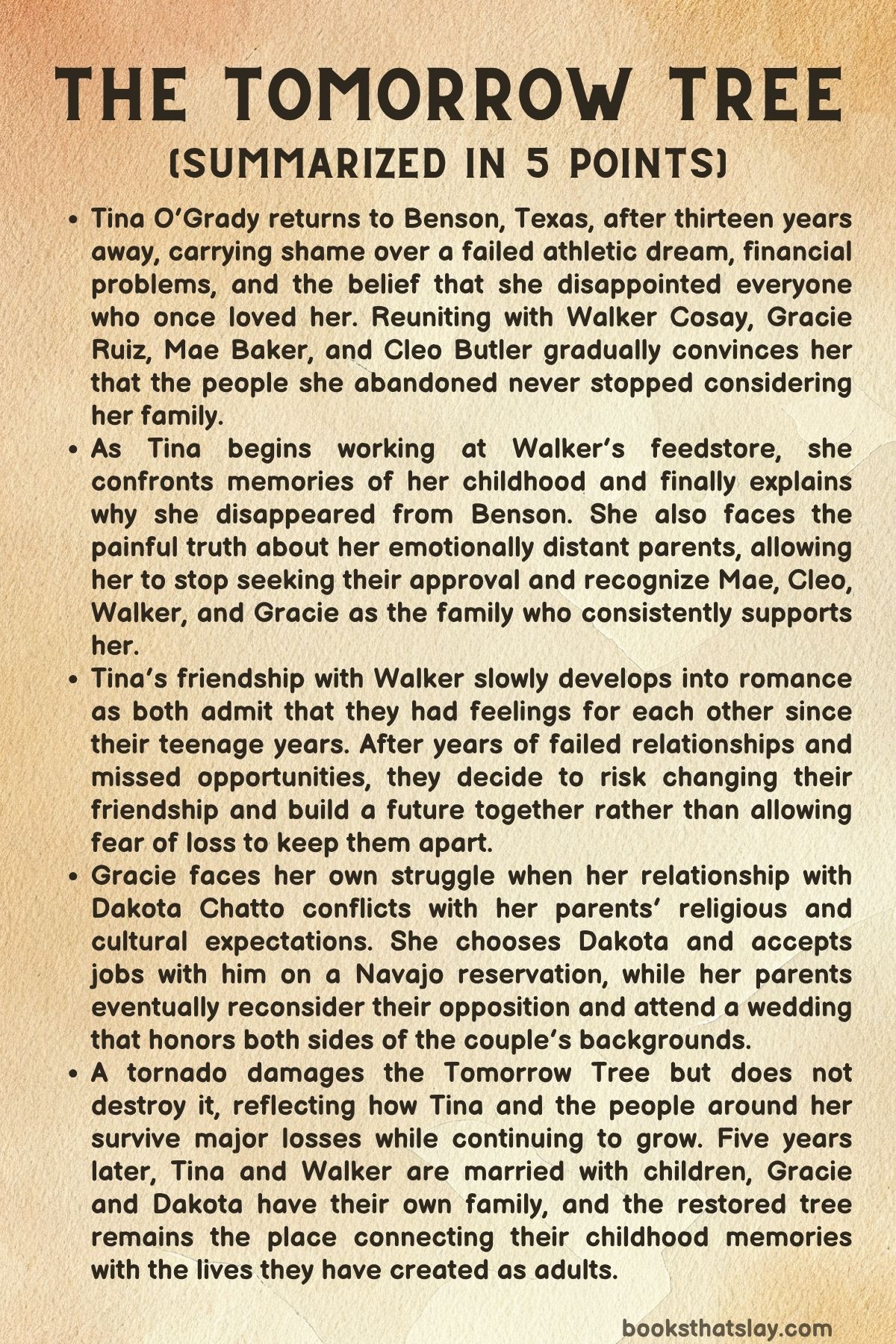
Summary
After thirteen years away from Benson, Texas, Tina O’Grady returns with no intention of staying permanently. She has come mainly to see the Tomorrow Tree, the enormous oak that once served as the center of her childhood with Walker Cosay and Gracie Ruiz, and the sight of it gives her a peace she has not experienced for years.
Tina is quickly taken in by Mae Baker and Cleo Butler, the two older women who helped raise the three children and still regard them as family. Gracie and Walker are happy to see Tina but also deeply hurt because she disappeared without explanation, yet Walker still offers her a job at his feedstore, giving Tina a reason to remain in Benson instead of continuing to California to visit her parents.
Working with Walker forces Tina to recognize that she is not the only one whose youthful ambitions ended badly. Her dreams of becoming an Olympic softball player were destroyed by injury, while Walker’s basketball ambitions also disappeared after an injury, leaving both of them to rebuild their lives in ways they never expected.
Tina also encounters former classmates Reesa, Sabrina, and Faith, whose condescending behavior reminds her of the social divisions and judgments she disliked about Benson. Gracie faces similar pressures from her strict parents, Elana and John, while carrying a secret of her own: she has been dating Dakota Chatto, a Navajo teacher, despite knowing that both families may have concerns about their cultural and religious differences.
When Tina and Walker accompany Gracie to Dakota’s property, Tina sees immediately that Gracie has found someone who genuinely makes her happy. Dakota surprises Gracie with plans for a summer road trip, and Tina struggles with the thought of losing her friend again so soon after their reunion, although she realizes that she has no right to resent Gracie after disappearing for thirteen years herself.
As Tina settles back into Benson, memories associated with the Tomorrow Tree and the few treasured possessions she carried through her unstable years make her confront what happened after high school. She finally tells Walker and Gracie that after her athletic career ended, she became involved with an irresponsible musician who accumulated enormous debts in her name and abandoned her, leaving Tina to spend years working exhausting jobs to repay what she owed.
Tina admits that shame, rather than indifference, kept her away. Walker and Gracie assure her that they would never have judged her, helping Tina understand that she deprived herself of support because she assumed that failure made her unworthy of returning home.
Gracie soon leaves with Dakota, while Tina decides not to continue to California after learning how relieved her parents are that she will not be visiting. Her disappointment strengthens her growing realization that the people who truly function as her family are in Benson, especially Mae, Cleo, Gracie, and Walker.
Walker takes Tina to Trade Days and introduces her to his paternal grandmother, Almeda “Ally” Cosay. Tina learns more about Walker’s Navajo heritage and receives an unexpectedly warm welcome from Ally, who knows how important Tina has been to Walker for years and encourages her to create a stable life rather than continue drifting.
The visit also strengthens Tina’s awareness that her feelings for Walker are becoming more than friendship. Sabrina and Faith appear at Trade Days and behave rudely toward Tina and Ally, but Ally refuses to accept their arrogance, leaving Tina with another example of what genuine loyalty looks like.
Meanwhile, Gracie and Dakota’s road trip becomes an opportunity for them to think seriously about their future. Changes in Dakota’s work schedule force them to shorten the trip, but the disappointment only pushes them toward more practical discussions about what a shared life might require.
Tina’s own understanding of family changes dramatically when Mae and Cleo reveal that they saved the babysitting money paid by Tina, Walker, and Gracie’s parents throughout childhood. They intend to divide that money among the three once they establish homes and families, showing that Mae and Cleo have quietly planned for their futures for decades.
The revelation encourages Tina to admit the childhood wound she has never overcome. When she was seven, she overheard her mother say that Tina had been an accidental pregnancy and that neither parent had wanted children, leaving Tina to spend much of her life trying to earn affection she never truly received.
At Mae and Cleo’s urging, Tina finally calls her parents. Vivian O’Grady confirms that she never wanted motherhood and never developed the bond Tina longed for, while Patrick O’Grady insists that providing financially should have been sufficient; their cold honesty hurts Tina but also ends the hope that they might eventually become different people.
Supported by Mae, Cleo, Walker, and Gracie, Tina begins separating her future from her parents’ emotional rejection. Instead of seeing herself merely as someone unwanted or damaged, she starts acknowledging her own resilience and ability to build a life on her own terms.
A tornado soon strikes Benson, sending Tina, Walker, Mae, and Cleo into the basement. The storm tears a major limb from the Tomorrow Tree and destroys Cleo’s greenhouse, but the house survives, and Tina sees the damaged tree as evidence that survival does not require remaining untouched.
The storm also leads to an absurd confrontation with hostile neighbor Iris Holt, whose long feud with Mae and Cleo erupts into a mud fight. Though the tornado causes real destruction, Tina discovers that disaster no longer automatically means losing the people around her.
Walker has his own emotional reckoning as he studies the damaged tree and thinks about the years he spent drinking, dating other women, and trying unsuccessfully to create a future that did not include Tina. He finally recognizes that his attachment to her never disappeared, while Tina also begins noticing physical attraction beneath their long friendship.
The arrival of Walker’s pregnant former girlfriend Yolanda gives Tina unexpected confirmation. Yolanda reveals that her relationship with Walker ended partly because he accidentally said Tina’s name during an intimate moment, making it clear that Tina remained emotionally present even during Walker’s other relationships.
Yolanda is carrying Brandon Massey’s triplet sons and plans to marry him, proving that Tina did not cause Brandon’s breakup with Sabrina as Sabrina has claimed. Tina and Walker celebrate their growing closeness through humor and shared mischief, including placing a giant metal rooster blown in by the tornado into Iris’s yard.
Gracie returns to Benson with major news of her own. She and Dakota have been invited to interview for positions on a Navajo reservation, where Gracie could teach young children and Dakota could serve as principal while teaching cultural subjects, an opportunity that could also lead quickly to marriage.
When Gracie tells her parents about Dakota and the possible move, they react as badly as she feared. Elana objects to Dakota not being Catholic, while John refuses to support the marriage and threatens to withhold both his blessing and the house they had intended to offer Gracie.
Devastated but determined, Gracie refuses to give up Dakota. Tina and Walker promise to stand beside her, with Walker even offering to walk her down the aisle, while Mae and Cleo immediately begin treating the wedding as a family celebration.
At the same time, Sabrina begins using a local social-media group to encourage people to drive Tina out of Benson. Instead of retreating, Tina attends church with Mae and Cleo and calmly confronts Sabrina about spreading accusations she cannot prove, showing how far she has come from the woman who once fled rather than face judgment.
Tina and Walker eventually resolve a smaller conflict after Walker excludes her from helping remove the damaged limb from the Tomorrow Tree. Tina explains that she needed to participate because removing it represented saying goodbye to part of her past, and Walker acknowledges that trying to protect her prevented him from understanding what she actually needed.
Soon afterward, Gracie and Dakota learn that both have received the reservation jobs, and Dakota formally proposes with a turquoise ring from his family. The news is bittersweet for Tina because Gracie will move away, but she now understands that love does not disappear simply because people no longer live in the same place.
Walker and Tina finally confront their own unfinished history. He admits that he wanted Tina even in high school but feared the prejudice of her father, while Tina reveals that she also cared for him but was intimidated by Walker’s grandfather Bull; once the truth is spoken, Walker asks Tina on a real date, and they finally kiss beneath the tree.
Their romance develops naturally from the friendship they already share. During a weekend near Trade Days, Walker asks Tina to date him exclusively, and they burn wood from the damaged tree while looking toward a future no longer controlled by old disappointments.
Walker privately realizes that he loves Tina, although he wants to make sure that their relationship is based on their adult selves rather than nostalgia. He gives her a serving board made from the fallen oak limb and glass doorknobs salvaged from his childhood home, physically joining pieces of both their histories into something useful and new.
Tina still fears that happiness will disappear once she trusts it, but Ally encourages her not to let fear decide her future. Walker likewise refuses to allow anxiety about what might happen someday to prevent them from enjoying the relationship they have finally allowed themselves to begin.
At Benson’s Fourth of July celebration, Tina confronts Sabrina again and makes it clear that she intends to remain in town permanently. Sabrina’s campaign against Tina begins collapsing, especially after Tina cleverly helps Sabrina escape Iris’s plan to make her move to Vega in exchange for Sabrina agreeing to stop attacking Tina and the others.
Gracie and Dakota’s wedding then brings the extended family together. At the last moment, John and Elana arrive, apologize for their earlier behavior, and choose their daughter over their prejudices, allowing John to walk Gracie down the aisle before the couple later participates in a traditional Navajo ceremony.
Watching the wedding makes Tina realize that if she ever marries, she wants something simple beneath the Tomorrow Tree. Walker nearly proposes at the reception but decides that such an important moment should belong privately to them.
Back at home, Mae and Cleo reveal that they have purchased Iris’s former house and want Tina and Walker to live there beside them, eventually inheriting it. Their dream is to watch another generation of children playing beneath the Tomorrow Tree, just as Tina, Walker, and Gracie once did.
Walker then asks Tina to meet him beneath the tree and proposes with an infinity-design ring. He tells her that her thirteen-year absence left part of him missing and that he now understands he has not simply loved her as an old friend; Tina accepts immediately.
Five years later, the Tomorrow Tree has healed and produced new growth where the storm damaged it. Tina and Walker are married with two daughters, while Gracie and Dakota return regularly with their children, preserving the friendship that began beneath the tree decades earlier.
Tina remembers the oak as the setting for childhood games, graduation, her return to Benson, Walker’s proposal, their winter wedding, and the arrival of their children. The place she once associated mainly with what she had lost has become inseparable from the life she has built, and Tina finally understands that coming home allowed her to stop running from the past without being trapped by it.
Characters
Tina O’Grady
Tina is the emotional center of The Tomorrow Tree, and her return to Benson begins a long process of redefining what home, family, failure, and love mean to her. She arrives carrying years of embarrassment because an injury destroyed her athletic ambitions and a disastrous relationship left her burdened with debt, circumstances she interpreted as proof that she had disappointed everyone who once believed in her.
Her deepest wound, however, comes from childhood rather than adulthood. Hearing that she was an unwanted pregnancy convinced Tina that affection had to be earned, so later failures felt especially dangerous because she had never developed a secure belief that she deserved love simply by existing.
This insecurity explains why she disappears rather than seeking help from Walker, Gracie, Mae, or Cleo. Tina assumes that people will judge her because judgment is what she expects from those closest to her, and her growth begins when she finally recognizes that her chosen family operates according to entirely different emotional rules.
Her confrontation with Vivian and Patrick becomes crucial because it gives Tina an answer she does not want but desperately needs. Once her parents confirm their emotional distance, she can stop waiting for them to become the people she wished they were and begin valuing the relationships that have consistently sustained her.
Tina also becomes increasingly assertive. Her refusal to let Sabrina’s gossip drive her from Benson, her direct confrontation at church and the Fourth of July celebration, and her willingness to explain her needs to Walker show that returning home does not mean returning to the frightened version of herself who once avoided conflict.
Her romance with Walker succeeds because it develops alongside her personal recovery rather than replacing it. Tina does not simply find happiness because a man loves her; she becomes capable of accepting Walker’s love because she has begun believing that past failures do not disqualify her from stability, family, or a future.
Walker Cosay
Walker is Tina’s emotional counterpart in The Tomorrow Tree, carrying his own history of disappointment beneath a calm, dependable exterior. His basketball ambitions ended with injury, and although he built a successful feedstore and remained rooted in Benson, his adult romantic life shows that staying geographically close to home did not mean he had resolved everything emotionally.
His feelings for Tina survived her thirteen-year absence, influencing relationships he attempted to build with other women. The revelation that he once said Tina’s name while involved with Yolanda demonstrates how thoroughly Tina remained part of his emotional life even when he tried to move forward.
Walker’s strongest quality is loyalty, but the book also shows that protectiveness can become a flaw when it prevents communication. His decision to exclude Tina from removing the storm-damaged tree limb comes from concern for her feelings, yet Tina needs participation rather than protection, teaching Walker that love requires listening instead of deciding what another person can handle.
His relationship with Lyle also reveals his maturity. Walker encourages the younger man to choose his own future rather than surrendering his ambitions to another person’s expectations, and the advice reflects Walker’s growing awareness of how fear and outside prejudice once prevented him from pursuing Tina.
His Navajo heritage is another meaningful element of his identity. Through Ally and his family history, Walker embodies a connection between Benson and a wider cultural inheritance, while his past experiences with prejudice explain some of the caution that shaped his youth.
By the time he proposes, Walker is no longer trying to substitute other relationships for the one he actually wants. His proposal is powerful because it reflects years of reflection, patience, and emotional honesty rather than impulsive nostalgia.
Gracie Ruiz
Gracie serves as both Tina’s oldest female friend and a parallel example of someone trying to build an adult life without allowing family expectations to dictate every decision. Her anger over Tina’s disappearance is genuine, but it coexists with immediate affection, showing that she values honesty while still leaving room for reconciliation.
Her relationship with Dakota places her in direct conflict with her parents. Gracie loves them and understands the religious and cultural values they want her to follow, yet she ultimately refuses to sacrifice a healthy relationship merely to preserve their approval.
Her decision becomes especially significant when John ties family support to obedience. Rather than accepting the offered house under those conditions, Gracie chooses uncertainty with Dakota, demonstrating that independence sometimes requires giving up security.
Gracie’s friendship with Tina also matures over the course of the story. Tina initially fears Gracie’s departures because separation reminds her of abandonment, but Gracie’s move ultimately proves that genuine friendship can survive distance.
The reconciliation with Elana and John before the wedding gives Gracie an ending that preserves family without requiring her to surrender herself. Their change matters because they come to her rather than demanding that she return to their expectations.
Dakota Chatto
Dakota is patient, thoughtful, and secure in both his relationship with Gracie and his cultural identity. He does not ask Gracie to abandon her background in order to join his life, and their relationship becomes an example of two people finding ways to honor difference without treating difference as a threat.
His Navajo heritage shapes many of his conversations with Gracie, particularly during their road trip. His explanations of animals, transformation, courage, patience, and spiritual meaning show that he experiences culture as a living part of daily life rather than as an abstract label.
Dakota is also practical about the future. The reservation positions offer both him and Gracie meaningful work, housing, and a community where they can build a shared life, and his proposal after they receive the jobs shows that he wants commitment grounded in realistic plans.
His family’s reaction provides an important contrast with Gracie’s parents. Although they have concerns about him marrying outside the Navajo community, they ultimately prioritize Dakota’s happiness, demonstrating the difference between expressing concern and attempting to control another adult’s decision.
Mae Baker
Mae functions as one of Tina’s true maternal figures. From the moment Tina returns, Mae treats her absence as something painful but forgivable, offering the kind of unconditional welcome Tina never receives from her biological parents.
Her decision, together with Cleo, to save the babysitting money earned while caring for Tina, Walker, and Gracie reveals the extraordinary depth of that commitment. Mae was not merely watching children for neighbors; she was quietly investing in the adults she hoped they would someday become.
Mae’s generosity is practical as well as emotional. She provides Tina with shelter, reassurance, a sense of family, and eventually the possibility of a permanent neighboring home.
Her humor and involvement in the feud with Iris keep her from becoming an idealized maternal figure without personality. Mae can be stubborn, competitive, and mischievous, yet those qualities make her affection feel lived-in rather than sentimental.
Cleo Butler
Cleo shares Mae’s role as part of the family Tina chooses rather than inherits. She is outspoken, protective, humorous, and often quicker than Mae to turn an ordinary conflict into an entertaining confrontation.
Her response to Tina’s childhood pain is especially important. Cleo directly challenges Tina’s belief that being unwanted by her parents means she is fundamentally unwanted, reminding her that love has surrounded her even when she failed to recognize it.
Cleo also has a strong instinct for caring for vulnerable creatures and people. After the tornado, she and Mae refuse to separate the abandoned kittens, and Cleo compares their bond to the relationship among Tina, Walker, and Gracie.
Beneath the comic exchanges with Iris, Cleo represents continuity. She creates the stable domestic environment to which Tina can finally return and helps turn Benson from a place associated with shame into a place associated with belonging.
Almeda “Ally” Cosay
Ally is Walker’s paternal grandmother and one of the wisest influences in Tina’s new life. She recognizes Tina immediately as someone emotionally important to Walker because he has been speaking about her for years.
Her warmth does not prevent her from giving Tina challenging advice. Ally insists that Tina establish a stable life for herself rather than simply attaching her future to another person, reinforcing the idea that romance should complement personal independence rather than replace it.
She also recognizes Tina’s fear after the relationship with Walker becomes serious. Ally’s assurance that love can be stronger than fear does not promise an effortless future; instead, she acknowledges that disagreements and difficult periods are inevitable but can be survived when people possess genuine commitment and shared history.
Her defense of Tina against Sabrina further establishes her as someone who values character over status. Through Ally, Tina experiences another form of maternal acceptance that contrasts sharply with Vivian’s emotional distance.
Sabrina
Sabrina operates as Tina’s most persistent social antagonist. Her behavior is rooted in status, resentment, and an intense concern with how she appears within the community.
Rather than accept responsibility when Brandon ends their engagement, Sabrina chooses Tina as a convenient target. Her online campaign accusing Tina of bringing trouble to Benson reflects her tendency to protect herself by redirecting humiliation toward someone else.
Sabrina is also significant because Tina’s responses to her measure Tina’s growth. The woman who once avoided Benson because she feared judgment eventually confronts Sabrina publicly and warns her that false accusations could have consequences.
The resolution of their conflict is intentionally more comic than dramatic. Tina does not defeat Sabrina through cruelty; instead, she maneuvers circumstances so that Sabrina has practical reasons to stop the harassment, allowing Tina to reclaim control without becoming consumed by revenge.
Iris Holt
Iris is the cantankerous neighbor whose decades-long feud with Mae and Cleo provides much of the novel’s comic conflict. Arguments about property, flowers, animals, and neighborhood grievances have become so established that hostility is almost a form of communication among the three women.
Her cruelty after the tornado briefly makes the conflict more serious. Saying that she hoped the storm would destroy Mae and Cleo’s property reveals how bitterness can harden into something genuinely unpleasant.
At the same time, Iris is written as exaggerated enough to remain a comic presence. Her mud fight with Mae and Cleo and the battle over the giant metal rooster transform neighborhood resentment into absurdity.
Her decision to sell her house ultimately produces an unexpectedly positive result. What Iris sees as an escape from Mae and Cleo becomes the means through which Tina and Walker are given a permanent home beside the women who raised them.
Elana Ruiz
Elana loves Gracie but initially allows religious expectations and fear of difference to interfere with that love. Her objections to Dakota are rooted largely in his not being Catholic and in her conviction that Gracie should follow the future her parents imagine for her.
Earlier, Elana also criticizes Tina and Walker without fully understanding them. Her exposure to Sabrina and the other women’s behavior gradually challenges some of her assumptions about who deserves respect.
Her greatest failure occurs when Gracie announces her intention to marry Dakota. Instead of listening to her daughter’s happiness, Elana responds through rules and expectations, contributing to Gracie’s painful decision to leave.
Her eventual apology before the wedding matters because she asks for forgiveness rather than attempting to justify herself. Elana’s change does not erase what she did, but it demonstrates that parents can reconsider beliefs when preserving a relationship becomes more important than defending pride.
John Ruiz
John shares many of Elana’s concerns but responds even more forcefully to Gracie’s decision. His refusal to support the marriage and his threat not to walk her down the aisle place parental authority ahead of his daughter’s autonomy.
His conditional offer of a house is particularly revealing. The gesture appears generous until it becomes clear that the gift depends on Gracie abandoning Dakota, turning financial support into a means of control.
John’s eventual appearance at the wedding represents a significant reversal. Asking whether he may still walk Gracie down the aisle shows that he has accepted that being part of his daughter’s life requires respecting choices he did not make himself.
Vivian O’Grady
Vivian is Tina’s emotionally distant mother and the source of one of the deepest wounds shaping Tina’s identity. Tina spends years interpreting Vivian’s lack of affection as evidence that something must be wrong with her.
When confronted, Vivian does not offer the comforting explanation Tina once hoped to hear. She confirms that motherhood was never something she wanted and that she never felt the connection Tina desired.
Vivian’s importance therefore comes less from transformation than from clarity. Her honesty is painful, but it finally allows Tina to stop organizing her adult life around the hope of earning maternal love that Vivian cannot provide.
Patrick O’Grady
Patrick is similarly distant, although his attitude is expressed through a belief that material provision should have fulfilled his parental obligations. He fails to understand that Tina needed emotional presence in addition to financial security.
His reaction reinforces Tina’s recognition that her parents are unlikely to become different people. Patrick therefore represents a model of parenthood based on duty without intimacy, contrasting strongly with Mae and Cleo’s far more emotionally invested care.
His earlier prejudice toward Walker also contributed indirectly to Tina and Walker remaining apart as teenagers. The choices of one generation therefore influence the emotional limitations of the next, even when those limitations are eventually overcome.
Lyle Richman
Lyle is a younger character whose dilemma allows Walker to express lessons he has learned from his own life. When Lyle’s girlfriend pressures him to choose marriage over a basketball scholarship, Walker encourages him to decide what future he actually wants rather than surrendering to someone else’s plan.
Lyle ultimately loses the relationship but keeps the possibility of pursuing his ambitions. His story provides a smaller parallel to several adult conflicts in the novel, particularly Gracie’s refusal to give up Dakota and Tina’s decision to stop living according to fear.
His craftsmanship also contributes symbolically to Tina and Walker’s relationship when he transforms wood from the damaged Tomorrow Tree into the serving board Walker gives Tina. In that act, something broken becomes something useful, mirroring the larger emotional movement of the story.
Yolanda
Yolanda is Walker’s former girlfriend, but she is not portrayed as a romantic rival in the conventional sense. Her appearance provides Tina with information about Walker’s past while also demonstrating that Walker’s attempts to build relationships with other women were complicated by feelings he had never resolved.
The revelation that Walker once accidentally spoke Tina’s name makes his long attachment impossible for Tina to dismiss. Yolanda therefore becomes an unexpected source of clarity rather than conflict.
Her pregnancy with Brandon’s identical triplet sons also exposes how unfair Sabrina’s accusations against Tina have been. Brandon’s relationship with Yolanda proves that the engagement had problems unrelated to Tina’s return.
Brandon Massey
Brandon is initially connected to Sabrina through their engagement, but his history with Gracie reveals an uglier side of his character. His earlier racial insults toward Gracie after she rejected him show that prejudice and entitlement were present long before his adult relationship problems.
His decision to leave Sabrina follows increasing discomfort with her behavior, although his simultaneous involvement with Yolanda complicates any interpretation of him as morally admirable. He is capable of recognizing Sabrina’s cruelty without necessarily behaving honorably himself.
His eventual commitment to Yolanda and their unborn children shifts him away from the main conflict. More importantly, his actions establish that Tina was never responsible for the collapse of his engagement, removing one of Sabrina’s primary accusations.
Themes
Home, Belonging, and Chosen Family
Home gradually changes from a geographic place Tina avoids into a network of relationships she consciously chooses. When she first returns to Benson, she treats the visit as temporary because the town is connected to memories of disappointment, yet Mae, Cleo, Walker, and Gracie immediately demonstrate that belonging has survived even when Tina herself refused to believe it.
The contrast between Tina’s biological parents and her chosen family gives this theme its emotional force. Vivian and Patrick provided materially but never gave Tina the affection she wanted, while Mae and Cleo spent decades saving money for three children who were not biologically theirs.
The boardinghouse, feedstore, neighboring homes, and Tomorrow Tree all become extensions of this idea of family. They matter because they contain people who repeatedly show up, forgive, protect, argue, celebrate, and remain present.
By the end of The Tomorrow Tree, Tina no longer measures family according to blood or home according to where she was born. She recognizes home as the place where her history can be acknowledged without being used against her, and the future house beside Mae and Cleo turns that emotional realization into something permanent.
Healing Without Erasing the Past
The damaged oak after the tornado provides the clearest representation of how healing works throughout the story. The tree survives, but one enormous limb is lost, and the scar remains even after new growth appears five years later.
Tina follows the same pattern. Her past cannot be undone: her athletic career is gone, her former partner exploited her financially, her parents cannot give her the childhood she wanted, and thirteen missing years cannot be restored.
What changes is the meaning Tina gives those experiences. Instead of treating them as evidence that she is ruined or destined to bring trouble into other people’s lives, she gradually sees them as events she survived.
The serving board made from the damaged limb strengthens this idea because destruction is converted into something functional and meaningful. Tina also needs to participate emotionally in removing the limb because healing requires acknowledging loss rather than pretending it never mattered.
The epilogue completes the image when the tree grows again around the place where it was broken. The scar has not vanished, but life continues around it, suggesting that recovery does not depend on returning to an untouched state; it depends on creating new growth alongside what remains.
Love Versus Fear
Fear repeatedly delays happiness in the story. Tina stays away from Benson because she fears judgment, Walker does not pursue her when they are younger because he fears prejudice and rejection, Gracie hides her relationship because she fears her parents’ response, and Tina later worries that loving Walker could destroy their friendship if the romance fails.
These fears are understandable because they arise from real experiences rather than imagination alone. Tina has known rejection, Walker has encountered prejudice, and Gracie correctly predicts that her parents will oppose Dakota.
The problem comes when fear begins making decisions in advance. Tina’s thirteen-year absence shows the cost most clearly: by trying to protect herself from possible rejection, she loses thirteen years with people who would have welcomed her.
Ally’s advice that love can be stronger than fear summarizes the healthier alternative. Love in the novel is not presented as certainty that nothing will go wrong; it is the willingness to accept risk because a relationship is worth participating in fully.
Tina’s eventual acceptance of Walker’s proposal therefore represents more than romantic fulfillment. She chooses possibility over defensive isolation, allowing herself to believe that a future can be valuable even though nobody can guarantee that it will remain painless.
Identity, Independence, and Other People’s Expectations
Several characters must decide whether they will live according to their own values or surrender important choices to family and social pressure. Gracie faces the clearest test when her parents attempt to make their approval and financial support conditional on ending her relationship with Dakota.
Her refusal establishes that adulthood requires more than physical independence. Gracie must accept the possibility of disappointing people she loves in order to protect the life she believes is right for her.
Tina faces a related struggle with Benson’s social expectations. Sabrina tries to define her publicly as a source of trouble, while Tina’s own history has trained her to accept other people’s negative judgments too quickly.
Lyle’s basketball dilemma offers the same conflict to a younger generation. Walker advises him not to give up his opportunity merely because his girlfriend demands a different future, advice that reflects the mistakes Walker has seen when people allow fear, romance, family, or public opinion to determine their direction.
The eventual reconciliations do not require characters to surrender their independence. Gracie’s parents come to her wedding because they change their behavior, while Tina earns peace by refusing to leave Benson simply because Sabrina wants her gone; acceptance becomes meaningful only when it does not require self-erasure.