The Very Secret Society of Irregular Witches Summary, Characters and Themes
The Very Secret Society of Irregular Witches by Sangu Mandanna is a contemporary fantasy novel about loneliness, chosen family, secrecy, and the courage required to belong somewhere.
Its central character, Mika Moon, has spent her life obeying rules that tell witches they must remain isolated from one another and hide their true identities from ordinary people. When she is invited to teach three young witches living together at a secluded house in Norfolk, she enters a family whose existence contradicts nearly everything she has been taught. What begins as a temporary teaching position gradually forces Mika to reconsider safety, trust, love, and the possibility of finally having a permanent home.
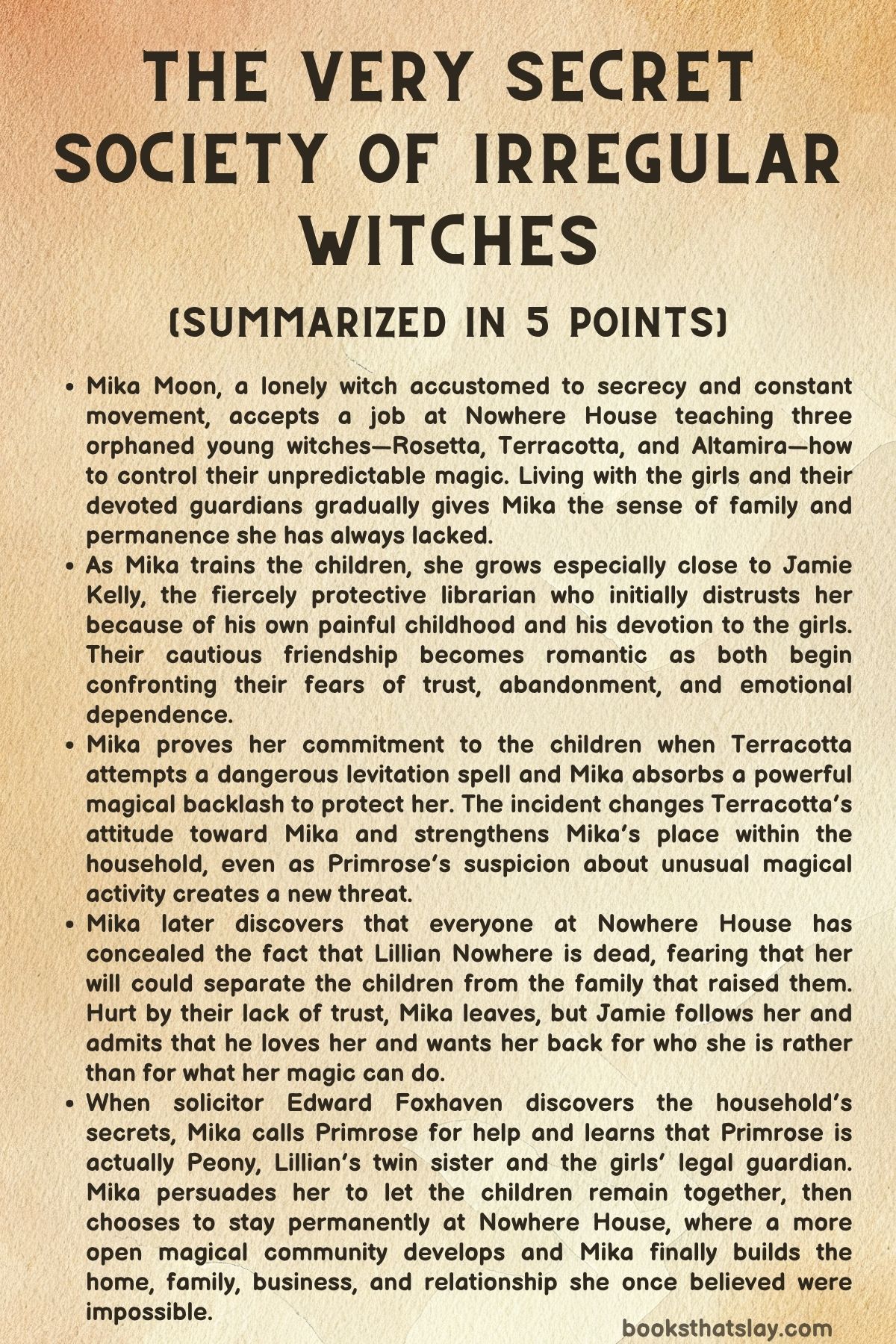
Summary
Mika Moon has lived most of her life according to the rules imposed by Primrose, the powerful witch who took responsibility for her after she was orphaned. British witches are expected to live separately because magical energy gathers around them, increasing the likelihood of accidents and exposure when several remain together for too long.
Mika has always resented the isolation this system creates. Her childhood consisted of temporary caregivers whose memories were erased whenever they discovered her magic, while her adult life follows the same pattern of moving frequently, maintaining shallow connections, and never allowing anyone to know her completely.
As a small rebellion, Mika posts online videos in which she pretends to be a witch while secretly performing genuine magic. One viewer, Ian Kubo-Hawthorn, recognizes what she truly is and sends her an extraordinary message offering her a live-in job teaching three young witches at Nowhere House in Norfolk.
Curiosity and necessity persuade Mika to investigate. At Nowhere House she meets Ian, his husband Ken, housekeeper Lucie, and the distrustful librarian Jamie Kelly, before discovering that the property is home to three orphaned witches: Rosetta, Terracotta, and Altamira.
The girls were adopted by Lillian Nowhere, an archaeologist who is supposedly away working abroad. Because Lillian has rarely been present to train them, the children possess powerful but poorly controlled magic, and their situation is becoming urgent because Lillian’s solicitor, Edward Foxhaven, plans to visit after Christmas.
Mika understands immediately how dangerous it is for three inexperienced witches to live together, but she also recognizes something painfully familiar in their isolation. Remembering what it felt like to learn magic without companionship, she accepts the teaching position and moves into Nowhere House with her dog Circe, magical plants, books, cauldrons, and even her koi pond.
The children react differently to her arrival. Rosetta and Altamira are enthusiastic, while Terracotta treats Mika as a threat and repeatedly jokes about murdering her, but Mika refuses to be intimidated and begins teaching the girls how magical intention, ingredients, and discipline can help them control the power surrounding them.
Jamie remains suspicious because his first priority is protecting the children. As Mika proves patient, competent, and genuinely affectionate toward them, however, his objections become harder to maintain, and their conversations gradually reveal that his hostility comes from fear rather than cruelty.
Mika soon begins experiencing something she has never truly had: ordinary domestic belonging. She helps in the garden, shares meals, participates in household routines, teaches the girls, talks with Ian and Lucie, and spends increasingly comfortable evenings with Jamie.
Her teaching also gives the girls greater independence. Mika and Jamie accompany Rosetta to a bookshop in Norwich, where Rosetta meets children who share her interests and briefly experiences life beyond the boundaries of Nowhere House, although an argument causes her magic to create a small cyclone inside the shop.
During the trip, Mika learns that Ian’s mother, Minerva Hawthorn, was a witch, explaining his unusual knowledge of magic. Ian also tells Mika that the household no longer regards her as a temporary employee because she has already proved that she belongs among them.
Mika and Jamie continue growing closer through late-night conversations while she experiments with magical ingredients. Their developing attraction is interrupted when Terracotta secretly attempts levitation despite Mika’s warnings and rises dangerously high above the garden.
When Mika tries to bring Terracotta down, the resulting conflict of magical forces creates a violent backlash. Mika deliberately redirects the dangerous energy away from Terracotta and takes the full impact herself, entering a temporary magical hibernation while her body heals.
The accident changes Terracotta’s attitude completely. She realizes that Mika was willing to injure herself to protect her, and Jamie acknowledges that Terracotta’s distrust had partly reflected his own behavior toward Mika.
Soon afterward, Primrose summons Mika because another witch has detected the enormous magical surge. Mika travels to Cambridge and successfully conceals the existence of the children, but her conversation with Primrose reveals important information about the history of witches.
Generations earlier, witches attempted a protective spell during a period of persecution, but the magic produced a terrible consequence: the birth of a witch became associated with the deaths of her parents. Primrose believes this long history of danger proves that witches must remain separated, while Mika increasingly questions whether loneliness should be accepted simply because it appears safer.
After the meeting, Mika is too exhausted to drive and discovers that Jamie and Ken have followed her to Cambridge because they anticipated she might need help. Mika impulsively asks Jamie to kiss her, but he refuses while she is physically weakened, showing that although he desires her, he will not take advantage of her impaired judgment.
Mika later tells Jamie and Ian about her past relationship with a man who exploited her magic for dishonest purposes. Her experiences with him and with earlier caregivers help explain why she expects affection to become conditional once people discover what she can do.
The growing intimacy between Mika and Jamie deepens when she accompanies him to Liverpool for his mother’s birthday. Jamie explains that after his father died, his older brothers became abusive and his grieving mother failed to protect him, eventually causing him to leave home at sixteen and find refuge with Lillian.
The trip gives Jamie some closure because he discovers that the people who once terrified him no longer possess the power they held in his childhood. Mika also encounters Hilda Kim, another witch from Primrose’s group, and encourages her to consider telling her fiancée Kira the truth instead of assuming secrecy must always come first.
On their journey home, Mika admits that beneath her constant travelling she has always wanted permanence, including a home and a shop where she could sell magical teas and potions. Jamie assures her that she has already become important to the family, directly challenging Mika’s fear that she can disappear from people’s lives without leaving any lasting effect.
Their romantic tension finally becomes a deliberate kiss during a stop in the woods. Both understand that the relationship matters precisely because neither is accustomed to trusting easily: Jamie fears outsiders, while Mika fears staying long enough to be abandoned.
The Winter Solstice celebration confirms how deeply Mika has become part of Nowhere House. She exchanges personal gifts with the family, manages the children’s magical disputes, and participates in traditions that make her feel less like a hired tutor and more like another member of the household.
Yet Jamie begins avoiding private conversations after their kiss. When Mika confronts him, he admits that his feelings are serious but refuses at first to reveal the final secret the household has been keeping from her.
Jamie eventually confesses that Lillian is dead and buried on the property. She died months before Mika arrived, and the story about her being abroad was invented because her will transfers guardianship of the girls to her sister Peony, a woman the family does not know or trust.
Mika is devastated less by Lillian’s death than by the realization that everyone continued lying after she believed she had earned their trust. Feeling that she has once again been valued only conditionally, she leaves for the old York house where she spent her childhood.
Christmas alone makes Mika recognize how profoundly her expectations have changed. The silence that once seemed ordinary now feels empty because Nowhere House has shown her what companionship can be.
Jamie travels to York and refuses to allow their relationship to end through silence. He admits that fear led the family to continue deceiving her and tells Mika plainly that he wants her to return because he loves her, not because of what her magic can provide.
Mika agrees to help when Edward arrives on December 26, but the family’s attempt to conceal Lillian’s death fails. Edward discovers evidence of both the deception and witchcraft, leaving the household with no safe way to allow him to depart with his memories intact.
Mika makes a dangerous choice and calls Primrose, whose memory-altering magic can solve the immediate problem. When Primrose arrives, an even greater secret emerges: she is actually Peony Smith, Lillian’s twin sister, and therefore the woman named in Lillian’s will.
Primrose erases Edward’s memories, but she initially intends to follow her lifelong beliefs and separate the three girls. Mika finally confronts her, arguing that Rosetta, Terracotta, and Altamira are sisters in every meaningful sense and that destroying their family in the name of safety would cause its own lasting harm.
Mika also challenges Primrose about the way she was raised. She acknowledges that Primrose’s harsh rules came from fear and childhood trauma, but insists that witches cannot continue treating isolation as the only possible form of survival.
The crisis itself proves Mika’s point because no individual could have solved it alone. Witches and non-witches protected one another through cooperation, trust, and affection, demonstrating that community can provide forms of safety that secrecy cannot.
Primrose ultimately yields, and when she argues that Lillian wanted the children raised with a witch, Mika volunteers to remain. Terracotta immediately declares that Mika belongs with them, transforming Mika’s decision to stay into a rejection of the temporary life she has accepted for years.
By spring, the consequences extend beyond Nowhere House. Witches begin meeting with trusted partners, relatives, and friends instead of maintaining absolute separation, and their combined abilities help renew the wards protecting the property.
Mika also realizes her dream of establishing a magical tea and potion shop on the grounds. Her relationship with Jamie is secure, the children remain together, and even Primrose begins participating in a less isolated magical community.
Most importantly, Mika no longer thinks of herself as someone destined to pass temporarily through other people’s lives. She has found a home where her magic does not need to be hidden, where conflict does not automatically mean abandonment, and where belonging comes from people repeatedly choosing to remain together.
Characters
Mika Moon
Mika is the emotional and moral center of The Very Secret Society of Irregular Witches, and nearly every major conflict is connected to her struggle between self-protection and belonging. She begins the book highly independent, competent, humorous, and rebellious, but much of that independence has been forced upon her by a childhood in which stability was repeatedly taken away.
Her constant movement between homes is less an expression of freedom than a strategy designed to prevent attachment from becoming dangerous. Because caregivers disappeared whenever they learned the truth about her magic, Mika learned to associate being fully known with eventual loss.
Her arrival at Nowhere House challenges this pattern almost immediately. Teaching Rosetta, Terracotta, and Altamira allows her to become the adult she needed when she was young: someone who treats magical children as people deserving education, patience, joy, and companionship rather than as problems requiring containment.
Mika is also notable for the way she uses power. She possesses considerable magical ability, yet her defining acts involve restraint, protection, and creativity, particularly when she takes Terracotta’s magical backlash into herself rather than allowing a child to suffer the consequences.
Her romantic relationship with Jamie reveals another side of her fear. Mika can accept temporary attraction easily enough, but permanent emotional commitment frightens her because it requires believing that another person may continue choosing her even after seeing her vulnerabilities.
Her eventual decision to remain at Nowhere House represents a fundamental change in how she understands courage. Leaving has always been easy because leaving preserves control, while staying requires her to accept uncertainty, forgiveness, dependence, and the possibility that love may survive disappointment.
Jamie Kelly
Jamie initially appears severe, suspicious, and unnecessarily hostile toward Mika, but these qualities come from a deeply developed protective instinct. He has effectively served as one of the girls’ primary parental figures, and his loyalty to them makes any unfamiliar adult seem like a potential danger.
His distrust is also connected to his own childhood. After his father’s death, Jamie suffered cruelty from his older brothers and neglect from his grieving mother, teaching him that the people who are supposed to provide safety can become the very people from whom protection is needed.
Books, Nowhere House, and the unconventional family he finds there become sources of stability. Consequently, his desire to preserve the household is not simply loyalty to Lillian’s children; it is also his attempt to defend the first place that offered him the security he lacked as a teenager.
Jamie’s relationship with Mika changes because she repeatedly contradicts his expectations. She accepts Terracotta’s hostility without retaliating, respects the children as individuals, risks herself to protect them, and consistently demonstrates that her interest in the family extends beyond her employment.
His refusal to kiss Mika while she is recovering from magical exhaustion is particularly revealing. Desire never overrides his sense of responsibility, and his attraction becomes convincing because it develops beside respect rather than replacing it.
Jamie’s greatest mistake is his participation in concealing Lillian’s death from Mika. His secrecy comes from fear rather than manipulation, but the book refuses to excuse the damage merely because his intentions were protective.
By travelling to York after Mika leaves, Jamie demonstrates real development. Instead of assuming that protecting himself means accepting her departure, he chooses vulnerability and asks her to remain without demanding that she immediately erase the hurt he caused.
Primrose / Peony Smith
Primrose is both an authority figure and a warning about what fear can become when it controls an entire life. As the woman responsible for Mika’s upbringing and the leader who enforces separation among witches, she sincerely believes that isolation protects people from dangers that history has repeatedly demonstrated.
Her philosophy is not created from abstract cruelty. She and her twin sister survived an abusive childhood, and the broader history of witches includes persecution, magical catastrophe, orphanhood, and the recurring deaths of witches’ parents.
Yet Primrose turns survival into a rigid system that leaves little room for emotional consequences. Her decision to erase caregivers’ memories of Mika protects secrecy while repeatedly teaching a child that relationships can be deleted whenever they become inconvenient or risky.
This makes Primrose one of the most complicated figures in The Very Secret Society of Irregular Witches because she can love Mika while still causing her enormous emotional harm. Her tragedy lies in confusing protection with control and believing that preventing one type of danger justifies creating another.
The revelation that Primrose is actually Peony, Lillian’s twin sister, strengthens this contrast. Two women shaped by similar trauma eventually choose opposite responses: Primrose creates increasingly strict boundaries, while Lillian experiments with building an unconventional family.
Primrose does change, although not instantly or completely. Her eventual acceptance of the girls remaining together and her participation in the later community of witches suggest that she is capable of reconsidering beliefs that once seemed absolute.
Rosetta
Rosetta is thoughtful, observant, and especially interested in the world beyond Nowhere House. Her fascination with books and her excitement during the Norwich outing reveal how strongly she wants ordinary experiences that other children take for granted.
Her meeting with children who enjoy the same comic books becomes significant because it shows that isolation has deprived her of opportunities for friendship. Although her accidental cyclone demonstrates that her control is still imperfect, Jamie’s refusal to treat the outing as a disaster confirms that a meaningful childhood cannot be reduced entirely to avoiding risk.
Rosetta often asks questions that expose contradictions in adult rules. Her willingness to wonder whether witches truly must remain hidden helps reinforce the wider challenge to Primrose’s worldview.
She also represents the possibility of a different future for magical children. With guidance rather than confinement, Rosetta can learn responsibility while still participating in the larger world.
Terracotta
Terracotta is defensive, intelligent, confrontational, and often extremely funny. Her jokes about murdering Mika initially function as a protective shield, allowing her to reject a new adult before that adult has the opportunity to disappoint or abandon her.
Her suspicion mirrors Jamie’s behavior, which he eventually recognizes. Terracotta has learned from the adults around her that outsiders are dangerous, so her hostility is partly an exaggerated version of the household’s general fear.
Her determination to attempt levitation reveals both confidence and immaturity. She resents limits because she interprets them as evidence that Mika does not respect her abilities, failing to understand that responsible teaching sometimes requires refusing what a student wants.
The magical accident becomes her most important turning point. Watching Mika deliberately absorb dangerous magic to protect her destroys Terracotta’s belief that the new tutor is merely an outsider with uncertain loyalty.
Her later apology shows that Terracotta can accept responsibility once she understands the consequences of her actions. By the end, her declaration that Mika belongs with the family becomes especially meaningful because the child who resisted Mika most strongly becomes one of the people most determined to keep her.
Altamira
Altamira is the youngest of the three witches and often displays magic with the least warning. Her accidental floating and bursts of uncontrolled energy illustrate the practical reason the children need a skilled teacher.
She is curious and receptive to Mika from the beginning. Unlike Terracotta, she does not treat the new arrival as an immediate threat, which allows Mika to begin teaching through spontaneous situations rather than formal instruction alone.
Altamira also contributes to the ordinary sibling atmosphere of Nowhere House. Her arguments, magical pranks, possessions, and emotional reactions prevent the children from being presented merely as extraordinary magical problems.
Her presence reinforces the novel’s argument that witches should be permitted normal childhood experiences. Magical ability may require unusual education, but it does not erase a child’s need for family, play, disagreement, security, and affection.
Ian Kubo-Hawthorn
Ian is theatrical, affectionate, perceptive, and unusually willing to challenge established assumptions. He recognizes Mika’s genuine magic from her supposedly fictional online videos because he grew up with a witch for a mother.
His decision to contact Mika is the action that changes the entire household. Where Jamie initially sees danger in inviting an outsider, Ian sees the greater danger in allowing three young witches to remain untrained and isolated.
Ian also acts as a bridge between magical and non-magical worlds. Although he has no magical abilities himself, his knowledge of witchcraft and his acceptance of witches demonstrate that ordinary people can be trusted with magical truth.
His long relationship with Ken provides Mika with an important example of commitment. Their decades together show her that lasting relationships are not created by certainty but by people continuing to choose one another despite fear, social pressure, and changing circumstances.
Ken
Ken is quieter than Ian but provides an equally important form of stability. His calm temperament balances Ian’s dramatic personality and helps make Nowhere House feel secure rather than chaotic.
His willingness to drive to Cambridge with Jamie when Mika is exhausted demonstrates how naturally he begins treating her welfare as a family concern. He does not need a dramatic declaration to show that Mika has become important; practical care communicates it for him.
Ken also strengthens the example established by his marriage to Ian. Their relationship represents endurance, mutual support, and the ability to create family outside traditional expectations.
Within the household, Ken often serves as a grounding presence. His contribution is less visible than Mika’s magic or Jamie’s protectiveness, but the emotional stability of Nowhere House depends heavily on people like him.
Lucie
Lucie is warm, practical, emotionally intelligent, and deeply embedded in the daily life of the household. She understands Jamie’s distrust without necessarily agreeing with it and encourages Mika to give him time rather than judging him solely by his initial hostility.
Her role as housekeeper understates her actual importance. Lucie participates in raising the children and contributes to the affectionate domestic structure that makes Nowhere House a genuine family rather than merely a residence.
She also helps normalize Mika’s presence. By welcoming her into everyday routines, Lucie gives Mika something she has rarely experienced: inclusion that does not depend on hiding her abilities or proving herself continuously.
Lucie represents the importance of ordinary forms of care. Meals, conversation, routines, and emotional attentiveness matter alongside magical protection because they create the environment in which the children actually feel safe.
Lillian Nowhere / Lily
Lillian is physically absent from most of the story, yet her decisions shape almost every major conflict. She adopts Rosetta, Terracotta, and Altamira and brings them together despite the traditional belief that multiple witches should not live in one place.
Her greatest achievement is therefore also her greatest risk. She imagines a different kind of life for magical children, but her frequent absence means that much of the responsibility for actually raising them falls to Jamie, Ian, Ken, and Lucie.
The revelation of her death changes how the reader understands the household’s secrecy. What initially appears to be anxiety about Edward discovering magic is actually connected to the family’s fear that Lillian’s death will cause them to lose the children entirely.
Her identity as Primrose’s twin sister also creates a powerful contrast between two responses to suffering. Lillian turns toward experimentation, travel, adoption, and unconventional family, while Primrose responds to similar fears through restriction and separation.
Edward Foxhaven
Edward is dangerous because his prejudice operates through social and legal authority rather than magical power. His distrust of the household reflects his belief that unconventional people are inherently less responsible or respectable.
He does not need to behave like an obvious villain to threaten the family. His position as Lillian’s solicitor gives him the ability to expose inconsistencies surrounding her disappearance, investigate the children’s circumstances, and potentially dismantle the home they have built.
Edward also demonstrates why secrecy cannot simply be abandoned without preparation. Mika may believe that a more open magical society is possible, but his reaction shows that disclosure to the wrong person can still have serious consequences.
His memory is ultimately altered by Primrose, solving the immediate crisis without changing him personally. He therefore functions less as a character who develops than as a representation of the institutional dangers the family must navigate.
Hilda Kim
Hilda represents witches who have begun questioning Primrose’s rules without yet finding the courage to reject them. Her engagement to Kira creates a direct conflict between magical secrecy and emotional honesty.
When Mika meets Hilda in Liverpool, she gives advice very different from what Primrose would offer. Rather than treating concealment as the automatic safest choice, Mika asks Hilda to consider whether a loving relationship can survive the truth.
Hilda’s situation shows that the consequences of isolation extend beyond physical separation between witches. The rules also force them to divide their identities, presenting one version of themselves to loved ones while hiding something fundamental.
Her presence helps show that Mika’s personal rebellion is part of a larger shift. Other witches are already reaching situations in which Primrose’s old system no longer provides satisfying answers.
Kira
Kira appears primarily through her relationship with Hilda, but she serves an important purpose in the story’s examination of secrecy. Because she does not initially know Hilda is a witch, their relationship raises the question of whether intimacy is genuine when one person must conceal such a large part of herself.
Kira is not presented as someone who has necessarily earned distrust. The problem exists because Hilda has been taught to assume that revealing magic is inherently dangerous.
Through Kira, the story distinguishes caution from automatic secrecy. Trust always involves risk, but refusing to risk honesty can itself prevent a relationship from becoming fully mutual.
Minerva Hawthorn
Minerva, Ian’s mother, is important despite being largely part of the past. As a witch who raised a non-magical son, she provides direct evidence that witches and ordinary people can share family life without catastrophe.
Ian’s knowledge of magical signs, including his ability to recognize Mika’s true nature online, comes from growing up around Minerva. Her influence therefore indirectly causes Mika to arrive at Nowhere House.
Minerva also complicates Primrose’s insistence that secrecy must be nearly absolute. Ian clearly knows what his mother was and still treats witches with understanding rather than fear.
Noah
Noah, Mika’s Brighton neighbor, illustrates the kind of relationships she maintains before Nowhere House. He is friendly enough to care for Circe, yet he does not know that Mika is truly a witch or that the teas she makes contain genuine magic.
Their connection is comfortable but carefully limited. Mika allows herself companionship only within boundaries that make departure easy.
Noah therefore helps establish the difference between having people around and allowing oneself to be known. Mika is not literally alone at the beginning, but emotionally she has structured her life to ensure that no relationship becomes permanent enough to threaten her.
Mika’s Former Boyfriend
Mika’s former boyfriend demonstrates why her fears about trust are based on experience rather than imagination. After learning that she possessed magic, he persuaded her to use it for cheating and theft while Mika convinced herself that helping him would secure his love.
The relationship reinforces an unhealthy lesson Mika had already learned from previous caregivers: once people discover what she can do, they may value her abilities more than they value her. This history explains why the household’s concealment of Lillian’s death affects her so severely.
When Jamie tells Mika that he wants her because of who she is rather than because she is useful, he is directly challenging the emotional pattern created by this earlier relationship. Mika’s difficulty believing him makes sense because exploitation has repeatedly accompanied disclosure in her past.
Jamie’s Mother and Brothers
Jamie’s mother and older brothers occupy relatively little direct narrative space, but their impact on his personality is substantial. After his father’s death, his brothers became abusive while his mother, consumed by grief, failed to intervene.
Their behavior explains Jamie’s fierce reaction to threats against the girls. He knows what it means for vulnerable children to remain unprotected inside a family, and he has built much of his adult identity around ensuring that Rosetta, Terracotta, and Altamira never experience that kind of helplessness.
His return to Liverpool is therefore less an attempt at reconciliation than an attempt to reassess the power of his childhood memories. Discovering that these people no longer control him allows Jamie to recognize that protecting himself in adulthood does not always require remaining emotionally closed.
Themes
Isolation Versus Community
Isolation is initially presented as a practical survival strategy, but the story repeatedly demonstrates its emotional cost. Witches have inherited a history of persecution and magical catastrophe, so Primrose’s insistence on separation has understandable origins, yet a rule designed to reduce physical danger gradually becomes a system that treats loneliness as unavoidable.
Mika embodies the consequences most clearly. She knows how to live alone, move without regret, hide her identity, and prevent relationships from becoming permanent, but none of those skills makes her genuinely content.
The three girls provide the strongest challenge to the old philosophy because separating them might reduce concentrations of magic while destroying a family. Their experience suggests that safety cannot be measured only by the absence of magical accidents.
In The Very Secret Society of Irregular Witches, community becomes an alternative source of protection. Mika teaches the children, Jamie protects them, Ian recognizes magical problems, Primrose solves the Edward crisis, and the non-magical adults provide the practical and emotional structure that allows everyone else to function.
The final gathering of witches therefore represents more than a change in meeting arrangements. By allowing trusted partners, relatives, and friends into their community, the witches begin replacing inherited isolation with carefully chosen connection, showing that survival and belonging do not have to be opposites.
Chosen Family and the Meaning of Home
Nowhere House becomes a family not because everyone is biologically related but because they repeatedly perform the work of belonging. Ian, Ken, Lucie, Jamie, and the children have created a household through protection, meals, arguments, celebrations, discipline, forgiveness, and shared responsibility.
Mika initially has difficulty recognizing this kind of family because she associates home with impermanence. Her childhood houses were places where caregivers appeared and disappeared, while her adult homes were deliberately temporary so that she could leave before attachment became dangerous.
The contrast becomes especially clear after she leaves Nowhere House for York. The physical building connected to her childhood still exists, yet it feels empty, while the house she has known only briefly has already become emotionally significant because people there notice her absence.
Chosen family also requires more than affection. The household hurts Mika by concealing Lillian’s death, and Mika’s eventual return does not erase that betrayal but demonstrates that family can include conflict followed by accountability and repair.
Her final decision to stay therefore changes the definition of home itself. Home is no longer simply a place where Mika is permitted to remain; it becomes a place where she accepts responsibility for others and trusts them enough to believe they want responsibility for her as well.
Fear, Protection, and Control
Many characters attempt to protect the people they love, but the story repeatedly asks when protection becomes control. Primrose isolates witches, Jamie distrusts outsiders, the household hides Lillian’s death, and Mika initially hesitates to expose the girls to ordinary experiences beyond the wards.
Each decision originates in a legitimate danger. Witches can be exposed, children can lose their home, magical accidents can happen, and vulnerable people can be exploited.
The problem appears when fear eliminates choice. Primrose’s methods protect secrecy but prevent Mika from forming stable relationships, while the household’s decision to withhold the truth about Lillian deprives Mika of the ability to decide whether she wants to help them with full knowledge.
Terracotta’s levitation accident offers a smaller version of the same conflict. Mika refuses to teach a dangerous spell because she understands Terracotta’s limitations, but Terracotta interprets the boundary as an attempt to underestimate and control her.
The novel ultimately favors protection that respects agency. Jamie refuses to kiss an exhausted Mika, Mika teaches rather than suppresses the children’s abilities, and the later witch community creates new practices instead of simply abandoning caution.
Safety therefore remains important, but it becomes healthier when people are informed, respected, and allowed to participate in decisions affecting their own lives.
Trust, Vulnerability, and the Courage to Stay
Mika and Jamie approach trust from opposite directions but share the same underlying fear. Mika expects people to leave, while Jamie expects outsiders to become dangerous, so both rely on emotional defenses that reduce immediate vulnerability while limiting genuine intimacy.
Their relationship develops because each gradually behaves in ways that challenge the other’s expectations. Jamie discovers that Mika protects the children even at personal cost, while Mika discovers that Jamie can desire her without exploiting weakness and care for her without demanding magical usefulness.
Trust does not become complete merely because they fall in love. Jamie’s decision to conceal Lillian’s death proves that someone can care deeply for another person and still allow fear to produce betrayal.
Mika’s response is equally important because her instinct is to leave. Returning requires more courage than departure because she must accept that relationships can survive mistakes without becoming worthless.
The same idea applies beyond romance. Terracotta must trust Mika’s limits, the household must trust outsiders selectively, Hilda must consider trusting Kira with the truth, and Primrose must reconsider whether younger witches can safely create forms of community she cannot completely control.
By the end, vulnerability is treated not as the absence of fear but as the willingness to remain connected despite it. Mika’s greatest transformation is therefore her decision to stay long enough for love, conflict, disappointment, forgiveness, and commitment to become parts of the same life.