We Dance Upon Demons Summary, Characters and Themes
We Dance Upon Demons by Vaishnavi Patel is a contemporary fantasy novel that combines Hindu mythology, reproductive-rights activism, political violence, family relationships, and mental health.
Set mainly in Chicago, the story follows Nisha Kulkarni, an abortion-clinic worker who unexpectedly receives the power of an ancient demon associated with ignorance and forgotten knowledge. Her supernatural awakening occurs while anti-abortion extremists are increasing their attacks on the clinic where she works. As Nisha learns to control her abilities, she must decide whom to trust, how far she is willing to go, and whether power can protect people without destroying the person who uses it.
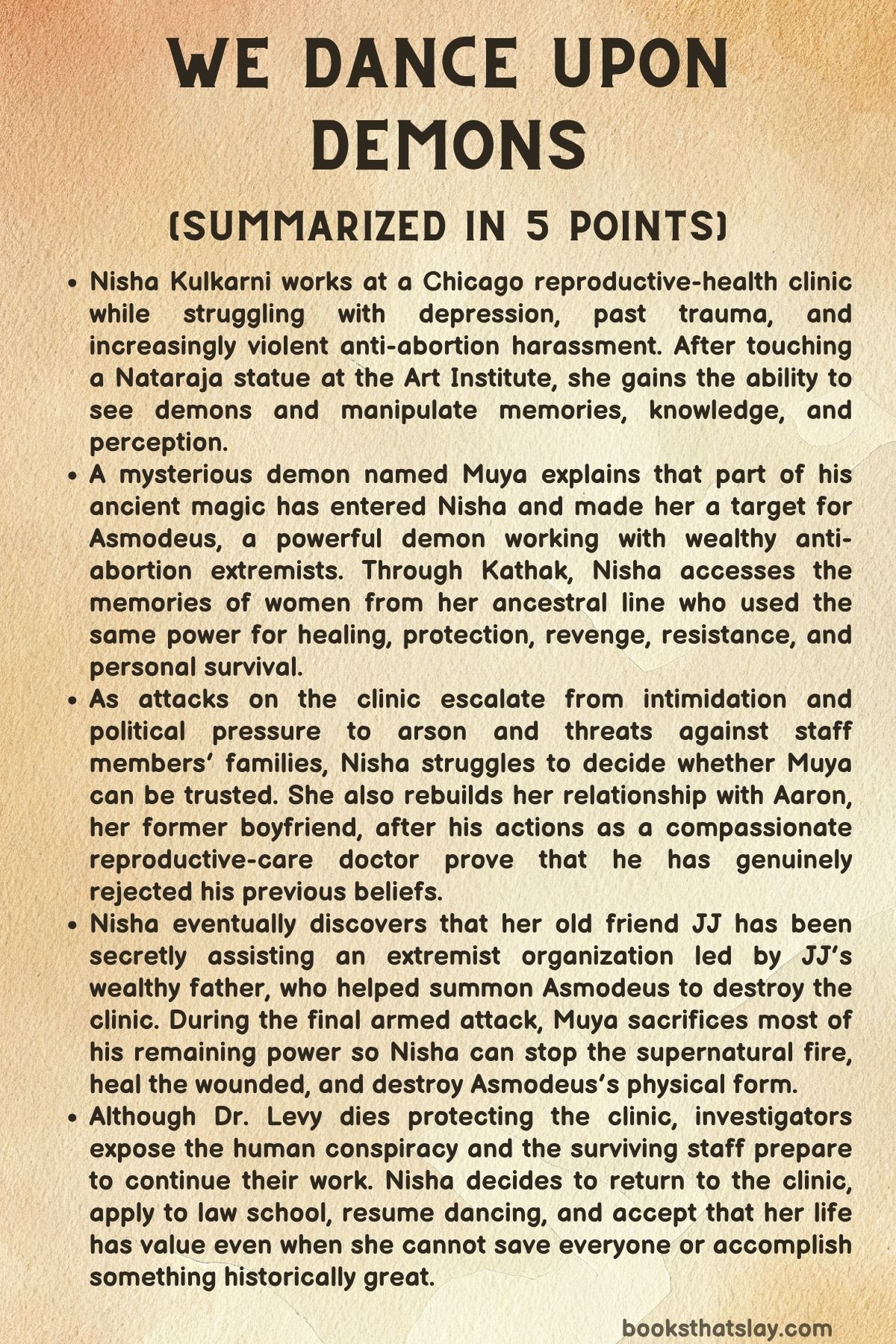
Summary
Nisha Kulkarni begins each day feeling as though she is drowning in shallow water. She knows that survival should be possible, yet depression prevents her mind and body from responding as she believes they should.
She works at Rogers Park Health Center, a Chicago clinic where she coordinates volunteers, escorts patients, and manages community outreach. Her responsibilities give her direction, even when she struggles to find personal reasons to continue.
The beginning of the annual Forty Days for Life campaign brings a larger and more hostile crowd of anti-abortion protesters to the clinic. They surround Nisha, mistake her for a patient, grab her, and accuse her of intending to murder a child.
Diane, the clinic receptionist, drives them away with a bullhorn. Once inside, Nisha channels her fear into practical work by arranging additional escorts and preparing for the harassment expected before Easter.
A second shock awaits her when Dr. Levy introduces Aaron Robinson as the clinic’s new medical resident. Aaron is Nisha’s former boyfriend, and their relationship ended after he saw her near an abortion clinic, assumed she was seeking an abortion, and abandoned her.
Aaron claims that his participation in an anti-abortion protest changed him and ultimately inspired him to enter reproductive medicine. Nisha cannot accept his explanation and suspects that he may be infiltrating the clinic.
After Diane encourages her to take a break, Nisha visits the Art Institute of Chicago. In the South Asian gallery, she approaches a Nataraja statue depicting Shiva dancing upon the demon of ignorance.
The statue reminds her of Kathak, the classical dance she abandoned after trauma and depression changed her relationship with her body. When she touches the statue, something cuts her finger, her blood touches the metal, and she collapses beneath a wave of heat.
Nisha awakens beside a mysterious Indian man who appears alarmed by what she has done. The stranger disappears when Aaron arrives, but Nisha continues seeing him near the museum, her workplace, and her home.
At the clinic, Nisha reconnects with JJ, a former college friend who introduces herself as Julie Perkins and volunteers to help during the protest campaign. JJ’s return seems comforting because she remembers Nisha before the accident and depression altered her life.
The comfort is soon disturbed by Daniel Olsen, a businessman who arrives at Nisha’s apartment claiming that his employer wants to purchase her assets. Nisha intermittently sees his ordinary human appearance transform into a creature with horns, tusks, a tail, and an elongated neck.
Aai, Nisha’s mother, arrives before the confrontation becomes more dangerous. Although Nisha questions whether the monstrous features were real, Aai also senses that something is wrong.
At a gathering hosted by the Bhat family, Nisha faces the social judgments of an affluent Indian American community. Sheetal Aunty treats her as a possible match for her son until she discovers that Nisha works at an abortion clinic.
Aai publicly defends her daughter, and Dr. Bhat argues that reproductive autonomy and the reduction of suffering are compatible with Hindu principles. Rima Iyer, who has left her abusive husband, also apologizes for previously participating in the community’s rejection of Nisha and Aai.
Nisha’s supernatural experiences intensify. She begins seeing several protesters as demons hidden behind human bodies, while an unknown stranger confirms that she now possesses a valuable gift.
During a volunteer shift at another clinic, protesters frighten a young boy by telling him that doctors will mutilate him. Nisha wishes that he could forget their words, and a strange heat travels through her hand.
The boy immediately loses his memory of the harassment and enters the clinic without fear. Nisha realizes that she can alter what people remember and perceive.
The museum stranger finally introduces himself as Muya. He explains that touching the statue released him from centuries of imprisonment and transferred part of his magic into Nisha.
Muya is connected to Muyalagan and Apasmara, the being traditionally shown beneath Shiva’s dancing feet. He claims to be a fragment or manifestation of that power rather than the exact figure described in religious art.
Because Nisha carries his magic, she can see demons, influence perception, alter knowledge, and command people to forget. Muya wants the power returned, but removing it could kill her unless she willingly and carefully releases it.
He also explains that other women once carried parts of his power. Through meditation, peace, or transcendence, Nisha may be able to enter the memories they left behind.
Nisha discovers that dance opens the connection. When she resumes Kathak, she enters the life of Chandini, a healer and midwife from the time of Chandragupta Maurya.
Chandini used Muya’s gift to protect her town from an approaching army. She created the appearance of a deadly plague, convincing the soldiers that entering the settlement would infect and kill them.
Although her deception saved thousands, the deeper transfer of power made her less entirely human. Chandini advises Nisha to recognize her strength and choose action rather than surrender.
Nisha investigates the Nataraja statue and learns that its museum records have mysteriously disappeared. She also finds accounts suggesting that demons work through corporations, wealthy individuals, political organizations, and coercive financial arrangements.
A powerful demon soon enters her dreams and offers money, influence, and freedom in exchange for Muya’s magic. When she refuses, he threatens to destroy her and everyone connected to the clinic.
Nisha later enters the memory of Tara, a woman who foresaw a plague approaching her coastal community. Tara persuaded the town to close its gates and maintain isolation, even after fear, loneliness, and resentment turned the population against her.
When Tara’s closest friend secretly left and returned infected, Tara enforced isolation despite their emotional bond. Her lesson teaches Nisha that protection sometimes requires painful boundaries and the willingness to be disliked.
At an Art Institute fundraiser, a human servant of the unknown demon surrounds wealthy donors with magical pressure. The gathered supporters reveal that the clinic is being targeted because its closure would weaken the entire regional abortion network.
Using Tara’s emotional hardness, Nisha makes the guests question the servant’s identity and presence. Their confusion breaks his control, giving her the first clear victory against the campaign.
The enemy quickly retaliates. A magically controlled driver attempts to run Nisha down, false accusations bring police officers to the clinic, and financial pressure threatens the building’s future.
Aaron repeatedly proves useful during these crises. He admits that his former beliefs were challenged by Michelle, who forced him to consider whether he cared about healthcare, gun violence, poverty, imprisonment, and the lives of patients harmed by his protests.
Nisha begins respecting him as a colleague, although forgiveness remains difficult. Her next ancestral vision shows Laila, a woman whose family was slaughtered by invaders.
Muya saved Laila and urged her to rebuild her life, but she secretly prepared for revenge. Years later, she trapped the invaders in their settlement, burned the buildings, killed the guards, and destroyed the land.
Laila’s actions horrify Nisha because they reveal how easily power can become an excuse for cruelty. Her warning is not about weakness but about the temptation to treat revenge as justice.
That danger becomes immediate when someone sets fire to the clinic. A supernatural influence makes the staff feel calm and safe while smoke spreads through the building.
Nisha breaks the spell and helps Diane evacuate the occupants. After an explosion leaves Aaron unconscious, she commands him to wake, using the same power that can violate minds to save his life.
The clinic temporarily closes, and Nisha’s depression becomes more severe. She overhears Aai mourning the life and potential that trauma, discrimination, violence, and illness appear to have taken from her daughter.
Nisha interprets her mother’s grief as proof that she has failed. Rather than accepting support, she leaves Aai’s home and isolates herself.
At her apartment, she meets Asmodeus, the Prince of Demons. He explains that demon magic has become rare and that the portion inside Nisha is worth far more than the human souls he usually acquires through bargains.
Asmodeus recognizes that Nisha may not value her own survival, so he threatens the clinic instead. He promises to destroy it through arson, political pressure, money, or murder unless she agrees to surrender the magic.
Seeking another ancestral lesson, Nisha witnesses the life of Heera. During the rise of the Maratha resistance, Heera removed the memories and loyalties of a demon protecting Afzal Khan’s forces, allowing Shivaji’s side to defeat its enemy.
Heera received no lasting recognition and returned peacefully to her family. She advises Nisha that happiness and meaningful action do not require fame.
Muya begins training Nisha to control her commands with greater precision. Their relationship gradually changes from open hostility into reluctant companionship, though Nisha remains uncertain about his intentions.
The violence around the clinic continues. A protester attacks Nisha, and her anger causes the surrounding aggression to turn back on the demonstrators, creating a fight she cannot fully control.
Muya later causes another protester to suffer a seizure so that he can steal a key card. Because Apasmara is associated with epilepsy, Nisha fears that Muya treats human suffering too casually.
The stolen card leads them to an office containing detailed plans to destroy the clinic. The documents identify Rogers Park Health Center as a strategic location and contain profiles of every employee, including Nisha.
The attackers escalate their threats by targeting Dr. Levy’s daughter and invading Aai’s home. Fearing for her mother’s life, Nisha agrees to meet Asmodeus and discuss surrender.
Her next vision concerns Usha, a nineteenth-century reproductive healer in Pune. After a young widow dies during an unsafe abortion performed by an unqualified man, Usha becomes the target of political betrayal and colonial prosecution.
Believing that Muya has manipulated events against her, Usha traps him inside the Nataraja statue. Nisha interprets this memory as proof that he cannot be trusted.
She confronts Muya and accuses him of working with Asmodeus. When he tries to alter her memory, she uses his own magic to resist, and their conflict ends with Muya attacking her fear that she has wasted her life.
Nisha then attempts to defeat Asmodeus by erasing his memory of her, the clinic, and Muya’s power. The plan succeeds temporarily, but Asmodeus has used their confrontation as a distraction.
Lauren, a recent patient, and her young son Jason are murdered by Lauren’s abusive boyfriend after he learns about her abortion. Nisha believes that her decision to resist Asmodeus caused their deaths.
Even while mourning, the clinic staff vote to remain open. Shreya Pillai, a scholar of demon mythology, helps Nisha understand that demons often embody human failures and may be directed by powerful people.
Aai and Rima organize a fundraiser with support from the Indian community. The event raises enough money to repair the clinic and finance its operations for several months.
Asmodeus attacks the gathering through a magical haze of lust and intensified attraction. Shreya recognizes the danger and stops a possessed man from leading Nisha away.
Nisha finally tells Shreya the full truth. She also tests Aaron by revealing her own past abortion, which occurred after their breakup.
Aaron admits that the information hurts him but clearly states that he had no right to control her decision. When Nisha explains her depression, he compares it to a rip current that can overpower even a capable swimmer.
Another vision reveals the truth about Usha. Muya had not betrayed her; ordinary humans had used colonial law, patriarchy, and fear to prosecute her, while he had tried to warn and protect her.
Usha’s final lesson is to choose trust. Nisha apologizes to Muya and begins accepting that uncertainty cannot be answered through isolation.
The clinic’s defenders grow as members of Aai’s community break through an illegal protest blockade. Aai also corrects Nisha’s belief that she was an unwanted child, explaining that she freely chose motherhood because she wanted her daughter.
Nisha soon discovers that JJ has been working with the anti-abortion network. JJ’s father, Harry Perkins Fleming, is the wealthy donor directing the effort to close the clinic.
JJ entered under a false name, collected information, and apparently assisted with the arson. Her offers to help Nisha find another job were attempts to remove her before the final attack.
During Nisha’s last ancestral vision, Chandini reveals the full life she created with Muya. Their relationship developed into enduring friendship and love, and her final request was that he protect her descendants.
The final attack begins with gunshots, smoke, and magical fire. A gunman shoots nurse Dan and Dr. Levy, while Aaron, the staff, patients, and even the regular protester Steve attempt to protect one another.
Asmodeus offers to stop the destruction if Nisha surrenders. Instead, she draws strength from her ancestors, her community, the earth, music, and her renewed understanding of her own choices.
She begins reversing the supernatural fire, healing injuries, repairing destruction, and unmaking Asmodeus’s physical presence. When her power fails, Muya gives her what remains of his magic and helps her complete the act.
The clinic survives, but Dr. Levy dies protecting the people inside. Investigators uncover the human conspiracy, while the witnesses conceal the supernatural events.
Muya survives with greatly diminished power and begins forming a genuine friendship with Nisha. She returns to the clinic, resumes dancing, plans to apply to law school, and accepts that she does not need historic greatness to justify her existence.
Her recovery is not presented as the disappearance of pain. Instead, she learns that she can continue working, loving, grieving, and choosing even when the possibility of sinking remains.
Characters
Nisha Kulkarni
Nisha is the emotional, political, and supernatural center of We Dance Upon Demons. Her work at Rogers Park Health Center reflects her commitment to reproductive freedom, but it also functions as a structure that keeps her moving when depression has weakened her sense of personal purpose.
She frequently measures her value through achievement, believing that she must save a clinic, transform a system, or accomplish something historically significant to justify her life. This belief makes her courageous and disciplined, but it also turns every failure into evidence that she should not exist.
Her supernatural gift intensifies this internal struggle because it gives her the ability to alter memory, perception, and knowledge. The power promises control in situations where political institutions, medical systems, and personal trauma have repeatedly left her powerless.
Nisha nevertheless remains deeply concerned about consent. She recognizes that forcing a person to forget or obey can be a violation even when the command produces a desirable result.
Her experiences with Chandini, Tara, Laila, Heera, and Usha present several possible versions of power. She must choose between protection, hardness, revenge, contentment, boldness, and trust without treating any single ancestral lesson as a complete answer.
Nisha’s depression is never portrayed as laziness or moral weakness. Her image of drowning in shallow water captures the painful gap between knowing what should be possible and being unable to make her mind respond.
She initially rejects therapy, family support, and friendship because she believes suffering should be handled privately. Her growth begins when she understands that isolation is not independence and that accepting help does not make her a burden.
Her final victory is therefore larger than defeating Asmodeus. She learns to continue living without demanding that every action prove her worth, and she accepts that saving one person or completing one ordinary day can still matter.
Muya
Muya initially appears suspicious, demanding, and emotionally distant. Because part of his magic has transferred into Nisha, he repeatedly asks her to surrender it, creating the impression that he values his power more than her life.
His morality is shaped by centuries of existence and by a perspective that differs greatly from ordinary human ethics. He can alter minds, cause seizures, conceal entire communities, and erase identity without always responding to those actions with the guilt Nisha expects.
Yet We Dance Upon Demons gradually reveals that Muya is not simply a dangerous supernatural creature. His long connection with Chandini and her descendants has bound him to a promise that survives imprisonment, betrayal, and the loss of much of his power.
His relationship with Chandini demonstrates his capacity for tenderness, humor, loyalty, and romantic love. Her death leaves him carrying a promise that no later descendant can fully understand until Nisha reaches the final memories.
Muya’s conflict with Usha is central to his characterization. He fails to communicate effectively, allowing his secrecy and controlling behavior to confirm her fears even though he is attempting to protect her.
His training of Nisha reflects both self-interest and growing concern. He teaches her precision, helps her survive attacks, and eventually offers to let the magic disappear rather than continue pressuring her to return it.
During the final confrontation, Muya gives Nisha his remaining power even though doing so permanently reduces him. This choice confirms that his loyalty to Chandini’s descendants has become more important than restoring his former strength.
Aai
Aai is Nisha’s mother, protector, cultural guide, and most constant source of love. She uses religious stories, breathing exercises, food, family gatherings, community contacts, and practical action to help her daughter survive.
Her spirituality differs from the rigid or politically convenient forms of religion used by several antagonists. For Aai, Hindu tradition contains stories of powerful women, divine resistance, bodily autonomy, and the defeat of destructive forces.
Aai sometimes struggles to understand the full depth of Nisha’s depression. Her attempts to encourage prayer, community participation, or productivity can feel inadequate when Nisha is barely able to leave the floor.
However, her shortcomings arise from fear and love rather than rejection. When Nisha finally explains the supernatural events, Aai believes her, researches protective traditions, and immediately begins helping.
Their most important confrontation concerns Nisha’s belief that she was unwanted. Aai firmly explains that she had reproductive choices and freely chose to become a mother because she wanted Nisha.
This correction frees Nisha from the idea that she must repay her mother by becoming exceptional. Aai’s love does not depend on success, historical importance, professional status, or emotional perfection.
Aai’s ability to mobilize the Indian community also changes the political situation around the clinic. She shows that social networks Nisha once experienced as judgmental can still become sources of protection when someone challenges their silence.
Aaron Robinson
Aaron begins as a painful reminder of abandonment and moral betrayal. He once participated in anti-abortion protest activity, assumed the worst about Nisha, and ended their relationship without allowing her to explain herself.
His return as a reproductive-care resident understandably appears suspicious. Nisha has no reason to trust a sudden transformation that places him inside the clinic he once opposed.
Aaron’s development is demonstrated through consistent behavior rather than verbal promises. He protects patients, acknowledges reproductive autonomy, regrets the harm caused by his former actions, and uses his medical training to provide care.
His apology does not demand immediate forgiveness. Although he hopes to rebuild his relationship with Nisha, he gradually accepts that remorse does not erase the consequences of what he did.
Aaron also recognizes the privilege attached to his identity as a white male physician. When police officers treat his explanation more seriously than Nisha’s, the incident shows how institutional authority can protect him while placing her at risk.
His response to Nisha’s abortion becomes the clearest test of his change. He experiences personal sadness but does not confuse that feeling with a right to control her body.
Aaron’s description of depression as a rip current is especially meaningful because it rejects the idea that strength guarantees safety. He sees Nisha’s struggle as something capable of overpowering anyone rather than as a personal failure.
JJ Perkins
JJ initially appears to represent friendship, familiarity, and Nisha’s lost connection to life before depression. Her return seems almost perfectly timed, offering companionship during a period of increasing danger.
The revelation that she is Harry Perkins Fleming’s daughter transforms nearly every earlier interaction. Her use of the false name Julie Perkins, her access to the clinic, and her repeated attempts to move Nisha into another job become signs of surveillance and manipulation.
JJ does not present herself as purely cruel. She claims that she offered Nisha opportunities to escape, suggesting that some part of her wanted to protect her former friend without abandoning her family’s campaign.
That limited concern cannot excuse her actions. By assisting an extremist organization, gathering information, and apparently enabling arson, she accepts the predictable possibility that patients and staff will be injured or killed.
Her betrayal is especially damaging because she uses intimacy as an investigative tool. She gains access not through supernatural force but through Nisha’s memories, trust, and desire to reconnect.
JJ also represents the comfortable person who treats political violence as strategic work. Her wealth and family influence allow her to imagine that she remains reasonable even while supporting actions that terrorize vulnerable people.
Dr. Levy
Dr. Levy is the clinic’s medical and moral leader. She combines direct patient care with a clear understanding of the political forces attempting to make that care impossible.
She repeatedly reminds Nisha that her life matters as much as the lives of the patients. This challenges Nisha’s tendency to treat self-sacrifice as the highest proof of commitment.
Dr. Levy’s philosophy emphasizes limited but meaningful action. She understands that no individual can solve every injustice, yet she refuses to dismiss the value of treating one patient or keeping one clinic open.
Her decision to continue operating after the fire and threats demonstrates courage, though it is not presented as a denial of danger. She knows that closing would leave hundreds without care and would reward those using intimidation.
Her death during the final attack completes the protective role she has occupied throughout the story. She places herself between the gunman and the people inside, acting according to the principles she has consistently expressed.
Dr. Levy’s influence survives her death through Nisha’s decision to continue. Her belief that saving one life can equal saving an entire world becomes the foundation of Nisha’s new understanding of purpose.
Diane
Diane is the clinic receptionist, but her role extends far beyond administrative work. She protects the entrance, manages crises, comforts staff, directs volunteers, and confronts protesters without pretending that their behavior is harmless.
Her bullhorn becomes an early symbol of practical resistance. While Nisha draws inspiration from goddesses and supernatural power, Diane shows that ordinary courage can also break through intimidation.
Diane pays close attention to Nisha’s emotional condition. She notices when Nisha’s reactions become unusual, encourages her to take breaks, and provides support without reducing her to her depression.
During the fire, Diane responds immediately once Nisha breaks the spell affecting the staff. Her decisiveness helps ensure that patients and employees escape before the building is consumed.
She also supports the decision to reopen after the attack. Her commitment shows that the clinic survives through the daily labor of people whose contributions may receive little public recognition.
Shreya Pillai
Shreya is a scholar of demon mythology who becomes both an intellectual ally and a friend. Her research challenges traditions that automatically describe every supernatural being as evil while ignoring human violence, colonial power, and political propaganda.
Her perspective helps Nisha question the simple division between humans and demons. Asmodeus may encourage cruelty, but wealthy human organizers summon him and direct his abilities toward goals they already desire.
Shreya also responds effectively under pressure. At the fundraiser, she notices Asmodeus’s magical influence and physically stops a possessed man from taking Nisha outside.
Her readiness to believe Nisha contrasts with Nisha’s fear that explaining the truth will make her appear irrational. Shreya provides knowledge without claiming authority over Nisha’s experience.
The mutual admiration between the two women suggests the possibility of a friendship based on equality rather than rescue. Shreya helps Nisha investigate the supernatural threat while respecting her ability to make decisions.
Rima Iyer
Rima first appears as someone who once participated in the Indian community’s mistreatment of Nisha and Aai. Her marriage to Ajay and her defence of his prejudices placed her on the side of respectability, patriarchy, and social exclusion.
After Ajay becomes physically violent, Rima leaves him and begins reassessing the ideas she previously accepted. Her suffering does not automatically erase the harm she caused, and Nisha is not required to forgive her immediately.
Rima’s apology is valuable because she does not demand that Nisha comfort her. She acknowledges her actions while understanding that forgiveness may take time or may never be complete.
Her later defence of Nisha during Aai’s conversation shows genuine change. She refuses to describe Nisha’s struggles as proof of incapacity and recognizes the work Nisha continues to perform despite her difficulties.
Rima also helps organize the fundraiser and mobilize community support. Her development illustrates how a person can leave a harmful system and begin repairing damage through sustained action.
Asmodeus
Asmodeus is the principal supernatural antagonist, but his danger comes from discipline rather than uncontrolled rage. He appears attractive, calm, persuasive, and fully aware of how to convert desire, fear, guilt, and grief into obedience.
He does not rely solely on magical force. He works through property purchases, political influence, wealthy donors, manipulated protesters, threats against children, arson, and armed violence.
His strategy is based on discovering what people value. When he realizes that Nisha is not strongly motivated by self-preservation, he threatens the clinic, her mother, her colleagues, and her patients.
Asmodeus also understands her guilt. The murders of Lauren and Jason are designed to make Nisha believe that resistance itself causes innocent deaths.
Although associated with lust, his influence extends to wrath, revenge, possession, and domination. He strengthens impulses already present in human beings rather than creating political hatred from nothing.
His dependence on human allies is essential. The Fleming network summons and directs him because its members want the clinic destroyed, demonstrating that supernatural evil cannot be separated from ordinary wealth and ideology.
Chandini
Chandini is the earliest and most influential ancestral figure connected to Nisha. As a healer and midwife, she uses Muya’s power to protect reproductive health, families, and an entire town.
Her deception of the approaching army shows how altered perception can serve a defensive purpose. She creates fear without needing to slaughter the soldiers, proving that power can prevent violence rather than merely answer it.
Chandini also builds the deepest relationship with Muya. Their companionship grows through shared work, humour, loyalty, affection, and eventual romantic love.
She does not seek marriage, children, fame, or political recognition as proof of a meaningful life. Her work as a healer, aunt, friend, protector, and companion gives her lasting satisfaction.
Her final request explains Muya’s continued involvement with her descendants. By asking him to protect future women in her family, she creates a responsibility that extends across centuries.
Chandini’s most important lesson is that Nisha cannot allow ancestral history to choose for her. The past offers examples, but Nisha must decide what kind of person she will become.
Tara
Tara represents vigilance, boundaries, and the emotional cost of responsible leadership. Her ability to perceive the approaching plague allows her to save her community before most people accept that danger exists.
She faces resistance from those who fear inconvenience, economic disruption, and social judgment more than an unseen illness. Tara remains firm because she understands that popularity cannot be the measure of a protective decision.
Her confrontation with her infected friend gives the lesson personal force. Tara must reject denial and insist on isolation even though doing so appears cruel.
The friend’s later illness proves Tara correct, but being correct does not remove the pain. Tara’s experience shows that leadership can require decisions that damage relationships while protecting a larger group.
Her hardness is useful to Nisha during the museum confrontation, yet the story does not present hardness as a complete moral identity. It is a tool for moments when compassion without boundaries would permit greater harm.
Laila
Laila embodies grief transformed into revenge. After invaders destroy her family and village, Muya rescues her and encourages her to begin again.
She outwardly accepts his advice while secretly building the skills required to retaliate. Her patience makes her violence deliberate rather than impulsive.
When she destroys the invaders’ settlement, she believes she is answering injustice with equal force. However, her refusal to distinguish between responsible individuals and ordinary inhabitants turns punishment into collective destruction.
Laila’s story warns Nisha that suffering does not automatically make future actions righteous. A person can be a victim of terrible violence and still become responsible for new violence.
Her fierceness remains valuable because it rejects passivity and fear. The danger arises when fierceness becomes an identity that permits no restraint, doubt, or mercy.
Heera
Heera demonstrates a form of heroism that does not depend on public recognition. She leaves her family temporarily because recurring visions convince her that she can help protect the newly built fort at Pratapgad.
Knowing she cannot defeat an army, she focuses on the single supernatural obstacle within her reach. By erasing the demon’s memories and loyalties, she removes the protection surrounding Afzal Khan’s forces.
History celebrates warriors while overlooking her contribution. Heera accepts this absence of recognition because she measures success by the result rather than by fame.
Her return to family life is not portrayed as retreat or wasted potential. She understands that a peaceful existence can remain meaningful after an extraordinary act.
Nisha initially finds her advice frustrating because she equates contentment with surrender. Later, she understands that Heera is offering freedom from the demand to prove one’s worth through endless sacrifice.
Usha
Usha is a reproductive healer whose life closely parallels Nisha’s work. She cares for women across class divisions while operating under colonial laws that can criminalize her medical practice.
The death of a young widow after an unsafe abortion leaves Usha consumed by guilt. Although an unqualified man caused the fatal injury, Usha blames herself for hesitating and failing to prevent the procedure.
Political allies abandon her when association with her becomes dangerous. Wealthy and powerful men then use British law and patriarchal judgment to portray her as responsible for harm committed by someone else.
Fear leads Usha to believe that Muya has engineered her isolation. She traps him in the Nataraja statue before learning that he had been attempting to warn and protect her.
Her mistake does not make her foolish. The betrayal surrounding her gives her reasonable grounds for suspicion, while Muya’s secrecy makes trust even more difficult.
Usha’s final lesson is that trust always involves risk. Her story encourages Nisha to distinguish cautious judgment from the belief that isolation is the only form of safety.
Harry Perkins Fleming
Harry Perkins Fleming represents the wealthy human power directing the campaign against the clinic. His organization treats reproductive healthcare as a strategic network that can be weakened by eliminating smaller facilities.
He does not need to appear personally at every act of violence. Money, property influence, political connections, family loyalty, hired operatives, and supernatural assistance allow him to remain distant from the consequences.
His relationship with JJ shows how extremist beliefs can be transmitted through family identity and privilege. She appears willing to endanger former friends in order to protect her father’s objectives.
Fleming’s role confirms that Asmodeus is not the original source of the hatred surrounding the clinic. Human beings summon him because he can strengthen a campaign they have already chosen to pursue.
Geeta
Geeta is a clinic employee who argues that the facility should temporarily close after repeated attacks. Her position does not arise from cowardice but from the realistic fear that one more violent event could destroy the organization permanently.
Her concerns create an important internal disagreement. The novel respects both the desire to continue serving patients and the need to protect workers from becoming sacrifices to a political cause.
Geeta’s presence prevents the clinic staff from appearing uniformly fearless. She represents the reasonable person who understands the value of the work but questions whether constant exposure to violence can be sustained.
Steve
Steve is a regular protester whose actions usually contribute to the intimidation surrounding the clinic. However, during the final attack, he attempts to stop the gunman.
His response establishes a boundary between protest and murder, even though his earlier behavior helped create the hostile environment in which violence became increasingly likely. He cannot be treated as a hero simply because he objects when the danger becomes undeniable.
Afterward, Steve gives a partially supportive public statement before returning to protest elsewhere. His limited change demonstrates how a person may recognize one form of extremism while refusing to reconsider the beliefs that supported it.
Divya
Divya is an undocumented woman who wants a child but considers abortion because pregnancy could cost her job and deepen her financial insecurity. Her situation demonstrates that a choice cannot be considered free when poverty, immigration status, employment, and healthcare costs eliminate realistic alternatives.
Nisha supports Divya without assuming that abortion is automatically the correct decision. She searches for practical resources that might allow Divya to continue the pregnancy while repeatedly acknowledging that she cannot promise a solution.
Divya’s story reinforces the clinic’s commitment to reproductive autonomy rather than to a particular medical outcome. Genuine choice requires the possibility of continuing or ending a pregnancy without coercion.
Lauren and Jason
Lauren and her son Jason become victims of intimate-partner violence after Lauren’s boyfriend learns about her abortion. Their deaths reveal the danger created when reproductive decisions become tools of possession and punishment.
Asmodeus uses the murders to intensify Nisha’s guilt, but the moral responsibility belongs to the abusive man and the larger system that enables violence. Nisha’s decision to resist a demon does not cause another person to commit murder.
Lauren and Jason remain important because their deaths prevent the political conflict from feeling abstract. The campaign against the clinic affects families whose private choices can expose them to lethal retaliation.
Themes
Reproductive Autonomy and Political Violence
Reproductive decisions in We Dance Upon Demons are shaped by money, employment, immigration status, family expectations, abusive relationships, medical access, racial propaganda, and the threat of criminal punishment. The clinic does not treat abortion as an isolated procedure but as one part of a larger system of healthcare and personal freedom.
Divya wants to continue her pregnancy but fears losing her income, while Lauren faces violence after making a different decision. These situations show that autonomy means more than legal permission; it requires safety, medical support, financial stability, accurate information, and freedom from coercion.
The anti-abortion campaign targets those conditions rather than engaging in honest concern for patients. Protesters frighten children, follow staff, harass patients, spread false medical claims, invade a school, burn a clinic, and assist an armed assault.
The supernatural elements strengthen rather than replace the political reality. Asmodeus magnifies lust, anger, fear, and vengeance, but wealthy human organizers provide the strategy, funding, access, and ideological purpose.
The clinic’s response is grounded in continued care. By reopening after attacks and supporting patients regardless of their final decisions, the staff refuse to let violence determine who may receive medical help.
Depression, Survival, and the Burden of Greatness
Nisha’s description of depression as drowning in shallow water captures an illness that appears irrational from the outside. She understands what actions might help, yet understanding does not automatically give her the ability to perform them.
Her suffering is worsened by the belief that she must accomplish something extraordinary. Because Aai sacrificed for her and because her work concerns vulnerable lives, Nisha imagines that ordinary existence would be an inadequate repayment.
The ancestral visions initially appear to support this pressure. Chandini saves a town, Tara prevents a plague, Laila destroys her enemies, Heera helps defeat a powerful army, and Usha risks prosecution to provide reproductive care.
Their complete stories eventually challenge Nisha’s interpretation. Chandini values friendship and daily service, Heera returns to family life, Usha makes a serious mistake, and Muya’s promise survives because of love rather than historical recognition.
Dr. Levy offers the clearest alternative to greatness by insisting that helping one patient still matters. This allows Nisha to separate purpose from perfection.
Her final decision to apply to law school, return to work, dance, and remain connected does not signal a miraculous cure. It shows her choosing life without requiring certainty that she will never feel herself sinking again.
Knowledge, Ignorance, and the Ethics of Power
Muya’s magic controls what people know, remember, notice, and believe. This ability can save a frightened child, conceal a town from soldiers, stop a plague, revive an injured person, or remove a demon’s loyalty.
The same power can erase identity, create obedience, trigger violence, hide danger, and remove a person’s ability to make an informed decision. Its moral meaning therefore depends on purpose, precision, consent, and consequence.
Nisha repeatedly struggles with whether beneficial results justify interference with another mind. She wants to protect patients, but she recognizes that commanding protesters or altering memories can reproduce the same denial of autonomy she opposes.
Ignorance also operates without magic. Protesters spread false medical information, institutions ignore political motives behind violence, wealthy donors hide their involvement, and communities deny abuse to preserve social respectability.
Usha’s mistake demonstrates another danger: incomplete knowledge can turn allies into enemies. Muya’s secrecy contributes to her fear, but human betrayal ultimately causes her prosecution.
The final confrontation requires knowledge to be shared rather than possessed. Nisha succeeds because ancestral memory, Muya’s experience, Shreya’s scholarship, community action, and her own judgment come together.
Community, Trust, and Imperfect Solidarity
Nisha begins the story believing that she must protect others while remaining personally isolated. She avoids therapy, rejects Aai’s invitations to return home, hides the supernatural danger, and treats dependence as proof of failure.
The people around her repeatedly challenge this belief. Diane watches her emotional condition, Aaron supports patients and acknowledges his past harm, Shreya believes her account, Rima accepts responsibility, and Aai organizes an entire community.
Not every ally agrees with Nisha on every issue. Some fundraiser donors hold reservations about abortion but still oppose intimidation and support immigrant healthcare.
Nisha gradually learns that political work cannot depend on perfect agreement. Partial solidarity can provide money, escorts, public legitimacy, physical protection, and opportunities for further change.
Trust remains risky because JJ uses friendship to enter the clinic and support the conspiracy. Her betrayal proves that intimacy can become a weapon, but it does not prove that all relationships are unsafe.
Usha’s history and Muya’s final sacrifice demonstrate that refusing every relationship can be as dangerous as trusting without judgment. Nisha’s growth lies in learning to evaluate people through sustained action while accepting that certainty is impossible.
The clinic survives because no single person saves it. Its defence depends on staff members, patients, relatives, scholars, community elders, medical workers, imperfect supporters, and a diminished demon who chooses loyalty over power.