When No One Else Will Summary, Characters and Themes
When No One Else Will by Amanda Skenandore is a historical novel set in Chicago during the final years of the Great Depression, when reproductive care was restricted by law, religion, gender expectations, and economic inequality.
The story follows Miriam “Mimi” Lukas, a former nurse who accepts work at an illegal abortion clinic after her husband’s injury leaves their family close to financial ruin. What begins as a desperate employment decision gradually changes Mimi’s understanding of medicine, morality, marriage, and female responsibility. Through her encounters with frightened patients, corrupt officials, grieving families, and determined coworkers, she must decide what kind of nurse, mother, wife, and woman she intends to become.
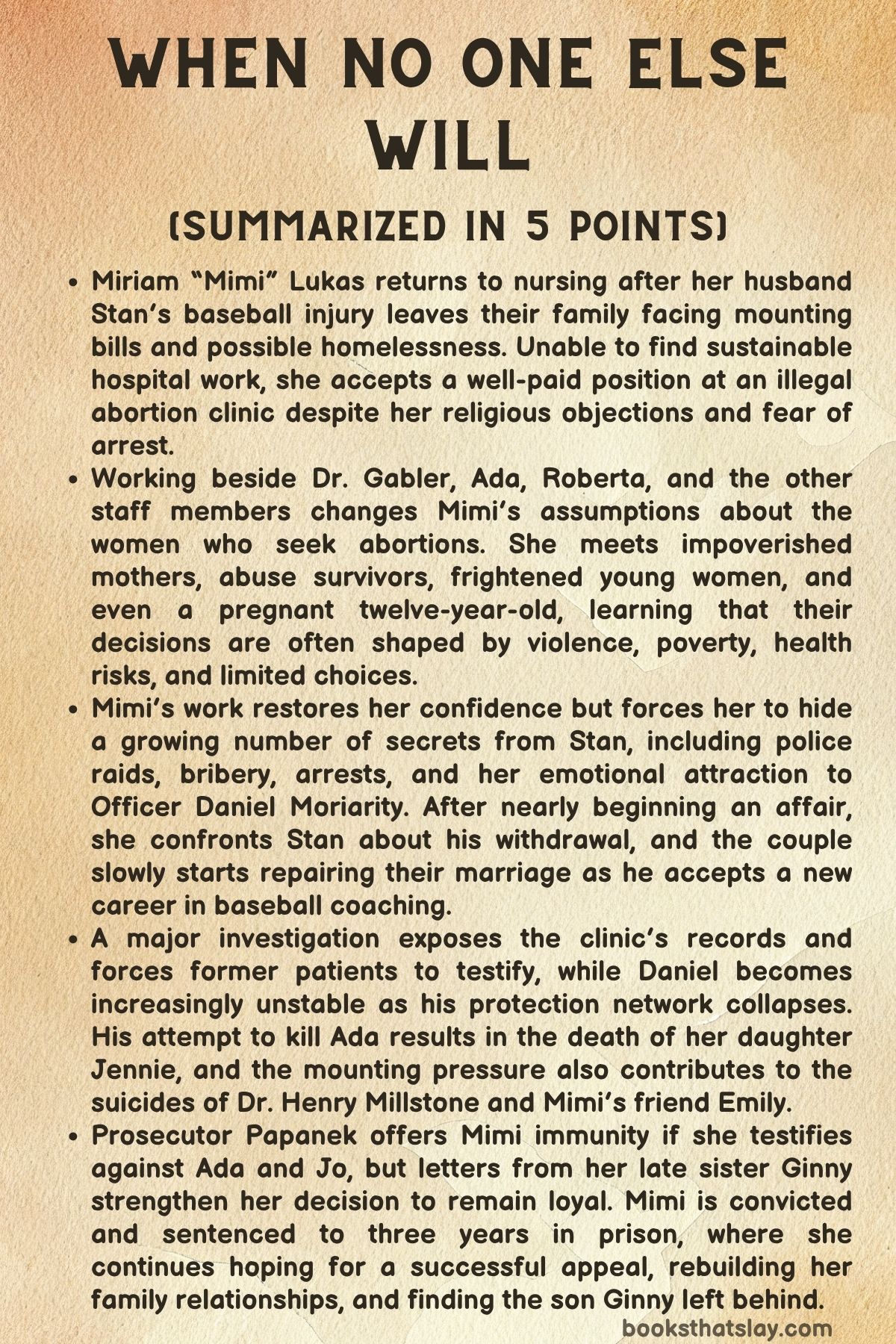
Summary
In Chicago in 1939, Miriam “Mimi” Lukas secretly visits her longtime physician to obtain a contraceptive diaphragm. She already has two children, Penny and Junior, and knows that another pregnancy would place unbearable pressure on a household weakened by medical bills, unemployment, and the severe leg injury that has threatened her husband Stan’s professional baseball career.
Because married women are expected to obtain their husbands’ approval, Mimi lies to the doctor and later forges Stan’s signature on the prescription. The experience reminds her of her older sister Ginny, whose pregnancy and death during Mimi’s childhood were surrounded by ignorance, punishment, and silence.
Mimi returns home to discover that the family’s refrigerator is being repossessed because they have fallen behind on payments. Stan continues to believe that his baseball associate Gibbins will find him another team, even after it becomes clear that no organization wants to risk signing an aging player with a damaged leg.
When Mimi suggests returning to nursing, Stan interprets the proposal as evidence that she has lost faith in him. He refuses to sell their car, accept public assistance, or consider a different occupation, forcing Mimi to seek employment without his support.
After being rejected for private-duty positions, Mimi obtains night work at Chicago Memorial Hospital. She struggles to manage nursing duties while cooking, cleaning, caring for the children, and satisfying the demands of Stan and his critical mother, Halina, who lives with the family.
Constant exhaustion leads to a serious accident on the ward when Mimi falls into a mop bucket, destroys a medication record, and frightens a traumatized veteran. She is dismissed, leaving the family with no dependable income and Mimi with few respectable employment options.
Mimi remembers that Emily Ranus, an old nursing-school friend, once mentioned a private clinic in need of assistance. Following several false leads, she locates the office of Dr. J. Gabler and is surprised to learn both that the physician is a woman and that the clinic performs illegal abortions.
Mimi initially refuses the generous offer because she considers abortion morally wrong and fears legal punishment. However, the possibility of losing her home, together with Stan’s continued refusal to confront their financial danger, drives her back to the office.
At the clinic, Mimi is trained by Roberta, a skilled Black nurse who teaches her how to interview patients, prepare operating rooms, document referrals, calculate fees, and provide postoperative care. Mimi expects to encounter reckless or immoral women but instead meets married mothers, frightened young women, abuse survivors, and poor families facing circumstances that offer no easy solution.
The clinic is medically organized, with sterilized instruments, anesthesia, careful examinations, and follow-up appointments. Mimi remembers the women she saw during nursing training who suffered infections, mutilation, and death after trying to end pregnancies themselves, and she begins to understand that legality and medical safety are not the same thing.
Her assumptions are challenged further by Rosaline Simms, a wealthy patient whom Mimi initially judges as spoiled and irresponsible. After noticing bruises on Rosaline’s body, Mimi learns that the young woman is trapped in a violent relationship and ended the pregnancy to prevent her abuser from gaining greater control over her life.
Mimi apologizes for her cruelty and begins separating regret from wrongdoing. Rosaline may mourn the circumstances that led to her decision while remaining certain that continuing the pregnancy would have created even greater suffering.
Memories of Ginny become more frequent as Mimi grows closer to the clinic’s patients. As a child, Mimi revealed Ginny’s secret pregnancy during a petty argument, after which their mother humiliated Ginny and sent her away to a home for unmarried mothers.
Mimi has spent years believing that her childish betrayal caused Ginny’s death. Every frightened patient now reminds her of the sister who had no reliable information, no family support, and no recognized right to determine her own future.
A visit to Dorothy Bates gives Mimi a clearer view of the connection between poverty and reproductive choice. Dorothy is forty-one, has seven children, lives in a nearly empty house, and cannot afford to miss work, yet her husband seeks physical intimacy because unemployment has destroyed his confidence and sense of worth.
Dorothy ended her pregnancy not because she lacked affection for children but because she was trying to feed and protect those already dependent upon her. Mimi secretly leaves groceries for the family and returns the watch Dorothy offered as collateral, although Ada later explains that the clinic cannot survive if compassion prevents it from collecting payment.
Mimi also becomes more aware of racial inequality through Roberta, who explains that a friend died by suicide after becoming pregnant. Roberta considers the clinic’s work a form of protection because women denied safe medical options will often resort to desperate measures.
As Mimi gains confidence at work, she becomes more assertive at home. She challenges Halina’s criticism, insists that her wages are keeping the household alive, and refuses to behave as though friendship, employment, and personal freedom are selfish desires.
The clinic is eventually raided by the police morals squad. Mimi is arrested with staff members and patients, spends the night in jail, and meets Bea, a singer and sex worker who once attempted to end a pregnancy with part of an umbrella after being abandoned by the man responsible.
Although the clinic’s connections cause the charges from this raid to disappear, Mimi initially decides that the danger is too great. Before leaving, she helps care for Annabelle, a pregnant twelve-year-old whose condition almost certainly resulted from sexual abuse.
The child’s fear makes Mimi recognize the limits of rigid moral arguments. The clinic cannot remove Annabelle from the person who harmed her, but it can prevent the pregnancy from becoming a continuing physical consequence of that abuse, and Mimi chooses to remain.
Mimi later delivers a protection payment to Daniel Moriarity, a police officer involved in the clinic’s bribery network. Daniel explains that he has an ill wife and four daughters, and he presents himself as another parent who has compromised his principles to maintain his household.
Their conversations become increasingly personal because Daniel listens to Mimi in a way Stan has not done for months. Mimi is drawn to his humor, warmth, and attentiveness, even while understanding that his protection of the clinic depends upon corruption.
During a visit to her parents’ farm in Iowa, Mimi learns that Ginny was impregnated by a married professor rather than a local boy. Her parents protected the man’s reputation and the family’s social standing while sending Ginny away and eventually burying her anonymously.
Back in Chicago, Mimi treats Zofina Dabrowski, a judgmental woman from Halina’s church. Zofina already has twins, her husband is unemployed, and another child would place the family beyond its ability to survive, so Mimi protects her secret rather than exposing her apparent hypocrisy.
Mimi and Daniel later meet by chance at the zoo with their children. Watching him behave tenderly toward his daughters increases Mimi’s attraction, while their discussion of unhappy marriages creates an emotional intimacy that neither is receiving at home.
The clinic’s operations require Mimi to participate in increasingly serious compromises. She accompanies an attorney to protect an infected patient from police questioning, sees money offered to the woman’s family for their silence, and realizes that secrecy is maintained through a mixture of loyalty, fear, legal manipulation, and financial pressure.
During another raid, Mimi removes cash and patient records from a hidden office and assists Daniel in arranging bribes to recover seized evidence. After the plan succeeds, their relief and attraction lead to a passionate kiss, although Mimi pulls away before the relationship becomes sexual.
Mimi’s patients continue to challenge superficial judgments. Blanche McAllister, a famous actress who initially appears arrogant and demanding, reveals that a previous abortionist raped her and performed the procedure without anesthesia, showing Mimi that pride and rudeness can function as defenses against fear.
Mimi also confesses her guilt about Ginny to Emily, who insists that Mimi was only a child. Emily reveals that her relationship with Dr. Henry Millstone began while he was married and hopes that their unconventional partnership can finally become a recognized marriage.
A former baseball employee suggests that Stan might have a future as a coach, but Stan rejects the idea because he still cannot accept that he will never play professionally again. Mimi realizes that she has been working to rescue someone who refuses every solution that requires him to change his identity.
At a party hosted by Ada, Mimi nearly leaves with Daniel but stops herself after recognizing that an affair would increase the suffering in both families. She returns home and finally confronts Stan about their finances, his emotional absence, her contraceptive use, the children’s fear, and her near-infidelity.
Stan breaks down and admits that he blames himself for the collision that destroyed his leg. He believes one mistake ended his entire life, and his refusal to seek another future has been driven by shame rather than simple stubbornness.
Their marriage begins to recover after this confession. Stan becomes more attentive, eventually contacts the baseball associate who suggested coaching, and receives an opportunity to work with the Chicago Cubs during spring training.
When Mimi’s mother dies, Mimi returns to Iowa and discovers unopened letters Ginny sent from the home for unmarried mothers. The letters prove that Ginny begged to come home, wanted contact with Mimi, and was deliberately ignored by their parents.
Meanwhile, the clinic faces a far more serious raid. Mimi, Ada, Jo, and others are officially arrested, fingerprinted, photographed, and investigated by Assistant State’s Attorney Papanek, who intends to prosecute the clinic as a large criminal enterprise.
Police seize the hidden patient records, allowing investigators to identify women who visited the clinic. Patients such as Zofina are summoned, questioned, and threatened with public exposure if they refuse to testify.
Daniel becomes increasingly desperate because the usual bribes no longer work and federal investigators may uncover his role in the protection network. He begins suggesting that Ada might expose him and implies that violence may be the only way to stop her.
A grand jury indicts Mimi, Ada, and Jo for conspiracy to commit abortion. Mimi finally tells Stan the truth about the clinic, the raids, the bribery, the arrests, and the possibility of prison, leaving him furious that she continued deceiving him even after their reconciliation.
The legal pressure destroys several people connected to the clinic. Henry Millstone dies from a narcotic overdose after writing confused accusations about a supposed abortion syndicate, and Emily follows him in suicide after receiving his final letter.
Daniel’s panic becomes violent when he goes to Ada’s home intending to kill her. In the darkness he shoots Ada’s daughter Jennie by mistake, and Mimi attempts unsuccessfully to stop the young woman’s bleeding before Daniel is arrested.
Public interest turns the tragedy into entertainment. Newspapers and neighborhood gossip portray the accused as monstrous criminals, while Mimi’s children are excluded from a community parade because adults fear association with their mother.
Papanek offers Mimi immunity in return for testifying against Ada, Jo, and the clinic. Accepting would allow her to remain with her children, protect Stan’s career, and avoid prison, but it would also betray her friends, patients, and professional belief in confidentiality.
Halina unexpectedly supports Mimi by telling her about a childhood friend who was raped, forced to marry her attacker, and subjected to repeated pregnancies. She tells Mimi that helping women in such situations was brave, even if accepting the risks was not always wise.
Mimi then learns from Ginny’s letters that her sister forgave her and gave birth to a living son before dying from postpartum bleeding. Their parents refused to claim the baby, who was sent to an orphanage, giving Mimi a new purpose and freeing her from the belief that Ginny died hating her.
Mimi rejects Papanek’s immunity offer because she does not want her children to learn that fear justified betraying others. Stan arrives unexpectedly at the trial, showing that although he remains hurt by her deception, he will not abandon her.
The judge allows testimony obtained through the seized records and finds Mimi, Ada, and Jo guilty. Each woman receives a three-year prison sentence, but Mimi accepts the punishment without regretting her refusal to testify against her companions.
One year later, Mimi is serving her sentence at the Oakdale Reformatory for Women. Stan has rebuilt his baseball career as a coach and is discussing the possibility of a women’s professional league as male players leave for military service after the United States enters the Second World War.
Ada and Jo remain imprisoned beside Mimi while their attorney appeals the convictions on constitutional grounds. Mimi continues to miss her family, performs occasional infirmary work, hopes for release, and begins searching for Ginny’s adult son, determined that silence will no longer decide the fate of her family.
Characters
Miriam “Mimi” Lukas
Mimi is the moral and emotional center of When No One Else Will, and her development depends on the gradual replacement of inherited certainty with informed compassion. She begins as a woman who considers abortion sinful, judges patients according to social stereotypes, and believes respectable behavior can shield a family from disgrace.
Her financial crisis forces her into the clinic, but money alone does not explain why she remains. Each patient teaches her that pregnancy cannot be separated from poverty, abuse, marriage, employment, health, social status, or the absence of reliable contraception.
Mimi’s nursing identity is essential to her transformation. She has spent years treating marriage and motherhood as reasons to abandon her professional ambitions, yet returning to medical work restores her confidence, gives her a community, and reminds her that she has abilities beyond domestic service.
Her generosity is both a strength and a weakness. She gives food to strangers, helps the Bates family, comforts abused patients, and stays with Annabelle, but she sometimes acts before considering consequences, as when she returns collateral, becomes involved in bribery, and underestimates Daniel’s instability.
Mimi’s secrecy complicates her moral courage. She lies to Stan about contraception, employment, arrests, bribes, and Daniel, partly because she fears his judgment but also because secrecy allows her to postpone difficult accountability.
Her refusal to testify against Ada and Jo marks the completion of her development. She no longer requires absolute certainty before acting; instead, she accepts that an imperfect decision may still be the most honorable one available.
Stan Lukas
Stan begins as a charming former baseball player whose self-worth has become inseparable from athletic success. His damaged leg represents more than physical injury because it destroys the identity through which he earned admiration, supported his household, and understood his masculinity.
His refusal to consider coaching, sell the car, accept assistance, or acknowledge financial danger places the family at risk. Although his depression is understandable, he repeatedly transfers responsibility to Mimi while dismissing the work that keeps their children fed.
Stan’s withdrawal damages his marriage more deeply than his unemployment. Mimi can endure financial hardship, but she struggles with being ignored, physically rejected, and expected to protect his pride while no one acknowledges her fear.
His confession about the collision reveals that guilt, rather than arrogance alone, drives his behavior. He believes his own mistake ended his career, and he responds by refusing any future that might confirm playing is truly over.
Stan changes after Mimi confronts him directly. He becomes more engaged with the children, accepts a coaching position, and eventually appears at her trial, showing that love can survive anger and betrayal even when forgiveness remains incomplete.
His limitations remain visible because he continues to undervalue Mimi’s career and initially treats her independence as the source of the crisis. Nevertheless, his courtroom presence demonstrates growth from passive dependence toward active loyalty.
Virginia “Ginny”
Ginny never participates in the present-day action, yet her absence shapes nearly every major choice Mimi makes. She represents the girls and women whose lives are controlled by ignorance, sexual double standards, parental shame, and institutions more concerned with respectability than care.
As a young woman, Ginny becomes pregnant by a married professor who escapes public responsibility. Her parents direct their punishment toward her, conceal the man’s role, send her away, reject her letters, and allow her to be buried anonymously.
For years, Mimi remembers Ginny primarily through guilt. She believes revealing the pregnancy during a childhood argument caused everything that followed, although the true responsibility belongs to the adults who abandoned a frightened girl.
Ginny’s letters restore her voice after decades of silence. They reveal that she forgave Mimi, wanted to maintain their bond, hoped to keep her child, and still imagined a future in which she could return home.
The discovery that Ginny gave birth to a son transforms her from a symbol of tragedy into a continuing family presence. Mimi’s search for her nephew becomes an attempt to repair what her parents concealed and to refuse the secrecy that erased Ginny from public memory.
Ada Martin
Ada is the clinic’s practical leader and one of the most formidable figures in When No One Else Will. She manages finances, referrals, staff, patient intake, legal protection, and the many unofficial relationships required to keep an illegal medical practice functioning.
Her compassion is disciplined rather than sentimental. She understands that helping women requires rent, salaries, equipment, bribes, legal representation, and clear financial rules, so she reprimands Mimi for returning Dorothy’s collateral even while recognizing the kindness behind the decision.
Ada rarely reduces morality to simple innocence or guilt. She knows that the clinic charges fees and participates in corruption, but she also knows that closing it would not end abortions; it would push women toward unsafe practitioners and self-inflicted injury.
Her loyalty is repeatedly demonstrated through action. She secures releases after raids, pledges her house for bail, protects patient information, supports frightened staff members, and refuses to condemn women who testify under pressure.
Jennie’s death exposes the terrible personal cost of Ada’s work. The protection system she helped maintain produces the frightened officer who comes to her house with a gun, and her daughter pays for corruption she did not create.
Ada’s endurance after this loss is not presented as emotional invulnerability. Her practical requests concerning the undertaker and funeral reveal a woman functioning because immediate duties remain, even when grief has left her almost unable to think.
Daniel Moriarity
Daniel initially appears as a sympathetic officer who protects the clinic, treats Mimi kindly after her arrest, and supports four daughters while caring for a chronically ill wife. His warmth and humor allow Mimi to see him as a potential alternative to Stan’s emotional distance.
His corruption is presented as gradual moral accommodation rather than simple greed. He accepts money, passes information, arranges protection, and justifies each action as necessary for his family.
Daniel and Mimi are drawn together because both feel unseen within their marriages. He listens to her frustrations, admires her competence, and offers physical affection at a moment when her husband seems incapable of recognizing her needs.
However, Daniel’s compromises have weakened his ability to face consequences honestly. When the protection network collapses, he does not accept responsibility or seek a lawful solution; instead, he becomes paranoid and blames Ada for the danger he created.
His attempted murder demonstrates how fear can transform protective devotion into destructive possession. He claims to act for his family, yet his violence guarantees their disgrace, separation, and suffering.
Daniel’s mistaken killing of Jennie also destroys Mimi’s romantic image of him. The attentive father and helpful officer cannot be separated from the desperate man who chooses a gun when bribery no longer protects him.
Halina Lukas
Halina first appears as a demanding mother-in-law who criticizes Mimi’s housekeeping, religion, parenting, cooking, and work. Her attachment to Polish Catholic traditions makes Mimi feel like an outsider in her own household and community.
Her criticism is partly rooted in a rigid understanding of family duty. She believes women should preserve the home, support their husbands, and protect social respectability, even when those expectations place an unfair burden on Mimi.
Halina nevertheless sees more than she initially admits. She recognizes Mimi’s late hours, emotional secrecy, and possible attraction to another man, although she incorrectly assumes adultery is the only explanation.
Her strongest moment comes when Mimi faces Papanek’s immunity offer. By telling the story of Beata, a Polish friend forced to marry the man who raped her, Halina acknowledges that law, marriage, religion, and family authority can all fail women.
She does not declare every decision Mimi made wise, but she recognizes the courage and value of helping desperate patients. Her support reveals that moral growth is not limited to younger or more socially independent characters.
Emily Ranus Millstone
Emily represents the independent professional life Mimi might have lived had she remained in nursing after graduation. She is stylish, confident, financially comfortable, and willing to reject conventional respectability in order to maintain her relationship with Henry Millstone.
Her early secrecy about the clinic reflects both caution and familiarity with scandal. She understands that respectable institutions depend upon hidden networks, private referrals, and people willing to perform work society publicly condemns.
Emily provides Mimi with friendship outside the household. She recognizes Mimi as a capable adult rather than merely Stan’s wife or the children’s mother, and she encourages her to believe that personal happiness matters.
Her relationship with Henry contains both devotion and dependence. She waits years for marriage, accepts social criticism, and builds her future around a man whose emotional stability is more fragile than she realizes.
Henry’s suicide destroys the life she has defended and leaves her with a letter that combines affection, self-dramatization, and a disturbing suggestion that he considered killing her. Emily’s own suicide shows how grief, isolation, public disgrace, and romantic dependency can become fatal when no stable support remains.
Dr. Henry Millstone
Henry is a physician whose intelligence and professional authority do not protect him from addiction, fear, or psychological collapse. He participates in the clinic’s work and eventually marries Emily, but the investigation exposes how dependent his identity is on professional respectability.
When threatened with prosecution, he hides, uses narcotics, and writes exaggerated accusations about a vast criminal syndicate. His final statements blur truth, self-protection, paranoia, and an attempt to control how others interpret his death.
Henry’s suicide creates consequences for everyone who survives him. Prosecutors gain a sensational narrative, Emily loses the future she expected, and the clinic staff must defend themselves against claims made by a man who is no longer available for questioning.
His personal letter to Emily is especially disturbing because it romanticizes death and implies that love could justify taking her life with his. This reveals that his affection has become possessive and unstable rather than protective.
Dr. J. Gabler
Dr. Gabler challenges Mimi’s expectations from their first meeting because Mimi assumes the clinic’s physician will be a criminal man rather than a calm, professionally trained woman. Her competence immediately complicates the belief that illegal medicine must also be careless medicine.
She performs procedures with sterilized instruments, anesthesia, trained nurses, postoperative observation, and follow-up care. Her standards show that the clinic’s illegality comes from the services offered, not from an absence of medical skill.
Dr. Gabler also represents an older generation of women who created professional authority in a male-dominated medical system. Her willingness to treat patients regardless of whether pregnancy directly threatens their lives places practical care above restrictive legal definitions.
Although she earns money from the work, the clinic cannot be understood as profit alone. Its continued existence depends on the conviction that women will seek abortions whether qualified physicians help them or not.
Jo
Jo is a loyal clinic employee whose dedication becomes especially visible during raids, arrests, and the trial. She shares Ada’s determination but expresses anger more openly, particularly when former patients identify staff members in court.
Her reaction to the witnesses exposes the emotional strain placed on caregivers who risk freedom for patients and then feel abandoned by them. Ada reminds her that the women are being threatened, but Jo’s resentment remains understandable because each identification moves the defendants closer to prison.
Jo’s refusal to cooperate with prosecutors demonstrates personal courage. Like Mimi and Ada, she chooses solidarity despite the possibility of a long sentence.
Her presence in prison at the end confirms that the clinic’s community survives even after its physical offices are destroyed. The women lose freedom but retain the relationships formed through shared work and shared consequences.
Roberta
Roberta is one of the first people to help Mimi reconsider abortion through experience rather than argument. She trains Mimi without humiliation, treats patients with warmth, and models the kind of nursing professionalism Mimi failed to find at Chicago Memorial.
Her motivation comes from the death of a friend who became pregnant and died by suicide. For Roberta, the clinic is not an abstract political statement but a direct response to what happens when frightened women have no safe source of assistance.
As a Black woman, she also faces discrimination that Mimi has rarely been forced to notice. Their travels reveal how strangers interpret the two nurses differently, even when their education and responsibilities are similar.
Roberta eventually resigns when the investigation becomes too dangerous. Her departure is not cowardice but a reminder that people with fewer social protections may face consequences differently and must judge risk according to their own circumstances.
Zofina Dabrowski
Zofina initially represents the judgment of the church community. She appears devout, critical, and eager to enforce standards of female respectability, making her arrival at the clinic seem hypocritical to Mimi.
Her situation reveals that public condemnation can coexist with private desperation. She has twins, an unemployed husband, limited money, and a pregnancy she believes her household cannot endure.
Mimi’s choice to protect rather than humiliate her demonstrates how much Mimi has changed. Their shared secrets temporarily create trust across religious, cultural, and personal divisions.
When prosecutors force Zofina to testify, her fear becomes stronger than that private bond. Her identification of Mimi is painful, but the novel presents her as coerced rather than malicious.
Zofina fears her husband, her congregation, legal punishment, and spiritual damnation. Her behavior shows how authorities use social shame to turn patients into witnesses against the people who cared for them.
Rosaline Simms
Rosaline first appears wealthy, fashionable, and emotionally detached, leading Mimi to assume that privilege has protected her from serious consequences. Her smoking and sarcastic manner make Mimi direct unresolved anger toward her.
The bruises on Rosaline’s wrist and face reveal that money does not guarantee personal freedom. Ending the pregnancy allows her to avoid a permanent bond with the man abusing her, even though it cannot immediately free her from the relationship itself.
Rosaline teaches Mimi that grief does not prove a decision was wrong. A person may mourn the violence, fear, and lost possibilities surrounding an abortion while still believing it was necessary.
Her acceptance of Mimi’s apology allows their interaction to become a moment of mutual honesty. Rosaline is not reduced to either victimhood or carelessness; she remains intelligent, defensive, frightened, and capable of understanding her own circumstances.
Dorothy Bates
Dorothy embodies the economic reality hidden beneath moral discussions about large families and motherhood. At forty-one, she already supports seven children in a cold house with little food, disconnected utilities, and almost no financial security.
Her husband’s unemployment has damaged his confidence, and physical intimacy provides one of his few remaining forms of comfort. Dorothy therefore carries the consequences of both his despair and the absence of practical contraception.
Her abortion is an act of responsibility toward the children she already has. She recognizes that another infant could take food, clothing, and care away from seven existing lives.
Dorothy’s circumstances expand Mimi’s understanding of poverty. Mimi’s family is struggling, but Dorothy shows her what it means to live without savings, professional credentials, reliable food, or possessions that can easily be sold.
Annabelle
Annabelle is a twelve-year-old patient whose pregnancy almost certainly results from sexual abuse. Her age and terror remove the protective distance Mimi has maintained through religious rules and social categories.
The child cannot be treated as someone who irresponsibly chose sexual activity. Continuing the pregnancy would require her body to carry an additional consequence of violence while the adult responsible might remain beyond punishment.
Mimi’s decision to stay with Annabelle becomes a decisive commitment to the clinic. She understands that resigning may protect her reputation, but it would leave children like Annabelle with fewer safe options.
Annabelle also demonstrates the limits of medical intervention. The clinic can end the pregnancy and provide temporary care, but it cannot guarantee that she will be removed from the person who harmed her.
Penny and Junior Lukas
Penny and Junior represent the family Mimi is trying to protect throughout the novel. Their needs motivate her search for employment, her financial decisions, her fear of prison, and her temptation to accept immunity.
The children also experience the consequences of adult pride and secrecy. They live with Stan’s withdrawal, notice the loss of household comforts, and are eventually excluded from a community parade because of accusations against their mother.
Mimi’s choices expose them to scandal, yet her refusal to betray her companions is also made with them in mind. She wants them to learn that moral responsibility involves more than avoiding punishment.
Their innocence gives the public cruelty greater force. Adults who claim to defend family values are willing to humiliate children for actions over which they had no control.
Blanche McAllister
Blanche uses celebrity, demands, and arrogance to control an experience that previously left her powerless. Mimi initially interprets her behavior as vanity, but Blanche’s history reveals that she was raped by an abortionist who exploited both her fear and the illegal status of the procedure.
Her earlier experience demonstrates why criminalization increases opportunities for abuse. A patient who cannot safely report an assault without admitting to an illegal abortion is vulnerable to anyone willing to misuse medical authority.
Blanche’s defensive behavior also reinforces the book’s warning against judging women by appearances. Confidence may conceal terror, wealth may coexist with exploitation, and social success does not remove the need for safe treatment.
Bea
Bea meets Mimi in jail and speaks openly about experiences respectable society prefers not to acknowledge. After being abandoned by the man who impregnated her, she attempted to end the pregnancy with part of an umbrella.
Her story gives physical reality to the consequences of denying medical care. Women do not stop seeking abortions when the law prohibits them; they often substitute dangerous objects, untrained practitioners, or suicide.
Bea’s occupation makes her easy for police and society to dismiss, yet she offers Mimi companionship and honesty during a frightening night. Her practical knowledge of custody contrasts with Mimi’s shock, showing how legal vulnerability is routine for women already pushed outside social respectability.
Assistant State’s Attorney Papanek
Papanek views the clinic primarily as an opportunity for prosecution, political recognition, and public authority. He refuses the bribes that once protected the operation, not because the legal system has suddenly become pure but because the case has become too valuable and visible to suppress.
His methods depend on fear. He uses stolen patient records, threatens women with exposure, mentions Mimi’s children, pressures witnesses, and offers immunity in exchange for betrayal.
Papanek understands that shame is more effective than evidence alone. Patients who might never volunteer information can be forced to testify by threatening their marriages, churches, families, and reputations.
His claim that mothers belong at home reveals the gender assumptions beneath his prosecution. He treats Mimi’s domestic role as a reason she should abandon professional loyalty, while ignoring that economic necessity and maternal responsibility originally led her to the clinic.
Mr. Smith
Mr. Smith serves as the defense attorney for Mimi, Ada, and Jo. His legal strategy focuses on the unconstitutional raids, warrantless seizures, stolen files, and testimony obtained from information the police should not legally possess.
He cannot fully protect the defendants from humiliating courtroom procedures. His cross-examinations sometimes force patients to describe intimate medical details, demonstrating how even necessary defense tactics can increase their distress.
Smith advises caution, explains the dangers honestly, and preserves constitutional objections for appeal. He does not promise an easy victory, but he gives the women a path through a system determined to portray them as criminals without considering the circumstances of their patients.
Mimi’s Mother
Mimi’s mother represents the destructive power of respectability when it replaces parental compassion. She responds to Ginny’s pregnancy with anger, physical punishment, secrecy, and banishment rather than protection.
Her choices are influenced by the standards of her era, but social pressure does not remove personal responsibility. She protects the married professor and the family reputation while refusing to read her daughter’s letters.
Her treatment of Ginny also harms Mimi. By concealing the truth, she allows a child to believe for decades that a petty act of sibling jealousy caused a death.
Even after becoming ill, she continues criticizing Mimi’s decisions and city life. Her inability to acknowledge past cruelty shows how moral certainty can become a defense against guilt.
Themes
Reproductive Autonomy and the Cost of Ignorance
Control over pregnancy is restricted in When No One Else Will not only by abortion laws but also by limited contraception, medical paternalism, religious condemnation, financial dependence, and the expectation that husbands should approve their wives’ decisions. Mimi must lie and forge Stan’s signature merely to obtain a diaphragm, even though she understands her family’s finances and physical risks better than the men judging her.
Ginny’s fate shows the extreme consequences of denying girls honest information. She becomes pregnant without receiving meaningful education about sex, is blamed rather than protected, and is sent away while the married man responsible retains his reputation.
The clinic’s patients demonstrate that reproductive choice cannot be separated from material circumstances. Dorothy has seven children to feed, Rosaline faces abuse, Zofina’s husband is unemployed, Annabelle is a child, and Blanche has already experienced sexual violence from an unsafe practitioner.
The novel does not present every decision as emotionally simple or free from regret. Instead, it argues that women understand the realities of their bodies and households in ways distant authorities often refuse to recognize.
Mimi’s development comes from listening to those realities. Her beliefs change because she encounters individual women whose lives cannot be reduced to legal categories such as innocent, immoral, deserving, or guilty.
Economic Pressure and Moral Compromise
Financial insecurity drives nearly every major decision in the story. Stan’s injury, unpaid bills, medical expenses, lost household appliances, overdue taxes, and the threat of homelessness force Mimi to choose between an illegal clinic and the possible collapse of her family.
Other characters make similar compromises. Daniel accepts bribes to support his sick wife and daughters, Ada pays officials to protect patients and staff, Betty Rawlings’s husband accepts money for silence, and physicians receive commissions for referrals.
These actions are not presented as equally defensible. The novel distinguishes between compromise made to provide care and corruption that becomes self-protective, exploitative, or violent, yet it also shows how easily one form can lead to another.
Mimi begins by accepting illegal employment, later carries money, hides records, assists with bribes, and lies to her husband. Each step appears manageable when viewed alone, but together they place her inside a system she can no longer describe as merely a nursing job.
Stan’s economic crisis produces a different kind of moral failure. His refusal to adapt forces Mimi to assume risks while he protects his pride, showing that inaction can harm a family as seriously as a questionable action.
Economic desperation does not erase responsibility, but it changes the meaning of choice. People who appear free may actually be selecting among several forms of danger, loss, and humiliation.
Female Solidarity, Judgment, and Care
Women repeatedly protect one another across differences of class, race, religion, age, and personality. A Black stranger discreetly warns Mimi about her undone dress, Roberta trains her without humiliation, Ada defends frightened patients, and Mimi eventually offers nonjudgmental care to women she once would have condemned.
This solidarity is rarely perfect. Mimi initially attacks Rosaline, feels vindicated when Zofina enters the clinic, and assumes Blanche’s behavior reflects vanity rather than trauma.
Her growth requires recognizing that judgment often protects the observer from uncomfortable similarities. Rosaline, Zofina, Dorothy, Blanche, Bea, and Mimi all conceal choices because male authority and public opinion could destroy their security.
The clinic staff forms a community based on shared labor and danger. Ada, Jo, Roberta, Emily, and Mimi provide one another with professional respect that many of them do not receive in their homes or conventional workplaces.
Solidarity also requires limits and accountability. Ada teaches Mimi that compassion cannot sustain a clinic without money, while Roberta demonstrates that each woman must decide how much legal risk she can bear.
Halina’s eventual support carries particular significance because it comes from someone who once enforced traditional expectations. By remembering Beata, she chooses empathy over rigid doctrine and recognizes that helping women may be morally necessary even when the methods are dangerous.
Secrecy, Shame, and Public Punishment
Silence protects characters temporarily but creates long-term damage. Mimi hides her contraception, employment, arrests, attraction to Daniel, and legal danger, while her parents hide Ginny’s pregnancy, letters, death, and surviving child.
Some secrets are necessary responses to unjust conditions. Patients conceal abortions because exposure could destroy marriages, reputations, employment, religious standing, or physical safety, and the clinic guards their records because confidentiality is essential to medical trust.
Other secrets prevent accountability. Daniel’s bribery network allows him to avoid confronting the danger of his actions, Henry hides his fear behind professional authority, and Stan refuses to speak honestly about the mistake that ended his career.
The prosecution uses shame as a weapon by forcing women to describe private medical experiences in court. Newspapers and neighbors then turn their suffering into gossip, reducing complex circumstances to scandalous entertainment.
Public punishment extends beyond the accused. Penny and Junior are excluded from the parade, Stan’s employment is threatened, Zofina fears her church, and Emily loses the ability to imagine life beyond Henry’s disgrace and death.
Mimi’s final refusal of immunity rejects secrecy as self-preservation when it requires betraying others. By accepting prison rather than becoming a state witness, she chooses an openly defended moral identity over a protected life built upon denial.