The Summer of Second Chances Summary, Characters and Themes
The Summer of Second Chances by K. L. Walther is a contemporary young-adult romance about grief, caregiving, family belonging, and the courage to accept love without guarantees. Nineteen-year-old Olivia Lupo has postponed college to remain close to her grandmother Annie, whose dementia is steadily erasing the memories that once anchored their relationship.
A summer reunion on Martha’s Vineyard leads Olivia into a hidden chapter of Annie’s youth and reconnects her with Connor, a boy she knew at camp years earlier. As Olivia recreates old photographs, she begins to understand that second chances are not about recovering the past exactly, but about choosing openness, forgiveness, and connection before fear makes the decision for her.
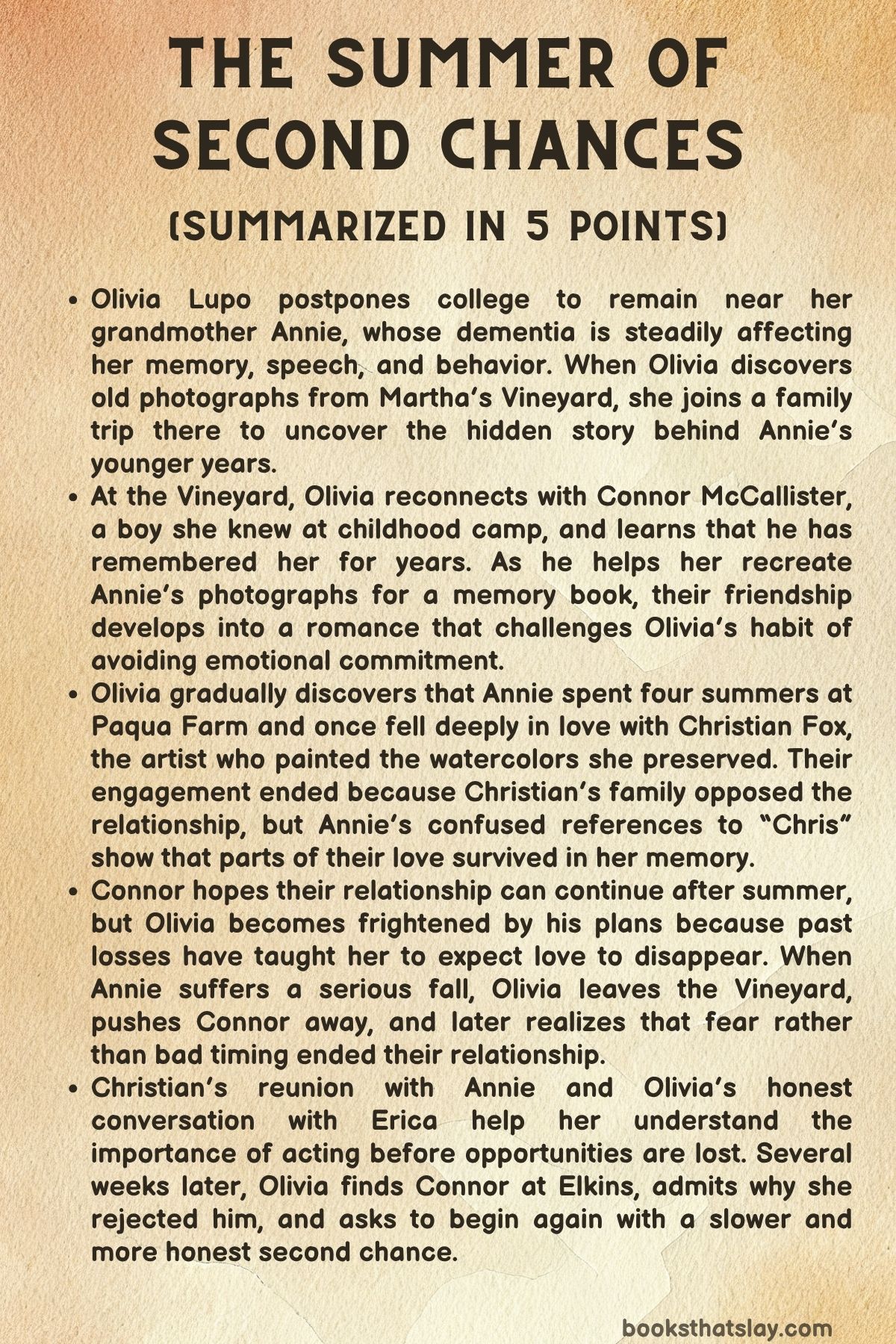
Summary
Nineteen-year-old Olivia Lupo has deferred her enrollment at Northwestern University so she can remain near her grandmother, Annette, whom she affectionately calls Annie. Annie helped raise Olivia after her mother died, but dementia has placed her in a memory-care facility where recognition, language, and emotional stability change from one visit to the next.
Olivia spends as much time with Annie as possible, quietly adapting whenever her grandmother confuses dates or forgets recent conversations. She is comforted by flashes of Annie’s former personality, but each visit also forces her to confront the painful reality that the woman she loves is gradually becoming unreachable.
Life at home offers little relief because Olivia feels like an outsider in her father’s second family. Her stepmother, Erica, is a successful lifestyle influencer, while Olivia’s younger half-siblings, Maisie and Bryce, seem to occupy a more permanent place in the household.
Olivia becomes especially resentful when she learns that Erica has been telling friends she has lost her ambition. During a confrontation, Olivia explains that postponing college was a deliberate sacrifice because she fears Annie may no longer recognize her if she leaves.
During a difficult visit, Annie fails to recognize Olivia and attempts to escape the facility because she believes she is being imprisoned. Before the situation worsens, Annie unexpectedly mentions having spent several summers on Martha’s Vineyard with a friend and someone named Chris, although Olivia’s father has no memory of such trips.
Curious about this hidden history, Olivia searches through Annie’s possessions and discovers Polaroids and miniature watercolor paintings. One photograph shows a young, carefree Annie beside an antique John Deere tractor, while a painting depicts the Aquinnah Cliffs on Martha’s Vineyard, proving that Annie’s memories of the island are real.
Olivia feels torn when her family prepares to attend Erica’s three-week reunion on the Vineyard. She worries that leaving Annie is a betrayal, but during a rare moment of clarity, Annie encourages her to take the trip and experience the island’s magic for herself.
Olivia decides to visit every location represented in Annie’s photographs and paintings. She plans to recreate the images and combine the old and new versions in a memory book that might bring Annie happiness or awaken memories from her youth.
The family arrives at the Carmichaels’ large property on Oyster Pond, where Olivia is assigned to a section of the house called Summer Camp. The name matches the caption on Annie’s tractor photograph, giving Olivia her first indication that her grandmother’s unknown past may somehow be connected to the reunion.
Olivia must share the small bunk room with Connor McCallister, a recent high-school graduate employed as a caregiver for two young boys, Teddy and Finn. Connor seems familiar, knows Olivia’s full name, and eventually reminds her that they attended Camp Skytop together eight years earlier.
Both Olivia and Connor had belonged to a group called the Homebodies because they regularly waited to telephone their families. Connor remembers Olivia far more clearly than she remembers him, and he admits that he had a childhood crush on her.
Olivia also realizes that Connor owns the Jeep she accidentally entered after an emotional visit to Elkins. He explains that his grandfather lives in the independent section of the same community and that he visits him frequently, creating another unexpected connection between them.
Connor begins helping Olivia recreate Annie’s photographs. He takes her to Jaws Bridge, where she overcomes her fear and jumps into the water with him, and then accompanies her to Edgartown Harbor Light and the Old Whaling Church.
His patience and enthusiasm make Olivia feel supported, but his emotional openness also frightens her. Connor admits that he likes her and approaches affection confidently, while Olivia prefers undefined relationships that can be ended before they become painful.
As she spends more time with the Carmichaels, Olivia gradually becomes involved in their games, dinners, celebrations, and affectionate arguments. She also notices that Erica’s siblings often criticize her career and personality, forcing Olivia to consider that her stepmother may feel misunderstood within her own family.
At the Flying Horses Carousel, Maisie notices a fair-haired young man standing beside Annie in one of the old photographs. Olivia realizes that Annie’s summers on the Vineyard may have involved a romance with someone other than Pops.
During a clear telephone conversation, Annie confirms that she met someone on the island before meeting her husband. She advises Olivia that a few happy weeks can be valuable even if they do not lead to permanence, giving Olivia permission to explore her attraction to Connor without knowing exactly where it will end.
Olivia and Connor finally kiss beneath the early-morning stars. Afterward, Olivia tells him about Annie’s dementia, her mother’s death, and the emotional strain of watching someone she loves lose memories that once defined their relationship.
Connor responds without pity and reveals that Teddy and Finn’s family is also affected by Alzheimer’s disease. His understanding allows Olivia to trust him with emotions she normally hides behind humor, irritation, and independence.
Their relationship grows more serious as Connor joins Olivia in visiting Aquinnah, Ocean Park, Grange Hall, the Martha’s Vineyard Museum, and other places associated with Annie. Although Olivia continues calling their relationship temporary fun, her attachment becomes obvious through her dependence on Connor’s comfort and her fear whenever his safety is threatened.
During a trip to Chappaquiddick, Connor suffers a severe allergic reaction caused by probable cross-contamination. Olivia administers his epinephrine and rushes him to medical care, realizing that the possibility of losing him terrifies her far more than she expected.
While Connor is recovering, Annie calls and mistakes Olivia for her son Chris. Connor takes the phone and speaks to Annie patiently, demonstrating that he is willing to enter the most painful and complicated part of Olivia’s life rather than participating only in its enjoyable moments.
Connor later arranges a private date at Paqua Farm because he wants Olivia to create an original Vineyard memory rather than spending the entire summer repeating Annie’s experiences. He then surprises her with the antique John Deere tractor shown in Annie’s photograph.
At the Fox family’s art studio, Olivia discovers that Christian Fox painted Annie’s miniature watercolors. Christian immediately recognized Olivia because she strongly resembles the young Annette Clark, and one of his larger paintings portrays Annie during her Vineyard years.
Christian explains that he met Annie on the ferry before college and that she spent several summers at Paqua Farm. Olivia realizes that Annie sometimes refers to Christian when she complains that “Chris” has not visited, meaning that fragments of this old relationship have survived even as many newer memories have disappeared.
The discovery also reveals a striking similarity between Olivia’s summer and Annie’s. Both women fall for caring young men on Martha’s Vineyard, but Olivia becomes alarmed when Connor begins discussing how their relationship could continue during college.
Connor believes they can attend Northwestern and Notre Dame while still making time for each other. Olivia argues that she has too many responsibilities and refuses to consider rearranging her life around a relationship, even though her resistance is driven less by practical concerns than by fear.
Their disagreement remains unresolved when Olivia learns that Annie has fallen and needs surgery. She immediately prepares to leave the island, and when Erica suggests that Olivia’s father can manage the situation, Olivia cruelly accuses her of not understanding family loyalty.
Connor challenges Olivia’s harsh treatment of Erica and asks her to promise only a telephone call and a dinner the following month. Olivia cannot make even that limited commitment, and their goodbye becomes an acknowledgment that they care deeply for each other but cannot overcome Olivia’s fear at that moment.
Annie survives surgery but returns to Elkins frail and minimally responsive. Olivia completes the memory book, names it Golden Hour Girls, and waits for an opportunity to show it to her grandmother.
Christian travels from Massachusetts to visit Annie after Erica informs him about the accident. He reveals that he and Annie spent four summers together, became engaged, and planned to marry until his socially prominent parents opposed the relationship and Annie ended the engagement by letter.
When Annie awakens, she immediately recognizes Christian and asks whether he still bites his nails. The recognition is brief, but it confirms that their lost romance remains somewhere within her, protected by a part of memory that dementia has not entirely erased.
Christian spends time with Olivia’s father and shares stories about Annie’s carefree youth, while learning about the marriage, family, and life she built after him. He later encourages Olivia not to accept that her relationship with Connor failed simply because the timing seemed wrong.
Olivia also apologizes to Erica for years of hostility. She explains that decisions involving bedrooms, graduation gifts, and family language made her feel temporary, but Erica reveals that these actions had innocent explanations and that she has always considered Olivia her daughter.
Erica admits that she is also devastated by Annie’s decline because Annie welcomed her, encouraged her career, and understood her better than her own relatives did. Olivia recognizes that she and Erica have been experiencing the same grief while expressing it in very different ways.
Erica identifies Olivia’s habit of choosing relationships she can leave before the other person has the opportunity to abandon her. Olivia realizes that the deaths of her mother and Pops, Annie’s dementia, and her father’s remarriage have taught her to treat emotional distance as a form of protection.
Several weeks later, Olivia sees Connor’s Jeep outside Elkins and waits for him inside it. She admits that she has used her responsibilities as a shield and asks whether they can meet again now that she understands why she pushed him away.
Connor acknowledges that their summer relationship developed too quickly and that both of them made mistakes. They reenact their accidental meeting by formally introducing themselves beside the Jeep, then agree to get ice cream and begin again without pretending that love can be made completely safe.
Characters
Olivia Lupo
As the central character in The Summer of Second Chances, Olivia is defined by fierce loyalty, unresolved grief, and a deep fear of being left behind. Her decision to defer Northwestern is not a sign of laziness or lost ambition, but an attempt to preserve whatever time remains with the grandmother who became her main maternal figure.
Olivia’s devotion is admirable, yet it has also become a way of avoiding uncertainty in her own life. Caring for Annie gives her a purpose she can defend, while college, romance, and independence would require her to enter situations she cannot control.
Her defensive personality is visible in her sarcasm, impatience, and refusal to define relationships. She prefers people she can leave because choosing to leave first appears less painful than waiting for illness, death, distance, or rejection to take someone from her.
This pattern explains her hostility toward Erica and her resistance to Connor. Olivia interprets ambiguous actions as evidence that she is unwanted because believing rejection has already happened allows her to prepare for it.
Martha’s Vineyard slowly restores parts of Olivia that caregiving and grief have suppressed. Jumping from the bridge, participating in family games, recreating photographs, and allowing herself to fall for Connor teach her that living fully does not diminish her love for Annie.
Her final decision to wait in Connor’s Jeep shows meaningful growth rather than a complete transformation. She remains frightened of loss, but she no longer allows that fear to prevent her from accepting connection.
Connor McCallister
Connor is emotionally open, affectionate, family-oriented, and unusually comfortable expressing what he wants. Where Olivia uses uncertainty as protection, Connor prefers clarity and believes that affection deserves effort rather than strategic distance.
His childhood memory of Olivia initially risks making his feelings appear based on an idealized version of her. However, he eventually explains that she represented the warmth and connection he hoped to find, not a fantasy he expected the adult Olivia to match perfectly.
Connor’s work with Teddy and Finn demonstrates his patience and responsibility. He cares for them attentively, treats Olivia’s younger siblings with kindness, and approaches Annie’s dementia without discomfort or embarrassment.
His willingness to help create the memory book reveals his respect for Olivia’s emotional world. He never treats the photographs as a trivial holiday project because he understands that they are Olivia’s attempt to preserve her relationship with Annie.
Connor is romantic, but he occasionally moves faster than Olivia can emotionally manage. His elaborate date, overnight camp, and discussion of their future come from sincere hope, yet they also place pressure on someone who has only recently begun lowering her defenses.
His maturity becomes clearest when he accepts responsibility for moving too quickly. By agreeing to begin again, he shows that love is not only expressed through grand gestures but also through patience, adjustment, and the willingness to meet another person at a more sustainable pace.
Annette “Annie” Clark Lupo
Within The Summer of Second Chances, Annie functions as both a beloved present-day figure and the keeper of a nearly lost personal history. Dementia has affected her language, recognition, behavior, and sense of time, but it has not erased every trace of the confident and adventurous woman she once was.
Her relationship with Olivia is the emotional foundation of the book. Annie raised and comforted Olivia after her mother’s death, leaving Olivia terrified that losing Annie’s recognition will mean losing the person who best understands her.
The photographs reveal a side of Annie that Olivia never knew. The young woman at Paqua Farm was carefree, romantic, artistic, and willing to spend summers outside the polished identity she later adopted.
Annie’s relationship with Christian complicates any simple understanding of her life. She loved him deeply and was once engaged to him, yet she eventually married Pops and created a different life that was not presented as lesser or false.
Her confused references to Chris show how dementia can collapse past and present without making every statement meaningless. What initially appears to be complete confusion sometimes contains an emotional truth that others have failed to recognize.
Annie also becomes the person who gives Olivia permission to leave. Even as her own independence disappears, she urges her granddaughter not to surrender her future to guilt.
Erica Lupo
Erica is initially presented through Olivia’s resentful interpretation. Her successful influencer career, polished appearance, busy schedule, and occasional insensitive remarks make her seem self-absorbed and eager to push Olivia out of the household.
The story gradually reveals that Erica’s actions have often been misunderstood. She considers Olivia her daughter, worries about her happiness, and wants her to attend the Vineyard reunion because she believes Olivia has become consumed by grief.
Erica’s own family frequently dismisses her career, criticizes her filming, and treats her interests as less serious than their own. These interactions show that Erica’s confidence partly conceals an old need to prove that her work and choices have value.
Her relationship with Annie is especially important. Annie welcomed her into the family, supported her creative ambitions, and gave her the acceptance that she did not consistently receive from the Carmichaels.
Erica’s emotional restraint is not indifference but a coping method. She tries to remain functional for Chris, the twins, and Olivia, even while privately grieving the gradual disappearance of a woman she loves.
Her reconciliation with Olivia changes both characters. By explaining her intentions without dismissing Olivia’s pain, Erica helps create a more honest relationship in which they can finally recognize each other as family.
Chris Lupo
Chris is Olivia’s father, Annie’s son, and a professional pilot whose work frequently takes him away from home. Although Olivia sometimes experiences his absences as another form of instability, he remains attentive to her emotional condition and tries to balance the needs of both his mother and daughter.
He supports Olivia’s devotion to Annie but recognizes that caregiving is exhausting her. His insistence that she attend the family reunion comes from concern that she is sacrificing her identity rather than from a desire to separate her from Annie.
Chris is also affected by the cruelty of dementia. Annie’s accusations that he never visits are deeply painful because they erase the care he has provided and make his loyalty feel invisible.
His response to Christian is generous rather than defensive. By listening to stories about Annie’s youth, he accepts that his mother had a significant life before motherhood and gains a fuller understanding of her.
Christian Fox
Christian represents the emotional power of unfinished history. His relationship with Annie shaped four summers of his youth, and the discovery that he continued painting her shows that she remained part of his inner life long after their engagement ended.
He does not treat Annie’s later marriage as a betrayal or attempt to claim ownership over her past. Instead, he is grateful to learn that she built a loving family and that pieces of their summers remained meaningful to her.
Christian’s parents’ disapproval contributed to the destruction of his relationship with Annie. His regret therefore comes not only from losing her but from recognizing that he allowed social expectations and timing to determine their future.
His advice to Olivia is shaped by this regret. He does not claim that every romance can be saved, but he urges her to distinguish between a genuinely impossible relationship and one being abandoned because fear makes inaction easier.
Christian’s reunion with Annie is brief but emotionally significant. Her immediate recognition confirms that the relationship survived within her memory even after decades of separation.
Maisie Lupo
Maisie is Olivia’s younger half-sister and one of the warmest members of her home life. She is affectionate, perceptive, and emotionally generous, especially when she comforts Olivia after a difficult encounter with Annie.
Her enthusiasm at the carousel helps uncover the unknown young man in Annie’s photograph. Maisie therefore contributes directly to the family mystery rather than functioning only as comic relief.
She also reminds Olivia that her bond with the second family is genuine. Olivia’s care for Maisie contradicts her belief that she exists entirely outside the household.
Bryce Lupo
Bryce is Olivia’s younger half-brother and Maisie’s twin. His energy, injuries, curiosity, and enthusiasm add movement to the family scenes and draw Olivia into experiences beyond her grief.
Connor’s easy relationship with Bryce allows Olivia to see how naturally he fits around the people she loves. This contributes to her attraction while also increasing her fear that the relationship may become too important.
Bryce and Maisie together represent a future-oriented form of family life. Their presence challenges Olivia to recognize that loving Annie’s generation does not require her to remain emotionally fixed in the past.
Pops
Pops, Olivia’s late grandfather, remains important through the choices and memories described by others. His marriage to Annie proves that her life after Christian contained genuine commitment, love, and meaning.
Christian reveals that Pops once changed major plans after meeting Annie. This decision contrasts with Christian’s failure to resist his parents’ opposition and demonstrates that timing can sometimes be altered by decisive action.
Pops also supported Erica’s work alongside Annie. His acceptance contributes to Erica’s sense that Olivia’s grandparents understood and valued her in ways her own relatives did not.
Gwen
Gwen is Olivia’s friend and one of the people willing to question whether her self-sacrifice has become unhealthy. She admires Olivia’s devotion but recognizes that Olivia needs experiences, relationships, and ambitions beyond the memory-care facility.
Olivia initially treats Gwen’s concern as criticism because she is sensitive to any suggestion that she should spend less time with Annie. Gwen nevertheless represents the outside life Olivia has placed on hold and the perspective that care for another person should not require total self-erasure.
Ashley, Teddy, and Finn
Ashley is Teddy and Finn’s mother and the person who employs Connor as their summer caregiver. Her decision to give Connor a week away reflects her awareness that he deserves time to experience the island for himself.
Ashley also comforts Olivia after a painful conversation with Annie. By sharing her own family’s experience with Alzheimer’s, she helps Olivia understand that cruel or confusing remarks are symptoms of the illness rather than accurate expressions of the person’s feelings.
Teddy and Finn reveal Connor’s nurturing qualities. His patience with their routines, questions, and bedtime needs shows that his gentleness is part of his normal character rather than behavior performed solely to impress Olivia.
Peggy and Topper Carmichael
Peggy and Topper are Erica’s parents and the central figures around whom the reunion is organized. Their property provides the setting where Olivia encounters the traditions, tensions, and affections of the extended Carmichael family.
Peggy’s later explanation that Erica had been deeply concerned about Olivia’s happiness helps correct Olivia’s distorted assumptions. Her words encourage Olivia to reconsider whether Erica’s behavior has been controlling or protective.
The anniversary celebration also parallels Olivia’s memory-book project. Both families use photographs and creative work to preserve relationships, although the process exposes different emotional tensions.
Nick, Charlie, Luke, Sage, Beth, Jay, and Allison
The extended Carmichael family creates an atmosphere that is affectionate, competitive, chaotic, and occasionally insensitive. Nick, Charlie, Luke, Sage, and the others help Olivia feel welcome through dinners, games, rescues, jokes, and shared traditions.
Beth and Jay also reveal the limitations of family closeness. Their dismissive attitudes toward Erica’s career show that belonging to a large family does not guarantee being fully understood.
Charlie, Luke, and Sage become especially important during the canoe accident when they rescue Olivia and Connor. Their mixture of concern, anger, and humor demonstrates how the Carmichaels turn even frightening moments into shared family history.
Andrew Fox and the Fox Family
Andrew initially appears to be the likely creator of Annie’s watercolors because Olivia sees him sketching. This false assumption maintains the mystery until Christian’s identity as the painter is revealed.
The wider Fox family preserves the location where Annie’s younger self flourished. Paqua Farm, its tractor, art studio, traditions, and landscapes give Olivia access to a part of her grandmother’s identity that had nearly disappeared.
Meredith, Wit, and the others welcome Olivia rather than treating Annie’s story as private property. Their openness allows the two families and two generations to reconnect.
Mads and Liam
Mads is Connor’s best friend and unintentionally creates conflict by calling Olivia Connor’s long-standing dream girl. Her statement makes Olivia feel responsible for fulfilling an idealized romantic future she never agreed to carry.
Although Mads exaggerates, her words expose the strength and duration of Connor’s attachment. They force Connor to clarify that Olivia represented a kind of connection he hoped to experience rather than someone he had literally spent years waiting to claim.
Liam, Connor’s younger brother, does not occupy much direct space in the story, but Connor’s concern about leaving him for college reveals his strong attachment to home. His guilt about missing family traditions helps Olivia understand that Connor also struggles with separation.
Tara and the Elkins Staff
Tara and the other staff members at Elkins provide the professional care Annie needs when Olivia can no longer calm or redirect her. Their presence emphasizes that love alone cannot manage every stage of dementia.
They also challenge Olivia’s belief that leaving Annie with trained caregivers is abandonment. The staff protect Annie while allowing Olivia to remain a granddaughter rather than becoming solely responsible for medical and behavioral care.
Themes
Loving Someone Through Memory Loss
Dementia changes the form of Olivia and Annie’s relationship without erasing its emotional importance. In The Summer of Second Chances, Olivia repeatedly encounters the painful difference between physical presence and recognition, as Annie may greet her lovingly during one visit and accuse the family of abandonment during another.
The illness also destabilizes the family’s understanding of truth. Annie’s statements about Chris initially sound like confused complaints about her son, but some of them refer to Christian, showing that fragmented memories may contain real emotional history even when their context has disappeared.
Olivia’s grief begins before Annie’s death because she is losing individual parts of her grandmother in stages. Familiar jokes, habits, corrections, and moments of recognition briefly restore their old relationship, only for the disease to interrupt it again.
The book avoids suggesting that a photograph, reunion, or memory book can cure Annie. Golden Hour Girls instead becomes a form of care that honors the woman Annie was, preserves her story for the family, and gives Olivia a constructive way to express love.
Christian’s visit reinforces the idea that recognition is unpredictable but meaningful. Annie cannot consistently retain the present, yet she immediately recognizes a man she loved decades earlier, revealing how emotional memory can endure in ways that neither medicine nor family can fully explain.
Fear of Abandonment and Emotional Self-Protection
Olivia’s fear of abandonment shapes nearly every conflict she experiences. The deaths of her mother and Pops, Annie’s gradual disappearance, and her father’s remarriage have taught her that loving someone creates the possibility of being left.
Instead of acknowledging this fear, Olivia presents herself as independent and practical. She chooses undefined romantic arrangements, rejects future planning, and interprets Erica’s behavior as rejection before Erica can explain herself.
Her responsibilities provide another form of protection. Caring for Annie is sincere and loving, but Olivia also uses the demands of caregiving, college, and family life to argue that there is no room for Connor.
Connor threatens this emotional system because he openly asks to remain in her life. His willingness to imagine visits, family meetings, and a future together forces Olivia to confront the difference between lacking time for love and being afraid to make time for it.
Erica eventually identifies Olivia’s pattern with painful accuracy: Olivia chooses people she believes she can leave before they leave her. The final reunion with Connor matters because Olivia stops demanding certainty and accepts that emotional safety cannot be guaranteed.
Beginning again does not remove her history or fear. It shows that courage can consist of choosing connection while understanding that loss remains possible.
Family Belonging and Misunderstanding
Olivia’s conflict with Erica grows from years of assumptions that have never been honestly discussed. Bedroom arrangements, gifts, language, and family routines become evidence in Olivia’s private belief that Erica considers her temporary.
The Vineyard reunion complicates that belief. Olivia sees Erica criticized by her siblings, discovers that Erica refers to her as a daughter, and learns that Erica worked hard to ensure she enjoyed the family trip.
Erica’s private grief over Annie further dismantles Olivia’s image of her as superficial. Annie supported Erica’s ambitions and gave her a form of acceptance that the Carmichael family sometimes fails to provide.
Olivia and Erica are therefore more alike than either initially recognizes. Both depend on creative projects to preserve memories, both feel judged by their families, and both hide vulnerability behind controlled behavior.
The broader Carmichael family also presents belonging as imperfect rather than idealized. Their games, meals, jokes, arguments, and rescues offer Olivia warmth, but their treatment of Erica shows how easily love can exist beside misunderstanding.
Reconciliation becomes possible only when Olivia and Erica explain the meanings they assigned to past actions. Their conversation demonstrates that family closeness depends not merely on affection, but on the willingness to question personal interpretations and listen to another person’s intentions.
Second Chances and the Choice to Act
The relationship between Annie and Christian shows how love can be altered by hesitation, social pressure, and decisions that appear final. They loved each other and planned to marry, but Christian’s parents opposed the match and Annie ended the engagement rather than continuing the struggle.
Neither person’s later life is presented as empty. Annie loved Pops and created a family, while Christian preserved his memories through art, yet their reunion reveals that an abandoned possibility can retain emotional power for decades.
Olivia and Connor approach a similar turning point. Their feelings are genuine, but Olivia initially treats college, family duties, and difficult timing as proof that continuing the relationship is impossible.
Christian challenges the assumption that timing is an external force people must always obey. His regret teaches Olivia that circumstances matter, but choices also shape whether those circumstances remain permanent.
The final scene does not restore the exact relationship Olivia and Connor had on the Vineyard. Instead, they deliberately return to the beginning and introduce themselves again, acknowledging that their first attempt contained too much speed, pressure, and fear.
Their second chance succeeds because it is smaller and more realistic. Rather than promising lifelong certainty, they choose ice cream, conversation, and another opportunity to know each other.
The same principle appears in Olivia’s reconciliation with Erica and her rediscovery of Annie’s past. A second chance cannot undo lost years or cure illness, but it can change what people decide to do with the time and understanding that remain.