The Summer Share Summary, Characters and Themes
The Summer Share by Jenn McKinlay is a contemporary romance about inheritance, concealed family history, grief and the unexpected discovery of home. It follows two strangers who inherit equal shares of a neglected coastal cottage and are required to live there together before deciding its future.
What begins as a tense property dispute gradually becomes a personal journey for both characters. As Hannah Spencer and Simon O’Malley investigate their grandfathers’ hidden relationship, they confront painful experiences, abandoned ambitions and fears that have kept them from building permanent lives. The cottage becomes more than an inheritance; it represents love, acceptance, community and the courage to choose happiness.
Summary
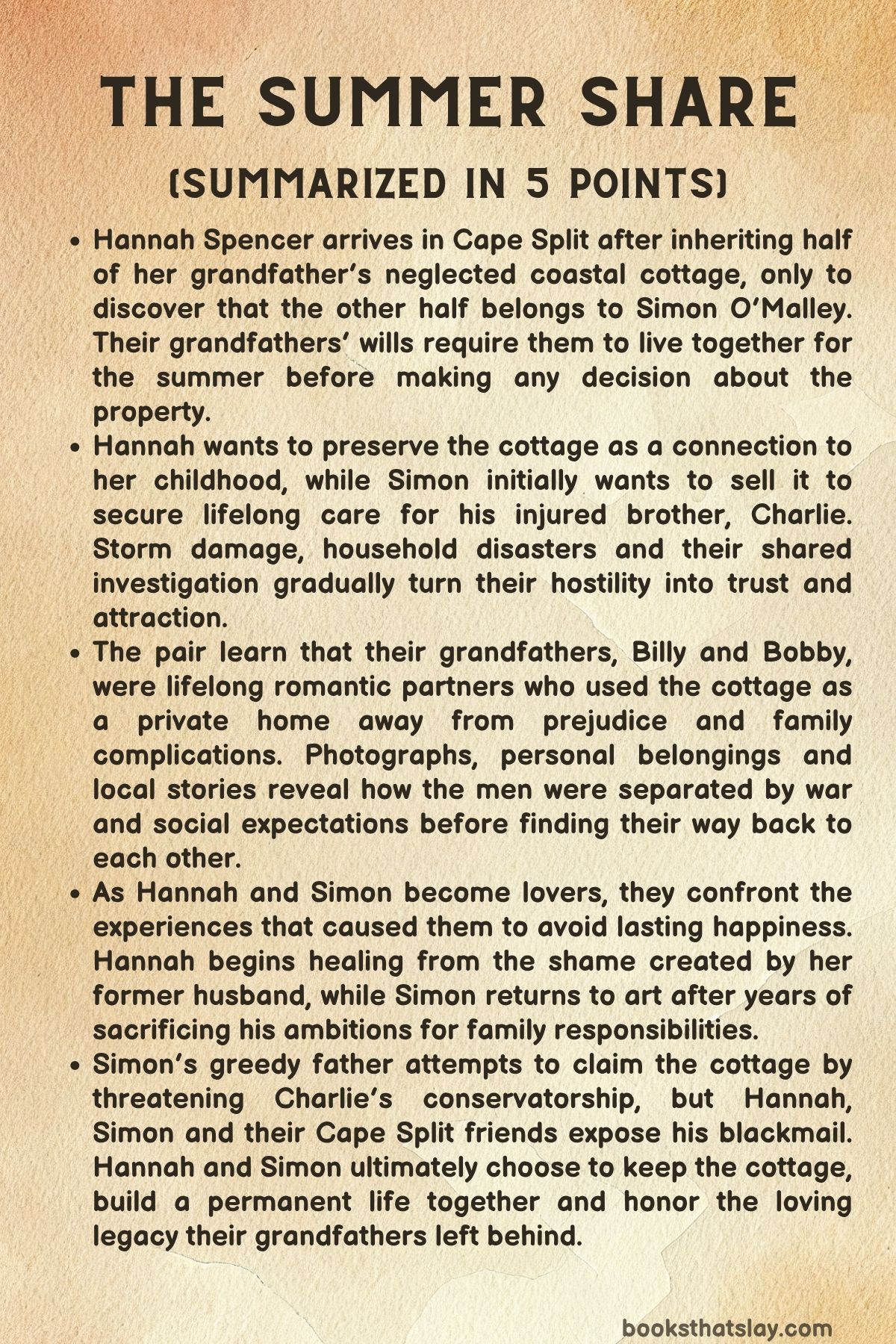
Hannah Spencer arrives in Cape Split on North Carolina’s Outer Banks with her enormous rescue dog, Dude, and the vintage Volkswagen van that has served as her home for several years. She has inherited a coastal cottage from her grandfather, whom she affectionately called Pops, and hopes the property will give her a quiet place to recover from his recent death.
The cottage carries many happy memories from Hannah’s childhood visits with Pops and Nana, but years of neglect have left it in poor condition. The electricity is disconnected, the garden is overgrown, the paint is peeling and nearly everything inside has been covered with dust sheets.
While inspecting the property, Hannah notices an unfamiliar man fishing from the private dock. Suspecting that he may be trespassing, she goes outside to confront him, but Dude races ahead and knocks the stranger into the water.
The man, Simon O’Malley, believes the cottage belongs to him because his grandfather, whom he called Gramps, left it to him. After Hannah rescues him from the channel, their mutual irritation is complicated by an immediate attraction and an unexpected sense of familiarity.
Their disagreement grows when both insist that they are the rightful owner. Attorney Vincent Cosmo soon arrives and explains that Pops and Gramps jointly owned the cottage, with each man possessing an equal share.
Their wills contain an unusual condition. Hannah and Simon must live together in the cottage for one summer before they can sell it, divide it or create another permanent arrangement, and every final decision must be made jointly.
Hannah wants to preserve the house because it represents her happiest memories and offers the possibility of a permanent home. Simon wants to sell it quickly, although he initially refuses to explain why the money is so important to him.
Simon is responsible for his brother Charlie, who suffered a traumatic brain injury in a serious car accident and now requires lifelong assistance. Simon believes selling the valuable waterfront property would provide enough money to protect Charlie’s future, but he keeps this motivation private because he does not yet trust Hannah.
The cottage immediately proves difficult to maintain. A storm reveals a leaking roof, a bat is discovered inside the house and a fallen tree crashes through an upstairs bedroom, forcing Hannah and Simon to cooperate despite their arguments.
Their shared problems slowly weaken their hostility. They catch the bat together, protect the cottage during the storm, sing ridiculous rain songs to calm Dude and begin discussing the lives they led before arriving in Cape Split.
Hannah learns that Simon once dreamed of becoming a children’s-book illustrator and studied art professionally. He abandoned that career for a stable insurance job after Charlie’s accident, choosing financial security and family responsibility over his own ambitions.
Simon learns that Hannah was once a journalist. After losing both her job and her marriage, she began documenting her travels online, partly to earn a living and partly to avoid facing the humiliation and grief connected to her former life.
The morning after the storm, local residents arrive with generators, tools, food and offers of assistance. Their generosity reveals that Pops and Gramps, known in Cape Split as Billy and Bobby, were deeply loved members of the community.
During the conversation, Roland realizes that Hannah and Simon do not know the truth about their grandfathers. He explains that Billy and Bobby were not simply friends or fishing companions but a devoted romantic couple who shared the cottage as their private home.
The revelation shocks both grandchildren. Simon struggles to reconcile the truth with his memories of Gramps as a married family man, while Hannah feels hurt that Pops never trusted her enough to reveal such an important part of his life.
They gradually understand that Billy and Bobby concealed their relationship because of social prejudice and complicated family circumstances. Simon is particularly concerned about his estranged father, Robert O’Malley Jr., whose greed, cruelty and homophobia could threaten both the inheritance and Simon’s guardianship of Charlie.
Hannah and Simon agree to suspend their dispute about selling the cottage until the end of the required summer. They remove the masking tape Hannah had used to divide the house and become partners in investigating Billy and Bobby’s history.
Their search uncovers photographs, shared possessions, reading glasses, cuff links, military objects and a carved bluebird made by Bobby. A hidden album shows the men living joyfully together and reveals that they regarded themselves as married after holding a private symbolic ceremony.
They learn that Billy and Bobby first met as teenagers after arguing over a fishing place near a local ice-cream shop called the Scoop. Their early relationship was interrupted when Bobby was drafted into the Vietnam War, after which social pressure and family obligations led both men into conventional marriages.
Bobby later became a widower, while Billy and Hannah’s grandmother eventually divorced. With Nana’s understanding and encouragement, Billy reunited with Bobby, and Cape Split became the one place where they could openly share their lives.
As Hannah and Simon reconstruct this history, their own attraction grows. A photograph of young Billy and Bobby leads to playful comments, and the tension between Hannah and Simon finally results in a passionate kiss.
Both are frightened by what the kiss might mean. Simon worries that a romance will complicate their disagreement over the house, while Hannah has convinced herself that she is incapable of maintaining a permanent relationship.
Hannah eventually explains that she endured years of fertility treatments during her marriage. Her husband blamed her for their inability to have children, called her defective and left her for a younger assistant who became pregnant.
The experience destroyed Hannah’s confidence and taught her to associate commitment with rejection. Even after becoming attracted to Simon, she insists that she can only manage brief relationships because she believes she cannot offer anyone a complete family.
Simon rejects the idea that infertility makes her inadequate. He treats her with admiration, patience and tenderness, helping her separate her worth from her former husband’s cruelty.
Simon’s sister Lorelei visits Cape Split and reveals the full reason behind his determination to sell. After Charlie’s accident, Simon gave up his artistic career and accepted work he disliked so he could pay for his brother’s care and provide stability.
Lorelei believes Gramps left Simon the cottage as a sanctuary rather than merely a financial asset. She argues that Simon has spent so much of his life sacrificing for other people that his grandfather may have wanted him to rediscover his own identity there.
Charlie’s visit strengthens this idea. Hannah treats him with respect, helps him prepare for a date and gives him Billy’s cuff links, while Simon watches her bring warmth and ease into a family situation he usually handles alone.
Charlie quickly recognizes the emotional value of the cottage. He tells Simon that selling it would mean losing something far more important than a building because the house already feels like home.
Hannah and Simon eventually agree to a temporary affair lasting only until the end of the summer. Their first night together helps Hannah reclaim confidence in her body, while Simon discovers a peace and emotional closeness that his isolated life has long lacked.
Although they continue calling the relationship temporary, they begin living like partners. They repair the cottage, ride Billy and Bobby’s restored tandem bicycle, visit neighbors, work side by side and become increasingly integrated into Cape Split’s community.
Hannah uses her online platform to support a local sea-turtle conservation effort. The success of her video demonstrates that her public work can benefit the community without violating anyone’s privacy, easing Simon’s earlier concerns about her influence.
A major turning point comes when Hannah discovers Simon’s old artwork in a locked trunk. Gramps had rescued the drawings after Simon discarded them and left a message urging him to accept help, return to his creativity and make room for happiness.
Simon finally allows himself to grieve openly. He begins drawing again and accepts an invitation to paint a mural on the Scoop, using the project to honor Billy, Bobby and the people of Cape Split.
Hannah also reconsiders her nomadic life after speaking with Nana. Nana explains that she always knew Billy loved Bobby and encouraged him to return to the man he loved, because she also deserved the freedom to find a partner who could choose her completely.
Nana advises Hannah not to surrender genuine love because of fear. Hannah realizes that she wants Cape Split to become her permanent home and that she has fallen deeply in love with Simon.
Their future is threatened by Simon’s father, Robert, who arrives demanding the cottage. He admits that he knew about Billy and Bobby, insults them viciously and threatens to challenge Simon’s authority over Charlie unless the property is surrendered.
When Charlie later runs away from his group home following a misunderstanding, Robert attempts to use the incident as evidence that Simon is an irresponsible conservator. He blackmails Hannah, demanding her half of the cottage in exchange for leaving Charlie’s guardianship untouched.
Hannah initially decides to sacrifice her ownership to protect Simon and Charlie. Simon refuses to accept her decision and reveals the nearly completed Scoop mural, which includes their grandfathers, their neighbors, Dude and Hannah running toward him.
The mural proves that Simon has chosen art, Cape Split and a future with Hannah. He declares that he loves her and no longer wishes to sell the cottage, while Hannah admits that she loves him and considers wherever he is to be her home.
They create a plan to expose Robert’s coercion. Hannah meets Robert on the cottage porch while Simon, Lorelei, Vincent and several neighbors hide nearby and listen as he repeats his threats.
When the witnesses reveal themselves, Vincent explains that Robert’s blackmail would seriously damage any attempt to challenge Simon’s conservatorship. Realizing that his scheme has failed, Robert leaves the property defeated.
Vincent then gives Hannah a letter from Pops. In it, Billy apologizes for keeping his life in Cape Split secret, explains that the community healed him and expresses hope that Hannah will find the same peace and belonging.
The letter also reveals that Pops met Simon and approved of him before arranging the inheritance. Billy and Bobby had therefore designed the summer not only to preserve their home but also to guide their grandchildren toward one another.
Simon asks Hannah to build a permanent life with him regardless of whether they marry or have children. Hannah agrees, embracing a future defined by chosen family, creativity, love and a home filled with Dude and the farm animals she jokingly demands.
Characters
Hannah Spencer
Hannah is the emotional center of The Summer Share, beginning the book as an independent but deeply wounded woman who has spent five years moving from place to place. Her van-life career appears adventurous and successful, yet it also functions as a carefully maintained escape from grief, professional disappointment and the collapse of her marriage.
Her strongest early motivation is her connection to Pops. The inherited cottage represents childhood security and unconditional love, making Simon’s desire to sell it feel like a threat to one of the few stable parts of her identity.
Hannah’s investigative nature remains present even after she leaves journalism. Once she learns that Pops and Gramps shared a secret life, she becomes determined to understand their relationship rather than accepting incomplete explanations.
This curiosity is balanced by empathy. She wants the truth, but she also respects the grandfathers’ privacy and refuses to turn their history into public content, showing that her professional instincts have matured since her days in traditional journalism.
Her former husband’s cruelty has left her believing that infertility makes her defective. This belief affects her understanding of romance, leading her to impose strict limits on relationships before another person has the opportunity to reject her.
Her growth comes through recognizing that family is not determined only by biological parenthood. Simon, Charlie, Dude and the Cape Split community show her that care, loyalty, companionship and shared responsibility can create a complete and meaningful life.
Hannah also rediscovers the value of staying in one place. Cape Split allows her to use her communication skills for conservation and community support while forming relationships that do not depend on constant movement.
By the conclusion, she is no longer protecting herself through distance. She chooses love, permanence and a home, not because her fears have vanished, but because she refuses to let past cruelty determine the rest of her life.
Simon O’Malley
Simon initially appears controlled, argumentative and overly focused on the financial value of the cottage. His secrecy makes his determination to sell seem cold, but his true motivation is his commitment to Charlie’s lifelong care.
He has built his adult identity around responsibility. After Charlie’s accident, Simon abandoned illustration, entered the insurance industry and accepted a life organized around income, benefits and security.
This sacrifice reveals his devotion, but it also shows his tendency to treat personal happiness as unnecessary. Simon believes loving his brother requires him to surrender every ambition that does not produce immediate practical results.
His relationship with Hannah challenges that belief. Her emotional openness, humor and curiosity create moments in which he can relax, laugh and express parts of himself that have long been buried.
Simon’s grief is quieter than Hannah’s because he has trained himself to suppress vulnerability. Discovering Gramps’s private life initially feels like a betrayal, yet the investigation eventually gives Simon a fuller understanding of the man who always believed in his artistic ability.
The preserved artwork and Gramps’s message force Simon to reconsider the difference between responsibility and self-erasure. Returning to art does not mean abandoning Charlie; it means accepting that devotion to another person does not require the destruction of one’s own identity.
His love for Hannah also changes his view of the cottage. What begins as a financial resource becomes a home connected to family history, community and the possibility of a life he genuinely wants.
By standing against his father, reclaiming his creativity and openly choosing Hannah, Simon becomes capable of protecting others without surrendering himself. His final transformation rests on balance rather than escape: he can remain Charlie’s devoted brother while also becoming an artist, partner and member of the Cape Split community.
Dude
Dude is Hannah’s enormous rescue dog and serves as both comic relief and an emotional bridge between Hannah and Simon. His first action is to knock Simon into the water, creating the chaotic meeting that begins their relationship.
Although physically intimidating, Dude is sensitive, affectionate and easily frightened by storms. His vulnerability brings out Simon’s gentler nature before Simon is willing to reveal it directly to Hannah.
Dude often interrupts romantic or serious moments, but his presence also exposes the truth about the characters’ feelings. Simon’s willingness to comfort him, share space with him and eventually treat him as family demonstrates how quickly Simon becomes emotionally invested in Hannah’s life.
He also responds protectively when Robert appears, symbolically placing himself between the cottage’s new family and the man threatening it. By the end, Dude is not merely Hannah’s companion but part of the household Simon and Hannah choose together.
William “Billy” Spencer, or Pops
Billy is deceased before the main events begin, yet his choices shape nearly every important development. To Hannah, he was Pops, the grandfather who gave her affection, happy summer memories and a sense of belonging.
His hidden life initially creates pain because Hannah interprets the secrecy as a lack of trust. As she learns more, she understands that Billy’s silence developed from decades of social pressure and the need to protect a relationship that could not always be acknowledged safely.
Billy’s love for Bobby was enduring rather than impulsive. Even after marriage, family responsibilities and years of separation, Bobby remained the person with whom he could live most honestly.
His relationship with Nana also reveals compassion rather than simple betrayal. Nana understood his love for Bobby and eventually encouraged him to pursue it, allowing both of them to seek more complete lives.
Billy’s final letter shows that he recognized Hannah’s restlessness and emotional exhaustion. By leaving her half of the cottage, he hoped Cape Split would give her the peace, community and stability that it once gave him.
His decision to arrange the shared inheritance also suggests careful foresight. He had met Simon and believed that the grandchildren might help one another, making the summer requirement a final act of guidance.
Robert “Bobby” O’Malley, or Gramps
Bobby is remembered by Simon as a loving grandfather, but the inheritance reveals a private identity Simon never knew. His concealed relationship with Billy forces Simon to accept that even the people closest to him may have histories shaped by fear, sacrifice and social expectations.
Bobby’s military service in Vietnam interrupted his youthful relationship with Billy. After returning, he built a conventional family life, but the cottage eventually allowed him to reunite with his first love.
His woodworking, shared possessions and photographs reveal a creative and affectionate side that Simon’s family never fully saw. These discoveries help Simon understand that Gramps was not rejecting his family but preserving a separate part of himself.
Bobby took particular pride in Simon’s artistic achievements. His decision to rescue Simon’s discarded work proves that he recognized how much Simon had lost when he abandoned illustration.
In The Summer Share, Bobby’s message to Simon is expressed through objects, memories and the cottage rather than direct conversation. He urges Simon to stop confusing duty with permanent unhappiness and to trust that a person can care for family while still pursuing a meaningful life.
Charlie O’Malley
Charlie is Simon’s brother and the person around whom Simon has organized most of his adult life. His traumatic brain injury has caused cognitive difficulties that require structured support, professional assistance and financial protection.
The story treats Charlie as a person with desires, humor and emotional insight rather than simply as a responsibility. He works with an occupational therapist, lives in a supportive home and wants an independent romantic life with Diana.
Charlie’s relationship with Simon contains deep affection, but Simon’s protectiveness sometimes prevents him from hearing what Charlie actually wants. Charlie understands that Simon has sacrificed too much and immediately recognizes that the cottage offers his brother happiness.
His interactions with Hannah are especially important. She does not pity him or treat him as incapable, helping him prepare for his date and including him naturally in household life.
Charlie’s warning that selling the cottage would mean losing more than property reveals his clear emotional perception. He sees the emerging family around Simon before Simon is ready to admit that it exists.
His later escape from the group home creates the crisis Robert tries to exploit. Even then, Charlie remains someone Simon and Hannah protect because they love him, not because his existence is merely a problem to be managed.
Lorelei O’Malley
Lorelei is Simon and Charlie’s sister, a medical professional who understands the family’s history and Simon’s pattern of self-sacrifice. She is more emotionally direct than Simon and quickly accepts the truth about Gramps and Billy.
Her perspective helps Simon reinterpret the inheritance. Rather than seeing the cottage only as money for Charlie, she suggests that Gramps intended it as a refuge where Simon could rest and rediscover his own life.
Lorelei also provides Hannah with important information about Simon’s past. Through her, Hannah learns that Simon did not abandon art casually but made a painful decision after Charlie’s accident.
Her support becomes essential during the confrontation with Robert. By standing publicly beside Simon, she rejects their father’s attempt to divide the siblings and confirms that protecting Charlie is a shared responsibility.
Lorelei’s presence reduces Simon’s belief that he must carry every burden alone. Her developing connection with Chance also reflects the novel’s wider emphasis on taking emotional risks rather than allowing duty or fear to eliminate personal happiness.
Robert O’Malley Jr.
Robert is Simon, Lorelei and Charlie’s estranged father and the main human antagonist. His behavior is driven by greed, prejudice and a desire to control the people around him.
He knew about Bobby and Billy’s relationship but chose to respond with contempt rather than understanding. His anger over the inheritance is not rooted in grief; it comes from believing that he deserves property Bobby deliberately withheld from him.
Robert’s most disturbing quality is his willingness to exploit Charlie. He threatens to challenge Simon’s conservatorship, using Charlie’s disability and recent misunderstanding as tools in a property dispute.
He also attempts to manipulate Hannah’s insecurities by suggesting that Simon may have seduced her for financial reasons. This tactic mirrors the emotional cruelty Hannah experienced in her marriage and shows Robert’s ability to identify and attack vulnerability.
His defeat comes through collective resistance. Simon, Hannah, Lorelei, Vincent and the neighbors refuse to let him isolate his targets, and his own repeated threats become evidence against him.
Robert therefore represents the secrecy, shame and coercion that damaged earlier generations. His removal from the cottage allows the new family to build a home based on honesty and mutual protection.
Nana
Nana is Hannah’s grandmother and Billy’s former wife. Her knowledge of Billy and Bobby’s relationship adds moral complexity to the family history and prevents the novel from reducing the situation to simple deception.
She understood that Billy loved Bobby in a way he could not love her. Rather than demanding that he continue an incomplete marriage, she encouraged him to reunite with Bobby and later found a more fulfilling relationship with George.
Nana’s decision reflects self-respect as much as generosity. She believed she deserved a partner who would choose her fully, just as Billy deserved the opportunity to live honestly.
Her advice becomes decisive for Hannah. By encouraging her granddaughter not to abandon real love because of fear, Nana helps Hannah recognize that protecting herself from every possible loss would also prevent her from receiving lasting happiness.
Vincent Cosmo
Vincent is the attorney responsible for explaining the unusual terms of the inheritance. His arrival ends the initial confusion over ownership and establishes the legal arrangement that requires Hannah and Simon to share the cottage.
Although he appears mainly in practical situations, Vincent understands the intentions behind the wills. He respects Billy and Bobby’s choices and preserves the letters and documents designed to guide their grandchildren.
His legal knowledge becomes crucial when Robert attempts to blackmail Hannah. Vincent explains that Robert’s coercion would damage any case against Simon’s conservatorship, turning the confrontation into a carefully witnessed exposure.
Vincent also delivers Billy’s final letter to Hannah. In doing so, he helps complete Pops’s plan and gives Hannah the apology, reassurance and blessing she needed.
Roland
Roland is one of Cape Split’s most direct and dependable residents. He provides practical help after the storm and casually delivers the revelation that Billy and Bobby were a couple.
His bluntness initially shocks Hannah and Simon, but it also reflects the community’s acceptance of the relationship. To Roland, Billy and Bobby’s love is not a scandal but a familiar part of local history.
Roland later helps restore the tandem bicycle and encourages Simon’s artistic return. His admiration for Simon’s drawing contributes to the pressure that finally persuades Simon to accept the mural commission.
During the confrontation with Robert, Roland serves as one of the hidden witnesses. His presence shows that Cape Split’s support is active rather than symbolic.
Zach
Zach is among the first neighbors to assist Hannah and Simon after the tree damages the cottage. His practical help introduces the cooperative spirit that defines Cape Split.
He also recognizes Hannah from her online work, alerting Simon to the reach of her public platform. This briefly creates tension, but it later allows Hannah to demonstrate that her influence can be used responsibly.
Zach’s involvement with sea-turtle conservation connects Hannah’s digital career to the local community. Through this effort, he helps her imagine work that combines travel journalism, environmental responsibility and a more permanent home.
Bebe and Luke
Bebe and Luke represent the younger families of Cape Split and quickly welcome Hannah and Simon into their lives. Their generosity helps transform the cottage from an isolated property into part of a wider neighborhood.
Bebe’s labor emergency allows Hannah to demonstrate her calmness, empathy and ability to support others. The community’s rapid response also shows Hannah what dependable relationships look like.
Their daughter Ava introduces another emotional test for Hannah, whose infertility once made babies a source of pain and humiliation. Hannah’s tenderness toward Ava shows that she can participate in family life without allowing biological motherhood to define her worth.
Bebe’s observation that Hannah and Simon seem to be taking Billy and Bobby’s place in the community recognizes their growing permanence. She sees them not as temporary visitors but as the next caretakers of the cottage’s social legacy.
Tim Larson
Tim Larson provides valuable information about Billy and Bobby’s teenage years. He remembers their first meeting near the Scoop and helps Hannah and Simon understand how an argument over fishing developed into a lifelong attachment.
He also reveals that Bobby proudly discussed Simon’s artistic success. This knowledge challenges Simon’s belief that his abandoned career no longer matters.
By offering Simon the Scoop mural, Tim creates a practical path back to art. The commission is not simply a job but an opportunity for Simon to connect his creative identity with Gramps, Cape Split and the future he is beginning to choose.
Chance
Chance appears primarily through his growing connection with Lorelei. Their attraction adds another romantic possibility within the story and suggests that Lorelei, like Simon, may be learning to create space for personal fulfillment.
His presence also helps move Lorelei beyond her role as the responsible sister and medical professional. Although less developed than the central characters, he represents companionship and the possibility of change outside Hannah and Simon’s relationship.
Diana and Julian
Diana is Charlie’s romantic interest at the group home, while Julian is his occupational therapist. Together, they show that Charlie has relationships and goals beyond his dependence on Simon.
Diana gives Charlie a reason to care about his appearance, plan dates and imagine emotional independence. The misunderstanding that occurs when he attempts to surprise her reflects his cognitive challenges without dismissing the sincerity of his intentions.
Julian represents the professional support surrounding Charlie. His role reminds Simon that caring for Charlie does not have to be a solitary duty and that accepting assistance is not the same as abandoning his brother.
Themes
Home as an Emotional Choice
The cottage begins as a disputed asset, but its true value develops through memories, relationships and shared acts of care. Hannah sees it as a connection to Pops, while Simon initially treats it as a financial resource capable of protecting Charlie.
As they repair storm damage, sort possessions and establish daily routines, the property becomes a space where both can stop living defensively. Hannah no longer needs constant movement, and Simon no longer needs to define his life entirely through sacrifice.
Cape Split strengthens this transformation by offering a community that notices, assists and welcomes them. The neighbors bring equipment, food, information and emotional support without demanding that Hannah and Simon earn acceptance first.
Charlie understands the cottage’s emotional worth before Simon does. His statement that selling it would mean losing more than a building identifies home as a network of belonging rather than a structure with market value.
By the end of The Summer Share, Hannah defines home as the place where Simon is, while Simon expresses his commitment through the mural and his decision to remain. Their future is not based only on ownership but on choosing to stay present for one another.
The Cost of Secrecy
Billy and Bobby’s hidden relationship demonstrates how prejudice can force people to divide their lives into public and private identities. Their cottage offered freedom, but maintaining that refuge required them to conceal the truth from the grandchildren they loved.
Hannah and Simon initially experience the secrecy as personal rejection. Both wonder why they were not considered trustworthy enough to know who their grandfathers truly were.
The investigation gradually replaces anger with historical understanding. Military service, conventional marriage, family expectations and fear of Robert’s reaction all contributed to the grandfathers’ decision.
The story does not suggest that secrecy was painless simply because it was necessary. Billy and Bobby lost years together, while their families inherited confusion and unanswered questions after their deaths.
Robert represents the continuing danger that made their caution understandable. His homophobia, greed and willingness to weaponize private information confirm that openness could still carry serious consequences.
The final letters, photographs and mural restore what secrecy erased. Hannah and Simon cannot change the years their grandfathers spent apart, but they can preserve their story without shame and build a future in which love does not require concealment.
Responsibility Without Self-Erasure
Simon believes that caring for Charlie requires him to surrender every ambition unrelated to financial stability. His insurance career, emotional restraint and determination to sell the cottage all come from a sincere desire to protect his brother.
The problem is not Simon’s responsibility but the belief that he must carry it alone. He dismisses art, pleasure and romantic connection as luxuries that someone in his position cannot afford.
Gramps’s preserved artwork challenges this assumption. His message urges Simon to accept help and recognize that devotion does not have to mean abandoning the self.
Lorelei reinforces the same lesson by reminding Simon that Charlie’s care belongs to the whole family. Hannah’s willingness to support Charlie also shows Simon that a committed partner can share responsibility rather than becoming another burden.
Charlie himself does not want Simon to remain unhappy on his behalf. His affection for the cottage and approval of Hannah reveal that Simon’s personal happiness contributes to the family’s well-being.
Simon’s return to art creates a more balanced future. He remains committed to Charlie, but he stops treating misery as evidence of love and accepts that responsibility can coexist with creativity, intimacy and personal choice.
Healing from Shame and Emotional Cruelty
Hannah and Simon carry different forms of shame created by people who used vulnerability against them. Hannah’s former husband defined her through infertility, while Simon’s father used fear, abandonment and control to shape his childhood.
Both respond by limiting their emotional lives. Hannah avoids long relationships, and Simon avoids dependence, creative risk and open grief.
Their romance becomes healing because neither demands immediate perfection from the other. Simon repeatedly tells Hannah that her body and worth are not determined by pregnancy, while Hannah creates enough emotional safety for Simon to cry, draw and admit what he wants.
Healing also occurs through action rather than reassurance alone. Hannah supports Charlie, Simon confronts Robert, and both choose to protect the cottage instead of surrendering to the people who taught them to feel inadequate.
The community provides further evidence that their past experiences were not universal. Cape Split offers acceptance without humiliation, allowing both characters to imagine relationships based on care rather than judgment.
Their commitment does not erase infertility, grief, family conflict or uncertainty. It changes the authority those experiences hold over them, enabling Hannah and Simon to build their future from self-respect rather than shame.