The Thoroughbreds Summary, Characters and Themes
The Thoroughbreds by Elin Hilderbrand and Shelby Cunningham is a contemporary coming-of-age novel set at Tiffin Academy, an elite boarding school in western Massachusetts.
The story follows a group of privileged and scholarship students navigating their final academic year while confronting complicated relationships, family problems, social rivalries, and uncertain futures. At the center is Charlotte “Charley” Hicks, whose growing confidence is tested by romantic jealousy and the pressure of preparing for college. Meanwhile, the school’s administration faces serious financial troubles and personal scandals. Through its interconnected characters, the novel examines friendship, ambition, identity, grief, and the difficult transition from adolescence into adulthood. It’s the 2nd book in the Academy series.
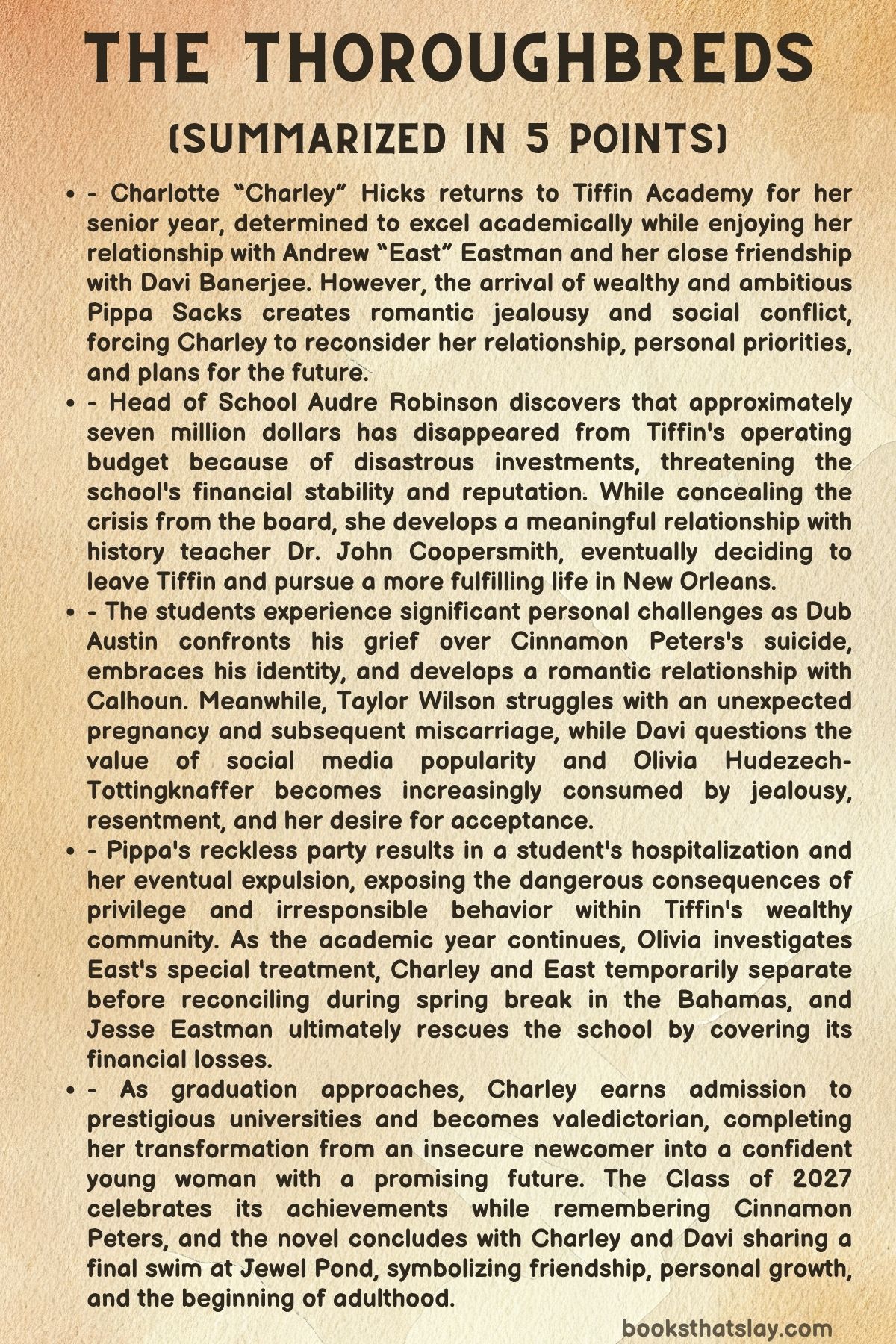
Summary
Charlotte “Charley” Hicks returns to Tiffin Academy for her senior year feeling considerably more confident than when she first arrived. After losing her father and struggling with her mother’s remarriage, she found an unexpected sense of belonging at the boarding school through friendships, academic achievement, and her relationship with Andrew “East” Eastman.
Her romance with East has become an important source of happiness, and the couple arrives together from Baltimore in his black pickup truck. Despite her excitement, Charley remains troubled by her mother Fran’s unhappy marriage to Joey, whose suspected infidelity has created considerable tension at home.
Tiffin itself carries complicated memories, particularly the suicide of Cinnamon Peters and the destructive gossip spread through the anonymous Zip Zap application. Those experiences changed the school’s students and faculty, leaving them more aware of the consequences of secrets, cruelty, and social pressure.
As the new academic year begins, Head of School Audre Robinson faces a crisis that threatens the institution’s future. Approximately seven million dollars has disappeared from Tiffin’s operating budget following disastrous investments managed by financial adviser Oak Bellamy.
Audre fears that revealing the losses will destroy her professional reputation and undermine confidence in the school. Rather than immediately informing the board, she decides to conceal the situation while hoping that financial markets will recover.
Meanwhile, Tiffin welcomes several new students and teachers, including scholarship student Liam Donovan, history teacher Dr. John Coopersmith, and college counselor John Maverick. Liam’s modest background and the death of his older brother from a fentanyl overdose sharply contrast with the wealth surrounding him.
Another newcomer, Philippa “Pippa” Sacks, quickly becomes a powerful social presence. Her wealthy family, fashionable appearance, and unwavering confidence attract attention, but her particular interest in East threatens Charley’s relationship.
Pippa believes that her privileged background makes her a more suitable romantic partner for East. Her growing popularity also attracts Olivia Hudezech-Tottingknaffer, an insecure student who desperately wants acceptance among Tiffin’s most influential teenagers.
Charley, meanwhile, embraces her responsibilities as editor of the school newspaper, the ‘Bred Bulletin. She wants the publication to become a meaningful reflection of student experiences, but Olivia and Pippa challenge her authority and create unnecessary conflicts.
Her academic dedication also brings her closer to John Maverick, whose enthusiasm for art history inspires her intellectual curiosity. Maverick recognizes Charley’s seriousness about education and considers organizing an extracurricular art appreciation course.
Charley eventually writes a deeply personal college essay imagining a dinner with her deceased father, Thad Hicks. Through memories of their shared love of literature, she expresses how profoundly his influence continues shaping her identity.
East approaches the college admissions process differently, appearing less interested in academic prestige and conventional achievement. Nevertheless, he privately consults Maverick about his future, asking that their discussions remain confidential, especially from Charley.
Elsewhere, Tiffin’s familiar social relationships undergo significant changes. Davi Banerjee, a successful social media influencer and one of Charley’s closest friends, becomes increasingly uncomfortable with the difference between her carefully managed online personality and her private emotions.
Although Davi enjoys considerable popularity, her family’s difficulties and her fear of becoming irrelevant leave her feeling isolated. Her neon sign proclaiming “Comparisons Are Odious” becomes a reminder of the values she wants to embrace, even as she struggles to follow them herself.
Dub Austin, the school’s prominent football player, experiences another kind of personal transformation. Still grieving Cinnamon Peters’s death, he delivers an emotional senior speech that allows him to speak openly about his identity and challenge the expectations that have defined him.
His growing relationship with Calhoun gives him the confidence to imagine a life beyond conventional athletic success. Although football helped him establish his place at Tiffin, Dub begins realizing that personal happiness may require making different choices.
Taylor Wilson and Hakeem Pryce also face changes in their romantic relationship. After becoming sexually intimate, Taylor discovers an emotional vulnerability that conflicts with her usually organized, achievement-oriented personality.
As autumn progresses, Audre’s professional responsibilities become increasingly exhausting. Her developing relationship with Dr. Coopersmith offers unexpected comfort, and his kindness gradually encourages her to consider a future in which her personal happiness receives greater attention.
Family Weekend temporarily improves Audre’s spirits when Tilly Benbow’s wealthy parents suggest that they may make a substantial donation. However, the anticipated financial relief remains uncertain, forcing Audre to continue hiding the school’s precarious circumstances.
Tensions reach a dangerous turning point when Pippa hosts an extravagant party at her family’s home. Alcohol, drugs, and reckless behavior transform the gathering into a serious scandal, eventually nicknamed the Haydensboro Massacre.
Younger student Grady Tish requires hospitalization, and the school faces difficult questions about responsibility, supervision, and privilege. Audre must interrupt her personal time with Coop to address the emergency, while Cordelia Spooner helps manage its immediate consequences.
The Honor Board becomes involved in investigating the misconduct, and Pippa ultimately faces expulsion. The scandal demonstrates that wealth and social influence cannot always protect students from the consequences of irresponsible decisions.
During this period, Taylor discovers that she is pregnant. Although she and Hakeem have promising college plans, she cannot imagine how parenthood would fit into their carefully anticipated futures.
Unable to share the truth with Hakeem, Taylor confides in Dub, trusting him because of their longstanding friendship and the secrets they have already protected for one another. She considers her options while trying to preserve the happiness of her relationship.
Before she can make a final decision, Taylor experiences a miscarriage. The loss devastates her, revealing that grief can exist even when a pregnancy was unexpected and its future remained uncertain.
Charley’s winter break brings renewed family difficulties when Fran confronts Joey about his suspected unfaithfulness. Joey refuses to surrender his phone and moves out, leaving Charley to witness another painful breakdown in her mother’s life.
Back at Tiffin, the rivalry between Charley and Olivia intensifies. Encouraged by Pippa, Olivia becomes obsessed with exposing the advantages enjoyed by East and other socially influential students.
Valentine’s weekend creates further complications when the school organizes the Tuck, a dance where students wear colors representing their romantic status. For Charley and East, the event brings their underlying disagreements about trust and the future into sharper focus.
Charley has begun questioning whether their love can overcome their differences. Although East fears losing her, she cannot promise that they will remain together, and their relationship reaches a painful breaking point.
Additional scandals further undermine the school’s atmosphere. Tilly Benbow becomes involved in an inappropriate relationship with an adult connected to another student’s family, while Audre grows increasingly weary of managing the consequences of other people’s decisions.
Charley also dismisses Olivia from the newspaper because of her inadequate contributions. Humiliated and angry, Olivia decides to pursue an investigation into Tiffin’s secrets, hoping to damage the reputations of the people she believes have excluded her.
Audre, meanwhile, announces her intention to leave Tiffin at the end of the academic year. Her relationship with Coop has encouraged her to imagine moving to New Orleans, pursuing different professional opportunities, and beginning a more personally fulfilling chapter of her life.
Her announcement sets off competition between Rhode Rivera and Cordelia Spooner, both of whom become possible successors. Their ambitions expose new professional rivalries at a time when the school’s financial position remains dangerously unstable.
Spring break provides Tiffin’s seniors with an opportunity to escape their academic responsibilities. A group travels to Harbour Island in the Bahamas, where luxurious accommodations, beaches, and nights at Daddy D’s nightclub create an atmosphere of excitement.
Charley and East remain emotionally attached despite their breakup, and the distance from campus allows them to reconsider their relationship. Pippa’s unexpected appearance on the island renews romantic tensions, but it also makes the couple more conscious of their continuing affection.
On the final night of the vacation, Charley and East publicly reconcile with a kiss on the dance floor. Their friends celebrate the reunion, while Davi privately captures the moment as another memorable episode in their shared school experience.
As college decisions arrive, the students confront the reality that their time at Tiffin is nearly over. Royce Stringfellow receives impressive offers from prestigious universities, while Willow Levy also plans to attend college in Baltimore.
Charley earns admission to Harvard and Columbia but considers Colgate because of its connection to her father. Her uncertainty shows that she is beginning to prioritize personal meaning over the prestige others expect her to pursue.
Dub visits Calhoun in Colorado and considers attending the University of Colorado Boulder. Although the decision could bring him closer to someone he loves, he worries about abandoning his ambitions in competitive football.
Olivia continues investigating East’s privileged position and obtains access to confidential college counseling information with Grady’s assistance. Discovering that Maverick considers her a follower devastates her because it confirms the insecurity underlying her pursuit of popularity.
At Tiffin’s 115th anniversary celebration, Audre’s financial deception finally becomes impossible to maintain. Jesse Eastman learns about the investment losses and agrees to cover the deficit, rescuing the institution from immediate financial disaster.
Jesse also learns that Audre rejected an improper financial offer from Erik Sacks, strengthening his respect for her judgment. Although he forgives her handling of the crisis, he insists that Oak Bellamy be dismissed as the school’s financial adviser.
Other members of Tiffin’s community also reconsider their futures. Chef Haz receives a generous offer encouraging him to remain, but ultimately recognizes that his attachment to the students matters more than financial rewards.
Rhode Rivera experiences growing literary success, while Maverick prepares to return to the Colbert School. Cordelia considers the possibility of Honey Vandermeid’s return, despite the complications surrounding Honey’s previous departure.
As graduation approaches, Charley is named valedictorian, finishing just ahead of Royce. His resentment contrasts with her sense of accomplishment after overcoming grief, family instability, and the difficulties of establishing herself at Tiffin.
The graduation ceremonies become an emotional farewell for students and teachers alike. Cinnamon Peters is remembered through an empty chair, while Dub’s transformation symbolizes the personal growth experienced by the graduating class.
Audre formally presents the graduates as the chapel bells toll twenty-seven times in honor of the Class of 2027. The students celebrate beneath green-and-gold confetti, recognizing that their shared experiences have created relationships they will carry beyond the school.
In the final moments, the ‘Bred Bulletin publishes its senior superlatives, acknowledging academic accomplishments, romantic relationships, and personal transformations. Charley and Davi walk toward Jewel Pond for one final swim, preparing to leave behind the place that helped them discover who they are and who they might become.
Characters
Charlotte “Charley” Hicks
Charlotte Hicks is the central character of The Thoroughbreds, representing the transition from emotional insecurity to confidence and independence. Having lost her father and experienced considerable unhappiness following her mother’s remarriage, Charley initially regarded Tiffin Academy as an escape from a painful family situation.
Over time, she develops strong friendships, discovers her academic abilities, and establishes a meaningful relationship with Andrew Eastman. Her enthusiasm for learning and commitment to the school newspaper demonstrate her intelligence, ambition, and willingness to accept responsibility.
Charley’s relationship with East reveals her emotional vulnerability, particularly when Pippa Sacks begins pursuing him. Although she loves East deeply, she gradually recognizes that a successful relationship requires trust, mutual understanding, and respect for individual aspirations.
Her bond with her deceased father remains particularly influential, shaping her love of literature and her approach to college admissions. By becoming valedictorian, Charley completes a remarkable personal transformation, proving that she can define success according to her own values rather than other people’s expectations.
Andrew “East” Eastman
Andrew Eastman is one of the most socially influential students in The Thoroughbreds, largely because of his family’s wealth, his father’s position within Tiffin’s leadership, and his confident personality. Despite his privileged circumstances, East often appears uninterested in the academic ambitions and social expectations that dominate the lives of his classmates.
His relationship with Charley reveals a more sensitive personality beneath his relaxed exterior. He genuinely loves her, but his uncertainty about the future and his interactions with Pippa create tensions that threaten their relationship.
East’s private conversations with John Maverick suggest that he is beginning to consider his future more seriously. His reluctance to share these discussions with Charley reflects both his desire for independence and the difficulties he experiences communicating important feelings.
Their eventual reconciliation demonstrates his willingness to preserve a relationship that has become emotionally significant. Nevertheless, his character continues to raise questions about how someone accustomed to privilege can establish an identity separate from family influence.
Davi Banerjee
Davi Banerjee is a prominent social media influencer whose experiences in The Thoroughbreds reveal the psychological difficulties associated with popularity and public attention. Although she appears confident, fashionable, and socially successful, she struggles privately with loneliness, family difficulties, and uncertainty about her future.
Her friendship with Charley provides an important source of emotional stability. Unlike relationships built around admiration or social advantage, their connection depends on loyalty, shared experiences, and genuine affection.
Davi’s neon sign proclaiming “Comparisons Are Odious” becomes an important symbol of her internal conflict. She understands that constant comparison damages self-confidence, yet her career depends partly on presenting an attractive lifestyle for others to admire.
Her decision to remain at school during Thanksgiving rather than visit family demonstrates how disconnected she sometimes feels from the people closest to her. By graduation, Davi is learning to distinguish authentic happiness from the temporary satisfaction of social media recognition.
Olivia Hudezech-Tottingknaffer
Olivia Hudezech-Tottingknaffer serves as an important source of interpersonal conflict in The Thoroughbreds, embodying the insecurity and resentment created by intense social competition. Although she desperately wants to belong among Tiffin’s most admired students, her constant comparison with others prevents her from developing confidence in her own identity.
Olivia particularly envies Charley, Davi, and East because of their established friendships and social influence. Her admiration for Pippa Sacks makes her increasingly willing to overlook questionable behavior in exchange for the possibility of acceptance.
Her participation in the school newspaper exposes her difficulties with responsibility and cooperation. When Charley dismisses her for failing to contribute meaningfully, Olivia interprets the decision primarily as a personal humiliation rather than considering her own behavior.
Her subsequent investigation into East’s privileged treatment demonstrates intelligence and determination, but these qualities are compromised by resentment. Discovering Maverick’s assessment of her as a follower forces Olivia to confront the uncomfortable possibility that her personality has become defined by other people’s approval.
Audre Robinson
Audre Robinson is one of the most complicated adult characters in The Thoroughbreds, representing the emotional and ethical burdens of institutional leadership. As Tiffin Academy’s Head of School, she is responsible for protecting its reputation, maintaining educational standards, and guiding students through difficult circumstances.
Her greatest challenge emerges when approximately seven million dollars disappears from the school’s operating budget. Instead of immediately revealing the financial losses, Audre conceals the crisis because she fears professional humiliation and the destruction of everything she has worked to establish.
Her decision illustrates the conflict between protecting an institution and protecting one’s own position within it. Although she genuinely believes that silence might prevent unnecessary damage, her secrecy creates substantial risks for the school.
Her developing relationship with Dr. Coopersmith introduces a different dimension to her personality. Through his affection and understanding, Audre begins recognizing that personal happiness should not always be sacrificed for professional obligations.
Her eventual decision to leave Tiffin marks a significant transformation. She learns that leadership does not require permanent self-denial and that beginning a different life can be an expression of courage rather than failure.
Philippa “Pippa” Sacks
Pippa Sacks is a wealthy and socially ambitious student whose arrival dramatically changes Tiffin’s existing relationships. Unlike classmates who spend years trying to establish themselves, Pippa immediately attracts attention through her confidence, financial privilege, and apparent disregard for conventional social boundaries.
Her interest in Andrew Eastman creates considerable tension with Charley. Pippa believes that shared wealth and social background make her naturally compatible with East, revealing her tendency to judge relationships through status and entitlement.
Her influence over Olivia further demonstrates her social power. Olivia admires Pippa intensely, but Pippa rarely offers the loyalty or emotional consideration that a genuine friendship requires.
The disastrous party at her family’s home exposes the dangerous consequences of her recklessness. Her eventual expulsion shows that confidence and wealth cannot completely eliminate accountability, even within an institution accustomed to dealing with privileged families.
Dub Austin
Dub Austin is a talented football player whose development extends far beyond athletic achievement. Initially recognized for his physical presence and leadership on the field, he carries considerable emotional pain following the suicide of his former girlfriend, Cinnamon Peters.
His senior speech becomes a defining moment because it allows him to acknowledge an important aspect of his identity publicly. The encouragement he receives demonstrates that vulnerability can strengthen relationships rather than undermine respect.
Dub’s growing romantic connection with Calhoun encourages him to imagine a future built around personal authenticity. His uncertainty about attending college in Colorado reveals the difficulty of balancing love with ambitions that have shaped his identity for years.
His compassion also appears when Taylor confides in him about her pregnancy. By graduation, Dub has become a more emotionally mature young man who understands that courage involves confronting painful truths and making independent choices.
Taylor Wilson
Taylor Wilson is an academically accomplished and disciplined student who approaches life through careful organization and clearly defined goals. As chair of the Honor Board, she represents responsibility, achievement, and a strong commitment to established standards.
Her relationship with Hakeem Pryce introduces emotional experiences that challenge her structured outlook. After discovering that she is pregnant, Taylor realizes that personal difficulties cannot always be resolved through analysis and planning.
Her decision to confide in Dub rather than Hakeem reflects her fear of disrupting the future she and her boyfriend have imagined. When she experiences a miscarriage, she confronts feelings of loss that she had not anticipated.
Taylor’s experiences reveal the limitations of perfectionism. Her character illustrates how emotional maturity often develops through circumstances that cannot be controlled or predicted.
Hakeem Pryce
Hakeem Pryce is a respected student whose relationship with Taylor Wilson forms an important part of the novel’s exploration of young love. Their shared academic ambitions and promising college futures initially suggest a stable and carefully organized path toward adulthood.
His relationship with Taylor becomes increasingly intimate, although he remains unaware of her pregnancy during her most difficult moments. This lack of knowledge creates a significant contrast between their apparent closeness and the private fears Taylor cannot express.
Hakeem’s interactions with Dub also reveal his capacity for friendship and acceptance. His response to Dub’s romantic interest in Calhoun demonstrates that genuine loyalty does not require judgment or elaborate explanations.
Cinnamon Peters
Cinnamon Peters is a deceased student whose presence continues influencing Tiffin’s community. Her suicide remains one of the school’s most painful experiences, shaping the emotional lives of students who knew her and challenging the institution’s sense of security.
Her relationship with Dub is particularly significant because he continues carrying grief and unresolved questions about her final communications. The email attachment she left behind represents the lingering emotional responsibilities created by her death.
The empty chair placed in her memory during graduation emphasizes that her absence remains meaningful. Cinnamon’s character demonstrates how the influence of a person can continue long after their life has ended.
Calhoun
Calhoun is Dub Austin’s romantic interest and an important influence on his developing sense of identity. Their relationship gives Dub the confidence to imagine a future in which personal happiness and emotional authenticity become central priorities.
During Dub’s visit to Colorado, their shared experiences offer a glimpse of life beyond Tiffin’s familiar social environment. The possibility of attending the University of Colorado Boulder becomes attractive partly because it would allow Dub to remain close to Calhoun.
Calhoun represents an opportunity for Dub to build a life according to his own desires rather than expectations inherited from his athletic identity.
Liam Donovan
Liam Donovan arrives at Tiffin as a scholarship student from Queens, carrying the emotional consequences of his older brother’s death from a fentanyl overdose. His modest background distinguishes him from classmates accustomed to extensive financial security.
His arrival with possessions packed in a trash bag emphasizes the economic disparities within the school. The generosity shown through the clothing, supplies, and necessities provided in his room makes his introduction to Tiffin especially meaningful.
Liam also attracts Olivia’s romantic interest, becoming part of the school’s developing social relationships. His presence highlights the opportunities elite education can offer while exposing the inequalities separating students who attend the same institution.
Tilly Benbow
Tilly Benbow is a wealthy student whose aristocratic background and social position make her an object of admiration among classmates such as Olivia. Her privileged lifestyle contributes to the atmosphere of exclusivity that characterizes Tiffin’s social hierarchy.
Despite her status, Tilly experiences personal difficulties that complicate her outwardly polished image. Her involvement in an inappropriate relationship with an adult connected to another student’s family becomes a serious scandal.
Her enthusiastic spreading of gossip about Pippa’s disastrous party also reveals her willingness to distance herself from people facing public humiliation. Tilly represents the contradictions of social privilege, particularly when wealth and status coexist with irresponsible decisions.
Royce Stringfellow
Royce Stringfellow is an academically gifted student whose intelligence and competitive personality make him a prominent member of Tiffin’s graduating class. His admission offers from prestigious universities, including MIT and Johns Hopkins, demonstrate his exceptional academic abilities.
His decision to attend Johns Hopkins also attracts attention because Willow Levy plans to study in Baltimore. Although the choice suggests that personal relationships may influence his plans, his motivations are not fully established.
Royce’s disappointment when Charley becomes valedictorian reveals the insecurity beneath his accomplishments. His reaction demonstrates how intense academic competition can make even successful students feel threatened by another person’s achievements.
Willow Levy
Willow Levy is a member of Charley’s social circle whose relationships contribute to the interconnected atmosphere of Tiffin Academy. She participates in the shared experiences of the graduating class, including the spring break vacation to Harbour Island.
Her college plans become a subject of speculation because she intends to attend university in Baltimore, where Royce Stringfellow also chooses to study. This coincidence suggests the possible importance of their romantic connection.
Willow’s role reflects the way personal relationships can influence decisions about life after boarding school. She also contributes to the broader portrait of students preparing to leave a familiar community.
Madison Jones
Madison Jones is Tiffin’s Head Prefect, a position that reflects her responsibility, leadership, and respected standing among students. She helps organize school activities and provides continuity during important traditions and celebrations.
Her involvement in planning the Valentine’s weekend Tuck demonstrates her commitment to student life. She also participates in the graduating class’s social activities while managing the expectations associated with her leadership position.
Although she experiences disappointment during the college admissions process, Madison secures strong educational opportunities. Her character represents the challenge of balancing institutional responsibility with the ordinary uncertainties of adolescence.
Grady Tish
Grady Tish is a younger student whose hospitalization becomes the most serious consequence of Pippa Sacks’s uncontrolled party. His experience transforms what initially appears to be reckless entertainment into an incident with potentially dangerous consequences.
Later, Grady assists Olivia in obtaining access to confidential college counseling information. His involvement connects him to another controversy surrounding privacy and student behavior.
Although his individual motivations receive limited attention, Grady’s actions demonstrate how younger students can become involved in situations beyond their maturity or judgment.
Sunny
Sunny is a student whose interaction with Davi Banerjee during Thanksgiving provides a revealing moment in Davi’s emotional development. While practicing music, Sunny encounters Davi, who offers her the neon sign associated with her social media identity.
Sunny declines because she recognizes that the sign has become personally meaningful to Davi. Her response encourages Davi to reconsider whether rejecting a familiar symbol would truly resolve her dissatisfaction.
Sunny’s brief appearance demonstrates how an ordinary conversation can encourage meaningful self-reflection.
John “Mav” Maverick
John Maverick is Tiffin’s new college counselor, an experienced educator whose professional and personal circumstances are closely connected. Following his separation from Amanda, he accepts the position partly because it allows him to remain near their twin sons.
Maverick approaches college counseling as an opportunity to understand students’ individual interests rather than simply direct them toward prestigious universities. His conversations with Charley reveal his appreciation for intellectual curiosity and genuine academic engagement.
His passion for art history motivates him to consider offering additional educational opportunities. Through his relationship with students, Maverick rediscovers the satisfaction of teaching subjects he finds personally meaningful.
His confidential conversations with East also demonstrate the trust students place in him. His eventual decision to return to the Colbert School reflects his desire to balance professional fulfillment with family responsibilities.
Dr. John “Coop” Coopersmith
Dr. John Coopersmith is a widowed history teacher whose arrival at Tiffin introduces an important possibility for Audre Robinson’s personal happiness. His connection to New Orleans and his calm, understanding personality make him particularly appealing to her.
Unlike individuals primarily interested in Audre’s professional authority, Coop recognizes the emotional burdens she carries. When she becomes overwhelmed by the school’s difficulties, he offers compassion without demanding immediate explanations.
Their relationship gradually develops into a meaningful romance. Through Coop, Audre begins imagining a future in which she can prioritize companionship, emotional security, and interests beyond Tiffin’s administration.
Coop represents the possibility of renewal after loss. His character demonstrates that personal happiness can emerge unexpectedly, even after years devoted to responsibilities and difficult experiences.
Rhode Rivera
Rhode Rivera is an English teacher and aspiring writer whose professional ambitions become increasingly significant throughout the academic year. His short story “Green Flag / Red Flag,” inspired by an unsuccessful romantic encounter, earns publication and renews his confidence.
His later experiences with a mysterious woman and her private retreat, the She-Shed, inspire another story titled “Mr. Fantabulous.” His growing literary recognition culminates in his work being selected for Best American Short Stories.
Rhode’s success encourages him to seek greater professional responsibility, including consideration for the Head of School position. However, his enthusiasm for recognition sometimes makes him appear overly concerned with his own accomplishments.
His character reflects the relationship between creative fulfillment and professional ambition. Although his achievements are genuine, he must confront the possibility that success does not automatically establish suitability for leadership.
Cordelia Spooner
Cordelia Spooner is Tiffin’s admissions director, responsible for attracting prospective students and maintaining the institution’s prestigious reputation. Her work requires balancing educational ideals with the practical importance of wealthy families and potential donors.
She demonstrates considerable dedication during emergencies, particularly when Grady Tish is hospitalized following Pippa’s party. Her willingness to manage difficult situations establishes her as an important member of the school administration.
Cordelia’s personal life remains complicated by her unresolved feelings for Honey Vandermeid. Although she attempts to move beyond their relationship, she continues experiencing emotional uncertainty about their separation.
Her ambition to become Head of School reveals another side of her personality. Her competition with Rhode suggests that professional advancement can sometimes encourage behavior inconsistent with the cooperation an institution requires.
Honey Vandermeid
Honey Vandermeid is Tiffin’s former college counselor and Cordelia Spooner’s former romantic partner. Although she is no longer employed at the school, her previous involvement in institutional scandals continues influencing how others perceive her.
Honey’s unexpected message to Cordelia reveals that their emotional connection has not entirely disappeared. Cordelia’s decision to delete the message, followed by immediate regret, demonstrates the complicated feelings surrounding their separation.
Later, the possibility of Honey returning to Tiffin creates another connection between the school’s past difficulties and its uncertain future. Her character represents the persistence of unresolved relationships and the possibility of reconciliation.
Chef Haz
Chef Haz is Tiffin’s respected chef, whose elaborate meals contribute significantly to the school’s distinctive atmosphere. His work is important not merely because of the food he prepares, but because it creates comfort, familiarity, and shared experiences for students.
He initially regarded his employment at Tiffin as a consequence of earlier mistakes. Over time, however, caring for the students becomes an important source of personal satisfaction.
When he receives an exceptionally generous offer encouraging him to remain, Haz recognizes that financial rewards are not his primary motivation. His decision to stay demonstrates that belonging and meaningful work can be more valuable than prestige or additional wealth.
Jesse Eastman
Jesse Eastman is Andrew Eastman’s father and an influential figure in Tiffin’s administration as president of the board. His financial resources and institutional authority place him in a position to make decisions affecting the entire school.
His importance becomes especially clear when he discovers the substantial losses in Tiffin’s operating budget. Rather than allowing the institution to collapse financially, Jesse agrees to cover the deficit.
Although he forgives Audre’s secrecy, he insists that Oak Bellamy be dismissed. His response combines generosity with an expectation of accountability, illustrating both the advantages and complications of relying on wealthy supporters.
Oak Bellamy
Oak Bellamy is the financial adviser responsible for managing the investments that produce Tiffin’s disastrous budget losses. His inability to provide Audre with immediate reassurance intensifies her anxiety about the institution’s financial position.
Although Oak remains largely outside the school’s everyday social activities, his professional decisions have consequences for students, teachers, and administrators. His role emphasizes the vulnerability of an institution that places substantial trust in financial management.
Jesse Eastman’s eventual insistence on dismissing him demonstrates that financial mistakes can produce serious professional consequences.
Erik Sacks
Erik Sacks is connected to the wealthy Sacks family and becomes significant through an improper financial offer involving Tiffin. His proposal creates an additional ethical challenge for Audre Robinson during a period when the school desperately needs money.
Audre’s decision to reject the offer demonstrates that her financial desperation does not eliminate every professional boundary. When Jesse Eastman learns about her refusal, his respect for her judgment increases.
Erik’s role illustrates how wealth can create opportunities for inappropriate influence within educational institutions.
Simone Bergeron
Simone Bergeron is a former Tiffin history teacher whose inappropriate involvement with East led to her dismissal. Although she is no longer part of the active faculty, the consequences of her actions remain connected to the school’s recent history.
After leaving Tiffin, Simone returns to Montreal and attempts to rebuild her life. Her circumstances demonstrate that professional misconduct can produce lasting consequences beyond the immediate scandal.
Her character also reflects the importance of appropriate boundaries between educators and students.
Fran Hicks
Fran Hicks is Charley’s mother, whose strained marriage to Joey creates considerable emotional difficulty for her daughter. Following the death of Charley’s father, Fran’s decision to remarry changes the family structure in ways that Charley finds difficult to accept.
Her growing suspicions about Joey’s fidelity eventually lead to a confrontation during which he refuses to provide access to his phone. His departure leaves Fran facing another painful disruption in her personal life.
Fran’s character demonstrates how parental decisions can affect children even when those children are approaching adulthood. Her difficulties also remind Charley that independence does not entirely eliminate concern for family members.
Joey
Joey is Charley’s stepfather and a central source of tension within her family. Charley dislikes him and associates his marriage to Fran with the emotional instability that followed her father’s death.
His refusal to allow Fran access to his phone strengthens suspicions about his behavior and contributes to the breakdown of their marriage. He eventually moves out, leaving Fran and Charley to confront the consequences.
The later scandal connecting him with Tilly Benbow reinforces the troubling impression created by his earlier conduct. Joey represents the selfishness and dishonesty that can undermine family relationships.
Thad Hicks
Thad Hicks is Charley’s deceased father, whose influence remains central to her emotional and intellectual development. Their shared love of books created a close relationship that continues shaping Charley’s memories and ambitions.
In her college essay, Charley imagines sharing a meal with him and discussing the literature she has encountered since his death. This imagined conversation demonstrates her desire to maintain an emotional connection with someone whose guidance she deeply values.
Her consideration of Colgate also reflects the importance of his memory. Thad represents the enduring influence of parental love and the ways grief can shape a young person’s understanding of identity.
Vikram Banerjee
Vikram Banerjee is Davi’s father, whose circumstances expose the financial pressures hidden behind his daughter’s glamorous public image. Following his divorce, his financial position has become more complicated, making unnecessary expenses increasingly frustrating.
At graduation, he discovers that Davi has already arranged for her belongings to be packed, stored, and transported to college. His expensive rental vehicle becomes another reminder of the difference between outward appearances and practical financial concerns.
Vikram’s character illustrates the difficulty parents can experience when supporting children accustomed to privilege.
Karen Austin
Karen Austin is Dub’s mother, whose concern for her son extends beyond his athletic achievements. She recognizes that Cinnamon Peters’s suicide has left him carrying emotional burdens he has struggled to share.
During graduation, Karen asks whether Dub has opened the attachment Cinnamon left behind. His confirmation gives her some reassurance, although he is not yet prepared to discuss its contents.
Her relationship with Dub illustrates the delicate balance parents must maintain between offering support and respecting their children’s growing independence.
Derrick Austin
Derrick Austin is Dub’s father, whose absence from graduation becomes a source of disappointment for Karen. His limited presence contrasts with the significant emotional developments taking place in Dub’s life.
Although the available account reveals little about Derrick’s personal motivations, his absence contributes to the novel’s examination of imperfect family relationships. It also emphasizes that major milestones do not always receive the parental participation students might hope for.
Beatrix
Beatrix is Charley’s old friend from Baltimore, representing an important connection to her life before Tiffin Academy. During winter break, Charley reaches out to her while coping with the deterioration of her mother’s marriage.
Their reunion allows Charley to reconnect with someone who knew her before the transformations brought about by boarding school. Beatrix’s role highlights the value of friendships that preserve continuity during periods of substantial personal change.
Amanda Maverick
Amanda Maverick is John Maverick’s estranged wife and the head of the Colbert School. Their separation creates practical and emotional challenges, particularly because they share twin sons.
Amanda’s professional position also connects Maverick to an educational institution outside Tiffin. His eventual decision to return to Colbert reflects the continuing importance of family proximity and responsibility.
Although Amanda receives limited direct attention, her circumstances help explain Maverick’s professional decisions and personal priorities.
O’Malley Donovan
O’Malley Donovan appears in connection with Tiffin’s 115th anniversary celebration, arriving alongside Jesse Eastman. The appearance places him near an important moment when Audre Robinson must confront the school’s precarious finances.
The supplied account does not develop his personality or individual motivations extensively. His role is primarily connected to the wider network of individuals associated with Tiffin’s institutional life.
Coach Bosworth
Coach Bosworth is an important authority figure in Tiffin’s athletic community, particularly in relation to Dub Austin. His response to Dub’s senior speech demonstrates a supportive understanding of leadership and personal courage.
Rather than treating Dub’s openness as a weakness, Bosworth praises his honesty. His reaction challenges the assumption that athletic strength requires emotional restraint and demonstrates how educators can help students feel accepted.
Yardley
Yardley is a woman whose unsuccessful date with Rhode Rivera indirectly contributes to his literary success. Their experience inspires Rhode to write “Green Flag / Red Flag,” a story exploring the conflicting judgments people make during modern dating.
Although Yardley has a minor role, the encounter demonstrates how apparently disappointing personal experiences can become valuable creative material. Her significance lies primarily in the influence she has on Rhode’s developing writing career.
Keith McNally
Keith McNally appears through his response to Davi Banerjee’s successful social media post about a meal at Balthazar. His comment adds to the attention generated by her video and reinforces the substantial reach of her online presence.
His brief appearance demonstrates the relationship between contemporary celebrity culture, commercial establishments, and social media influence. It also marks a moment when Davi discovers that her online success can develop from genuine personal interests.
Themes
Privilege, Class, and Institutional Power
In The Thoroughbreds, economic privilege shapes the opportunities, relationships, and expectations surrounding almost every character. Tiffin Academy is an institution where extraordinary resources provide students with educational advantages, luxurious living conditions, and access to influential social networks.
However, the novel repeatedly demonstrates that privilege does not guarantee responsible behavior or emotional security. Students such as Pippa and Tilly possess considerable wealth, yet their actions reveal entitlement, insecurity, and difficulties understanding appropriate boundaries.
The contrast between Liam Donovan and his affluent classmates provides one of the clearest examinations of social inequality. Liam arrives with limited possessions and a painful family history, while other students enjoy financial advantages they have rarely needed to question.
His experiences demonstrate that students entering the same educational institution can begin from radically different circumstances. The opportunities available at Tiffin may help reduce some disadvantages, but they do not erase the social differences that influence students’ daily lives.
The financial crisis exposes another dimension of privilege through the school’s dependence on wealthy individuals. Audre’s inability to manage the investment losses places Tiffin in serious danger, yet Jesse Eastman’s resources ultimately prevent an institutional catastrophe.
This rescue reveals both the benefits and the dangers of concentrated financial power. The school survives because a wealthy supporter can provide extraordinary assistance, but that dependence raises questions about independence, accountability, and institutional fairness.
East’s special treatment and Olivia’s investigation further complicate the subject. Although Olivia’s motivations are influenced by jealousy, her concerns about unequal opportunities cannot be dismissed solely because she approaches them resentfully.
The novel suggests that wealth becomes particularly problematic when it encourages people to confuse influence with merit. Genuine responsibility requires recognizing that privilege creates obligations rather than unlimited freedom from consequences.
Identity, Self-Acceptance, and Social Comparison
The struggle to establish an authentic identity shapes the experiences of students who are constantly surrounded by expectations about popularity, achievement, appearance, and future success. At Tiffin, young people are repeatedly encouraged to measure themselves against classmates whose lives appear more impressive or desirable.
Davi Banerjee embodies this conflict through her career as a social media influencer. Her online personality depends on presenting an attractive lifestyle, yet she becomes increasingly aware that admiration from strangers cannot replace emotional security or genuine friendship.
Her slogan, “Comparisons Are Odious,” expresses an ideal she finds difficult to practice. The contradiction illustrates how understanding the harmful effects of comparison does not automatically free someone from the desire for recognition.
Olivia experiences a more destructive version of the same problem. Instead of identifying her own interests and abilities, she attempts to gain acceptance by imitating students she considers socially superior.
Her attachment to Pippa demonstrates how the desire to belong can undermine independent judgment. When Olivia discovers Maverick’s assessment of her as a follower, the criticism is devastating because it exposes a truth she has avoided confronting.
Dub Austin offers a contrasting example of personal growth. His willingness to speak openly about his identity allows him to establish a sense of self that extends beyond football and other people’s assumptions.
His relationship with Calhoun encourages him to make decisions based on genuine affection rather than conventional expectations. Through Dub, the novel presents self-acceptance as an ongoing process requiring courage, honesty, and independence.
Charley’s experiences reinforce this message through her approach to college admissions. Her willingness to consider a personally meaningful university rather than automatically choosing the most prestigious option demonstrates that maturity involves developing an individual understanding of success.
Love, Grief, and the Changing Meaning of Family
The relationships in The Thoroughbreds reveal how love and loss can influence personal development long after the original experiences have occurred. Romantic attachment, parental affection, friendship, and grief appear in different forms, demonstrating that emotional connections are rarely simple or predictable.
Charley’s relationship with her deceased father illustrates the lasting power of familial love. Although Thad Hicks is no longer alive, the books they shared and the memories they created continue influencing her intellectual interests and personal decisions.
Her imagined dinner with him becomes an expression of ongoing attachment rather than an inability to move forward. Through literature and memory, Charley discovers ways to preserve an important relationship while continuing to develop independently.
Her mother’s troubled marriage provides a contrasting example of family instability. Fran’s relationship with Joey creates distrust and emotional strain, showing how adult romantic decisions can affect children even when they are preparing to leave home.
The novel also examines grief through Dub’s response to Cinnamon Peters’s suicide. His emotional development is influenced by unresolved questions about her death and the responsibility he feels toward her memory.
His growing relationship with Calhoun demonstrates that new love does not require forgetting someone who has died. Instead, emotional recovery involves accepting that affection, sadness, and hope can coexist.
Taylor’s miscarriage introduces another form of grief, one complicated by uncertainty about whether she wanted to continue the pregnancy. Her sadness reveals that losing a possible future can be painful even when that future was unexpected.
Audre and Coop provide an adult perspective on love’s capacity to create new beginnings. Their relationship encourages Audre to reconsider a life defined almost entirely by professional sacrifice.
Together, these experiences demonstrate that meaningful relationships require vulnerability and that emotional maturity often emerges through accepting change rather than resisting it.
Growing Up, Ambition, and the Freedom to Choose
The approaching end of senior year forces Tiffin’s students to confront the difference between the futures others have imagined for them and the lives they actually want. College applications, academic rankings, romantic relationships, and family expectations become increasingly significant as graduation approaches.
Charley’s academic achievements initially seem to position her for a straightforward progression toward an elite university. However, her consideration of Colgate demonstrates that personal fulfillment may involve different priorities from those encouraged by competitive educational environments.
Her relationship with East creates a similar challenge because their individual ambitions do not always align. Their temporary separation reveals that affection alone cannot resolve differences about independence and the future.
Dub faces a comparable decision between pursuing competitive football and remaining near Calhoun. His dilemma demonstrates that growing up frequently requires accepting uncertainty rather than choosing between obviously correct and incorrect alternatives.
Taylor’s experience introduces the limitations of attempting to control every important decision. Her pregnancy and miscarriage force her to recognize that intelligence, discipline, and careful preparation cannot prevent every painful experience.
The adult characters face similar questions, suggesting that personal growth does not end with adolescence. Audre must decide whether maintaining professional authority is worth sacrificing her chance for happiness with Coop.
Rhode pursues literary recognition while considering administrative leadership, and Chef Haz evaluates whether financial rewards would genuinely improve his life. Their circumstances show that ambition can become more meaningful when connected to personal values rather than external approval.
Graduation ultimately represents both accomplishment and uncertainty. The students leave Tiffin with valuable friendships, painful memories, and significant achievements, but they cannot know exactly what adulthood will bring.
The novel presents maturity as the ability to accept this uncertainty while remaining responsible for one’s choices. Success becomes less about satisfying predetermined expectations and more about creating a future that reflects individual identity, meaningful relationships, and a genuine sense of purpose.