The Three Graces of Pearl Street Summary, Characters and Themes
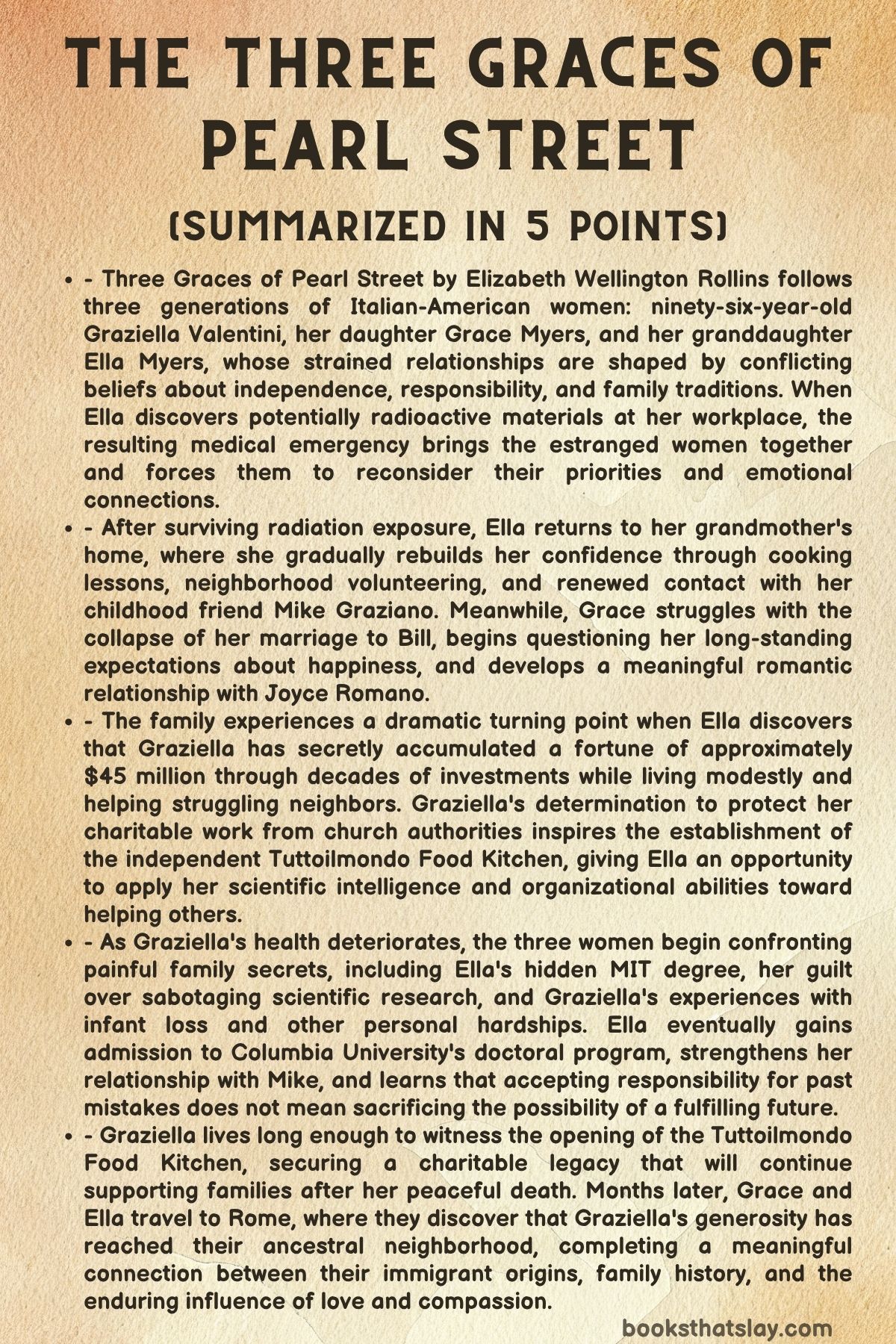
The Three Graces of Pearl Street by Elizabeth Wellington Rollins is a multigenerational family novel about love, independence, forgiveness, and the responsibilities that connect generations of women. Set primarily in a New York neighborhood shaped by Italian-American traditions, the story follows ninety-six-year-old Graziella Valentini, her daughter Grace Myers, and her granddaughter Ella Myers as unexpected crises bring them together after years of disagreement and emotional distance.
Through family secrets, changing relationships, financial discoveries, and the creation of a charitable institution, the novel examines how women of different generations understand freedom and responsibility. It also explores the lasting influence of ancestry and the possibility of rebuilding relationships before it is too late.
Summary
The story begins in early twentieth-century Rome, where ten-year-old Maria Tuttoilmondo faces an unexpected separation from her family after her older brother is arrested for stealing meat. Her mother gives her a ticket to America that was originally intended for her brother, forcing Maria to undertake a frightening journey toward an unfamiliar future.
Maria secretly brings a six-toed black kitten aboard the ship, and the animal becomes her companion during the crossing. After arriving at Ellis Island, she settles with a distant relative in New York, beginning an immigrant family history that will eventually extend across several generations.
Inspired by the Roman statue of the Three Graces, Maria passes down a naming tradition associated with radiance, joy, and flourishing. Her descendants become Graziella, Grace, and Ella, three women whose lives will eventually become closely connected through an extraordinary series of events.
More than a century later, twenty-seven-year-old Ella Myers reluctantly returns to her grandmother’s house at 125 Pearl Street for Christmas Eve. She has spent five years distancing herself from her family, particularly her controlling grandmother, Graziella Valentini, and her equally protective mother, Grace Myers.
Ella has type 1 diabetes, and the older women have always monitored her condition closely. Although their concern comes from love, Ella believes their constant supervision has prevented her from developing genuine independence.
The family reunion becomes disastrous during the traditional Feast of the Seven Fishes when Ella announces that she is vegan and discovers that Graziella has prepared nothing suitable for her. Their argument expands to encompass environmental activism, Ella’s decision to leave MIT, her uncertain employment, and her rejection of conventional expectations.
When Graziella offers her canned cat food instead of dinner, Ella angrily throws the can against a religious figurine. She leaves Pearl Street determined never to return unless someone dies.
Six weeks later, Graziella is preparing chicken cutlets for a neighbor who has recently given birth prematurely when television reports announce a possible radioactive emergency near Times Square. Realizing that Ella works in the affected area, she immediately abandons her cooking and drives to find Grace.
Grace, a Columbia University psychology professor, is already struggling with a troubled marriage, menopausal symptoms, and her estrangement from Ella. Her husband, Bill, has spent years working in Bermuda and has recently admitted that he is involved with another woman.
Despite their strained relationship, Grace joins Graziella in a desperate journey toward Manhattan. Their concern becomes more frightening when authorities establish police barricades around Ella’s workplace and refuse to provide information about her condition.
Meanwhile, Ella has discovered a suspicious lead-lined container containing two vials of blue liquid among donations at Big Apple Bargains, the thrift shop where she works. Recognizing that the container may hold radioactive material, she contacts emergency services despite the furious objections of her supervisor, George, who fires her.
Emergency responders isolate Ella and transport her to a hospital for medical evaluation. Alone and frightened, she begins confronting the possibility that she may die without repairing her relationships with her family.
Grace and Graziella attempt to cross the police barricades, leading to Graziella striking an officer with her cane and both women being detained. FBI investigators subsequently question them about Ella’s scientific background, environmental beliefs, and possible involvement in the incident.
The investigators eventually arrange a telephone conversation between Ella and her mother. Hearing Grace’s voice brings Ella immense relief, and she admits that her rejection of family relationships has caused unnecessary suffering.
Medical examinations reveal that Ella has experienced radiation sickness, but doctors expect her to recover without permanent damage. Investigators also discover that her quick response prevented a potentially catastrophic situation involving a deceased scientist’s collection of radioactive materials.
The experience changes Ella’s priorities, and she agrees to return to Pearl Street while recovering. Although Graziella initially allows her to stay for only one week, the arrangement gradually develops into a renewed period of family life.
Ella soon discovers that the circumstances she left behind have become impossible to maintain. She has lost her job, her relationship with Marcus has ended, and the Brooklyn warehouse where she lived offers little comfort or security.
Graziella refuses to allow her granddaughter to remain inactive and assigns her responsibilities at St. Joseph’s food kitchen and neighborhood cleanup projects. Although Ella initially resents the work, she begins recognizing the value of helping people through practical, sustained effort.
During a cleanup assignment, Ella encounters Mike Graziano, a childhood friend who has grown into a confident and attractive man. Mike previously worked in investment banking but now serves as an FBI investigator specializing in financial crimes, having chosen work he considers socially meaningful.
Their renewed friendship gradually becomes romantic, offering Ella a relationship in which she feels accepted despite her insecurities. Mike encourages her to reconsider her accomplishments, develop independence, and stop allowing past mistakes to determine her future.
At the same time, Grace faces the collapse of her marriage. Bill’s infidelity and prolonged absences force her to question the comfortable suburban existence she has maintained for decades, including her country club membership and expensive home.
Grace also develops an unexpected friendship with Joyce Romano, a woman whose family has a longstanding rivalry with Graziella’s. Their shared interest in cold-water swimming gradually becomes an important source of companionship as Grace reevaluates her emotional needs and personal identity.
Meanwhile, Ella begins taking cooking lessons from Graziella, discovering that her grandmother’s culinary abilities require the same patience, observation, and precision that scientific work demands. Their growing cooperation allows them to exchange knowledge, with Ella teaching Graziella how to use a computer.
Graziella’s determination to remain active becomes increasingly difficult as her eyesight deteriorates and her physical strength weakens. Following a fall at the church food kitchen, she suffers a concussion and hip injury, forcing Grace and Ella to confront the possibility that she cannot continue living as independently as before.
The accident also reveals previously unknown details about Graziella’s childhood polio and other medical hardships. Her reluctance to discuss painful experiences frustrates Grace, who believes that family members should share important information rather than conceal it.
A much greater revelation follows when Ella discovers that her grandmother possesses approximately $45 million in investments. Graziella has accumulated this fortune through decades of disciplined financial trading while continuing to live modestly and quietly supporting people throughout the neighborhood.
The discovery produces anger and confusion, particularly when Grace and Ella realize how extensively Graziella has concealed her financial circumstances. Another secret emerges when Graziella reveals that Ella actually earned her bachelor’s degree from MIT, despite allowing everyone to believe that she abandoned her education without graduating.
Ella also discovers that Mike knew about Graziella’s wealth through his previous professional association with her accountant. Misinterpreting his silence as dishonesty, she confronts him, damaging their developing relationship before eventually understanding that he was bound by professional confidentiality.
Graziella’s fortune becomes central to a disagreement with the Catholic Church concerning the future of the food kitchen. She intends to use her estate to maintain a charitable operation dedicated directly to feeding struggling families, but church officials seek control over a substantial portion of the money.
Unwilling to let her resources disappear into institutional administration, Graziella decides to establish an independent nonprofit organization. She gives Ella a central role in the project, recognizing that her granddaughter’s scientific intelligence, organizational skills, and concern for social justice can serve a meaningful purpose.
Ella begins searching for suitable premises, developing financial records, coordinating suppliers, and planning the facility’s operations. She proposes naming it the Tuttoilmondo Food Kitchen in honor of Maria, the immigrant ancestor whose journey to America began the family’s history.
The project becomes an opportunity for the three generations to cooperate in ways that their earlier disagreements had made impossible. Graziella contributes experience and financial resources, Grace provides emotional and professional support, and Ella applies her analytical abilities to creating a sustainable organization.
Meanwhile, Ella finally explains the shame surrounding her departure from MIT. While participating in nuclear fusion research, she deliberately sabotaged part of a professor’s work, later discovering that the man was struggling with serious personal difficulties.
Overwhelmed by guilt, Ella allowed this wrongdoing to destroy her confidence and effectively abandoned the career she once wanted. Mike helps her recognize that taking responsibility for a mistake does not require permanently surrendering the possibility of becoming a better person.
Ella secretly applies to doctoral programs and is eventually accepted at Columbia University. Her success marks an important turning point because she is no longer choosing between intellectual ambition and social responsibility.
Grace also begins establishing an independent future. She acknowledges her romantic feelings for Joyce, receives unexpected acceptance from Graziella, and gradually realizes that ending her marriage may allow her to build a life more consistent with her own desires.
As the food kitchen approaches completion, Graziella’s health continues deteriorating. She nevertheless remains determined to secure the organization’s future, successfully pursuing an investment opportunity that produces approximately $20 million in additional resources.
The Tuttoilmondo Food Kitchen opens during an elaborate neighborhood celebration attended by relatives, volunteers, religious sisters, and numerous people whose lives Graziella has helped. Ella speaks about the family’s immigrant ancestry, and the event becomes a public recognition of the values Graziella has practiced throughout her life.
Shortly afterward, Graziella realizes that death is approaching. She begins arranging her funeral, instructs her family about unfinished responsibilities, and encourages Grace to accept an offer to become Columbia University’s dean of students.
She also tells Grace and Ella about the Roman piazza containing the statue that inspired their family names, urging them to visit the place together. In private conversations, she encourages Ella to pursue her future, trust her judgment, and recognize that love requires responsibility without demanding perfection.
Mike reveals his intention to marry Ella, and Graziella asks Grace to give him her engagement ring for the eventual proposal. Surrounded by her daughter, granddaughter, and household cats, Graziella dies peacefully after sharing her final memories and family recipes.
Her death leaves Grace and Ella devastated, but the neighborhood’s response reveals the extraordinary reach of her generosity. They discover that she quietly financed education, helped families through emergencies, assisted artists, and supported people whose circumstances had gone largely unnoticed.
Several months later, Ella hires an experienced director to oversee the food kitchen, passes her driving examination, and prepares to begin graduate school. Although leaving Pearl Street is emotionally difficult, she understands that honoring Graziella also means accepting responsibility for her own future.
Grace and Ella plant ninety-six daffodils at Graziella’s grave, commemorating each year of her life. The family house remains connected to Maria’s extended relatives, allowing it to continue providing shelter and stability.
The following May, the two women travel to Rome, fulfilling Graziella’s final wish. Ella is now engaged to Mike and pursuing doctoral research, while Grace has become Columbia’s dean of students and established a loving relationship with Joyce.
In Rome, they visit the neighborhood where Maria grew up and discover the statue of the Three Graces. They also encounter people who remember fragments of their family’s history, revealing that the connection between their American lives and Italian ancestry has never completely disappeared.
Their journey takes an unexpected turn when they discover a food kitchen operated by religious sisters, with Graziella’s photograph displayed inside. Realizing that her charitable legacy has reached the neighborhood her mother left more than a century earlier, Grace and Ella understand that the family’s history has come full circle.
Graziella’s death has not ended her influence, because the values she practiced continue through the people and institutions she helped create. The story closes with the surviving women embracing lives shaped by their own choices while carrying forward the generosity, resilience, and love inherited from earlier generations.
Characters
Graziella Valentini
Graziella Valentini is the ninety-six-year-old matriarch of the family and the central figure connecting its past, present, and future. In Three Graces of Pearl Street, she represents extraordinary resilience, practical intelligence, generosity, and the determination to remain useful despite the limitations imposed by age.
A fiercely independent woman, Graziella has built her life around family responsibilities, religious service, and helping people in her neighborhood. Her demanding personality often makes her difficult to live with, particularly because she believes that providing food, discipline, and practical assistance is more valuable than expressing affection through words.
Her relationship with Ella reveals both her greatest strengths and her most significant weaknesses. Although she loves her granddaughter deeply, her tendency to criticize Ella’s appearance, employment, diet, and decisions contributes to their estrangement.
Graziella’s own history explains much of her behavior, including her childhood polio, the death of her infant son Francis, her miscarriages, and the sacrifices she made while raising Grace. These experiences taught her that suffering cannot always be prevented, but that people can respond to hardship through purposeful work.
Her remarkable financial success introduces another dimension to her character. Despite accumulating an enormous fortune through investments, she lives modestly and uses her money to assist struggling families, demonstrating that she understands wealth primarily as a resource for improving other people’s lives.
However, her secrecy also exposes her desire for control. By concealing her finances and personal history, she protects her independence while unintentionally preventing Grace and Ella from fully understanding her.
Her decision to challenge the Catholic hierarchy over the food kitchen demonstrates the difference between her religious convictions and her willingness to obey institutional authority. She refuses to allow powerful officials to interfere with the charitable work that has become her life’s purpose.
Graziella’s final achievement is not the fortune she accumulates or even the organization she establishes, but her ability to prepare Grace and Ella to continue living without her. By the end of the novel, she has learned to place greater trust in the women she raised, accepting that her legacy must eventually belong to them.
Grace Myers
Grace Myers is Graziella’s daughter, Ella’s mother, and a respected Columbia University psychology professor whose personal life has become increasingly unsatisfying. In Three Graces of Pearl Street, her experiences explore the difficulties of maintaining an identity separate from marriage, motherhood, and expectations inherited from previous generations.
For much of her adult life, Grace has defined herself through her responsibilities toward other people. Her daughter’s diabetes required constant attention, while her husband’s prolonged absences forced her to manage family life with substantial assistance from Graziella.
Her relationship with Ella is complicated by this history of caregiving. Grace sincerely wants her daughter to become independent, yet she struggles to abandon protective habits developed during years of medical emergencies.
Her marriage to Bill represents another relationship in which she has accepted circumstances that do not satisfy her emotional needs. His infidelity forces her to recognize that she has spent years defending his behavior while overlooking her own unhappiness.
The prospect of divorce threatens several elements of Grace’s identity, including her suburban home, country club membership, financial security, and social relationships. She initially interprets these losses as evidence that her life is collapsing rather than as opportunities to reconsider what she genuinely wants.
Her cold-water swimming becomes an important symbol of personal discovery. The activity allows her to experience physical relief, emotional independence, and companionship outside the social environment associated with her marriage.
Through her developing relationship with Joyce, Grace begins acknowledging feelings about her sexuality that she had previously avoided confronting. Her mother’s unexpected acceptance helps her recognize that personal happiness does not require following conventional expectations.
Grace’s transformation also affects her parenting. She gradually learns that respecting Ella’s independence means allowing her daughter to make mistakes without treating every uncertain decision as a crisis.
By accepting the position of dean of students at Columbia and establishing a loving relationship with Joyce, Grace enters a new stage of life. She becomes more confident in her professional abilities, emotional choices, and capacity to build a future without depending on Bill.
Ella Myers
Ella Myers is Graziella’s granddaughter and the youngest of the three central women. In Three Graces of Pearl Street, she represents the struggle between personal independence and the responsibilities that accompany intelligence, privilege, and family relationships.
At the beginning of the novel, Ella is deeply frustrated with conventional expectations of success. Despite possessing exceptional scientific abilities, she has abandoned her academic ambitions and chosen a precarious lifestyle centered on environmental concerns and resistance to consumer culture.
Her type 1 diabetes complicates her search for independence because her mother and grandmother have spent years monitoring her health. Ella interprets their concern as control, making her increasingly determined to demonstrate that she can manage her life without their involvement.
However, her rejection of family support has not produced the freedom she expected. Instead, she lives in uncomfortable conditions, struggles financially, and maintains relationships that provide little emotional security.
The radioactive emergency becomes a defining moment because it forces her to confront her mortality and acknowledge how much she misses her family. Her ability to identify the dangerous material also demonstrates that the scientific knowledge she has tried to abandon remains an essential part of her identity.
Ella’s hidden academic history reveals that her withdrawal from MIT was motivated partly by guilt rather than ideological conviction. After sabotaging a professor’s research, she allowed one serious mistake to convince her that she did not deserve a successful scientific career.
Her developing relationship with Mike challenges this belief. He encourages her to accept responsibility for her actions without allowing shame to prevent her from becoming someone different.
Working at the food kitchen provides Ella with a way to reconcile her intellectual abilities with her desire to help others. She discovers that scientific thinking, organizational planning, and financial knowledge can create lasting improvements in people’s lives.
Her gradual willingness to learn cooking, pursue doctoral research, and accept romantic commitment demonstrates increasing emotional maturity. She also begins understanding that independence does not require rejecting family traditions or refusing assistance.
By the end of the story, Ella is capable of maintaining her own home, pursuing advanced education, participating in a stable relationship, and helping oversee a charitable organization. Her development shows that meaningful adulthood involves accepting both individual freedom and responsibility toward others.
Maria Tuttoilmondo
Maria Tuttoilmondo is the Italian immigrant ancestor whose journey establishes the family’s history in America. Although she appears primarily through the prologue and the memories of later generations, she provides the foundation for the novel’s exploration of ancestry, courage, and inherited values.
As a ten-year-old girl, Maria is forced to leave Rome after her brother’s arrest changes her family’s circumstances. Her decision to bring a six-toed kitten on the voyage demonstrates her resourcefulness, emotional attachment, and willingness to challenge restrictions when necessary.
Maria’s arrival in America represents both opportunity and profound loss. She must adapt to a new country while carrying memories of the family, language, and neighborhood she has left behind.
Her influence survives through the naming tradition associated with the Three Graces, the family’s food customs, and the stories Graziella eventually shares. Even generations later, her descendants continue drawing strength from the identity she preserved.
The discovery of Graziella’s photograph in a Roman food kitchen gives Maria’s story a particularly meaningful conclusion. The family that began with her forced departure has eventually returned to help people in the neighborhood where her American journey originated.
Mike Graziano
Mike Graziano is Ella’s childhood friend and eventual romantic partner, whose patience, intelligence, and emotional steadiness help her reconsider her understanding of herself. In Three Graces of Pearl Street, he provides an example of someone who combines professional success with compassion and personal responsibility.
Although Mike once worked in investment banking, he eventually entered the FBI and specialized in investigating financial crimes. His career demonstrates that he understands the desire to pursue meaningful work without entirely rejecting professional achievement.
Unlike Ella’s earlier romantic partners, Mike does not expect her to conceal her unusual interests, medical needs, or intellectual abilities. He treats her as a capable adult while acknowledging the emotional difficulties that have shaped her decisions.
His loyalty to his sister Tina also reveals his understanding of family responsibility. Having experienced the death of his mother, he recognizes that love often involves obligations that cannot simply be abandoned.
Mike’s knowledge of Graziella’s finances temporarily damages his relationship with Ella. His refusal to disclose confidential information, however, demonstrates his professional integrity rather than personal dishonesty.
His response to Ella’s admission about sabotaging scientific research becomes particularly important. Instead of excusing her behavior or condemning her permanently, he encourages her to understand the difference between wrongdoing and an identity defined entirely by guilt.
By choosing to build a future with Ella, Mike demonstrates that romantic commitment can support independence rather than threaten it. His willingness to share responsibilities makes him a suitable partner for a woman still learning how to trust herself and others.
Joyce Romano
Joyce Romano begins as a neighborhood acquaintance whose family has maintained an old rivalry with the Valentinis. In Three Graces of Pearl Street, she becomes an important influence on Grace’s emotional recovery and developing understanding of her sexuality.
Joyce is confident, perceptive, and relatively comfortable discussing subjects that Grace finds difficult to confront. Her willingness to speak openly about Bill’s past infidelity helps Grace recognize that her marriage may have been troubled for longer than she understood.
Their shared cold-water swimming sessions create opportunities for friendship outside Grace’s familiar social environment. Joyce provides companionship without requiring Grace to maintain the image of the successful wife and respected suburban professional.
As their friendship develops into romance, Joyce becomes associated with the possibility of happiness after disappointment. She does not erase Grace’s grief or immediately resolve her insecurities, but she demonstrates that emotional intimacy remains possible during middle age.
Her relationship with Grace also challenges the old neighborhood divisions maintained by Graziella. The eventual acceptance of their partnership suggests that inherited conflicts need not determine the choices of later generations.
Bill Myers
Bill Myers is Grace’s estranged husband and Ella’s father, whose emotional absence has affected both women for many years. His prolonged employment in Bermuda provides him with a convenient explanation for remaining physically distant from his family.
Although Bill has enjoyed the comforts associated with marriage and professional success, he has failed to participate consistently in Ella’s upbringing. Much of the responsibility for managing her diabetes and emotional needs has fallen on Grace and Graziella.
His infidelity reveals the extent to which he has placed his own desires above his family’s stability. Grace gradually realizes that she has repeatedly defended his behavior, making excuses that prevented her from acknowledging the seriousness of their marital problems.
His relationship with Patricia, a wealthy eighty-seven-year-old woman, becomes a source of unexpected humor. Nevertheless, the absurdity surrounding his new romance does not diminish the damage caused by years of dishonesty and neglect.
Bill functions as a contrast to the women who sustain one another through difficult circumstances. His departure ultimately encourages Grace to recognize that financial comfort and social respectability cannot replace mutual affection or genuine partnership.
Frank Valentini
Frank Valentini is Graziella’s late husband and one of the most significant influences on her understanding of love, honesty, and practical generosity. Their relationship began when he worked as a mail carrier delivering letters to the abbey where Graziella was preparing for religious life.
Falling in love with Frank changed the direction of Graziella’s future. She abandoned her intention to become a nun and chose marriage, discovering a different form of devotion through family and community responsibilities.
Frank is remembered as a skilled, generous man who restored household objects and believed in helping people without expecting repayment. The rocking chair he repaired remains an especially important reminder of their marriage and the children they raised.
Although he has died before the main events, his memory continues influencing Graziella’s decisions. When confronted with the consequences of concealing her wealth, she imagines Frank’s advice and questions whether her secrecy has become unfair to Grace and Ella.
Francis Valentini
Francis is Graziella and Frank’s infant son, whose early death profoundly affects the family’s emotional history. Although he does not participate directly in the main story, his absence remains an important influence on Graziella’s personality.
His death helps explain why Graziella takes feeding children and supporting vulnerable families so seriously. She cannot undo the loss of her own child, but she can devote her energy to protecting and nourishing others.
The rocking chair associated with his infancy becomes a meaningful household object. By using it for subsequent generations of neighborhood children, Graziella transforms a reminder of suffering into something connected with comfort and continuing life.
Giuseppe Pucci
Giuseppe Pucci is Graziella’s father, whose work as a stonemason symbolizes the labor and perseverance of earlier immigrant generations. The stonework he created remains part of the physical landscape surrounding the family home.
His belief that worthwhile work should endure beyond an individual’s lifetime becomes especially important to Graziella. She remembers his example while planning an independent food kitchen capable of surviving after her death.
Giuseppe’s influence connects the family’s material surroundings with its moral values. The lasting structures he built become a parallel to the charitable institution Graziella hopes to leave for future generations.
Tina Graziano
Tina is Mike’s sister and an important member of the extended neighborhood community. Her enthusiasm for animals and affectionate relationships with other people contribute to the welcoming atmosphere surrounding Pearl Street.
Mike’s commitment to caring for Tina demonstrates the responsibilities that shape his personal decisions. Their relationship also helps Ella recognize that love includes consideration for people whose needs may affect future plans.
Tina’s kindness becomes particularly evident after Graziella’s death, when she encourages Grace to eat and recalls her own difficulties following the loss of her mother. Her experience allows her to offer practical comfort without minimizing the family’s grief.
Although she occupies a supporting role, Tina represents the quiet compassion that sustains people during emotionally difficult periods.
Father Gerald
Father Gerald is the priest assigned to St. Joseph’s following the departure of Father Tomas. Graziella initially distrusts him, partly because she resents the replacement of a priest with whom she had established a strong working relationship.
His early interactions with Graziella reveal the difficulties faced by someone attempting to earn the confidence of a fiercely independent community leader. She repeatedly questions his judgment, administrative knowledge, and understanding of the food kitchen’s daily responsibilities.
Over time, Father Gerald demonstrates genuine concern for Graziella and the people she serves. He assists during her medical emergency, visits her in the hospital, and becomes increasingly sympathetic to her efforts to protect the food kitchen.
His willingness to support her despite pressure from church authorities distinguishes personal religious service from institutional loyalty. By the later stages of the novel, Graziella has come to trust him as someone whose commitment to helping others is sincere.
Flora
Flora is an abbess who knew Graziella during her years in the convent and remains connected to her religious past. Her appearance allows the family to understand aspects of Graziella’s youth that have rarely been discussed.
Through Flora’s recollections, Graziella emerges as a spirited young woman who was willing to challenge expectations long before becoming an elderly neighborhood matriarch. Their longstanding friendship demonstrates that leaving religious life did not require Graziella to reject every relationship associated with it.
Flora’s decision to bless the Tuttoilmondo Food Kitchen becomes an important affirmation of Graziella’s charitable mission. Unlike the church officials who prioritize control over financial resources, she understands that feeding vulnerable people is itself a meaningful expression of faith.
Her participation in Graziella’s funeral also provides moral recognition for a woman whose generosity was sometimes undervalued by the institutions she served.
The Cardinal
The cardinal represents the institutional authority that Graziella challenges while attempting to establish an independent food kitchen. His interest in the financial arrangements surrounding her estate creates the central conflict between charitable purpose and organizational control.
Rather than recognizing Graziella’s right to determine how her money should be distributed, he attempts to maintain the archdiocese’s influence over the resources she has accumulated. His behavior suggests an institution more concerned with administrative authority than with the specific needs of the people receiving assistance.
His interactions with Graziella also expose unequal power relations between senior male religious officials and women performing much of the daily charitable work. Graziella’s refusal to accept his demands demonstrates that religious devotion does not require unconditional obedience.
The cardinal functions less as a fully developed personal figure than as a representation of the organizational structures Graziella believes must be challenged when they obstruct practical compassion.
Peggy
Peggy is the bookkeeper associated with St. Joseph’s Church whose interactions with Graziella contribute to growing distrust between the charitable workers and church administration. Her refusal to provide financial records raises concerns about transparency and accountability.
Graziella believes charitable organizations must be financially responsible precisely because they handle resources intended for vulnerable people. Peggy’s resistance therefore becomes more than a personal disagreement.
Her later questioning of the legitimacy of Graziella’s wealth further damages their relationship. Through Peggy, the novel examines how suspicion, defensiveness, and administrative secrecy can undermine cooperation within institutions that publicly claim to serve others.
Marcus
Marcus is Ella’s former romantic partner, whose behavior reveals the instability of the life she has built away from Pearl Street. Although Ella initially regards her unconventional relationships as expressions of independence, Marcus offers little emotional reliability.
His failure to contact her during her hospitalization demonstrates how weak their connection has become. The situation becomes even more humiliating when he announces that he has entered a monogamous relationship with one of Ella’s former roommates.
Marcus serves as a contrast to Mike, whose affection is accompanied by reliability and consideration. Through the failure of this relationship, Ella begins recognizing that rejecting conventional expectations does not automatically produce emotional freedom.
George
George is Ella’s unpleasant supervisor at Big Apple Bargains, where she works sorting donated goods. His behavior represents the everyday indifference and narrow thinking that have contributed to Ella’s dissatisfaction with conventional employment.
When Ella discovers potentially radioactive materials and contacts emergency services, George becomes furious about the disruption. His decision to fire her demonstrates his failure to recognize both the seriousness of the situation and her professional judgment.
His treatment of Ella provides a contrast between institutional position and genuine competence. Although George possesses workplace authority, Ella’s scientific knowledge and willingness to act responsibly ultimately prevent a dangerous incident.
Maria, the Neighbor
Maria is Graziella’s neighbor and tenant, whose premature delivery creates an opportunity for the novel to demonstrate the practical nature of Graziella’s generosity. Her need for food and assistance motivates Graziella to prepare nourishing meals for her recovering family.
The difficulties surrounding Maria’s baby also awaken painful memories of Graziella’s own experiences with pregnancy and infant loss. Through this connection, the younger woman’s circumstances reveal why Graziella responds so intensely to vulnerable mothers and children.
Maria and her family represent the ordinary people whose needs shape the food kitchen’s purpose. Their relationship with Graziella illustrates how community support often begins with personal attention rather than large public gestures.
Teddy
Teddy is an intelligent but troublesome boy who attends Graziella’s religious classes. His disruptive behavior initially appears to demand discipline, but Graziella recognizes that his intelligence and energy might become valuable if directed toward meaningful responsibilities.
Her understanding of Teddy reflects the same insight she gradually develops about Ella. Both young people possess abilities that are unlikely to flourish through criticism alone.
Teddy’s role highlights Graziella’s belief that responsibility can help people develop confidence and self-respect. Rather than simply dismissing him as badly behaved, she considers how useful work might encourage him to become more constructive.
Chantal
Chantal is one of Grace’s psychology students, whose conversation with her professor unexpectedly encourages Grace to reconsider her personal identity. By asking whether Grace is gay, she raises a subject that Grace has avoided examining openly.
Although Grace initially finds the question unsettling, it awakens memories of an earlier romantic experience with a woman. Chantal therefore becomes an indirect influence on Grace’s eventual willingness to acknowledge her feelings for Joyce.
Grace’s response also demonstrates her commitment to mentoring young people. Even while experiencing personal uncertainty, she remains attentive to Chantal’s emotional needs and offers her a place within a supportive family environment.
Patricia
Patricia is Bill’s new romantic partner, whose introduction further exposes the emotional distance between Bill and his family. Her considerable wealth and advanced age make her relationship with Bill particularly surprising to Grace and Ella.
The discovery that Patricia is eighty-seven creates one of the novel’s moments of unexpected comedy. Rather than allowing Bill’s romantic choices to continue humiliating them, Grace and Ella eventually find themselves laughing together.
Patricia functions primarily as a catalyst for Grace’s emotional detachment from her former husband. Her presence makes it easier for Grace to recognize that Bill’s decisions no longer need to determine her happiness.
Angela Lopez
Angela Lopez is the experienced nonprofit professional Ella hires to direct the Tuttoilmondo Food Kitchen after Graziella’s death. Her appointment reflects Ella’s growing understanding that effective charitable work requires professional management as well as generosity.
Angela’s neighborhood connections and administrative experience make her suitable for maintaining the institution’s daily operations. By trusting her with leadership, Ella demonstrates that she has learned to delegate responsibilities rather than attempt to manage everything herself.
Her arrival also makes it possible for Ella to pursue graduate education without abandoning Graziella’s legacy. Angela represents the transition from an organization dependent on one determined individual to a sustainable institution capable of serving future generations.
Donald
Donald is Graziella’s longtime estate lawyer, whose professional involvement reflects the careful planning behind her charitable ambitions. Although he receives relatively limited attention, his role is important in establishing that Graziella’s wealth and intentions are supported by serious legal arrangements.
Graziella understands that generosity alone cannot guarantee the survival of an organization after its founder dies. Donald’s involvement helps connect her personal wishes with the legal and financial structures necessary to protect them.
His presence reinforces the importance of responsible preparation when transferring wealth and authority between generations.
Officer Flórez
Officer Flórez is a police officer involved in the aftermath of Grace and Graziella’s attempt to cross the emergency barricades near Times Square. Unlike some of the authorities confronting the women, she responds with sympathy to their desperation.
Her recognition that her own grandmother might behave similarly allows her to understand Graziella’s actions without entirely dismissing the seriousness of the situation. Through her, the story briefly demonstrates how empathy can soften the conflict between institutional rules and personal emergencies.
Agents Tolley and O’Sullivan
Agents Tolley and O’Sullivan are the FBI investigators who question Grace and Graziella following the discovery of radioactive material. Their questions about Ella’s activism, scientific education, and finances initially make the family fear that she is being treated as a possible suspect.
Their investigation illustrates how unusual personal choices can become grounds for suspicion during a public emergency. Although their questions are professionally motivated, they also expose the difficulty of judging character through incomplete information.
The agents ultimately provide the family with information about Ella’s hospitalization, helping transform an atmosphere of uncertainty into the beginning of relief.
Juno
Juno is the injured Maine coon cat Ella rescues during her driving examination. Her discovery forces Ella to choose between completing an important personal milestone and helping an animal in immediate distress.
By abandoning the test to rescue Juno, Ella demonstrates that her compassion is no longer limited to abstract beliefs about improving the world. She is willing to accept an immediate personal disadvantage when faced with suffering she can directly relieve.
Juno’s name, drawn from Roman mythology, also reflects Ella’s developing connection to her ancestry. The cat ultimately becomes part of her independent life, connecting her future with the animal-loving traditions of previous generations.
Adam
Adam is a traumatized cat whose care becomes another responsibility within Graziella’s household. His difficult behavior and medical needs require patience from family members who are already overwhelmed by personal crises.
Grace initially resents having to collect and care for him, but she nevertheless follows her mother’s wishes. Adam’s presence illustrates Graziella’s belief that vulnerable creatures deserve assistance even when caring for them is inconvenient.
Like the other cats in the novel, he contributes to the larger depiction of a household where love is expressed through everyday acts of protection and care.
Themes
Family Relationships, Independence, and Intergenerational Understanding
The relationships between Graziella, Grace, and Ella reveal how love can become complicated when different generations disagree about independence, responsibility, and personal freedom. Each woman believes she understands what is best for the others, yet their attempts to provide protection frequently produce resentment rather than gratitude.
Graziella belongs to a generation shaped by immigration, economic uncertainty, physical hardship, and the belief that family members must sacrifice personal comfort for collective survival. Her approach to love emphasizes discipline, nourishment, financial security, and the willingness to intervene whenever someone appears to be making a serious mistake.
Grace occupies a difficult position between her mother and daughter. She understands Graziella’s intentions but also recognizes Ella’s desire to make independent choices, particularly because Grace herself has spent much of her adult life accommodating the expectations of others.
Ella initially believes freedom requires rejecting the traditions and assistance associated with Pearl Street. However, her estrangement leaves her isolated, demonstrating that independence without meaningful emotional connections can become another form of limitation.
The radioactive emergency forces the three women to confront the fragility of their relationships. Their eventual reconciliation develops not because they eliminate their differences, but because they begin recognizing that affection and disagreement can exist together.
In Three Graces of Pearl Street, family becomes a source of strength when its members accept that protecting someone does not always mean controlling their decisions. Graziella gradually trusts Ella with significant responsibilities, Grace learns to respect her daughter’s adulthood, and Ella discovers that accepting help does not make her incapable.
By the end of the story, each woman has changed her understanding of what family loyalty requires. Their relationships become healthier because responsibility is increasingly shared rather than imposed, allowing personal growth to exist alongside lasting emotional attachment.
Wealth, Social Responsibility, and the Meaning of Generosity
Graziella’s enormous financial fortune challenges conventional assumptions about wealth, particularly the belief that financial success necessarily produces luxury, selfishness, or separation from ordinary community life. Despite possessing millions of dollars, she continues repairing household items, preparing meals, and living according to habits developed during earlier periods of economic uncertainty.
Her wealth becomes meaningful through the assistance it provides to others. She quietly finances education, supports neighborhood families, purchases essential resources, and maintains charitable programs without expecting public acknowledgment.
However, the novel also recognizes that generosity requires careful organization. Graziella understands that distributing money without considering long-term consequences may provide temporary relief without creating the stability vulnerable families need.
This distinction becomes central to her conflict with the Catholic hierarchy. She refuses to surrender control of her estate because she believes administrative structures may divert substantial resources away from the people she intends to help.
Ella initially struggles with the discovery of her grandmother’s fortune because it challenges her criticism of privilege and capitalist institutions. Her experience managing the food kitchen gradually teaches her that money can become a powerful instrument for social improvement when combined with ethical judgment and practical expertise.
The Tuttoilmondo Food Kitchen represents the fullest expression of this understanding. Its financial resources support a carefully managed institution designed to provide nourishment, stability, and dignity long after Graziella’s lifetime.
The story also emphasizes that wealth creates obligations toward future generations. Graziella wants Grace and Ella to possess financial independence, but she also expects them to recognize the broader responsibilities that accompany inherited advantages.
Ultimately, generosity is presented not as an isolated act of giving but as a continuing commitment to creating opportunities for others. The value of Graziella’s fortune lies less in its monetary size than in the lasting improvements it makes possible.
Forgiveness, Personal Growth, and Second Chances
Ella’s concealed history at MIT demonstrates how guilt can become destructive when a person begins treating one mistake as permanent evidence of personal unworthiness. Her decision to sabotage a professor’s research was a serious ethical failure, but the consequences extend beyond the immediate incident because she refuses to forgive herself.
Rather than confronting her wrongdoing and attempting to rebuild her professional life, Ella distances herself from scientific research and allows her family to believe that she never completed her degree. Her withdrawal becomes a form of self-punishment disguised partly as rejection of conventional achievement.
Mike’s response helps her understand that accepting responsibility does not require abandoning every future opportunity. By acknowledging his own past difficulties, he challenges Ella’s belief that morally imperfect people cannot deserve happiness, love, or meaningful work.
Grace experiences a different need for forgiveness as her marriage collapses. She must confront Bill’s dishonesty while also reconsidering the years she spent defending his behavior and suppressing her own emotional needs.
Her eventual growth does not require excusing Bill or restoring their relationship. Instead, it involves releasing the expectation that her marriage must define the success or failure of her life.
Graziella also demonstrates the possibility of change despite her advanced age and deeply established convictions. Her growing willingness to trust Father Gerald, share painful family memories, and accept Grace’s romantic relationship shows that personal development does not belong exclusively to younger people.
Forgiveness throughout the novel involves acknowledging pain without allowing it to determine every future decision. The characters cannot erase their mistakes, disappointments, or losses, but they can choose how those experiences influence their relationships.
Ella’s return to scientific study, Grace’s new professional and romantic life, and Graziella’s reconciliation with her family demonstrate that second chances require both courage and practical action. Transformation becomes possible when individuals accept their limitations without surrendering their capacity to improve.
Cultural Heritage, Mortality, and the Continuation of Love
The family’s Italian ancestry establishes a connection between individual identity and experiences extending far beyond a single lifetime. Maria Tuttoilmondo’s childhood departure from Rome begins a history of migration, sacrifice, adaptation, and cultural preservation that continues influencing her descendants more than a century later.
Names, recipes, family objects, and neighborhood traditions become important methods of preserving this history. Although the women belong to different generations and hold contrasting beliefs, they remain connected through customs passed down by people whose lives they may only partially understand.
Food occupies a particularly important place within this inheritance. Graziella’s recipes preserve memories of her mother, immigrant communities, religious celebrations, and ordinary family gatherings, transforming cooking into a form of historical knowledge.
Ella’s decision to document these recipes reflects her developing awareness that cultural traditions can disappear when they remain dependent on one person’s memory. By recording Graziella’s techniques, she begins protecting knowledge that might otherwise be lost after her grandmother’s death.
Mortality gives these efforts increasing urgency. As Graziella’s health declines, Grace and Ella become aware that no amount of medical attention, financial success, or personal determination can prevent the eventual end of her life.
Yet Three Graces of Pearl Street presents death as a transformation in the way love is experienced rather than the complete disappearance of a person’s influence. Graziella survives through the charitable institution she establishes, the knowledge she passes down, and the decisions her descendants make after losing her.
The novel’s conclusion in Rome brings this idea into focus. Grace and Ella discover that Graziella’s generosity has reached the neighborhood her mother left behind, creating an unexpected connection between the family’s origins and its future.
The appearance of a cat, the statue of the Three Graces, and the photograph displayed in the Roman food kitchen reinforce the sense that seemingly separate generations remain connected through shared actions and memories. These details suggest continuity without denying the reality of grief.
By the final scenes, Grace and Ella have begun creating independent futures while remaining emotionally connected to Graziella. Their journey demonstrates that honoring the dead does not require preserving life exactly as it was, but carrying forward the values that made their relationships meaningful.