The Very Definition of Love Summary, Characters and Themes
The Very Definition of Love by Sophia Benoit is a historical romance set in Regency-era England, centered on a woman whose intellectual curiosity and practical responsibilities have left little room for conventional romance. Lady Harriet Bancroft studies language, collects forbidden slang, supports her troubled family, and has grown accustomed to being overlooked by society.
Her accidental encounter with Lord Alexander Stirling, a charming man determined to avoid marriage and emotional attachment, creates a scandal that forces both of them into an arrangement neither wants. What begins as reluctant cooperation gradually becomes a story about trust, intellectual freedom, family wounds, desire, companionship, and learning to recognize love when it appears in an unexpected form. It’s the first book in The Bancroft Sisters series.
Summary
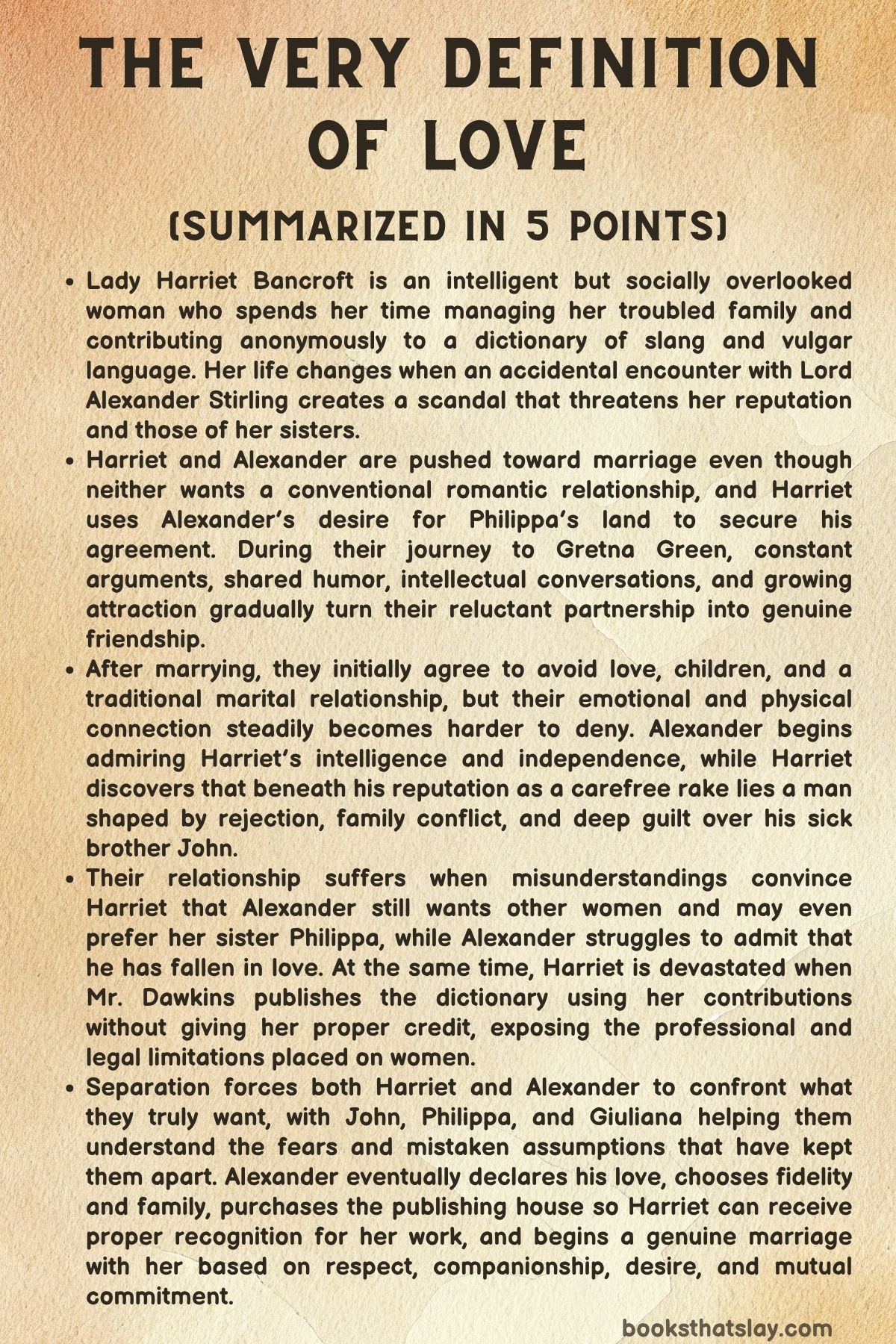
Lady Harriet Bancroft enters another London social season with almost no expectation of attracting attention. After years of being overlooked beside her beautiful sisters Philippa and Caroline, Harriet has accepted that society considers her unremarkable, and she is far more interested in language than marriage.
Behind her quiet social presence, Harriet carries enormous responsibility. Her father, the Earl of Tidewell, has damaged the family finances through gambling and drinking, leaving Harriet to manage creditors, servants, money, and the welfare of her younger sisters.
Harriet’s private intellectual life gives her a sense of purpose unavailable to her in fashionable society. Writing under the gender-neutral name H. M. Bancroft, she has been corresponding with Mr. Dawkins and assisting him with a dictionary of slang and vulgar language, although he believes his knowledgeable correspondent is a man.
At Lady Dunley’s ball, Harriet hopes to meet Dawkins for the first time. Her sisters dress her carefully and attempt to make her appear more fashionable, but the transformation changes almost nothing about the way society treats her, reinforcing Harriet’s belief that she lacks the mysterious appeal possessed by women such as Philippa and Caroline.
Lord Alexander Stirling attends the same ball with entirely different intentions. Known for charm, sexual experience, and resistance to commitment, Alexander hopes to speak privately with Philippa because he wants to purchase valuable northern land belonging to her.
Harriet becomes distracted from her search for Dawkins when she hears several vulgar expressions she does not recognize. Desperate to record one of them, she enters the library and writes the word on her wrist when she cannot find paper.
Alexander arrives expecting Philippa and mistakes Harriet for her sister from behind. When he embraces her, Harriet reacts as though she is being attacked and knees him, producing an absurd introduction that soon becomes a surprisingly entertaining discussion of obscene vocabulary.
Their encounter is interrupted when Philippa and Lady Neddlesby discover them in what appears to be an intimate situation. Realizing that Harriet’s reputation could be destroyed, Philippa immediately claims that Harriet and Alexander are secretly engaged.
Alexander initially has no intention of marrying anyone. Harriet also dislikes the thought of forcing a man into marriage, but the scandal threatens not only her own position but the prospects of Caroline and Frances, making the situation far more serious than personal embarrassment.
Harriet soon learns that Alexander desperately wants Philippa’s land at Hardwicke. Determined to protect her family rather than wait helplessly for events to unfold, she goes looking for Alexander and eventually finds him drunk at the home of his mistress, Giuliana Hightower.
Giuliana proves unexpectedly practical and kind. When Harriet proposes traveling to Gretna Green to settle the matter quickly, Giuliana arranges transportation and has the intoxicated Alexander placed inside the carriage, effectively sending the two north together before he is capable of objecting.
Alexander wakes to discover that Harriet has carried him toward Scotland without his consent. Their journey quickly becomes a battle of stubbornness, logic, irritation, attraction, and negotiation, with Harriet insisting that marriage is necessary and Alexander attempting to find alternatives.
Harriet finally uses the one argument Alexander cannot easily dismiss: if he refuses to marry her, Philippa will never sell him Hardwicke. Alexander reluctantly agrees but demands a marriage in name only, declaring that he intends to remain sexually independent, will not fall in love, and does not want children.
Harriet agrees to those conditions but creates a boundary of her own. Since the marriage will supposedly produce no children and Alexander plans to continue seeing other women, she sees no reason for them to consummate it.
Their long journey changes the relationship before either fully understands what is happening. Alexander becomes fascinated by Harriet’s intelligence, endless questions, unusual vocabulary, lack of pretension, and complete failure to behave like the women he normally pursues.
Harriet gradually discovers that Alexander is more attentive than his reputation suggests. He listens to her arguments, takes her intellectual interests seriously, reassures her without mocking her insecurities, and becomes increasingly interested in the person she is rather than the social role she occupies.
Physical attraction grows alongside friendship. Harriet’s lack of sexual education leads to frank conversations in which she asks Alexander questions most women of her class have never been allowed to ask, and Alexander slowly becomes the person she trusts to explain desire without making her feel ashamed.
Their discussions eventually become physical lessons. Alexander helps Harriet understand her own body and experience pleasure, while Harriet begins recognizing how deeply female ignorance is enforced by social rules designed to keep women dependent and uninformed.
Although they continue claiming that their arrangement is practical, Alexander’s emotional attachment becomes increasingly obvious. He secretly purchases Harriet’s wedding ring before their simple Gretna Green ceremony and finds himself affected by details about her that would once have seemed insignificant.
The marriage ceremony leaves both of them unsettled because it feels more meaningful than either intended. On the return journey, Harriet fears that greater intimacy will make her fall in love with a husband who has already promised emotional distance and continued relationships with other women.
Alexander responds to his growing feelings by retreating. He rides ahead to London, leaving Harriet to interpret his departure as rejection, although he has actually fled because his desire and affection have become difficult for him to control.
Back in London, Harriet initially returns to her father’s house and resumes managing her family’s problems. Alexander, meanwhile, waits for her, reorganizes his home with her tastes in mind, chooses books she may enjoy, and slowly reveals through his actions that he has already begun imagining her as part of his everyday life.
After her father returns drunk and violent, Harriet again sacrifices her own resources to protect Caroline and Frances. Alexander eventually discovers that she has not come to his house and asks her to live with him, partly because public appearances of a happy marriage will help repair his reputation with respectable business associates.
Harriet agrees only after securing her independence. She insists that she must continue working with Dawkins, keep her own earnings, and have access to Alexander’s library, conditions he accepts without resistance.
Living together intensifies their emotional connection. Their dinners become a source of genuine companionship, Alexander becomes increasingly jealous of Dawkins, and Harriet begins comparing her disappointing intellectual acquaintance with the far warmer, more attentive man she has married.
At social events, however, Harriet remains insecure about Alexander’s attention to beautiful women. She also misunderstands his protective concern for Philippa, believing that Alexander may still prefer her sister, while Alexander fails to explain his actions clearly enough to prevent the suspicion.
Their attraction eventually overwhelms many of the boundaries they created at the beginning of the marriage. They become physically intimate without immediately completing the marriage, and Harriet finally understands that Alexander has desired her intensely throughout their relationship.
Alexander also begins revealing the wounds beneath his refusal to marry properly. He explains his difficult relationship with his father, the rejection he experienced from his mother, and his profound love and guilt concerning his sick elder brother, John.
John’s illness lies at the center of Alexander’s deepest fear. Years earlier, Alexander promised that he would never take the life he believed should have belonged to John, including the roles of heir, husband, and father, and he has treated that promise as a moral obligation ever since.
Meanwhile, Harriet’s professional hopes collapse. Dawkins has already submitted the dictionary containing her contributions without crediting her, and when confronted, he dismisses her work and uses the restrictions placed upon women to argue that she has no meaningful contractual claim.
At the same time, misunderstandings destroy Harriet’s confidence in her marriage. She believes Alexander remains involved with Giuliana and may have redirected his interest toward Philippa, while Alexander mistakenly believes Harriet’s rejection proves that their relationship meant less to her than it did to him.
Harriet leaves Alexander’s home. Both become miserable apart, but neither immediately possesses the courage or clarity required to repair the damage.
Philippa helps Harriet understand that Alexander’s behavior may not come from an inability to love. She points out that his history of abandonment, paternal cruelty, guilt, and emotional isolation has taught him to treat attachment as dangerous.
Giuliana gives Alexander an equally necessary confrontation. She makes him admit that he has not been sexually involved with anyone else since Harriet entered his life and forces him to recognize that fidelity is not something that happens automatically but something he can deliberately choose.
Harriet then visits John and learns the full truth behind Alexander’s promise. John has never wanted the conventional future Alexander imagines himself stealing and considers his brother’s lifelong sacrifice unnecessary.
Understanding Alexander more clearly changes Harriet’s approach. She also encourages John to pursue enjoyment on his own terms, eventually helping him attend a ball and supporting his growing connection with his dance instructor, Mr. Monroe.
At the same time, Alexander sees the published dictionary and realizes how completely Harriet has been denied recognition. Unable to restore what Dawkins has taken through apology alone, he begins looking for a practical way to give Harriet control over her intellectual future.
At the Courtenays’ ball, Alexander finally rejects his father’s authority openly. When the duke insults Harriet, Alexander defends her publicly, calls her the most beautiful woman present, refuses the possibility of returning to former lovers, and makes clear that his loyalty now belongs to his wife.
Harriet still believes she can accept a limited version of Alexander’s affection and attempts to seduce him without demanding promises. Alexander stops her because he no longer wants temporary intimacy or a convenient marriage.
He finally tells Harriet that he has not been with another woman since meeting her and that he wants to become a faithful husband. More importantly, he admits that he loves her and wants her love in return.
Alexander then reveals the final part of his apology. He has purchased the publishing house responsible for Dawkins’s dictionary so that Harriet can receive proper credit and gain a professional future that does not depend upon a man choosing to acknowledge her.
The gesture matters because Alexander gives the business to Harriet without making it conditional upon her remaining with him. For the first time, his wealth becomes a means of supporting her autonomy rather than controlling her choices.
Harriet explains that she never disliked the wedding ring she lost. She had sacrificed it to obtain money for protecting her sisters, revealing once again how consistently she has placed other people’s safety before her own needs.
Alexander now rejects the conditions he created at the beginning of their marriage. He wants companionship, fidelity, children, family, and a shared future, even if accepting those desires means abandoning the promise through which he has punished himself for years.
Harriet no longer has to choose between intellectual freedom, physical desire, loyalty to her sisters, and marriage. She and Alexander finally consummate their relationship after reaching emotional honesty rather than merely surrendering to attraction.
The following morning, Harriet tells Alexander repeatedly that she loves him. Their marriage, which began through scandal, bargaining, and mutual reluctance, becomes the kind of loving partnership neither believed possible when they first entered the library as strangers.
Characters
Lady Harriet Bancroft
Harriet is the intellectual and emotional center of The Very Definition of Love, and much of her development concerns the difference between being socially overlooked and actually being insignificant. Society treats her as the forgettable Bancroft sister, but the book steadily reveals a woman of unusual intelligence, discipline, curiosity, courage, and practical competence.
Her fascination with slang is much more than a comic personality trait. Language represents knowledge, and Harriet understands that women are deliberately denied words for their bodies, desires, and experiences because ignorance makes them easier to control.
Her scholarly work therefore becomes connected to a larger desire for intellectual independence. She is not satisfied merely to know what respectable women are permitted to know; she wants access to the entire range of human expression, including language considered vulgar or improper.
Harriet’s strongest quality is also one of her greatest vulnerabilities: she assumes responsibility for other people almost automatically. Because her father is unreliable, she manages money, protects her sisters, negotiates crises, hides dangerous substances, and repeatedly sacrifices her own comfort and resources.
This habit has taught Harriet to measure her value according to usefulness. She knows how to solve other people’s problems, but she has much more difficulty believing that someone might value her simply because her presence brings happiness.
Her insecurities about beauty reflect years of comparison with Philippa and Caroline. Even when Alexander desires her openly, Harriet repeatedly searches for explanations that allow her to believe he must actually prefer someone else.
Yet Harriet is not passive in the face of insecurity. She travels after Alexander, negotiates the conditions of marriage, insists upon control of her earnings, defends her work, seeks information about Alexander’s past, and eventually takes emotional risks despite knowing she may be hurt.
Her sexual awakening is closely connected to her intellectual character. She approaches desire through questions, observation, vocabulary, experimentation, and honest curiosity, refusing the expectation that female innocence must mean permanent ignorance.
Harriet’s eventual willingness to love Alexander does not require her to become a different woman. The conclusion instead allows her intelligence, sexuality, professional ambition, family loyalty, and romantic life to exist together rather than forcing her to sacrifice one identity for another.
Lord Alexander Stirling
Alexander begins The Very Definition of Love convinced that freedom depends upon avoiding emotional obligation. His reputation as a rake allows him to treat intimacy as temporary, controlled, and recreational, protecting him from the vulnerability he associates with permanent attachment.
His confidence is genuine in some areas but defensive in others. Alexander knows that he is attractive, wealthy, socially experienced, and sexually skilled, yet his childhood has left him deeply uncertain about whether he deserves secure affection.
The Duke of Belhaven’s contempt has shaped Alexander’s self-image from an early age. His mother’s infidelity made his parentage a visible source of humiliation within the family, while her later rejection reinforced the belief that emotional closeness eventually leads to abandonment.
His relationship with John reveals a very different side of his personality. Alexander loves his elder brother with extraordinary loyalty and has turned that love into a form of self-punishment by deciding that he must never possess the marriage, children, or inheritance he believes should belong to John.
This promise allows Alexander to present avoidance as sacrifice. Rather than admit that he is frightened of love and family, he convinces himself that refusing both is an honorable act performed for his brother.
Harriet disrupts this emotional system because she does not respond to him as expected. She challenges him, questions him, laughs at him, refuses to be impressed by his reputation, and makes companionship more satisfying than the effortless admiration he previously received from other women.
His attraction to Harriet gradually becomes inseparable from admiration. He listens to her ideas, remembers details about her interests, searches for books she might like, creates opportunities for her research, and becomes furious when others dismiss her intelligence.
Alexander’s jealousy exposes his emotional investment before he can admit it verbally. His irritation with Dawkins is partly possessive, but it is also connected to his awareness that Harriet values intellectual recognition and might seek from another man the respect Alexander desperately wants to provide.
His interference with Dawkins nevertheless demonstrates that protectiveness can become controlling when it ignores Harriet’s autonomy. Alexander’s later apology matters because he accepts that good intentions do not excuse making professional decisions on her behalf.
Giuliana and John both force Alexander to abandon the stories he has created about himself. Giuliana makes him recognize that fidelity is a choice, while John frees him from the belief that marriage or fatherhood would represent theft.
Alexander’s development is ultimately about accepting responsibility for love rather than responsibility for avoiding it. He cannot guarantee that he will never make mistakes, but he can decide what kind of husband he wants to become and act accordingly.
Philippa Bancroft
Philippa initially appears to represent everything Harriet believes she lacks. Beautiful, socially confident, widowed, experienced, and capable of commanding attention, she moves through society with an ease that makes Harriet’s invisibility feel even more painful.
Yet Philippa is never presented simply as a rival. She is fiercely protective of Harriet and uses her social intelligence to contain the library scandal immediately, inventing the engagement because she understands how quickly respectable society can destroy a woman’s reputation.
Her practicality sometimes borders on manipulation, particularly when she suggests using Hardwicke as leverage against Alexander. Even so, her willingness to negotiate ruthlessly comes from an accurate understanding of a world in which women often possess very little direct power.
Philippa also has vulnerabilities hidden beneath her glamorous image. Her financial security becomes uncertain when questions arise over her late husband’s estate, reminding the reader that beauty, status, and widowhood do not guarantee independence.
Her conversations with Harriet later become essential to repairing the marriage. Philippa sees Alexander’s feelings more clearly because she is not trapped inside Harriet’s insecurity, and she recognizes that nearly every interaction she has with him eventually returns to Harriet.
Philippa functions as both protector and truth-teller. She helps Harriet see that Alexander’s emotional limitations may come from fear rather than indifference and encourages her sister to consider possibilities that hurt has made difficult to imagine.
Giuliana Hightower
Giuliana first enters the story as Alexander’s mistress, but the book deliberately refuses to reduce her to a sexual rival. She is practical, perceptive, generous, humorous, and remarkably free of jealousy toward Harriet.
Her treatment of Harriet during their first meeting establishes her character immediately. Rather than humiliating an inexperienced young woman who has arrived in an awkward situation, Giuliana listens, helps solve the problem, lends Harriet what she needs, and organizes the journey to Gretna Green.
Giuliana understands Alexander better than he understands himself. She recognizes that his cultivated image as an emotionally detached rake does not accurately describe a man who becomes deeply attentive once he genuinely cares about someone.
Her most important contribution comes when Alexander’s marriage appears to have failed. Giuliana refuses to support his self-deception and forces him to admit that he has already chosen Harriet in practice even while refusing to name that choice as love.
She also distinguishes attraction from behavior. Alexander fears that someday noticing another woman will prove him incapable of fidelity, but Giuliana points out that commitment depends upon decisions rather than the complete disappearance of temptation.
Her continuing friendship with Alexander further complicates conventional assumptions about former lovers. The relationship changes form without becoming meaningless, suggesting that affection can survive even after its sexual dimension ends.
John, Marquess of Weston
John initially exists in Alexander’s mind as a source of guilt rather than as a fully independent person. Alexander imagines him as the rightful owner of a future that illness has stolen, then structures his own life around refusing anything that might resemble taking John’s place.
When John finally appears directly, he challenges that entire interpretation. Intelligent, humorous, and impatient with being treated as a symbol of tragedy, he has desires that differ sharply from the conventional future Alexander has imagined for him.
John’s love for Alexander is central to understanding the family. During childhood, he protected his younger brother despite suffering under the same difficult father, creating one of the few secure emotional bonds Alexander has ever known.
He views Alexander’s promise never to marry or have children as unnecessary because he never asked his brother to surrender those possibilities. In this way, John becomes the person capable of releasing Alexander from a burden created through love but sustained through misunderstanding.
Harriet’s relationship with John is equally important. Instead of treating him only as a sick man, she asks what he actually wants and takes seriously his simple desire to attend a ball.
His possible attraction to Mr. Monroe also reinforces the idea that a meaningful life does not need to follow the expectations imposed by family or society. John becomes a character associated with the right to define happiness personally rather than accept the future others have assigned to him.
The Duke of Belhaven
The Duke of Belhaven represents authority without emotional generosity. As Alexander and John’s father, he uses rank, legitimacy, family reputation, and inheritance as instruments of judgment rather than sources of protection.
His treatment of Alexander has left lasting damage. By repeatedly emphasizing Alexander’s questionable legitimacy and treating him as inferior, the duke helps create the insecurity that Alexander later hides beneath charm and sexual confidence.
His behavior toward John is equally revealing. Rather than responding to his ill heir with tenderness, he continues to evaluate him according to usefulness, inheritance, and dynastic expectation.
The duke’s interest in Philippa exposes his opportunism. Marriage and property are connected in his thinking, and his possible pursuit of her becomes especially troubling once Alexander reveals the financial importance of her land.
His insults toward Harriet finally provoke Alexander into rejecting him openly. That confrontation marks an important stage in Alexander’s development because he stops measuring his behavior according to his father’s approval and instead defends the life and wife he has chosen.
The Earl of Tidewell
Harriet’s father is one of the clearest sources of instability in her life. His gambling, drinking, financial irresponsibility, and violent behavior force his daughters to live with consequences they did not create.
Tidewell’s failures explain much of Harriet’s maturity. She has become skilled at budgeting, persuasion, crisis management, and emotional restraint because someone in the household has always needed to compensate for his unreliability.
His abuse also helps explain why Harriet initially reacts so strongly to Alexander’s drinking. Alcohol is not neutral in her experience; it is connected to unpredictability, financial danger, intimidation, and physical violence.
Harriet repeatedly manages her father instead of being protected by him. She flatters his pride, hides money, removes dangerous substances, and even gives up Alexander’s wedding ring to persuade him to leave her sisters alone.
The character therefore represents a destructive reversal of familial responsibility. Harriet’s eventual movement toward a healthier marriage becomes more meaningful because Alexander gradually offers a form of partnership entirely different from the control and instability she learned to expect from her father.
Mr. Dawkins
Dawkins begins as an idealized intellectual figure in Harriet’s imagination. Because their correspondence allows her mind to be taken seriously, she imagines that their scholarly connection may contain the possibility of personal understanding and perhaps romantic compatibility.
The reality is far less impressive. Once Harriet meets him, he appears emotionally ordinary and increasingly limited, especially when contrasted with Alexander’s genuine curiosity about her ideas and enthusiasm.
His most serious failure is professional rather than romantic. Dawkins uses Harriet’s contributions to complete the dictionary but submits the work without giving her recognition.
When confronted, he relies on the very social and legal restrictions that forced Harriet to hide her gender in the first place. He treats her mistaken male identity and status as a married woman as excuses for denying her contractual and financial rights.
Dawkins therefore exposes the limits of intellectual respectability. A man can study unconventional language and still remain deeply conventional in his treatment of the woman whose labor made his work stronger.
Harriet’s disappointment in him marks an important end to idealization. She learns that intellectual compatibility means little without respect, fairness, generosity, and recognition of another person’s humanity.
Caroline Bancroft
Caroline is one of the beautiful sisters against whom Harriet measures herself. Her social success contributes unintentionally to Harriet’s belief that attractiveness is an indefinable quality she herself does not possess.
Yet Caroline is not responsible for Harriet’s insecurity and is not portrayed as cruel or competitive. The sisters share genuine loyalty, and Harriet’s concern for Caroline repeatedly motivates major decisions.
Harriet’s willingness to accept marriage after the scandal is partly driven by the fear that Caroline’s future prospects will be damaged. Later, when their father becomes violent, Harriet immediately places Caroline’s safety ahead of money or personal comfort.
Caroline therefore helps establish the strength of the Bancroft sisters’ bond. She is part of the family network that prevents Harriet from becoming as emotionally isolated as Alexander has been.
Frances Bancroft
Frances is younger and more vulnerable than Harriet, making her one of the people Harriet feels responsible for protecting. Her presence reinforces the stakes of the Bancroft family’s financial and domestic instability.
When their father returns and Frances is found bruised, the consequences of his behavior become impossible to treat merely as embarrassment or inconvenience. Harriet’s urgency comes from knowing that the household is physically unsafe whenever he returns.
Frances also adds warmth to the family scenes. Her interactions with Alexander, including questioning him when he arrives looking for Harriet, show that the sisters are not passive background figures but a household with its own loyalties and defensive instincts.
Hawthorne
Hawthorne serves as Alexander’s practical man of business and provides an outside assessment of how the scandal affects Alexander’s financial interests. His concern is not primarily romantic but reputational, especially because Lord Holden’s cooperation matters to Alexander’s land dealings.
By recommending that Alexander publicly behave like a devoted husband, Hawthorne unintentionally creates circumstances that increase the couple’s time together. What begins as a strategy for appearances eventually becomes increasingly difficult to distinguish from genuine domestic attachment.
Hawthorne therefore functions as a practical catalyst. He represents the business world Alexander understands well, but his advice pushes Alexander toward the emotional relationship he understands far less.
Lord and Lady Holden
The Holdens represent respectable social approval and the influence reputation can exert over business. Alexander needs Lord Holden’s cooperation, which gives him a practical reason to convince the couple that his marriage has reformed him.
Harriet proves unexpectedly talented at managing the encounter. She invents an elaborate romantic history for herself and Alexander, understanding immediately what kind of story will satisfy the Holdens’ moral expectations.
Their presence exposes the performative nature of social respectability. Harriet and Alexander initially stage marital devotion for observers, yet the performance becomes amusing partly because genuine affection is already developing beneath it.
Lady Neddlesby
Lady Neddlesby plays a small but decisive role in the plot. Her discovery of Harriet and Alexander in the library turns an eccentric private encounter into a public threat to Harriet’s reputation.
Her reaction reflects the severe standards applied to unmarried women. Nothing needs actually to have happened between Harriet and Alexander; the appearance of impropriety is enough to create consequences.
Because Philippa immediately invents the secret engagement in response, Lady Neddlesby’s presence becomes the accidental trigger for the marriage. She represents the surveillance through which polite society disciplines women’s behavior.
Miss Cressida Holmes
Cressida Holmes appears as the Duke of Belhaven’s mistress and becomes useful in exposing his hypocrisy. Alexander warns her that the duke’s romantic promises are unlikely to lead to marriage unless property or social advantage accompanies the match.
Her presence also allows Harriet to protect John during the ball by arranging a dance between them. Although Cressida remains a supporting figure, she helps reveal how women can be misled by powerful men who expect affection without offering security.
Mr. Monroe
Mr. Monroe teaches Harriet and John to dance before the Courtenays’ ball. His role is relatively small in the central romance, but his connection with John introduces the possibility of another relationship developing outside conventional expectations.
Harriet notices John’s particular interest in him and encourages John to continue seeing Monroe after the lessons are no longer necessary. Her response demonstrates her instinct to support another person’s happiness rather than force it into socially approved categories.
Captain Williams and the Sailors
Captain Williams and his sailors become part of one of Alexander’s most thoughtful gifts to Harriet. By arranging for her to interview them, Alexander gives her direct access to the living slang and vulgar expressions that fascinate her professionally.
The sailors matter less as individually developed characters than as representatives of a linguistic world Harriet normally cannot access. Their presence shows that language is shaped across class, occupation, gender, and social boundaries rather than only in respectable drawing rooms.
The episode is also important because Alexander understands exactly why the experience matters to Harriet. Instead of giving her a conventional luxury, he gives her access to knowledge, demonstrating that he has learned to value what she values.
Themes
Language, Knowledge, and Female Independence
Language functions as a form of power throughout The Very Definition of Love. Harriet’s fascination with slang may initially appear unusual or comic, but her interest gradually reveals a serious question about who is permitted to possess knowledge and who is expected to remain ignorant.
Women in Harriet’s society are expected to know very little about their own sexuality while simultaneously being judged according to sexual rules created by men. Harriet recognizes that lacking words for the body also makes it more difficult to discuss pleasure, consent, discomfort, desire, and personal experience.
Her dictionary work therefore becomes an act of intellectual independence. By collecting language considered vulgar, Harriet enters areas of knowledge from which respectable women are usually excluded and challenges the assumption that curiosity itself is improper.
The betrayal by Dawkins shows that access to knowledge does not automatically produce equality. Harriet contributes real intellectual labor, yet her gender allows a male scholar to take that labor, publish it, and later argue that she has no meaningful legal claim.
Alexander’s eventual purchase of the publishing house addresses this injustice not because he can erase what happened but because he can transfer institutional power into Harriet’s hands. The gesture becomes meaningful only because the business belongs to her independently of the future of their marriage.
Harriet’s development therefore connects language with self-possession. Learning words for desire, demanding credit for professional work, asking questions without shame, and controlling her own income are all parts of the same struggle to define herself rather than accept definitions imposed by others.
Love as Choice Rather Than Instinct
The relationship between Harriet and Alexander repeatedly challenges the idea that love is valuable only when it appears effortlessly. Their marriage begins without romantic intention, and both initially treat emotional distance as a sensible form of protection.
Alexander especially believes that a good relationship would require certainty he cannot provide. Because he fears someday wanting someone else, disappointing Harriet, or repeating the failures of his parents, he assumes that avoiding commitment is more honorable than risking imperfection.
Giuliana challenges this logic by separating feelings from actions. Attraction may not always be controllable, but loyalty can be chosen, and fidelity depends less on never noticing another person than on deciding how to behave after commitment has been made.
Harriet must learn a related lesson. She repeatedly assumes that if Alexander truly loved her, his feelings would be obvious, uncomplicated, and free of fear, yet his history has taught him to hide attachment rather than trust it.
Their eventual union becomes possible when both stop demanding emotional certainty before action. Alexander chooses to become faithful, honest, supportive, and present, while Harriet chooses to trust what he repeatedly demonstrates rather than only what her insecurities predict.
Love is therefore presented not simply as overwhelming emotion but as continuing behavior. Listening, apologizing, changing harmful patterns, defending another person’s freedom, accepting responsibility, and returning after mistakes give the relationship its lasting meaning.
Family Responsibility, Guilt, and Sacrifice
Both central characters have developed distorted ideas about responsibility because of their families. Harriet believes she must constantly solve problems for her sisters, while Alexander believes he must deny himself an ordinary future to protect the imagined rights of his brother.
Harriet’s sacrifices are often necessary because her father refuses to fulfill his own responsibilities. She manages finances, protects her sisters from violence, gives away money, surrenders her wedding ring, and repeatedly places her own safety or happiness behind the needs of the household.
These actions reveal courage, but they also create a dangerous emotional habit. Harriet becomes so accustomed to being useful that she struggles to imagine receiving care without first earning it through service.
Alexander experiences responsibility differently but with similar consequences. His promise to John transforms brotherly love into lifelong guilt, and he convinces himself that marriage, children, inheritance, and happiness would amount to stealing a life that should have belonged to his sick brother.
John’s own wishes expose the flaw in that sacrifice. Alexander has spent years protecting a future John never wanted, demonstrating how guilt can turn love into a justification for unnecessary suffering.
The healthier relationships in the story gradually redefine family responsibility as mutual rather than one-sided. Harriet’s sisters support her emotionally, John releases Alexander from his promise, Giuliana challenges his self-deception, and Alexander eventually gives Harriet resources without demanding obedience in return.
The theme ultimately distinguishes care from self-erasure. Responsibility matters, but love becomes destructive when people assume they must disappear, suffer, or surrender every personal desire in order to prove loyalty.
Social Reputation, Gender, and Personal Freedom
Reputation controls much of the characters’ behavior long before love does. Harriet and Alexander marry because being discovered together in a library creates social consequences that fall far more heavily on Harriet and her sisters than on Alexander.
The imbalance reveals how differently men and women are judged. Alexander’s sexual reputation can coexist with social influence, while Harriet risks permanent damage simply because another woman sees her alone with him in circumstances that look improper.
Harriet’s frustration with restrictions on female movement expands this criticism beyond sexuality. Where she can go, whom she can meet, what she can study, what contracts she can make, and how independently she can earn money are all limited by rules that assume women require male supervision.
Even beauty becomes part of this system. Harriet initially believes that her failure to attract attention proves a personal deficiency, although the standards surrounding her have taught her to value herself according to how effectively she attracts male approval.
The story repeatedly exposes reputation as performance. Harriet and Alexander pretend to be devoted spouses for the Holdens, Harriet adopts exaggerated meekness around the duke, and fashionable society accepts carefully constructed appearances while frequently ignoring emotional truth.
Freedom therefore develops through the rejection of external definitions. Harriet claims intellectual, financial, sexual, and professional agency, while Alexander rejects his father’s expectations, abandons the identity of the permanent rake, and chooses the kind of marriage he once believed he was forbidden to want.
By the end, neither character becomes socially free in an absolute sense, but both gain the ability to decide which expectations deserve obedience. Their happiness depends on replacing identities assigned by society and family with choices they can consciously call their own.