The Viper by Brad Meltzer Summary, Characters and Themes
The Viper by Brad Meltzer is a modern thriller that starts with a dying fugitive returning to his hometown to fix one old wrong—and getting murdered for it. The shockwaves pull in Zig Zigarowski, a mortician at Dover Air Force Base still carrying the loss of his young daughter, and Roddy LaPointe, a cop chasing the truth about the mother he never knew.
Their search leads from a small-town funeral home to a guarded commune, and back to a long-buried scandal involving stolen evidence, a tight high-school friend group, and a secret about who Roddy and his twin sister Nola really are. It’s the 3rd book in the Zig and Nola series.
Summary
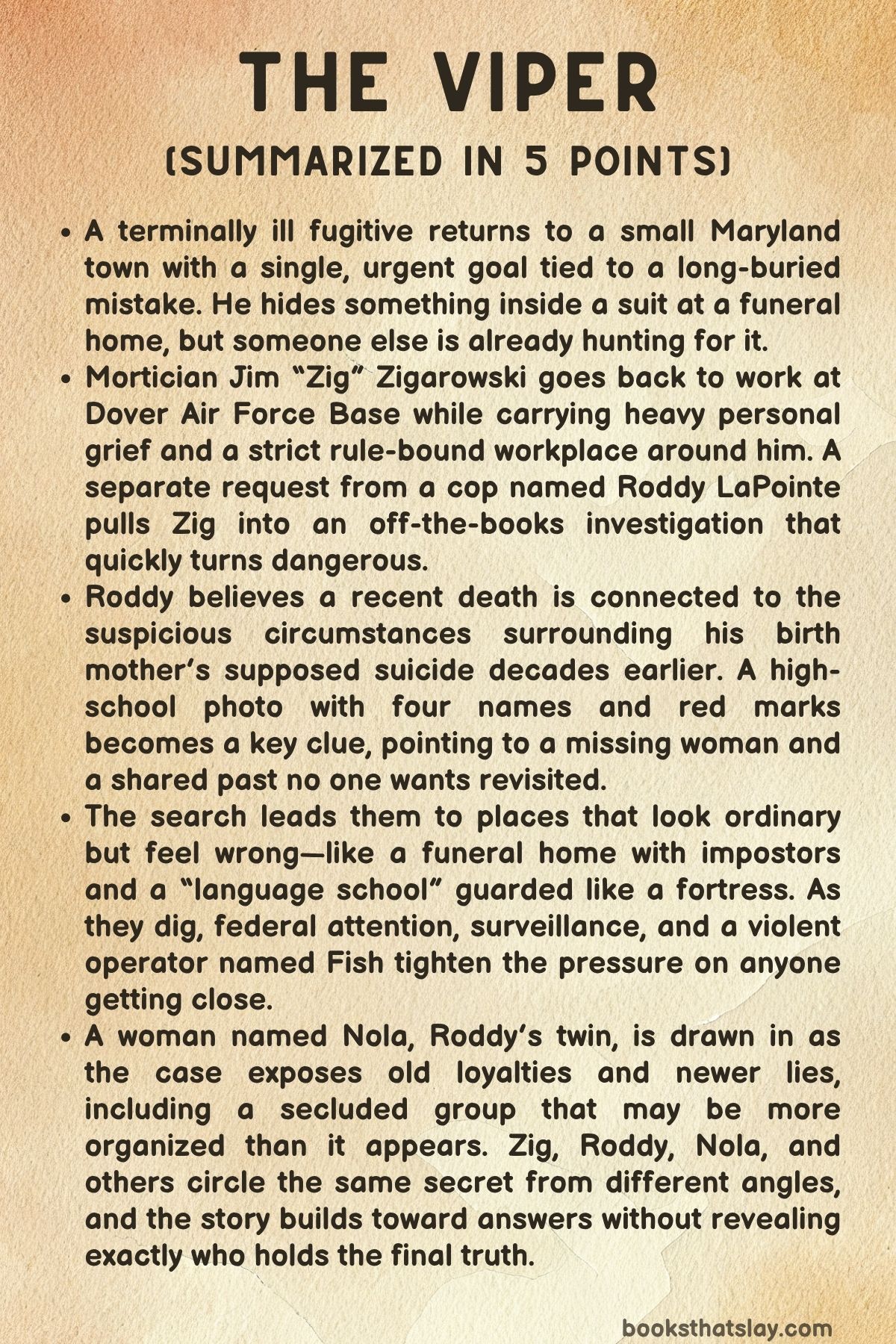
A sick man using the name Harry Smith walks into Generaux & Sons Funeral Home in Arrow Rock, Maryland, and calmly hands the director, Dustin Generaux, a navy double-breasted suit for his eventual burial. He is really Andrew Fechmeier, a fugitive who has lived under a plain alias for years.
He is dying of a fast, brutal brain disease and has come back to town with one aim: to correct something he did long ago. The suit is more than clothing.
Fechmeier has hidden something inside its lining, choosing the funeral home’s locked storage as the safest place to keep it out of sight.
Fechmeier returns to his motel room and finds it torn apart. Someone has been searching for what he brought.
A short, controlled attacker confronts him, calls him by his real name, and demands to know whether he came back with a specific item. Fechmeier insists he is only sick and only visiting.
The attacker tests him with shallow knife cuts meant to force the truth. When Fechmeier keeps denying everything, the man shoots him in the head and searches his body.
He leaves empty-handed, unaware the real target is locked away with the suit.
Two days later, Jim “Zig” Zigarowski comes back to work at the Dover Air Force Base mortuary after time away. Zig is skilled, blunt, and restless, but the grief he carries is quiet and constant.
He sets a photo of his daughter Maggie on his desk and tries to focus on the job again. When a grieving family demands to see their son’s body and questions whether the remains are even their child, Zig tries to help, but Colonel Judith Gupta shuts it down fast.
She warns him that the base runs on protocol and legal risk, not personal judgment. Zig is forced through training and bureaucracy before he is allowed full access again.
While Zig is stuck in orientation videos, a New Jersey cop, Roddy LaPointe, keeps texting him. Roddy is not looking for standard professional help.
He needs Zig because of where the case leads: a funeral home, a dead man, and a past that Roddy believes was covered up.
Zig finally agrees to meet Roddy, and Roddy drives him to Generaux & Sons in Maryland, where Fechmeier’s body is being handled. The place feels wrong immediately.
Two men in jeans hover like staff but do not move like morticians. They answer technical questions too quickly, like they have memorized lines, not lived the work.
Zig plays along, then forces Roddy to explain once they are back in the car.
Roddy tells him Fechmeier is tied to the death of Roddy’s birth mother, Daniella Brown. Roddy and his twin sister Nola were abandoned as toddlers outside a hospital, found strapped into car seats with no parent in sight.
Daniella was later “found” dead in a ditch in a way Roddy has never accepted: four flat tires, a gunshot, and no proper autopsy. Roddy dug into old records and found a yearbook photo captioned with four names—Daniella Brown, P.K. Runyon, Ivy Munn, and Andrew Fechmeier—each marked with a red X. P.K. died in a bizarre accident not long before Daniella’s death, and Ivy and Fechmeier vanished afterward.
Now Fechmeier has resurfaced and has been murdered, and Roddy believes the same force that killed Daniella is active again.
They watch the impostors leave the funeral home in a pale blue Dodge Challenger, and Roddy tags the car with a tracker. Unknown to them, another man is watching, too—Philip “Fish,” disguised as a construction worker running surveillance from across the street.
He is tracking the same people, for reasons he doesn’t fully explain.
The story flashes back to Daniella’s final night. She flees with the twins in her car, hits a spike strip, and is forced into a ditch.
A man confronts her, demanding the return of something taken on a night at a drive-in. Daniella insists she doesn’t have it and offers to be searched.
The man shoots her anyway. The men stage the scene to look like an accident, but when the twins move, they refuse to kill children.
Instead they abandon the toddlers at a hospital, leaving them alive but erased from their mother’s life.
In the present, Nola lives in Pennsylvania and works as an artist, but her past includes time embedded with the military and exposure to real violence. While sketching refugees in a church for a museum project, she gets a call from the FBI.
The agent, Amy Waggs, tells Nola they have figured out what Roddy is doing and that he has stepped into something being watched at a federal level. Waggs shows Nola crime scene photos of Fechmeier and warns her that Zig is the one being visibly exposed while Roddy stays mostly protected.
Nola understands what that means: Roddy is taking risks, but Zig is the one whose face, name, and car can be tracked and used.
Roddy and Zig follow their lead to Annapolis, to a storefront that claims to be a language school. It looks normal from the road, but Zig notices an oversized security setup—cameras, buzz-in doors, and the sterile feel of a place meant to hide real work.
Zig goes in alone, acting like a customer, and tries to draw out information. A young clerk becomes guarded the moment Zig references the blue Challenger.
Zig leaves his phone behind on purpose so the clerk has to handle it, giving Roddy a chance to identify him through prints and records.
Soon after, Fish arrives at the language school and forces his way inside. The encounter turns violent fast.
Fish kills the clerk with a thrown knife and shoots two armed men who come out from the back. He finds an ID that shocks him, suggesting the men were not who they appeared to be.
Roddy traces Fechmeier’s burner phone to a storage facility near Arrow Rock and discovers it is tied to old courthouse overflow—evidence and files. Before Zig and Roddy can open a suspicious unit, a gun is pressed to Zig’s neck.
The person holding it is Melinda Bix, a prosecutor and the sheriff’s daughter. She is sharp, angry, and already halfway sure Roddy is either a threat or a tool.
Roddy pushes back, and the argument turns into a confession: Daniella Brown was his mother.
Melinda reveals she was part of the same high-school circle—along with Fechmeier, Ivy, P.K., and Daniella. Daniella was nicknamed “the viper.” Whatever happened back then was not small-town gossip.
It involved stolen property, missing evidence, and people who died when they got too close to the truth.
Zig and Roddy then confront Vincent Koch, an older wealthy man whose name sits at the center of the old scandal. Koch plays power games, talks like a man protected by money, and refuses real answers.
Zig leaves with the clear sense that Koch is hiding something, but that he also knows how to stay just out of reach.
In the parking garage after the meeting, Fish ambushes Zig and Roddy with a gun and knife, demanding information about a place called Heavenly Meadows and why Fechmeier would have joined a commune unless he was chasing something else. Roddy loses control and accuses Fish of killing Daniella and Fechmeier.
Fish appears to be taking instructions through an earpiece. Before he can finish the attack, Melinda appears and shoots Fish in the hand.
Fish throws his knife as a last move, and Roddy takes the blade in his chest. Roddy survives the immediate injury, but the damage is severe.
Not long after, Nola arrives and makes it clear she is done watching from the edges. Evidence suggests Fish killed Fechmeier using the same combination of knife and gun.
Waggs shares what she has: Heavenly Meadows looks like a cult, but its paperwork is a shell, and its founder’s identity doesn’t hold up. Nola adds a detail that makes it worse: she has been restrained there before by a man claiming to be FBI, but his wallet said he was a U.S. Marshal assigned to special operations.
Nola hunts Fish in the dark and catches him near a creek. They fight in mud and water, and the struggle becomes a near-death chokehold underwater.
Fish is injured and bleeding, but he is not trying to survive. He is trying to end it on his terms and take Nola with him.
Nola wakes on the bank, coughing and stunned, and finds Fish facedown, likely dead.
Then the situation collapses further. The sheriff is found dead, and Roddy—already weakened—hits the end of what his body can take.
Zig arrives as Roddy’s breathing turns shallow and his color drains. Roddy and Nola share a raw final exchange that mixes anger, need, and the weight of a life built on half-truths.
Roddy dies with Nola holding his hand.
Days later, Zig prepares Fechmeier’s body for burial and dresses him in the same double-breasted suit. While adjusting the jacket, Zig notices the weight is wrong and finds the hidden object stitched into the back—proof that Fechmeier returned to town with something worth killing for.
In Arrow Rock, Ivy Munn—alive, cornered, and armed—confronts Melinda. Ivy brings Fechmeier’s phone and points out that Zig found a second, identical phone hidden in the suit, one that called only a single person.
Ivy argues Fechmeier came back for Melinda. Melinda argues the evidence was staged and accuses Ivy of killing her father.
The fight exposes more of the past: emerald earrings, missing tapes, and the way the sheriff and Fish were pulled toward The Breakfast Club’s old crime.
When Ivy accuses Melinda of protecting a predator, the argument turns lethal. Ivy shoots Melinda in the head and bends to collect the earrings.
A click behind her stops her cold. Nola is there, aiming a gun at Ivy.
Nola demands the truth about Daniella. She has a file that proves Daniella could not have given birth to twins.
Ivy finally admits what Daniella never could: Ivy is the twins’ biological mother, and Daniella took them and raised them as her own. Ivy describes a young, risky pregnancy and a decision made between friends—one woman refusing motherhood, the other choosing it fully.
Daniella’s later death was not just a murder; it was the aftershock of secrets and stolen leverage that never stayed buried.
Police sirens approach. Ivy prepares to run, promising she will find Nola again.
Nola warns her to stay away from Roddy’s funeral. Nola leaves first, and Ivy disappears into the night.
In the aftermath, Zig returns to his work, steadying himself after being pulled into a war that was never his. At a church service project, Zig finds Nola sketching again.
A quiet twelve-year-old volunteer is nearby—Violet, Nola’s daughter, whom Nola has been watching from a distance. Zig sits beside Nola, not forcing comfort, not trying to fix what can’t be fixed.
He simply stays present with her, sharing music through a single earbud while she draws, as both of them try to live with what the truth cost.
Characters
Andrew Fechmeier (Harry Smith, “Fetch”)
Andrew Fechmeier is the story’s hinge: a man who has spent decades surviving by disappearing, only to return to Arrow Rock because dying has stripped away the usefulness of running. By adopting the painfully common alias “Harry Smith,” he shows how practiced he is at erasing himself, yet his decision to walk back into the town he escaped reveals a late-blooming moral urgency—he wants to “set something right,” not because it will save him, but because it might finally stop the harm radiating from an old mistake.
His terminal Creutzfeldt-Jakob disease adds a brutal clock and also a kind of clarity: he is less afraid of being caught than of dying without correcting the past. The suit he deposits at Generaux & Sons is classic Fechmeier—careful, secretive, and built on misdirection—and the hidden object stitched into the lining suggests he understands that truth is only safe when disguised.
Even in death, he stays slippery: the killer can search every obvious place and still miss what matters. Fechmeier’s legacy becomes the catalyst for other people’s obsessions, grief, and revenge, turning him into both a victim and an instigator whose choices keep detonating long after his final breath.
Dustin Generaux
Dustin Generaux is a small but important embodiment of normalcy brushing up against extraordinary danger. As a funeral director, he operates in a world of rituals and sealed doors, which makes him the perfect unwitting gatekeeper for Fechmeier’s hidden cache.
His professionalism—padlocking storage, following procedure—ironically becomes part of the story’s security architecture; he protects something valuable without understanding it. Generaux’s presence also underlines one of the book’s recurring tensions: institutions meant to provide closure, such as funeral homes, mortuaries, and courts, can become repositories of secrets that prevent closure instead.
He is not a conspirator, just a man doing his job, and that innocence makes the intrusion of impostors and surveillance feel even more predatory.
Jim “Zig” Zigarowski
Zig is the emotional anchor of The Viper. He returns to the Dover Air Force Base mortuary carrying both competence and grief, and the novel makes his grief practical: it shapes how he reads people, how quickly he intervenes, and how fiercely he tries to keep others from being crushed by bureaucratic indifference.
The framed photo of his dead daughter Maggie is not just a symbol; it is his operating system. It fuels his impatience with protocol when he hears a mother wail, and it explains why he becomes the adult in the room when Roddy’s anger starts tipping into recklessness.
Zig’s gift is his ability to observe without escalating—he notices the wrong smell in a funeral home, the too-easy agreement about outdated embalming fluid, the surveillance cameras that don’t match the “language school” front—yet his deeper gift is empathy that doesn’t turn sentimental. He is funny in a battered way, using humor as a pressure valve, but he is also deeply principled: he will bend rules to help the living and honor the dead, even when authority threatens him with consequences.
Over the story, Zig’s arc is about learning how to live in the present again; the final image of him sharing music with Nola is a quiet victory over the inertia of mourning.
Roddy LaPointe
Roddy is a man built out of absence. Because he never truly had his mother, he turns the mystery of her death into a personal religion, and that devotion makes him both relentless and unstable.
His investigative drive is sharp—he finds patterns in yearbooks, tracks the red X marks, notices implausibilities in the “suicide” narrative—yet his emotional temperature is always near boiling, which is why Zig often has to act as his stabilizer. Roddy’s relationship with truth is complicated: he wants it with a purity that borders on violence, but he also uses people, including Zig, as shields when the danger spikes, whether he admits it or not.
His twin bond with Nola is similarly fraught; their shared origin is a shared wound, and his accusation about what she remembers of their mother’s hair shows how identity becomes a battlefield when memory is uncertain and adoption has rewritten their story. Roddy’s end is tragic not just because he dies, but because he dies in a moment where connection finally breaks through his armor—reaching for Nola’s hand, letting Zig and Nola be there—suggesting that his life might have softened if he’d had time.
Nola Brown
Nola is the novel’s paradox: an artist who has learned to survive like a weapon. Her life blends tenderness and lethal competence—sketching refugees in a church one moment, hunting an assassin through darkness the next—and the book uses that contrast to show how trauma can sharpen perception without erasing humanity.
She is emotionally guarded, often refusing the easy comforts people offer, but her guard is not coldness; it is discipline, a way to keep herself from falling apart. Her combat history and her ability to “observe” in lethal environments make her uniquely suited to see what others miss, yet she still needs anchors, which is why Zig matters to her even when she resists him.
The underwater fight with Fish crystallizes her core trait: she can stay present inside terror, using absurd mental lists to regulate panic, but she is also capable of fear when the stakes shift from survival to meaning—when she imagines Zig finding her body, she chooses life again. By the end, Nola becomes the story’s moral interrogator, demanding the truth about Daniella and refusing to let Ivy rewrite the narrative without consequence.
Her silent vigilance over Violet adds another layer: despite all her hardness, she is still a mother orbiting her child with fierce, quiet love.
Daniella Brown (“the viper”)
Daniella exists mostly in echoes and flashback, but she dominates the story’s emotional landscape. The nickname “the viper” suggests danger, cunning, and perhaps betrayal, yet the truth is more human: she is someone who made a life-defining choice involving babies, secrecy, and survival, and that choice attracted predators and opportunists.
In her final minutes, Daniella is brave in an ordinary, maternal way—trying to protect her toddlers, offering to be searched, attempting to negotiate—until she learns the cruel lesson that compliance does not protect you when the other side wants silence. Her staged “suicide” becomes the original lie that infects everything: it robs Roddy and Nola of a coherent origin story and gives powerful people a template for laundering violence into paperwork.
Daniella’s character is thus defined by duality: she is both the caretaker who raised children that were not biologically hers and the participant in a secret that made her a target, a woman whose love and fear tangled into decisions that outlived her.
Ivy Munn
Ivy is one of the most volatile presences in The Viper, because she fuses victimhood, agency, and cruelty into a single person. As a member of the Haruspex commune, she is trapped inside an apparatus of control, yet she is not passive: she hides an illegal gun, monitors coded safety signals, and makes plans the moment the system fails.
Her determination to confront the old tragedy is real, but so is her capacity for violence; when she shoots Melinda, it is not an accident or a forced hand—it is a choice that reveals how far she has drifted from any moral center she might claim. Ivy’s most destabilizing revelation is biological and relational: she is the twins’ biological mother, which reframes years of longing and rage for Nola and Roddy.
That truth does not redeem Ivy; instead it complicates her, showing that she can be both the young woman who could not bear motherhood and the adult who weaponizes truth when it suits her. She speaks in promises—she will find Nola later—yet her instinct is always flight, suggesting a lifelong pattern of running from accountability while demanding others understand her pain.
Philip “Fish” Boyd
Fish is the story’s predator, but he is not a simple monster; he is a professional instrument shaped by secrecy, institutions, and obsession. Disguised as a construction worker, armed with a fillet knife and a gun, he moves like someone trained to kill cleanly and leave confusion behind.
His interest in Heavenly Meadows and his fury that Fechmeier “wouldn’t join a cult unless he had another motive” hint that Fish is tied to a larger system—he is not just chasing an object, he is policing a narrative. The most chilling aspect of Fish is his relationship to death: in the underwater struggle with Nola, he stops caring about his own survival and turns into pure annihilation, willing to die if it means taking her with him.
That nihilistic commitment makes him more terrifying than a killer who wants to escape. Even his identity carries rot—prints match an ex-EMT declared dead—implying institutional manipulation, faked records, and the deliberate creation of ghosts who can operate without consequences.
Fish represents violence as policy: a man who kills because someone told him the truth is too expensive to allow.
Amy Waggs
Amy Waggs functions as the story’s warning system and its reminder that power often hides behind “process.” She is positioned inside federal machinery, and her significance comes from what she notices: that the alert on Roddy did not come through normal channels but through a DOJ office that implies restriction and sensitivity. Waggs is not simply an ally; she is cautious, skeptical, and aware that help can also be surveillance.
Her concern that Zig is the one “exposed” shows she reads risk in systems terms—license plates logged, faces recorded, paper trails created—while the others are still thinking in personal terms. Waggs’s role adds a layer of paranoia that feels earned: someone with access is watching, and that means the conflict is not just local history but a protected secret.
Colonel Judith Gupta
Colonel Gupta embodies institutional defensiveness, the kind born from constant exposure to liability, scrutiny, and tragedy. Her refusal to let the Bradys into sensitive areas is framed as pragmatic, even necessary, yet it clashes with Zig’s instinct to treat grief as sacred.
She is not heartless; she is hardened, and her authority is rooted in preventing disaster before it becomes a headline or a lawsuit. By forcing Zig through orientation and protocol, she becomes an obstacle, but also a symbol: systems prioritize containment over compassion, and Zig’s heroism partly lies in pushing against that without collapsing the system entirely.
Specialist Olivia Bach Armas
Olivia is a brief presence, but she brings a vital human warmth to the sterile environment of the base mortuary. Her joking, orientation-style escorting shows how younger service members cope with proximity to death by leaning on levity and routine.
She also serves as a mirror for Zig: he knows this place intimately, she knows it as procedure, and their interaction highlights how Zig is returning not just to a job but to a landscape of memory and unresolved grief.
Mr. and Mrs. Brady
The Bradys represent grief as confrontation. Their demand to see their son Marcus’s body, their suspicion of bandages, and their fear of misidentification show how mourning can turn into mistrust when families feel shut out by official processes.
They also reveal a social reality Gupta names bluntly—litigation and institutional risk—making them both sympathetic and, in the system’s eyes, dangerous. Their scene pressures Zig to choose between empathy and compliance, clarifying what kind of man he is.
Marcus Brady
Marcus is absent in body but present as a cause: his death is the immediate spark that tests Zig’s instincts and triggers Gupta’s clampdown. He is also a reminder that the novel’s central mystery is nested within a wider world of real grief and real dead, keeping the story from feeling like it is only about one secret.
Melinda Bix
Melinda is one of the story’s sharpest moral contrasts: she is part of law enforcement culture through her father, yet she is willing to point a gun at Zig and Roddy because she is protecting something bigger than their feelings. Her strength is her willingness to pivot when evidence changes; she verifies identities, negotiates, and later risks herself to shoot Fish and save them.
At the same time, she is deeply entangled in the original “Breakfast Club” history, and that entanglement makes her both potentially compromised and deeply motivated. Her porch confrontation with Ivy shows a woman trying to hold a line between truth and self-preservation, but also someone who has likely carried secrets for years.
Her death is abrupt and cruel, and it functions as a warning: proximity to the old secret does not just threaten the guilty; it destroys anyone standing nearby.
Sheriff Bix
Sheriff Bix represents old-town authority with sharp edges: suspicious, blunt, and quick to assume the worst. His conflict with Melinda suggests a controlling streak and a worldview built on dominance rather than trust.
His later murder, staged amid burn marks and violence, ties him directly into the same machinery of manipulation that shaped Daniella’s “suicide,” implying that he was either a gatekeeper, a participant, or a liability who finally became expendable.
Vincent Koch
Vincent Koch is wealth as intimidation. He doesn’t need to shout; he uses space, security, and social gravity to force others onto the defensive.
His building, his dog, his controlled elevator ride, and his casual needling are all part of an ecosystem that says he is untouchable. Koch’s denials about the infamous night, his insistence it was just a screen door, and his quick pivot to communicating through lawyers paint him as someone skilled at laundering reality into plausible deniability.
Whether he is guilty or simply protected, he behaves like a man used to consequences bouncing off him, which makes him a natural magnet for Roddy’s rage.
Gaea
Gaea, Koch’s husky, is more than atmosphere: she is a nonverbal show of control. By greeting Zig and Roddy first, she sets the tone that Koch owns the space and decides who enters and how they feel while doing it.
In a story full of human predators, the dog also serves as a quiet contrast—pure instinct, loyal to her master, part of the fortress rather than the conspiracy.
Richard P. Flowers (“The Herald”)
Flowers is the face of coercive belief. Even without extensive direct scenes, his title—“The Herald”—and the strict curfew, controlled computers, and punishments implied by Ivy’s hidden gun suggest a leader who thrives on surveillance and obedience.
The revelation that he “doesn’t exist” as a real identity turns him from charismatic cult leader into something more modern and frightening: a constructed persona used to run a sophisticated shell, implying that the commune may be less spiritual delusion and more operational cover. Flowers symbolizes how power can disguise itself as enlightenment while functioning like a containment unit for secrets.
Jules Clarke
Jules is a quieter tragedy threaded through the chaos, offering a different kind of mortality than gunfire. Her leukemia and sudden deterioration add emotional texture and remind the reader that not all loss is the product of conspiracy; some is simply the body failing.
The get-well bag from Zig, with its humor, reveals how Zig loves people: he tries to make the unbearable slightly lighter, even when he cannot fix it. Jules’s scenes deepen Zig by showing him in caregiving mode outside the main plot’s urgency.
Bunny
Bunny functions as Jules’s immediate emotional support, the friend who shows up in hospital rooms and occupies the intimate space where fear lives. In a book full of people pursuing answers, Bunny is someone practicing presence, which is its own form of courage.
Maggie Zigarowski
Maggie is Zig’s permanent wound and his moral compass. Even though she is not alive in the present timeline, the details—her photo, the Girl Scout accident, the “extra year” Zig received—shape his every choice.
Maggie’s memory explains Zig’s sensitivity to parents, his intolerance for institutional coldness, and his willingness to walk into danger for strangers. She is also the reason Zig understands Roddy’s grief even when Roddy’s behavior becomes reckless: Zig recognizes what it means to be remade by loss.
Violet
Violet represents the fragile future Nola cannot fully enter but cannot abandon. The fact that Nola keeps tabs on her quietly, at a church service project, suggests a mother who believes she is dangerous or undeserving of closeness, yet cannot stop herself from protecting and witnessing her child’s life.
Violet’s presence also softens Nola’s harshness by proving that love still organizes her world, even if she expresses it from the shadows.
Royall Barker
Royall Barker appears in flashback as a force of coercion aimed at a young Nola, and his insistence on the Girl Scouts uniform adds an unsettling element of control and performance. He feels like a handler—someone moving a child toward a threatening encounter—and his presence hints at a broader network of adults who exploited access, authority, or innocence.
Themes
Hidden truth and manufactured stories
From the moment Andrew Fechmeier walks into a funeral home with a suit that is more container than clothing, the story places survival next to concealment and asks what it costs to keep a secret alive. The novel uses literal hiding—an item stitched inside a jacket lining, a second phone concealed, a coded Instagram “I’m safe” post—to show how truth gets stored in places people don’t think to look.
This does not stay limited to objects. People become storage too.
Roddy grows up with a life story that is missing its key pages, and the official version of his mother’s death is presented as clean and final even as the details feel wrong: the staged scene, the missing scrutiny, the convenient label of suicide. The plot keeps proving that “official” does not mean “true,” only that the system has agreed to stop asking questions.
That agreement spreads outward—into the funeral home with impostors playing staff, into a “language school” that behaves like a secured facility, into a commune that looks spiritual on the surface and operational underneath, and into government channels where a DOJ office flagging activity suggests the case is being shaped by higher access.
The consequences of manufactured stories are personal and corrosive. When a family narrative is built on a lie, love does not vanish, but identity becomes unstable.
Nola’s memory of her mother’s appearance turns into a battlefield, and the revelation that Daniella could not have carried twins does more than correct a fact—it forces a re-evaluation of every emotional anchor Roddy and Nola built. The theme also highlights how secrets act like currency.
The tape, the earrings, the hidden evidence files—these are not merely clues, they are leverage that controls who gets protected and who gets sacrificed. Even the cult-like “School” depends on curated truth: the leader’s identity is a construction, the organization’s legitimacy is a front, and members are kept compliant by managing what they are allowed to know.
In this world, information is not simply discovered; it is controlled, traded, and weaponized, and the path to clarity is blocked not by lack of evidence but by layers of deliberate misdirection.
Grief, guilt, and the urge to repair what cannot be repaired
The emotional engine under the chase is not curiosity; it is unfinished pain. Zig comes back to the Dover mortuary carrying the weight of his daughter’s death, and the framed photo on his desk makes his work feel less like a job and more like penance.
His memories turn small moments into permanent debts: a Girl Scout incident that gave Maggie “one extra year” becomes both a gift and a torment, because extra time can feel like proof that time should have been possible to save as well. That same logic appears in Fechmeier’s return to Arrow Rock while terminally ill.
He does not come back to live; he comes back to correct. The choice to stash something valuable inside a burial suit is symbolic of a person planning his ending while trying to leave behind one honest act that might balance what he did decades earlier.
The theme treats repair as a human reflex—an attempt to make the last page of a life say something better than the middle chapters did.
Roddy’s investigation operates like grief with a badge on it. He wants a name, a motive, and a clean line from “then” to “now” because uncertainty is its own form of punishment.
What makes his pursuit tragic is that answers arrive too late to protect him from the damage of seeking them. The story repeatedly shows that grief does not stay contained; it recruits people.
Zig gets pulled into danger because he understands what it means to lose a child and to live with the sense that the world moved on too fast. Nola’s relationship with grief is harder, sharper, and shaped by what she has done and seen.
Her calm in violence is not presented as natural toughness so much as learned adaptation, a way to keep functioning when feeling fully would break her. This is why small human gestures land with force: Zig’s crude get-well gift, his insistence on being present, even sharing an earbud in a church pew.
These are not sentimental decorations; they are survival techniques against emotional numbness.
The theme also shows guilt as contagious. Melinda’s choices are shaped by the town’s history and her father’s shadow, and Ivy’s decisions are shaped by the original theft and its aftermath.
Everyone carries a private ledger of what they owe, what they hid, what they allowed. Attempts to repair those debts lead to new harm, because the past is not waiting politely to be resolved.
It is active, defended, and protected by people who prefer damage over exposure. Repair becomes dangerous because it threatens the arrangements that let others sleep at night.
Power disguised as protection
Institutions in The Viper keep claiming they are acting for safety, procedure, and order, yet those words repeatedly function as cover for control. At Dover, Colonel Gupta blocks grieving parents from seeing their son’s body and frames it as risk management—lawsuits, protocol, and facility security.
Even if some of her concerns are practical, the moment reveals a larger pattern: compassion becomes negotiable when an institution fears consequences more than it values transparency. This pattern scales up in the investigation.
Alerts arrive from an unusual federal channel, the case is treated as sensitive, and watchers appear who are not operating like ordinary law enforcement. The message is that “protection” often means protecting the system, not the person.
People are watched, tracked, and flagged not because someone is trying to help them, but because their actions might interfere with what powerful actors want contained.
The story also explores private power—wealth, local influence, and social position—as a parallel system to official authority. Vincent Koch’s building, security, and lawyer-forward posture demonstrate how money can turn questions into inconvenience and accountability into paperwork.
When Zig and Roddy try to push, the meeting becomes less about truth and more about dominance: who controls the room, who decides when the conversation ends, who gets to refuse without consequence. Similarly, the commune operates like power in a softer costume.
“The School” presents itself as guidance and community, but its structure depends on surveillance, restricted movement, punishment for hidden weapons, and a leader whose identity is itself a manufactured credential. The point is not merely that such a group is dangerous; it is that people often accept control if it is packaged as belonging and certainty.
Even interpersonal power follows this logic. Fish stalks, interrogates, and harms people while acting as if he is enforcing some moral accounting—demanding “the truth” about Heavenly Meadows and “what was stolen.” He treats violence as justified auditing, as though pain is a legitimate method of fact-finding.
Melinda, too, uses a prosecutor’s posture—credentials, verification, demands for routes and data—to take control of a situation where she is emotionally implicated. The theme does not claim that authority is always corrupt; it shows how easily authority becomes a mask for fear, ambition, or self-preservation.
The people caught inside these systems—Roddy, Zig, Nola, even Fechmeier—have to decide when to cooperate, when to resist, and what it means to pursue justice when the gatekeepers of “justice” may be shaping the outcome for reasons that have nothing to do with right and wrong.
Identity, family, and the violence of inheritance
The book treats identity as something built from stories, and then tests what happens when those stories are exposed as incomplete or false. Roddy and Nola grow up as twins with a shared origin that is both intimate and unknown.
Their mother exists more as a wound than a person, and the absence becomes formative: Roddy turns into someone who needs proof, names, and records; Nola turns into someone who trusts observation and control more than explanations. Their differences read like two strategies for surviving the same missing truth.
When the revelation arrives—that Daniella could not have carried them, that Ivy is their biological mother, that the family history was an intentional choice—it lands as a kind of psychological violence. It forces a re-definition not only of parentage but of loyalty, memory, and grief.
Roddy’s anger at Nola for remembering their mother as blond is not really about hair color; it is about the terror that even their most basic shared memories might be unstable.
The theme also examines chosen family versus assigned family. Daniella taking the babies is both an act of love and an act of narrative control.
Ivy refusing to hold the twins, then later moving into a controlled community, suggests someone trying to escape a self she cannot bear to inhabit. Melinda’s relationship to her father reveals another inheritance: not biology alone, but the social power and moral compromises that come with a family name in a small town.
Zig’s identity is anchored in fatherhood even after his daughter is gone; it shapes how he reads pain in others and why he cannot stay detached. Nola’s identity includes motherhood too, but expressed through distance—quiet surveillance of her daughter rather than open connection—showing how trauma can make care feel unsafe unless it is managed from the edges.
Violence is presented as part of inheritance as well, not because people are “destined” to repeat it, but because unresolved history keeps recruiting the next generation. A theft committed in adolescence triggers deaths decades later; secrets meant to protect children instead set them on paths of obsession, combat, and loss.
The story suggests that inheritance is not just DNA or property; it is unfinished business, withheld information, and the roles people are forced to play because someone else made a choice long ago. By the end, small acts of presence—Zig sitting with Nola, sharing music, staying in the moment—become meaningful resistance against an inheritance that keeps trying to turn people into instruments of the past rather than owners of their own lives.