The Whispers by Ashley Audrain Summary, Characters and Themes
The Whispers by Ashley Audrain is a psychological drama set in a suburban neighborhood where appearances conceal hidden fractures. At its heart, the novel explores motherhood, marriage, desire, envy, and the unspoken struggles of family life.
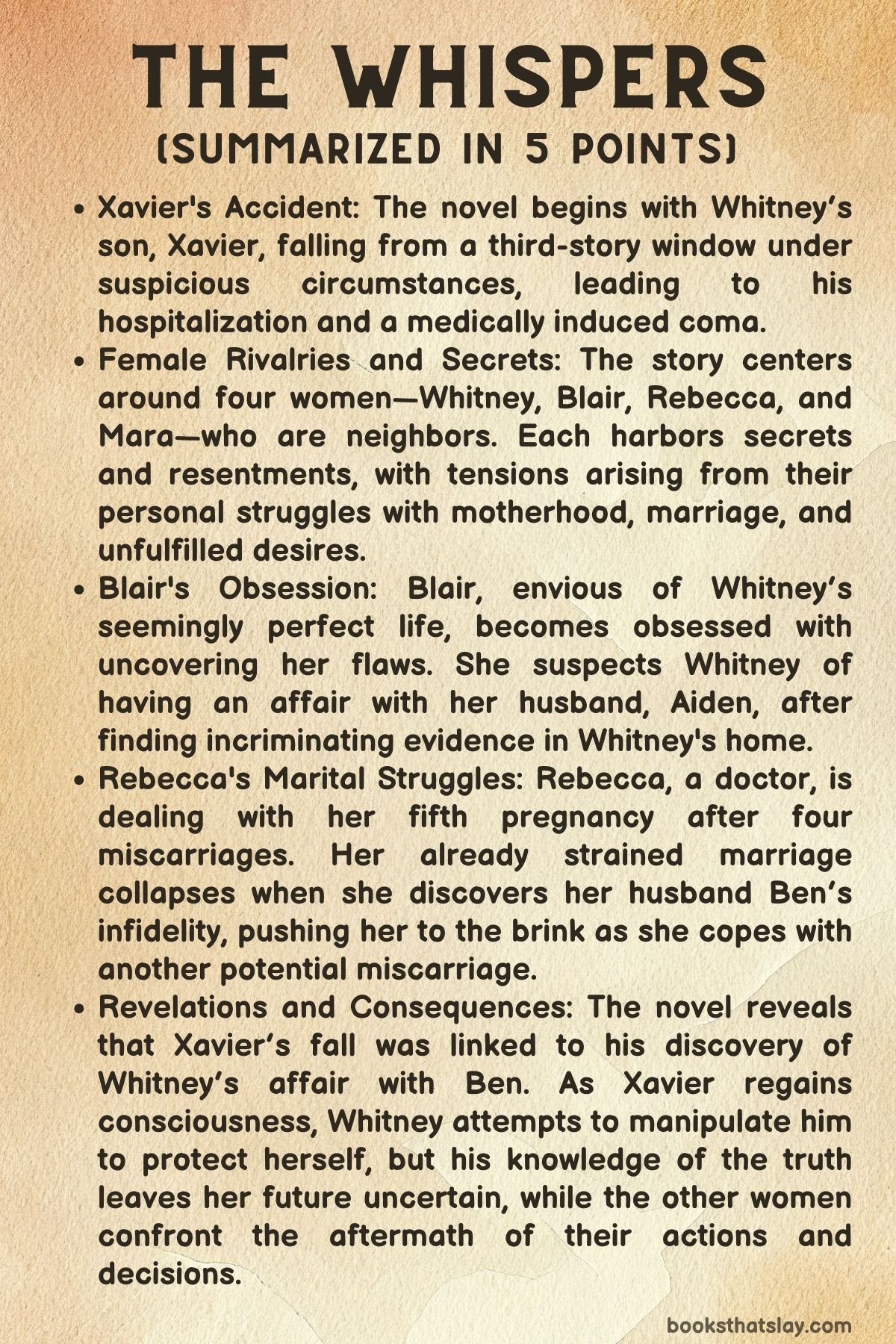
Through the voices of four women—Whitney, Blair, Rebecca, and Mara—it reveals how their lives intersect around a tragic accident involving Whitney’s son, Xavier. The novel traces the weight of secrets, betrayals, and guilt that linger beneath polished surfaces. Audrain uses shifting perspectives to peel back layers of intimacy and isolation, capturing the complexity of relationships and the silent burdens people carry.
Summary
The novel opens with a man alone in his home, spiraling into anxiety and fear late at night. His sense of panic is heightened by the haunting image of a child he cannot reach.
Hours later, a phone call shatters the night: a woman’s trembling voice confesses, “Something terrible happened.”
The story then shifts to a summer gathering in the Loverlys’ backyard. Whitney, the elegant host, takes pride in the carefully staged event—catered food, manicured grass, and perfectly dressed children.
Yet beneath the polished exterior lies tension. Her son Xavier resists her control, while her friend Blair, her neighbor Rebecca, and elderly neighbor Mara observe and judge in silence.
Whitney’s carefully managed image collapses when she violently lashes out at Xavier upstairs, her screams echoing down to the party. Ashamed, she realizes her guests have heard her rage.
Months later, Blair is consumed by suspicions about her husband Aiden’s infidelity. Her anxieties deepen when Xavier goes missing one morning.
Soon, the neighborhood is shaken when Xavier is rushed to the hospital after falling from his bedroom window. Rebecca, a pediatric resident, is forced to treat him, torn between professional detachment and personal shock at seeing her neighbor’s child on the operating table.
Whitney, overwhelmed by guilt, sits vigil at her son’s bedside, remembering the many ways she failed to connect with him. Her husband Jacob, stranded abroad, cannot return immediately, leaving her alone with her anguish.
Blair’s unease intensifies when she discovers hints that Whitney and Aiden may be connected. She sneaks into Whitney’s house under the pretense of checking in and is overcome with envy for her neighbor’s seemingly perfect life.
She wanders the pristine home, snoops in bedrooms and closets, and finally uncovers a clue linking Aiden to Whitney. Her jealousy spirals into self-destructive behavior, and she leaves shaken, unsure of the truth.
Meanwhile, Mara, the elderly neighbor across the street, reflects on her life. She recalls raising her sensitive son Marcus, who spoke only to her in whispers and struggled to fit in.
Her devotion to him consumed her marriage, and after a tragic confrontation with her husband Albert, Marcus withdrew completely. The weight of her past loss shapes how she observes Whitney and Xavier, seeing echoes of her own son in the troubled boy.
As Xavier lies unconscious, Whitney replays the painful history of her motherhood. She recalls moments of anger and frustration, when her ambition and need for control clashed with his fragile nature.
Rebecca, who has longed for a child and endured multiple miscarriages, struggles with resentment as she supports Whitney. She hides her own pregnancy, uncertain whether it will survive, and fears disappointing her husband Ben.
Blair’s suspicions about Aiden resurface after a confrontation. She learns from her daughter Chloe that Xavier was bullied at school and even told that no one would care if he died on the very day of his fall.
This revelation forces Blair to consider whether his injuries might have been self-inflicted rather than accidental. Her guilt over her daughter’s role collides with her suspicion of Aiden’s betrayal.
Rebecca soon discovers evidence of Whitney’s affair with her husband Ben, devastating her. Her grief over repeated miscarriages and betrayal pushes her to a breaking point.
In a vengeful act at the hospital, she orchestrates a moment when Whitney is pulled away from Xavier’s bedside, ensuring she misses the chance to be present if he wakes. Overwhelmed, she miscarries again, ending her marriage to Ben in anguish.
Mara, newly widowed after Albert’s sudden death, reflects on her past mistakes and guilt over Marcus’s life. She remembers the paper airplanes Xavier often sent into her yard, connecting the boy’s loneliness with her son’s.
She leaves one last paper plane on the Loverlys’ porch, a silent farewell.
Whitney’s relationship with Jacob unravels as the truth of her infidelity surfaces. Yet their focus remains on Xavier, whose survival is uncertain.
In a flashback, the night of his fall is revealed. After finding a message on his wall—“I DON’T WANT TO BE YOUR SON ANYMORE”—Whitney coldly dismissed him, telling him he no longer had a mother.
Later, while she was with Ben outside, Xavier saw her from his window and cried out. Terrified of exposure, Whitney hid.
Moments later, he fell. She panicked, scribbled over his damning words, and called for help.
Two weeks later, Xavier has survived but remains fragile. Whitney waits for a private moment with him at the hospital.
At last, he speaks: “What will happen—to you—when I tell them everything?” His words confirm that he remembers the night of his fall and is conscious of the devastating consequences his truth might bring.
The story closes with this haunting uncertainty. Each of the women—Blair, Rebecca, Whitney, and Mara—has confronted loss, betrayal, and guilt, their lives bound together by the tragedy of Xavier’s fall.
Behind their suburban facades lie fragile relationships, hidden desires, and unbearable secrets that can never fully be contained.
Characters
Whitney Loverly
Whitney emerges as the most complicated figure in The Whispers, embodying both the polished exterior of suburban perfection and the hidden turmoil of a mother buckling under pressure. Her identity is built around control—she curates her home, her image, and her social presence meticulously.
Yet, beneath this façade lies a well of frustration and resentment, particularly directed toward her sensitive son, Xavier. Her ambition and attachment to work constantly clash with the demands of motherhood, leaving her alienated from her children.
Whitney’s volatile relationship with Xavier exposes her as a woman caught between the ideals of maternal devotion and the stark reality of her inability to connect with her child. Her affair with Ben and her cruel dismissal of Xavier before his fall underline her flaws, painting her as both a victim of her own conditioning and a perpetrator of harm.
Ultimately, Whitney embodies the dangers of suppressed guilt, ambition, and emotional detachment in the seemingly perfect suburban life.
Xavier Loverly
Xavier is the quiet center of tragedy in the novel. Sensitive and withdrawn, he becomes a mirror reflecting the tensions and failures of his family.
His fragility—expressed in small acts like stealing loot bags or scribbling anguished words on his bedroom wall—speaks to a child struggling for recognition and love. Xavier’s relationship with Whitney is fraught, as her impatience and rage often erupt in destructive ways, leaving him isolated.
His fall, whether accidental or deliberate, symbolizes the weight of neglect, misunderstanding, and cruelty he endures, not only from his family but also from peers like Chloe. Xavier’s voice, though faint, resonates powerfully; his final words to Whitney show both his awareness of the truth and his haunting consideration of the cost of revealing it.
Blair
Blair represents the simmering discontent of suburban motherhood and marriage. On the surface, she participates in neighborhood gatherings and dutifully tends to her daughter, Chloe, yet her inner life is consumed by suspicion, envy, and shame.
She obsesses over her husband Aiden’s potential infidelity and measures her own shortcomings against Whitney’s curated image. Blair’s intrusion into Whitney’s home reveals not only her jealousy but also her yearning to step outside the limitations of her own life.
Her act of sexual exploration in Whitney’s bed illustrates both desperation and a search for identity beyond her role as wife and mother. At the same time, her daughter’s cruelty toward Xavier exposes Blair’s blind spots in parenting, further complicating her guilt.
Blair embodies the corrosive effects of envy, unfulfilled desire, and generational echoes of betrayal.
Aiden
Aiden, Blair’s husband, is portrayed less through his own perspective and more through Blair’s suspicions and projections. His charm, once the foundation of their relationship, has withered into distance and indifference.
Whether or not he is unfaithful remains ambiguous, but his secrecy and detachment fuel Blair’s paranoia. His remark that Blair seems to want to hate him cuts to the truth of their fractured marriage: their bond is not merely damaged by external temptations but also by Blair’s need to confirm her fears.
Aiden becomes a figure of quiet resentment, representing the failure of communication and trust in their relationship.
Rebecca
Rebecca, the pediatric doctor and neighbor, lives at the intersection of professional authority and private grief. Her clinical composure masks deep anguish over her miscarriages and her desperation to become a mother.
She is haunted by the irony of saving other people’s children while unable to sustain her own pregnancies. Her marriage to Ben is fractured by secrecy and betrayal, culminating in her discovery of his affair with Whitney.
Rebecca’s moments of quiet cruelty, such as orchestrating Whitney’s absence during Xavier’s awakening, reveal the corrosive power of jealousy and grief. She symbolizes the fragile line between professional detachment and personal despair, a woman defined by loss who lashes out in morally ambiguous ways.
Ben
Ben is a shadowy presence in the narrative, seen largely through the eyes of women around him. His affair with Whitney betrays his wife, Rebecca, and fractures the delicate balance of the neighborhood’s relationships.
He is portrayed as distracted, distant, and morally weak, drawn to Whitney’s allure while neglecting his wife’s silent suffering. Though less developed than the women, his actions set off reverberations that deepen the central conflicts.
He represents the ease with which selfish choices can unravel multiple lives.
Mara
Mara, the elderly neighbor, serves as both observer and ghost of the past. Excluded from the social circles of the neighborhood, she reflects from the margins with a wisdom forged through grief.
Her life is defined by her devotion to her son Marcus, whose anxiety and eventual death left her consumed by guilt and loneliness. Mara’s memories of raising Marcus parallel Whitney’s struggles with Xavier, highlighting generational patterns of maternal sacrifice and sorrow.
Her watchful detachment, her memories of whispers with Marcus, and her recognition of Xavier’s pain make her both a mirror and a warning to the younger mothers around her. She embodies the theme of motherhood as both a consuming love and a devastating burden.
Jacob Loverly
Jacob, Whitney’s husband, exists in the narrative as a stabilizing force who is frequently absent. His work obligations leave Whitney to shoulder the burdens of parenting, exacerbating her resentment and detachment.
His arrival at the hospital underscores his devotion and desperation, yet his reliance on Whitney to hold their lives together blinds him to the truth of her betrayals. Jacob’s pragmatic attempts to manage Xavier’s accident by controlling narratives reveal his fear of vulnerability and scandal.
He represents the patriarchal expectation of order, even as the ground beneath his family collapses.
Chloe
Chloe, Blair’s daughter, becomes a pivotal yet understated character. Her cruelty toward Xavier, culminating in the revelation that she and her friends told him no one would care if he died, provides crucial context for his despair.
Chloe reflects the echoes of her mother’s bitterness and broken marriage, suggesting how children absorb and replicate the dynamics of their parents’ lives. Her innocence is tainted by the cruelty of peer pressure and the absence of emotional guidance, making her both victim and perpetrator within the story.
Marcus
Marcus, Mara’s son, exists mostly in memory but profoundly shapes Mara’s narrative. His sensitivity and withdrawal, coupled with his tragic death, make him a ghostly presence haunting Mara’s present.
Marcus’s whispers, his fragile bond with his mother, and his eventual silencing by his father’s cruelty parallel Xavier’s trajectory, creating a chilling symmetry across generations. Through Marcus, the novel underscores the long shadows cast by parental choices and the fragility of childhood.
Themes
Motherhood and Its Complexities
In The Whispers, motherhood is shown as both a source of deep love and an overwhelming burden. Whitney embodies the tension between ambition and maternal responsibility, struggling to reconcile her professional drive with the unpredictable demands of her children.
Her moments of rage toward Xavier reveal how resentment and exhaustion can overpower affection, leaving her ashamed and guilty. Rebecca offers a stark contrast—her desperate longing to become a mother and her repeated miscarriages highlight the cruel irony of desiring something that others, like Whitney, may experience as suffocating.
Mara represents yet another dimension, as her identity is completely tied to her son Marcus, even at the cost of her marriage and independence. Her story demonstrates how devotion can become a form of entrapment, binding a woman’s sense of self to her child’s fragile existence.
Blair, though already a mother, questions her adequacy, often envying Whitney’s seemingly polished parenting while ignoring her own emotional neglect of Chloe. The novel thus portrays motherhood not as a single universal experience but as a spectrum shaped by circumstance, expectation, and personal history.
Across these narratives, Audrain emphasizes the contradictions of maternal love—its capacity for tenderness and sacrifice, but also its potential to breed resentment, envy, and devastating guilt.
Marriage, Desire, and Infidelity
The marriages in The Whispers are fraught with secrecy, unmet needs, and quiet betrayals. Whitney’s affair with Ben destabilizes not only her own marriage but also Rebecca’s, creating a ripple effect that poisons trust between neighbors.
Her actions stem from dissatisfaction with Jacob, yet they also expose her hunger for validation beyond motherhood. Blair’s marriage to Aiden is eroded by suspicion, her discovery of the foil wrapper and Whitney’s bracelet pushing her to confront the possibility of betrayal.
Rather than offering comfort, Aiden accuses her of seeking reasons to resent him, revealing the emotional distance already entrenched between them. Rebecca’s marriage to Ben collapses under the weight of deceit, her grief over infertility compounding the betrayal she uncovers.
Even Mara’s marriage to Albert was characterized by silence and unspoken resentment, their bond frayed by Marcus’s fragility and Albert’s withdrawal. Infidelity here is not just physical; it is emotional absence, the withholding of intimacy, and the betrayal of shared trust.
Through these fractured unions, Audrain illustrates how marriages often mask loneliness, how desire can both sustain and destroy, and how silence between partners can become more corrosive than spoken conflict.
The Burden of Secrets and Silence
Secrets drive the tension of The Whispers, shaping relationships and distorting truth. Whitney hides her affair, her guilt about motherhood, and even the extent of her rage toward Xavier.
Rebecca keeps her miscarriages, her clandestine hospital ultrasounds, and her pregnancy hidden from Ben until it is too late. Blair harbors shame about her obsession with Whitney’s life, trespassing into her home, and her unsettled suspicions of Aiden.
Mara lives under the shadow of Marcus’s death, burying the truth of her role in his final flight. These silences are not protective but corrosive, eroding bonds between spouses, friends, and neighbors.
What is left unsaid gains power, distorting perception and allowing mistrust to flourish. Xavier himself embodies the weight of silence, unable to voice his despair until it culminates in the words scrawled on his wall.
By the time Whitney confronts his pain, it is almost too late. The novel suggests that silence within families and communities perpetuates cycles of shame, misunderstanding, and isolation, turning neighbors into strangers despite their physical closeness.
Guilt, Shame, and Responsibility
Guilt saturates the lives of the characters, becoming an almost physical presence. Whitney’s guilt stems from her violent outbursts, her affair, and her inability to connect with Xavier, culminating in the belief that she failed as both mother and wife.
Rebecca is consumed with shame over her miscarriages, perceiving herself as defective, and later feels a dark satisfaction in sabotaging Whitney when her own life falls apart. Blair is ashamed of her intrusive behavior in Whitney’s home and of her inability to provide Chloe with the stability she lacked as a child.
Mara lives under the crushing weight of responsibility for Marcus’s death, interpreting his memory as a constant accusation. This guilt is not resolved but continues to fester, influencing choices and shaping relationships.
Audrain shows how shame corrodes self-worth and how responsibility, whether accepted or denied, defines the characters’ futures. Xavier’s accident crystallizes these emotions, forcing each character to confront their hidden failures.
Yet even in confession, guilt lingers, leaving open the question of whether forgiveness—especially self-forgiveness—is possible.
Suburban Facades and Social Performance
The novel situates its drama in a suburban neighborhood, where manicured lawns and curated gatherings conceal turmoil behind closed doors. Whitney’s meticulously staged party is emblematic of this performance—designed to project perfection while chaos brews upstairs.
Blair envies Whitney’s polished exterior, unaware of the fractures beneath it, while maintaining her own appearance of composure despite marital suspicion and internal shame. Rebecca presents herself as the competent doctor and supportive neighbor, though privately she crumbles under the weight of infertility and betrayal.
Mara’s role as the quiet, watchful widow across the street makes her both invisible and omniscient, aware of cracks others cannot see. The novel critiques the pressure of suburban ideals, where appearances matter more than authenticity, and where vulnerability is hidden for fear of judgment.
The facade is not only external but internal—each woman crafts a narrative about herself that rarely aligns with reality. Through this setting, Audrain underscores how societal expectations encourage repression, leaving communities bound by proximity but divided by unspoken truths.