The Woman in Me Summary and Analysis
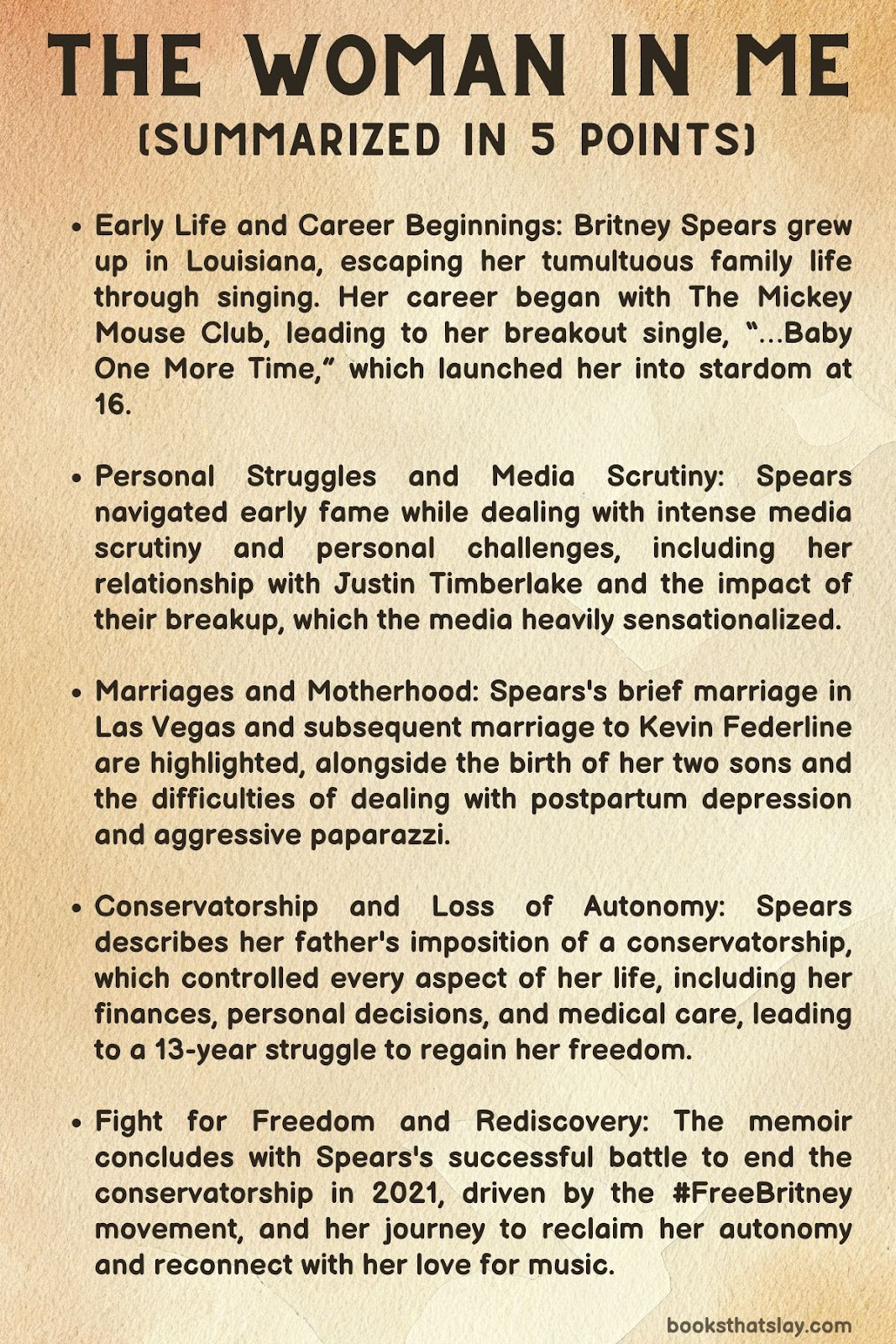
The Woman in Me by Britney Spears is a powerful memoir that traces the life of one of the most iconic performers of modern times. From her childhood in small-town Louisiana to her meteoric rise as a global superstar, Spears reveals the complex forces that shaped her journey—family struggles, unrelenting fame, personal heartbreak, and years of legal control under a conservatorship.
Through moments of triumph and devastation, she shares how music and motherhood anchored her while the world around her often misjudged and exploited her. This book is not only a reflection on celebrity but also a reclaiming of her voice and identity after years of silence.
Summary
Britney Spears begins her story with her childhood in Kentwood, Louisiana, where the chaos of her parents’ marriage and her father’s alcoholism left her seeking peace in nature and song. Music became her sanctuary, a way to escape constant conflict and to feel free.
Family history loomed large, with tragedies such as her grandmother’s suicide and the difficulties her mother’s family faced in adapting to rural life. Despite this instability, Britney’s natural love for singing and dancing gave her confidence.
Her earliest performances in church and school revealed her gift and passion for entertaining.
Her family’s circumstances were often unstable, but Britney developed resilience. A pivotal moment in her early years came when her older brother Bryan survived a serious accident, shifting family dynamics and deepening her bond with him.
Britney also cherished her great-grandmother Lexie, whose vibrant presence gave her a sense of stability until she was taken out of Britney’s life. By age eight, she was auditioning for The Mickey Mouse Club, and though initially too young, she soon found herself in New York City, performing in stage productions and television before eventually joining the show alongside future stars Justin Timberlake, Christina Aguilera, and Ryan Gosling.
The environment sharpened her skills and introduced her to the world of professional entertainment, but returning home afterward left her torn between pursuing fame and living a normal life.
Teenage years brought experimentation, dating, and a growing awareness of her own ambition. With the support of her mother and a lawyer’s guidance, Britney recorded a demo that eventually reached Jive Records.
At fifteen, she signed her first contract, and soon afterward recorded her debut album. Her first single, “…Baby One More Time,” released in 1998, launched her into superstardom.
The video concept she suggested—dancing in a schoolgirl outfit—became a cultural phenomenon. Overnight, Britney transformed from a small-town girl into an international pop sensation.
The fame was exhilarating but also exhausting, as constant media attention scrutinized her every move, often focusing on her body and image more than her artistry.
Britney’s career soared with chart-topping albums, tours, and collaborations with legendary performers. She was hailed as the Princess of Pop, embodying a new era of music and celebrity culture.
Yet her personal life was equally visible. Her high-profile romance with Justin Timberlake captured the public imagination.
She loved him deeply, but their relationship was marred by infidelity and a devastating secret abortion that she underwent at his insistence. Their eventual breakup, delivered by text, shattered her emotionally, especially as Justin used music and media appearances to paint her as the villain.
The media frenzy amplified her pain, branding her negatively while dismissing his flaws.
Despite personal struggles, Britney sought refuge in her music and new relationships. She bonded with Madonna, whose confidence inspired her, and released the album In the Zone, featuring the hit “Toxic,” which earned her a Grammy.
However, media interviews and coverage increasingly intruded into her personal life, often humiliating her. Seeking stability, she impulsively married childhood friend Jason Alexander in Las Vegas, only for her family to annul the marriage.
Soon after, she met Kevin Federline. Their whirlwind romance led to marriage and two children, Sean Preston and Jayden James.
Britney prioritized family life, but relentless paparazzi harassment and Kevin’s ambitions strained their relationship. Their divorce left her vulnerable, and a custody battle over her children intensified the scrutiny.
In 2007, Britney’s life unraveled under immense pressure. Grieving her aunt’s death, battling postpartum depression, and restricted from seeing her sons, she reached breaking points.
Her public head-shaving and umbrella incident became tabloid spectacles, mischaracterized as madness rather than desperate acts of grief and rebellion. She briefly dated a paparazzo and was constantly surrounded by cameras that profited from her distress.
Despite releasing Blackout, an album she considered her best work, her public image was in freefall. Court decisions further limited her custody rights, devastating her.
In 2008, her father, Jamie Spears, placed her under a conservatorship, supposedly to protect her but in reality stripping her of autonomy. He, along with others, controlled her finances, career, and personal choices.
Britney was forced into performances, tours, and a Las Vegas residency, despite being deemed “unfit” to manage her own life. Her relationships were monitored, her health decisions restricted, and her creative input often dismissed.
Her father criticized her body and imposed strict rules on her lifestyle. Though she continued to deliver successful shows and albums, behind the scenes she felt like a prisoner, infantilized and exploited.
The conservatorship lasted thirteen years, during which Britney’s family profited while she struggled for freedom. She attempted to assert control through small acts, like teaching dance classes and recording music, but every challenge to the arrangement was suppressed.
The turning point came when she was forced into a rehabilitation facility in 2019, heavily medicated and isolated against her will. Hearing about fans’ #FreeBritney movement gave her hope, showing her that people outside recognized her plight.
By 2021, Britney began publicly speaking out. In a landmark court appearance, she declared her desire to end the conservatorship, exposing its abuses.
With the help of attorney Mathew Rosengart, she achieved her father’s removal as conservator and ultimately the termination of the arrangement. In November 2021, while on vacation, Britney learned she was finally free.
This marked the beginning of a new chapter where she could reclaim her life and choices.
After the conservatorship, Britney began to heal and embrace her independence. She recorded new music, including a duet with Elton John, married Hesam Asghari, and began living life on her own terms.
Though she continued to face challenges such as migraines and lingering trauma, she reveled in simple freedoms—driving, choosing her own meals, and spending time with her children. Her feelings toward her family remained complicated, as she recognized their role in her exploitation, but she expressed gratitude to fans who supported her.
For Britney, the end of the conservatorship was not just a legal victory, but the start of rediscovering herself as a woman, an artist, and a mother.
Key People
Britney Spears
Britney Spears stands at the center of The Woman in Me, not only as the narrator but also as the figure through whom the entire emotional and psychological journey unfolds. From her earliest days in rural Louisiana, Britney is depicted as a child who sought refuge in music and dance, finding in them a sense of freedom and healing amidst a volatile home environment.
Her determination and raw talent propelled her into the entertainment industry at a young age, but her journey is equally marked by vulnerability, resilience, and an enduring desire for love and stability. Her character embodies the duality of being both a global icon and a young woman navigating family fractures, public scrutiny, and personal heartbreak.
Through her voice, readers witness a woman who was repeatedly stripped of control, yet continually rediscovered her strength, especially in her fight against the conservatorship. Britney emerges as complex—deeply human in her longing for normalcy, yet extraordinary in her ability to survive and reclaim her voice after years of exploitation.
Jamie Spears
Jamie Spears, Britney’s father, is portrayed as a deeply flawed and often antagonistic force in her life. Shaped by his own traumatic childhood and fueled by alcoholism, Jamie carried cycles of abuse and control into his parenting.
His role in Britney’s story becomes most pronounced when he assumes legal and financial authority over her through the conservatorship, an arrangement that stripped her of autonomy while enriching him. He is shown as critical and domineering, micromanaging aspects of Britney’s personal life—from her finances to her body image—while benefitting from her relentless labor as a performer.
In Britney’s eyes, Jamie symbolizes betrayal from within the family, a figure who chose power and money over compassion and paternal love. His character is central to the narrative of control, oppression, and ultimately the struggle for liberation.
Lynne Spears
Lynne Spears, Britney’s mother, appears in the memoir as a more ambiguous figure. While at times supportive, particularly in Britney’s early life and career beginnings, Lynne often seems overshadowed by passivity and her own struggles.
She is remembered for enabling moments of recklessness, such as drinking with Britney during her teenage years, and later for profiting from her daughter’s fame, notably through the publication of her memoir during Britney’s darkest chapter. Britney’s reflections suggest a complicated mix of love, disappointment, and resentment toward her mother, who oscillates between caregiver and bystander.
Lynne embodies the paradox of being both part of Britney’s safety net and part of the system that exploited her, leaving their relationship emotionally fraught and unresolved.
Bryan Spears
Bryan Spears, Britney’s older brother, is depicted with affection and a sense of shared history, particularly because of the traumatic accident that left him bedridden and needing Britney’s care in childhood. Their bond is rooted in closeness, and Britney’s nurturing of Bryan highlights her instinct to protect those she loves.
However, as the narrative progresses, Bryan becomes a more peripheral figure, his role in Britney’s adult life less prominent. He is less condemned than their parents, yet still part of the family structure that benefitted from her career.
His presence in the story represents both sibling love and the silence of those who did not fully intervene during Britney’s struggles.
Jamie Lynn Spears
Jamie Lynn Spears, Britney’s younger sister, is described as spoiled and rude during Britney’s return home following her breakup with Justin Timberlake. Their relationship appears strained, with Britney expressing frustration at Jamie Lynn’s behavior and the sense of being pushed aside within her own family.
Later, Jamie Lynn’s public stance during the conservatorship years and her own memoir added to Britney’s sense of betrayal. To Britney, her sister represents a microcosm of the broader dynamic within the Spears family—someone who benefitted from her fame and fortune, yet offered little solidarity during her most vulnerable moments.
Justin Timberlake
Justin Timberlake plays a pivotal role in Britney’s coming-of-age story. Their relationship, beginning with youthful innocence on The Mickey Mouse Club and evolving into a high-profile romance, encapsulates both Britney’s joy and her deepest heartbreak.
Britney portrays Justin as charismatic and talented, but also self-centered and unfaithful. Their secret abortion, which Britney underwent under pressure, left lasting trauma, and his decision to end the relationship via text compounded her devastation.
Justin’s public portrayal of Britney as unfaithful, particularly through songs like “Cry Me a River,” positioned him as both a career opportunist and a source of personal pain. In her telling, Justin represents the collision between private vulnerability and public betrayal, a turning point in how Britney experienced fame and trust.
Kevin Federline
Kevin Federline enters Britney’s life as a source of comfort and passion, yet quickly becomes emblematic of betrayal and disillusionment. Their whirlwind romance and marriage initially gave Britney hope for stability and family life, but his duplicity—already being a father to two children with another woman—foreshadowed their unraveling.
As Britney struggled with postpartum depression and public harassment, Kevin distanced himself, ultimately weaponizing her public image in their custody battle. His pursuit of fame, alongside his role in restricting her access to her sons, positions him as a figure who capitalized on her vulnerability while exacerbating her suffering.
Madonna
Madonna is depicted as a mentor and empowering influence during a critical phase of Britney’s career. Their collaboration, particularly their headline-making kiss at the VMAs, positioned Britney within a lineage of powerful female performers.
Madonna’s guidance extended beyond music, introducing Britney to Kabbalah and encouraging her to embrace control over her artistry and image. Unlike many figures in the memoir, Madonna represents solidarity and strength, someone who inspired Britney to assert herself in an industry that repeatedly sought to control her.
Lexie Spears
Lexie, Britney’s great-grandmother, plays a brief but meaningful role in her early life. Known for her boldness and unconventional spirit, Lexie provided Britney with joy, stability, and love.
The abrupt end to their closeness, deemed unsafe by Britney’s mother after an accident, devastated her. Lexie represents both the nurturing influence that Britney craved and the fragility of childhood connections within a fractured family system.
Her memory lingers as one of the few figures who offered unconditional affection.
June Spears
June, Britney’s paternal grandfather, looms as a shadow over the Spears family history. His cruelty, particularly toward Britney’s grandmother Jean, established cycles of abuse and trauma that reverberated into later generations.
Though Britney did not directly experience his abuse, the legacy of his harshness is seen in the dysfunction of her father, Jamie. June’s character underscores how generational trauma and patriarchal dominance shaped the Spears family dynamic long before Britney became its most famous member.
Jean Spears
Jean, Britney’s paternal grandmother, is remembered tragically as a woman who suffered under June’s cruelty and ultimately took her own life. Her story profoundly impacted Britney’s father and shaped the troubled environment in which Britney grew up.
Jean’s character embodies the silent suffering of women within oppressive family structures and serves as a grim precursor to the struggles Britney herself would face with control, confinement, and despair.
Hesam (Sam) Asghari
Hesam Asghari, who later became Britney’s husband, represents renewal and hope in the later chapters of her life. His presence provided Britney with companionship, support, and a sense of normalcy amid the suffocating restrictions of her conservatorship.
Their relationship, built during her years of confinement and blossoming in freedom, highlights Britney’s enduring capacity for love and trust even after deep betrayals. Hesam symbolizes a turning point—proof that Britney could reclaim not only her autonomy but also joy in intimacy and partnership.
Themes
Family Legacy and Trauma
Generations of hardship form an undercurrent throughout The Woman in Me, shaping not only Britney Spears’ life but also the dynamics of her family. The text underscores how cycles of trauma were passed down, beginning with her grandfather June’s cruelty and alcoholism, which scarred her father and influenced his abusive tendencies.
The ripple effect of her grandmother Jean’s tragic suicide also left a lingering shadow of grief and instability that marked the household. On her mother’s side, the dislocation and dissatisfaction of her grandmother Lily fed into a sense of displacement that Britney felt throughout her life.
What emerges is a portrait of a family weighed down by unresolved pain, where love is complicated by addiction, volatility, and betrayal. For Britney, the legacy of this trauma manifested in both her search for escape through performance and in her struggles to find healthy relationships later in life.
Her father’s heavy drinking, her mother’s fragility, and the overall instability of her home made singing more than just a hobby—it became a sanctuary. The story demonstrates how unresolved intergenerational trauma not only molds individual behavior but also shapes opportunities for exploitation, leaving Britney vulnerable to manipulation from her own family when she later entered the conservatorship.
The inheritance of pain within her family is not portrayed as an isolated tragedy but as the framework that shaped Britney’s life trajectory, explaining both her early brilliance and her later suffering.
Identity and Performance
Performance, for Britney, becomes both liberation and prison. From a young age, she found herself drawn to the spotlight, performing for relatives, church congregations, and eventually global audiences.
Singing and dancing initially offered a means of expression and control in contrast to the chaos of her household. However, once she entered the machinery of fame, performance ceased to be purely personal and became a tool for others’ profit.
Her carefully crafted image—sexy yet innocent, powerful yet submissive—was less a reflection of her true self than a projection of what record labels and the media demanded. The tension between Britney as a person and Britney as a pop star created an identity split that haunted her career.
On stage she exuded confidence, but off stage she often wrestled with self-doubt, burnout, and the dissonance between public perception and private reality. The narrative reveals that performance extended beyond the stage into her personal life, as she was forced to play the role of dutiful daughter, submissive conservatee, and compliant celebrity.
Her resistance—whether through the infamous head-shaving moment or her eventual refusal to continue rehearsals—was not rebellion without cause but rather an assertion of her true self against a lifetime of being molded for the spotlight. The theme of identity and performance asks the reader to consider what happens when a person’s very existence is consumed by the demands of spectacle.
Control and Exploitation
A powerful throughline in The Woman in Me is the theme of control—who has it, who abuses it, and how it is taken from Britney. From her early career, control was often seized by those around her: managers, producers, and later, her family.
The conservatorship epitomizes this exploitation, stripping her of autonomy while paradoxically forcing her to generate extraordinary wealth. She was told she was incapable of making basic life decisions yet was simultaneously expected to deliver flawless performances night after night, fund a network of handlers, and adhere to harsh restrictions.
The details she recounts—the surveillance, the forced medications, the denial of creative choices—paint a picture not of protection but of systematic exploitation. This control extended into her most intimate choices, such as being denied the right to remove an IUD.
Her parents, particularly her father, are portrayed as central figures in this abuse, profiting from her labor while silencing her voice. Beyond family, the media and industry also perpetuated her exploitation, sensationalizing her struggles and reinforcing the narrative of her supposed instability.
This theme is not only about Britney’s personal suffering but also about broader questions of power: how society views women, particularly those who resist conformity, and how legal systems can be weaponized to entrench abuse. Her story becomes emblematic of how fame can be used as justification for stripping a person of agency.
Motherhood and Loss
Motherhood is depicted as Britney’s greatest joy but also her deepest wound. From the moment she gave birth to Sean Preston and Jayden James, her identity as a mother became central to her sense of purpose.
Yet, this joy was continuously undermined by external forces—the paparazzi that turned her parenting into a spectacle, the courts that limited her custody, and her ex-husband who weaponized her image against her. Her account makes clear that her much-publicized breakdowns were less about fame fatigue and more about her anguish over being separated from her children.
The head-shaving incident, often mocked and misunderstood, is reframed as an expression of grief and a desperate cry against losing her sons. Even under the conservatorship, her children remained the anchor that kept her enduring the suffocating restrictions.
The narrative emphasizes that what the world saw as scandal was, in reality, a mother’s raw response to unbearable loss. In this sense, motherhood is not just a theme of nurturing but also of resilience and survival.
It exposes the cruelty of a system that judged her maternal fitness based on public appearances while ignoring the context of harassment, postpartum depression, and manipulation she endured. The text insists on the sanctity of Britney’s bond with her children and positions it as both her motivation to fight for freedom and her most significant emotional grounding.
Resilience and Liberation
Despite the hardships, the memoir is ultimately a story of resilience. Over and over, Britney Spears was pushed to the edge—by family, by media, by the courts—yet she managed to preserve a core sense of self that allowed her to seek freedom.
Her strength is evident not only in her survival of trauma but also in her ability to continue creating, performing, and caring for her children in impossible circumstances. Liberation comes gradually, first through small acts of resistance like refusing to rehearse or posting freely on Instagram, and later through her testimony in court where she declared her desire to reclaim her life.
The #FreeBritney movement represents the outside acknowledgment of her suffering, but the book underscores that her liberation was ultimately her own—an internal decision to no longer accept silence. Even after regaining her freedom, she frames her life not in terms of triumph over victimhood but as an ongoing process of healing, reclaiming joy in simple things long denied to her.
This theme demonstrates that resilience is not about unbroken strength but about persistence through brokenness, the determination to fight for autonomy even when stripped of power. Her liberation, when it came, was not just legal but also deeply personal: the chance to rebuild an adult life on her own terms after years of forced compliance.