The Widow by John Grisham Summary, Characters and Themes
The Widow by John Grisham is a sharp legal suspense novel set in a quiet Virginia town where one unexpected client upends a tired lawyer’s life. Simon F. Latch has been getting by on routine work and bad habits, until Eleanor “Netty” Barnett—an elderly widow with no close family—walks into his office asking for a new will.
What sounds simple becomes a high-stakes struggle involving rival lawyers, angry heirs, secrets, and a death that turns Simon into the most hated man in town. It’s a story about greed, fear, and how fast “opportunity” can become a trap.
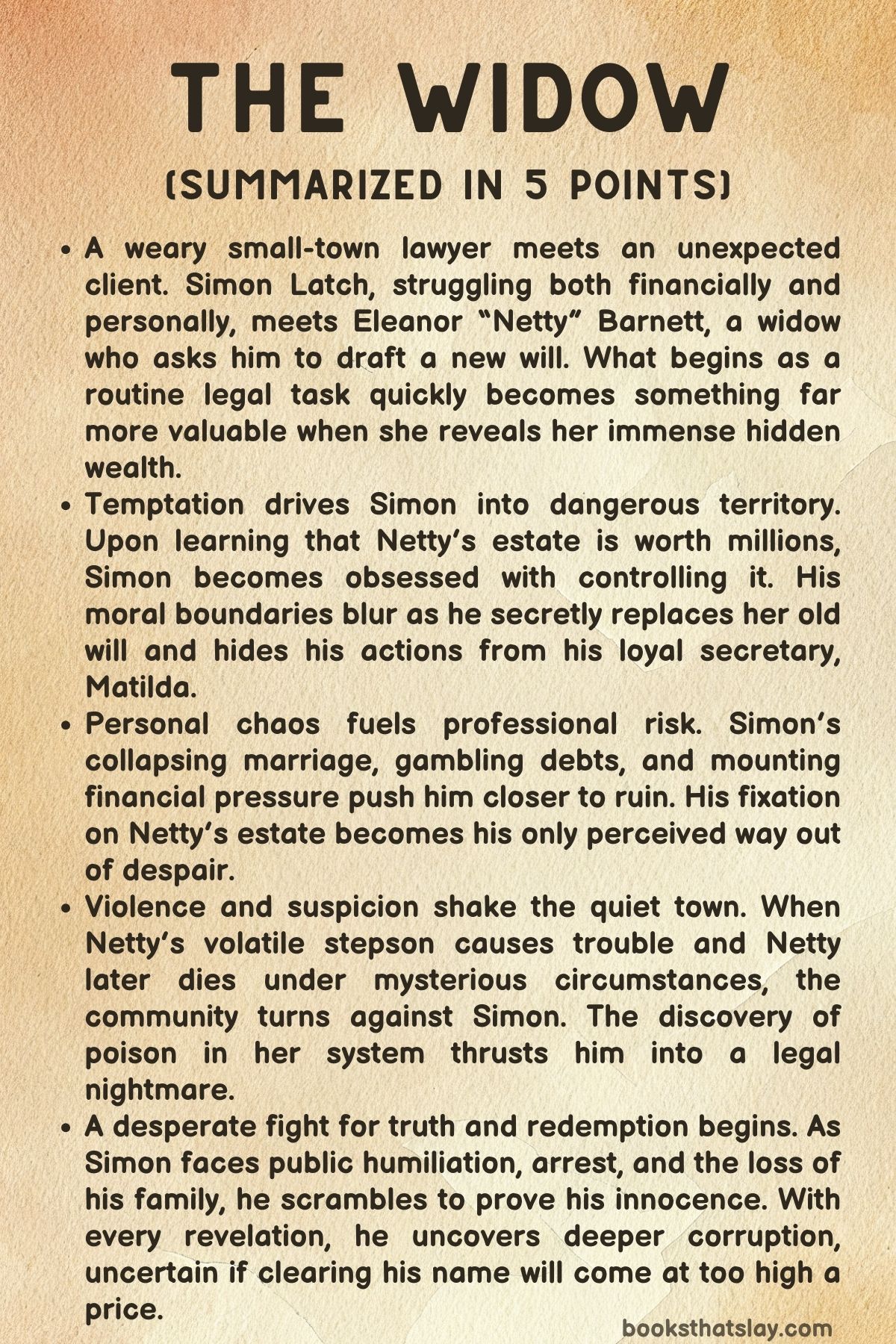
Summary
Simon F. Latch is a small-town attorney in Braxton, Virginia, worn down by low-paying cases and a practice kept afloat largely by his capable secretary, Matilda “Tillie” Clark. His routine changes when Eleanor Barnett—known as Netty—arrives to revise her will.
Netty is a widow with no children and little affection for her late second husband’s two sons, Clyde and Jerry Korsak. She appears nervous about privacy and insists the matter stay quiet.
In their first talk, Simon realizes Netty’s estate may be far larger than anything he has ever handled. She says her husband Harry spent decades accumulating Coca-Cola and Wal-Mart stock and never sold.
The holdings, along with large cash accounts in Atlanta, add up to what she claims is well over $16 million, with dividends bringing in hundreds of thousands per year. Simon can barely concentrate after she leaves.
The number hangs in his mind, not only because of the legal work, but because it represents escape from debt, a failing marriage, and the cramped living quarters above his office.
Netty shows Simon her current will, drafted by rival attorney Walter “Wally” Thackerman across the street. The document sets up a memorial trust that would sell everything and place the proceeds under Thackerman’s control for years.
The fees are enormous, the powers granted to Thackerman are broad, and buried inside is a direct gift to Thackerman of $485,000. Simon points out how lopsided it is.
Netty is startled and upset; she had not understood what she signed. Simon offers to prepare a cleaner will, warns her the stepsons may sue if excluded entirely, and suggests a modest gift to each with a no-contest provision.
As Netty’s trust in Simon grows, Simon’s appetite for the case grows with it.
Because Netty fears gossip and because Simon wants control, he keeps Tillie out of the loop and schedules meetings after hours. He hires a local investigator, Spade, to confirm Netty’s story.
Spade traces Harry’s career and confirms the stock trail exists, though he cannot verify the exact amounts without legal tools. Then Simon gets a call from Netty’s Atlanta broker, Buddy Brown, who confirms that Netty is indeed “well taken care of,” though he refuses details.
To Simon, that is enough. He becomes determined to be the lawyer in charge when Netty dies—especially after learning about a temporary gap in federal estate tax rules that makes timing unusually valuable.
Simon replaces Thackerman’s will with one of his own. On a day when Thackerman is away, Simon arranges for neighbors Tony and Mary Beth Larson to serve as witnesses, carefully setting up a record that Netty is competent and acting voluntarily.
The new will puts Netty’s money into a charitable foundation that Simon will administer as executor and trustee, giving him control and a pathway to substantial fees without the obvious self-gift Thackerman tried. Simon celebrates quietly, treating Netty and the witnesses to lunch, and urges Netty not to inform Thackerman.
Netty hesitates but follows Simon’s advice.
At home, Simon’s life is collapsing. His marriage to Paula has been dead for years, and money is too tight for an easy split.
Then Paula proposes an open marriage and bluntly admits she wants sex again, but not with him. The conversation is strangely calm, and the end comes fast: they move toward divorce, plan how to tell the children, and accept that their household will fracture.
Meanwhile Simon’s gambling, already a problem, gets worse. Losses pile up, and his bookie, Chub, begins pressing for payment.
Trouble escalates when Clyde Korsak, drunk and armed, storms into Thackerman’s office demanding to know what Netty has done with her will. The encounter turns violent, becomes local news, and ends with Clyde jailed.
Netty is terrified, especially when Clyde calls from jail asking for money. Simon tells her to refuse contact, and he uses the fear to tighten his grip on her decisions.
He even moves her temporarily to a comfortable hotel under his name, keeping her away from town and away from Thackerman’s reach. Netty increasingly relies on Simon for everything: legal choices, safety plans, even funeral preferences.
Then Netty dies, and Simon’s careful plan turns into a nightmare. Authorities find evidence of thallium poisoning.
A search warrant leads to a small safe linked to Netty, containing two competing wills—Simon’s and Thackerman’s—along with personal documents. Investigators discover that thallium was present in ginger cookies from a local restaurant and that the cookies were delivered to Netty at the hospital by Tillie on two occasions.
The case shifts from suspicious to explosive. Simon is labeled a “person of interest,” then quickly indicted for murder.
The story leaks, reporters descend, and Simon becomes the town villain overnight.
Simon surrenders, is processed into jail, and sits through a humiliating weekend as headlines paint him as a greedy lawyer who killed a rich client. Paula and the children flee under police escort to avoid harassment.
In court, bail is set high, and Simon has no easy access to funds. Desperate, he turns to Chub, who offers a lifeline by buying Simon’s office building and letting him keep using it briefly.
Simon posts bond and gets out, but his practice is unraveling, his reputation is wrecked, and the probate fight becomes another battlefield. Meanwhile, a conservator and outside lawyers dig into Netty’s finances and uncover a stunning twist: the fortune Netty described was largely a story.
Much of the wealth was lost long ago in a disastrous investment, leaving far less than anyone assumed.
Even with the money diminished, the criminal case remains. Simon insists he did not poison Netty, but the evidence circle is tight.
He reaches into darker corners for help, meeting a hacker known as Zander through Spade’s connections. Zander obtains hospital personnel files and begins digging into the background of hospital staff.
A nurse, Loretta Goodwin, shares a troubling memory: an X-ray technician named Oscar Kofie appearing in Netty’s room without a reason, and later talking too comfortably about poisons at a party. The name fits patterns Zander and her imprisoned boyfriend, Cooley, uncover—Kofie has moved from hospital to hospital, with suspicious deaths in his wake.
Simon travels to Pennsylvania and finds a former attorney, Alan Teel, who reveals that Kofie had been investigated years earlier after thallium deaths. Evidence existed, including recordings and proof of poison stockpiles, but it was buried through a secret settlement that pushed Kofie out quietly instead of exposing him.
Armed with this, Simon and his lawyer Raymond Lassiter push federal authorities to act. The FBI raids Kofie’s apartment, finds poisons including thallium, intercepts a shipment, and arrests him.
In a closed hearing just before Simon’s sentencing, Teel testifies under protection, and the FBI presents what they found. The judge vacates Simon’s conviction, dismisses the charges with prejudice, and declares him free.
After months of public hatred and private panic, Simon finally gets the words he needs most: he is innocent. He breaks down, then reaches for the phone to call his children and begin the long task of rebuilding a life that will never look the same.
Characters
Simon F. Latch
Simon F. Latch is a small-town lawyer caught in a web of moral and financial turmoil. His life is marked by a deteriorating marriage, financial instability, and a growing addiction to gambling, all of which lead him to take questionable actions in his professional life.
As a lawyer, Simon is initially presented as someone burned out from handling mundane cases, but his encounter with Eleanor Barnett and her fortune sparks a shift in his character. Simon becomes obsessed with the potential wealth he could gain from her estate.
He orchestrates the signing of a new will, positioning himself as the executor and trustee, thus ensuring he will receive substantial legal fees. Over the course of the book, Simon’s increasing manipulation of Eleanor, his strained relationship with his wife, and his descent into gambling addiction reveal his moral decline.
Simon’s character is complex, as he struggles with guilt and a sense of entitlement, yet his actions show a person driven by selfishness and a deep desire to control the situation. His transformation from a burnt-out lawyer to a man desperate to secure a fortune is both tragic and chilling.
Eleanor Barnett (Netty)
Eleanor Barnett, or Netty, is a wealthy widow whose past is intertwined with both personal and financial complexities. She is a quiet, elderly woman with no children and a strained relationship with her late husband’s family.
Netty’s wealth comes as a shock to those around her, as she inherits a fortune from her late husband, Harry Korsak, whose investments in Coca-Cola and Wal-Mart stock made him extremely wealthy. Despite her wealth, Netty is portrayed as somewhat naïve and vulnerable, especially in her dealings with Simon.
Her trust in Simon grows throughout the novel, especially when he reassures her about her will and advises her on her finances. However, she is also depicted as a lonely person, with few close family ties and a complicated past involving failed marriages.
Eleanor’s character evokes a sense of sympathy, as she becomes the pawn in a larger game between Simon, her stepsons, and other legal interests. Her decision to trust Simon, despite the red flags he raises, ultimately leads to her tragic demise, which becomes the central mystery of the novel.
Matilda Clark
Matilda Clark is Simon’s secretary, and her role, while peripheral, is crucial in unveiling Simon’s secretive actions. Initially, Matilda is portrayed as diligent and loyal to Simon, handling much of the administrative work in his law office.
However, her growing suspicions about Simon’s behavior begin to surface as she notices inconsistencies in his actions, particularly regarding his dealings with Eleanor. While she does not play a direct role in the legal manipulations surrounding Eleanor’s will, Matilda’s suspicions about Simon’s behavior eventually lead her to discover his lies.
Despite her trust in him, she uncovers the truth about Simon’s secret handling of the will and becomes an unintentional whistleblower in the investigation. Matilda’s character represents the moral compass in the story, contrasting Simon’s increasingly dubious actions with her integrity and desire to do what is right.
Wally Thackerman
Wally Thackerman is Simon’s rival, a lawyer who drafts an earlier version of Eleanor’s will, which Simon later replaces with his own. Wally’s character is somewhat secondary to Simon’s, yet his role in the story is pivotal in driving the conflict.
Thackerman is portrayed as an experienced, though morally ambiguous, attorney who seeks to benefit from Eleanor’s wealth. His secretive actions, such as gifting himself a large sum of money in Eleanor’s original will, set the stage for Simon to maneuver his way into a more advantageous position.
Wally’s violent reaction when his will is challenged—particularly when his stepson Clyde Korsak attacks him—further adds to the tension between the two lawyers. Thackerman’s role is that of a catalyst for Simon’s rise to power, and his subsequent fall due to his own greedy actions serves as a backdrop to Simon’s own moral degradation.
Clyde Korsak
Clyde Korsak is one of Eleanor’s stepsons and a key antagonist in the story. He is characterized by his volatility, criminal background, and a sense of entitlement to his late father’s wealth.
Clyde’s reckless behavior and violent temper are evident when he confronts Wally Thackerman, demanding to see Eleanor’s will, and later when he becomes involved in the chaos surrounding her death. His desperation for money leads him to pursue Eleanor aggressively, showing his lack of morals and his willingness to use violence to achieve his goals.
Clyde’s criminal past and his stormy relationship with Eleanor underscore his role as a foil to Simon, whose own moral descent mirrors Clyde’s unrestrained pursuit of wealth.
Jerry Korsak
Jerry Korsak, the other stepson of Eleanor, is less violent than Clyde but equally driven by greed. He is a more calculating figure, always looking for ways to manipulate situations to his advantage.
His actions are more subtle compared to Clyde’s, but he shares a similar desire for control over Eleanor’s estate. Jerry’s character provides a more nuanced perspective on the stepsons’ relationship with Eleanor, revealing a person who hides behind a veneer of civility while still pursuing his own financial interests.
His involvement in the legal disputes surrounding Eleanor’s will adds another layer of complexity to the inheritance conflict.
Raymond Lassiter
Raymond Lassiter is Simon’s attorney and provides a more grounded, rational counterpoint to Simon’s increasingly erratic behavior. As Simon’s legal defense throughout the trial, Raymond serves as a stabilizing influence in the narrative.
His loyalty to Simon is clear, though he is aware of Simon’s flaws. Raymond’s pragmatic approach to Simon’s defense contrasts sharply with Simon’s emotional and impulsive actions, especially as the trial progresses.
He is instrumental in helping Simon navigate the legal challenges he faces, offering a more rational perspective as Simon becomes increasingly overwhelmed by his own guilt and fear of the future.
Cora Cook
Cora Cook, known as “the Cougar,” is the Commonwealth’s attorney, and her character embodies the law’s pursuit of justice, particularly in the investigation of Eleanor’s death. While she initially treats Simon as a suspect, her thorough and meticulous investigation of the case reveals her professional commitment to uncovering the truth.
Cora’s role in the story highlights the tension between the legal process and personal motives, as she seeks to hold Simon accountable for the murder of Eleanor. She is a determined, no-nonsense figure who pushes the investigation forward, even when others are hesitant to pursue it.
Cora represents the unyielding force of justice, pressing on despite the obstacles Simon creates.
Zander
Zander is a mysterious character with a background in the darker side of the internet. She becomes involved in Simon’s search for answers regarding Eleanor’s poisoning, using her hacking skills to dig into hospital records and trace the origins of the poison.
Zander is portrayed as intelligent, resourceful, and somewhat rebellious, operating in a morally gray area to help Simon uncover the truth. Her relationship with Simon is built on mutual necessity, as she helps him navigate the digital underworld to find crucial evidence.
Zander’s character adds an intriguing layer of complexity to the investigation, providing the technological expertise that Simon lacks in his search for the truth.
Themes
Greed and Moral Corruption
In The Widow, Simon F. Latch’s journey is a deep exploration of the destructive power of greed and its ability to corrupt a person’s moral compass. Simon, once a small-town lawyer content with the simplicity of his life, finds himself drawn into the allure of wealth when he discovers the vast fortune left by Eleanor Barnett.
His initial decision to manipulate her will for personal gain seems minor, but as he becomes more entrenched in his plans to control her estate, his moral boundaries erode. Simon’s desperation for wealth grows as he envisions a future of financial stability and success, even if it means dishonesty and manipulation.
He resorts to deceit, tricking Eleanor into believing that he has her best interests at heart, all while secretly positioning himself to inherit a substantial amount of her fortune. The theme of greed is not only portrayed through Simon’s actions but also reflected in his personal life.
His failing marriage and strained family dynamics further highlight his inner turmoil and the ways in which his pursuit of wealth and success causes personal destruction. The case of Eleanor Barnett acts as a catalyst, transforming Simon from a burnt-out lawyer to a morally compromised individual, showing how greed can cloud judgment and destroy relationships.
Simon’s manipulation of Eleanor is a tragic commentary on how an individual’s desire for wealth can lead them down a path of moral decay, turning them into something unrecognizable.
Deception and Trust
Trust is a fragile concept in The Widow, and much of the narrative is driven by the manipulation of this trust. Simon, who presents himself as a professional and trustworthy attorney, uses his position to deceive Eleanor, gaining her trust to exploit her for personal gain.
He builds a façade of friendship and care, taking her out to lunch and discussing her life and legacy, all while secretly scheming to control her estate. Simon’s manipulation extends to his personal relationships as well, particularly with his wife, Paula, and his assistant, Matilda.
His failure to be honest and his reliance on deception causes a breakdown in his marriage and in his work environment. Eleanor herself, despite her vulnerability, is not immune to deception.
She trusts Simon, believing him to be a reliable figure in her life, unaware that he is preparing to exploit her fortune. The theme of deception also extends to the legal and medical institutions, as Simon works behind the scenes to cover his tracks, even tampering with evidence and trying to sway the opinions of those who might be called to witness.
The way in which Simon uses trust to further his goals highlights the dangerous consequences of dishonesty and the delicate balance between trust and betrayal. By the end of the novel, the theme of deception is fully realized as Simon’s lies catch up with him, resulting in his indictment for murder.
Ultimately, the theme of deception reveals the immense personal cost of betrayal, as Simon’s web of lies unravels, leading to his fall from grace.
Isolation and Loneliness
As the novel progresses, Simon’s internal sense of isolation becomes more pronounced, mirroring his external circumstances. Despite his legal success and professional reputation, Simon is deeply disconnected from those around him.
His strained marriage to Paula reflects a lack of emotional connection, and his personal life is marked by loneliness. His relationship with his children is distant, and he often finds himself isolated in his office, obsessively working on Eleanor’s case.
Even though Simon interacts with numerous people throughout the story, including Eleanor, Matilda, and various other characters, his emotional isolation remains a central theme. His thoughts are consumed by his ambitions, and this obsession leads him to distance himself further from the people who care about him.
His fixation on Eleanor’s estate and his role in controlling it provide a temporary escape from the reality of his fractured personal life. Simon’s increasing alienation highlights how his pursuit of wealth and success, coupled with his dishonesty and manipulation, have distanced him from meaningful human connections.
By the end of the book, Simon’s isolation is not just emotional but also physical, as he faces the legal consequences of his actions alone. The theme of loneliness serves as a stark reminder of the personal costs of ambition and greed, showing how even when one achieves success, it can come at the expense of deeper connections and fulfillment.
The Impact of Wealth on Character
The Widow explores the profound impact that wealth has on both the individual and those around them. Simon’s journey is a testament to how the pursuit of wealth can drastically change one’s character, often for the worse.
In the case of Eleanor Barnett, her substantial inheritance serves as the catalyst for Simon’s transformation, revealing how the promise of wealth can corrupt even the most ordinary individuals. Initially, Simon’s actions are motivated by a desire to improve his financial situation and escape his personal struggles.
However, as he becomes more involved in the management of Eleanor’s estate, his sense of moral integrity deteriorates. He is willing to manipulate and deceive to secure his own future, even if it means taking advantage of someone who trusts him.
The allure of wealth has a similar effect on other characters in the novel, such as Clyde and Jerry Korsak, Eleanor’s stepsons, who are willing to go to extreme lengths to claim a share of the inheritance. The theme of wealth and its effect on character is also explored through Simon’s financial struggles.
His gambling problems and reliance on the prospect of Eleanor’s fortune to solve his financial issues emphasize how money can become a powerful force that shapes actions and decisions. Ultimately, the novel suggests that wealth, while offering the promise of security, can also be a destructive force, leading individuals to make choices that compromise their values and relationships.
Justice and the Legal System
Throughout The Widow, the theme of justice is intricately examined through the lens of Simon’s legal battles and the broader legal system. Simon, a lawyer by profession, finds himself entangled in a web of legal conflicts, starting with the manipulation of Eleanor’s will and culminating in his indictment for her murder.
The novel raises questions about the fairness of the legal system, particularly in cases where wealth and influence are involved. Simon’s actions, driven by a desire to control Eleanor’s estate, initially appear to be within the bounds of the law.
However, as his lies begin to unravel, the legal system turns against him, and he is forced to face the consequences of his manipulations. The depiction of the legal process, including the use of private investigators, subpoenas, and court hearings, highlights the complexities of justice and the ways in which individuals can exploit the system for personal gain.
Simon’s ultimate struggle with the legal system, particularly his defense against the charges of murder, underscores the tension between legal maneuvering and moral responsibility. The novel presents a critique of the legal profession, showing how the pursuit of justice can be compromised by personal interests and the power dynamics at play in high-profile cases.
Simon’s journey also emphasizes the idea that, while the legal system may offer a path to justice, it is not always equitable, and those who operate within it must navigate a delicate balance between legal tactics and ethical conduct.