Just Like That Summary, Characters and Themes
Just Like That by Lena Hendrix is a contemporary romance about unexpected parenthood, complicated family histories, and the possibility of finding love after devastating loss.
Set in the small Michigan town of Outtatowner, the novel follows Hazel Adams, a free-spirited traveler caring for her deceased sister’s young son, and JP King, a wealthy businessman burdened by his family’s disturbing secrets. When Hazel arrives believing JP is the child’s father, their conflicting personalities lead to arguments, attraction, and an unconventional domestic arrangement. As hidden truths emerge, both must reconsider their understanding of love, responsibility, and what makes a family.
Summary
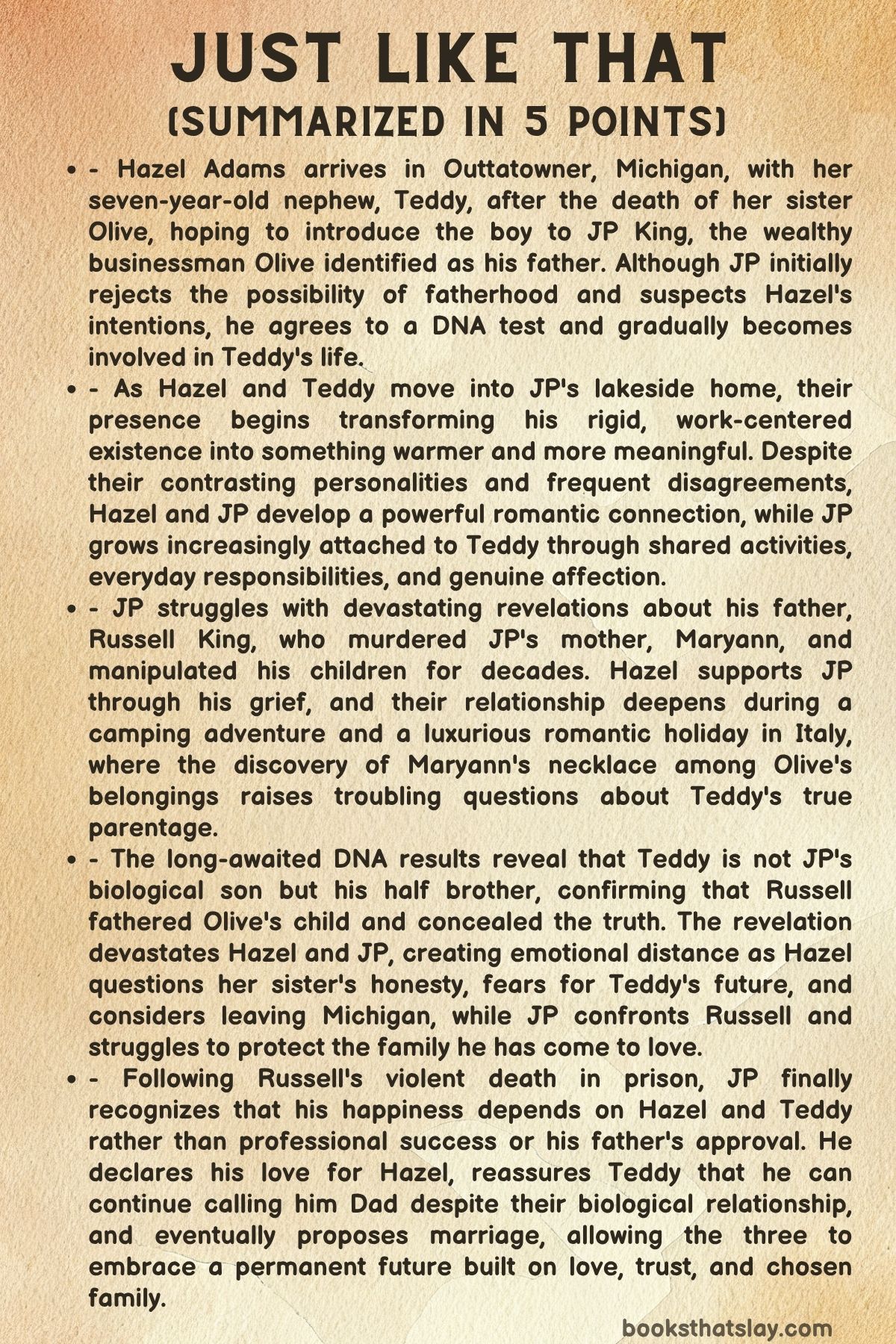
Hazel Adams arrives in Outtatowner, Michigan, with her seven-year-old nephew, Teddy, hoping to fulfill her deceased sister Olive’s final wishes. Four months after Olive’s death, Hazel is still struggling with grief and the unexpected responsibilities of raising a child.
Her arrival takes a frightening turn when Teddy disappears. With assistance from a local woman named Sylvie, the police, and the fire department, Hazel discovers that he has gone to the fire station searching for JP King, the man he believes is his father.
JP is the wealthy head of King Equities, a family business threatened by revelations about his father, Russell King. Russell has been arrested following discoveries suggesting that he murdered his wife, Maryann, decades earlier and convinced their children that she had abandoned them.
Already overwhelmed by business troubles and family responsibilities, JP reacts with disbelief when Teddy identifies himself as his son. He does not recognize Olive’s name and suspects Hazel may be pursuing financial advantages.
Hazel explains that Olive identified JP as Teddy’s father in documents and a final letter. Although offended by JP’s suspicions, she agrees that a DNA test is necessary to establish the truth.
Their first encounters reveal sharply contrasting personalities. Hazel is adventurous, outspoken, and accustomed to traveling in a converted school bus, while JP values structure, financial security, and careful planning.
Nevertheless, Teddy’s enthusiasm gradually softens JP’s resistance. When JP learns that Hazel and Teddy are living in their bus, he allows them to park on his secluded lakeside property.
Hazel initially regards JP as an arrogant businessman, but she notices tenderness beneath his stern exterior. JP, meanwhile, finds himself increasingly distracted by Hazel’s confidence, humor, and unconventional lifestyle.
A meeting with Judge Burns establishes temporary arrangements allowing JP to become involved in Teddy’s life while the DNA results remain pending. During the proceedings, Hazel presents a photograph showing Olive with a younger JP, although he still cannot remember meeting her.
Teddy’s desire to know his father begins changing JP’s attitude. The boy explains that Olive always believed JP possessed a good soul, an observation that affects him despite his emotional reservations.
As Hazel and Teddy become familiar with Outtatowner, they form friendships with members of the King and Sullivan families. Hazel befriends Lark and becomes increasingly attracted to the town’s welcoming community.
JP’s family history remains a source of anguish. The Kings and Sullivans, once bitter rivals, have begun cooperating to uncover the truth about Maryann’s disappearance.
During a family gathering, Duke Sullivan announces developments concerning an investigation of Wabash Lake, where authorities suspect Russell concealed evidence of Maryann’s murder.
The news unsettles JP, but his attention also turns toward Teddy’s living conditions. Realizing that his enormous house could provide the child with greater comfort, JP unexpectedly invites Hazel and Teddy to move inside.
Hazel is surprised by the offer, particularly after JP’s initial hostility. Nevertheless, she accepts, recognizing that the arrangement could provide Teddy with stability.
Their shared living situation gradually resembles a family home. JP attempts to make pancakes, purchases a booster seat, arranges Teddy’s school enrollment, and begins planning activities around the child’s interests.
Hazel witnesses the emotional significance of these ordinary gestures. JP’s growing willingness to participate in family life makes her reconsider her assumptions about him.
Their relationship also develops romantically. An unexpected kiss reveals their mutual attraction, although Hazel struggles with guilt because she believes JP once had a relationship with Olive.
Hazel becomes involved with the Bluebird Book Club, whose members welcome her into their close-knit community. Their companionship helps her confront her loneliness and imagine a future beyond constant travel.
Meanwhile, JP begins relaxing his rigid habits. During an intimate tarot-reading session, he allows Hazel to introduce him to her spiritual interests, and their attraction becomes increasingly difficult to conceal.
A family beach outing further strengthens their connection. Watching JP play with Teddy, Hazel recognizes his capacity for affection and notices the resemblance between them.
The investigation into Maryann’s death eventually produces devastating evidence. JP must accept that his mother did not voluntarily abandon her children but was murdered by the father who controlled their lives.
Hazel comforts him, recognizing that his childhood was shaped by betrayal and emotional neglect. Her compassion allows JP to acknowledge grief that he has spent years suppressing.
Hoping to give him relief from his responsibilities, Hazel organizes a surprise camping trip with Teddy. JP initially resists but eventually enjoys the opportunity to experience an uncomplicated family adventure.
The trip brings Hazel and JP closer together. Their private moments reveal genuine tenderness, although Hazel continues worrying that loving him might represent a betrayal of Olive’s memory.
JP subsequently visits Russell in prison, hoping to confront the father who shaped his ambitions and insecurities. Russell admits that he considered JP useful because his desire for approval made him easy to manipulate.
The encounter forces JP to recognize that his professional identity was built around satisfying a cruel and controlling parent. He begins questioning whether preserving King Equities is worth sacrificing his own happiness.
His growing attachment to Hazel becomes impossible to ignore when she arranges a date with Charles Attwater. JP reacts with jealousy and interferes with the proposed meeting, even while pretending that Hazel is merely his friend.
Their prolonged romantic uncertainty finally ends when JP openly acts on his feelings. Hazel responds enthusiastically, and their relationship develops into a passionate partnership.
However, emotional commitment remains difficult for JP. Although he acknowledges how important Hazel and Teddy have become, he hesitates to make promises while their circumstances remain uncertain.
JP eventually arranges an extravagant romantic trip to Italy, allowing Hazel and Teddy to choose how they want to spend the time. Teddy decides to remain with trusted relatives in Michigan, giving Hazel and JP an opportunity to enjoy their relationship independently.
Before their departure, JP experiences a frightening moment when Teddy temporarily disappears from his sight during a carnival. Finding him safe with Sloane brings enormous relief and makes JP realize that his love for the boy no longer depends on biological confirmation.
In Italy, Hazel discovers a different side of JP’s personality. His luxurious travel arrangements contrast with her improvised adventures, but she appreciates the care behind his meticulous planning.
Along the Amalfi Coast, their relationship deepens. JP admits that Hazel and Teddy have changed him, while Hazel confesses that she originally intended to confront him, secure his surrender of parental rights, and leave Michigan.
Instead, she has fallen in love with him.
Their happiness is interrupted when JP recognizes a necklace Hazel is wearing. The jewelry belonged to his mother, Maryann, but Hazel explains that she inherited it from Olive.
The discovery raises disturbing questions about Olive’s connection to the King family. JP begins suspecting that Russell may have given Olive the necklace, suggesting a hidden relationship that neither Hazel nor JP previously considered.
Back in Michigan, the long-awaited DNA results finally arrive.
The test reveals that Teddy is not JP’s biological son. Instead, the evidence indicates that Teddy is JP’s half brother, making Russell King the boy’s biological father.
The revelation devastates both adults. JP realizes that Russell’s exploitation extended into another generation, while Hazel discovers that Olive concealed the truth about Teddy’s parentage.
JP confronts Russell in prison, where his father confirms his involvement with Olive. Russell’s cruel suggestion that Teddy might become another obedient successor enrages JP, who physically attacks him before being restrained.
Hazel struggles with feelings of betrayal toward Olive. Through reflection and support from her friends, she begins considering whether Russell exploited her sister’s vulnerability and desire for financial security.
The revelation creates emotional distance between Hazel and JP. Although they still love each other, Hazel fears that the complicated biological connection may endanger Teddy’s future.
She retreats to the school bus with Teddy, uncertain whether remaining in Outtatowner is the right decision. JP interprets her withdrawal as a sign that he may lose the two people who have become central to his happiness.
Teddy senses Hazel’s distress and encourages her not to become consumed by every possible difficulty. His simple advice reminds her that the relationships they have built remain meaningful despite the unexpected truth.
Meanwhile, JP receives news that Russell has been violently attacked in prison. His brother Abel brings him to meet Oliver, the imprisoned man responsible for the assault.
Oliver explains that he acted to protect the family from Russell’s continuing threats. Shortly afterward, JP learns that his father has died from the injuries.
Russell’s death brings conflicting emotions. JP feels relief that his father can no longer harm them, but he must also accept that he will never receive the paternal love and approval he once desired.
The experience clarifies his priorities.
Returning to Hazel, JP declares that he loves her and wants a permanent future with her and Teddy. He refuses to allow Russell’s actions or the DNA results to destroy the family they have created.
JP also speaks privately with Teddy, explaining that they share the same biological father and are therefore half brothers. Teddy asks whether he can continue calling JP Dad, and JP assures him that he can.
Their conversation establishes that fatherhood, for JP, is now a commitment based on affection and responsibility rather than genetics.
The King siblings subsequently gather to discuss Russell’s death and the arrangements concerning his remains. Their conversations reveal the enduring consequences of his secrets but also their growing determination to establish healthier family relationships.
Hazel and JP agree to make their living arrangement permanent. Hazel recognizes that her freedom no longer requires constant movement, while JP realizes that professional success cannot replace meaningful personal relationships.
The family also decides that therapy will help them process their losses and establish a healthier future.
Their relationship reaches its conclusion when JP proposes marriage with an alexandrite engagement ring, a gemstone associated with change and transformation.
Hazel joyfully accepts, understanding that their unexpected journey has given them the love, stability, and belonging neither originally expected.
Characters
Hazel Adams
Hazel Adams is the female protagonist of Just Like That, whose transformation from an independent traveler into a committed guardian and romantic partner provides much of the novel’s emotional development. Her personality combines humor, spontaneity, stubbornness, and an underlying fear that she is incapable of providing the stability Teddy deserves.
Before Olive’s death, Hazel spent years traveling in a converted school bus and developing a successful social media presence. Her freedom allowed her to avoid permanent responsibilities, but it also created distance between her and her sister.
Olive’s death forces Hazel to confront the consequences of that independence. Becoming Teddy’s guardian introduces responsibilities for which she feels unprepared, and she constantly compares herself unfavorably with Olive’s maternal abilities.
Her protectiveness is apparent from the beginning, particularly when Teddy disappears shortly after their arrival in Outtatowner. The incident intensifies her insecurity but also establishes how deeply she loves her nephew.
Hazel’s initial hostility toward JP comes from her determination to defend Olive and Teddy. She interprets his skepticism as cruelty, especially because she believes her sister trusted him to become involved in her child’s life.
However, Hazel possesses considerable emotional intelligence beneath her sarcastic exterior. She gradually recognizes JP’s loneliness, his troubled childhood, and the enormous responsibilities imposed upon him by his family.
Her relationship with JP challenges her understanding of independence. She discovers that accepting help does not necessarily mean surrendering control over her own life.
Hazel’s attraction to him also exposes her unresolved grief. Believing he was once romantically involved with Olive, she struggles with the possibility that pursuing him represents disloyalty to her sister.
The revelation about Teddy’s biological father creates an even greater conflict. Hazel must accept that Olive deliberately concealed important information, forcing her to reconsider a relationship she had previously viewed through the lens of idealized memories.
Rather than simply condemning her sister, Hazel attempts to understand the circumstances that may have influenced Olive’s decisions. This ability to consider uncomfortable possibilities demonstrates her growing emotional maturity.
Her friendships with the Bluebird women also influence her development. For someone accustomed to constantly moving, their acceptance offers a new understanding of community and belonging.
By the end of the book, Hazel recognizes that stability and freedom can coexist. Her decision to establish a permanent home with JP and Teddy reflects growth rather than the abandonment of her individuality.
JP King
JP King is the male protagonist of Just Like That, initially characterized by his wealth, emotional restraint, distrust, and unwavering devotion to professional responsibilities. His transformation involves confronting the destructive influence of his father and learning to value relationships above control.
As the leader of King Equities, JP carries enormous pressure to protect the family business from the consequences of Russell’s crimes. He believes that maintaining order and financial stability is essential to preventing further damage.
His upbringing explains much of his difficult personality. Russell manipulated JP’s desire for paternal approval, encouraging him to equate professional achievement with personal worth.
JP’s first response to Teddy’s claim of parentage is suspicion. He cannot remember Olive and assumes Hazel may have financial motives, illustrating how deeply distrust has become embedded in his thinking.
Despite his harshness, JP gradually reveals an instinctive capacity for care. His decisions to purchase a booster seat, arrange school enrollment, prepare breakfast, and provide comfortable accommodations demonstrate affection before he can openly acknowledge it.
His relationship with Teddy becomes central to his personal transformation. The boy’s unconditional trust allows JP to experience a form of love that was largely absent from his childhood.
His romance with Hazel presents a different challenge. Her unconventional lifestyle disrupts his routines, while her refusal to be intimidated exposes the limitations of his controlling behavior.
JP’s attraction gradually becomes emotional dependence, which frightens him because vulnerability conflicts with the identity he has carefully constructed.
The discoveries about Maryann’s death and Russell’s manipulation force JP to reassess his father. He recognizes that the business empire he has dedicated himself to preserving may represent the continuation of Russell’s harmful legacy.
The DNA revelation represents his greatest emotional test. Discovering that Teddy is his half brother rather than his biological son requires JP to separate his understanding of fatherhood from genetic identity.
His decision to continue raising Teddy demonstrates that he has rejected Russell’s transactional view of family relationships.
By openly declaring his love for Hazel and proposing marriage, JP finally abandons the belief that emotional commitment represents weakness. His development establishes him as a man who learns to define success through love, integrity, and chosen responsibility.
Teddy Adams
Teddy Adams serves as the emotional center of Just Like That, connecting Hazel and JP while challenging their assumptions about love and responsibility. Although only seven years old, he possesses unusual intelligence, curiosity, confidence, and emotional sensitivity.
Having lost his mother, Teddy approaches the possibility of meeting his father with remarkable optimism. His decision to seek JP at the fire station demonstrates both his determination and his limited awareness of the potential consequences.
Teddy’s intelligence frequently appears through his fascination with science, books, and unusual facts. His curiosity creates humorous exchanges with the adults while emphasizing his distinctive personality.
His similarities to JP initially appear to support the assumption that they are father and son. Their shared seriousness, preference for certain clothing, and physical resemblance create a connection that becomes especially meaningful after the eventual revelation.
Unlike Hazel, Teddy does not initially approach JP with suspicion. He believes Olive’s description of the man as fundamentally good and offers him affection without demanding immediate proof of deserving it.
His trust gradually encourages JP to become more emotionally available. Ordinary activities such as breakfast, beach outings, and camping become opportunities for JP to develop genuine parental instincts.
Teddy also possesses an emotional understanding that contrasts with his age. When Hazel retreats into uncertainty, he recognizes her sadness and encourages her to stop imagining every possible disaster.
The revelation about Russell threatens to undermine Teddy’s understanding of his family. However, his response when JP explains their biological relationship demonstrates his ability to distinguish between family labels and emotional reality.
His request to continue calling JP Dad becomes one of the novel’s defining moments. It confirms that his attachment depends on the love he receives rather than the exact nature of their genetic connection.
Ultimately, Teddy represents hope and the possibility of establishing healthy relationships after loss. His presence helps both protagonists discover versions of themselves they might never have encountered otherwise.
Olive Adams
Olive Adams is a deceased but profoundly influential character whose decisions shape nearly every significant development in the novel. As Hazel’s older sister and Teddy’s mother, she initially exists through memories, written instructions, and the affection others continue to feel for her.
Hazel remembers Olive as optimistic, charismatic, and adventurous. These qualities contribute to an idealized image of a woman who appeared capable of handling responsibilities more successfully than her younger sister.
Olive’s final letter sends Hazel to Outtatowner by identifying JP King as Teddy’s father. This decision creates the circumstances that bring Hazel, JP, and Teddy together.
However, Olive’s apparent certainty becomes increasingly troubling when JP cannot remember their supposed relationship. The photograph Hazel produces and the mysterious necklace subsequently complicate the question of what actually happened.
The DNA results expose the central deception: Russell King, not JP, is Teddy’s biological father.
This revelation changes Olive’s characterization considerably. Rather than existing solely as a loving mother whose wishes deserve unquestioning obedience, she emerges as someone capable of hiding painful truths.
The novel suggests that Russell may have exploited Olive’s vulnerability and desire for security through money, gifts, and promises. Nevertheless, the precise emotional circumstances of their relationship remain less certain than its consequences.
Olive’s decisions place both Hazel and Teddy in difficult situations after her death. Hazel must reconcile her love for her sister with anger over the deception that shaped their new lives.
Yet Olive is not reduced entirely to her mistakes. Her affection for Teddy and the memories she created remain meaningful even after the truth emerges.
Through Olive, the novel examines the difficulty of loving someone whose decisions caused suffering. Her character illustrates how grief can coexist with disappointment, anger, and a continuing desire for understanding.
Russell King
Russell King is the principal antagonist of Just Like That, representing manipulation, cruelty, entitlement, and the destructive consequences of using family relationships as instruments of power. Although much of his involvement occurs through the revelations surrounding his crimes, his influence dominates the lives of the central characters.
Russell’s most devastating crime is the murder of his wife, Maryann. By convincing his children that she abandoned them, he deprived them of their mother while controlling their understanding of their own childhood.
His manipulation extends beyond concealing the murder. He deliberately shapes JP into a loyal successor, exploiting his son’s ambition and need for approval to secure control over King Equities.
Russell considers relationships according to their usefulness. His dismissal of his other sons and his treatment of JP as an investment reveal his inability to recognize family members as independent individuals.
His concealed relationship with Olive further exposes his exploitation of vulnerable people. The gifts, promises, and financial arrangements associated with their connection suggest an imbalance of power.
The discovery that Russell fathered Teddy demonstrates how his actions continue harming younger generations. His reaction is particularly disturbing because he views the child as another potential instrument of control.
Rather than expressing regret, Russell imagines creating the obedient successor he believes JP failed to become.
His death in prison ends his direct threat but does not erase the damage he caused. The King siblings must still process their mother’s murder, their father’s manipulation, and the discovery of additional family connections.
Russell functions as a contrast to JP’s eventual understanding of fatherhood. Where Russell seeks obedience and personal advantage, JP learns that being a parent requires patience, affection, and responsibility.
Maryann King
Maryann King is the deceased mother of the King siblings, whose disappearance and murder provide the novel with a significant emotional and investigative foundation. Although she does not participate directly in the present-day narrative, her absence shapes JP’s childhood and adult identity.
For decades, her children believed that she had abandoned them. This false explanation deprived them not only of their mother but also of an honest understanding of their family history.
The discovery of Russell’s responsibility transforms their memories of childhood. JP must recognize that the woman he believed rejected him was actually the victim of a terrible crime.
Maryann also represents the love and security that Russell denied his children. The photographs preserved by the Bluebird Book Club allow Hazel to see JP as a vulnerable boy whose emotional difficulties began long before adulthood.
The investigation into Wabash Lake creates an opportunity for the family to confront the truth. Although the discoveries intensify their grief, they also challenge Russell’s control over their memories.
Maryann’s necklace becomes particularly important because it links Olive to Russell’s concealed activities. This object ultimately helps JP question the original explanation of Teddy’s parentage.
Her character illustrates how the truth about a deceased person can transform the lives of those who survive them. Through the recovery of Maryann’s story, the King siblings gain an opportunity to understand their past without relying on their father’s lies.
Royal King
Royal King, JP’s brother, represents independence from the controlling expectations imposed by Russell. As the owner of a tattoo shop, he has established an identity outside the corporate structure that dominates JP’s life.
Royal recognizes the destructive pressure surrounding King Equities and encourages JP to consider leaving the business behind. His advice challenges JP’s belief that maintaining the family company is an unavoidable obligation.
Although Royal is less interested in corporate responsibilities, he remains invested in the well-being of his siblings. His involvement in family gatherings and efforts to support JP demonstrates loyalty without the need for obedience.
Royal also assists Hazel in arranging the camping trip, helping create an experience that encourages JP to temporarily abandon his professional obligations.
His relationship with Veda provides an example of affectionate partnership within the wider family. Their interactions offer Hazel a contrast to the uncertainty surrounding her own developing romance.
Royal’s importance lies partly in demonstrating that the King siblings do not need to follow identical paths to establish meaningful lives. His independence offers JP an alternative model of adulthood based on personal choice rather than paternal approval.
Veda
Veda is a supportive member of the King family’s wider circle and an important influence on Hazel’s developing understanding of relationships. Her connection with Royal and familiarity with the family’s history allow her to recognize tensions that Hazel sometimes struggles to interpret.
She offers Hazel companionship during gatherings and encourages her to consider JP’s behavior more critically. Rather than accepting his emotional distance as unavoidable, Veda suggests that Hazel should recognize her own worth.
Her advice reflects an understanding that attraction alone cannot sustain a healthy relationship. Emotional commitment requires both people to acknowledge their feelings and accept responsibility for their choices.
Veda also contributes to the warmth of the extended family community. Her affectionate exchanges with Royal provide Hazel with an example of a relationship in which confidence and vulnerability can coexist.
Through Veda, the novel reinforces the importance of female friendship and honest emotional guidance.
Lark
Lark is one of Hazel’s first genuine friends in Outtatowner and helps introduce her to the town’s social environment. Her welcoming personality provides Hazel with companionship during a period marked by grief, uncertainty, and unfamiliar responsibilities.
Their friendship allows Hazel to discuss her concerns about Teddy and JP without constantly defending herself. Lark’s willingness to listen creates a sense of emotional safety that Hazel has rarely experienced during her years of travel.
Lark also offers observations about the King family. Her knowledge of Russell’s behavior and the suffering of his children helps Hazel interpret JP’s emotional guardedness with greater compassion.
During the beach outing, Lark notices the physical resemblance between JP and Teddy, reinforcing the assumption that they are father and son.
Although this interpretation later proves incomplete, the conversation highlights how convincingly the apparent family relationship has developed.
Lark represents the ordinary friendships through which Hazel gradually becomes attached to Outtatowner. Her presence demonstrates that belonging can begin through small acts of welcome and understanding.
Sylvie
Sylvie plays a significant role in Hazel’s introduction to Outtatowner, immediately assisting when Teddy disappears. Her ability to organize help demonstrates the strong community connections that distinguish the town.
She later welcomes Hazel into the Bluebird Book Club, creating opportunities for friendship and emotional support. Through Sylvie, Hazel encounters women who possess complicated histories but remain committed to one another.
Sylvie’s personality combines warmth, humor, confidence, and a willingness to become involved in other people’s lives. Her social influence helps connect Hazel with the broader King and Sullivan families.
She also encourages JP to participate in unfamiliar social activities, contributing to his gradual willingness to relax and enjoy himself.
Her character represents the importance of community leadership expressed through everyday generosity rather than formal authority.
Abel King
Abel King is one of JP’s brothers and a protective figure within the extended King family. His loyalty becomes particularly visible during the later developments involving Russell.
He and Sloane provide a safe environment for Teddy while Hazel and JP travel to Italy. Their willingness to care for the boy shows how readily the wider family has accepted him.
Abel’s connection with Oliver becomes important when Russell is attacked in prison. Oliver claims that his actions were intended to protect Abel’s family and prevent Russell from causing further harm.
Abel accompanies JP to learn what happened, placing him beside his brother during another painful confrontation with their father’s legacy.
His character contributes to the novel’s portrayal of sibling loyalty and the complicated choices people make when attempting to protect loved ones.
Sloane
Sloane is a dependable member of the extended family whose care for children makes her especially important to Hazel and Teddy’s adjustment. She helps provide the stable support network Hazel initially fears she lacks.
Her willingness to organize sleepovers and look after Teddy gives Hazel opportunities to develop her friendships and romantic relationship with JP.
Sloane also becomes involved in moments that reveal JP’s emotional transformation. During the carnival incident, Teddy is safely with her while JP experiences overwhelming fear for the missing boy.
Her presence reassures the adults that Teddy is surrounded by people who genuinely care for him.
Sloane represents the practical forms of love that sustain family relationships, particularly the willingness to share childcare responsibilities.
Whip King
Whip King is another of JP’s brothers and a firefighter whose involvement helps initiate the central conflict. When Teddy appears at the fire station claiming JP is his father, Whip contacts JP and brings the situation to his attention.
His actions create the circumstances for JP’s first meeting with Hazel and Teddy.
Whip’s relationship with Maryann is also significant. Russell’s remarks suggest that Whip possessed a strong emotional attachment to their mother, making the truth about her murder especially painful.
Within the family, Whip contributes to the sense that the King siblings have experienced their father’s cruelty differently. Their shared suffering does not eliminate their individual emotional responses.
Aunt Bug
Aunt Bug is an affectionate and respected figure within the King family, providing continuity and emotional support during a period of upheaval. Her presence reveals aspects of JP’s personality that are less visible during his professional interactions.
Hazel notices his tenderness toward Aunt Bug, an observation that challenges her early impression of him as emotionally cold.
After Russell’s death, the siblings gather at Aunt Bug’s home to discuss family matters and arrangements concerning their father’s remains. Her home becomes a setting in which the family can confront painful realities together.
Aunt Bug symbolizes enduring familial affection that exists independently of Russell’s controlling influence.
Duke Sullivan
Duke Sullivan belongs to the family historically opposed to the Kings, yet his involvement in the investigation of Maryann’s disappearance reflects the changing relationship between the two clans.
His announcement concerning Wabash Lake becomes an important turning point because it brings the possibility of recovering evidence about Maryann’s death closer to reality.
Through Duke, the story demonstrates how cooperation can replace generations of resentment when families recognize a shared moral responsibility.
His presence also contributes to the wider community environment that eventually welcomes Hazel and Teddy.
Judge Burns
Judge Burns provides legal structure to the uncertainty surrounding Teddy’s guardianship and presumed parentage. Rather than relying entirely on Hazel’s claims or JP’s objections, the judge emphasizes the importance of evidence and the child’s welfare.
The temporary arrangements allow JP and Teddy to establish a relationship while awaiting DNA confirmation.
This decision becomes crucial because their emotional attachment develops before the unexpected truth about Teddy’s biological father emerges.
Judge Burns represents an institutional perspective on family responsibilities, contrasting with the impulsive emotions influencing the central characters.
Charles Attwater
Charles Attwater serves as a minor but effective source of romantic conflict. Hazel’s proposed date with him forces JP to confront feelings he has repeatedly denied.
Charles’s reputation makes JP suspicious, but his reaction is driven largely by jealousy rather than detached concern.
The possibility of Hazel becoming involved with another man exposes the inconsistency between JP’s insistence on friendship and his actual emotional investment.
Charles therefore functions as a catalyst for JP’s eventual willingness to acknowledge his romantic desires.
Oliver
Oliver is an imprisoned associate of Abel whose violent intervention brings Russell’s life to an end. His actions introduce a morally difficult dimension to the family’s struggle for protection.
He admits to attacking Russell with a makeshift weapon and appears willing to accept additional punishment for his actions.
Oliver explains that his motivation was to prevent Russell from threatening Abel’s family again. His loyalty is presented alongside the disturbing reality of deliberate violence.
His involvement forces JP to confront the consequences of Russell’s cruelty beyond his immediate family.
Oliver’s character also raises questions about justice, revenge, and whether protecting loved ones can justify extreme actions.
MJ
MJ appears within the Bluebird social circle and contributes to the humor and interpersonal tensions surrounding the secondary characters. Her encounter with Logan suggests an unresolved personal history.
Her irritation at Logan’s teasing nickname creates immediate curiosity among the other women.
Although the supplied events do not establish the complete circumstances of their relationship, MJ’s reactions suggest strong feelings that she is unwilling to explain publicly.
Her presence adds individuality to the Bluebird community and demonstrates that its members possess their own complicated emotional lives.
Logan
Logan is introduced through his tense interaction with MJ, which attracts attention because of their obvious familiarity and antagonistic chemistry. His teasing manner suggests confidence and a willingness to provoke reactions.
The exchange provides comic relief during a period when Hazel is struggling with unsettling discoveries about Olive and the King family.
Logan’s broader motivations and personal history are not fully established in the supplied material, but his appearance introduces the possibility of a separate romantic conflict.
His character helps expand the social world beyond Hazel and JP’s immediate relationship.
Themes
The Meaning of Family Beyond Biological Relationships
Family in Just Like That is defined increasingly through affection, loyalty, and responsibility rather than genetic relationships or traditional household structures. Teddy’s connection with JP provides the clearest expression of this idea because their relationship develops under an assumption that eventually proves incorrect.
When Teddy first announces that JP is his father, JP responds with disbelief and demands scientific confirmation. His attitude reflects an understanding of parenthood grounded in biological evidence and legal responsibility.
However, the months they spend together gradually transform this perspective. JP begins caring for Teddy through ordinary gestures, including preparing meals, arranging school enrollment, providing transportation, and spending time with him.
These experiences create a relationship that becomes emotionally real before the DNA results arrive. JP discovers that parental love develops through shared experiences and continued commitment rather than simple biological certainty.
The revelation that Teddy is his half brother threatens the family’s established understanding of itself. Nevertheless, the discovery does not erase the trust and affection they have already developed.
Teddy’s request to continue calling JP Dad demonstrates the difference between biological classification and personal identity. For him, fatherhood is defined by the person who offers security, affection, and dependable care.
Hazel’s role reinforces this broader understanding of family. Although she is Teddy’s aunt, she assumes the responsibilities of motherhood after Olive’s death.
The extended King and Sullivan families provide further examples through their willingness to welcome Hazel and Teddy into their community.
The novel ultimately suggests that family relationships acquire meaning through everyday choices. Genetic connections may explain where individuals come from, but love and responsibility determine who remains beside them.
Grief, Betrayal, and Emotional Healing
Grief affects nearly every central relationship, yet the characters experience loss in profoundly different ways. Hazel mourns her sister, Teddy mourns his mother, and JP must confront the discovery that his own mother’s disappearance was the result of murder.
Hazel’s grief is complicated by guilt over her absence during Olive’s life. Having spent years traveling, she worries that she failed both her sister and Teddy by remaining emotionally and physically distant.
Her sudden responsibilities intensify this guilt. Whenever she struggles with guardianship, she imagines that Olive would have handled the situation more successfully.
The revelation about Russell adds betrayal to her mourning. Hazel discovers that the sister she admired concealed important information, forcing her to reconsider memories that previously provided comfort.
Her emotional development requires accepting that love does not demand an idealized understanding of the deceased. Olive can remain important to Hazel even after her mistakes become undeniable.
JP’s grief operates differently because it has been shaped by decades of deception. Russell’s claim that Maryann abandoned her children caused emotional wounds that influenced JP’s adult behavior.
Learning that his mother was murdered changes the meaning of his childhood. He must recognize that his feelings of abandonment were deliberately created by the person who should have protected him.
His eventual confrontation with Russell exposes the emotional abuse that underlies his relentless ambition and need for control.
In Just Like That, healing does not occur simply because the truth becomes known. The characters must also develop healthier relationships, acknowledge painful emotions, and accept support.
Their decision to pursue family therapy is particularly meaningful because it recognizes that love alone cannot automatically resolve longstanding trauma. Recovery requires honesty, patience, and a willingness to seek help.
Freedom, Stability, and Personal Transformation
Hazel and JP initially represent opposing understandings of a successful life. Hazel values mobility, spontaneity, and independence, while JP prioritizes financial achievement, controlled routines, and permanent structures.
Hazel’s converted school bus symbolizes her freedom from conventional expectations. It allows her to travel, work independently, and avoid the restrictions she associates with a settled life.
However, becoming Teddy’s guardian changes the practical and emotional meaning of this lifestyle. The uncertainty that once made travel exciting becomes more difficult when she must consider a child’s education, safety, and need for belonging.
JP represents the opposite problem. His enormous house and professional success provide material security, but his dedication to work leaves him isolated.
His commitment to King Equities is also influenced by Russell’s expectations. What appears to be personal ambition is partly the result of an upbringing that taught him to seek approval through achievement.
Hazel’s arrival disrupts his carefully controlled existence. Her colorful possessions, unusual routines, and spontaneous plans introduce experiences he would never have chosen independently.
The camping trip demonstrates the significance of this change. JP discovers that abandoning his schedule temporarily does not undermine his responsibilities and can instead strengthen his relationships.
Likewise, the Italian holiday allows Hazel to experience another form of freedom. By accepting JP’s planning and generosity, she realizes that receiving support does not necessarily diminish her independence.
Both characters eventually reject the extremes represented by their original lifestyles.
Hazel discovers that a permanent home can provide emotional security without eliminating adventure. JP learns that financial success means little when it prevents him from enjoying the people he loves.
Their personal transformation suggests that freedom and stability are not inherently incompatible. A fulfilling life may require finding a balance between individual desires, shared responsibilities, and emotional commitment.
Love, Trust, and the Courage to Become Vulnerable
The romance between Hazel and JP develops through conflict because both characters initially rely on emotional defenses. Hazel protects herself through humor and independence, while JP uses suspicion, authority, and professional discipline to maintain distance.
Their first interactions reveal how these defenses interfere with trust. JP assumes Hazel may be interested in his wealth, while Hazel interprets his guarded behavior as evidence that he lacks compassion.
Gradually, their experiences challenge these assumptions. Hazel witnesses JP caring for Teddy, and JP discovers that Hazel’s unconventional behavior does not make her irresponsible or incapable of providing love.
Their growing attraction becomes meaningful because it requires them to reveal parts of themselves they usually conceal.
JP’s vulnerability is particularly difficult because his father exploited his emotional needs. Russell used the promise of approval to encourage obedience, teaching JP that affection could become an instrument of control.
Hazel offers a different experience by recognizing his suffering without demanding that he conceal it. Her compassion during the discoveries about Maryann helps him acknowledge emotions he has spent years suppressing.
Hazel faces her own difficulty with trust. Her grief over Olive and her fear of failing Teddy make romantic happiness seem both desirable and dangerous.
She also worries that loving JP might constitute a betrayal of her sister. These concerns cause her to retreat when the truth about Teddy’s parentage emerges.
The temporary separation reveals that love cannot thrive when both individuals allow fear to determine their decisions.
JP’s eventual declaration of love represents a decisive rejection of his earlier emotional restraint. By choosing Hazel and Teddy despite their complicated circumstances, he demonstrates that commitment requires accepting uncertainty.
Hazel’s acceptance of his proposal reflects a similar willingness to risk vulnerability.
The novel presents lasting love not as the absence of fear or conflict but as the decision to remain emotionally present despite them. Trust develops when individuals acknowledge their weaknesses and repeatedly choose honesty, compassion, and commitment.