The Winged Game Summary, Characters and Themes
The Winged Game by Sophie Kim is a fantasy sports romance built around carriwitchet, a dangerous magical competition in which riders bond with Winged creatures and battle through the air for enchanted jewels. At its center are Taissa Cho, a disgraced former champion trying to reclaim the life taken from her, and Kion Locke, the rival whose actions helped destroy her career.
Their forced partnership grows into something far more complicated as a failing team, unexplained curses, criminal magic, buried trauma, and a crisis threatening every Winged creature force them to reconsider what they believe about each other, themselves, and the meaning of loyalty.
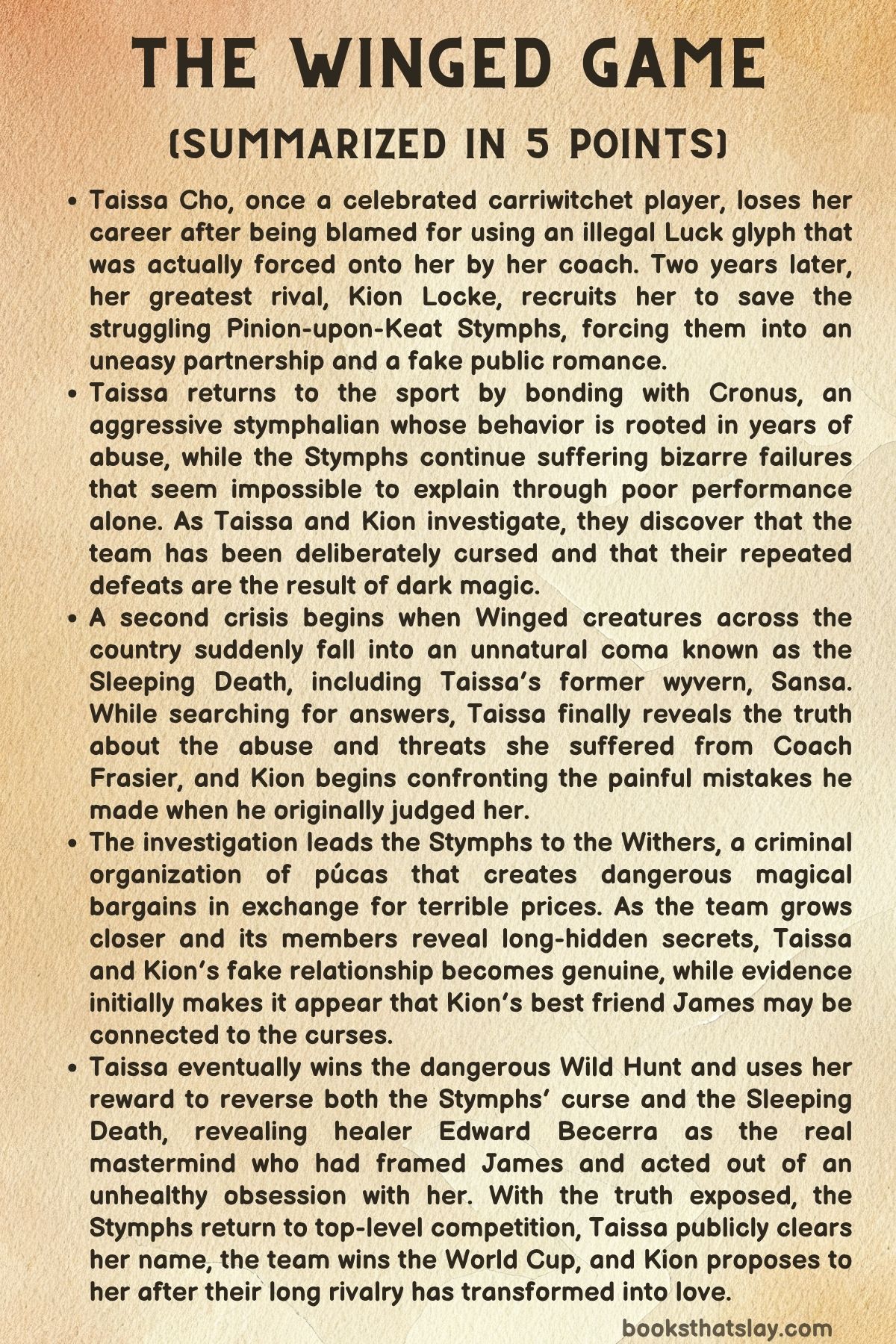
Summary
Two years before the main events, Kion Locke captains the Pinion-upon-Keat Stymphs against the Banallan Wyverns in a fiercely contested carriwitchet match. His greatest opponent is Taissa Cho, a gifted young Robber whose spectacular skill both frustrates and impresses him.
During the match, Taissa performs a daring aerial maneuver and steals the final jewel, but Kion notices an illegal Level Three Luck glyph on her neck. He reports what he has seen, beginning a scandal that destroys Taissa’s career and separates her from Sansa, the wyvern with whom she shares a magical Bond.
Two years later, Taissa is living in relative isolation in Scotland, working an unpleasant retail job and enduring the consequences of public disgrace. She still dreams about returning to carriwitchet, even though she has been expelled from the Wyverns, blacklisted by the league, harassed by strangers, and forced to live without Sansa.
Her bitterness toward Kion is especially intense because he had once been her idol. Years earlier she asked him to mentor her, only to experience what seemed to be a humiliating rejection, and his later role in exposing the Luck glyph transformed that disappointment into hatred.
Kion unexpectedly arrives at Taissa’s cottage because the Stymphs are facing dissolution after two disastrous seasons. Their team has become strangely incompetent, Samara is leaving because of her pregnancy, and Kion believes that Taissa remains one of the best Robbers the sport has ever produced.
Taissa refuses to make the reunion easy. When Kion admits that he needs her badly enough to save the team, she makes him kneel and beg before accepting the offer, gaining a measure of satisfaction from seeing her proud rival placed in a vulnerable position.
At Pinion-upon-Keat, Taissa encounters a team damaged by years of losing. The Stymphs are divided, old friendships are deteriorating, and club owner Bill Dodds is deeply suspicious of hiring someone still publicly considered a cheater.
Publicist Niamh quickly creates another complication when a photograph of Kion and Taissa traveling together inspires romantic speculation. Hoping to generate attention, money, and sponsorships, she persuades them to pretend that they are dating.
Taissa’s return to flying takes an unexpected form when she chooses Cronus, an elderly and notoriously violent stymphalian, as her new Winged. She discovers that Cronus’s aggression is largely the result of abuse from handler Hackit Markus, who burned, starved, punished, and frightened him until ordinary commands became associated with pain.
Instead of demanding obedience, Taissa offers Cronus a choice. Their Bond becomes possible because she promises to treat him as a partner rather than property, and their difficult relationship gradually becomes one of the strongest emotional connections in the story.
Training remains disastrous. Taissa is physically out of condition, Cronus resists traditional riding techniques, and the Stymphs display such extraordinary levels of failure that ordinary bad luck seems increasingly unlikely.
Meanwhile, the staged romance between Taissa and Kion begins changing their personal relationship. Their exaggerated public affection produces accidental kisses, jealousy, comic misunderstandings, and moments of genuine attraction that neither wants to acknowledge.
Their comeback match against the Cockatrices changes the direction of the story when every opposing Winged suddenly loses consciousness in the air. The Stymphs abandon the competition and attempt dangerous rescues, but the event causes deaths, injuries, and panic.
Taissa immediately falls under suspicion because of her previous Luck-glyph scandal. This time, however, Kion publicly defends her, marking an early sign that his certainty about her guilt is beginning to weaken.
The disaster becomes known as the Dust Bite, while Taissa becomes convinced that the Stymphs’ endless failures may also have supernatural origins. With Kion’s help, she visits Alun Davies, a síceach who discovers black marks in their magical auras and confirms that the team is suffering from an Unlucky curse.
The crisis soon expands beyond the Stymphs. Taissa senses Sansa calling to her through the remains of their supposedly severed Bond and realizes that the Wyverns have fallen into the same mysterious coma as the Cockatrices.
Kion accompanies Taissa and several teammates on a secret journey into the Banallan Nexitory. There, Taissa finally confronts memories of what actually happened during the scandal: Coach Colum Frasier exploited her vulnerability after her father’s death, physically restrained her, forced the Luck glyph onto her body, and threatened Sansa to guarantee her silence.
When Taissa eventually tells Kion the truth, he believes her immediately. He is horrified by his own role in condemning her and promises that she will never have to confront Frasier alone again.
Kion, in return, reveals the truth about his childhood. He grew up in the abusive Waywardly Home, invented the respectable family background he later presented to the public, and carries physical and emotional scars from years of violence.
Their old perceptions begin collapsing. Taissa realizes that the man she once saw first as an idol and then as a monster is deeply afraid of attachment and abandonment, while Kion recognizes that the arrogant cheater he imagined was actually someone struggling under coercion, fear, and isolation.
The mystery of the sleeping Wingeds grows more dangerous as species throughout the country collapse. Strangely, the stymphalians remain unaffected.
Evidence collected from Sansa includes mysterious black dust that forms the image of a black horse when exposed to fire. James eventually connects this phenomenon to púcas and the Withers, a criminal organization known for dangerous supernatural bargains.
Taissa and Kion confront Orla Banes, leader of the Withers, and learn that the Sleeping Death was commissioned by an unknown client. They also discover that a different client hired the organization two years earlier to curse the Stymphs.
Hackit Markus initially appears connected to the crime, but interrogation reveals that he only acted as a proxy for a concealed mastermind. The real culprit carefully avoided direct contact with the púcas.
As the investigation continues, James becomes increasingly ill. His body begins aging unnaturally, and evidence found in his room suggests that he may have made the bargain responsible for destroying the Stymphs’ competition.
Kion desperately resists the idea because James is his closest friend. His decision to defend James despite incriminating evidence causes a serious argument with Taissa, who cannot ignore the painful contrast between Kion’s loyalty to James and his refusal to believe her during her own scandal.
Kion eventually apologizes, and their relationship becomes officially real rather than a publicity arrangement. At the same time, the wider team begins recovering its emotional unity as members reveal secrets, fears, crimes, losses, and personal struggles they had previously hidden from one another.
The authorities discover one possible way to reverse the curses. During the Wild Hunt, a Seelie rider must secretly mount a púca in horse form, remain aboard through the dangerous race, finish first, and claim a boon that the púca must grant without extracting a price.
The Stymphs enter the Wild Hunt disguised as Unseelie. One by one, the riders fall behind until only Kion and Taissa remain in the race.
Taissa narrowly defeats Kion and wins the right to demand a boon from Orla. She carefully asks for both the Stymphs’ performance curse and the Sleeping Death to be reversed without hidden consequences, causing the afflicted Wingeds to awaken.
A supernatural gift of knowledge then reveals the mastermind: Edward Becerra, the Stymphs’ healer. Edward had long been obsessed with Taissa, had previously stalked her, and originally cursed Kion’s team as retaliation connected to her downfall.
When Taissa unexpectedly joined the Stymphs, Edward tried to correct his first bargain by making another wish that the Stymphs would have no competition. The púcas interpreted that demand catastrophically, creating the Sleeping Death, while Edward framed James to hide his responsibility.
Edward is arrested, James recovers, and the Stymphs finally play without supernatural interference. One month later they defeat the Perytons and earn promotion back to the Major League.
Taissa also publicly exposes Frasier, this time surrounded by people prepared to believe and defend her. Her reputation begins to recover not because she becomes someone new, but because the truth about who she always was finally receives a hearing.
Taissa and Kion openly declare their love for one another, while the restored Stymphs move forward as a stronger team. Their professional recovery eventually carries them to the World Cup final in Brazil.
There, Taissa repeats the extraordinary aerial maneuver that first attracted Kion’s attention years earlier, now with no illegal glyph attached to her success. Her performance proves that the brilliance people once attributed to cheating belonged to her all along.
The Stymphs win the World Cup, and during the celebration Kion proposes to Taissa. She jokingly refuses before accepting, bringing their journey from admiration and hatred to trust, partnership, love, and a shared future to its conclusion.
Characters
Taissa Cho
Taissa is the emotional center of The Winged Game, a character whose confidence, aggression, humor, and competitiveness exist alongside deep damage caused by betrayal and public humiliation. Her apparent hardness is largely defensive, developed after the sport she loved rejected her and the people around her accepted a false version of what happened.
Her relationship with carriwitchet is central to her identity. Losing her career means more than losing employment or fame because flying, competing, and bonding with a Winged gave structure to her sense of self, making her return to the Stymphs a personal restoration as much as a professional one.
Taissa’s history with Frasier explains many of her emotional reactions. She was manipulated when grieving her father, physically forced to carry the illegal Luck glyph, and then silenced through threats against Sansa, leaving her trapped between protecting her Winged and defending her own reputation.
Her bond with Cronus reveals one of her strongest qualities: she is capable of recognizing pain beneath aggression because she understands what it means to be judged only by outward behavior. Rather than trying to dominate him, she offers choice, patience, and protection, creating a partnership based on consent rather than control.
Taissa’s relationship with Kion develops because she gradually stops treating him as a symbol of everything that happened to her. Once she learns about his trauma, fear, scars, and misunderstandings, anger becomes empathy without requiring her to pretend that his previous treatment of her did not matter.
Her eventual victory is therefore larger than winning matches. By returning to professional play, exposing Frasier, restoring her reputation, building a new Bond with Cronus while recovering her connection with Sansa, and forming a healthier relationship with Kion, Taissa reconstructs a life that other people tried to define for her.
Kion Locke
Kion begins The Winged Game as a proud, controlling captain whose confidence often appears absolute. Beneath that public identity is a survivor of childhood violence who built his adult life around discipline, achievement, secrecy, and the desperate need to create a family that would not abandon him.
The Stymphs matter so deeply to Kion because they are not merely teammates. After growing up in the Waywardly Home without reliable affection or protection, he treats the team as proof that he finally belongs somewhere, which explains why the possibility of its dissolution produces such intense fear.
His greatest flaw is the certainty with which he judges people when he believes he possesses enough evidence. He sees Taissa’s Luck glyph and assumes guilt, then spends years reinforcing that interpretation instead of asking whether circumstances might be more complicated.
His growth requires him to recognize how damaging that certainty can be. Believing Taissa when she finally tells him about Frasier becomes important not because it erases what Kion previously did, but because it marks his willingness to listen rather than impose his existing version of events.
Kion’s fear of abandonment also shapes his romantic behavior. Attraction frightens him because emotional dependence represents vulnerability, and his admission that he becomes attached easily reveals why he prefers arguments, competition, and control to openly acknowledging how much another person matters to him.
His relationship with Taissa eventually teaches him that trust cannot be created through perfect control. By revealing his childhood, showing his scars, admitting responsibility for Quaid’s death, considering therapy, and allowing his teammates to know the truth about him, Kion begins replacing secrecy with genuine connection.
Cronus
Cronus is one of the clearest examples of how outward aggression can conceal long-term suffering. He is introduced as an old, dangerous stymphalian whom nearly everyone considers violent, but Taissa quickly recognizes that his behavior has been shaped by repeated abuse.
Hackit Markus conditioned Cronus to associate commands with burning, starvation, physical punishment, and fear. His refusal to cooperate is therefore not simple stubbornness but a survival response created by someone who repeatedly used authority as an excuse for cruelty.
Taissa’s decision to bond with him changes their lives because she refuses to demand submission. She asks him to choose partnership, allowing Cronus to preserve autonomy even within the magical Bond between rider and Winged.
His sarcastic, irritable personality prevents him from becoming merely a symbol of victimhood. Cronus remains difficult, jealous, aggressive, and darkly funny, giving him a personality independent of the abuse he survived.
His jealousy toward Sansa also reveals vulnerability. When he fears Taissa may abandon him for her first Winged, his reaction shows how deeply he has come to value the security she offers.
By the end, Cronus has not been transformed into an obedient creature. Instead, he becomes a willing partner who trusts Taissa precisely because she never requires him to stop being himself.
Sansa
Sansa represents Taissa’s lost life and the injustice of her expulsion. Their Bond was supposed to be permanent, making its forced severing one of the most painful consequences of the Luck-glyph scandal.
Even after authorities attempt to erase their connection, traces remain. Taissa’s ability to hear Sansa during the Sleeping Death confirms that their relationship survived magical separation at some deeper level.
Sansa is also central to understanding why Taissa remained silent about Frasier. His threats against the wyvern forced Taissa to choose between defending herself publicly and protecting the creature she loved.
Her eventual restoration to Taissa’s life carries symbolic weight because it repairs something that powerful people tried to destroy permanently. Sansa’s presence beside Cronus at the World Cup shows that Taissa does not need to choose between her past and present Bonds.
James Ridgeshaw
James is Kion’s closest friend and one of the most complicated members of the Stymphs. He serves as Kion’s emotional anchor during traumatic episodes, making his friendship one of the few places where Kion initially allows genuine dependence.
His distrust of Taissa is partly protective. Having watched years of hostility between her and Kion, James sees her arrival as a potential threat to someone whose vulnerabilities he understands better than most.
His anger over the fake relationship also exposes how deeply he values honesty within their friendship. Kion’s willingness to lie to him hurts because James believes their closeness should make secrecy unnecessary.
James’s own secrecy eventually creates a parallel problem. He hides the seriousness of his Fading Fever because he fears becoming a burden and believes being medically removed could contribute to the team’s destruction.
The evidence that appears to implicate him in the púca bargains is convincing because James really has considered making such a bargain. His willingness to sacrifice himself to save the team shows devotion, but it also demonstrates how fear can push loyalty toward self-destructive extremes.
His reconciliation with Kion requires both men to acknowledge that protecting someone by withholding the truth can damage the relationship they are trying to preserve. Their friendship becomes stronger once they stop treating vulnerability as something that must be hidden.
Cato
Cato is Kion’s stymphalian and one of the stable forces in his life. Their established Bond contrasts with Taissa and Cronus’s uncertain beginning, showing what long-term cooperation between rider and Winged can become.
Cato also helps communicate the history of Cronus’s mistreatment. His knowledge contributes to Kion’s growing recognition that the older stymphalian’s violent reputation was created partly by human cruelty rather than natural viciousness.
As Cronus gradually reconnects with other stymphalians, Cato becomes part of that recovery. His presence therefore reinforces the wider restoration taking place within both the human team and its Wingeds.
Niamh
Niamh operates as the Stymphs’ publicist and understands attention as a resource almost as valuable as athletic success. Her decision to turn speculation about Kion and Taissa into a fake relationship initially appears ridiculous, but it becomes financially and strategically important.
She is highly pragmatic and often views crises through the possibilities they create for publicity. That attitude can appear insensitive, especially when the characters are dealing with genuine danger, trauma, and professional collapse.
Yet her campaign helps rehabilitate Taissa’s reputation. Public opinion gradually shifts from hostility toward curiosity and eventually admiration, giving Taissa social space to reclaim the identity that scandal took from her.
Niamh therefore represents the strange power of public narrative. The same culture that helped destroy Taissa can be manipulated into reconsidering her, even before the full truth becomes public.
Óríon
Óríon initially appears eccentric, mischievous, and suspiciously knowledgeable about illegal magic. His abilities make him particularly useful when the team needs stealth, magical deception, or unconventional solutions.
His later confession reveals that this competence grew from a violent history. His father led the criminal Styrja organization, and Óríon’s attempt to escape ultimately ended with his sister Selka being killed and Óríon killing his father.
His public carriwitchet career therefore serves purposes beyond ambition. Visibility helps protect him from people who still want to find him, turning fame into a form of survival.
Óríon’s willingness to reveal this history encourages Kion and Taissa to disclose their own secrets. His confession becomes one of the moments that transforms the Stymphs from teammates who hide pain from one another into people willing to share the truth.
Mahina
Mahina’s role demonstrates the importance of inclusion within the Stymphs. Taissa’s request to learn British Sign Language so she can communicate with Mahina directly becomes an early indication that Taissa genuinely wants to join the team rather than merely use it to restart her career.
Kion initially misreads that effort as performative because his existing prejudice against Taissa makes sincere behavior difficult for him to recognize. Seeing Taissa practice later forces him to reconsider that assumption.
Mahina also contributes to the growing sense of community surrounding Taissa. Their developing connection helps establish that belonging is created through effort, attention, and communication rather than simply sharing a uniform.
Her later romantic development with Adriel adds another element to the team’s renewal. As the Stymphs recover professionally, their damaged personal connections also begin moving toward healthier forms.
Adriel
Adriel is one of the teammates most willing to help Taissa integrate into the Stymphs. By agreeing to teach her British Sign Language, he supports her desire to communicate directly with Mahina and recognizes the sincerity behind her effort.
His near-fatal accident during cursed practice demonstrates how dangerous the Stymphs’ supernatural problem has become. What initially appears to be embarrassing incompetence eventually threatens the players’ lives.
Adriel also contributes to the team’s quieter emotional development. His growing relationship with Mahina suggests that the restoration of the Stymphs is not limited to athletic performance.
Brontë
Brontë begins as part of a team fractured by years of failure. Her eventual admission that she likes Taissa matters because Taissa has become reluctant to trust teammates after being abandoned by the Wyverns during her scandal.
Brontë’s troubled relationship with Isla reflects the wider emotional damage affecting the Stymphs. Their inability to repair personal tensions parallels the team’s inability to coordinate successfully while under the curse.
Her jealousy when Isla begins connecting with someone else shows that unresolved attachment remains beneath their conflict. Like many members of the Stymphs, Brontë must confront the difference between caring about someone and knowing how to maintain a healthy relationship with them.
Isla
Isla’s conflict with Brontë illustrates how prolonged failure can damage relationships outside competition. The Stymphs’ collapse has created resentment and emotional distance that cannot simply be repaired by improving their athletic technique.
Seeing Isla enjoy herself with someone new during the Shrieking Pumpkin sequence makes Brontë confront what losing her may actually mean. Isla’s later appearance with a new girlfriend confirms that not every broken relationship in the story is restored to its previous form.
Her arc offers a useful contrast to Kion and Taissa. Some relationships change through reconciliation, while others require acceptance that affection does not guarantee compatibility.
Knox
Knox functions as a reliable member of the Stymphs and becomes increasingly involved in Taissa’s transition from outsider to teammate. His participation in the mission to reach Sansa is particularly important because what begins as Taissa’s private desperation becomes a collective effort.
He also joins the others during the Wild Hunt, willingly entering an event where discovery could mean death. His participation demonstrates the extent to which the team has recovered its capacity for loyalty and coordinated risk.
Although his personal history receives less attention than that of Kion, Taissa, James, or Óríon, Knox helps establish the group identity that ultimately becomes essential to the story’s resolution.
Estee
Estee, Taissa’s mother, provides humor, affection, and an external perspective on her daughter’s decisions. Her jokes about murdering Kion express protective anger while allowing Taissa’s painful circumstances to be discussed without every family interaction becoming solemn.
She also understands that returning to carriwitchet exposes Taissa to serious emotional danger. Her concern is therefore not opposition to Taissa’s ambitions but recognition of how much another rejection could cost her.
By appearing beside Taissa when she eventually speaks publicly about Frasier, Estee becomes part of the support system Taissa lacked when the scandal first occurred. Her presence reinforces how different Taissa’s second confrontation with the public is from the first.
Colum Frasier
Frasier is one of the story’s most damaging antagonists because he abuses professional authority, emotional vulnerability, and Taissa’s love for Sansa. His actions create the false foundation upon which much of Taissa’s public disgrace is built.
He targets Taissa after her father’s death, when she is grieving and easier to manipulate. Forcing the Luck glyph onto her and then threatening Sansa leaves Taissa trapped inside a situation that outsiders later interpret as voluntary cheating.
Frasier’s later public statements against her demonstrate another form of control. By continuing to describe Taissa as dishonest, he helps maintain the narrative that protects him from scrutiny.
Taissa’s eventual decision to expose him publicly reverses that power relationship. This time she speaks while surrounded by teammates and family who are prepared to support her, making his ability to isolate her far weaker than it once was.
Hackit Markus
Markus initially appears primarily as Cronus’s abusive handler. His treatment of the stymphalian reveals how cruelty can create the very behavior later used to justify further punishment.
He burns, starves, beats, and intimidates Cronus, then allows the resulting aggression to define the animal’s reputation. Taissa’s ability to recognize this pattern makes Markus an important contrast to her approach toward Bonding.
His involvement in the larger magical conspiracy initially makes him seem like a possible mastermind. The truth is less dramatic but still morally serious: he agrees to act as a proxy for an unknown client seeking a púca bargain.
Markus therefore represents complicity. He may not design the Sleeping Death, but his willingness to participate makes the resulting devastation possible.
Edward Becerra
Edward is constructed to appear trustworthy for much of the story. As the Stymphs’ healer, he occupies a position associated with care and has regular access to injured and vulnerable players.
His apparent romantic interest in Taissa initially functions mainly as a source of jealousy for Kion. The later discovery that Edward has been stalking Taissa completely changes the meaning of his earlier behavior.
Edward’s obsession motivates the original curse against the Stymphs. Rather than respecting Taissa’s autonomy, he treats his feelings as justification for punishing people connected to her life.
His second bargain is even more destructive. Trying to eliminate the Stymphs’ competition results in the Sleeping Death because the púcas interpret his wish by incapacitating Wingeds throughout the country.
Framing James demonstrates that Edward’s behavior is not merely impulsive jealousy. He is capable of planning, deception, identity misuse, and allowing an innocent person to suffer physically for his crimes.
His exposure turns the familiar healer into the hidden source of widespread harm, reinforcing the story’s repeated warning that outward roles do not always reveal moral character.
Magis Rowan Elder
Magis Elder represents the official investigation into the curses. His early suspicion of Taissa reflects how strongly her old scandal continues to shape institutional responses to her.
The Truth glyph examination allows Taissa to deny responsibility, yet suspicion itself demonstrates how easily a damaged reputation can influence interpretations of new events. Taissa remains someone authorities consider capable of wrongdoing before they seriously examine other possibilities.
Elder becomes more effective once evidence establishes púca involvement. His cooperation with Felicity Vance helps connect the curse affecting the Stymphs to the much larger Sleeping Death investigation.
He ultimately participates in exposing Markus and Edward, making him part of the institutional correction that follows earlier failures of judgment and communication.
Felicity Vance
Felicity Vance represents the Department of Magical Creatures and approaches the Sleeping Death primarily through concern for the affected Wingeds. Her involvement becomes increasingly important as the crisis spreads across species.
Her later argument with Elder reveals that government departments had pieces of useful information earlier but failed to cooperate effectively. Fear of the Withers and poor communication allowed the crisis to grow while different authorities treated related problems separately.
Vance’s eventual collaboration with Elder demonstrates the necessity of sharing information when a threat crosses institutional boundaries. The investigation succeeds only once separate forms of expertise begin operating together.
Orla Banes
Orla Banes, leader of the Withers, occupies an unusual position because she is dangerous without being the central villain. She participates in a criminal system that sells supernatural bargains capable of causing enormous suffering, yet she also follows rules that occasionally restrain that system.
Her refusal to identify clients protects the Withers and obstructs the investigation. At the same time, she provides enough information for Taissa and Kion to understand that two separate bargains lie behind the Stymph curse and Sleeping Death.
Her refusal to make a bargain with the visibly ill James is particularly revealing. She is willing to participate in harmful magic but apparently possesses limits regarding whom she will exploit.
During the Wild Hunt she becomes the púca Taissa must defeat. Once Taissa wins, Orla is bound by supernatural law to honor the boon, making her both an obstacle and the mechanism through which the curses can finally be reversed.
Lionel Hawke
Lionel Hawke is an influential figure from Kion’s past whose assistance helped protect him after the Waywardly Home fire. His presence suggests that Kion’s later stability was partly made possible by someone willing to intervene when his circumstances could have resulted in severe legal consequences.
Kion later trusts Lionel enough to ask him to investigate suspicious magical activity surrounding the Stymphs’ decline. Although the investigation does not initially identify the curse, the request shows that Kion had considered supernatural interference before Taissa’s arrival.
Lionel therefore occupies a quiet but important position in Kion’s history. He represents one of the few adults connected to Kion’s younger life who appears as a source of assistance rather than violence.
Alun Davies
Alun Davies provides the first convincing magical confirmation that the Stymphs are cursed. His ability to read auras gives Taissa and Kion evidence that their extraordinary failures cannot be explained by ordinary bad performance.
His previous romantic involvement with Taissa also produces jealousy in Kion, helping expose feelings Kion is still refusing to acknowledge openly. Alun’s accurate observations about their personalities and attraction make their mutual denial increasingly difficult to maintain.
More importantly, his discovery of flickering black marks suggests that the curse is unusual and actively affecting them. His contribution shifts Taissa and Kion from suspicion toward a genuine investigation.
Jacks Clarke
Jacks Clarke is a mischievous dullahan whose knowledge of the Unseelie world gives the Stymphs access to information they cannot obtain through ordinary channels. He identifies Shrieking Pumpkin as the location where Orla Banes can often be found.
His assistance also allows the group to bypass security when entering the club. Jacks therefore functions as an important bridge between the Stymphs and a magical criminal environment unfamiliar to most of them.
Without his information, their theory about the Withers would remain difficult to pursue. His relatively small role has major consequences because it gives the investigation a physical destination and brings the characters face-to-face with Orla.
Bill Dodds
Bill Dodds represents the financial and organizational pressure surrounding the Stymphs. As club owner, he is concerned with survival, reputation, and whether Taissa’s presence will create additional problems for an already failing team.
His initial resistance to hiring her reflects the persistence of her public image as a cheater. Kion’s decision to defend her against Bill becomes significant because it demonstrates how his attitude is already beginning to change.
Bill later communicates the seriousness of the club’s situation and suggests professional psychological support for the team. Although Kion rejects the idea because of his fear of exposing his trauma, the suggestion anticipates his eventual willingness to consider therapy.
Samara
Samara’s pregnancy creates the practical opening through which Taissa enters the Stymphs. Her departure leaves the team without one of its Robbers at precisely the moment when its survival is threatened.
Taissa later chooses Samara’s number 02 instead of returning to her former number eighteen. The choice makes Samara indirectly important to Taissa’s attempt to create a new professional identity rather than simply recreate her years with the Wyverns.
Number 02 becomes associated with beginning again. Through that choice, Taissa accepts that returning to carriwitchet does not require becoming exactly the athlete she was before.
Quaid
Quaid belongs to Kion’s traumatic childhood and is central to his guilt surrounding fire. He was one of the boys who repeatedly abused Kion at the Waywardly Home.
During a violent confrontation, Kion used a forbidden Fire glyph and caused the blaze that killed Quaid. The event becomes one of Kion’s deepest secrets because he carries both trauma from being abused and guilt over responding with lethal force.
Kion’s eventual confession to Taissa demonstrates extraordinary vulnerability. He expects knowledge of Quaid’s death to make her reject him, revealing how strongly he believes his past makes him undeserving of lasting affection.
Selka
Selka is Óríon’s sister and the central loss in his history. She attempts to protect him during the conflict with their violent father and is killed as a result.
Her death explains much of the grief and guilt beneath Óríon’s more eccentric public personality. Killing his father afterward becomes both retaliation and the act that permanently separates him from his former life.
Although Selka does not participate directly in the present-day plot, her fate explains why Óríon understands secrecy, criminal magic, danger, and survival better than his teammates initially realize.
Themes
Reputation, Judgment, and the Difference Between Appearance and Truth
Public judgment shapes nearly every stage of Taissa’s life after the Luck-glyph scandal. People see the glyph, assume voluntary cheating, and construct an identity for her that becomes almost impossible to challenge because every later action is interpreted through the reputation she already possesses.
Kion initially makes the same mistake. He observes real evidence but assumes that evidence gives him complete knowledge of the circumstances, never considering coercion, threats, or the possibility that Taissa herself might have been a victim.
The story repeatedly returns to this gap between what can be seen and what is actually true. Cronus appears vicious but has been abused, Kion appears arrogant and emotionally secure while hiding severe trauma, James appears implicated in dark magic while being framed, and Edward appears caring while secretly acting from dangerous obsession.
Reputation becomes a kind of unofficial sentence because once a public story has been accepted, contradictory evidence struggles to receive equal attention. Taissa’s eventual press conference matters precisely because she finally speaks in circumstances where other people are prepared to listen rather than merely judge.
Her final athletic success provides another answer to the original accusation. When she performs the same extraordinary maneuver without illegal magic, the moment confirms that the ability people dismissed as artificially enhanced was genuinely hers all along.
Consent, Control, and the Meaning of Partnership
The distinction between control and partnership appears most clearly through Taissa’s relationship with Cronus. Years of abuse have taught him that commands lead to pain, so attempts to control him reproduce the conditions that created his aggression.
Taissa succeeds only when she stops thinking about how to make Cronus obey and starts asking whether he is willing to cooperate. Their Bond becomes functional because choice remains present inside it.
This idea also reflects Taissa’s personal history. Frasier violates her autonomy by forcing magical alteration onto her body, while his threats against Sansa restrict her ability to speak afterward.
Edward repeats the same fundamental mistake in another form. His obsession with Taissa becomes dangerous because he responds to desire by trying to manipulate the world around her rather than accepting that her choices do not belong to him.
Kion must learn a healthier version of the same lesson in their romance. His early instinct is to control situations through rules, competition, secrecy, and certainty, but emotional intimacy requires him to accept that Taissa cannot promise never to leave him.
Their eventual relationship works because both characters choose it without a publicity contract determining their behavior. The story therefore presents partnership not as possession or guaranteed obedience, but as an agreement continually sustained by trust, freedom, and mutual willingness.
Trauma, Secrecy, and the Risk of Isolation
Several characters survive serious trauma by hiding it. Kion conceals his childhood, scars, fire-related guilt, and flashbacks, while Taissa keeps the truth about Frasier hidden because revealing it once seemed likely to place Sansa in danger.
James similarly hides the seriousness of his illness because he fears being treated as weak or becoming responsible for the Stymphs’ dissolution. Óríon builds a successful public identity while concealing his connection to organized crime, the death of his sister, and the killing of his father.
These secrets initially function as forms of protection. Each character believes concealment prevents rejection, punishment, danger, pity, or abandonment.
Over time, however, secrecy creates new forms of suffering. Kion’s lies damage his relationship with James, Taissa’s silence allows Frasier’s version of events to dominate public opinion, and James’s refusal to discuss his health prevents his closest friends from understanding how badly he is struggling.
The turning point comes when the Stymphs begin exchanging truths rather than protecting themselves through carefully managed identities. Their sense of family becomes stronger after difficult confessions because acceptance is finally based on knowledge rather than performance.
Healing is not presented as forgetting trauma. Instead, connection becomes possible when characters discover that being fully known does not always lead to the rejection they fear.
Chosen Family, Belonging, and Rebuilding Identity
Belonging drives much of The Winged Game, especially because Taissa and Kion both experience forms of exclusion that shape their adult identities. Taissa loses her team, career, public standing, and Bond with Sansa, while Kion grows up without a dependable family and later treats the Stymphs as the first permanent home he has ever possessed.
This explains why the threatened dissolution of the team affects Kion so severely. Losing the Stymphs would confirm his oldest fear that every form of belonging is temporary.
Taissa approaches the group from the opposite direction. She desperately wants community but distrusts it because her former teammates failed to support her when she needed them, making friendship feel dangerous even when the Stymphs begin accepting her.
The team’s gradual recovery is therefore emotional before it is athletic. Learning BSL, helping Taissa reach Sansa, protecting one another during the Dust Bite, sharing painful histories, playing an illegal midnight game simply for enjoyment, and entering the Wild Hunt together rebuild the bonds that losing had damaged.
By the final matches, the Stymphs perform well because they have recovered trust in one another rather than merely receiving relief from the curse. Victory matters, but the deeper transformation is that these characters stop treating belonging as something earned only through usefulness, success, or perfection and begin experiencing it as something created through loyalty, honesty, choice, and mutual care.