The Wish by Heather Morris Summary, Characters and Themes
The Wish by Heather Morris is a novel about love, mortality, family and the lasting power of shared memories. At its centre is fifteen-year-old Jesse Morgan, whose leukaemia has returned after years of treatment.
Knowing that she may not have much time left, Jesse requests an unusual final gift: an immersive film that will preserve her family’s happiest moments and help them rebuild after her death. Her ambitious idea brings her into the life of Alex Daniels, a talented but emotionally guarded designer. As they work together, Jesse’s wish begins changing not only her divided family but everyone involved in fulfilling it.
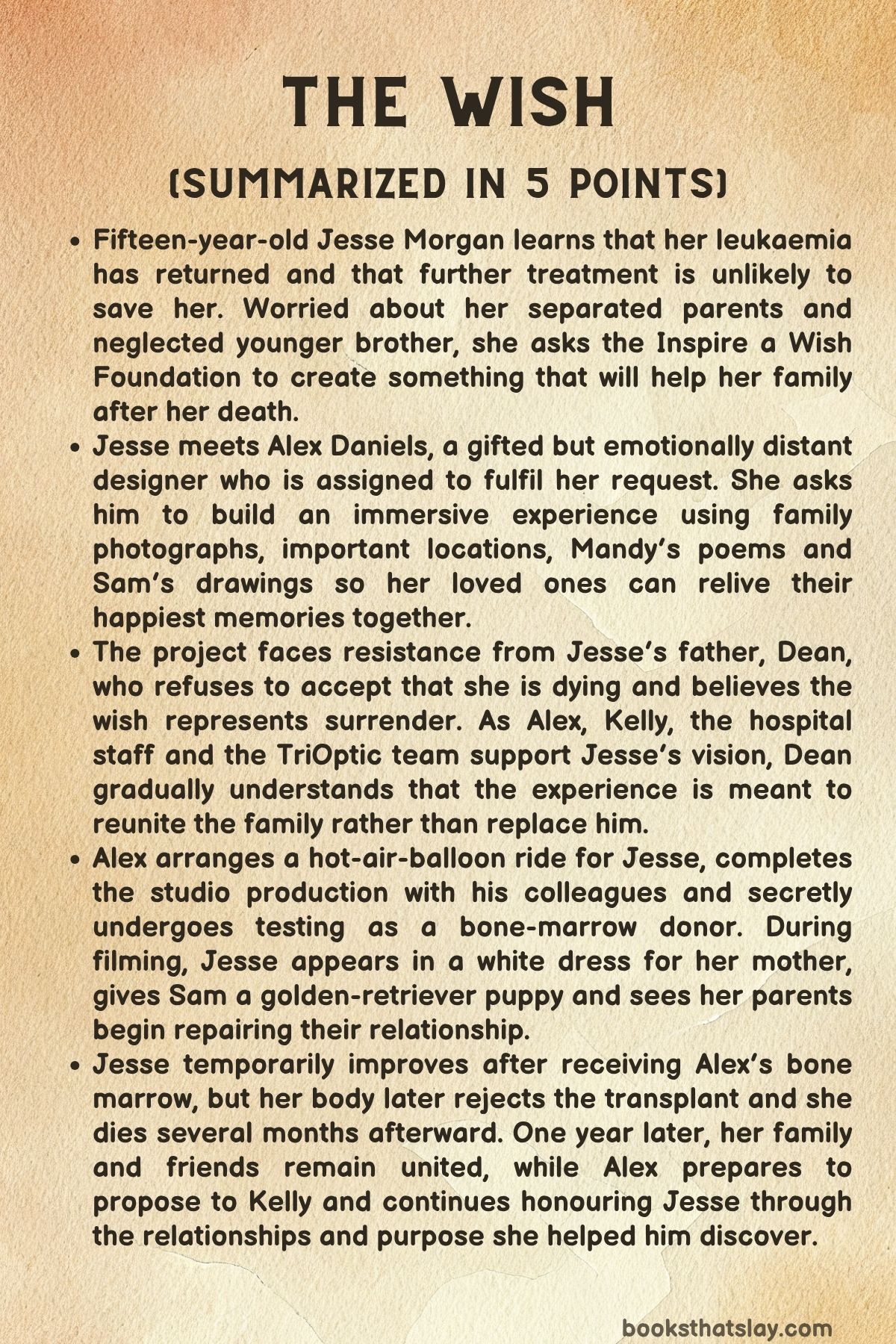
Summary
Fifteen-year-old Jesse Morgan sits on the rocks near her family’s beachfront home and speaks to the waves as though they can understand her fears. Her leukaemia has returned, and she knows that another round of treatment is unlikely to save her.
Jesse has already contacted Kelly, her hospital social worker, and asked her to involve the Inspire a Wish Foundation. Her greatest concern is not her own death but what will happen to her parents, Mandy and Dean, and her eight-year-old brother, Sam.
The family returns to Ward 6 East, the paediatric oncology ward that has become painfully familiar. Jesse reunites with her close friend Amy and the other members of their self-named “dream team,” Ryan and Luke, whose humour makes the hospital feel less frightening.
Sam remains withdrawn because Jesse’s illness has taken away much of his childhood. He has missed holidays, family outings and the chance to own the puppy he desperately wants because Jesse’s weakened immune system makes animals dangerous for her.
Meanwhile, Alex Daniels works at TriOptic Studios, creating artificial intelligence, animation and computer-generated imagery. Although highly talented, Alex is isolated from his colleagues and lives alone with Max, his golden retriever.
Alex’s manager, Ian Williams, orders him to take on Jesse’s wish because the company hopes to gain positive publicity. Alex initially resists, but his fear of losing the secure life he built after growing up in foster care forces him to visit the hospital.
His first meeting with Kelly is disastrous. Alex’s memories of uncaring social workers make him distrust her, while Kelly believes his defensive attitude proves that he does not understand the seriousness of Jesse’s situation.
When Alex finally meets Jesse, she explains that she does not want a conventional video or collection of photographs. She wants a physical environment in which her family can stand together while scenes from their lives move around them.
Jesse hopes to include family photographs, Sam’s drawings, Mandy’s poems and images of important places. She wants the finished experience to contain memories of her childhood as well as imagined moments from the future, including the wedding her mother will never see.
Alex warns that such a production would normally require a large crew, advanced equipment and considerable time. Jesse interprets his caution as rejection and angrily sends him away, leaving both Alex and Kelly ashamed of how the meeting ended.
After reconsidering the challenge, Alex returns and honestly admits that he is frightened by the project. Jesse shows him her sketchbook and tells him that she believes he is capable of creating what she imagines, giving Alex a degree of trust he has rarely received from anyone.
They begin organising photographs, locations and family stories. As they work side by side, Jesse gains a renewed sense of purpose, while Alex becomes emotionally invested in her life rather than viewing the assignment as an obligation.
The project faces its greatest opposition from Dean. Jesse’s father refuses to accept that she is dying, dismisses the wish as a meaningless game and believes that allowing the foundation to become involved means the family has surrendered hope.
Mandy has reached a different stage of grief. She understands that treatment may only extend Jesse’s life briefly, yet she remains committed to supporting whatever will give her daughter peace and happiness.
Dean’s rage has already contributed to the collapse of his marriage. He has travelled internationally searching for cures, attacked Mandy for accepting medical reality and distanced himself from the family because he cannot bear his helplessness.
Alex gradually recruits his colleagues Steve, Sarah, Charlie and Phil to help him. They secretly contribute their expertise in coding, animation, effects and environmental design, turning the project into a large collaborative production.
Jesse’s illness continues to affect the young people around her. Amy learns that her own treatment has succeeded, but instead of feeling uncomplicated happiness, she experiences guilt because she is recovering while Jesse is becoming weaker.
Jesse feels sorrow and jealousy, yet she refuses to diminish Amy’s joy. Their friendship allows them to acknowledge emotions that others might consider unacceptable, including resentment, fear and guilt.
Dean eventually forbids Alex from seeing Jesse, forcing Kelly and Mandy to decide whether Jesse’s wishes should take priority over his authority. Kelly initially mishandles the conflict, but Jesse reminds her that protecting a patient must include listening to what that patient actually wants.
The dream team also intervenes. Ryan calls TriOptic Studios and demands that Alex stop behaving foolishly and return, while Amy encourages Mandy to prevent the adults’ conflicts from destroying Jesse’s final opportunity.
Alex comes back and begins photographing Jesse with her family and friends. These sessions capture ordinary moments of laughter, playfulness and affection, allowing everyone to see Jesse as a teenager rather than merely as a patient.
Alex and Kelly also begin recognising their attraction to each other. They share a love of dogs and old films, but both are emotionally guarded and frequently disguise their concern through arguments.
When Jesse’s chemotherapy fails completely, her doctors explain that no further treatment can be offered. Mandy accepts the news with devastation, while Dean responds by attacking Alex and fleeing from the finality of what he has heard.
Alex also struggles to accept the diagnosis. Kelly tells him that death occurs in a single moment, while all the time before that remains part of living, encouraging him to focus on what Jesse can still experience.
Determined to create one extraordinary memory, Alex secretly arranges a hot-air-balloon ride. As they fly above the coast, Jesse sees her home, the ocean and the athletics track where she once competed under Dean’s proud supervision.
The flight helps Alex understand Dean more fully. Dean is not simply an angry obstacle; he is a father mourning the future he believed he would share with his daughter.
Jesse later explains the deeper purpose of her project. Cancer has separated Mandy and Dean, caused Sam to feel forgotten and left the family unable to imagine happiness after her death.
She wants the film to give them permission to remember her without remaining trapped in grief. She also wants Sam to receive a puppy, her parents to rediscover their love and everyone to recognise that their lives must continue.
As Jesse grows weaker, Alex becomes terrified that the production will fail. The software does not function properly, the digital elements refuse to align and Ian attempts to bring a television crew into the hospital before the wish is complete.
Alex refuses to let Ian exploit Jesse and risks losing his job. His colleagues support him, fix the software problems and gather at his house, transforming his formerly silent home into a place filled with food, music, teamwork and companionship.
Alex secretly undergoes testing to determine whether he could donate bone marrow to Jesse. The first results appear disappointing, but later examination reveals enough compatible markers to justify further testing.
Dean’s resistance finally collapses when Kelly explains everything Alex and his colleagues have done. He finds Jesse and Alex sitting beside the ocean and, instead of beginning another confrontation, thanks Alex for helping his daughter.
Ryan and Luke contact TriOptic’s owner, Frank Wallace, and persuade him to give Alex access to the full studio. Frank recognises the importance of the project and also discovers the affordable filmmaking software Alex has developed independently.
Frank offers Alex a partnership and removes Ian from authority. Alex accepts but asks for Steve to become the official team leader, showing that he has learned to value cooperation rather than control.
The family arrives at TriOptic’s soundstage for filming. A giant curved screen, physical props and digitally recreated locations allow Jesse, Mandy, Dean and Sam to stand inside their memories.
They recreate family outings, listen to Mandy’s recorded poems and interact with images based on Sam’s drawings. Amy, Ryan and Luke join the hospital scenes, ensuring that Jesse’s friendships are preserved alongside her family life.
For the final sequence, Jesse appears in a simple white dress and flowers, giving Mandy a vision of the wedding she will never attend. Alex then presents Sam with Bea, a golden-retriever puppy who represents the ordinary childhood Jesse wants him to enjoy.
Jesse hears Dean tell Mandy that he still loves her, confirming that her plan to reunite her family is succeeding. Exhausted by the filming, she collapses into Alex’s arms, but she has completed the most important part of her wish.
That evening, Alex undergoes a painful bone-marrow biopsy. The doctors determine that he is not a perfect match, but the similarities are strong enough for them to offer Jesse a risky transplant.
Jesse’s condition deteriorates rapidly, and her friends visit to say what may be their final goodbyes. Luke embraces her, Ryan shares a gentle first kiss with her and Amy lies beside her as they prepare for separation.
Mandy and Dean agree to the transplant because no other possibility remains. Alex donates without revealing his identity, and Jesse survives the initial procedure.
Sam accidentally exposes Alex’s secret by mentioning that Alex has the same hip injury he suffered after donating marrow. Dean realises what Alex has done and thanks him privately, though Alex asks him not to tell Jesse.
One week later, the completed film is shown in the hospital theatre. The Morgans, the teenagers, hospital staff and TriOptic employees watch Jesse’s memories together, responding with laughter, tears and applause.
Frank announces that TriOptic will use Alex’s work to create similar experiences for other seriously ill children. He refuses to exploit Jesse for publicity and promises that her privacy will be respected.
For several months, Jesse grows stronger. Alex and Kelly begin a relationship, Mandy and Dean continue repairing their marriage and the transplant appears to have given the family a possible future.
The hope does not last. Jesse’s body gradually rejects Alex’s marrow, and the doctors conclude that another transplant would only increase her suffering.
Jesse returns to the hospital with only days remaining. During a private conversation, she tells Alex that she always knew he was the donor but remained silent because she did not want the failed transplant to damage their friendship.
She explains that her wish was partly meant for him. Alex had spent his life avoiding attachment, and Jesse wanted him to accept Kelly’s love, build a family and stop protecting himself from the very relationships that could make his life meaningful.
One year after Jesse’s death, everyone she brought together gathers on the beach beside the Morgan home. Mandy and Dean have reunited, Sam plays with Bea and Max, and Jesse’s hospital friends remain connected to the family.
Alex and Kelly are now deeply involved in the Morgans’ lives. At Jesse’s favourite rocks, Alex shows Mandy an engagement ring and asks for the approval he would have sought from Jesse.
Mandy assures him that Jesse knew he would become part of their family. Through the memories she preserved and the relationships she repaired, Jesse’s wish continues shaping the lives of everyone who loved her.
Characters
Jesse Morgan
Jesse Morgan is the emotional centre of The Wish, a fifteen-year-old girl whose awareness of her approaching death gives her an unusual combination of maturity, urgency and clarity. Rather than concentrating solely on what she is losing, she worries about the people who will remain after her.
Her greatest fear is that cancer has damaged her family beyond repair. She recognises Dean’s anger, Mandy’s exhaustion and Sam’s neglected childhood, and she understands that her death may intensify all three problems unless she finds a way to help them.
Jesse’s wish therefore functions as an act of care rather than a request for personal entertainment. She wants her family to enter their memories together, experience her continued presence and eventually accept that finding happiness after her death will not mean forgetting her.
Her intelligence appears in the precision of her creative vision. She distinguishes between an ordinary video and a shared physical environment, selects meaningful locations and insists that Mandy’s poems and Sam’s drawings become central elements.
Jesse is also honest about the less admirable emotions created by illness. She feels jealous when Amy enters remission, becomes frustrated when adults ignore her decisions and acknowledges that she does not always possess endless courage.
These moments make her more convincing because her generosity is not based on perfection. She feels fear, envy and anger but repeatedly chooses to protect the happiness of others.
Her friendship with Alex becomes especially important because she sees his loneliness long before he admits it. By trusting his talent, encouraging his relationship with Kelly and asking him to accept love, Jesse fulfils an emotional wish for Alex that he never knew how to express.
Jesse ultimately becomes the person who reunites a divided family, gives her brother a more normal future and creates a new community among strangers. Her physical life ends, but the relationships she repaired continue carrying her values forward.
Alex Daniels
Alex Daniels begins The Wish as a gifted designer who has built his adult life around security, independence and emotional control. Losing his mother at seven and moving through numerous foster homes taught him that attachment leads to abandonment.
His townhouse, expensive motorbike and carefully organised routine represent protection from the instability of his childhood. Max is his only dependable companion because loving a dog feels safer than trusting people who might leave him.
Alex’s first response to Jesse’s project is defensive because it threatens both his professional confidence and emotional isolation. He understands its technical difficulty, but he is even more frightened by the responsibility of becoming close to a dying child.
Jesse’s faith in him begins changing his sense of himself. No one has previously trusted his talent with such certainty, and her confidence encourages him to attempt work beyond anything he has created before.
His development is visible in his growing willingness to depend on others. Instead of working alone, he accepts help from Steve, Sarah, Charlie, Phil, Kelly, Frank and the hospital staff.
Alex also learns to distinguish between pity and genuine commitment. He does not simply create a gift for Jesse; he listens to her, treats her as a creative partner and respects her authority over the story of her own life.
His decision to be tested as a donor reveals the depth of his attachment. Although he knows the procedure may fail, he offers part of himself without demanding recognition, gratitude or emotional reward.
Jesse ultimately teaches Alex that love cannot be secured by avoiding loss. His relationship with Kelly, place within the Morgan family and new professional partnership all become possible because he allows Jesse to challenge the emotional barriers he spent years constructing.
Kelly
Kelly is a dedicated social worker whose protective instincts are both her greatest strength and her most significant weakness. She has devoted her life to helping vulnerable children, yet the emotional demands of that work have encouraged her to separate her professional identity from her private life.
Her early hostility toward Alex comes from genuine concern for Jesse. She fears that an indifferent corporate employee will make promises, disappoint a dying teenager and deepen the family’s distress.
However, Kelly sometimes confuses protection with control. When Dean blocks the project, she initially considers replacing Jesse’s wish rather than fully recognising that Jesse has the right to decide what matters during the final stage of her life.
Sandy’s criticism forces Kelly to examine whether her personal attachment is clouding her judgement. Kelly then apologises, contacts Mandy and works to restore Alex’s involvement.
Her relationship with Alex exposes the loneliness beneath her competence. Like him, she returns to an empty home, relies on familiar routines and avoids relationships that might require emotional vulnerability.
Kelly’s insight that Jesse is still living until the moment of death becomes one of her most important contributions. It helps Alex move away from helpless despair and redirect his energy toward improving the time Jesse still has.
By the conclusion, Kelly accepts both professional grief and personal love without allowing either to overwhelm the other. Her relationship with Alex suggests that caring deeply does not have to destroy her ability to continue helping others.
Mandy Morgan
Mandy is Jesse and Sam’s mother, a woman forced to balance hope with the recognition that her daughter’s illness is terminal. Unlike Dean, she gradually accepts the limits of medicine, but her acceptance never means that she loves Jesse less or wants her life to end.
She has spent years managing hospital admissions, treatment schedules, emotional crises and the practical needs of the household. This constant responsibility has left her exhausted, yet she continues creating poems, preserving family memories and supporting Jesse’s decisions.
Mandy’s conflict with Dean reflects the destructive pressure that prolonged illness can place on a marriage. She understands that his anger comes from grief, but she also recognises that she and the children cannot continue living under the force of his rage.
Her decision to support the wish is an assertion that Jesse deserves control over the time she has left. Mandy refuses to let Dean’s denial prevent their daughter from creating something meaningful.
The imagined wedding scene is particularly significant for Mandy. Watching Jesse in a white dress gives her a brief experience of the adult future she once expected to witness, allowing her to mourn that future while also celebrating the daughter standing before her.
Mandy’s reunion with Dean does not erase their earlier pain. Instead, it shows that Jesse’s wish has given them a shared language for grief and reminded them of the love buried beneath blame, exhaustion and fear.
Dean Morgan
Dean is one of the most emotionally conflicted figures in the novel. His anger, accusations and attempts to control Jesse’s decisions make him difficult, but his behaviour grows from overwhelming love and an inability to accept powerlessness.
Athletics once formed a central part of his relationship with Jesse. He imagined watching her compete, grow into adulthood and continue sharing the routines that connected them, and her illness destroys that imagined future.
Dean responds by searching for cures, travelling overseas and treating acceptance as betrayal. Because he believes a good father should be able to protect his child, every medical failure feels like evidence of his own inadequacy.
His aggression toward Mandy and Alex reveals how grief can become harmful when it is expressed only through blame. Mandy appears to be giving up, while Alex appears to be replacing him as the person capable of giving Jesse what she needs.
The balloon flight and the immersive film help correct that misunderstanding. Alex is not trying to become Jesse’s father; he is giving Dean a way to remain connected to his daughter after her death.
Dean’s apology and gratitude are therefore major steps in his development. By listening to Jesse, participating in her project and rebuilding his relationship with Mandy, he finally turns love away from control and toward presence.
Sam Morgan
Sam is an eight-year-old boy whose childhood has been organised around his sister’s illness. Although he loves Jesse deeply, he has also lost holidays, family attention, ordinary outings and the puppy he wants.
His silence and occasional bitterness reflect emotions he is too young to explain. He is frightened of Jesse’s death, angry with Dean’s absence and uncomfortable with the cheerful behaviour adults use to cover their anxiety.
Sam’s bond with Jesse is tender because she recognises his sacrifices. She comforts him during arguments, includes his drawings in the project and makes his future happiness one of the central purposes of her wish.
His interaction with Alex in the hospital playroom reveals their shared understanding. Both know what it feels like to be a lonely child surrounded by adults who are distracted by problems they cannot solve.
Sam’s defence of Alex is also important because he identifies the truth before Dean does. He understands that Alex can help Jesse in a way the family cannot, and his directness challenges the adults’ pride.
Receiving Bea gives Sam permission to resume an ordinary childhood. The puppy is not a replacement for Jesse but a sign that she wants him to experience joy without feeling that happiness betrays her memory.
Amy
Amy is Jesse’s closest hospital friend and the person who most fully understands the emotional reality of serious illness. Their friendship is built through shared treatments, sleepless nights, physical discomfort, jokes and fears that healthy teenagers cannot completely understand.
Her remission creates one of the book’s most complicated emotional situations. Amy feels guilty for recovering, as though survival means abandoning Jesse or breaking an unspoken promise between them.
Jesse’s jealousy does not damage their relationship because both girls understand that contradictory emotions can exist together. Jesse can resent Amy’s future while also sincerely celebrating her recovery.
Amy remains actively involved in protecting Jesse’s wish. She challenges the adults, supports the dream team and refuses to allow her departure from the ward to end their friendship.
Her final time beside Jesse demonstrates the depth of their connection. Amy’s survival carries responsibility as well as relief because she must continue living with the memory of the friend who did not receive the same outcome.
Ryan
Ryan uses humour as a way of resisting the fear and helplessness of hospital life. His exaggerated telephone call to TriOptic allows the teenagers to laugh while also taking practical action when the adults fail them.
He is loyal to Jesse and treats her as a friend rather than a fragile patient. His jokes and confident manner help preserve the ordinary social world of adolescence inside a medical environment.
Ryan’s first kiss with Jesse becomes meaningful because it gives her an experience she feared she would never have. The moment is gentle and private, offering affection without pretending that the future will be different.
His continued closeness to the Morgan family after Jesse’s death shows that the friendships formed in the ward do not disappear when treatment ends. He becomes one of the people responsible for carrying Jesse’s memory into the future.
Luke
Luke is quieter and more openly emotional than Ryan, but his loyalty is equally strong. He joins the dream team’s efforts to protect Jesse’s project and participates in the photographs and studio production.
His request for one of Jesse’s deep hugs reveals how important her physical warmth has become to him. When he breaks down in her arms, the scene reverses the usual expectation that everyone must remain strong for the dying person.
Luke’s goodbye demonstrates that grief begins before death. He is already mourning the loss of Jesse while she is still present, yet his willingness to show that pain confirms the depth of their friendship.
Like Ryan and Amy, Luke remains connected to the Morgans. His presence at the later beach gathering shows that Jesse’s hospital friendships have become part of her family’s continuing life.
Sandy
Sandy, the charge nurse, combines practical authority with emotional wisdom. She welcomes Alex when Kelly distrusts him, encourages him to reconsider Jesse’s request and repeatedly helps the adults focus on Jesse’s needs.
Her conversations with Kelly and Dean are especially important. She warns Kelly that personal attachment may be influencing professional judgement and tells Dean that refusing to listen to Jesse will leave him with lasting regret.
Sandy understands that medical care involves more than treatment. When medicine can no longer promise recovery, respect, comfort, dignity and choice become even more important.
Her compassion is never sentimental or passive. She challenges harmful behaviour directly, protects Jesse’s independence and supports unconventional decisions when they serve the patient’s emotional well-being.
Steve
Steve is Alex’s most dependable colleague and one of the first people to recognise that Alex needs friendship as much as technical assistance. Calling Alex his “work bestie” surprises him because Alex has never allowed himself to think of a colleague in such personal terms.
Steve provides both practical support and ordinary care. He recruits the wider TriOptic team, brings food prepared by Lydia and works through the night without expecting praise.
He also recognises the commercial value of Alex’s independent software and encourages him to stop allowing Ian to control his future. His belief helps Alex understand that loyalty to a workplace does not require accepting humiliation.
Alex’s recommendation that Steve lead the reorganised company shows how much he respects him. Steve possesses the interpersonal qualities Alex lacks, and their partnership proves that leadership can be shared rather than guarded.
Ian Williams
Ian represents ambition without empathy. He views Jesse’s wish primarily as a publicity opportunity and measures the project according to its possible benefit to TriOptic.
His treatment of Alex depends on intimidation. He mocks Alex’s abilities, threatens his job and attempts to claim attention for work he does not understand.
Ian’s plan to bring a television crew to the hospital before the project is complete exposes his willingness to exploit Jesse’s illness. Alex’s refusal becomes an important moral turning point because he chooses Jesse’s privacy over professional security.
Although Ian later attends the film screening, his loss of authority is appropriate. He serves as a contrast to Frank, Steve and Alex, who eventually recognise that ethical responsibility must guide the company’s creative power.
Frank Wallace
Frank initially remains distant from Jesse’s project, allowing Ian to manage the company’s involvement. His understanding changes after Ryan and Luke explain the obstacles Alex faces and persuade him to look at the work personally.
Once Frank sees the immersive film, he recognises both its emotional importance and Alex’s exceptional talent. He provides full access to the studio and ensures that the wish can be completed properly.
His response to the publicity question also shows development. Although the foundation project originally attracted the company partly because of media attention, Frank later refuses to use Jesse’s condition as advertising material.
By offering Alex a partnership and supporting similar projects for other children, Frank turns one extraordinary wish into a lasting organisational purpose. His decision allows Jesse’s influence to continue beyond her own family.
Max
Max is Alex’s golden retriever and his first secure emotional relationship. Alex speaks to him during moments of doubt, frustration and loneliness because Max offers affection without judgement or abandonment.
Max also acts as a quiet guide toward human connection. His reactions encourage Alex to return to Jesse, acknowledge his feelings for Kelly and accept the people gathering around him.
As Alex’s home changes from an isolated space into a centre of friendship and teamwork, Max welcomes everyone without hesitation. His behaviour demonstrates the openness Alex must learn to imitate.
Max’s friendship with Bea and presence at the final beach gathering reinforce the idea that Alex has become part of the Morgan family. The dog who once represented Alex’s solitary life eventually becomes part of a much larger community.
Sarah, Charlie and Phil
Sarah, Charlie and Phil represent the collaborative effort required to turn Jesse’s vision into reality. Each contributes specialised knowledge that Alex could never have supplied alone.
Sarah identifies the outdated software causing the project’s technical failures and finds a way to adapt newer improvements. Her intervention arrives when Alex is close to admitting defeat.
Charlie and Phil contribute to the effects, environmental design and studio production that make the experience convincing. Their willingness to work after hours and risk Ian’s anger demonstrates that compassion can reshape professional relationships.
Together with Steve, they transform Alex’s understanding of creative achievement. The finished work is not the product of one isolated genius but of a group that combines skill, patience and shared responsibility.
Christine
Christine provides the medical honesty required during the final stages of Jesse’s illness. She explains when treatment has failed, presents the risks of the imperfect transplant and refuses to give the family false certainty.
Her role involves balancing possibility with responsibility. The donor match offers hope, but Jesse’s weakened condition means the procedure may hasten her death rather than extend her life.
Christine respects Mandy and Dean enough to provide the full medical reality and allow them to decide. She also contacts Alex directly to confirm his consent, recognising that his sacrifice must be voluntary and informed.
Her presence reminds the reader that hope and medicine are not always aligned. Doctors may offer an opportunity, but they cannot guarantee that love, courage or effort will overcome biological limits.
Bea
Bea, the golden-retriever puppy given to Sam, represents the childhood Jesse wants her brother to reclaim. For years, he has been unable to have a dog because Jesse’s treatment has required an unusually controlled home environment.
The gift shows that Jesse has thought beyond her own immediate desires. She wants Sam’s life after her death to contain companionship, freedom and ordinary happiness.
Bea also helps the family imagine continuity. Her presence at the beach one year later suggests that Jesse’s death has not frozen the household in permanent mourning.
Themes
Love as Action and Chosen Family
Love in The Wish is repeatedly measured through decisions, sacrifices and sustained attention rather than declarations alone. Jesse expresses love by designing a future for her family, Alex expresses it through creative labour and medical risk, and the TriOptic team expresses it by giving their time without expecting recognition.
The project brings together people who were previously isolated from one another. Alex has no family beyond Max, Kelly hides in an empty apartment, Dean has separated from Mandy and the teenagers live inside the restricted world of the oncology ward.
Working toward Jesse’s wish changes those separate lives into a community. Alex’s colleagues enter his home, Kelly becomes part of his personal life and the Morgans begin treating him as someone who belongs with them.
Chosen family does not replace biological family in the story. Instead, it enlarges the circle of people who accept responsibility for one another.
Alex’s bone-marrow donation is the clearest physical expression of this idea. He cannot guarantee that his sacrifice will save Jesse, yet he offers it because love does not depend on certainty of success.
Jesse gives Alex an equally important gift by teaching him to receive affection. Her final request that he build a future with Kelly shows that allowing oneself to be loved can require as much courage as giving love to someone else.
Grief, Denial and Acceptance
The characters experience grief long before Jesse dies. Her diagnosis creates anticipatory mourning, forcing everyone to imagine a loss that has not yet occurred while continuing to speak, laugh and make plans with her.
Dean represents denial in its most destructive form. His search for cures begins as devotion, but it develops into anger because accepting medical reality feels like admitting that he has failed as a father.
Mandy’s acceptance is quieter and more practical, yet it is no less painful. She supports Jesse’s wish because she understands that respecting her daughter’s final choices is more loving than pretending unlimited time remains.
Sam expresses grief through withdrawal and irritation, while Amy experiences it through guilt. Alex initially responds by trying to solve everything technically, and Kelly protects herself through professional distance.
None of these reactions is presented as completely wrong. The problem occurs when a person’s private method of coping prevents them from listening to someone else.
Dean begins healing only when he stops treating Jesse’s acceptance as surrender. By participating in the film and thanking Alex, he recognises that acknowledging death does not cancel hope, love or parental responsibility.
The final beach gathering shows acceptance as continued relationship rather than emotional closure. Jesse remains present through memory, habits and the connections she created, but the survivors are also able to form new plans.
Memory, Storytelling and Legacy
Jesse understands that memory can become either a source of comfort or a prison. If her family remembers only hospitals, arguments and failed treatments, her death may permanently define their lives through suffering.
Her immersive film therefore reorganises memory. It includes illness but places it beside beaches, athletics, drawings, poems, jokes, friendships and imagined celebrations.
The physical design of the project is essential because Jesse does not want her relatives isolated behind separate headsets. She wants them standing together, responding to the same scenes and recognising that memory is a shared family experience.
Sam’s drawings and Mandy’s poems show that family history belongs to everyone, regardless of age or artistic training. Alex does not replace their voices; he uses technology to give those voices movement, scale and permanence.
The imagined wedding sequence demonstrates that legacy can include futures that never occurred. Jesse cannot become the adult bride Mandy expected to see, but the staged moment allows mother and daughter to acknowledge that lost possibility together.
The film’s later use for other seriously ill children expands Jesse’s legacy beyond personal remembrance. Her wish changes TriOptic’s purpose and creates a method through which other families may preserve their own stories.
Memory is therefore active rather than static. It influences careers, relationships, institutions and decisions long after Jesse is gone.
Hope, Mortality and Living Fully
Hope changes meaning throughout the story. At first, Dean treats hope as belief in a cure, while Mandy and Jesse begin recognising that hope may need to exist without recovery.
Kelly’s statement that dying happens in a moment while the preceding time is still living provides the clearest expression of this distinction. Jesse’s approaching death does not make her remaining experiences meaningless.
The balloon flight, studio production, friendships and family dinner matter because they occur within limited time, not despite that limitation. Their value comes from presence, attention and the willingness to experience joy without demanding permanence.
The transplant temporarily restores conventional hope. Jesse survives, becomes stronger and receives three additional months with her family, but the eventual rejection prevents the procedure from becoming an easy answer.
Alex’s donation is not rendered meaningless by its failure to save her permanently. It gives Jesse more time, demonstrates his love and proves that effort retains value even when the final outcome cannot be controlled.
Jesse embodies a form of hope based on influence rather than survival. She knows that she may die, yet she believes her family can reunite, Sam can enjoy his childhood, Alex can accept love and her friends can continue carrying what she taught them.
Mortality gives urgency to these changes, but it does not erase happiness. The novel presents a full life not as a certain number of years but as the ability to love, create meaning and leave others more capable of living.