Student Union Summary, Characters and Themes | Julie Murphy
Student Union by Julie Murphy is a contemporary college romance built around a fake marriage between two former childhood friends carrying years of anger, guilt, and unresolved affection.
Clover Walsh needs married-student housing to protect her scholarship, while Bennett Graves sees the arrangement as an opportunity to repair the damage he caused when they were teenagers. Their shared dormitory, public displays of affection, jealous conflicts, and forced participation in university traditions gradually turn their practical agreement into something genuine. Alongside its romance, the book examines financial inequality, consent, forgiveness, friendship, family expectations, and the difficult process of choosing love without surrendering personal independence. It is the first book in Julie Murphy’sThe Undergrads series.
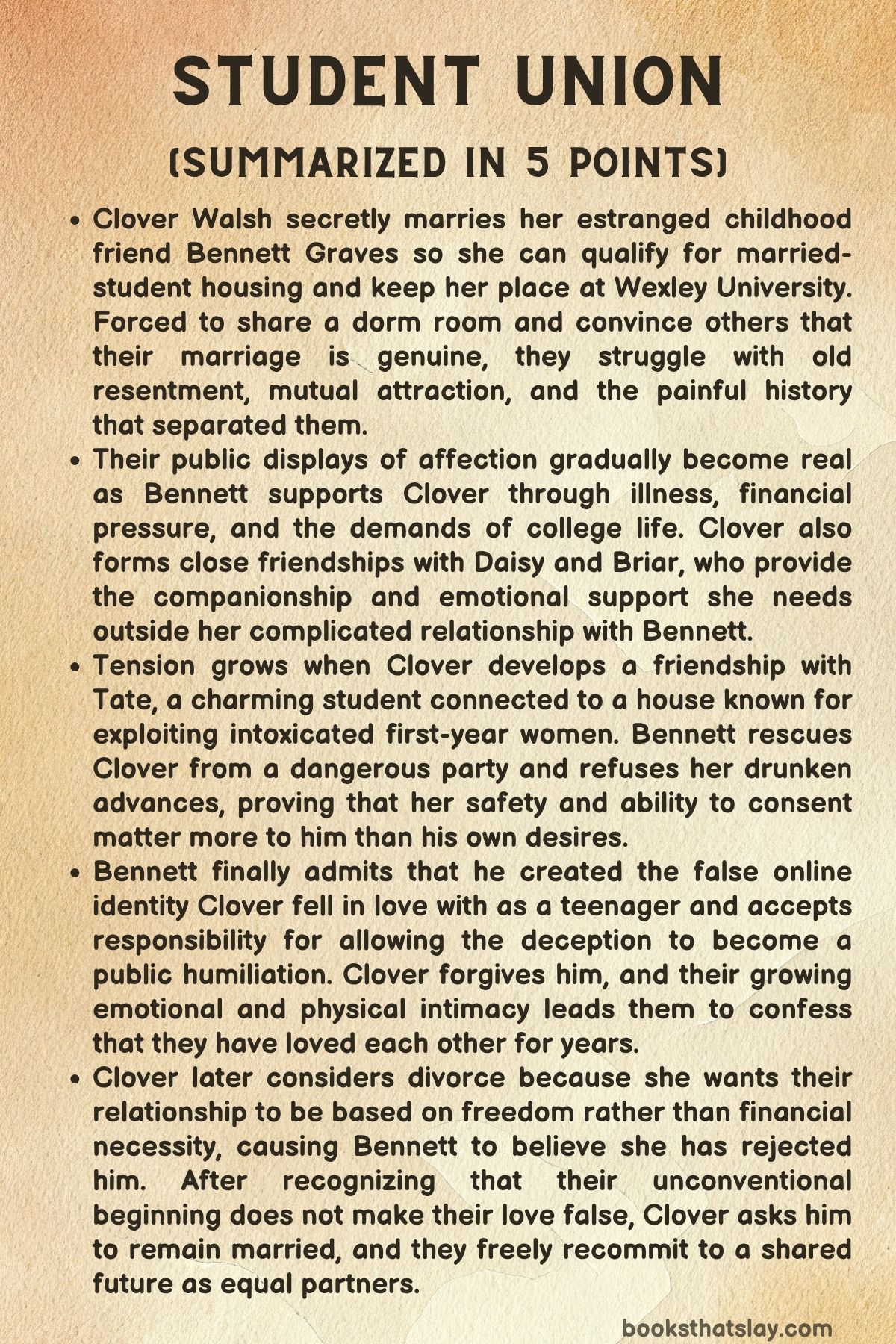
Summary
Eighteen-year-old Clover Walsh waits nervously at a courthouse in Cannon Beach, uncertain whether Bennett Graves will appear for the marriage they have secretly arranged. He arrives late with flowers, rings, and the polished confidence she remembers from childhood, but the ceremony remains tense because they have barely spoken in three years and their past is filled with betrayal.
Clover has earned a full academic scholarship to Wexley University, but the family that had promised to fund her housing unexpectedly withdraws its support. Since first-year students must live on campus, she risks losing her place unless she qualifies for an exception permitting married couples to live together.
Bennett is the only person she knows who will also attend Wexley, so she proposes a one-semester marriage followed by a divorce after final examinations. He is offended by the coldness of her request, but Clover reminds him that he owes her for the humiliation and emotional damage he caused when they were teenagers.
After their courthouse wedding, they move into Haystack Hall, an old university dormitory with little privacy. Their room contains two twin beds bolted together, forcing them to share one large sleeping space and making their supposed marriage far more intimate than either expected.
Their neighbours, enthusiastic Daisy and guarded Briar, immediately become interested in the young newlyweds. Bennett begins acting like an affectionate husband whenever other people are present, using pet names, touching Clover, and inventing romantic explanations for their behaviour, while Clover retaliates by creating embarrassing stories of her own.
The university’s housing office closely supervises married students, particularly through assistant director Madeline Linch. Clover and Bennett realize that they must attend couples’ events, maintain a believable room, and behave like people who genuinely chose each other.
They establish rules intended to protect their arrangement. They will divorce after the semester, avoid bringing romantic partners into the room, share the bed without unnecessary contact, and keep the true nature of the marriage secret.
Despite these limits, Bennett rejects an opportunity to resume a casual relationship with Vanya. He tells himself that seeing other people would threaten their cover, but his jealousy and growing preoccupation with Clover suggest that his feelings are already much deeper.
Clover begins studying finance because the sudden loss of financial support has taught her the importance of independence. She also takes an introductory pottery course, where she meets Tate, an attractive and confident student who quickly begins flirting with her.
At the same time, Clover forms a genuine friendship with Daisy and Briar. Daisy is cheerful, romantic, and determined to experience everything college offers, while Briar supports herself through a secret grilled-cheese business operated from her dormitory.
Bennett finds sharing a room with Clover unexpectedly familiar because they grew up together. Clover’s mother, Beth, once worked for Bennett’s family, and Clover lived in the Graves guesthouse, becoming Bennett’s closest companion while Beth gave him the warmth he rarely received from his emotionally distant mother, Sydney.
Their attraction becomes impossible to ignore during a married-student bowling event. While inventing an absurd story about how they met, Clover sits on Bennett’s lap and kisses him deeply, intending to win their private competition, but the intensity of the moment leaves both of them shaken.
Soon afterward, Bennett invites several friends and female classmates into the dormitory. Clover returns to find strangers sitting on their bed, moving her possessions, and treating her limited personal space carelessly.
Their argument becomes cruel when Bennett reminds her that he is paying for the room and suggests that she could attend community college instead. Clover orders him out, and Bennett retreats rather than apologizing because facing her pain would require him to confront the kind of person he was when he first betrayed her.
Clover later attends a hockey party with Daisy and meets Tate again. Tate treats her kindly and dances closely with her, but Clover notices Bennett watching them with unmistakable anger while sitting beside Vanya.
Bennett warns Clover that Tate is dangerous, but his jealousy makes his concern appear controlling. Clover deliberately encourages Tate’s attention, while Bennett struggles to explain that his objections come from knowledge of a predatory student culture rather than simple possessiveness.
Their conflict temporarily softens when Bennett buys Clover food after a late shift. He admits that he will remain celibate during their marriage and, believing she has fallen asleep, quietly confesses that he was jealous.
Bennett begins caring for Clover through small practical acts, including replacing her charger, stocking snacks, and remembering the products she uses. His behaviour reveals that his tenderness is not new; it has survived beneath years of shame, avoidance, and emotional immaturity.
His memories expose the true nature of their teenage separation. When they attended different schools, Bennett created a false online identity named Josh and used it to speak to Clover honestly without risking the judgment of his wealthy classmates.
Clover fell in love with Josh because the person behind the messages understood her, encouraged her, and shared intimate thoughts. Bennett’s feelings were genuine, but the identity, photograph, and personal history were false, turning his affection into a damaging deception.
At a university alumni dinner, Bennett sees Clover working as a caterer while visibly ill. He abandons his family responsibilities and influential contacts to take her back to the dormitory, where he remains beside her through a high fever.
Clover refuses expensive medical treatment, forcing Bennett to recognize the seriousness of their financial differences. He gives her medicine, monitors her temperature, arranges supplies, helps her shower when she becomes too weak to stand, and treats her vulnerability with care rather than taking advantage of it.
The experience changes their relationship because Clover allows Bennett to occupy a trusted position in her life again. Daisy later tells Clover that Bennett’s panic during her illness proves that he loves her and suggests that forgiveness must sometimes be chosen deliberately.
During Wexley’s Midnight Yell tradition, Bennett and Clover hold hands, exchange childhood memories, and behave like a couple without consciously performing for anyone. When the stadium lights go dark, Bennett kisses her with years of suppressed longing, and Clover responds before pretending afterward that the kiss was only part of their act.
Clover nevertheless fears becoming dependent on a marriage that is supposed to end. When Tate invites her to an exclusive party at 1919 Hemphill, she agrees to attend with Daisy and Briar despite Bennett’s warning that the house keeps a scoreboard tracking sexual encounters with first-year women.
At the party, Clover hides her phone so Bennett cannot follow her location. She becomes heavily intoxicated, Daisy becomes sick, and Briar leaves to take Daisy home, allowing Tate to isolate Clover and lead her upstairs.
Bennett notices that Clover’s phone location has not moved and goes to the house. He finds her abandoned phone, confronts Tate, and discovers Clover unconscious in Tate’s bedroom with her costume damaged and most of her clothing removed.
When Clover awakens, she tries to initiate sex with Bennett and admits that she wants him rather than Tate. Bennett is tempted but stops because she is too intoxicated to give meaningful consent, choosing her safety even though she interprets his refusal as rejection.
Later, Tate publicly announces that Clover’s missing wedding ring was found in his bed and exposes Bennett’s extensive sexual history. Clover feels inexperienced and excluded from Bennett’s life, but the confrontation finally forces them to discuss the humiliation that destroyed their friendship.
At fifteen, Clover had arrived at a country-club celebration expecting to meet Josh. Bennett’s friends revealed the deception in front of everyone, and Bennett, terrified that they would discover his genuine feelings, claimed he had targeted Clover because she was desperate.
The incident separated not only Clover and Bennett but also their mothers. Beth moved away from the Graves property after Sydney defended Bennett, leaving both families damaged by pride, class differences, and their inability to discuss what had happened.
In the present, Bennett apologizes without minimizing his responsibility. He explains that another student arranged the public meeting after discovering the account, but he accepts that his silence, cowardice, and final cruel statement caused Clover’s deepest pain.
Clover tells Bennett that she forgives him, though forgiveness does not erase her insecurity or jealousy. During a private meeting in the library, they admit their possessiveness and attraction, and Bennett carefully asks for consent as their relationship becomes physically intimate.
Their dormitory life soon resembles a real marriage. They study together, attend university events, share routines, joke with friends, and develop a sexual relationship based on communication, reassurance, and respect for boundaries.
Sydney unexpectedly discovers them together and orders them to attend dinner at the Graves estate. Beth is also invited, forcing the two mothers to confront the secrecy surrounding the marriage and the resentment that ended their former friendship.
A storm traps everyone at the estate overnight. Clover and Bennett visit the guesthouse where she once lived, and the familiar surroundings allow them to speak honestly about their childhood, their attraction, and the future they secretly desire.
After they make love, Bennett shows Clover a bumblebee tattoo symbolizing Grandpa Dean’s beehives and the bond between them. He confesses that he has loved her for most of his life, and Clover admits that she loves him and no longer wants their relationship to end.
Their happiness is disrupted when Sydney offers to cover Clover’s expenses and arrange legal assistance. Clover believes accepting financial independence will allow her and Bennett to divorce and then choose each other again without obligation, but Bennett overhears part of the conversation and assumes his mother is paying Clover to leave him.
Clover argues that their marriage began through necessity and that dating after a divorce would place them on equal ground. Bennett believes the marriage has already become real, and when Clover says she does not want it, he leaves the dormitory devastated.
Bennett isolates himself at the townhouse until Tex and Julian force him to return to class. Meanwhile, Daisy, Briar, and Beth challenge Clover’s belief that love must follow a conventional order before it can be genuine.
Determined to recover Clover’s lost ring, Bennett and Julian enter another event at 1919 Hemphill. Bennett finds the ring among photographs and belongings taken from intoxicated women, confirming that Tate and the other residents have been exploiting vulnerable students.
Bennett destroys the house’s sexual scoreboard but is badly beaten by several residents. At the hospital, Clover learns that the engagement ring he claimed was fake is genuine and sees how seriously he has always treated their marriage.
Sydney later tells Bennett that Clover rejected her financial offer and never contacted the lawyer. Understanding that Clover did not choose money over him, Bennett prepares divorce papers anyway because he wants her to possess the freedom he once failed to respect.
Clover spends the break wearing both rings and reconsidering her fears. When Bennett returns with signed divorce papers, she creates a private dinner in their dormitory and asks him to remain married to her.
She explains that their unusual beginning does not invalidate the love, trust, friendship, and life they have built. They return the rings to each other, exchange personal vows, and decide that this voluntary recommitment, rather than the courthouse ceremony, marks the true beginning of their marriage.
At Sydney’s New Year’s Eve celebration, Clover and Bennett are openly together, while the presence of Beth and Sydney suggests that their families are also beginning to heal. Watching fireworks recalls the night of Clover’s public humiliation, but the memory is transformed because Bennett now stands beside her honestly, and they enter the future as equal partners who have consciously chosen each other.
Characters
Clover Walsh
At the center of Student Union, Clover Walsh is intelligent, determined, practical, and deeply aware of how quickly financial security can disappear. Her full academic scholarship represents years of disciplined work, and the threat of losing university housing is frightening because it places her entire future at risk.
Clover’s marriage proposal reflects both desperation and resourcefulness. She is willing to use an unconventional solution rather than surrender her education, yet choosing Bennett also reveals that she still trusts him at some level despite insisting that she cannot forgive him.
Her interest in finance develops from experience rather than simple ambition. Having once lived near wealth without possessing it herself, she understands that dependence leaves people vulnerable to decisions made by those with greater power.
Clover’s anger toward Bennett is connected to more than the false Josh identity. She trusted the person behind the messages, shared her private thoughts, and arrived at the country club believing she was about to meet someone who loved her, only to discover that Bennett and his friends had turned her emotions into public entertainment.
Her guarded attitude protects her from repeating that humiliation. She frequently hides sincere feelings behind sarcasm, rules, challenges, and claims that affectionate moments are merely part of their performance.
Clover’s relationship with her body also shapes her choices. Tate’s insults, comparisons with Bennett’s former partners, and her own fear of being undesirable create insecurity, but Bennett’s patient admiration gradually helps her understand that affection does not require her to compete with anyone.
Her friendships with Daisy and Briar are essential to her development. Through them, Clover experiences college as a social community rather than merely an academic opportunity she must survive, and their acceptance gives her a support system independent of Bennett.
Clover’s decision to consider divorce does not mean she lacks love. She fears that a marriage created by financial necessity will always contain obligation, and she wants Bennett to choose her without guilt while also proving that she can support herself.
Her final decision shows that independence does not require rejecting intimacy. By asking Bennett to remain married, she accepts that a relationship can begin imperfectly and still become freely chosen through honesty, consent, forgiveness, and equal commitment.
Bennett Graves
Bennett Graves begins the novel as a young man divided between social confidence and deep emotional shame. He has wealth, charm, influential connections, and an easy ability to perform in public, but he carries a lasting belief that his worst actions have made him unworthy of genuine love.
His childhood with Clover gave him the affection and security missing from his relationship with Sydney. Beth treated him warmly, Grandpa Dean offered stability, and Clover became the person with whom he could be vulnerable before social pressure taught him to treat vulnerability as weakness.
The Josh deception exposes both Bennett’s capacity for intimacy and his moral cowardice. He wanted to speak honestly to Clover but lacked the courage to do so as himself, creating a false identity that allowed emotional sincerity without personal accountability.
His greatest failure occurs when the deception becomes public. Rather than defend Clover or confess that he loved her, Bennett protects his status by repeating the cruel interpretation created by his classmates.
Bennett’s agreement to the fake marriage is partly motivated by guilt, but guilt does not fully explain his actions. He accepts because the arrangement gives him a chance to remain close to Clover, serve a meaningful purpose in her life, and recover a connection he never stopped wanting.
His jealousy initially appears immature and possessive. He reacts angrily to Tate, resents Clover’s independence, and sometimes uses financial power carelessly, especially when he reminds her that he is paying for the dormitory.
However, Bennett’s knowledge of Tate’s behaviour gives his warnings legitimate urgency. His rescue of Clover and his refusal to have sex with her while she is intoxicated demonstrate that he is capable of placing her safety above desire, pride, and the hope of gaining her affection.
Caregiving reveals Bennett’s strongest qualities. When Clover becomes ill, he remembers her allergies, helps her without violating her boundaries, and abandons family obligations because her well-being matters more than Sydney’s business expectations.
His destruction of the scoreboard is both heroic and reckless. He protects future victims and attacks a culture of exploitation, but he also uses physical danger as a form of punishment against himself, believing suffering might prove that he has become good.
Bennett’s most important growth occurs when he prepares the divorce papers. Within Student Union, his final act of love is not the fight, the expensive ring, or the public declaration, but his willingness to release Clover rather than bind her through money, guilt, or legal obligation.
Daisy
Daisy is Clover’s enthusiastic neighbour and one of the first people to welcome her into university life. Her cheerful personality, curiosity, and immediate fascination with Clover’s supposed marriage create humour, but her role grows beyond that of an energetic friend.
She is open about her desire for romance and sexual experience, yet she is less reckless than she initially appears. Her frustration with Aaron comes from wanting to explore adulthood on her own terms, while Aaron’s refusal to treat sex casually forces her to consider the emotional responsibilities attached to intimacy.
Daisy also lives beneath family expectations. Her wealthy father is a television pastor who believes she is attending seminary, so her college life represents an attempt to create an identity separate from the role designed for her.
Her loyalty becomes clear during Clover’s illness and emotional crises. She listens without judgment, notices Bennett’s devotion, and encourages Clover to consider forgiveness as an active decision rather than a feeling that must appear automatically.
Although Daisy becomes dangerously intoxicated at the Hemphill party, the experience also reveals the importance of collective safety. Her vulnerability forces Briar to leave with her, creating the separation that places Clover at greater risk and showing how predatory environments exploit moments when friends cannot protect everyone at once.
By the end of the story, Daisy is part of Clover’s chosen family. She offers companionship, shelter, humour, and emotional honesty, helping Clover understand that accepting support does not make her weak or dependent.
Briar
Briar initially appears cynical, suspicious, and far less sentimental than Daisy. She immediately questions Clover and Bennett’s perfect-young-couple image, making her one of the few people capable of noticing the tension beneath their public affection.
Her secret grilled-cheese business shows her intelligence and entrepreneurial determination. Rather than treating college as a carefree period, Briar manages finances, protects her limited opportunities, and works creatively within the restrictions of dormitory life.
Her grandparents’ tuition fund gives her access to Wexley, but only if she graduates within four years. This condition explains her practicality and connects her to Clover, since both women understand that education can depend on financial rules outside their control.
Briar acts as a protective realist during the Hemphill party. She recognizes the danger, objects to leaving Clover behind, and is forced to choose between assisting an intoxicated Daisy and remaining with Clover.
Her strongest contribution comes after Clover reveals the fake marriage. Briar refuses to shame her and instead questions the assumption that a relationship is invalid merely because events occurred in the wrong order.
Through the lesson inherited from her late aunt, Briar encourages Clover to stop saving love for a supposedly perfect future. She helps Clover recognize that caution can become another form of avoidance when it prevents a person from accepting something genuine in the present.
Beth Walsh
Beth Walsh is Clover’s loving, hardworking mother and a major influence on her daughter’s determination. Her former role as Sydney’s assistant placed her near wealth while keeping her financially dependent on the Graves family.
Beth created a warm home in the guesthouse and treated Bennett with the affection he rarely received from Sydney. Her closeness with Bennett shows that the original family bond was emotional and domestic rather than merely professional.
Her reaction to Clover’s public humiliation is immediate and protective. After learning about Bennett’s deception, Beth confronts him and leaves the Graves property when Sydney defends her son.
Beth’s departure protects Clover, but it also carries consequences. The decision ends her friendship with Sydney, removes Bennett from Clover’s life, and leaves old grievances unresolved for years.
Her advice later becomes more flexible than Clover expects. Rather than condemning the marriage, Beth acknowledges that love does not always arrive in an orderly or socially approved manner.
Beth also begins reconsidering Sydney’s behaviour. She recognizes that their conflict involved class, pride, employment, motherhood, and unequal power, making reconciliation difficult but not impossible.
Sydney Graves
Sydney Graves is Bennett’s powerful, controlled, and emotionally distant mother. Her focus on business, reputation, and the Graves Corporation has given Bennett material security but little confidence that he is valued apart from family expectations.
She genuinely cares about Clover and Beth, yet her wealth affects how she expresses care. Sydney assumes that offering money, housing, or professional assistance will solve problems, without always understanding how such offers can create obligation or reinforce inequality.
Her defence of Bennett after the country-club incident destroys her friendship with Beth. Sydney responds as a protective mother but fails to recognize that defending him without accountability deepens Clover’s humiliation.
Her later offer to fund Clover’s education is similarly complicated. She intends to give Clover choices and treats her as a daughter, but she approaches the situation without considering how Bennett or Clover might interpret the financial intervention.
Sydney’s conversation with Bennett during Thanksgiving reveals her capacity for change. She apologizes, explains her motives, challenges his belief that he is unlovable, and offers the physical affection he has needed since childhood.
Her developing reconciliation with Beth suggests that she is learning to build relationships without controlling their terms. She remains influential and imperfect, but she becomes more emotionally responsive as the family begins repairing its damaged bonds.
Tate
Tate initially appears charming, attentive, confident, and easy to trust. He offers Clover uncomplicated romantic attention at a time when her relationship with Bennett is confusing, making him seem like a possible alternative to the pain of their shared history.
His charm gradually becomes a method of control. He encourages Clover to ignore her judgment, undermines her marriage, isolates her at the Hemphill party, and presents himself as protective while benefiting from her intoxication and emotional uncertainty.
Tate’s connection to the sexual scoreboard reveals that his behaviour is part of a wider predatory culture. Women are treated as points, stories, and possessions rather than people capable of granting or refusing consent.
His insults about Clover’s body expose the cruelty beneath his confidence. He attacks her appearance to provoke Bennett and later returns the wedding ring through public humiliation, using private vulnerability as a social weapon.
The collection Bennett discovers in Tate’s room confirms that his conduct is systematic rather than accidental. Tate represents entitlement protected by wealth, status, male loyalty, and an institution reluctant to see what occurs behind closed doors.
Julian
Julian is one of Bennett’s closest college friends and initially treats the marriage as an entertaining mistake. His jokes about the missing prenuptial agreement and Bennett’s sudden domestic behaviour provide humour, but he quickly recognizes that Bennett’s feelings are serious.
He supports Bennett during Clover’s illness by purchasing an excessive and poorly understood collection of medical and menstrual supplies. The scene shows that Julian may be immature, but he responds when a friend genuinely needs help.
Julian also helps Bennett confront the Hemphill residents. He assists with the plan to recover Clover’s ring, distracts Tate, and arrives during the fight rather than abandoning Bennett when the situation becomes dangerous.
His loyalty is practical rather than sentimental. He may tease Bennett constantly, but he refuses to let him disappear into alcohol, isolation, and self-pity after the separation.
Tex
Tex is another member of Bennett’s close university circle. Like Julian, he begins by treating the marriage as strange and amusing, but he soon sees that Bennett’s interest in Clover differs from his previous casual relationships.
Tex helps identify Bennett’s feelings before Bennett is willing to name them. His direct observations force Bennett to consider that his celibacy, jealousy, and caregiving are signs of love rather than mere responsibility.
During Bennett’s emotional collapse, Tex participates in the intervention that pushes him back toward daily life. His support demonstrates that Bennett has built healthier friendships than the cruel social group that influenced him as a teenager.
Sandra and Greta
Sandra and Greta are an older married couple studying marriage counselling while living in university housing. Their long relationship gives them a comfort, humour, and emotional familiarity that sharply contrasts with Clover and Bennett’s nervous performance.
They create pressure because Clover and Bennett fear that trained counsellors will recognize the deception. At the same time, their example offers a picture of marriage as companionship developed through time, patience, shared routines, and mutual knowledge.
Sandra and Greta also help normalize Clover and Bennett’s place within the married-student community. Their kindness allows the younger couple to experience marriage as something more complex than legal paperwork or romantic performance.
Madeline Linch
Madeline Linch is the assistant director of housing and the person most likely to expose Clover and Bennett’s arrangement. Her questions, inspections, and insistence on participation in married-student events force them to create a convincing public identity.
Although she often functions as a comic obstacle, Madeline also represents institutional control. Clover’s access to education depends on satisfying rules that may not reflect the realities of financially vulnerable students.
Her watchfulness unintentionally pushes Clover and Bennett toward real intimacy. The affectionate gestures they perform to convince her repeatedly awaken feelings they have tried to suppress.
Marianne
Marianne works with Clover at the diner and serves as the official witness at the courthouse wedding. Her presence gives practical support to a decision Clover cannot share with Beth or her new university friends.
She also assists Bennett when Clover becomes ill at the alumni event. Marianne recognizes that Clover’s determination to finish a paid shift has become dangerous and insists that Bennett take responsibility for her care.
Her character represents the working community surrounding Clover. Unlike the wealthy Graves network, Marianne’s support is direct, observant, and based on shared labour rather than influence.
Grandpa Dean
Grandpa Dean is no longer present during the main events, but his memory remains central to Clover and Bennett’s emotional history. He offered Clover a meaningful paternal presence and gave Bennett an example of warmth that differed from Sydney’s reserved parenting.
His beehives become an important symbol within the romance. Bennett’s bumblebee tattoo connects Grandpa Dean, Clover’s name, their childhood, and Bennett’s belief that the two of them have always belonged together.
Clover’s memories of him also explain why the Graves estate still feels partly like home. The property contains both humiliation and genuine love, preventing her past from being divided into simple categories of good and bad.
Valerie
Valerie plays a decisive role in turning Bennett’s private deception into public humiliation. After discovering the Josh account on Bennett’s phone, she assumes it is a cruel prank and arranges the meeting at the country club.
Her behaviour reflects the social environment Bennett chose to enter. Within that group, emotional vulnerability is embarrassing, and humiliating Clover becomes entertainment rather than an act with lasting consequences.
Although Valerie initiates the public setup, Bennett remains responsible because he does not warn Clover or reject the plan. Her role clarifies the difference between causing an opportunity for harm and choosing to participate in it.
Vanya
Vanya is one of Bennett’s former sexual partners and represents the casual life he lived before reconnecting with Clover. She offers to resume their relationship, but Bennett refuses despite having no explicit rule preventing outside encounters.
Clover initially views Vanya as a rival because of her beauty and history with Bennett. However, Bennett’s lack of interest in restarting the relationship demonstrates that his emotional focus has already shifted completely toward Clover.
Vanya is not presented as an antagonist. Her presence primarily exposes Clover’s jealousy and Bennett’s growing commitment.
Aaron
Aaron is a hockey player who becomes involved with Daisy. His refusal to have sex without a relationship frustrates her, but it also challenges the assumption that young men always seek casual access without emotional responsibility.
His boundary gives Daisy an opportunity to think about what she actually wants. Through Aaron, the story shows that consent includes the right of every participant to define the circumstances under which intimacy feels acceptable.
Dylan and Marshall
Dylan is the resident adviser whose arrival catches Clover and Bennett trying to examine their joined beds. Bennett’s exaggerated explanation of newlywed activity helps establish the comic performance required to keep their arrangement secret.
Marshall is Madeline Linch’s boyfriend and participates in the married-student gathering. His presence helps make the university events feel like social environments rather than formal inspections, though Clover and Bennett remain aware that Madeline is always evaluating them.
Both characters contribute to the external pressure surrounding the marriage. Even minor interactions can expose Clover and Bennett, so ordinary dormitory life becomes a continuous exercise in improvisation.
Lacey Rosen and Mallory
Lacey Rosen is a successful Wexley graduate whom Bennett is expected to charm on behalf of his mother’s business interests. Bennett’s decision to abandon the conversation when Clover becomes ill shows that personal loyalty has finally become more important than status and corporate expectations.
Mallory, the Graves family chef, welcomes Clover back to the estate and describes it as her home. Her warmth confirms that Clover’s childhood connection to the property was real, even though differences in wealth and employment made her place within the family insecure.
Together, the supporting figures of Student Union reveal the competing worlds surrounding Clover and Bennett. One world values networking, image, and inherited influence, while the other is built through care, memory, work, food, friendship, and the quiet recognition of belonging.
Themes
Forgiveness as a Deliberate Choice
In Student Union, forgiveness is treated as a conscious moral decision rather than the automatic disappearance of anger. Clover does not forget the false identity, the public humiliation, or Bennett’s cruel words simply because he becomes attentive and affectionate in college.
Her forgiveness becomes possible only after Bennett accepts responsibility without using Valerie, peer pressure, youth, or love as excuses. He explains the circumstances, but he does not claim that sincere feelings made the deception harmless.
Bennett must also learn to forgive himself without demanding that Clover prove his goodness. His rescue attempts, caregiving, and destruction of the scoreboard are meaningful, but his willingness to be beaten reflects a dangerous belief that suffering can erase guilt.
Daisy, Briar, Beth, and Sydney each help separate forgiveness from perfection. They show that people can acknowledge lasting harm while still deciding that future relationships should not be controlled entirely by past failures.
Clover’s final choice does not rewrite what happened at the country club. Instead, she accepts that Bennett has changed through repeated actions involving honesty, consent, patience, and accountability.
Forgiveness therefore becomes the foundation for a new relationship rather than a return to their childhood innocence. Clover and Bennett cannot become the people they were before the betrayal, but they can build something more mature because they now understand the consequences of silence, fear, and dishonesty.
Financial Power, Independence, and Unequal Choices
Money shapes nearly every major decision Clover makes. Her scholarship covers tuition but not the housing required by the university, meaning a single financial withdrawal can threaten years of academic effort.
The fake marriage appears irrational only when viewed without this economic pressure. For Clover, marrying Bennett is not a romantic fantasy but a strategy created by an institution that offers limited flexibility to students without family resources.
Bennett’s wealth gives him alternatives that Clover does not possess. He can maintain a townhouse room, purchase supplies without calculation, leave a paid event, threaten legal action, and treat medical care as an obvious response rather than a financial danger.
His early failure to understand Clover’s position leads him to use money carelessly during arguments. Suggesting community college or reminding her that he pays for the dormitory reduces her education to something his generosity makes possible.
Sydney’s financial offers are more compassionate but equally complicated. She wants to create freedom for Clover, yet assistance from a powerful family can feel like another arrangement in which Clover must accept terms established by someone else.
Clover’s desire for divorce grows from this fear of obligation. She wants to know that affection, housing, education, and marriage are not parts of the same financial transaction.
The resolution does not require Clover to reject every form of support. Instead, she learns that agency comes from having meaningful choices and participating equally in decisions, while Bennett learns that love cannot be proven by paying for someone’s life or removing every difficulty on their behalf.
Consent, Safety, and Ethical Intimacy
The contrast between Bennett and Tate establishes consent as one of the story’s clearest moral concerns. Tate uses charm, alcohol, isolation, social pressure, and apparent kindness to weaken Clover’s ability to make independent decisions.
The culture of 1919 Hemphill treats intoxicated first-year women as opportunities. The scoreboard, black markings, stolen belongings, photographs, and hidden trophies reveal a system in which exploitation is shared, recorded, and normalized by a group.
Bennett has participated in casual sexual relationships, but the book distinguishes sexual experience from predatory behaviour. His past does not make him dangerous; his choices when Clover is vulnerable determine his character.
When Clover attempts to initiate sex while intoxicated, Bennett stops even though she clearly expresses desire. He understands that attraction is not the same as meaningful consent and accepts the risk that she may feel rejected rather than use her impaired condition for personal satisfaction.
Their later intimacy in the library and guesthouse is presented differently. Bennett asks questions, observes Clover’s reactions, accepts boundaries, offers reassurance, and allows her to guide the pace of each encounter.
Clover’s pleasure matters because she is not being treated as an achievement or proof of masculine success. Their physical relationship becomes ethical through communication, safety, trust, and the freedom to stop.
The theme also applies outside sexual situations. Bennett’s eventual willingness to sign the divorce papers recognizes that consent must exist within marriage itself, since loving Clover requires giving her the power to leave.
Chosen Family, Community, and Belonging
Clover arrives at Wexley focused on survival. She has earned admission but does not yet feel secure enough to believe that the university, dormitory, or social experience truly belongs to her.
Daisy and Briar gradually transform Haystack Hall into a community. Their friendship is built through shared meals, strange businesses, parties, laundry-room conversations, illness, embarrassment, and emotional support rather than background or social status.
Bennett’s understanding of family is similarly complicated. Sydney is his biological mother, but Beth and Grandpa Dean gave him forms of warmth and acceptance that shaped his emotional life just as strongly.
The collapse of Beth and Sydney’s friendship damages both children because the original bond connected two households into one unconventional family. Their reunion at the Graves estate reveals that Clover and Bennett’s marriage is also an attempt to repair a wider structure of belonging.
The guesthouse symbolizes this complexity. It once represented Clover and Beth’s dependent position on Graves property, yet it was also a genuine home filled with childhood closeness, care, and memory.
By returning there voluntarily, Clover and Bennett reclaim the space without denying its unequal history. They transform it from evidence of dependence into a place where they express love openly and imagine a shared future.
The ending expands family beyond inheritance and legal status. Daisy, Briar, Tex, Julian, Beth, Sydney, and the Graves household form a network of imperfect people who choose to remain present, challenge harmful behaviour, and help one another recover after mistakes.