The Things We Never Say Summary, Characters and Themes
The Things We Never Say by Elizabeth Strout is a literary novel about the private suffering concealed beneath ordinary relationships.
Through the life of Artie Dam, a respected history teacher, the book examines depression, family secrets, political fear, class resentment, parenthood, friendship, and the limits of emotional intimacy. Artie is deeply compassionate toward others, yet he struggles to communicate his own pain to the people closest to him. His near-death experience gives him a renewed desire to live, but survival does not erase the personal and social forces wearing him down. The novel presents kindness as a quiet but lasting form of resistance.
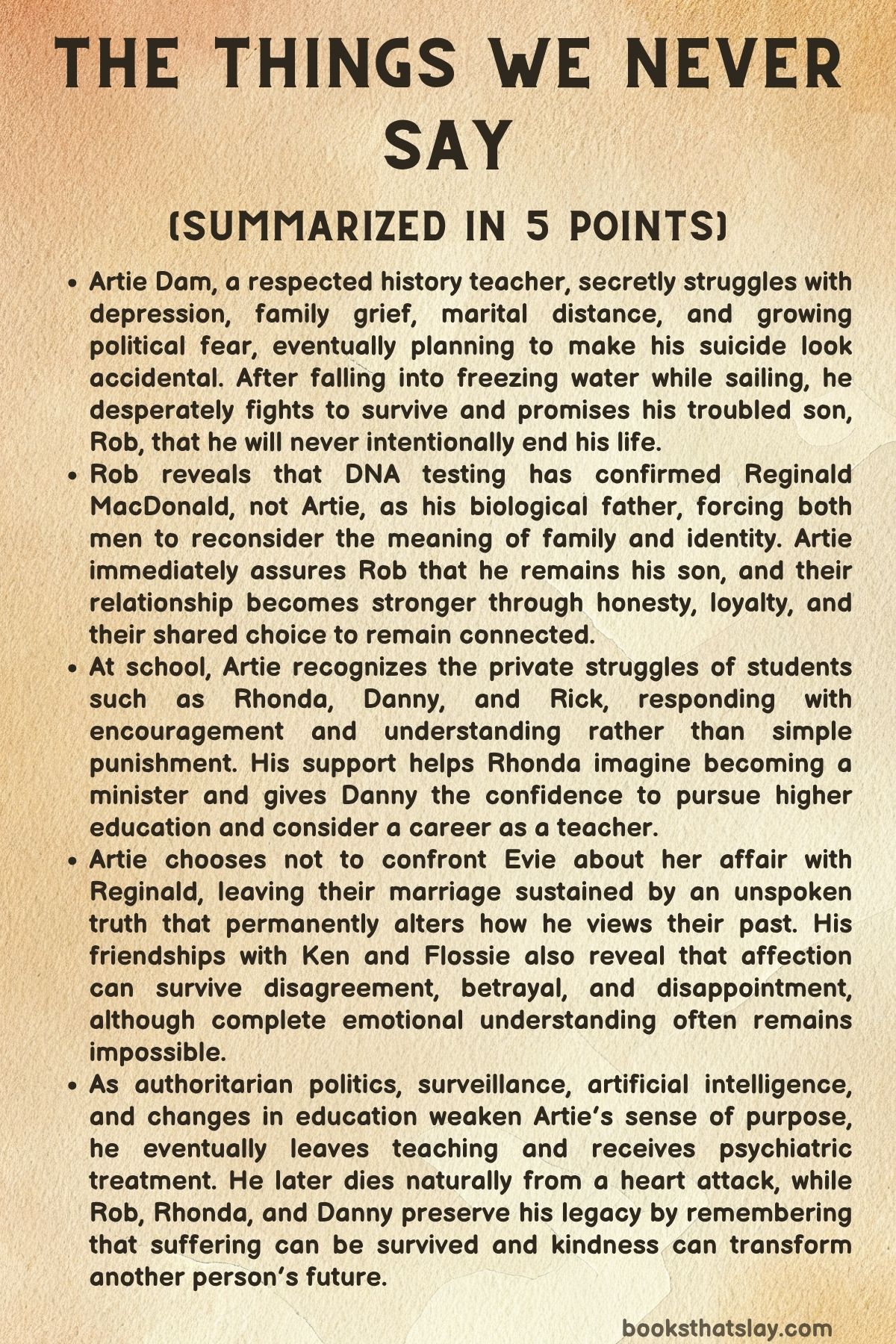
Summary
Artie Dam is a fifty-seven-year-old history teacher living on the Massachusetts coast. His students admire him for his warmth, generosity, humor, and ability to recognize those who feel ignored, but beneath his approachable manner, he is experiencing a severe emotional collapse.
His closest friend, Flossie MacDonald, has moved to Ohio, leaving him without the person to whom he once spoke most freely. His marriage to Evie remains outwardly stable, yet years of unspoken resentment and emotional distance have made genuine intimacy difficult.
Artie is especially worried about his adult son, Rob, who has never fully recovered from the car accident that killed his teenage girlfriend, Heather. Rob has withdrawn emotionally and now reveals that he is separating from his wife, Francesca, after beginning a relationship with a woman named Rachel.
Artie’s sensitivity to other people’s suffering is evident at school. When the awkward and vulnerable Rhonda Lazarre is mocked, he defends her with unusual intensity, partly because he recognizes the pain of being treated as different.
His compassion is accompanied by anger, exhaustion, and despair. Memories of his mentally ill mother, his abused sister Maria, his neglected father, and the class divisions within his marriage continue to trouble him.
Artie has secretly decided to kill himself by arranging an accident that will not look intentional. He believes this will protect his family from the shame, guilt, and confusion that might follow an obvious suicide.
The pain hidden within other households confirms his belief that ordinary life is filled with invisible desperation. Tom Marino, the father of Artie’s student Danny, breaks down while working as a plumber because his wife is having an affair.
Artie later goes sailing and falls into freezing water, just as he had foreseen in a vivid dream. Although the accident resembles the death he had planned, the moment he enters the water, he discovers that he desperately wants to survive.
He fights against the cold until Kenneth Moynihan and Ken’s son rescue him. In the hospital, Artie realizes that his desire to die has disappeared, even though the problems that caused it remain.
Rob suspects that the fall may have been intentional and confronts his father directly. He tells Artie that he sees him as an explorer whose continued existence gives him permission to keep living through his own pain.
Recognizing that Rob’s survival is emotionally connected to his, Artie promises that he will never kill himself. The promise becomes one of the most important commitments of his remaining life.
During his recovery, Artie thinks about his father’s kindness, Maria’s suffering, Francesca’s intense devotion to music, and Reginald MacDonald’s long-standing contempt for him. These memories contribute to a renewed sense that individual lives may be connected in ways that cannot be fully explained.
Artie tells a sympathetic doctor about his dream, believing that it predicted his fall. Evie remains skeptical, but Artie begins to take his intuitions and spiritual impressions more seriously.
Ken, the man who saved him, becomes a new friend. Their conversations give Artie an honesty and companionship that have been missing since Flossie moved away.
When Artie returns to school, his students welcome him affectionately. Rhonda tells him that he must have a guardian angel, and his kindness toward her later influences her decision to become a minister.
Rob introduces Rachel to the family, but the meeting is uncomfortable. Evie suspects that Rachel steals one of the family’s small pillboxes, though Artie initially hesitates to accept the accusation.
Artie begins sailing again with genuine happiness, yet political hostility soon unsettles him. An antisemitic fight at a soccer match confirms his fear that intolerance is spreading through the country.
At school, Principal Hoover Lakeland tells Artie that some parents want him to include Confederate viewpoints in his teaching of the Civil War. Hoover privately shares Artie’s fear that democratic institutions are weakening and that authoritarianism is becoming increasingly possible.
Artie responds by teaching his students about fascism, Nazism, propaganda, and the speed with which civil protections can disappear. When Rhonda asks whether world peace can ever exist, he gives her hope despite his own doubts.
Artie’s concern about Rob becomes stronger after he remembers Rob’s words at the hospital. Guided by an intuition that his son may be considering suicide, he drives unannounced to Rob’s home in Somerville.
There, Rob reveals the secret that has shattered his understanding of his identity. Before his death, Reginald MacDonald wrote Rob a letter claiming to be his biological father, and DNA testing confirmed the claim.
Artie immediately tells Rob that the discovery changes nothing about their relationship. Whatever his genetic connection to Reginald may be, Rob remains Artie’s son because of the life, trust, and love they have shared.
Francesca has supported Rob through the discovery and joins their conversation. The three discuss parenthood, free will, identity, and the possibility of choosing one’s relationships rather than being defined by biology.
Artie takes Reginald’s letter home but does not confront Evie. His silence creates a new form of distance in their marriage, because he must now live beside her while knowing that she concealed an affair for decades.
The revelation changes Artie’s understanding of many past events. Reginald’s attention to Rob, his pride at Rob’s graduation, and his continued closeness with Evie now appear to have been signs of a truth Artie failed to recognize.
Overwhelmed by anger and confusion, Artie begins stealing inexpensive objects. He takes a cheap comb and later tries to steal two shirts, even though he has never previously lived as a dishonest person.
Charles Schwartz, the storeowner who catches him, investigates Artie’s background and realizes that the theft may be connected to emotional loss rather than criminal greed. Instead of humiliating him or calling the police, Charles releases him with unexpected mercy.
Artie returns home shaken, but Evie does not recognize the seriousness of his distress. Her failure to see his crisis strengthens the novel’s portrayal of people living close together while remaining unaware of each other’s inner lives.
Thanksgiving brings Rob and Francesca to the family home. Music creates a rare sense of closeness when Francesca transforms Artie’s simple composition and explains that she searches for God through her playing.
The family talks about ancestry, Maria, and Artie’s father. Artie feels both included and isolated because he shares the truth about Rob with Rob and Francesca while continuing to conceal it from Evie.
Rachel visits again, and her habit of stealing small objects becomes increasingly clear. Artie delays warning Rob, partly because his own shoplifting has made him ashamed and less certain of his right to judge her.
At school, Rick Roper uses a homophobic slur after noticing Artie’s old cellphone pillowcase. Artie reacts impulsively by expelling him from class and later gives the pillowcase to Rhonda, who receives it as a sign of acceptance.
Artie also catches Danny Marino writing an obscenity on a wall. Rather than reporting him, Artie admits that he sometimes feels the same desire to curse the world, then quietly helps Danny remove the words.
Danny is transformed by the realization that adults also carry anger, confusion, and grief. Artie’s honesty allows him to see his teacher not simply as an authority figure but as another struggling human being.
After Hoover requires a meeting with Rick’s parents, Artie apologizes for losing control while insisting that Rick must also take responsibility. Reading Rick’s work afterward, Artie discovers the boy’s profound love for his father and begins to understand the fear and loneliness beneath the family’s hostility.
Anne Merrill later tells Artie that she suspects her husband is again being unfaithful. Artie listens sympathetically but does not reveal his own marital discovery, reinforcing the distance created by secrecy.
Rob calls in distress because he wants to end his relationship with Rachel but does not know how. Artie repeats the practical advice his own father once gave him, helping Rob face the difficult conversation directly.
Rob ends the relationship and learns that Rachel has stolen from several people. As he increasingly relies on Artie for guidance, their bond confirms that chosen loyalty and sustained care can matter more than biological parenthood.
Artie asks his students about their futures and discovers that many of their ambitions are mixed with anxiety. He encourages them toward nursing, medicine, business, libraries, education, and other lives in which their abilities may be useful.
Danny initially refuses to discuss his plans, but Artie later discovers his remarkable understanding of Shakespeare. He urges Danny to seek financial assistance, attend college, and become a teacher, offering him a future he had never imagined for himself.
Artie refuses Evie’s plan for a Christmas visit to London because the city has become connected in his mind with her deception. Since he will not tell her what he knows, he cannot explain the intensity of his refusal.
When Charles dies, Artie mourns the man whose mercy saved him from public disgrace. He teaches his students that kindness often comes from people who understand suffering that others cannot see.
Ken also tells Artie that Heather’s parents would welcome a letter from Rob. The possibility gives Rob a way to confront the guilt and grief he has carried since Heather’s death.
Before Christmas, Rob and Francesca announce that they have reunited. Their reconciliation delights Artie, who is moved when Rob gives him white socks and a miniature sailboat and promises that they will sail together again.
Artie then dreams that Rob and Francesca must leave the United States. The dream is fulfilled when Rob later loses his government position and moves with Francesca to Brussels.
At a Christmas party hosted by the Peabodys, Artie feels increasingly alienated from the privileged social world connected to Evie’s family. His discomfort revives his resentment about the class prejudice that shaped his marriage and separated him from his own father.
Evie tells Artie that Endicott’s former wife, Evelyn, has attempted suicide. The news confirms Artie’s belief that people often conceal their greatest suffering because those around them may not know how to receive it.
On Christmas Day, Artie decides that he will never tell Evie he knows the truth about Rob. His silence is not forgiveness, but a deliberate choice to preserve the existing structure of their lives.
Artie also discovers that Ken supports the incoming president whose politics Artie fears. Although deeply disturbed, he accepts that someone can disagree with him politically and still be loving, generous, and decent.
His reunion with Flossie on New Year’s Day is far more painful than he expected. Their former ease has disappeared, and Flossie reveals that she once had an affair with Anne’s husband while also expressing optimism about the new president.
Artie begins laughing uncontrollably, but the laughter expresses grief rather than amusement. He is mourning his country, his marriage, Maria, his lost friendship with Flossie, and the impossibility of fully knowing another person.
In the years that follow, the United States moves toward the authoritarian future Artie feared. Rob secretly works in Brussels on an independent European artificial-intelligence system and warns Artie to use burner phones because surveillance and political danger are increasing.
Artie and Rob eventually share one final sailing trip. During the journey, they discuss vanishing civil protections, technological control, and the uncertainty of the future before a sudden fog leaves them briefly lost.
Hoover later dies by suicide after being targeted for helping undocumented immigrants. His death, combined with political violence, workplace changes, and the decline of educational trust, steadily weakens Artie’s emotional stability.
A new principal marginalizes him, artificial intelligence makes student dishonesty easier, and longtime colleagues retire. Teaching, which once gave Artie purpose, begins to feel disconnected from the society and students he hoped to serve.
Artie eventually freezes in front of a class and asks his students for help. After leaving the school, he enters a psychiatric hospital, where medication reduces his distress but also dulls his personality and emotional range.
Anne visits him, and a return to Revere offers moments of companionship and familiarity. Artie eventually sells his sailboat and senses that he may not live much longer, but he repeatedly assures Evie that he will keep his promise never to harm himself.
During a heat wave and power failure, Artie dies naturally from a massive heart attack. At his funeral, Rhonda and Danny mourn the teacher whose attention and kindness changed the direction of their lives.
Danny fears that Artie may have died by suicide and asks Rob directly. Rob compassionately tells him that Artie died of a heart attack, allowing Danny to retain the lesson Artie tried to give others: suffering can be survived, and kindness can continue through the people who receive it.
Characters
Artie Dam
At the center of The Things We Never Say, Artie Dam is a compassionate teacher whose public warmth conceals severe depression, unresolved grief, political fear, and marital loneliness. He is skilled at recognizing distress in students and strangers, yet he cannot communicate his own suffering with the same clarity.
Artie’s desire to die does not emerge from a single event. It grows from memories of his mother’s mental illness, Maria’s abuse, his guilt about neglecting his father, his fear for Rob, the loss of Flossie’s companionship, and his belief that society is becoming crueler and less stable.
His fall into the freezing water becomes the decisive moment of his life. He discovers that wanting relief from pain is not the same as wanting existence to end, and his desperate fight to survive overturns the plan he had privately created.
Artie’s promise to Rob gives his survival a moral purpose. He understands that remaining alive is not only a private decision because Rob has built part of his own emotional stability around his father’s continued presence.
The revelation about Rob’s biological father produces anger, humiliation, and a profound crisis of identity. Artie’s shoplifting shows how emotional disorientation can appear through behavior that seems completely disconnected from the underlying injury.
Despite his pain, Artie repeatedly chooses compassion. He protects Rhonda, encourages Danny, tries to understand Rick, helps Rob confront Rachel, and accepts Ken’s political differences without erasing Ken’s goodness.
His final decline is therefore not a rejection of the promise he made. He continues living until natural death, even when illness, authoritarian politics, technological change, and the loss of professional meaning make life increasingly difficult.
Artie’s greatest legacy lies in the people he notices. Rhonda and Danny carry his influence forward because he treated their vulnerability as evidence of possibility rather than weakness.
Evie Dam
Evie is Artie’s wife and Rob’s mother, a woman whose composed exterior conceals a long history of secrecy. Her marriage to Artie is functional and enduring, but it lacks the emotional openness that might allow either partner to reveal the full truth of their inner life.
Her affair with Reginald MacDonald changes the meaning of the family’s past. By allowing Artie to raise Rob without knowing the truth of his paternity, she protects the existing household while denying Artie the ability to make informed choices about his own life.
Evie is not presented as openly cruel. She cares about her family, responds to Rob and Francesca’s reconciliation with happiness, and attempts to maintain familiar traditions, but she often fails to perceive the depth of Artie’s distress.
Her suspicion that Rachel steals the pillbox demonstrates that she can be observant when the evidence fits an external problem. In contrast, she struggles to recognize the emotional transformation occurring inside her husband.
The class background of Evie’s family also influences the marriage. Artie feels that her father looked down on him, and his entry into Evie’s privileged world contributed to his neglect of his own father and origins.
Evie’s silence about Reginald becomes part of the novel’s broader examination of whether concealment can preserve love or merely prevent honest intimacy. Artie’s final decision not to confront her leaves their marriage intact in form while ensuring that its deepest conflict will never be openly addressed.
Rob Dam
Within The Things We Never Say, Rob is Artie’s son in every emotional and moral sense, even after biology complicates that identity. He is intelligent, vulnerable, and deeply affected by the death of his teenage girlfriend, Heather.
Rob’s grief has never been fully resolved. His hospital conversation with Artie suggests that he has considered suicide and that his father’s survival gives him a model for continuing through pain.
The discovery that Reginald is his biological father destabilizes Rob’s sense of self. He fears that inherited identity may matter more than the relationship he has lived, but Artie immediately rejects that possibility.
Rob’s bond with Artie becomes stronger after the revelation because both men actively choose the relationship. Their discussions about free will, personality, ancestry, politics, and technology allow them to know one another more honestly than before.
His relationships with Francesca and Rachel reveal his uncertainty about love. Rachel offers a temporary escape from the intensity of his marriage, but her dishonesty and compulsive stealing expose the instability of that choice.
Francesca remains beside Rob during the paternity discovery, showing that their marriage contains a depth his relationship with Rachel lacks. Their eventual reconciliation suggests that separation can sometimes clarify rather than destroy genuine attachment.
Rob later works on politically sensitive artificial intelligence in Brussels and becomes increasingly aware of surveillance. His warnings to Artie show that his childhood dependence has developed into an adult desire to protect his father.
Francesca
Francesca is Rob’s wife, a gifted pianist whose intensity can make her appear difficult or emotionally overwhelming. Her relationship with music is spiritual, and she describes playing as a search for God.
Her temporary separation from Rob does not erase her loyalty. When he learns the truth about Reginald, she supports him through the confusion and joins the conversation in which Artie reaffirms his fatherhood.
Francesca understands that Rob’s crisis is not simply about genetics. It involves grief, belonging, personal choice, and the fear that another man’s character might somehow determine who Rob is.
Her transformation of Artie’s composition demonstrates her creative power. She takes something simple and expands its emotional meaning, much as she helps Rob interpret his life beyond the immediate shock of the revelation.
Her reconciliation with Rob is based on a renewed recognition of their connection. Moving to Brussels with him suggests that she remains his partner through professional loss, political danger, and a major change in their lives.
Flossie MacDonald
Flossie is Artie’s former closest friend and one of the few people with whom he once felt able to speak openly. Her move to Ohio leaves him emotionally isolated at a time when his need for honest companionship is becoming urgent.
Flossie’s flamboyant personality and earlier closeness with Artie create the expectation that their reunion will restore him. Instead, their meeting reveals how distance, politics, time, and undisclosed history have altered the friendship.
Her revelation that she once had an affair with Anne’s husband introduces another example of concealed betrayal. It also forces Artie to recognize that even the friend he believed he knew completely possessed a private life outside his understanding.
Flossie’s support for the new president further separates them. Artie’s uncontrollable laughter expresses his inability to reconcile the friend he remembers with the person sitting before him.
She represents the painful truth that emotional intimacy cannot always be recovered simply because it once existed. Some relationships survive in memory long after their actual form has disappeared.
Reginald MacDonald
Reginald is Rob’s biological father and the source of the secret that transforms Artie’s understanding of his family. During his life, he treated Artie with contempt while maintaining a concealed connection with Evie and a special interest in Rob.
His deathbed letter may appear to be an act of honesty, but it transfers the burden of truth to Rob after Reginald can no longer answer questions or accept responsibility. The letter disrupts several lives while protecting him from direct consequences.
Reginald’s attention to Rob’s accomplishments gains a new meaning once the truth becomes known. What previously seemed like ordinary family friendship is revealed as a biological father’s hidden pride.
Artie worries that Reginald’s character might influence Rob, but he rejects the idea that biology determines moral identity. Reginald therefore becomes a contrast to Artie, who proves fatherhood through daily care rather than genetic connection.
Kenneth Moynihan
Kenneth Moynihan saves Artie from drowning and becomes an important friend during Artie’s renewed commitment to life. His rescue is both physical and symbolic because it returns Artie to a world in which new relationships remain possible.
Ken offers Artie honest companionship without demanding complete agreement. Their dinners and conversations restore some of the pleasure Artie lost when Flossie moved away.
When Artie confides that Rob is not biologically his, Ken responds with sympathy and discretion. He does not reduce the situation to scandal or offer empty advice, allowing Artie to speak without being judged.
Ken’s political support for the incoming president deeply troubles Artie, yet their friendship continues. Through Ken, Artie learns that a person can hold beliefs he finds dangerous while still acting with courage, kindness, and loyalty.
Ken also helps Rob confront Heather’s death by explaining that her parents would welcome a letter. His role throughout the story is practical, steady, and quietly restorative.
Rhonda Lazarre
Rhonda is an awkward student who is frequently vulnerable to ridicule. Artie recognizes her difference as a strength and defends her when others attempt to reduce her to an object of amusement.
Her belief that Artie has a guardian angel reflects her openness to spiritual meaning. She notices his goodness without understanding the full extent of his depression.
Artie’s encouragement gives Rhonda permission to imagine that her honesty and sensitivity might help others. His treatment of her eventually contributes to her decision to become a minister.
The cellphone pillowcase he gives her becomes a symbol of acceptance. An object mocked through a homophobic insult is transformed into a gift of trust and personal connection.
Rhonda’s presence at Artie’s funeral confirms the lasting effect of small acts of recognition. She carries forward the compassion he offered when she was still learning how to understand herself.
Danny Marino
Danny is one of Artie’s most significant students because his anger, intelligence, and uncertainty remain hidden beneath silence and disruptive behavior. His father’s emotional breakdown and family difficulties shape an environment in which Danny has little reason to imagine a hopeful future.
When Artie catches him writing an obscenity on the wall, he does not respond with punishment alone. By admitting that adults sometimes want to curse the world as well, Artie gives Danny an unexpected experience of honesty.
Danny later reveals an exceptional understanding of Shakespeare. Artie sees an intellectual ability that Danny has not been encouraged to value and urges him to seek financial support, attend college, and become a teacher.
This intervention changes Danny’s sense of what is possible. Artie does not merely praise him; he provides a specific vision of a life beyond the limits Danny has accepted.
At the funeral, Danny fears that Artie may have died by suicide. His need to know shows how deeply Artie’s survival has become connected to his own belief that suffering can be endured.
Tom Marino
Tom Marino is Danny’s father, a plumber whose emotional collapse exposes the suffering concealed beneath working life. His wife’s affair leaves him overwhelmed, and he breaks down in front of Artie.
Tom’s distress broadens Artie’s awareness that betrayal and loneliness are not limited to his own household. Men who appear practical and self-sufficient may be carrying pain they do not know how to express.
His situation also provides context for Danny’s anger. The instability surrounding the boy helps explain why Artie’s recognition and encouragement become so important.
Hoover Lakeland
Hoover Lakeland is the school principal and one of Artie’s closest allies in understanding the political danger developing around them. Although he sometimes performs administrative duties that frustrate Artie, he shares Artie’s concern about authoritarianism.
Hoover warns Artie that parents want Confederate perspectives added to the history curriculum. His fear is not simply about one complaint but about a broader effort to weaken truthful education and reshape public memory.
He later shelters undocumented immigrants and becomes a political target. The pressure contributes to his eventual suicide, making him one of the clearest examples of how public cruelty can destroy private resilience.
Hoover’s death also affects Artie’s final decline. The loss removes a colleague who understood both his educational values and his political fears.
Anne Merrill
Anne is Artie’s colleague and friend, though their relationship is limited by what neither fully reveals. She tells him that her husband may again be unfaithful, unaware that Flossie once had an affair with the same man.
Her confession gives Artie an opportunity to share his discovery about Evie, but he remains silent. Their conversation demonstrates how people may speak honestly about one pain while concealing another.
Anne later visits Artie during his psychiatric hospitalization. Her continued presence offers companionship when his professional identity and emotional energy have nearly disappeared.
She represents imperfect but meaningful friendship. She cannot save Artie from decline, yet she refuses to vanish when his condition makes ordinary social interaction difficult.
Rick Roper
Rick Roper is a student whose homophobic insult provokes an unusually impulsive response from Artie. His behavior reflects the political hostility entering the school, but his later writing reveals that he cannot be understood only through his offensive language.
Artie discovers that Rick has a deep love for his father. This emotional attachment exposes the fear, dependence, and loneliness beneath the family’s aggressive beliefs.
The meeting with Rick’s parents forces Artie to balance accountability with self-examination. He apologizes for losing control while insisting that Rick must also acknowledge the harm he caused.
Rick’s role challenges Artie to practice the complexity he teaches. Understanding another person’s pain does not excuse prejudice, but it can prevent moral judgment from becoming dehumanization.
Charles Schwartz
Charles Schwartz is the storeowner who catches Artie trying to steal shirts. Instead of treating him only as a criminal, Charles investigates enough of Artie’s life to recognize that the theft is connected to emotional crisis.
His decision to release Artie is an act of mercy without sentimentality. Charles understands that shame and punishment may intensify the despair that produced the behavior.
The encounter becomes especially important because Evie fails to notice how distressed Artie is when he returns home. A near stranger sees what his wife cannot.
After Charles dies, Artie remembers him as proof that kindness often comes from private experience with suffering. His influence survives in Artie’s teaching and in the mercy Artie later extends to others.
Rachel
Rachel is the woman Rob dates during his separation from Francesca. Her awkwardness and emotional instability make family gatherings uncomfortable, and Evie quickly suspects that she steals small objects.
Her repeated thefts suggest a compulsive attempt to possess fragments of other people’s lives. The behavior parallels Artie’s shoplifting, though their motives and circumstances are not presented as identical.
Artie’s own shame makes him hesitate to warn Rob. Through Rachel, the book shows how moral certainty becomes difficult when a person recognizes a version of the same behavior in himself.
Rob eventually ends the relationship and confirms that she has stolen from several people. Rachel’s role is brief but important because she helps Rob recognize the difference between temporary escape and lasting partnership.
Maria
Maria is Artie’s sister, whose history of abuse remains one of his deepest sources of sorrow. Her suffering contributes to his heightened awareness of vulnerability and his inability to accept casual cruelty.
Although she is largely present through memory, Maria shapes Artie’s behavior toward Rhonda, Danny, and other wounded people. He reacts strongly when someone is humiliated because he understands how lasting such damage can become.
His grief for Maria is also mixed with helplessness. He cannot repair what happened to her, and that inability becomes part of the emotional burden he carries throughout adulthood.
Artie’s Father
Artie’s father is remembered as a kind and practical man whose advice continues to guide the family. Artie repeats his father’s wisdom when helping Rob end his relationship with Rachel.
His memory is also connected with guilt. After marrying into Evie’s wealthier family, Artie neglected his father and allowed class shame to distance him from his own origins.
The father’s influence survives through Artie’s parenting. His practical kindness passes from one generation to the next, demonstrating how moral inheritance can matter more than biological inheritance.
Heather
Heather is Rob’s teenage girlfriend who died in the car accident that permanently altered his emotional life. Although she does not appear directly in the present action, her absence shapes Rob’s grief, guilt, relationships, and possible suicidal thoughts.
Her parents’ willingness to receive a letter gives Rob a chance to address pain that has remained suspended for years. Heather therefore represents both irreversible loss and the possibility of delayed communication.
Evelyn
Evelyn, Endicott’s former wife, attempts suicide, and the news confirms Artie’s belief that severe suffering is often hidden. Her crisis is known to him only indirectly, which reinforces the distance between external knowledge and another person’s actual experience.
She functions as a reminder that social position and outward normality do not provide immunity from despair. Her pain adds another private tragedy to the privileged community that Artie increasingly finds alienating.
Themes
Silence, Secrecy, and the Limits of Intimacy
In The Things We Never Say, silence is not simply the absence of speech. It is a force that protects relationships from immediate conflict while gradually preventing people from knowing one another honestly.
Evie’s concealment of Rob’s paternity preserves the family for decades, but it also denies Artie knowledge that belongs to his own life. After discovering the truth, Artie mirrors her silence by refusing to confront her, creating a marriage in which both partners live beside a reality they never discuss.
The pattern extends beyond their household. Flossie hides her affair with Anne’s husband, Anne does not know the full history of her marriage, Rob carries guilt about Heather, Danny conceals his intelligence, and Hoover faces political danger that many around him do not fully understand.
Artie is often able to sense hidden suffering, yet he also contributes to the culture of concealment. He plans a disguised suicide, hides his shoplifting, withholds the truth about Rob from Evie, and refuses to explain why London has become intolerable to him.
The novel does not suggest that complete disclosure is always possible or even desirable. Instead, it asks whether intimacy can survive when silence becomes the primary method of maintaining peace.
People may love one another deeply and still remain partly unknowable. Adulthood requires accepting that limitation, but it also requires recognizing when silence has become a form of abandonment.
Depression, Survival, and Moral Responsibility
Artie’s depression is presented as an accumulation of personal grief, social fear, loneliness, guilt, and exhaustion. His outward competence does not protect him from suicidal thinking, and his kindness toward others does not automatically teach him how to extend the same mercy to himself.
The near-drowning separates the wish for relief from the wish for death. Once Artie enters the freezing water, his body and mind fight desperately for life, revealing that his suicidal plan was driven by unbearable pain rather than a simple rejection of existence.
Rob’s response changes the moral meaning of Artie’s survival. By calling his father an explorer whose endurance gives him permission to endure, Rob shows that an individual life may support other lives in ways that remain invisible.
Artie’s promise never to kill himself does not cure his depression. He later experiences political despair, professional displacement, psychiatric hospitalization, emotional dullness, and the loss of activities that once gave him meaning.
His achievement lies in continuing to honor the promise despite those conditions. Survival is shown not as a permanent triumph over suffering but as a repeated decision made within suffering.
The distinction becomes essential at Artie’s funeral. Danny needs reassurance that his teacher did not surrender because Artie’s endurance has become evidence that pain can be survived without denying its severity.
Parenthood, Biology, and Chosen Love
Rob’s paternity crisis challenges the belief that biology is the foundation of family identity. Reginald contributes genetic inheritance, but Artie performs the daily work of fatherhood through care, guidance, protection, discipline, memory, and continued presence.
Artie’s immediate response to Rob is decisive. He does not pause to calculate whether the revelation has reduced their connection because he understands that years of shared life cannot be erased by a DNA result.
Rob nevertheless fears that Reginald’s character may define him. Artie counters this fear by insisting that moral identity is created through choices rather than inherited automatically through blood.
The contrast between the two fathers is sharp. Reginald watches Rob from a distance, conceals the truth, and reveals it only when death protects him from responsibility, while Artie remains present through grief, marriage problems, political danger, and personal crisis.
Artie’s own father adds another dimension to the theme. His kindness survives through the advice Artie gives Rob, showing that emotional inheritance may pass through remembered words and behavior.
Parenthood is therefore presented as a relationship repeatedly chosen by both generations. Rob chooses to keep turning toward Artie, and Artie chooses to remain his father even when biology, betrayal, and anger might have encouraged withdrawal.
Kindness as a Lasting Form of Resistance
Kindness in the novel is rarely dramatic. It appears when Artie protects Rhonda, admits his anger to Danny, encourages a student’s ambition, listens to Tom, understands Rick’s loneliness, and reassures Rob that he remains his son.
These acts matter because they occur within a society becoming increasingly hostile. Political intimidation, antisemitism, homophobia, historical distortion, surveillance, and authoritarian control create pressure to treat people as categories rather than individuals.
Charles Schwartz demonstrates the theme most clearly when he catches Artie stealing. He could punish or expose him, but he recognizes emotional loss beneath the crime and responds with mercy.
Artie later passes that mercy forward. His handling of Danny’s graffiti echoes Charles’s refusal to reduce a person to one damaging action, while his treatment of Rick combines accountability with an effort to understand the fear beneath prejudice.
The influence of kindness is not always visible at the moment it is offered. Rhonda becomes a minister, Danny imagines becoming a teacher, Rob learns that chosen love is stronger than biology, and Artie finds enough meaning to honor his promise.
By the funeral, kindness has become a form of inheritance. Artie’s body is gone, but the people he noticed carry his values into lives he will never see.
The novel presents this transmission as a quiet resistance to despair. A person may be unable to stop political decline, repair every betrayal, or remove another person’s grief, but a single act of recognition can alter what that person believes is possible.