Pot Shot Summary, Characters and Themes
Pot Shot by Laura Piper Lee is a romantic comedy about chronic illness, medical prejudice, cannabis, community, and the emotional cost of measuring personal worth through achievement.
The novel follows Nomi Wyeth, an aspiring dispensary owner, and Julian D’Angelo, the rigid doctor who was once her academic rival and teenage love interest. Their humiliating reunion develops into a public battle over Nomi’s business before forcing them to confront their shared history. Beneath the sharp humor and physical comedy, the story examines bodily autonomy, compassionate healthcare, vulnerability, ambition, and the importance of allowing others to offer support without surrendering independence.
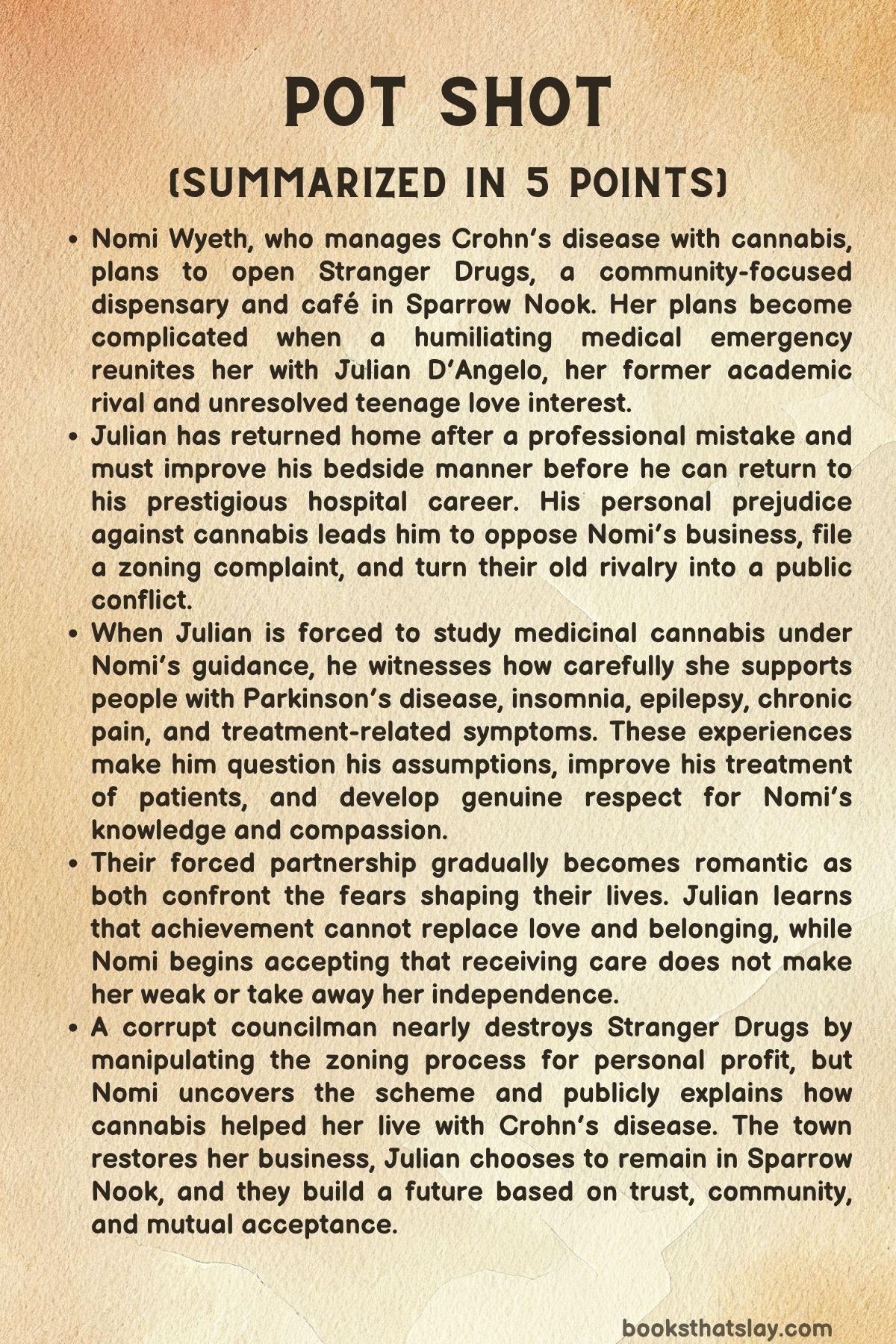
Summary
Thirty-three-year-old Nomi Wyeth is preparing for a Memorial Day beach trip while testing a powerful cannabis strain and attempting to shave her bikini area. Nomi has Crohn’s disease, which is considered to be in remission but continues to influence her health, body image, confidence, finances, and reluctance to pursue romantic relationships.
Her best friend, Eve, unexpectedly enters the apartment, startling Nomi and causing her to cut herself badly with the electric razor. Eve rushes her to a local clinic, where the doctor treating her is Julian D’Angelo, Nomi’s former debate partner, academic rival, and unresolved teenage love interest.
The reunion is embarrassing for both of them. Julian professionally stitches the wound, but their familiar competitiveness returns through insults, awkward jokes, and unmistakable attraction.
Julian has temporarily returned to Sparrow Nook after making a serious mistake at Philadelphia General Hospital. He has been ordered to spend six months improving his bedside manner at Dr. Srinivasan’s family clinic, where his blunt comments and judgmental attitude have already produced numerous patient complaints.
His harsh personality comes from a lifelong determination to remain capable, successful, and independent. After the disability and death of his father, Anthony, Julian came to believe that achievement was the only protection against shame, helplessness, and rejection.
Nomi is equally determined to prove herself. She works at Xscape Your Brain, a corporate cannabis dispensary owned by Damon, but she dislikes his focus on profitable recreational products and wants to provide careful assistance to people managing pain, anxiety, Parkinson’s disease, and other conditions.
Her experience with Crohn’s disease inspired this ambition. Cannabis restored her appetite and reduced her pain when traditional treatments failed, leading her to plan Stranger Drugs, a community dispensary and social lounge that she intends to open with Eve.
Nomi leases the beautifully restored Strange Drugs Pharmacy before receiving final approval for her license. The historic building, with its vintage soda fountain and glowing sign, represents independence, purpose, and a future shaped by her own knowledge rather than by other people’s expectations.
To raise money and demonstrate public support, Nomi and Eve host a large cannabis-themed event called the Stranger Drugs Pot Luck. The gathering attracts residents, potential customers, council members, and supporters who respond positively to Nomi’s plans for local products, medicinal guidance, infused baked goods, and a welcoming social space.
Damon arrives after discovering that Nomi intends to compete with his business. He publicly fires her and cruelly suggests that someone with chronic health problems cannot operate a dispensary without being rescued, striking directly at Nomi’s fear that illness makes her unreliable and dependent.
Julian arrives at the party to collect Dr. Srinivasan and unknowingly consumes several powerful cannabis-infused desserts. He becomes affectionate, playful, and relaxed, briefly connecting with relatives he usually avoids before becoming angry when he sees his mother, Gisella, using cannabis.
Cannabis reminds Julian of his father’s decline, and he assumes that it caused Anthony’s death. Overwhelmed by intoxication and unresolved anger, Julian climbs through a window and becomes trapped on Nomi’s roof.
Nomi attempts to calm him, but Julian panics after learning how much cannabis he consumed. He accuses her of drugging him, loses his balance, and falls into a hedge, escaping serious injury.
Inside Nomi’s home, his intoxicated behavior becomes increasingly ridiculous and flirtatious. He sings into her vibrator, jokes about falling into her hedge, asks to kiss her, and briefly shares a passionate moment with her before Nomi stops them.
The following morning, Julian is horrified by his behavior and the photographs circulating among his relatives. Instead of accepting responsibility, he blames Nomi and turns his embarrassment into moral opposition to her business.
At the city council meeting, he arranges a public debate about cannabis. Nomi presents Stranger Drugs as a responsible, locally supported business that will educate customers and provide alternatives to impersonal corporate dispensaries, while Julian emphasizes addiction, impaired judgment, exploitation, and mental-health risks.
Nomi exposes the prejudice underlying his arguments and wins the council’s approval by a narrow vote. Julian then files a zoning complaint claiming that a dispensary should not operate beside a family clinic, preventing Nomi from opening while officials investigate.
The complaint threatens to exhaust Nomi’s savings before she can earn revenue. When she confronts Julian at his mother’s house, he dismisses her financial losses as evidence that the business was poorly planned, while Nomi accuses him of trying to force her into the role of a failure.
Sparrow Nook turns against Julian. Residents chase him, vandalize his car, circulate embarrassing flyers using photographs from the party, and flood his phone with calls, while Nomi insists that the community is acting independently because people believe he is attacking someone who has helped them.
Nomi attempts to sell cannabis through a roadside stand but learns that she needs another state license. With no immediate legal source of cannabis income, she and Eve temporarily convert the building into Stranger Coffee, despite knowing almost nothing about preparing coffee.
Julian’s medical career also deteriorates. During an appointment with Mr. Gutierrez, he refuses to recognize how cannabis helps manage the man’s Parkinson’s symptoms and instead accuses him of having a drug habit.
Dr. Srinivasan removes Julian from patient care and orders him to study cannabis, observe its medicinal uses, and learn directly from Nomi. Julian must persuade the woman whose business he endangered to become his teacher.
His understanding begins to change when Gisella explains the truth about Anthony. Anthony’s disability and chronic pain followed an industrial accident, while prescription opioids, not cannabis, caused his fatal overdose.
Julian also speaks with his dying Aunt Edna, who uses cannabis to tolerate the effects of leukemia treatment. Both women challenge his belief that judgment is the same as responsibility and urge him to listen before deciding what other people need.
Julian withdraws his complaint in exchange for Nomi’s cooperation, but she demands compensation for lost rent, payment for developing his curriculum, and unpaid labor at the coffee shop. Their forced partnership gives Nomi control while placing Julian in situations where he must observe rather than dominate.
Nomi introduces him to Hillary Frankel, whose severe menopause-related insomnia was repeatedly dismissed by doctors, and to Mr. Gutierrez, whose movements improve significantly with carefully chosen cannabis. Julian sees that Nomi asks detailed questions about dosage, unwanted effects, daily functioning, and quality of life.
They also visit Charlie, a child with treatment-resistant epilepsy. Although prescription CBD greatly reduces his seizures, insurance restrictions and school policies prevent his family from obtaining consistent treatment, and Julian begins searching for a legal solution.
Working beside Nomi gradually changes his approach to medicine. He learns to pause before criticizing, treat patients as individuals, and recognize that many people turn to alternative care only after conventional systems ignore or fail them.
Nomi sees his progress and begins questioning her belief that he is incapable of change. Julian apologizes sincerely, admits that he has always liked her, and joins her at a D’Angelo family celebration.
During the party, Julian’s uncle Gino mocks Anthony, provoking Julian into shoving him. Nomi protects Julian from the consequences, and the two retreat to the garage containing Anthony’s enormous miniature model of Sparrow Nook.
Julian finally explains how his father’s disability, pain, cannabis use, and opioid overdose shaped his obsession with achievement. Nomi tells him that he does not need professional greatness to deserve love and that existing can be enough.
Their bond deepens during a group trip to Wildwood with Eve and Graham. Julian plans the journey like a professional assignment, but Nomi and her friends disrupt his schedule and introduce him to friendship based on enjoyment rather than performance.
At the boardwalk, Nomi persuades him to ride a roller coaster despite his fear. His terror turns into laughter, allowing him to experience uncomplicated pleasure without treating it as a reward for success.
That night, Julian admits that his prestigious career has left him anxious, angry, and lonely. Nomi recognizes that their renewed relationship has also awakened emotional and physical needs she has long denied.
They kiss on the beach and become intimate at the house. Julian respects Nomi’s boundaries and treats her body with care, allowing her to experience desire without viewing herself through the limitations and indignities associated with Crohn’s disease.
Julian immediately considers their relationship serious, while Nomi tries to define it as temporary because he is expected to return to Philadelphia. Their happiness is interrupted when the zoning commission decides to continue investigating Stranger Drugs despite Julian’s withdrawal.
The D’Angelo family organizes legal and political support for Nomi. However, the increasing pressure causes a severe Crohn’s flare, and Nomi hides her symptoms because she fears Julian will stop seeing her as a partner and start treating her as a patient.
Julian notices her weight loss, exhaustion, pain-relieving cannabis use, and physical withdrawal but interprets her secrecy as emotional rejection. He offers practical support, yet Nomi refuses to let him see the full reality of her condition.
Meanwhile, Julian demonstrates genuine professional growth by recognizing that Mr. Gutierrez is experiencing a life-threatening Parkinson’s crisis. He personally takes him to Philadelphia General and uses respectful collaboration rather than arrogance to secure immediate treatment.
At the zoning hearing, Councilman Mike Tonuto exposes Julian and Nomi’s sexual relationship to weaken Julian’s testimony. He questions Nomi’s qualifications, attacks her for leaving pharmacy school, and portrays her medication use as intoxication.
Nomi is already physically weak and emotionally overwhelmed. When Tonuto depicts her as an irresponsible drug user exploiting vulnerable people, she flees the hearing, and the commission denies approval for Stranger Drugs.
Soon afterward, Aunt Edna dies. Julian follows Nomi after the funeral and offers to move her into his Philadelphia apartment, pay her expenses, and help her return to pharmacy school.
Nomi hears the proposal as confirmation that Julian still prefers the ambitious student she once was to the woman she has become. Their conflict worsens when he admits seeing her abnormal bloodwork, and she accuses him of trying to fix her rather than accept her.
After reflecting on his future, Julian realizes that returning to Philadelphia fills him with dread, while remaining in Sparrow Nook feels peaceful. He visits Nomi with food, electrolyte drinks, heating pads, fans, toilet paper, and a bidet, offering support without demanding control.
Nomi finally tells him about her Crohn’s diagnosis, failed treatments, teenage disappearance, and dependence on cannabis for pain relief and appetite. Julian listens as her partner rather than her physician and shares his own humiliating professional mistake, restoring honesty between them.
Medical testing reveals active inflammation but limited permanent intestinal damage. Nomi’s new gastroenterologist, Dr. Rashad, respects her past experiences and proposes a wider, research-based treatment plan rather than forcing her back onto medications that previously harmed her.
The zoning dispute appears to have cost Nomi the historic building, but she discovers that JM Enterprises has been registered at the same address. The company is controlled by Commissioner Jacqueline Lombardi, frequent complainant Wilson Phillips, and Tonuto, whose legal name appears in the records.
Nomi realizes that Tonuto wanted the property for a restaurant franchise and manipulated the zoning process to remove her. During the Labor Day parade, she publicly presents the evidence and exposes his corruption.
When Tonuto again calls her an irresponsible stoner, Nomi refuses to hide. She reveals her Crohn’s disease to the town and explains that cannabis helped her eat, manage pain, and recover a sense of joy.
The council overturns the zoning decision and suspends Tonuto and Lombardi pending investigation. Julian announces that he has rejected Philadelphia General, accepted Dr. Srinivasan’s local practice, and plans to run for Tonuto’s council seat.
Julian proposes marriage, but Nomi refuses because their romantic relationship has lasted only six weeks. He promises to ask again, treating her answer as a request for time rather than a rejection of their future.
Two months later, Stranger Drugs is thriving in its original location. Eve operates the bakery, Graham handles security, Julian prepares to take over the neighboring clinic, and the entire downtown benefits from the crowds drawn to Nomi’s business.
Julian continues proposing every week, and Nomi’s firm refusal gradually becomes an internal possibility. Their story ends in the clinic where their humiliating reunion occurred, but the hostility and shame of that first encounter have been replaced by playfulness, trust, desire, and an enduring partnership.
Characters
Nomi Wyeth
Nomi is the emotional and entrepreneurial center of Pot Shot, defined by intelligence, compassion, humor, stubbornness, and a powerful need to preserve her independence. Her dream of opening Stranger Drugs is not simply a business ambition but the result of living through chronic pain, ineffective treatments, disrupted education, financial insecurity, and the judgment attached to cannabis use.
Her expertise comes from both personal experience and careful observation of customers whose needs are often overlooked by conventional healthcare. She listens closely, respects individual responses, and views quality of life as a legitimate medical concern rather than a secondary issue.
Nomi’s strongest quality is her determination to create meaning from experiences that once made her feel powerless. She transforms cannabis from something associated with secrecy and stigma into the basis of a responsible community service.
However, her determination also becomes emotional isolation. Because she fears being seen as weak, she withholds information, refuses assistance, and treats accepting care as though it will automatically cost her autonomy.
Her resistance to romantic commitment comes partly from the unpredictable nature of Crohn’s disease. She assumes that a partner will eventually resent canceled plans, physical limitations, medical emergencies, and the practical realities of living beside chronic illness.
Nomi’s relationship with Julian forces her to reconsider this belief. She learns that vulnerability does not have to turn her into a problem and that a loving partner can offer help without claiming authority over her body.
Her public disclosure during the parade marks an important stage in her growth. Instead of allowing Tonuto to weaponize the label of an irresponsible cannabis user, she openly connects her illness, treatment, survival, and joy.
Nomi does not overcome Crohn’s disease, nor does the book suggest that love removes its effects. Her victory comes from accepting medical support, romantic intimacy, friendship, and community assistance while continuing to define herself on her own terms.
Julian D’Angelo
Julian begins Pot Shot as a brilliant but emotionally rigid physician whose intelligence has become separated from empathy. He believes that expertise gives him the right to decide what other people need, and he often mistakes criticism, efficiency, and control for responsible medical care.
His personality is shaped by unresolved grief surrounding his father. After Anthony became disabled and later died from an opioid overdose, Julian associated dependence, cannabis, physical limitation, and failure with one another.
Achievement becomes his defense against becoming like the version of his father he has constructed in his mind. Medical prestige, professional status, expensive surroundings, and relentless productivity allow him to imagine that he has escaped vulnerability.
This ambition leaves him isolated. He distances himself from his loud extended family, has few meaningful friendships, and approaches social situations as performances that must be planned and completed correctly.
His initial opposition to Nomi’s dispensary is partly based on medical concerns but is also intensely personal. He resents her for abandoning the academic future he imagined for both of them, never understanding that illness forced her to withdraw.
Julian’s development depends on learning to listen without immediately translating information into judgment. Observing Nomi with medicinal clients teaches him that patients possess knowledge about their own bodies and that medical systems frequently fail through dismissal, expense, policy, or narrow eligibility standards.
His work with Charlie and Mr. Gutierrez demonstrates that his intelligence becomes far more valuable once it is joined with humility. He begins using his professional access to remove barriers rather than to prove superiority.
Julian’s romantic growth follows the same pattern. At first, he wants to rescue Nomi with money, housing, school, and treatment, but he eventually understands that support must be based on what she requests rather than what he considers best.
Rejecting Philadelphia General is not presented as abandoning ambition for romance. It represents his recognition that prestige alone cannot provide belonging, purpose, intimacy, or satisfaction.
By accepting the local practice and entering community politics, Julian directs his abilities toward service rather than status. He remains intense, competitive, and sometimes socially awkward, but those qualities no longer control every relationship.
Eve
Eve is Nomi’s closest friend, business partner, future bakery manager, and most persistent source of emotional support. She combines enthusiasm, blunt honesty, humor, creativity, and loyalty, making her essential to both Stranger Drugs and Nomi’s personal survival.
She believes in the dispensary before it becomes financially secure and remains committed even when Damon fires Nomi, zoning problems block cannabis sales, and their temporary coffee shop becomes a disaster. Her willingness to improvise keeps the business functioning during periods when Nomi’s fear threatens to overwhelm her.
Eve also refuses to treat Nomi as fragile. She recognizes the seriousness of her illness but continues to challenge her avoidance of desire, friendship, and romantic risk.
Her interference in Nomi and Julian’s relationship is often comic, particularly when she arranges shared rooms, encourages flirtation, or participates in the shock-collar exercise. Beneath the humor, Eve understands that Nomi has spent years denying herself pleasure because she expects illness to make intimacy unsafe.
Eve’s baking becomes part of Stranger Drugs’ identity. It contributes to the welcoming, social environment Nomi wants to create and distinguishes the business from corporate dispensaries that view customers mainly as sources of revenue.
Graham
Graham is Eve’s partner and a reliable member of Nomi’s chosen family. He offers practical assistance, participates in the group’s chaotic humor, supports Stranger Drugs through its crises, and eventually becomes responsible for security and identification checks.
His importance lies less in personal conflict than in the stability he provides. Graham represents the kind of friendship Julian has never learned to maintain: relaxed, imperfect, loyal, and based on shared enjoyment rather than competition.
During the Wildwood trip, Graham and Eve help dismantle Julian’s carefully planned schedule. Their behavior teaches him that friendship cannot be reduced to efficiency and that people may enjoy his company without requiring him to impress them.
Graham’s presence also shows that Nomi is not isolated simply because she avoids romance. She has already built strong nonromantic relationships, and Julian must become part of that community rather than replacing it.
Dr. Srinivasan
Dr. Srinivasan functions as Julian’s professional mentor, critic, and eventual predecessor. He understands that Julian’s medical knowledge is exceptional but recognizes that knowledge without respect can harm patients.
Rather than excusing Julian’s behavior because of his talent, he removes him from patient care after the confrontation with Mr. Gutierrez. His conditions force Julian to study cannabis, observe Nomi’s work, and confront the assumptions guiding his clinical decisions.
Dr. Srinivasan models a form of medicine based on continuity and relationships. His practice allows doctors to understand patients over time, making it possible to notice personal circumstances that might be invisible during a brief emergency encounter.
His decision to offer Julian the practice confirms how fully Julian has changed. The offer is based not only on medical skill but on evidence that Julian has finally learned to treat people as participants in their own care.
Gisella D’Angelo
Gisella is Julian’s mother and one of the most important sources of truth about his childhood. She loves her son but refuses to protect the false story he has created about Anthony’s decline.
By explaining that prescription opioids caused Anthony’s fatal overdose, Gisella separates cannabis from the tragedy Julian has blamed on it for years. She also explains that Anthony’s miniature town was an effort to rebuild motor skills, not evidence of laziness or surrender.
Gisella understands that Julian’s ambition is rooted in fear rather than pure confidence. Her reminder that Anthony loved him simply because he existed challenges his conviction that affection must be earned through exceptional performance.
She also encourages him to learn how Nomi wants to be supported. This advice later becomes the foundation of his more respectful response to Nomi’s Crohn’s flare.
Anthony D’Angelo
Anthony is dead before the main events, yet his influence shapes Julian’s career, prejudice, family relationships, and concept of personal value. Julian initially remembers him as a warning about irresponsibility, dependence, cannabis, and unrealized potential.
The fuller account reveals a man whose life changed after a workplace accident. Chronic pain and disability limited his independence, while opioid medication introduced the danger that eventually caused his death.
His miniature version of Sparrow Nook becomes a symbol of patience and persistence. What Julian interprets as withdrawal was actually an attempt to rebuild physical abilities and create something meaningful within new limitations.
Anthony’s unconditional love stands in direct opposition to Julian’s achievement-based worldview. Understanding his father more accurately allows Julian to accept that disability does not erase dignity and that receiving help does not make a person morally deficient.
Aunt Edna
Aunt Edna brings comic directness, emotional honesty, and an awareness of mortality into Julian’s development. Living with terminal leukemia, she uses cannabis to manage appetite and treatment effects, offering Julian evidence that contradicts his rigid assumptions.
She treats death without sentimentality or fear. Her carefully planned funeral, humorous stories, slideshow, and instructions for celebration reflect her determination to control how she leaves the world.
Edna openly supports Nomi and Julian’s relationship, but her contribution goes beyond matchmaking. She advises Julian to relax emotionally, stop treating his entire life as a test, and become willing to experience pleasure.
Her death forces Julian to consider what kind of future he actually wants. Honoring her by adopting BonBon, joining the Shriners, and participating more fully in Sparrow Nook shows his growing acceptance of family and community.
Damon
Damon represents corporate exploitation within the cannabis industry. While Nomi views cannabis as a complex product requiring knowledge, responsible guidance, and attention to medical needs, Damon concentrates on popular recreational strains and profit.
His decision to fire Nomi publicly reveals both cruelty and insecurity. He attempts to undermine her confidence by suggesting that chronic illness makes her incapable of running a business without rescue.
Damon’s language mirrors Nomi’s private fears, which makes his attack especially damaging. He assumes that illness and leadership are incompatible, revealing a narrow understanding of competence.
Although he is not ultimately responsible for the zoning conspiracy, his hostility establishes the commercial pressures surrounding Stranger Drugs. Nomi must defend her business from both moral opponents and cannabis companies that value expansion over service.
Mike Tonuto
Mike Tonuto is the central political antagonist. He initially presents himself as a council member concerned about zoning, public welfare, and procedural integrity, but his actions are driven by private financial interests.
He encourages Julian to continue challenging the dispensary because Julian’s medical status gives the opposition credibility. Tonuto then uses the resulting complaint to pursue a property he wants for his own restaurant franchise scheme.
His questioning at the hearing relies on stigma rather than honest evidence. He attacks Nomi’s education, medication use, illness, romantic relationship, and professional qualifications to create an image of irresponsibility.
Tonuto’s corruption is particularly harmful because it disguises private greed as public concern. By manipulating legal processes, he nearly destroys a business that has genuine community support.
His defeat occurs when Nomi refuses to accept the identity he assigns to her. Once she publicly explains her illness and discovers the corporate records connecting him to the property, his moral performance collapses.
Jacqueline Lombardi
Jacqueline Lombardi is a zoning commissioner who helps Tonuto continue the investigation after Julian withdraws his complaint. Her position allows the conspiracy to appear procedurally legitimate even when its purpose is corrupt.
She claims that the complaint possesses independent merit, preventing Nomi from assuming that Julian’s withdrawal will end the dispute. Her actions extend the financial pressure until Nomi is close to losing the business.
Lombardi represents institutional complicity. Tonuto could not misuse zoning authority so effectively without another official willing to support or conceal the plan.
Her suspension shows that corruption rarely depends on one person acting alone. It requires cooperation from those who prioritize personal advantage over the responsibilities of public office.
Veronica D’Angelo-Bork
Veronica is the real-estate agent who helps Nomi secure the historic pharmacy and later becomes part of the legal effort to protect the business. Her professional knowledge makes her valuable during both the lease negotiations and the zoning conflict.
As a member of the D’Angelo family, she also helps bring Nomi into Julian’s wider community. She moves comfortably between family loyalty, commercial expertise, and political organization.
Veronica does not treat Nomi’s dispensary as an embarrassing or unserious project. She recognizes its potential and works to preserve Nomi’s contractual and financial interests when the city threatens the lease.
Her discovery of possible alternatives after the adverse decision demonstrates practical resilience. Even when she cannot guarantee the original location, she continues searching for a path that keeps Nomi’s business alive.
Vinny
Vinny is Julian’s lawyer cousin and an important part of the family response to the zoning crisis. He helps prepare arguments, examine procedures, and organize a defense capable of challenging the commission.
His involvement shows Julian that his relatives will support him when he asks. Julian has spent years distancing himself from the D’Angelo family because he expects mockery, chaos, and disappointment, yet Vinny responds with competence and loyalty.
Vinny also demonstrates how community action can become organized resistance. The campaign to save Stranger Drugs depends not only on emotional support but on legal knowledge, documentation, and sustained preparation.
Dr. Eric Sampson
Eric is Julian’s former medical-school adviser and closest source of outside guidance. Julian turns to him after treating Nomi’s injury, after losing control of his professional situation, and when he struggles to understand his feelings.
Eric recognizes Julian’s tendency to treat embarrassment as catastrophe. He responds with humor but also pushes Julian toward responsibility, apology, and honest self-examination.
Unlike Dr. Srinivasan, Eric does not supervise Julian directly. His role is more personal, helping him separate genuine ethical problems from shame, fear, and excessive self-punishment.
Eric’s arrival after Edna’s death gives Julian space to process grief and make a career decision based on emotional truth. Through their conversation, Julian realizes that Philadelphia represents dread while Sparrow Nook represents the life he actually wants.
Mr. Gutierrez
Mr. Gutierrez demonstrates the difference between judgmental and collaborative care. His Parkinson’s symptoms improve with cannabis selected through Nomi’s careful guidance, yet Julian initially dismisses that benefit and accuses him of having a drug problem.
His angry rejection of Julian’s attitude becomes a turning point. He directly names Julian as the kind of doctor who harms patients by refusing to listen.
Later, when Mr. Gutierrez develops a life-threatening akinetic crisis, Julian recognizes the danger and acts quickly. Saving him demonstrates that Julian has retained his clinical brilliance while learning to apply it with urgency, respect, and cooperation.
Mr. Gutierrez also recognizes Nomi’s illness before Julian fully understands it. His encouragement for her to trust Julian shows the reciprocal nature of the community Nomi has created through years of caring for others.
Charlie and Deborah
Charlie is a child with treatment-resistant epilepsy, while Deborah is his mother and advocate. Their situation exposes the gaps between scientific evidence, insurance rules, school policies, and the daily realities faced by families.
Prescription CBD greatly reduces Charlie’s seizures, but narrow coverage requirements make it difficult to obtain. Even when Nomi helps the family find a useful nonprescription option, school regulations prevent reliable daytime access.
Deborah is forced to manage medical, legal, financial, and educational barriers while protecting her child. Her experience challenges Julian’s assumption that following official systems always produces responsible care.
Julian’s determination to secure access to Epidiolex through an assistance program demonstrates his transformation. Instead of blaming Deborah for seeking alternatives, he uses his knowledge and status to create a workable solution.
Hillary Frankel
Hillary Frankel is a successful businesswoman whose severe menopause-related insomnia has been repeatedly dismissed by physicians. Her professional success complicates stereotypes suggesting that medicinal cannabis users are irresponsible or incapable.
Her experience teaches Julian that suffering can remain invisible even when a patient appears outwardly accomplished. Standard recommendations did not resolve her condition because her doctors failed to take its effect on her daily life seriously.
Nomi’s approach is different because she asks what Hillary experiences, what she has already tried, and what outcome would make her life more manageable. Hillary therefore helps Julian understand why many patients seek guidance outside conventional clinics.
Dr. Rashad
Dr. Rashad is Nomi’s new gastroenterologist and represents the compassionate medical care the story advocates. She takes Nomi’s history seriously rather than assuming that previous treatment failures resulted from noncompliance or fear.
Her examination confirms active inflammation but also reveals that Nomi has avoided much of the permanent damage she expected. This information validates Nomi’s years of self-management while showing that additional care is now necessary.
Dr. Rashad offers options grounded in current research instead of forcing Nomi to repeat medications that previously harmed her. Her approach protects Nomi’s autonomy while giving her reason to feel hopeful about treatment.
Officer Lil Dom
Officer Lil Dom appears when Julian attempts to have Nomi’s roadside cannabis operation shut down. Instead of validating Julian’s assumptions, he confirms that she holds a legitimate operating license.
His obvious attraction to Nomi provokes Julian’s jealousy, revealing that Julian’s campaign against her is already entangled with unresolved desire. Nomi’s admission that she once kissed Dom further exposes how personally Julian reacts to her life.
Dom also reflects Nomi’s connection to Sparrow Nook. She is known, trusted, and socially integrated, while Julian has returned as an outsider who assumes professional authority should automatically outweigh local relationships.
Uncle Gino
Gino embodies the cruel side of the D’Angelo family’s humor and its tendency to turn painful subjects into entertainment. His comments about Anthony provoke Julian because they repeat the shame Julian has carried since childhood.
Julian’s decision to shove him reveals how emotionally unprocessed his father’s death remains. Nomi’s immediate effort to protect Julian demonstrates her understanding that his reaction comes from grief rather than simple aggression.
Gino’s behavior also creates the circumstances in which Julian finally tells Nomi the truth about Anthony. The confrontation therefore helps move Julian from defensive anger toward honest vulnerability.
Wilson Phillips
Wilson Phillips is a resident whose name becomes associated with repeated complaints manipulated by Tonuto. His involvement suggests that Tonuto has a history of using other people as public faces for challenges serving his private agenda.
Wilson is not developed as a major independent personality, but his position is structurally important. He shows how political actors can exploit citizens, complaints, and procedural rules to conceal who truly benefits from an official decision.
Graham, Sammy, and the Wider Community
Sammy, Tonuto’s half brother, operates the local restaurant that would have been threatened by Tonuto’s planned franchise. Although Sammy plays a limited direct role, the scheme involving him exposes the personal resentment and rivalry behind the zoning conflict.
The broader Sparrow Nook community functions almost like a collective character. Residents attend fundraisers, defend Nomi, testify for the dispensary, pressure Julian, and rally behind Nomi when she publicly reveals Tonuto’s corruption.
Their methods are not always admirable, particularly when Julian is chased, mocked, and harassed. Nevertheless, their loyalty demonstrates how deeply Nomi’s work has affected people who felt ignored by impersonal businesses and medical institutions.
Themes
Chronic Illness, Autonomy, and the Fear of Dependence
Living with Crohn’s disease affects Nomi’s physical comfort, finances, education, sexuality, career, and willingness to trust another person. Pot Shot refuses to treat chronic illness as a temporary obstacle that disappears once the heroine finds love or professional success.
Nomi’s deepest fear is not pain alone but the possibility that pain will change how others define her. She worries that Julian will stop seeing a desirable, capable partner and begin seeing a patient whose choices must be supervised.
Her secrecy grows from earlier experiences of losing control. Medical treatments harmed her, illness disrupted her education, employers questioned her reliability, and Damon openly suggested that she could not manage a business without rescue.
The novel distinguishes support from control. Julian initially responds to Nomi’s difficulties by proposing money, housing, education, and medical solutions, but his plans reflect his priorities rather than hers.
Their relationship improves only when he asks what she needs and accepts the limits she sets. Arriving with practical supplies during her flare becomes meaningful because he offers them as a partner rather than using them to claim authority over her body.
Nomi’s growth also requires recognizing that independence does not mean complete isolation. Allowing someone to bring food, sit nearby, attend an appointment, or express concern does not erase her autonomy.
Her eventual return to medical care demonstrates a balanced form of agency. She chooses a doctor who listens, considers updated evidence, and respects her history, proving that accepting treatment can be an active decision rather than a surrender.
Compassionate Healthcare and the Limits of Expertise
Julian begins with extensive medical knowledge but little understanding of how patients experience illness outside clinical categories. He evaluates people through rules, risk factors, compliance, and professional authority, often failing to recognize fear, financial pressure, dismissal, or practical barriers.
Nomi possesses no completed pharmacy degree, yet her consultations demonstrate a form of expertise grounded in attentive listening. She asks how symptoms affect daily life, what treatments have already failed, what side effects are acceptable, and what improvement would actually matter to the individual.
The contrast does not suggest that formal medicine is unnecessary. Mr. Gutierrez’s crisis, Charlie’s prescription access, and Nomi’s gastrointestinal testing all require trained physicians, diagnostic systems, legal prescriptions, and urgent clinical intervention.
Instead, the story argues that technical skill becomes dangerous when separated from humility. Julian’s first encounter with Mr. Gutierrez damages trust because he decides what cannabis means before listening to what the patient experiences.
His later response to the akinetic crisis shows a healthier use of authority. He identifies the emergency, acts decisively, communicates with other professionals, and uses his status to help rather than humiliate.
Dr. Rashad embodies the balance the novel supports. She respects research and medical monitoring while taking Nomi’s previous reactions and personal knowledge seriously.
Compassionate healthcare therefore requires partnership rather than passive obedience. Patients bring lived knowledge, doctors bring clinical resources, and the strongest outcomes emerge when neither side treats the other as irrelevant.
Achievement, Shame, and Unconditional Worth
Julian has constructed his identity around the belief that love, dignity, and security must be earned through exceptional performance. His father’s disability and death convince him that dependence invites humiliation, so he pursues prestige with such intensity that he loses friendship, family connection, pleasure, and emotional flexibility.
His competitiveness once helped him succeed academically, but it later becomes a defense against vulnerability. Every mistake feels like proof that he is becoming irresponsible, while every social interaction becomes another examination he must pass.
This mindset explains why he reacts so violently to the cannabis incident. Rather than accepting an embarrassing accident, he attempts to restore control by condemning Nomi’s business and presenting himself as the responsible medical authority.
Nomi carries a related form of shame. She fears that leaving school, relying on cannabis, experiencing flares, and needing assistance will cause others to view her as wasted potential.
Their romance develops as each challenges the other’s false definition of worth. Nomi tells Julian that he does not need professional greatness to deserve affection, while Julian eventually assures her that illness does not reduce her value or make her a burden.
Anthony’s unconditional love provides the clearest alternative to achievement-based worth. Julian’s realization that his father loved him simply because he existed weakens the shame that has governed his adult life.
By choosing Sparrow Nook, Julian does not reject excellence. He chooses to direct his abilities toward relationships and service rather than using them to prove that he deserves to belong.
Community, Stigma, and the Right to Tell One’s Own Story
Nomi’s dispensary becomes successful because it responds to needs that larger institutions ignore. Customers are drawn not only to cannabis products but to education, conversation, local relationships, food, and an environment where their reasons for seeking relief are taken seriously.
The opposition to Stranger Drugs depends heavily on stigma. Julian initially imagines cannabis users as irresponsible, Damon treats them as consumers, and Tonuto portrays them as impaired people whose presence threatens public order.
Nomi challenges these assumptions through the range of people she serves. Her clients include professionals, older adults, seriously ill patients, parents, and individuals managing neurological conditions, insomnia, chronic pain, appetite loss, and treatment effects.
Political language becomes especially dangerous when it allows Tonuto to hide corruption behind moral concern. By calling Nomi an irresponsible stoner, he attempts to make her identity seem more important than the evidence of his financial scheme.
Nomi defeats him by taking control of the story he intends to use against her. She publicly names her Crohn’s disease and explains how cannabis helped her survive, making secrecy unnecessary and depriving Tonuto of the power to expose or shame her.
The community’s response confirms that public understanding can change when people connect policy debates to actual lives. Residents recognize that the dispensary is not an abstract cultural threat but a local service built by someone they know and trust.
Stranger Drugs ultimately represents belonging without forced conformity. It succeeds because Nomi creates a space where people can seek pleasure, relief, knowledge, and companionship without being reduced to stereotypes.