The Wolf and his King Summary, Characters and Themes
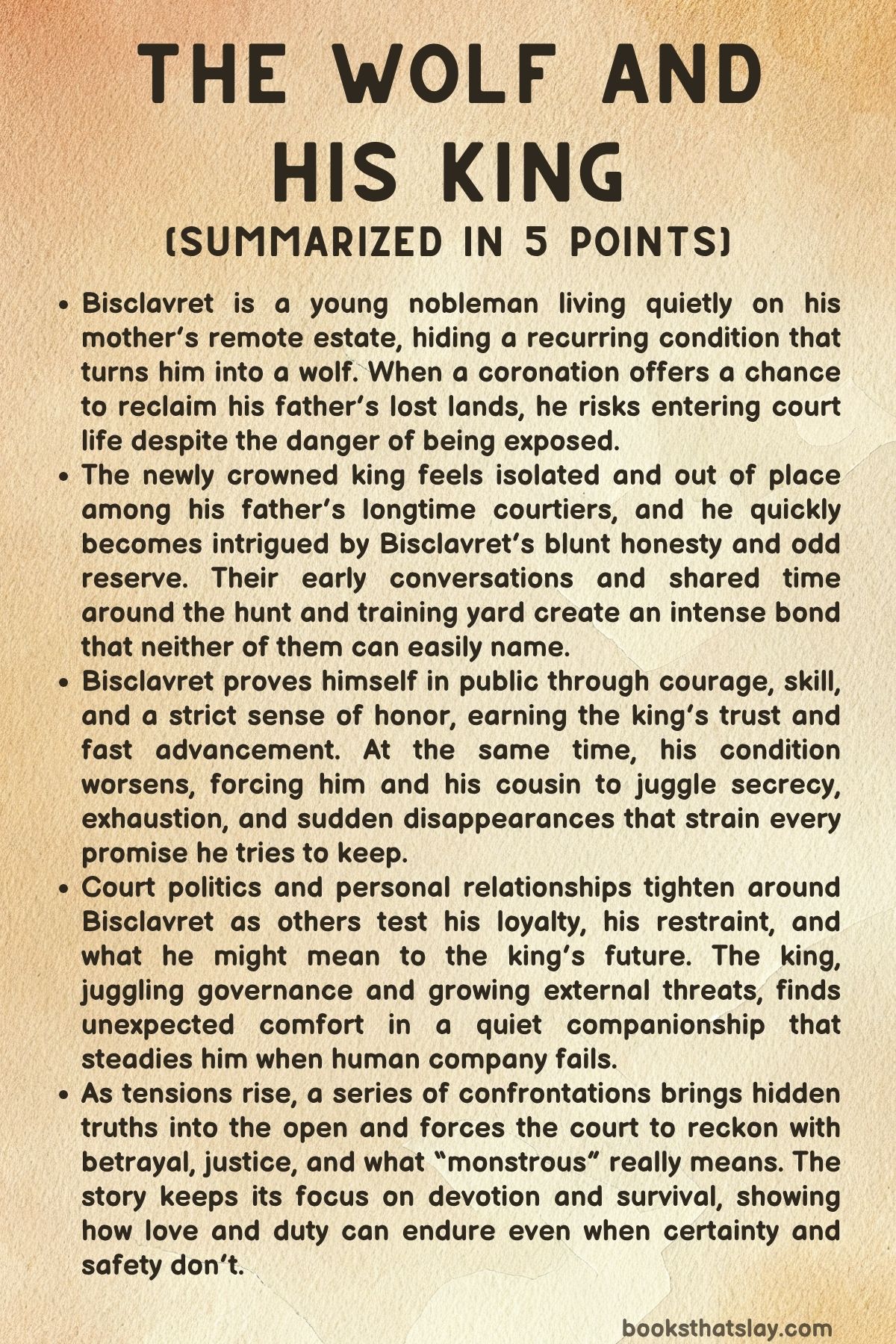
The Wolf and his King by Finn Longman is a medieval-set story about duty, loneliness, and the cost of surviving with a secret that can ruin you. Bisclavret, a young noble living on the edge of the woods, suffers from a recurring “wolf-sickness” that turns him into a wolf without warning.
When a new king takes the throne, Bisclavret is pulled into court to swear loyalty and claim his father’s lost lands. What begins as a risky bid for safety becomes a bond between two men who recognize the same quiet fear in each other: the fear of failing the roles the world demands.
Summary
Bisclavret lives alone on his late mother’s small estate, keeping to the hills and the woods because he carries a condition he cannot control. At unpredictable times, pain gathers in his body, his senses sharpen, and he turns into a wolf.
He wakes afterward exhausted and ashamed, terrified that one day he will not come back to himself. His mother once promised that his father’s title and lands would be restored, but she died before she could secure anything for him.
Since then, Bisclavret has avoided towns and noble gatherings, choosing isolation over the risk of harming someone or being exposed as something monstrous.
A cousin arrives with news that forces Bisclavret to choose between hiding and stepping into danger. The old king is dead.
The prince has returned from years abroad and will be crowned within the week, followed by a celebratory hunt. The cousin insists Bisclavret must attend.
He is still noble by blood and land, and if he presents himself at court, he might finally petition the new king to restore the inheritance that reverted to the crown when Bisclavret’s father died. Bisclavret resists, warning that travel, crowds, and noise make his transformations more likely.
The cousin promises to help him stay out of sight when needed, to find secluded places where he can sleep and recover. The possibility of reclaiming his father’s lands, and the pull of a life that might be safer than endless hiding, finally persuades Bisclavret to go—though he plans to leave as soon as his oath is taken.
At court, the newly crowned king sits amid loud celebrations that feel distant from grief. He is surrounded by courtiers who loved his father and treat him as a symbol rather than a person.
When Bisclavret’s cousin approaches, he explains that his kinsman was delayed by weather and lamed horses. The king allows Bisclavret to take his oath during the feast.
When Bisclavret arrives, he is plainly dressed and uncomfortable among splendor, but his presence is hard to ignore. The king questions him and learns that Bisclavret’s father served faithfully and died before his son was born, leaving a barony that was absorbed into crown holdings.
Instead of accepting the oath immediately, the king invites Bisclavret to sit by the hearth, eat, and speak with him. The invitation is unusually personal for a first meeting, and it catches Bisclavret off guard.
The king also insists Bisclavret join the hunt the next day and promises him proper horse and gear. Bisclavret hesitates, afraid of what the woods and the excitement might draw out of him, but he agrees.
That night, the thing Bisclavret fears arrives. He loses control and changes, returning later in battered human form—barefoot, torn, bloodied, and exhausted.
By morning he has collapsed in the stables like a servant. The king searches for him and finds him sleeping in straw, bruised and unwell.
Bisclavret claims it was only sickness brought on by wine and refuses a physician. The king does not force the issue, but he quietly provides warmth, a bath, clean boots, better clothes, and weapons.
Bisclavret, humiliated by how close he came to failing at the first test, clings to his plan: secure the inheritance, return to solitude, and repay his cousin’s loyalty by finally making their family whole.
The hunt becomes the moment that changes how the king sees him. In the forest, the king feels briefly alive again, but when a boar turns and charges, fear locks him in place.
The men around him hesitate. A spear strikes true—thrown by Bisclavret.
Bisclavret moves through the chaos with steady focus, finishes the boar with a dagger, and then presents the dagger to the king as if the victory were the king’s own. He offers his blade and loyalty, turning personal skill into public support for a ruler who needs it.
The king is impressed, not only by courage but by the instinct to protect the crown without claiming glory. He decides Bisclavret should be made a knight and wants to test him further.
The king orders his scribe—one of his closest companions from abroad—to search records about Bisclavret’s father’s lands. Meanwhile, Bisclavret is summoned to train with blunted weapons while watching eyes measure him for arrogance or ambition.
Instead of assigning another knight to spar with him, the king enters the yard himself, driven by curiosity and a desire to know what Bisclavret truly is. Their fight is hard and close.
Bisclavret is faster than expected, adapts quickly, and forces the king to work for every exchange. When the king finally yields, he is exhilarated and unsettled in equal measure.
Bisclavret admits he is mostly self-taught, having only practiced as a boy with his cousin.
Afterward, Bisclavret asks for privacy. In the armoury, with the cousin present, conflict erupts.
The cousin argues that Bisclavret is turning away from the inheritance he came to claim by allowing himself to be drawn deeper into court life. Bisclavret insists he is not fit to stay.
He says his health is fragile, that noise and crowds push him toward something like madness. The king senses there is more behind the fear, but he must think politically: granting lands and favor requires a man capable of duties, of commanding men, of showing his face when needed.
The cousin offers a compromise—he will serve as steward on Bisclavret’s estate if released from his current lord. This would keep the land managed even if Bisclavret keeps some distance from court.
Then the scribe arrives with the crucial discovery: Bisclavret’s father’s estate was never granted to another and remains crown property, close to the castle and bordering the royal hunting forest. The king sees the solution immediately.
He can restore the lands to Bisclavret and keep him within reach, close enough to attend key events but not forced to live daily in the castle. Bisclavret is overwhelmed by the nearness of his father’s old life, realizing his father served within sight of the very court Bisclavret has fled all his years.
The king tells him to return home, settle his affairs, and come back within a fortnight for his knighting.
Bisclavret rides home with his cousin, torn between relief and dread. He has been given everything he wanted—lands, a path toward security, and a king’s attention—but the same attention feels dangerous.
The cousin warns that the king is newly crowned, politically uncertain, and drawn to Bisclavret in a way that could create enemies. Even so, the cousin promises to help, even if it means setting aside his own advancement for a time.
During the fortnight, the king tries to rule while carrying an obsession he cannot name aloud. He grants mercy to petitioners, speaks carefully with his ward about marriage and her right to refuse a match, and reaches for comfort with his scribe when loneliness bites too hard.
The ward, sharp-eyed and bold, becomes curious about Bisclavret and proposes meeting him alone as a test of his courtesy. The king reluctantly allows it, aware of the risk to reputation but unable to deny the request.
When Bisclavret returns, the church becomes part of the process. The chaplain hears his confession and assigns a vigil.
Bisclavret admits he lies for safety and is haunted by despair, hinting at a condition he fears will be seen as madness, but he does not reveal the wolf. The chaplain responds with understanding rather than condemnation.
Before the ceremony, the ward visits Bisclavret unchaperoned and tries to provoke him into impropriety. Bisclavret refuses to touch her and holds to the boundaries of her rank and his vows.
Satisfied, she helps him prepare—braiding his hair, adjusting armor, and sending him forward as if she is helping choose what kind of knight he will be.
At the knighting, Bisclavret swears service and kneels. The king, hands unsteady, dubs him.
The ritual closeness—kissed feet, hands, and lips as custom—lands with force on both of them. At the feast that follows, the ward dances with Bisclavret while the king watches, jealous and shaken.
That night, Bisclavret changes again outside the walls and runs until dawn, returning naked and frightened. His cousin finds the scattered clothes and helps him dress, realizing the wolf carried him onto the newly restored lands.
For Bisclavret, the irony is sharp: his curse drags him to the very ground that was meant to save him.
For a time, Bisclavret becomes a familiar presence at court, liked by the knights for his skill and directness. The king trains with him, seeking reasons to be near.
Meanwhile, the ward grows close to Bisclavret in a different way—helping with armor, walking with him in gardens, giving him a woven belt in her colors that he wears. The king notices and reacts with cold restraint.
Bisclavret’s condition worsens in the background. Wolves are reported in the royal forest and deer are found half-eaten.
When the king mentions it, Bisclavret reacts with panic and refuses to join a hunt, looking ill and injured. The king questions Bisclavret’s cousin, who admits Bisclavret has episodes like sleepwalking in the woods, but refuses to say more.
The king is unsettled, especially when the cousin flinches at talk of wolves.
The hunt fails, leaving only confusing tracks and mangled remains. Soon after, the king’s scribe presents him with a bound book of lais as a farewell gift and announces he is leaving the court to return to his homeland.
The king pleads, even threatens authority, but cannot stop him. The departure deepens the king’s isolation.
Winter passes. Bisclavret appears irregularly, often pale and sleepless, fighting well yet refusing explanation.
His cousin, no longer serving as steward, returns to knighthood and eventually rides away with his lord. The king continues ordering hunts that never find the wolf.
Bisclavret claims fences are stronger and speaks almost tenderly of men who become wolves, suggesting the creature is not hunting people. Privately, Bisclavret realizes the truth: during a recent episode he was gone three days and likely killed the deer himself.
He vomits afterward, cannot stomach food, and avoids the physician.
Bisclavret’s wife comes to court, frantic with worry. In the chapel she confronts him, confessing she feared him dead and kept vigil.
He apologizes without telling the truth, promises he will always return, and they plan to go home separately. When the cousin arrives, he presses Bisclavret hard.
He suggests annulment and warns Bisclavret could kill his wife if he loses control. He also believes Bisclavret entered the royal forest and killed the deer.
Their argument turns cruel; Bisclavret accuses the cousin of loving his wife. The cousin insists he cares about her safety.
Furious and wounded, Bisclavret dismisses him as steward and orders him off the lands.
As time goes on, Bisclavret’s disappearances strain his marriage. His wife, anxious and resentful, demands the truth, especially as they fail to conceive.
Bisclavret confesses: he becomes a wolf, must leave his clothes where he can retrieve them, and without them he may not be able to return to human form. She asks practical questions, learns the cousin knew, and realizes his wedding-night flight was connected.
Though shaken, she agrees to watch for his return. Their intimacy becomes bitter, marked by fear and obligation.
Then the betrayal lands. Bisclavret goes to the ruined chapel where he hides his clothes and finds them gone.
His body flickers between forms, panic breaking his control. In the end, he becomes fully wolf and cannot change back.
He vanishes from human life.
Rumors spread that his wife mourns him and that the cousin comforts her. The king rides to Bisclavret’s estate and sees the wolf in the forest, but his horse refuses to approach and the wolf flees.
At the house, the wife and cousin show torn, bloody clothing and claim the wolf killed Bisclavret. The king returns in shock, tells the chaplain Bisclavret is dead, and grieves in solitude.
Spring arrives. Bisclavret’s wife marries the cousin, now positioned as heir.
The king withdraws into mourning but slowly resumes his duties, shaping a reign built on reforms and restraint. War threatens the borders.
The king refuses to join a neighboring conflict and refuses to surrender his crown to a stronger ruler. His barons call neutrality weakness, but he argues that choosing a side will invite invasion.
He permits limited preparation—each lord must raise a small force, older recruits rather than eager youths. Skirmishes still claim lives.
When an ally begs for supplies, he refuses, believing even food would declare allegiance. When a dissenting lord sends knights to fight without permission and most return dead, the king executes the lord for betrayal, sickened by the act but convinced it is necessary.
Through these months, the wolf appears at the castle—cleaned and tended by servants—and begins following the king like a shadow. At first people fear it, but the wolf proves gentle in the king’s presence and protective against unannounced intruders.
The king invites it into his chamber, and for the first time in a long while he sleeps. He speaks to the wolf as if it understands: confiding worries about rule, exhaustion, and fear of war.
He also speaks of Bisclavret, admitting the private thought that perhaps Bisclavret is not dead, but fled because he could not endure the king’s attention.
After the war ends without invading their lands, the court revives festivals. At a harvest feast, Bisclavret’s cousin arrives.
The wolf attacks him with sudden fury, nearly killing him before the king drives it back and has it restrained. Whispers spread and guests leave early.
Shaken, the king keeps the wolf close but watches it with new suspicion.
During the first postwar hunt, Bisclavret’s wife appears and accuses the wolf of killing her husband. The wolf breaks free and attacks her, tearing off her nose before it is restrained.
A knight in green declares the truth: the wolf is Bisclavret. The king interrogates the wounded woman until she confesses.
She and the cousin stole Bisclavret’s clothes, trapping him in wolf form and claiming he died. She reveals that Bisclavret’s mother’s estate still holds old garments of his.
The king sends messengers to retrieve the clothes and tries first in the public hall—nothing happens. Then he chooses privacy.
He places the clothes in his bedchamber, calls the wolf by name, and leaves him alone. When he returns with witnesses, Bisclavret lies in the king’s bed in human form, restored at last.
Relief breaks through restraint, and they reunite, the king overwhelmed by the return of someone he believed lost.
Justice follows. Bisclavret’s wife and cousin are banished.
Bisclavret remains with the king, but the curse is not ended. One night the change hits violently and leaves him naked and unstable in the forest.
The king comes searching with clothes, helps him dress, and promises that when it happens again, he will come again too—an oath not of politics, but of presence.
Characters
Bisclavret
Bisclavret is a man built out of fear and restraint, someone who has spent so long treating himself as a danger that he has mistaken isolation for virtue. In The Wolf and his King, his “wolf-sickness” is not only a supernatural affliction but also the shape of his shame: he feels the change coming, he cannot stop it, and every transformation threatens to erase the careful person he believes he must be in order to deserve a place among others.
His life on his late mother’s estate is both hiding and penance—he keeps away from courts and towns not because he despises them, but because he is terrified of what he might do there. That terror is paired with a stubborn, aching hope that he has never fully let die: the belief that he should have inherited his father’s place in the world, and that reclaiming those lands could let him live with a little more dignity and safety.
What makes him compelling is the constant tension between the knight he wants to be and the beast he fears he already is; his courage in the hunt and the training yard is real, but it sits on top of a deeper dread that he is only temporarily human. Even when he earns knighthood and restored lands, he remains a man who lies as a survival skill, and who tries to control love, loyalty, and longing the way he tries to control his body—by clenching down and hoping nothing breaks through.
The King
The king is defined by newness and loneliness: newly crowned, newly burdened, surrounded by people who loved his father and therefore treat him like an echo rather than a person. In The Wolf and his King, his authority often reads less like triumph and more like confinement—the dais isolates him, ceremony performs him, and the noise of celebration emphasizes how little intimacy he has.
Bisclavret’s arrival hits him like oxygen: a strange, raw presence who does not flatter smoothly, who carries visible history, and who offers a kind of devotion that feels chosen rather than obligatory. That attraction is emotional, political, and bodily at once, and the king’s intensity can feel almost dangerous because it comes from a place of hunger as much as admiration.
He tries to be a ruler of mercy and order, yet he is repeatedly forced into the uglier side of kingship—judgment, death, and decisions that stain him even when they protect his realm. The wolf becomes the king’s private refuge, a creature that offers loyalty without politics and warmth without negotiation, and the fact that he talks to the wolf more honestly than to any courtier reveals both his tenderness and his isolation.
His greatest strength is that he refuses to become merely his father’s heir in temperament; he chooses restraint where others demand glory, peace where others want conquest, and he accepts the cost of being misunderstood. Yet the story also makes clear that his heart is not as controlled as his policy—his jealousy, grief, and longing shape his choices as much as his principles do, and his eventual reunion with Bisclavret is not simply romantic relief but the restoration of the one relationship that makes his crown feel survivable.
Bisclavret’s Cousin
Bisclavret’s cousin is the story’s most complicated kind of loyal: the loyal person who believes his loyalty gives him the right to pressure, to argue, and to decide what “good” looks like for someone else. He functions first as the bridge that drags Bisclavret out of isolation and back into history—into oaths, inheritance, and the dangerous closeness of court.
He is pragmatic in a way Bisclavret is not; he sees politics, deadlines, optics, and the limited window in which a new king might be persuaded. At the same time, his care is not cleanly selfless.
He is a lesser knight with his own ambitions, and the more Bisclavret rises, the more the cousin’s identity becomes entangled with being the maker, guide, and guard of that rise. His fear about the wolf-sickness is genuine, and he is often the only person consistently treating the condition as an urgent risk to others rather than a private tragedy, but that fear curdles into control when Bisclavret refuses his counsel.
The rupture between them—accusations of love, jealousy, betrayal—shows how easily protection can become possessiveness and how quickly moral certainty can become self-justification. His later actions, culminating in taking Bisclavret’s wife and participating in the theft that traps Bisclavret in wolf form, reveal a character who may have begun as a hard-edged guardian and ended as someone willing to destroy the person he claimed to save, if only to resolve the threat and claim the life that threat kept from him.
The Scribe
The king’s foreign scribe is intimacy without power, a companion who exists outside the noble hierarchy enough to be trusted and inside the king’s private life enough to be indispensable. He is a stabilizing presence: he brings knowledge, records, and practical help—such as researching Bisclavret’s father’s lands—but more importantly he provides the king with a space where grief and desire can be spoken aloud without becoming public policy.
The relationship between them carries the tenderness of familiarity and the ache of impermanence, and the scribe’s departure is one of the story’s sharpest emotional turns because it strips the king of a coping mechanism right as the court’s pressures grow heavier. His leaving also underlines a quiet theme: the king can command armies and charters, but he cannot command a person to remain his comfort without becoming the sort of tyrant he refuses to be.
The scribe is not framed as a villain or a rival; he is instead proof that the king’s loneliness is not solved by status, and that even love offered freely can still end, leaving the monarch to return to the cold work of rule with fewer hands to hold him steady.
The Ward
The king’s ward embodies the court’s watchfulness and its tests—politeness and virtue are never merely personal qualities here, they are political signals. She is intelligent enough to understand the danger of Bisclavret’s sudden elevation and curious enough to probe what kind of man he truly is.
Her choice to meet him alone and tempt him is a calculated experiment, one that reveals both her agency and her awareness of how reputation governs survival at court. When Bisclavret refuses her, she becomes, paradoxically, one of his most intimate helpers: she dresses him, braids him, guides him through the visible performance of knighthood.
Her affection later—walking with him, gifting him a belt in her colors—can be read as genuine fondness, adolescent or romantic interest, or simply the pleasure of connection with someone whose presence feels vivid and new. But the king’s jealousy around her also shows her narrative function: she is a mirror reflecting how personally the king experiences Bisclavret, and how quickly private longing becomes court rumor.
She is neither purely innocent nor purely manipulative; she is a young noble learning to move in a world where attention is currency, and where the safest way to understand someone powerful is to test them before they can test you.
The Chaplain
The chaplain represents the story’s moral interior, a figure who cannot change the political world but can influence how characters survive it internally. He is one of the few people who meets Bisclavret not as a curiosity or a weapon, but as a suffering soul trying to remain human.
His insistence on Confession and vigil turns knighthood into something more than ceremony—it becomes an examination of truth, lying, despair, and the costs of secrecy. The chaplain’s counsel is sympathetic without being naïve; he offers compassion while still working within a religious framework that values honesty and penitence, which makes Bisclavret’s half-confessions feel both understandable and tragic.
For the king, the chaplain is a place to put grief when grief cannot be put anywhere else; when the king believes Bisclavret dead, the chaplain’s prayers help him carry loss without turning it into brutality. He is quiet, but his presence is load-bearing: he anchors the story’s insistence that monstrousness is not only about claws and blood, but also about what secrecy, shame, and power do to a conscience.
The Knight in Green
The knight in green operates like a catalyst, a social force who drags people into revealing themselves. He is part of the martial culture that surrounds the king and threatens to swallow Bisclavret—drink, bravado, camaraderie, and the expectation that men prove themselves publicly.
His insistence on taking Bisclavret into the village for ale frames him as a mentor in the rougher language of knighthood, the kind of education Bisclavret missed while living hidden. Yet his most consequential role arrives later, when he asserts what others cannot yet accept: that the wolf is Bisclavret.
By speaking that truth, he becomes the hinge between tragedy and restoration, transforming the wolf from a symbol of loss into a person who can be recovered. He suggests a character who understands men not only by their words but by their patterns—who watches, notices, and is willing to challenge a narrative that has become convenient for powerful people.
Whether motivated by loyalty to the king, affection for Bisclavret, or simply blunt justice, he functions as the one who refuses to let the court’s fear become a final verdict.
The Huntsman
The huntsman is a practical voice of the realm, someone whose job is to read the land and translate it into warnings. He is the one who names the return of wolves and presents the evidence—half-eaten deer, signs in the forest—that nudges the court toward suspicion and action.
He stands for the way nature intrudes on governance: the king can decree policy, but he cannot decree what prowls in the trees. His reports are also psychologically sharp because they strike directly at Bisclavret’s terror; the huntsman does not know the secret, but his knowledge becomes the trigger that exposes how tightly Bisclavret’s human life is balanced on concealment.
The huntsman is not individualized as richly as others, yet his presence matters because he makes the wolf real in the public imagination, turning what might have remained a private curse into a problem the kingdom feels entitled to solve.
Bisclavret’s Wife
Bisclavret’s wife begins as a person shaped by absence: she marries a man who vanishes, withholds, and returns as if from another life, leaving her to build devotion out of uncertainty. Her early actions—praying for him, keeping vigil, confronting him in the chapel—read as sincere attachment and desperation for stability.
She is also trapped in the brutal arithmetic of noble marriage: heirs matter, fertility matters, and a husband who disappears threatens not only the heart but the household’s future. When Bisclavret finally tells her the truth, she responds with the mind of someone who must live with consequences; she asks practical questions, learns about the clothes, and understands the mechanics of survival.
That makes her later betrayal especially chilling because it is not impulsive—it is targeted at the one vulnerability she now comprehends. Taking the clothes is an act that weaponizes intimacy, turning knowledge into a cage.
Yet the story also invites a darker empathy: she has lived with fear of abandonment and with a husband whose body becomes dangerous; her decision can be read as self-preservation that crosses into cruelty, a choice to end uncertainty by destroying the man who embodies it. Her accusation of the wolf and the violent loss of her nose are not framed as random punishment but as the physical exposure of what she tried to hide: that she shaped the monster she claimed to fear, and that her performance of mourning was built on a lie that could not stay buried.
The Seneschal
The seneschal represents institutional pressure—the court as a machine that demands spectacle, reassurance, and normalcy even after trauma. His push to revive festivals is not simply callousness; it is governance logic.
A kingdom needs rhythms that signal stability, and the seneschal understands that morale and display are forms of power. His presence highlights how little space the king is allowed for private grief, and how quickly the realm’s needs override the monarch’s emotional reality.
He is the voice saying that peace must be performed, not merely achieved, which deepens the king’s loneliness: even when the king chooses restraint and prevents invasion, he must still prove to others that his reign is confident and flourishing.
The Hare-Poacher
The hare-poacher is a small figure with a large thematic role: he is the human cost of law, and the opportunity for mercy to become policy. The king’s decision to spare him and give him goats and coin reveals what kind of ruler he is trying to be—a king who does not need cruelty to feel powerful.
The poacher’s presence also emphasizes a contrast with the later execution of the disobedient lord; the king can be generous, but he is not sentimental, and he learns that mercy given upward and mercy given downward carry different political weights. This minor character exists to show that the king’s values are not abstract: he tests them on the bodies of ordinary people, and those tests shape the kind of peace he later becomes known for.
Themes
The body as a battleground for identity and control
The Wolf and his King treats Bisclavret’s condition less like a fantasy mechanism and more like an ongoing crisis of agency. The “wolf-sickness” is not presented as a single dramatic event but as a recurring takeover that arrives with physical warning signs and then ignores his wishes anyway.
That predictability without control is what makes it terrifying: he can anticipate pain and blood, but not prevent the loss of judgment and memory that follows. Because of that, his isolation is not simply fear of rejection; it is an ethical decision he makes repeatedly, choosing distance over the risk of harming someone.
What follows is a life built around hiding, managing symptoms, and limiting attachment, which slowly narrows him into someone who survives rather than lives. When he enters court, the problem is no longer only the change itself but the social environment that accelerates it—noise, crowds, attention, expectations.
That pressure turns the body into a political liability, because a private medical reality could become public scandal, and public scandal could become punishment. The story keeps returning to the humiliations that come from this gap: waking in straw, refusing a physician, inventing excuses that sound weak because the truth sounds impossible.
Even after his lands are restored, the body remains a trap. The missing clothes reveal how fragile his autonomy is: his humanity can be stolen by a simple act of theft, turning a person into an animal permanently, not through magic but through a practical dependency.
By the end, recovery is not described as a cure but as a new form of care: someone must be willing to bring the clothes, close the door, keep the secret, and stay when it becomes ugly. The theme insists that identity is not only inner truth; it is also the ability to remain yourself when your body refuses to cooperate, and the ability to keep being treated as a person when you cannot reliably perform personhood.
Power, loyalty, and the moral weight of rulership
The king’s authority is shown as heavy, lonely work rather than glamour, and the book repeatedly tests what it means to rule when grief and uncertainty are still fresh. He begins surrounded by people who served his father, which creates a court full of inherited expectations and performances, while he feels unknown on his own dais.
That sets up a central tension: power looks absolute from the outside, yet he experiences it as constant exposure, constant judgment, and constant fear of making the wrong choice in public. His attention to Bisclavret becomes one way of resisting the hollow scripts of court.
He chooses conversation over ceremony, direct testing over rumor, and personal judgment over courtiers’ opinions, and that preference shapes how he governs. The restoration of the father’s lands is not only generosity; it is a strategic decision that ties a valuable knight to the crown while keeping him close enough to monitor and to call upon.
Later, that same closeness becomes emotionally dangerous, because the king’s need for someone real collides with the political need to appear stable and available for alliances. The theme deepens when war threatens.
The king’s refusal to join a broader conflict is framed as an assertion of sovereignty and a commitment to protect his people from being used as fuel for other rulers’ ambitions. That position costs him social approval, strains bonds with his barons, and forces him into compromises that still stain his hands.
When disobedient knights ride out and return dead, he responds with execution, and the narrative does not let that act feel clean or heroic. It becomes a moment where lawful authority and personal sickness meet: he must be seen to punish betrayal, yet he is sickened by the sentence he pronounces.
Loyalty in this world is therefore never abstract. Bisclavret offers “blade and fealty” by making the king’s victory possible, but the king later has to decide whether he deserves loyalty when he cannot promise safety, certainty, or even emotional steadiness.
The wolf at his door becomes the clearest symbol of this theme: he uses it as protection and intimidation, while also relying on it as companionship, which mirrors how rulers often turn living beings into instruments and then discover they need them as people.
Intimacy under surveillance and the cost of secrecy
Relationships develop inside a culture where privacy is rare and interpretation is constant. Every glance becomes potential gossip, every invitation becomes a political story, and even kindness can be misread as favoritism.
The king’s draw toward Bisclavret therefore carries double risk: personal vulnerability and public consequence. Their closeness begins with the king choosing to treat a travel-stained stranger with warmth, but the court immediately becomes an audience.
That external pressure shapes the way desire is experienced: jealousy flares when Bisclavret dances with the ward, relief becomes tangled with fear when Bisclavret disappears, and longing becomes something the king confesses to his scribe because the confessional space of friendship is safer than court. The scribe’s role is crucial here, because he provides a sanctioned intimacy—private, useful, deniable—that the king uses to numb himself when the obsession becomes unbearable.
Yet even that relationship is unstable, because the scribe leaves, and the king’s loneliness is exposed again, making the wolf’s companionship feel not bizarre but inevitable. Bisclavret’s secrecy functions differently.
For him, hiding the truth is survival, but it is also a slow poison in his marriage and friendships. His wife’s experience shows the domestic cost of unexplained disappearances: fear, humiliation, loneliness, and the suspicion that she is unwanted or deceived.
When he finally tells her, the confession is not romantic release; it is practical information exchanged under strain, followed by a bitter tenderness that recognizes love without solving the danger. The cousin embodies another angle: loyalty mixed with resentment, caretaking mixed with ambition.
He knows the truth, carries it, and tries to manage it, but he also wants recognition and a future of his own. That combination makes secrecy combustible, because secrets create hierarchy.
Whoever knows the truth can threaten, protect, bargain, or betray. The theft of the clothes is the story’s most brutal statement about intimate trust: a spouse and a relative take the one object that allows return, turning secrecy into captivity.
After that, the king’s later choice to restore Bisclavret in private—placing the clothes in his bedchamber and leaving him alone—becomes a corrective vision of intimacy: secrecy used to protect rather than to dominate. The theme argues that love in a watched world requires deliberate boundaries, chosen witnesses, and the courage to accept imperfect truth instead of demanding perfect transparency.
Betrayal, inheritance, and the struggle over who gets to belong
The plot is propelled by questions of rightful place: who deserves land, title, marriage, and safety. Bisclavret’s original dispossession is legal and impersonal—his father dies, the barony returns to the crown—but its emotional consequences are lifelong, turning him into a noble who lives like an outcast.
Restoration of inheritance becomes more than a property issue; it is a promise that he can re-enter human society with dignity. The king’s decision to return the lands nearby offers a kind of conditional belonging: Bisclavret can live apart yet remain within reach of court, as if the state is saying, “You may belong, but on terms that keep you visible.” That arrangement reveals how belonging is always negotiated rather than granted freely.
Marriage is another field of inheritance politics. Bisclavret’s wife is not only a partner; she is part of the estate’s future, tied to lineage, legitimacy, and the expectation of children.
When they fail to conceive and his absences increase, the marriage becomes socially vulnerable, making it easier for rumors to spread and for the cousin to position himself as the stabilizing alternative. The cousin’s arc shows how inheritance can tempt even those who began as allies.
He initially pushes Bisclavret toward court and offers stewardship, presenting himself as family devoted to Bisclavret’s success. Over time, frustration grows as Bisclavret’s fear threatens the very future the cousin helped build.
When Bisclavret dismisses him, it is a personal rejection with material consequences, and the cousin’s later marriage to the widow is framed publicly as comfort but also functions as a transfer of power. The betrayal is not only emotional; it is administrative, legal, and embodied in who sleeps in the house and who holds the keys.
The wolf trapped without clothes becomes a displaced subject, unable to claim title or speak for himself, which echoes how law can erase a person if they cannot perform the right rituals of identity. Even the king’s court participates in this logic when it treats the wolf first as a threat, then as a tool, and finally as a companion, shifting its attitude based on usefulness and narrative control.
The eventual banishment of the wife and cousin reads as a restoration of moral order, but the book refuses to pretend banishment fixes everything. The wolf can return; the vulnerability remains.
Belonging is shown as something maintained by ongoing recognition—someone must keep seeing Bisclavret as Bisclavret even when he cannot prove it. In that sense, inheritance is not only land handed down; it is the fragile social agreement that a person still counts when they are easiest to discard.