Theo of Golden Summary, Characters and Themes
Theo of Golden by Allen Levi is a character-centered novel about an elderly Portuguese stranger whose year in the town of Golden quietly changes the people around him.
Theo arrives with wealth, experience, artistic sensitivity, private grief, and a determination to remain known only by his first name. What begins with his fascination for a collection of local portraits develops into a personal practice of giving, listening, friendship, and service. Beneath the gentle pace lies a mystery concerning Theo’s past and his true reason for coming to Golden, while the story examines attention, art, faith, loss, mercy, community, and the lasting consequences of ordinary kindness.
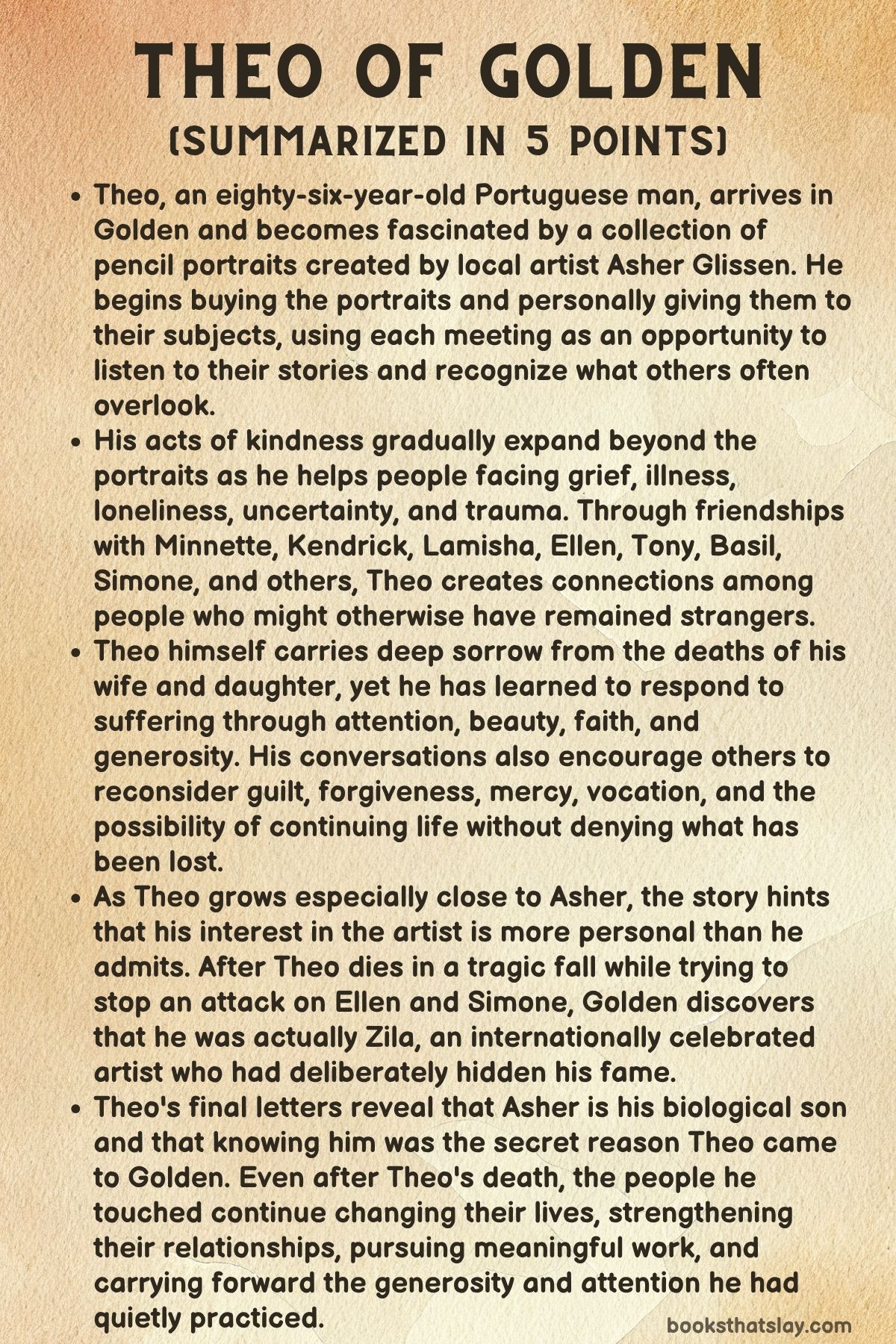
Summary
Theo, an eighty-six-year-old Portuguese man, arrives in Golden from New York and immediately becomes fascinated by the town. He is especially drawn to the Oxbow River, which reminds him of the Douro River of his childhood, and his first walks reveal a man who notices almost everything: architecture, flowers, birds, historical details, faces, light, and objects that most people would simply pass.
At the Chalice coffee shop, Theo discovers ninety-two pencil portraits displayed on the walls. They were drawn by local artist Asher Glissen, whose ability to capture not only physical likeness but also personality and emotion immediately impresses Theo.
Theo becomes troubled by the fact that many of these beautiful portraits remain unsold. He decides to buy one depicting Minnette Prentiss and return it to her as a gift, arranging a meeting at a fountain on the Promenade known locally as the Fedder.
Minnette is initially suspicious of the strange handwritten letter she receives from an elderly man with no surname or return address. Her husband Derrick, a prosecutor, is even more cautious, but the couple eventually attends the meeting after deciding that Theo’s letter sounds eccentric rather than threatening.
When Minnette meets Theo, his courtesy and genuine interest quickly reassure her. He explains that he believes Asher’s portraits belong with the people whose lives inspired them, but their conversation becomes far more personal when Theo tells Minnette that her portrait seems to contain kindness, courage, strength, and sadness.
Minnette admits that she has spent much of her life satisfying the expectations of her demanding father, Pearce Glissen. Although professionally successful as an accountant, she dislikes her career, longs for motherhood, and remains burdened by grief over a pregnancy she ended in college under her father’s pressure.
Theo does not judge or lecture her. He listens, affirms what he sees in her character, and gives her the portrait, discovering that the conversation surrounding the gift matters even more to him than the object itself.
The experience gives Theo a new purpose. He decides to purchase Asher’s portraits one by one, locate their subjects, meet them privately, and give the artwork back to them. He deliberately chooses faces that interest him, especially those suggesting weariness, grief, worry, or hidden difficulty.
Theo moves into an apartment above Ponder House, where he becomes close to James Ponder. Ponder learns more about Theo’s private circumstances than almost anyone else and agrees to help locate portrait subjects, handle money, and protect his anonymity.
Ponder’s secretary, Anita Gidley, initially regards Theo with deep suspicion, but she gradually becomes involved in the project. As she sees how carefully he uses his resources for others, both she and Ponder begin changing their own understanding of generosity and usefulness.
One of Theo’s important meetings is with Kendrick Whitaker, a university custodian whose daughter Lamisha was badly injured in a car crash that killed her mother. After learning about Lamisha, Theo first sends the girl art supplies and later quietly arranges access to an excellent orthopedic specialist and practical financial support for the family.
Theo eventually becomes Lamisha’s friend rather than simply her benefactor. He visits her in the hospital, reads children’s books dramatically, and even writes a story about a princess with a limp who fears returning to school, giving Lamisha a way to imagine her own difference without reducing her to it.
Another important friendship begins with Ellen, a homeless woman whose unusual speech and fierce attachment to her bicycle cause many people to dismiss her as unstable. Theo instead listens patiently, discovering intelligence, humor, literary knowledge, artistic instinct, and devastating grief beneath her fragmented manner.
When he asks about the happiest day of her life, Ellen tells him about giving birth to Willa Francesca after a traumatic event involving William, the man she loved. Ellen has been separated from her daughter for approximately thirty years and still carries a lock of Willa’s hair.
Theo later helps Ellen find acceptance at St. James church when others initially react with alarm to her arrival with her bicycle. Their friendship expands through birdwatching and bicycle rides, during which Theo discovers Ellen’s practice of arranging feathers and wood into artistic creations.
Rather than treating her merely as someone who needs assistance, he encourages her to regard her “featherwood” as meaningful creative work. That encouragement slowly helps Ellen develop greater confidence and a sense that she can produce something valuable herself.
Theo also becomes close to Tony, the sarcastic owner of the Verbivore bookstore. Behind Tony’s humor is a Vietnam veteran carrying terrible guilt after accidentally killing a Vietnamese boy during combat, and Theo gradually becomes one of the few people before whom Tony can speak openly about the experience.
Tony’s spiritual doubts are connected to that trauma. He also remembers his friend Bobbo, a deeply religious soldier who shared an improvised Communion with him during the war and later died after giving Tony his New Testament.
Theo does not attempt to erase Tony’s guilt with easy reassurance. Instead, their conversations allow Tony to consider the possibility that death, forgiveness, faith, and hope may contain meanings he has spent decades resisting.
A younger member of Theo’s growing circle is Simone Lavoie, a gifted cellist studying under Professor Gobelli. Theo respects Simone’s discipline and becomes invested in his development, while Simone eventually forms friendships with Kendrick and Basil, a street musician whose musical ability Theo also recognizes.
Basil once worked as a teacher but abandoned his career to care for his cancer-stricken sister Genevieve. After her death, disappointment and anger left him uncertain about his future, and he now supports himself largely through street performances.
Theo does not tell Basil what he should become. Instead, he recognizes the intelligence, generosity, music, and unrealized possibility already present in him, allowing Basil to recover a stronger sense of his own worth.
As these relationships develop, Theo also grows increasingly close to Asher. Their conversations about portraiture, beauty, vocation, and artistic purpose reveal striking similarities between them, particularly their belief that worthwhile art must help people see more clearly and must contain love.
Yet Theo becomes visibly emotional around Asher in ways he cannot explain. His original “business” in Golden remains secret, as does his surname, and his friends gradually accept that whatever Theo is hiding matters less than the kind of person he demonstrates himself to be.
The portrait project is not without failure. When Theo purchases a portrait of a woman named Clarise, her controlling boyfriend Cleave Torber confronts him, destroys the artwork, and leaves Theo genuinely furious.
Theo later learns that Clarise now uses the name Mia and has escaped that part of her life. When she asks him to destroy the damaged picture because it belongs to a past she wants to leave behind, Theo respects her request.
The book also examines mercy through Kendrick’s response to Mendez, the man who caused the crash that killed his wife. Kendrick learns that Mendez is a desperate father who returned to the United States to support his own seriously ill daughter and caused the accident after falling asleep while driving.
Although Kendrick remains fully aware of what he has lost, he asks Derrick to consider mercy at sentencing. Mendez ultimately receives a sentence equal to the time already served, and Kendrick’s choice demonstrates that compassion does not require denying harm or pretending that justice is unnecessary.
As the months pass, Theo’s friends increasingly become friends with one another. His personal acts of attention create a community that no longer depends entirely upon him, as musicians, workers, artists, booksellers, families, and previously isolated people begin crossing social boundaries.
At Simone’s major recital, many members of this new community gather together. After the formal program, Simone performs an original piece called “Fado for Theo” with Basil and Kendrick, honoring the man who helped bring them together.
Theo has also secretly arranged for Simone’s parents to attend. Asher presents them with a portrait of their son performing, and Theo publicly honors Simone as a serious artist while he is still young enough to receive that recognition directly.
Theo later thinks that the evening may have been the happiest day of his life. Hours afterward, however, everything changes.
Three intoxicated young men attack Ellen near the Fedder and attempt to destroy her bicycle. Simone intervenes and is brutally beaten; his hand is broken, and the attackers smash his cello.
From the balcony of Ponder House, Theo sees what is happening and desperately calls for the men to stop. Leaning too far over the low railing while trying to intervene, he falls to the pavement and dies.
Golden is devastated. Almost immediately, however, Theo’s carefully protected identity becomes public: he was Gamez Theophilus Zilavez, known internationally as Zila, one of the world’s most celebrated artists.
His paintings hang in major collections, and his long life included artistic success, international travel, philanthropy, personal tragedy, and a spiritual crisis after the deaths of his wife and young daughter Tita. His final known series consists of images connected to the ordinary people and objects of Golden.
The greatest revelation comes afterward. Documents entrusted to Ponder show that Theo’s reason for coming to Golden was deeply personal: Asher is his biological son.
As a young artist in Madrid, Theo had loved Asher’s mother, another artist from Golden. Theo’s growing arrogance damaged their relationship, and she returned home pregnant, eventually marrying a childhood friend who knowingly raised Asher as his own.
Years later she informed Theo of the truth but asked him never to contact her. Theo respected that request, yet in old age he finally came to Golden because he wanted to know the son whose life he had watched only from a distance.
The portraits therefore led Theo to Asher while allowing their relationship to develop naturally. Theo dies before telling him directly, leaving Asher to discover through letters, paintings, and carefully preserved objects that the elderly friend who admired his work was also his father.
Theo’s influence continues after his death. Simone recovers and joins a respected symphony, Basil returns to education, Lamisha grows into an independent young woman, Minnette leaves the career she hated and becomes a mother, and Ellen develops her featherwood work into a successful business.
Tony begins attending church occasionally, Katherine eventually publishes the stories of Theo’s portrait gifts, Kendrick advances professionally, and Asher continues making portraits rather than allowing inheritance or fame to replace his artistic vocation. Olivia Reese also arrives in Golden, with the implication that she is Ellen’s long-lost daughter Willa and is searching for her mother.
A plaque is eventually placed on Theo’s bench beside the Fedder. His year in Golden becomes evidence that a person does not need public recognition, dramatic authority, or extraordinary circumstances to change other lives; careful attention, generosity, courage, mercy, beauty, faith, and love can continue moving through a community even after the person who initiated them is gone.
Characters
Theo
Theo is the moral and emotional center of Theo of Golden, but his importance comes from the unusual contradiction at the center of his character. He possesses international fame, substantial wealth, artistic authority, and extraordinary experience, yet deliberately enters Golden without allowing any of those things to define his relationships.
His anonymity gives him freedom from status. People respond to the elderly man who listens to them rather than to the famous artist they might otherwise try to impress, and this allows Theo to discover whether affection and friendship can develop without the interference of reputation.
Attention is Theo’s defining practice. He notices faces, birds, rivers, architecture, plants, paintings, voices, gestures, and emotional changes, but his observation is not merely aesthetic curiosity; it becomes a moral way of living because noticing something usually creates responsibility in him.
His portrait bestowals illustrate this principle. The physical gift is important, but what Theo really gives people is the experience of being looked at carefully, listened to seriously, and treated as though their lives are worthy of time.
Theo is also shaped by severe grief. The deaths of his wife and daughter Tita shattered him, and his later spirituality develops not from an untouched or easy life but from his attempt to survive loss without allowing sorrow to close him permanently against beauty.
His generosity therefore has depth because it is practiced by someone who understands suffering. He does not promise that pain disappears; instead, he repeatedly demonstrates that grief and goodness can exist in the same life.
Theo is not presented as flawless. His past arrogance contributed to the loss of Asher’s mother, and his secrecy concerning Asher shows both restraint and fear: he wants to know his son but is reluctant to claim a place in his life that he may not deserve.
His final accident is consistent with the character established throughout the book. Theo dies because he cannot emotionally distance himself from violence against Ellen and Simone, making his death a tragic extension of the attentiveness that has governed his year in Golden.
Asher Glissen
Asher is both an accomplished portrait artist and the hidden personal reason behind Theo’s arrival, making him central to the emotional structure of Theo of Golden. For most of the story, he understands Theo merely as an eccentric older patron and fellow lover of art, unaware that their immediate intellectual sympathy has a biological dimension.
Asher’s portraits are important because they do more than reproduce appearances. He seems capable of revealing guarded emotion in faces, which is why Theo repeatedly detects sadness, longing, intelligence, humor, and strength in them.
His artistic philosophy also demonstrates his independence from commercial definitions of success. Asher believes that good art allows people to recognize something previously unseen and that genuine creative work must contain love, a belief that strongly resembles Theo’s mature understanding of art.
This resemblance becomes more meaningful when the truth about their relationship emerges. Their connection has already been established through ideas, habits of observation, and creative instinct before either fatherhood or inheritance can formally define it.
Asher is also significant because he remains committed to vocation rather than status. Even after learning Theo’s identity and inheriting responsibilities connected with his estate, he continues creating portraits rather than abandoning his own work for wealth or prestige.
The tragedy of Asher’s story is that recognition comes after Theo’s death. He gains a father at precisely the moment when an ordinary future with that father becomes impossible, leaving him with paintings, letters, memories, and the knowledge that their friendship had already become an authentic form of filial love before either man named it.
Ellen
Ellen initially appears as a woman whom respectable society has learned not to see properly. She is homeless, mentally troubled, unpredictable in conversation, fiercely attached to her bicycle, and therefore easily reduced by others to her visible instability.
Theo’s relationship with her challenges that reduction. By allowing Ellen to speak without constantly correcting or reorganizing her thoughts, he discovers a woman with extensive memory, literary knowledge, humor, artistic imagination, sensitivity to nature, and an enduring capacity for love.
Her deepest wound is her separation from her daughter Willa Francesca. The memory of holding Willa as a newborn remains the happiest event of Ellen’s life, suggesting that beneath years of instability and displacement survives a coherent emotional identity built around motherhood.
Her bicycle similarly becomes more than an eccentric possession. It represents mobility, familiarity, personal dignity, independence, and one of the few things in her unstable life over which she can exercise consistent care.
Ellen also grows when Theo recognizes value in her featherwood creations. His encouragement does not simply give her money or materials; it changes her relationship with herself by allowing her to see that she can create something other people might value.
Her later business therefore represents more than economic improvement. It marks a movement from being treated primarily as a recipient of assistance toward becoming an artist, maker, and participant in community life.
Tony
Tony protects himself with comedy, sarcasm, loud opinions, and theatrical complaints about the financial condition of his bookstore. These habits initially make him seem like comic relief, but they gradually emerge as defenses developed by a man carrying decades of unresolved war trauma.
His defining wound comes from Vietnam, where he accidentally shot a young boy whom he had befriended. The golf ball he had previously given the child turns the memory into something painfully specific, and Tony’s inability to forgive himself helps explain both his spiritual skepticism and his reluctance to treat ideas such as heaven casually.
Bobbo’s memory provides a second spiritual influence. Tony remembers a soldier who remained religious despite war, shared Communion with him in a foxhole, spoke about forgiveness, and died soon afterward.
Theo never pressures Tony toward belief. His role is to create enough trust for Tony to reconsider whether guilt, death, and suffering must have the final word.
Tony’s friendship also shows his capacity for loyalty and tenderness beneath his performance. He recommends books for Lamisha, participates enthusiastically in Golden’s social world, and is capable of modifying his humor when he realizes that joking about Ellen would wound something Theo values.
By the end, Tony has not become a completely different personality. He remains recognizably himself, but he occasionally attends St. James and preserves a ritual of remembrance through the port Theo gave him, suggesting a quieter openness to hope.
Minnette Prentiss
Minnette is the first portrait recipient and therefore the person through whom Theo discovers what his bestowals can become. Her meeting establishes that the portrait itself is only an opening through which a deeper human encounter can occur.
Externally, Minnette appears successful. Internally, she has spent years living according to expectations imposed by Pearce, particularly the expectation that professional achievement should matter more than the life she actually wants.
Her confession about terminating a pregnancy under her father’s pressure reveals how deeply this pattern has affected her. She carries grief and shame privately while continuing to perform competence in a career that gives her little satisfaction.
Theo’s importance to Minnette lies in the fact that he does not tell her what she must do. Instead, he identifies qualities already present in her and offers recognition without control, which sharply contrasts with her father’s behavior.
Her eventual decision to leave the career path she dislikes and become a mother is therefore not simply a happy conclusion. It represents her gradual recovery of agency after years of allowing other people’s standards to determine the shape of her life.
Naming her son Theo also demonstrates that her first meeting at the Fedder became one of the decisive emotional experiences of her adulthood.
Derrick Prentiss
Derrick begins as a practical counterweight to Minnette’s curiosity. As a prosecutor, he is professionally trained to anticipate danger, question motives, and work with people through legal categories, so Theo’s mysterious letter naturally activates his suspicion.
His caution is not portrayed as unreasonable. Theo really does know more about Minnette than the couple knows about him, and Derrick’s decision to observe the meeting before trusting the stranger shows protective concern rather than simple cynicism.
His more important development occurs through Kendrick and the Mendez case. Kendrick forces Derrick to confront the danger of seeing defendants primarily as charges, files, or representatives of social categories rather than as individual human beings.
Derrick’s profession emphasizes judgment, but the people around Theo repeatedly expose him to the moral importance of attention before judgment. This does not require him to abandon law; instead, it enlarges his understanding of what justice ought to consider.
His marriage to Minnette also provides emotional stability. Although he initially procrastinates about buying her portrait, he supports her increasing honesty about what she wants and ultimately becomes part of the family life she had long desired.
James Ponder
James Ponder becomes Theo’s most important practical confidant. Unlike many characters who know only the elderly stranger on the Promenade, Ponder has access to financial information, private documents, and enough of Theo’s background to understand that his secrecy is intentional and legitimate.
His strengths are discretion, practicality, institutional knowledge, and judgment. These qualities complement Theo’s imagination because Ponder can turn generous impulses into arrangements that are responsible, sustainable, and respectful of recipients.
The relationship also changes Ponder personally. Theo’s use of money introduces him to a model of wealth in which resources become tools for restoring dignity rather than demonstrations of status.
Their professional arrangement eventually becomes genuine friendship. Ponder is therefore deeply affected by Theo’s death, and his grief demonstrates that he was never merely the lawyer, landlord, or administrator behind the project.
Afterward, Ponder becomes one of the people responsible for carrying unfinished relationships forward. His encounters with Olivia and Asher make him a custodian not only of documents and property but of Theo’s remaining acts of truth and connection.
Anita Gidley
Anita Gidley begins as one of the people most resistant to Theo. Efficient, suspicious, protective of Ponder, and uncomfortable with unexplained irregularities, she views the mysterious elderly tenant as a possible problem requiring control.
Her transformation is gradual rather than sudden. As she traces addresses, mails letters, handles expenses, and watches the consequences of Theo’s choices, she begins to recognize that the apparently inefficient portrait project is producing forms of value that cannot be measured through ordinary business standards.
Theo effectively expands her definition of usefulness. Efficiency remains part of her character, but she learns that professional skills can serve compassion rather than merely administration.
Her fierce protectiveness later shifts toward Theo’s friends and memory. After his death, she shields the exhausted Ponder from intrusive outsiders and trusts her intuition when Olivia appears, showing that she has become more responsive to human need rather than less competent.
Kendrick Whitaker
Kendrick is one of the book’s strongest examples of moral growth through suffering. A quiet night-shift custodian, he initially enters Theo’s circle as a grieving father whose wife has been killed and whose daughter Lamisha faces a difficult physical recovery.
He is cautious and observant, but his reserve should not be confused with emotional coldness. Much of his life has narrowed around caring for Lamisha, working, and surviving a family catastrophe.
Kendrick’s greatest moral test concerns Mendez, the driver responsible for the crash. He begins with every reason to understand Mendez primarily as the person who destroyed his family, yet seeing the other man’s remorse and learning about his sick daughter changes the emotional meaning of the case.
His request for mercy is remarkable because it does not deny his wife’s death. Kendrick distinguishes between forgiving a human being and pretending that no harm occurred, allowing compassion to operate without falsifying reality.
His hidden musical ability also broadens his character. Simone’s discovery of his singing voice allows Kendrick to be seen as more than a custodian, while their later performance together demonstrates the book’s resistance to reducing anyone to occupation or social position.
Lamisha Whitaker
Lamisha is a child whose life has been radically altered by physical injury and bereavement. She loses her mother in the crash and faces surgeries, a lengthy hospital stay, fear about her leg, and anxiety about eventually returning to school visibly changed.
Theo’s friendship with her is significant because he never treats her only as a medical problem. Art supplies, books, storytelling, humor, and companionship preserve a wider sense of childhood around her while adults deal with the seriousness of her recovery.
“The Princess of Titalamish” is especially important because it converts Lamisha’s fear into imaginative form. The fictional princess does not remove her limp; instead, the story offers Lamisha a way to imagine dignity and courage without requiring physical perfection.
Her adult future confirms that disability does not become the defining limit of her life. She remains physically affected by the accident but becomes healthy and independent, showing that recovery in the book means learning how to live fully rather than returning to an untouched past.
Simone Lavoie
Simone represents disciplined artistic ambition. Unlike Basil’s informal musical life, Simone’s career is built through structured training, technical repetition, sacrifice, formal performance, and his determination to study with Professor Gobelli.
His seriousness initially makes him seem somewhat separate from the more socially chaotic lives around the Promenade. As Theo’s network develops, however, Simone becomes connected with people he might otherwise never have known, especially Kendrick and Lamisha.
His recital reveals the mature relationship between technical skill and emotional expression. Simone has trained intensely not simply to demonstrate difficulty but to make disciplined technique serve music.
“Fado for Theo” marks an additional stage in his development. By performing with Basil and Kendrick, Simone moves beyond institutional distinctions between classical musician, street performer, and custodian and acknowledges that meaningful music can arise from different forms of experience.
His intervention during Ellen’s assault also demonstrates courage independent of artistic achievement. The attackers break the hand on which his professional future depends and destroy his cello, yet he acts because another human being is in danger.
His eventual physical recovery and successful symphonic career therefore feel earned rather than merely convenient. Simone survives an event that might have ended his vocation and returns to music with the support of the community that has formed around him.
Basil Cannonfield
Basil initially appears to be an unconventional street musician, but his history reveals an educated and deeply responsible man. He trained in English, became a teacher, and later abandoned his career to care for his sister Genevieve during cancer.
That decision demonstrates loyalty at considerable personal cost. His later bitterness is intensified by the fact that Genevieve’s estranged husband receives the insurance money after Basil has performed the difficult work of caring for her.
Street music becomes both survival and refuge. Basil has genuine ability, but his uncertainty after Genevieve’s death leaves him suspended between vocation, grief, and the fear of choosing another future.
Theo’s gift matters because it recognizes Basil without trying to reorganize his life for him. That respect allows Basil’s later return to education to emerge as his own movement rather than obedience to somebody else’s plan.
His eventual marriage to Trina, teaching, and pursuit of a doctorate indicate restoration rather than rejection of his musical period. The years on the sidewalk remain part of the person he becomes.
Pearce Glissen
Pearce represents one of the clearest contrasts with Theo. Where Theo asks people who they are and what they value, Pearce habitually measures them through salary, career, productivity, status, and usefulness according to his own standards.
His relationship with Minnette shows the emotional cost of this worldview. His pressure has taught his daughter to distrust her own desires and equate approval with conformity, leaving her professionally successful but personally unhappy.
At Thanksgiving, Pearce’s inability to describe what his own mother actually valued exposes another dimension of his failure. He understands relationships through competition and achievement so strongly that he has difficulty remembering a parent as a complete person rather than as someone who favored one son over another.
Yet Pearce is useful precisely because he prevents the book from making goodness seem automatic. He demonstrates how ordinary habits of evaluation can diminish other people without obvious cruelty.
Katherine Lesker
Katherine is a journalist caught between professional instinct and ethical understanding. Theo’s portrait project is clearly an excellent story, and her desire to report it is not malicious; it reflects the normal logic of her profession.
Theo challenges her by explaining that publicity would alter the meaning of the gifts. A private encounter could become part of a public story about a benefactor, shifting attention from recipients toward the giver.
Her own portrait changes the issue from abstract ethics to personal experience. Katherine, who is uncomfortable with her appearance and accustomed to remaining behind her writing, suddenly understands what it feels like to be seen generously rather than publicly evaluated.
Her decision to wait demonstrates restraint. She does eventually publish the stories after Theo’s death, but only when the conditions that made secrecy essential have changed.
Mia / Clarise
Mia, formerly known as Clarise, represents the complicated relationship between identity, memory, and the right to leave part of one’s past behind. Theo initially knows her only through a portrait and the frightening violence of Cleave Torber, who destroys the image before Theo can meet its subject.
When Mia later discovers the damaged portrait, she reveals that Clarise is connected with an earlier life she no longer wants to preserve. The portrait that Theo originally viewed as something worthy of restoration therefore has an entirely different meaning for its subject.
Her request teaches an important limitation of Theo’s philosophy of giving. Not every object associated with a person should be returned, preserved, or celebrated, because the recipient has the right to determine what a memory means.
Theo’s willingness to destroy the portrait shows respect for Mia’s authority over her own story. The episode therefore becomes less about saving artwork than about recognizing the person represented by it.
Cleave Torber
Cleave is one of the few characters toward whom Theo feels open dislike. His violence against Clarise’s portrait is disturbing not simply because an artwork is destroyed but because his aggression suggests a desire to control the woman represented by it.
He responds to Asher’s act of drawing Clarise and Theo’s act of purchasing the portrait as though both men have violated something he owns. This possessiveness turns the portrait into a symbolic extension of his relationship with her.
Cleave also provides a necessary limit to the novel’s optimism. Theo’s attentiveness does not transform everyone he encounters, and kindness is not presented as a technique guaranteed to overcome cruelty.
Mendez
Mendez is initially defined entirely by one devastating fact: he drove the vehicle that killed Kendrick’s wife and severely injured Lamisha. The story then complicates that definition without reducing his responsibility.
He is an undocumented Guatemalan father who returned because he needed work to support a seriously ill daughter. Exhaustion led him to fall asleep while driving, turning desperation and poor judgment into catastrophe.
His remorse matters because it allows Kendrick to see another suffering parent rather than an abstract enemy. Mendez remains responsible for the consequences of his actions, but the novel refuses to equate responsibility with the total meaning of a human life.
His quiet gesture of gratitude toward Kendrick after sentencing is therefore more powerful than a lengthy apology would be. The scene allows mercy to occur without pretending that either man’s grief can be repaired through words.
Professor Gobelli
Professor Gobelli represents disciplined mentorship within Simone’s artistic life. His role is less emotionally expansive than Theo’s, but he provides the technical structure that allows Simone’s natural talent to develop into professional mastery.
He stands for the demanding side of art: repetition, preparation, correction, patience, and standards. Simone’s recital succeeds because inspiration has been supported by months of disciplined labor under Gobelli’s guidance.
After Theo’s death, Gobelli’s performance of “Fado for Theo” also links artistic instruction with community mourning. The teacher becomes the musician who gives voice to grief when his injured student cannot perform.
Brooke Glissen
Brooke provides much of the domestic warmth surrounding Asher’s life. Her presence helps establish Glissen House as a place of hospitality, continuity, food, family memory, and welcome.
Her Thanksgiving gathering becomes especially significant because it brings Theo into the family environment he has privately longed to approach. Without knowing the truth about him, Brooke allows Theo to experience an evening among the descendants and memories connected with the woman he once loved.
Brooke’s role is quiet, but that quietness matters. The book repeatedly values forms of care that do not call attention to themselves, and hospitality is one of them.
Shep Carlile
Shep is one of the seemingly ordinary people whose small actions produce unexpectedly large consequences. By helping make Asher’s portraits part of the Chalice and talking with Theo about them, he unknowingly provides the setting in which Theo’s entire bestowal project begins.
His coffee shop also becomes a social center where characters repeatedly meet. The Chalice functions almost as a communal living room for Golden, and Shep’s role in maintaining that environment helps make the relationships surrounding Theo possible.
Ocie Van Blarcum
Ocie becomes important during Ellen’s difficult arrival at St. James. While some people interpret Ellen’s behavior as a threat or disruption, Ocie joins Theo in treating her as a person who requires accommodation rather than expulsion.
His willingness to help protect Ellen’s bicycle allows her to attend church without surrendering the object that gives her security. That practical kindness converts a general ideal of hospitality into an arrangement Ellen can actually live with.
Tita
Tita, Theo’s daughter, is absent from the present action but remains one of the deepest influences on his character. Her death destroys the emotional structure of his earlier life and contributes to his long period of withdrawal, guilt, and spiritual crisis.
Theo’s ritual of sitting near rivers before sunset is partly an act of remembrance for her. As a result, many of his later habits of attention are connected to grief; beauty does not cause him to forget Tita but gives him a way to continue loving her without being permanently imprisoned by loss.
His story for Lamisha even carries an echo of Tita in its title, suggesting that his tenderness toward children is inseparable from the daughter he can no longer care for directly.
Gammy / Asher’s Mother
Gammy is initially known through Minnette’s affectionate memories as the loving grandmother who provided an emotional alternative to Pearce’s demanding influence. Only later does her full significance become clear.
She was the young artist Theo loved in Madrid and the mother of Asher. Her refusal to remain with an increasingly arrogant Theo becomes one of the defining moral failures of his early life, while her later request that he not contact her demonstrates that she maintained firm control over the boundaries of her family.
Her influence survives through Asher’s artistic life, Minnette’s memories, family traditions, old correspondence, and Theo’s enduring love. She is physically absent but structurally essential because much of Theo’s final year is an attempt to approach the consequences of the life they once shared.
Olivia Reese / Willa Francesca
Willa exists for most of the novel as the lost daughter inside Ellen’s memory. She represents one of the few wounds Theo recognizes he cannot ethically attempt to repair on impulse.
His decision not to send Ellen a birthday reminder about Willa demonstrates his growing understanding that kindness must consider the recipient’s vulnerability rather than merely the giver’s intentions.
After Theo’s death, Olivia Reese arrives and is strongly implied to be Willa. Her search for Ellen converts a story of irreversible separation into the possibility of reunion, while importantly allowing that movement to arise from Willa herself rather than from Theo forcing the outcome.
Robert “Bobbo” Akroyd
Bobbo exists primarily through Tony’s memory, but his influence has lasted for decades. In Vietnam he combines military courage with intelligence, gentleness, and religious conviction, demonstrating to Tony that faith can survive even within extreme violence.
The improvised Communion he shares with Tony becomes one of the veteran’s most important spiritual memories. Bobbo’s death soon afterward leaves Tony with both grief and the New Testament his friend had carried.
Bobbo therefore becomes part of Tony’s unresolved question about whether death is final. Theo does not replace him as a spiritual influence; instead, he helps Tony return to a conversation that Bobbo began many years earlier.
Trina
Trina appears mainly in connection with Basil, but her presence points toward the rebuilding of his personal life after the prolonged disruption caused by Genevieve’s illness and death. She belongs to the future Basil gradually becomes willing to imagine.
Their eventual marriage reinforces the idea that healing does not require erasing the past. Basil remains the man shaped by teaching, caregiving, loss, street music, and uncertainty even as he enters a more stable stage of adulthood.
Samantha
Samantha belongs to Asher’s wider family and helps expose the contrast between Pearce’s values and the values held by other members of the family. Her likely marriage to Cody immediately becomes, for Pearce, an occasion to ask about earning power rather than character or purpose.
Later, Samantha wears the Evening of Biscopo at her wedding, allowing an object connected with Theo’s past to enter the future of the family. The gesture gives continuity to memories that had remained hidden for decades.
Cody
Cody is a minor character, but Pearce’s reaction to him is revealing. His agricultural work in difficult parts of the world appears motivated by service and vocation, yet Pearce immediately evaluates him through income.
Cody therefore functions mainly as a test of competing definitions of success. His work asks whether a meaningful life should be judged through contribution and purpose rather than financial prestige.
Frankie Knowles
Frankie is a young wheelchair user whom Theo meets through one of the portrait bestowals. His significance lies primarily in the way Theo approaches him.
Rather than allowing disability to dominate the interaction, Theo puts himself at Frankie’s eye level and speaks with him about NASCAR and his interests. The scene illustrates Theo’s larger habit of addressing the person before the condition.
Lena
Lena is one of Theo’s portrait recipients and becomes part of a humorous encounter at the Fedder. When a loud businessman intrudes on their conversation, Theo becomes increasingly absurd in his attempts to protect Lena’s privacy, eventually singing loudly enough to drive the man away.
Her presence helps demonstrate that Theo does not regard a bestowal as a casual public transaction. Once someone has agreed to sit beside him and tell her story, he believes that person deserves his full attention and a protected conversational space.
Leah, Taquon, Hardy, and Miller P.
Leah, Taquon, Hardy, and Miller P. appear briefly among the many portrait recipients Theo remembers after temporarily suspending his outdoor meetings. Their limited narrative space is itself meaningful because the project is not restricted to dramatic or obviously wounded individuals.
Leah has a husband serving overseas, Taquon is a sheriff’s deputy, Hardy is an old-fashioned barber uncertain about the vanity of displaying his own portrait, and Miller P. is a lawyer who suspects he has seen Theo before. Together they reinforce the idea that every ordinary face can open onto a life containing private history, humor, concern, work, relationships, and questions of identity.
Themes
Attention as a Form of Love
Much of Theo of Golden is built around the difference between merely looking at people and actually seeing them. Theo’s gift is not simply generosity with money; it is his willingness to stop, observe, listen, remember details, and treat another person’s experience as worthy of sustained attention.
The portraits provide the clearest symbol of this idea. Asher studies faces closely enough to capture qualities their owners may hide in daily life, while Theo turns that visual attention into personal encounter by asking the people in those portraits to tell him about themselves.
Minnette becomes more than a successful accountant when Theo recognizes sadness in her face. Kendrick becomes more than a custodian when Simone hears him sing, Ellen becomes more than a homeless woman when someone listens carefully to her literary references and memories, and Basil becomes more than background music when Theo actually stops to hear him.
The same principle operates negatively through characters who fail to pay attention. Pearce evaluates people through income and career, congregants initially see only Ellen’s disruption, and Derrick’s legal work sometimes encourages him to see cases instead of faces.
Attention therefore carries ethical consequences. To see a person accurately is to make simplistic judgment more difficult because careful observation reveals histories, wounds, abilities, contradictions, and hopes that categories cannot contain.
Theo’s practice ultimately changes the community because people begin repeating it. The strongest evidence of his influence is not that everyone remembers him fondly but that they increasingly learn to notice one another after he is gone.
Art, Beauty, and Human Recognition
Art is presented less as decoration or cultural prestige than as a way of helping people see reality differently. Asher’s inexpensive portraits may have little commercial status, yet they become capable of opening conversations that alter lives because they return people to the mystery of their own faces.
Asher’s belief that good art should contain love is especially important. Artistic value cannot be reduced to fame, price, reputation, or technical display because the deeper question is whether a work enlarges perception and allows another person to recognize something meaningful.
Theo’s hidden identity strengthens this argument. He is internationally celebrated, yet the people of Golden receive some of his most important gifts before they know that the giver is a famous artist.
His final artistic work also focuses on ordinary objects connected with Golden rather than grand subjects. This suggests that mature artistic vision is capable of finding significance in hats, feathers, rivers, shoes, medicine bottles, faces, and other details that gain meaning through relationship.
The story also refuses to separate art from other forms of vocation. Simone’s cello, Basil’s street music, Ellen’s featherwood, Lamisha’s drawings, Kendrick’s singing, gardening, teaching, medicine, hospitality, and even careful parenting can all become creative acts when performed with discipline and regard for others.
Beauty without goodness, however, is treated as dangerous. Theo’s reflection on attractive but toxic azaleas leads him to consider the danger of beauty without wisdom, power without compassion, and art without humility.
Art therefore matters because of what it trains people to notice and what that heightened perception asks them to do.
Grief, Mercy, and the Possibility of Renewal
Nearly every major character carries some form of loss. Theo grieves Tita and his wife, Tony carries war trauma and Bobbo’s death, Kendrick loses his wife, Lamisha loses her mother and part of her physical ease, Ellen lives with separation from Willa, Basil mourns Genevieve, and Minnette carries private grief connected with the pregnancy she ended.
The book does not suggest that healing means returning to the person one was before suffering. Theo never stops remembering Tita, Lamisha retains a limp, Tony cannot undo what happened in Vietnam, and Kendrick’s wife remains dead.
Renewal instead means refusing to allow suffering to determine every future moral choice. Theo turns grief into attentiveness, Basil eventually moves again toward education, Ellen becomes a maker and businesswoman, and Lamisha grows into an independent adult.
Kendrick’s decision concerning Mendez provides the clearest expression of mercy. He has every reason to demand severe punishment, yet when he sees Mendez as another frightened father, he decides that acknowledging the man’s humanity does not require denying the damage he caused.
This distinction prevents mercy from becoming sentimentality. Forgiveness cannot restore Kendrick’s wife or erase responsibility, but vengeance would not repair those losses either.
Tony’s spiritual struggle presents a similar problem on an inward level. He must consider whether forgiveness can apply even to a man who cannot forgive himself, making mercy not only something offered to others but something a wounded person may eventually have to receive.
Renewal is therefore fragile and incomplete, but it remains possible. The characters move forward not because the past becomes harmless but because love, friendship, art, faith, work, and compassion give them reasons not to remain permanently governed by it.
Anonymous Goodness, Community, and Legacy
Theo’s insistence on anonymity raises a central question about why people perform good actions. He does not want the portrait recipients to feel that they have become supporting characters in the public story of a generous wealthy man, which is why Katherine’s proposed article troubles him.
His refusal of publicity protects the dignity of the recipient. If a gift becomes primarily evidence of the giver’s virtue, attention shifts away from the person whose life supposedly matters.
This principle also explains why Theo refuses Mrs. Gidley’s suggestion that he distribute all the portraits at a single efficient event. The personal meeting is not wasted time surrounding the gift; the encounter is part of what is being given.
Gradually, anonymous goodness becomes communal rather than individual. Ponder contributes legal and financial skill, Gidley performs administrative work, Tony chooses books for Lamisha, doctors use medical expertise, musicians perform together, church members make space for Ellen, and friends later replace Simone’s destroyed cello.
Theo therefore does not create dependency on himself. His greatest success occurs when people who originally knew one another through him develop independent relationships and begin practicing generosity without requiring his direction.
His death tests whether this community was merely attracted to a charismatic old man or genuinely changed by knowing him. The ending answers by showing people continuing their vocations, friendships, acts of service, and care after his absence.
Legacy in the story is consequently separated from fame. Theo’s museum reputation shocks Golden, but his real inheritance is the change in how people see themselves and one another, allowing one year of private kindness to continue through lives he can no longer personally guide.