Half His Age Summary, Characters and Themes
Half His Age by Jennette McCurdy is a coming-of-age story centered on Waldo, a seventeen-year-old girl whose hunger for attention, certainty, and emotional connection leads her into a dangerous relationship with her forty-year-old creative-writing teacher.
Beneath the central romance, the book examines loneliness, compulsive desire, consumerism, beauty standards, parentification, self-worth, and the difference between wanting something and actually being fulfilled by having it. Waldo’s fixation on an unavailable man also mirrors her mother’s repeated attachment to unreliable partners. What begins as an intense pursuit gradually becomes a story about recognizing unhealthy patterns, accepting disappointment, and learning how to exist without constantly chasing someone or something.
Summary
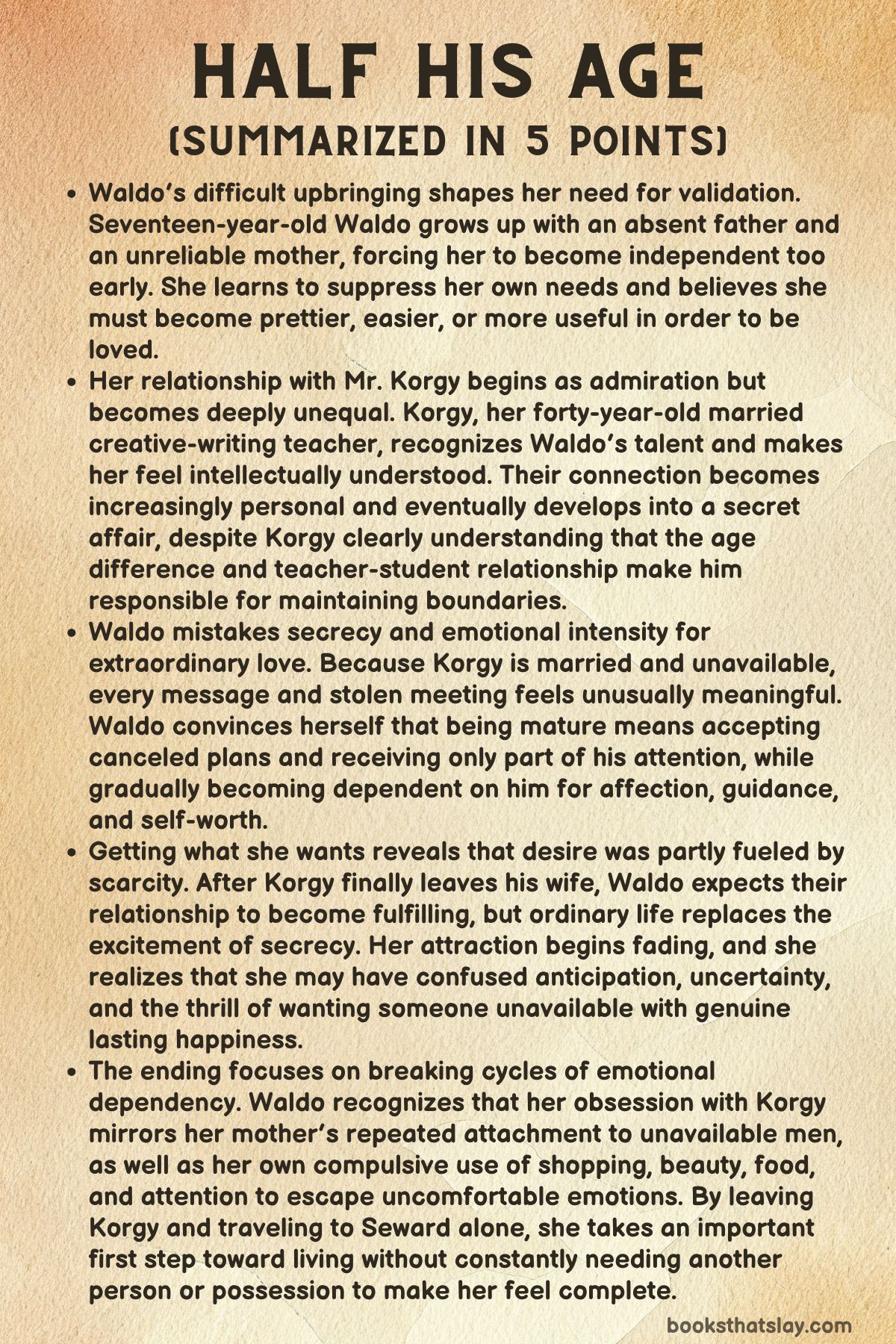
Seventeen-year-old Waldo lives in Anchorage with her mother and has already learned to expect very little from the people around her. Her father is absent, money is limited, and her mother frequently disappears to spend time with her boyfriend, Tony. Waldo has grown accustomed to taking care of practical responsibilities herself while also managing her mother’s emotional crises. A childhood comment from her mother that she was difficult to love has remained deeply embedded in her thinking.
As a result, Waldo often suppresses her needs and performs whatever version of herself she believes other people will prefer.
Her relationship with Randy Julep illustrates this problem. Although she receives physical attention from him, she feels almost no genuine emotional connection. She finally ends the relationship after admitting to herself that attraction cannot be manufactured.
Alone afterward, Waldo turns toward another familiar source of relief: shopping. Cosmetics, clothes, beauty products, food, and internet distractions offer short bursts of anticipation. She repeatedly convinces herself that the next purchase might transform her life, only to feel disappointed once she owns it.
Everything changes when she enters Mr. Korgy’s creative-writing class. Korgy is forty, married, a father, and openly disappointed with the life he has built. He once dreamed of becoming a novelist but chose stability and gradually abandoned that ambition.
His willingness to admit failure immediately fascinates Waldo. Unlike the boys she has previously dated, he seems intellectually and emotionally complicated. She becomes attracted not only to his appealing qualities but also to his age, sadness, awkwardness, and imperfections.
Writing becomes the route through which Waldo seeks his attention. Korgy recognizes genuine talent in her work and tells her that she has a distinctive voice. For a girl who has spent years making herself smaller, his recognition feels enormous. She begins associating him with something larger than romance: he seems able to see intelligence and possibility in her that she cannot reliably see in herself.
Meanwhile, her longtime friendship with Frannie has become strained. Frannie comes from a stable Mormon household and believes strongly in plans, education, and conventional ideas of responsibility.
Waldo once felt completely at home with her, but she now suspects that Frannie sees their friendship partly as an act of helping someone less fortunate. That suspicion causes Waldo to distrust even sincere kindness.
Korgy gradually moves beyond an ordinary teacher-student relationship with Waldo. He invites her to dinner with his wife, Gwen, and their young son, Gregory. Waldo studies Gwen closely and becomes jealous not simply of her marriage but of her security, competence, and everyday access to Korgy. Afterward, Waldo sends Korgy a carefully suggestive message containing her personal number. Private communication follows.
Their conversations become increasingly intimate. Korgy discusses his abandoned writing ambitions, family tensions, grief over his younger sister’s death, and his dissatisfaction with adulthood. Waldo believes these disclosures prove that she understands him more deeply than Gwen does. During a private walk, she kisses him. Korgy initially stops the situation and acknowledges the obvious boundaries: Waldo is seventeen, he is married, and he is her teacher. He even recognizes that responsibility belongs to him as the adult.
That recognition does not hold. After another emotionally charged encounter, Korgy admits that his feelings for Waldo are real. He argues that those feelings should not be acted upon, while Waldo insists that her difficult childhood has made her more mature than other teenagers. Korgy correctly recognizes that she has been forced into adult responsibilities too early, but eventually he allows emotional desire to overrule the boundaries he previously understood. Their secret affair begins.
For Waldo, finally being chosen by Korgy creates temporary emotional relief. Her anxiety decreases, ordinary life seems easier, and she interprets the change as evidence that the relationship is healing her. Korgy also assumes the role of mentor outside school, introducing her to books, music, films, art, and healthier habits. His care feels comforting because Waldo has rarely experienced a dependable adult taking care of her. Yet this makes their relationship even more unequal: he becomes teacher, guide, fatherlike caretaker, romantic partner, and source of validation at the same time.
The affair can exist only in stolen spaces. Gwen and Gregory remain Korgy’s public family, while Waldo receives whatever time is left. Meetings are canceled, conversations end when family duties intervene, and Waldo learns to keep herself permanently available. She increasingly believes that being a good partner means asking for nothing. When Korgy praises her maturity and understanding, she initially takes the compliments as proof of her exceptional nature. Eventually she begins noticing that she is rewarded most when she quietly accepts disappointment.
Her situation increasingly resembles her mother’s relationship with Tony. Both mother and daughter wait for unavailable men to contact them. Both interpret small pieces of attention as proof of larger love. Both attempt to become desirable enough that the man will finally choose them completely. Waldo believes her own relationship is different because it feels more intellectual and emotionally significant, but her behavior repeatedly exposes the similarity.
Korgy eventually attempts to end the affair, recognizing how dependent and distressed Waldo has become. Devastated, she tells him that she loves him, but he does not return the words. She finally tells Frannie what has happened. Frannie considers Korgy’s actions abusive and wants to protect Waldo, while Waldo fiercely defends the relationship. Even so, she finally allows herself to cry openly in front of her friend.
During the separation, Waldo briefly dates Nolan, a boy her own age. Nolan is kind, emotionally available, and uncomplicated. His stable family initially seems boring to Waldo, yet she begins wondering whether what she calls boredom may actually be security. She cannot, however, reproduce the intensity she experienced with Korgy. Eventually Korgy and Waldo reunite, and Korgy finally tells her that he loves her. Nolan recognizes that Waldo cannot return his feelings and ends their relationship rather than accepting partial affection.
After Waldo graduates and turns eighteen, she expects the relationship with Korgy to change. Instead, secrecy and limited availability continue. A decisive moment comes when Gwen unexpectedly returns home while Waldo is with Korgy. Waldo is hidden in a closet and forced to listen to the ordinary intimacy of his marriage. Suddenly the hierarchy she has spent months rationalizing becomes impossible to ignore.
Waldo attempts to leave. Korgy responds by promising to end his marriage, and eventually he actually does. For the first time, Waldo gets what she believed she wanted: unrestricted access to him. But the disappearance of secrecy changes everything. Ordinary days replace stolen meetings. They eat, watch television, sleep, discuss errands, and share domestic routines. The excitement created by waiting and uncertainty begins disappearing.
Korgy tries to restart his abandoned novel and imagines that leaving Gwen has restored his authentic self. Waldo gradually resents being treated as the explanation for his liberation. She also begins developing independent preferences instead of automatically accepting his judgments as superior. Most importantly, her physical desire for him weakens. She realizes that she may have confused anticipation, scarcity, secrecy, and emotional instability with proof of extraordinary love.
At the same time, Waldo’s mother begins attending a recovery program for compulsive relationships. She recognizes how childhood instability contributed to her dependence on men and takes responsibility for the damage her behavior caused Waldo. Her insights give Waldo language for patterns that resemble her own.
Korgy becomes increasingly needy as Waldo becomes less invested. Their earlier roles reverse. He complains that she desperately wanted him while he was unavailable but lost interest once he destroyed his marriage to become available. The accusation contains enough truth to disturb her. Meanwhile, Waldo reconnects with Frannie and discovers that they can care about each other without agreeing about how life should be lived.
Hoping to restore their relationship, Korgy surprises Waldo with tickets to Hawaii. She agrees to go, but at the airport her body resists what her mind keeps trying to accept. Rather than forcing herself forward, Waldo finally trusts the feeling. She walks away from the gate and leaves Korgy behind.
She returns home intending to take the long-promised Seward trip with her mother, only to discover that Mom has returned to Tony. This time Waldo does not explode. She understands that recognizing a destructive pattern does not automatically mean someone can escape it.
Waldo decides to go to Seward alone. Calls from Korgy and her mother fill her phone, but she turns it off. Driving by herself, she recognizes how many things she has used to avoid being alone with her own emotions: relationships, shopping, beauty products, food, internet distractions, fantasy, and attention. The ending does not suggest that every problem in her life has been solved. Instead, it gives her something quieter and more important. For once, Waldo is not waiting to be chosen, improved, rescued, entertained, or completed. She is simply moving forward on her own.
Characters
Waldo
Waldo is the central character of Half His Age, and nearly every major theme in the book is expressed through the gap between what she consciously believes and what her behavior reveals. At seventeen, she sees herself as unusually independent and mature. In practical terms, that belief has considerable justification. Poverty, an absent father, and an unreliable mother have forced her to manage responsibilities that many teenagers do not face. Yet the independence that makes her seem mature also conceals profound emotional deprivation. Waldo has learned to take care of other people while having little understanding of how to care for herself.
Her greatest emotional wound is the belief that love must be earned by becoming easier, prettier, more useful, or less demanding. Consequently, she alters herself around romantic partners. Beauty routines, sexual attention, expensive products, intellectual performance, and emotional accommodation all become methods of proving her worth. Her compulsive shopping follows the same psychological structure as her romantic obsession. Wanting something creates possibility; receiving it produces temporary relief; disappointment follows; then another object of desire appears.
Her relationship with Korgy demonstrates this cycle on the largest scale. Because he is unavailable, every small piece of attention feels exceptionally valuable. She mistakes the intensity generated by uncertainty for evidence that their connection must be extraordinary. Once he becomes fully available, the emotional machinery that sustained her desire begins shutting down. Waldo’s development therefore depends less on learning that Korgy is imperfect than on recognizing something about herself: she has organized much of her life around wanting.
Her final decision to travel alone is significant because she stops demanding that another person become the source of her transformation. Waldo does not finish the book as a completely healed or certain young woman. She becomes something more convincing: a person who has begun noticing her own patterns and is finally willing to experience herself without immediately escaping into another obsession.
Mr. Korgy
Mr. Korgy is the most ethically complicated adult in Half His Age. He initially appears perceptive, intelligent, vulnerable, and unusually honest about his failures. He dreamed of becoming a novelist but gradually chose stability over artistic risk, leaving him dissatisfied with the adult life he created. Waldo is attracted partly because he articulates disappointment rather than hiding behind authority. More importantly, he recognizes her writing ability and gives language to a creative identity she has never possessed before.
Korgy is capable of understanding the moral problem in their relationship. Early on, he recognizes that Waldo is seventeen, that he is her teacher, and that the responsibility for maintaining boundaries belongs to him. This awareness makes his later choices more serious, not less. He does not simply fail to recognize a boundary; he identifies it accurately and then crosses it anyway.
His relationship with Waldo also satisfies his own psychological needs. Her admiration allows him to recover an image of himself as intelligent, artistic, youthful, and misunderstood. He becomes her cultural guide, introducing books, films, music, and ideas, but the mentoring role also strengthens the imbalance between them. Even when he believes he is enriching Waldo’s life, he remains the adult deciding what she ought to appreciate and what kind of future she should pursue.
Korgy repeatedly praises Waldo for being mature when her supposed maturity makes the affair easier for him. When she accepts canceled plans, secrecy, and limited time without complaint, he treats accommodation as evidence of exceptional understanding. His affection may be genuine, but genuine emotion does not remove the unequal conditions under which it develops.
Once Korgy finally leaves Gwen, another side of him becomes clearer. He invests enormous meaning in Waldo, treating the relationship as evidence that he can reclaim the writer and independent man he believes marriage buried. When his novel falters and Waldo becomes distant, his emotional stability deteriorates. He has therefore committed a version of Waldo’s mistake: he expects another person to restore a missing part of himself. Their eventual failure shows that neither can permanently make the other responsible for personal transformation.
Mom
Waldo’s mother is loving, unreliable, affectionate, neglectful, self-aware, and self-deceiving at different moments, making her one of the book’s most important secondary characters. She genuinely loves her daughter. Her handwritten notes, gifts, encouragement, pride, and occasional moments of tenderness are not meaningless. The problem is that her love does not consistently translate into dependable parenting.
Her life repeatedly becomes organized around men. When a relationship is going well, she is energized and hopeful. When it collapses, she becomes devastated and often turns Waldo into her emotional caretaker. This reverses the expected parent-child relationship. Waldo learns early that adults may need her more than they protect her, contributing directly to her belief that usefulness is one of the conditions of love.
Mom also teaches Waldo, both intentionally and unintentionally, that female desirability can secure male attention. Her emphasis on appearance becomes part of Waldo’s later obsession with grooming and beauty products. The parallel between Mom and Waldo is central: both become preoccupied with emotionally unavailable men, both romanticize small signs of attention, and both repeatedly confuse longing with evidence of destiny.
Her participation in a recovery program represents real growth because she begins naming her behavior as a pattern rather than treating every failed romance as an isolated tragedy. She examines how her childhood contributed to her behavior while acknowledging that explanation does not remove adult responsibility. Yet her eventual return to Tony prevents the book from presenting insight as an instant cure. Her relapse helps Waldo understand that people can recognize what they are doing and still struggle to change.
Frannie
Frannie is Waldo’s oldest significant friendship and represents stability, structure, planning, religion, and conventional expectations. As children, she and Waldo share genuine closeness. The relationship becomes complicated when Waldo begins suspecting that Frannie’s friendship is partly motivated by a desire to help someone less fortunate. Whether or not that interpretation is fair, it changes Waldo’s ability to receive Frannie’s kindness without questioning its motive.
Frannie often functions as an outside moral perspective. When she learns about Korgy, she recognizes dangers Waldo refuses to acknowledge and initially wants adults or authorities involved. Her reaction is protective, but Waldo interprets protection through the history of feeling like Frannie’s charity project. The conflict therefore becomes larger than disagreement about Korgy. Waldo wants the right to define her own experience, while Frannie fears that respecting that autonomy may mean ignoring harm.
Their later reconciliation is important because neither woman completely converts the other. Frannie still values plans, religion, education, and an orderly future. Waldo still resists living according to a predetermined route. What changes is their need to judge each other. Waldo eventually understands that planning makes Frannie feel secure rather than shallow, while Frannie accepts that Waldo does not need an equally detailed plan. Their friendship becomes healthier when difference no longer has to prove that one of them is superior.
Gwen Korgy
Gwen initially exists in Waldo’s imagination primarily as an obstacle. Waldo wants to find evidence that Gwen and Korgy are unhappy because marital dissatisfaction would make her own desire easier to justify. Yet the actual Gwen is more complicated. She appears competent, socially confident, practical, and secure in ways that make Waldo deeply uncomfortable.
What Waldo envies most is not Gwen’s appearance but her ordinary access to Korgy. Gwen can share meals, household responsibilities, parenting, history, irritation, and mundane conversations with him. She possesses the everyday relationship Waldo cannot obtain during the affair. This distinction becomes increasingly important as Waldo realizes that stolen romantic intensity is not the same thing as participating in someone’s complete life.
Gwen also exposes the limits of Korgy’s narrative about his marriage. He frequently presents himself as the dreamer restrained by a practical wife, but the story gives enough evidence to suggest that his domestic responsibilities are real rather than merely oppressive. His later attempt to portray the marriage as years of obligation serves his desire to make leaving it seem like personal liberation.
Although Gwen is not given the same interior access as Waldo or Korgy, her position matters morally. She is making decisions about her marriage and family without crucial information. When Korgy eventually leaves, the consequences involve not only romantic disappointment but the destruction of a household and major changes to Gregory’s life.
Nolan
Nolan represents one of the clearest alternatives to Waldo’s understanding of romance. He is close to her age, available, interested in her, and capable of expressing affection openly. Precisely because he lacks Korgy’s forbidden status and unpredictability, Waldo initially experiences him as emotionally underwhelming.
His importance lies in the fact that he forces Waldo to question whether intensity is always desirable. With Nolan, she encounters kindness without secrecy and physical closeness without months of anxiety. Instead of automatically appreciating this, she finds herself searching for reasons that something is missing. The relationship demonstrates how thoroughly her nervous system has learned to associate uncertainty with desire.
Nolan’s strongest moment comes when he recognizes that Waldo does not reciprocate his investment. He does not respond by trying harder to win her, accepting whatever attention she offers, or demanding that his feelings be rewarded. He ends the relationship and refuses immediate friendship because remaining close would be unhealthy for him. In doing so, Nolan models something that both Waldo and Korgy struggle to understand: wanting another person does not create an entitlement to continue a relationship with them.
Tristan
Tristan is Frannie’s boyfriend and later leaves for a religious mission in Romania. He occupies a relatively minor role, but his presence reinforces several of Waldo’s assumptions about other people. Because he belongs to Frannie’s Mormon social world, Waldo frequently interprets his friendliness as duty rather than sincerity. She expects religious kindness to conceal self-congratulation in the same way she suspects Frannie’s friendship once did.
There is little evidence, however, that Tristan is behaving maliciously. His ordinary friendliness helps reveal how defensive Waldo has become. She often rejects kindness before she has to risk depending on it. During the zoo visit, his observation about whether an animal might experience loneliness contributes to a conversation that touches Waldo’s fear of connection and isolation. Tristan therefore functions less as a psychologically central individual and more as part of the stable peer world that remains available while Waldo directs most of her emotional energy toward Korgy.
Gregory Korgy
Gregory is Korgy and Gwen’s young son. He has limited direct agency in the story, yet his importance is substantial because he represents a responsibility that romantic fantasy cannot erase. Waldo frequently wants to think of Korgy principally as the man who understands and desires her, but Gregory repeatedly reminds her that Korgy is also a father with obligations that exist independently of their relationship.
During the affair, Gregory is one reason Korgy must leave Waldo and return home. Waldo experiences these interruptions as evidence that she comes second, but they are also reminders of the adult life into which she is attempting to enter. Once Korgy leaves Gwen, restricted access to Gregory contributes strongly to his distress. The separation demonstrates that his decision has consequences extending far beyond himself, Waldo, and Gwen.
Gregory also complicates Korgy’s fantasy of starting over. A person can leave a marriage, but fatherhood cannot be discarded without consequence. His presence keeps the story connected to responsibility even when Korgy and Waldo prefer to understand their choices primarily through the language of love and personal freedom.
Tony
Tony is Mom’s recurring romantic partner and functions primarily as the object around which her compulsive attachment becomes visible. Waldo does not need Tony to be exceptionally cruel for the relationship to damage her family life. His emotional inconsistency is enough to dominate Mom’s attention.
Mom repeatedly prioritizes Tony’s preferences, waits anxiously for his messages, changes herself to please him, and collapses when the relationship appears to end. Waldo watches these cycles with frustration while failing for much of the story to recognize how closely her relationship with Korgy resembles them.
Tony therefore matters less as an individually developed personality than as part of a pattern. His departures create Mom’s promises of reform, while his returns repeatedly interrupt those promises. Even after Mom enters recovery and begins understanding her dependence on relationships, she eventually resumes contact with him. His final reappearance helps Waldo accept that she cannot make her mother recover according to the timetable she wants.
Randy Julep
Randy Julep appears briefly at the beginning but performs an important structural function. Waldo’s relationship with him establishes the emotional emptiness that precedes Korgy. She understands that she has been using physical attention as a substitute for genuine connection and that she frequently performs enthusiasm because she believes being desired is preferable to being alone.
Randy also demonstrates that Waldo already possesses some capacity for self-recognition. She is able to admit that chemistry is absent and end the relationship rather than continue indefinitely. What she cannot yet recognize is the larger pattern behind her romantic behavior. Ending things with Randy creates space for Korgy, whose intellectual attention appears fundamentally different but eventually becomes another means through which Waldo seeks external confirmation of her worth.
Mr. Condren
Mr. Condren is a very minor character who substitutes for Korgy during one of his absences. The uploaded material provides little independent characterization of him, so assigning him a larger personality would go beyond what the book material supports. His narrative function, however, is useful. His appearance tells Waldo that Korgy is away, and her immediate response shows how completely her thinking has become centered on her teacher.
Instead of treating Korgy’s absence as something that may have countless ordinary explanations, Waldo instinctively interprets it in relation to herself. She imagines that he may be staying away because of the emotional force between them. Mr. Condren therefore serves mainly as a neutral piece of reality against which Waldo’s increasingly self-referential romantic thinking becomes visible.
Themes
Desire, Obsession, and the Difference Between Wanting and Having
Waldo’s emotional life is repeatedly driven by anticipation rather than satisfaction. In Half His Age, she becomes intensely attached to things that remain just beyond her reach, whether they are clothes she imagines will transform her appearance, attention that might make her feel desirable, or Korgy’s limited time and affection.
Her relationship with Korgy becomes especially powerful because he is unavailable. His marriage, fatherhood, age, and position as her teacher create distance, and that distance gives every message, meeting, glance, and promise extraordinary significance; instead of questioning whether the relationship actually meets her needs, Waldo interprets the difficulty of obtaining him as evidence that he must be uniquely valuable.
This pattern becomes clearer once Korgy leaves his wife and becomes available to her. The secrecy disappears, stolen meetings become ordinary days, and constant access produces boredom, irritation, and declining desire rather than the permanent happiness Waldo expected.
Her changing feelings reveal that much of the relationship’s intensity came from pursuit itself. Waldo gradually understands that wanting can create a powerful emotional state that says little about whether the desired person or object will actually provide fulfillment.
This realization extends beyond romance. Shopping, beauty products, food, internet distractions, and relationships all offer temporary excitement because they allow Waldo to imagine that satisfaction is about to arrive, while her eventual decision to leave Korgy marks her first serious attempt to stop organizing her life around the next thing she must obtain.
Love, Power, and Unequal Relationships
The relationship between Waldo and Korgy is shaped by a significant imbalance of age, authority, experience, and social power. Waldo considers herself unusually mature because she has worked, managed money, cared for herself, and carried emotional responsibilities that should have belonged to adults, but being forced to behave independently does not place her on equal ground with a forty-year-old teacher.
Korgy recognizes this imbalance before repeatedly acting against his own understanding of it. He knows that Waldo is his teenage student, acknowledges that maintaining boundaries is his responsibility, and initially understands the professional and personal consequences of crossing them, which makes his later participation especially important to the book’s examination of responsibility.
The imbalance also appears in subtler ways. Korgy becomes Waldo’s teacher, romantic partner, intellectual authority, cultural guide, and source of emotional validation simultaneously, allowing his approval to influence how she sees her intelligence, future, interests, and worth.
Waldo often believes that proving her maturity means accepting disappointment without complaint. When Korgy cancels plans or gives priority to Gwen and Gregory, she suppresses her anger, and his praise for her understanding encourages her to continue treating the absence of needs as a virtue.
The book therefore separates mutual desire from equality. Two people may genuinely feel attached to each other, but shared emotion does not automatically eliminate differences in authority, responsibility, or the ability to shape the relationship’s terms.
Self-Worth, Beauty, and Consumerism
Waldo repeatedly treats her appearance as a problem that can be solved through sufficient effort. Makeup, clothes, skincare, grooming routines, exercise, and shopping become ways of constructing a version of herself that she hopes will finally feel desirable enough to deserve sustained attention.
Her fixation on beauty is connected to lessons absorbed from childhood. Her mother places great importance on appearing desirable to men, while Waldo’s earlier experiences teach her that being wanted can feel like evidence of personal value; consequently, she often approaches her body not as something she inhabits comfortably but as something that must constantly be corrected, decorated, managed, and presented.
Shopping follows the same pattern. Purchasing something creates a brief period in which Waldo can imagine becoming prettier, happier, more confident, or fundamentally different, but once the product arrives, the fantasy collapses and another purchase becomes attractive.
This makes consumerism an emotional coping mechanism rather than simple materialism. Waldo is perceptive enough to recognize that products cannot repair loneliness or insecurity, yet the temporary rush of choosing and buying allows her to avoid sitting with emotions she does not know how to regulate.
Her later decision to clean out unwanted possessions signals an important shift. Instead of keeping things because she once desired them or spent money on them, she accepts that previous investment does not require continued attachment, a realization that also applies to Korgy.
Generational Patterns, Emotional Dependency, and Breaking the Cycle
Waldo spends much of the story criticizing her mother for repeatedly allowing romantic relationships to control her emotional life. Mom becomes euphoric when Tony gives her attention, devastated when he withdraws, and hopeful again when he returns, leaving Waldo frustrated by what appears to be an endless cycle of attachment, disappointment, and reconciliation.
What Waldo initially fails to recognize is how closely her own behavior resembles her mother’s. Both women become attached to men who cannot fully prioritize them, both wait anxiously for messages, both interpret limited attention as evidence of extraordinary love, and both adjust themselves in hopes of becoming impossible to leave.
The parallel is especially significant because Waldo believes intelligence and self-awareness protect her from repeating her mother’s mistakes. She sees her relationship with Korgy as deeper and more sophisticated than Mom’s relationship with Tony, yet the emotional structure remains similar: desire becomes obsession, separation produces emotional collapse, and another person becomes responsible for regulating self-worth.
Mom’s attempt at recovery eventually gives both characters language for these patterns. She begins recognizing that romantic relationships activate older wounds rather than create them, although her eventual return to Tony demonstrates that understanding a pattern does not guarantee immediate freedom from it.
Waldo’s ending takes a different direction. By leaving Korgy and driving to Seward without waiting for either him or her mother, she does not claim permanent freedom from dependency; instead, she makes the first meaningful choice not to repeat the familiar response of chasing someone else for relief.