There Is No Antimemetics Division Summary, Characters and Themes
There Is No Antimemetics Division by qntm (pronounced ‘quantum’ and is the pen name of British author and software developer Sam Hughes) is a science fiction novel set in the world of anomalous entities and the mysterious organization dedicated to containing them: the SCP Foundation. The story explores the terrifying effects of antimemetics, entities that erase themselves from the memory of anyone who encounters them, leaving only confusion and dread in their wake.
Through a series of interconnected narratives, the novel delves into the challenges faced by the Foundation’s Antimemetics Division, tasked with handling these mind-bending threats. The book highlights the struggle between knowledge and oblivion, as characters battle to uncover the truth while dealing with the terrifying consequences of forgetting it.
Summary
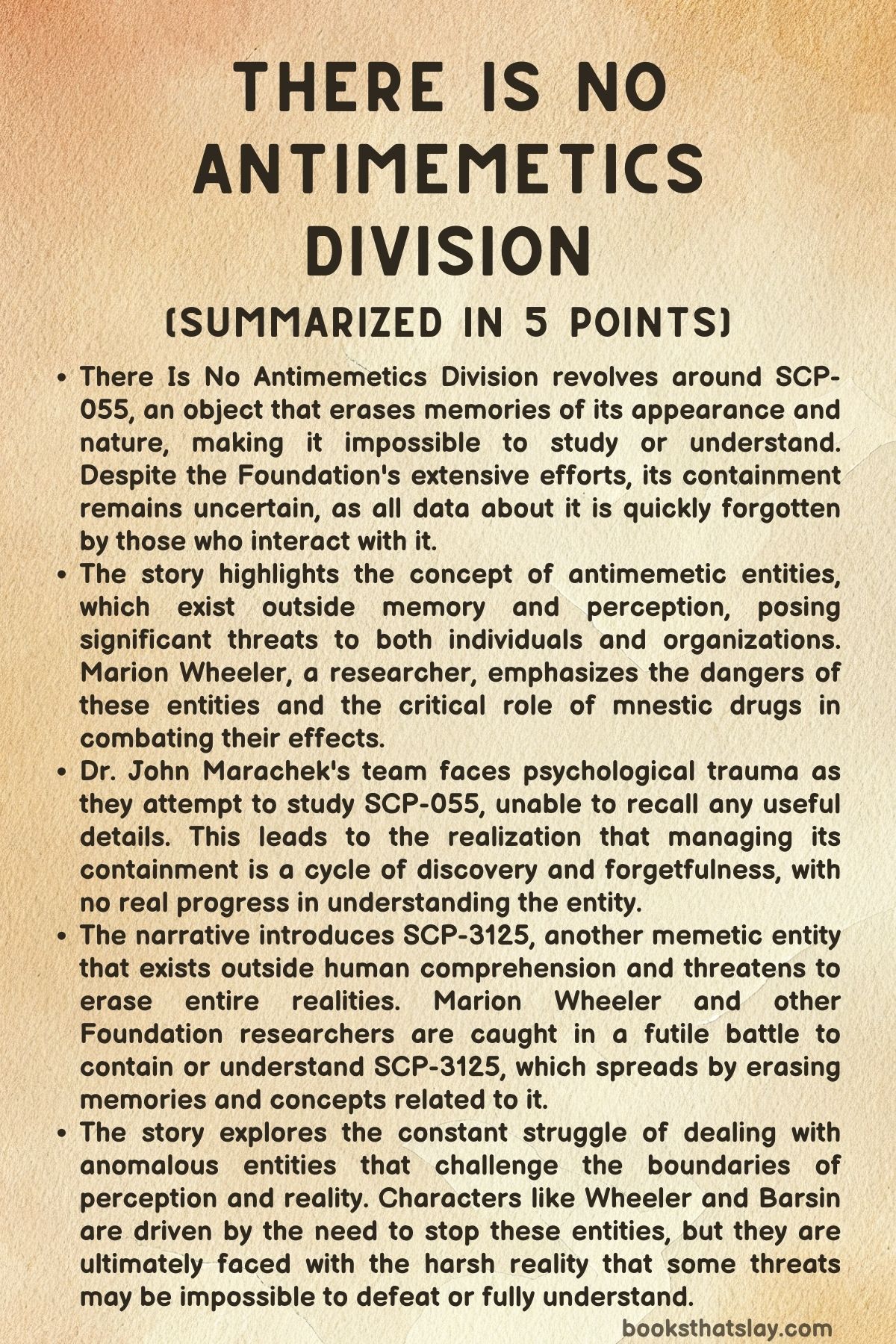
The story unfolds within the vast, secretive world of the SCP Foundation, an organization dedicated to containing and studying anomalous entities. One such entity, SCP-055, is a highly dangerous antimemetic phenomenon.
Its true nature and appearance remain unknown because anyone who comes into contact with it quickly forgets everything about it, even if they’ve recorded data or observed it. Despite this memory loss, a substantial amount of data has been gathered, but its inability to be properly studied or remembered makes it nearly impossible to understand or contain.
The anomaly’s purpose and origin remain a mystery, and efforts to destroy or relocate it have consistently failed. SCP-055’s ability to erase memories is so potent that it is classified as Keter, the highest level of danger, representing a constant threat to those interacting with it.
Dr. John Marachek, who is part of the team studying SCP-055, details the experience of a survey team’s encounter with the entity. The team initially remembers that SCP-055 isn’t spherical, but all further details fade from their memories.
This leads to confusion and mental disarray, leaving the team unable to gather any useful information about the anomaly. Dr. Marachek speculates that the only way to contain it effectively may be to create a person who can retain memories about SCP-055 and thus maintain some understanding of it over time.
Marion Wheeler, the chief of the Antimemetics Division, is introduced as a key figure in the novel. She specializes in handling antimemetic threats, entities that exist outside the boundaries of memory and perception.
These anomalies can cause massive psychological damage by making themselves untraceable, erasing all evidence of their existence and leaving people with only vague recollections and deep confusion. Wheeler emphasizes the importance of mnestic drugs, which can help restore lost memories about antimemetic entities, and highlights the vital role her division plays in containing these types of threats.
In a meeting with O5-8, an influential figure in the Foundation, Marion discusses the complexities of SCP-055 and other antimemetic entities. Initially skeptical, O5-8 becomes more alarmed as Marion provides evidence of SCP-055’s abilities.
Despite their best efforts, the team is unable to comprehend the true nature of SCP-055, and Marion describes how the entity’s power lies in its ability to erase itself from the memory of anyone who encounters it. The only certainty about SCP-055 is that it exists, and it remains one of the many dangerous antimemetic threats that the Foundation is working to manage.
As Marion explains, there are many other entities like SCP-055 that threaten the stability of the world. These threats are particularly insidious because they cannot be contained or understood in traditional ways.
They are often outside the scope of human comprehension, and the Antimemetics Division’s mission is to try to manage their influence by manipulating memories. However, even the experts in her division are not immune to the dangers posed by these anomalies, and Marion herself faces the overwhelming task of preserving what little knowledge remains about these entities.
As the narrative shifts focus, the story introduces SCP-3125, a cognitohazard with a far more dangerous scope. SCP-3125 exists outside human understanding, infecting all aspects of reality and spreading through mental and conceptual contamination.
The Foundation has created an entire containment system for SCP-3125 at Site 41, but it is near impossible to fully study or contain. Anyone who enters the unit undergoes a memory purge to prevent them from retaining any knowledge of the entity.
Marion Wheeler is scheduled to visit this unit, despite the fact that all attempts to study the entity have failed. When she enters, she finds the unit in disarray, filled with frantic notes and recordings from previous researchers who, after interacting with SCP-3125, were driven to madness or death.
While examining the data, Marion finds a video recording of herself from a past visit, revealing chilling details about SCP-3125. The entity spreads by erasing the memories of anyone who understands it, making it nearly impossible to contain or even study.
It has infiltrated countless organizations, erasing their knowledge and driving them to extinction. The Antimemetics Division, once a large team of researchers, is now reduced to a fraction of its former size.
Despite the apparent futility of their efforts, Marion remains determined to find a way to stop SCP-3125.
Marion realizes that the only way to stop SCP-3125 is by creating a machine capable of neutralizing it, but such a machine can only be constructed by fully understanding the entity, which is an impossible task due to the nature of SCP-3125. As Marion grapples with the idea that humanity is losing the war against this devastating force, she comes to terms with the irreversible brain damage caused by the mnestic drugs she’s been taking.
The foundation’s resources are exhausted, and Marion is left to confront the possibility that the entity will continue to spread uncontrollably.
The final stages of Marion’s investigation lead her to an underground lab, where she discovers a failed attempt at creating an irreality amplifier—a machine designed to counteract SCP-3125. However, she realizes that the machine cannot stop the entity, and the efforts to contain it are in vain.
Faced with the overwhelming evidence of humanity’s impending destruction, Marion makes the difficult decision to accept the futility of the situation. The novel ends with the haunting realization that SCP-3125 will continue to spread, erasing knowledge, memories, and humanity itself.
The final part of the novel shifts perspectives once again, following a new character, George Barsin, an agent working in the Anomalous Religious Expressions Division. Barsin investigates a strange cult that has been using an anomalous religious phenomenon to spread chaos across the world.
As he delves deeper into the cult’s activities, Barsin faces an increasing sense of dread and unease as he discovers that the force behind the cult is part of a much larger, more terrifying phenomenon. Barsin’s struggle against this malevolent entity mirrors the themes of memory manipulation and reality-altering forces that dominate the novel.
In the end, the novel leaves readers with a bleak understanding of the vast and unknowable forces at work in the world of antimemetics. The Foundation’s struggle against these threats is Sisyphean, as they face entities that can erase themselves from existence, making it nearly impossible to confront them directly.
The characters’ experiences emphasize the fragility of memory, perception, and reality, and the inevitable collapse of everything once it is caught in the grip of these mind-bending anomalies.
Characters
Marion Wheeler
Marion Wheeler is a central figure in There Is No Antimemetics Division, and her role as the chief of the Antimemetics Division highlights her expertise in dealing with entities that exist outside the boundaries of human perception and memory. As a senior researcher, Marion demonstrates an unwavering dedication to understanding and containing antimemetic threats, particularly SCP-055 and SCP-3125.
Her professional demeanor, while stoic and calculated, contrasts with the psychological toll the constant battle against these threats takes on her. She is tasked with investigating and neutralizing entities that can erase themselves from memory, a responsibility that isolates her from others, both mentally and emotionally.
Her efforts to develop mnestic drugs to counteract memory loss and her commitment to combating SCP-3125, even in the face of its inevitable spread, reflect her resilience and determination. However, as her work progresses, it becomes clear that Marion is increasingly overwhelmed by the scope of the threat, especially as the very drugs meant to protect her start to erode her mind.
By the end of the narrative, Marion’s realization that she may be humanity’s last line of defense against SCP-3125 is heartbreaking, as she faces the futility of her efforts and the inevitable collapse of reality as she knows it.
Dr. Bartholomew Hughes
Dr. Bartholomew Hughes is an enigmatic character whose daily life involves navigating the eerie and dangerous environment of S167-00-1006, a containment unit located inside the skull of a massive creature, Cryptomorpha gigantes. His work in the unit is focused on maintaining the structure’s antimemetic properties, allowing him to function in a space where reality itself is distorted.
Hughes’s detachment from the horrors around him is remarkable—he constantly reminds himself that the disturbing environment he works in is merely the remains of a single organism. This professional coldness reflects his ability to compartmentalize and focus on his work, even when the stakes involve global survival.
His role in a meeting with high-ranking individuals about the containment of SCP-3125 further underscores his expertise, as he is tasked with contributing ideas to counter the omniversal-level threat. Despite his initial reluctance to take on a dangerous mission, Hughes eventually agrees, understanding that the task is too important to abandon.
His character represents the grim determination required to combat an existential threat, even at the cost of personal sacrifice. Hughes’s final decisions, reflecting a commitment to protecting humanity, cement his tragic role as a leader caught in a seemingly unwinnable battle.
George Barsin
George Barsin is a character who initially seems to embody the impersonal, methodical approach of the Foundation but gradually reveals a more human side as he navigates his mission. As an agent with the Anomalous Religious Expressions Division, Barsin is tasked with investigating a cult linked to a mysterious anomalous force.
His experience is marked by the growing realization of the devastating scale of the threat he faces, as well as his growing disillusionment with the Foundation’s methods. Barsin’s pragmatic approach to dealing with Red, a member of the cult, initially portrays him as someone who relies on impersonal and even brutal measures to achieve his goals.
However, as he witnesses the true nature of the force controlling Red, Barsin’s internal conflict grows. He begins to question whether the Foundation’s methods—such as orbital strikes and extreme containment protocols—are justified, especially when they involve the loss of innocence.
Ultimately, Barsin falls victim to the same mind-manipulating entity that he had been combating, demonstrating the inescapable nature of the threat. His character arc reflects the tragic futility of his efforts and the collapse of personal and institutional control when faced with an enemy that erases memories and manipulates minds.
Adam Wheeler
Adam Wheeler is a character who finds himself trapped in a surreal, psychological nightmare in There Is No Antimemetics Division. As a violinist on tour, Adam’s experiences serve as a contrast to the more scientific and tactical perspectives of characters like Marion Wheeler and Dr. Bartholomew Hughes.
His story explores the personal and existential ramifications of an unrelenting, antimemetic force that distorts reality and erases memory. During a performance, Adam’s surroundings become increasingly grotesque, and he finds himself surrounded by alien entities, a situation that forces him to confront the collapse of the world he once knew.
His growing awareness of his isolation, as well as the resurfacing of memories about Marion, adds a deeply emotional layer to his character. The unraveling of his reality forces Adam to face the horrifying knowledge that he may be the last unaffected human in a reality overtaken by forces beyond his comprehension or control.
His journey explores themes of isolation, memory loss, and the overwhelming weight of an irreversible loss. Adam represents the personal, human cost of encountering antimemetic phenomena, as his struggle culminates in the realization that the world he once knew has been completely consumed by forces that he cannot escape or fight.
Red
Red is a tragic figure in There Is No Antimemetics Division, a young man caught in the grip of a malevolent, mind-altering force. His character is defined by his vulnerability, as he becomes an unwitting vessel for a powerful anomalous entity.
When George Barsin encounters Red, he initially appears as a malnourished and unkempt figure, embodying the physical toll that the entity has taken on him. Despite his resistance, Red is ultimately controlled by the entity, forced to act as a puppet in the larger, sinister scheme.
His interactions with Barsin reveal his internal struggle, as he is partially freed from the entity’s control but remains deeply influenced by its presence. Red’s character arc, though brief, highlights the insidious nature of the anomalous force controlling him and the larger global threat it represents.
In his final moments, after Barsin’s efforts to break the entity’s hold, Red regains some of his humanity, but it is too late to reverse the damage done. Red’s tragedy lies in his inability to escape the influence of the entity, illustrating the pervasive and destructive power of antimemetic forces.
Paul Kim
Paul Kim is a character who appears in There Is No Antimemetics Division as a colleague of Marion Wheeler and a voice of concern regarding the safety of regular visits to SCP-3125’s containment unit. His skepticism about the effectiveness of the memory-purging systems used during the containment process reflects a practical, grounded perspective in contrast to Wheeler’s more determined approach.
Paul’s role serves to emphasize the psychological and existential toll that working with antimemetic entities takes on individuals. His concern for Marion’s well-being and the safety of the team reveals a human side to the otherwise clinical world of the Antimemetics Division.
Despite his doubts, Paul ultimately supports the necessity of the division’s work, understanding that the potential consequences of ignoring these threats are far too great. While his character does not undergo significant development, his role as a grounding influence highlights the personal cost of dealing with entities that threaten both memory and reality itself.
Themes
Memory and Its Fragility
In There Is No Antimemetics Division, the fragility of memory plays a pivotal role, particularly in the context of entities like SCP-055 and SCP-3125. Memory, as an essential aspect of human experience, becomes both a tool and a weapon, shaped and manipulated by the very phenomena the characters seek to understand.
SCP-055’s ability to erase itself from memory illustrates the terrifying potential of losing one’s grasp on reality. The more the characters attempt to study it, the more their recollections are wiped away, leaving them trapped in a cycle of forgetfulness and confusion.
This process of memory erasure disrupts the ability to comprehend, leaving them in a constant state of disorientation. This highlights the terrifying aspect of an entity that not only exists outside human understanding but also prevents any record or recollection of its presence.
Similarly, SCP-3125 feeds on human understanding, erasing any knowledge of itself, which makes any attempt to counteract it futile. The concept of memory here extends beyond mere loss; it becomes a psychological and existential threat.
The characters who come into contact with these entities face not only physical danger but the psychological torment of not being able to retain any meaningful data about what they encounter. This constant cycle of discovery and forgetfulness underlines the horror of an existence where knowledge itself becomes a transient, uncontrollable force.
The narrative constantly challenges the reliability of memory, portraying it as both a blessing and a curse, easily manipulated and lost in the face of antimemetic threats.
The Invisibility of Threats
The theme of invisible threats runs deeply throughout the book, especially in the cases of SCP-055 and SCP-3125, where the real danger lies in their untraceable, invisible nature. These entities do not present themselves in ways that can be perceived or even remembered, making them far more insidious than physical threats.
SCP-055, classified as an “anti-meme,” exists in such a way that any effort to understand it is doomed to fail. Its very nature is to erase all details from the minds of those who come into contact with it, making it impossible to track, study, or even conceptualize its existence.
This creates a terrifying form of existential dread, where the very process of trying to comprehend the anomaly leads to personal oblivion. SCP-3125 operates similarly, manifesting as a cognitohazard that spreads through reality by manipulating perception and erasing memories.
The inability to directly perceive or recall these threats heightens their danger, as those tasked with confronting them are often left clueless about the full scale of the menace. The fact that these threats do not exist in the traditional sense—appearing outside the boundaries of human understanding—challenges the characters’ ability to engage with them in any meaningful way.
This lack of visibility serves to amplify the horror, as the characters are perpetually under threat, yet unable to identify, confront, or eliminate the danger. In this context, the fear of the unknown becomes the most potent form of horror, as the characters grapple with forces that cannot be seen or remembered.
The Struggle for Control and the Price of Knowledge
The constant battle for control over dangerous entities, especially SCP-055 and SCP-3125, underscores a central theme of the book—the high cost of knowledge and the dangers associated with it. The characters, particularly those in the Antimemetics Division, are in a continual struggle to gain some form of understanding about the threats they encounter, yet the knowledge they seek often comes at a steep price.
Marion Wheeler’s attempts to understand SCP-055 and SCP-3125 reveal the existential cost of this pursuit. In one sense, the division’s focus on gathering data and containing the entities is a rational response to the threat, yet it is also a futile endeavor.
The more they know, the more they risk their sanity and very lives. SCP-3125, for example, has the ability to erase any knowledge of itself, making any progress in understanding it ultimately meaningless.
Even when the researchers attempt to protect themselves using mnestic drugs to fortify their memories, these measures come with irreversible psychological damage. The irony lies in the fact that the knowledge they seek to protect humanity from actually drives them to madness and death.
The pursuit of control over these anomalies seems to perpetuate a cycle where the knowledge itself is tainted, dangerous, and, in some cases, lethal. This theme explores the inherent tension between the need to understand the unknown and the devastating consequences of that understanding.
The more the characters learn, the more they realize how little they can control, making them question whether the price of knowledge is truly worth the risk.
Isolation and the Human Condition
Another powerful theme in There Is No Antimemetics Division is the exploration of isolation, particularly the isolation of the characters within their own minds. The presence of antimemetic entities such as SCP-055 and SCP-3125 not only isolates the characters physically from the world but also mentally.
They are cut off from the broader human experience, trapped in a loop of discovery and forgetfulness, which leaves them emotionally and psychologically distant from the rest of humanity. Marion Wheeler’s narrative arc reveals this isolation most starkly.
As she becomes more deeply immersed in the battle against SCP-3125, she realizes that she may be the last person standing against the entity. This realization of being alone in the fight, without any possibility of help or escape, reflects a broader existential loneliness.
The characters’ attempts to save humanity often feel doomed from the outset, as they struggle against forces beyond their comprehension and control. This theme highlights the alienating nature of the world they inhabit—one where the boundaries of reality itself are in constant flux, and the human capacity to relate to others is challenged by the very anomalies they seek to contain.
The loss of memory, the loss of understanding, and the inevitable breakdown of human connections reflect a deeper commentary on the fragility of the human condition, especially when faced with incomprehensible forces. The more the characters fight to maintain control, the more they become distanced from their own humanity, highlighting a central paradox of the narrative: the more they try to preserve knowledge and existence, the more they lose what makes them human.
The Inevitable Fall of Humanity
The book explores the grim reality of humanity’s inability to stop forces that exist outside the realm of human understanding. This theme of inevitable downfall pervades the narrative, especially in the context of SCP-3125 and its world-consuming spread.
Despite the efforts of the Antimemetics Division and other characters to fight back, the overwhelming power of these entities renders all attempts at resistance futile. The narrative unfolds as a slow march toward the inevitable collapse of human civilization, as SCP-3125 spreads across the world, erasing memories and minds.
Marion Wheeler’s final acceptance of the inevitable defeat emphasizes the helplessness that the characters face. Despite all the strategies, knowledge, and resources at their disposal, they are powerless to prevent the inevitable.
The destruction of entire civilizations, the erasure of history, and the unraveling of human understanding create a sense of hopelessness that permeates the book. This theme critiques the illusion of human control over the larger forces of the universe, suggesting that some threats, whether physical or memetic, are beyond human comprehension and resistance.
The end result is a narrative steeped in existential dread, where humanity’s attempts to fight back against an unknowable enemy ultimately lead to its destruction, not by force, but by the slow erosion of memory, meaning, and identity.