They Say a Girl Died Here Summary, Characters and Themes
They Say a Girl Died Here by Sarah Pinborough is a psychological thriller that combines small-town murder mystery, supernatural speculation, family trauma, and questions about memory and fate.
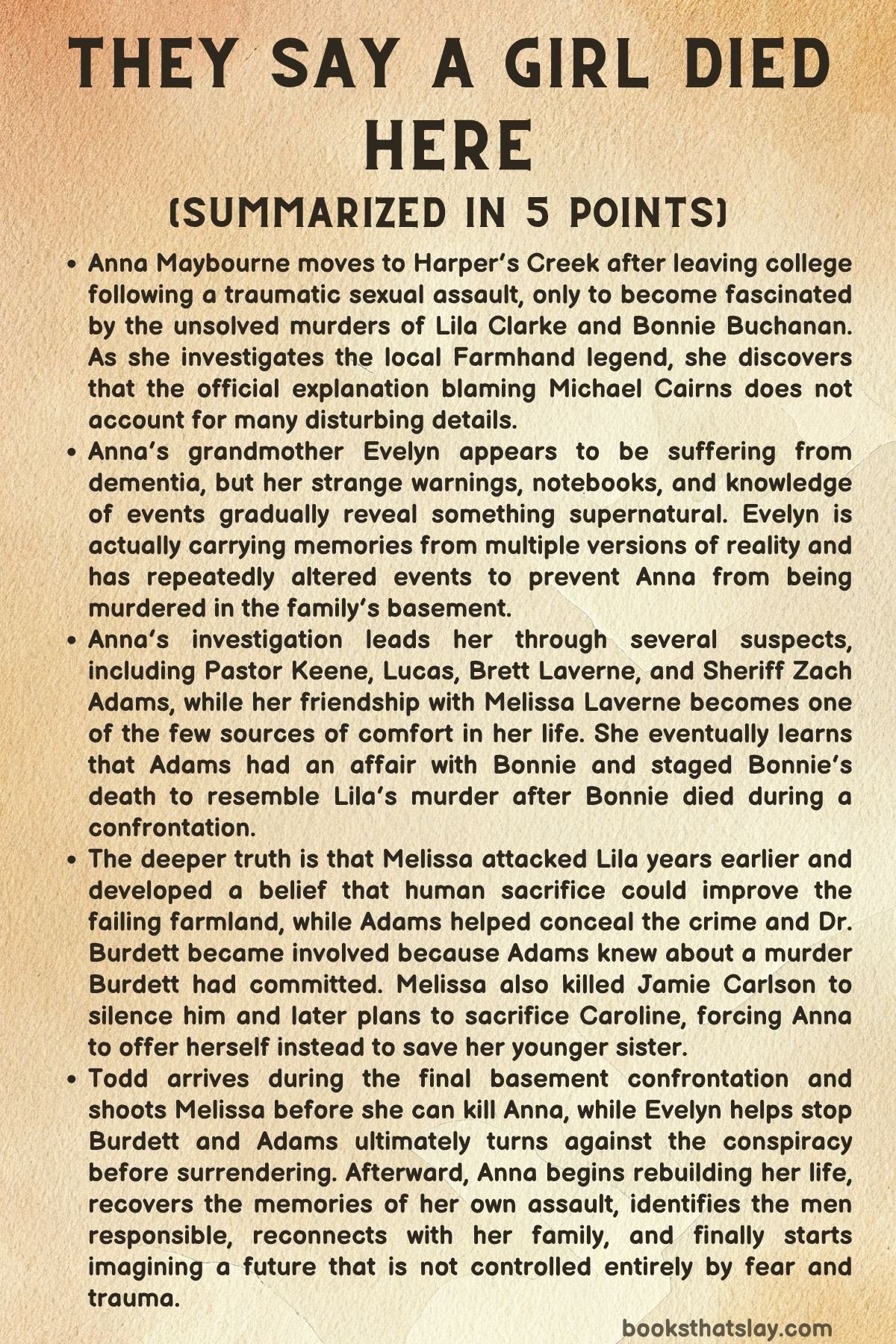
The story follows Anna Maybourne, a young woman whose life has been fractured by sexual assault, as she moves with her family to Harper’s Creek and becomes fascinated by two unsolved murders associated with the legend of the Farmhand. What begins as an investigation into old deaths gradually becomes inseparable from Anna’s own damaged memories, her grandmother Evelyn’s strange mental decline, and a frightening pattern suggesting that past and future may not be as fixed as they appear. It is the expanded full-length version of the author’s earlier 2016 limited-edition novella They Say a Girl Died Here Once.
Summary
Anna Maybourne arrives in Harper’s Creek carrying trauma she cannot completely remember. After leaving college following a sexual assault that was recorded and circulated, she has become suspicious of men, uncomfortable with intimacy, estranged from old friends, and uncertain whether she can ever return to the person she once was.
Her family has its own difficulties. Claire, Anna’s mother, works exhausting nursing shifts while caring for Anna, Anna’s younger sister Caroline, and Evelyn, Claire’s increasingly confused mother.
Evelyn appears to be developing dementia, but some of her episodes are unusually disturbing. She becomes frightened by the family’s new house, stands staring through windows for unexplained periods, speaks about girls whose voices fill her head, and repeatedly behaves as though she remembers things no one else has experienced.
Meanwhile, Harper’s Creek remains haunted by two murders. Lila Clarke was killed six years earlier and Bonnie Buchanan three years later, both strangled, struck in the head, washed, mutilated by the removal of a square of skin, and abandoned on farmland.
A farmworker named Michael Cairns was blamed after police discovered that he secretly photographed local girls, including the victims. Cairns later died during a robbery, allowing the authorities to treat the murders as solved, but many residents remain unconvinced.
Local children have turned the killings into the legend of the Farmhand, supposedly a monster who returns every three years to kill another girl. Caroline becomes terrified because another three-year anniversary is approaching, while Anna initially dismisses the story as childish superstition.
Anna begins considering the murders as material for a writing competition. Writing had once been central to her identity, and investigating Lila and Bonnie offers her the possibility of becoming intellectually active again instead of defining herself entirely through what happened at college.
Her interest deepens when she meets Jamie Carlson, Lila’s former boyfriend. Jamie insists Cairns was not the killer and describes seeing a mysterious clown around the time of Lila’s death, although his history of addiction has made most people dismiss him.
Anna also becomes friends with Melissa Laverne, Lila’s former friend and the rebellious niece of Sheriff Zach Adams. Melissa seems to understand Anna’s anger and loneliness, and their friendship allows Anna to experience nightlife, laughter, companionship, and ordinary youthful freedom again.
The investigation becomes more serious when Anna visits Bonnie’s mother and secretly discovers evidence that Bonnie had been involved in a hidden romantic relationship. Later information suggests Bonnie may have been pregnant, giving Anna reason to believe someone powerful had wanted that relationship concealed.
Jamie dies from what appears to be a drug overdose shortly after speaking with Anna. Because he had remained determined to challenge the official account of Lila’s death, Anna suspects that someone may have silenced him.
At the same time, strange events inside Anna’s house intensify. Melissa reveals that local teenagers once entered the basement through an insecure window, and Anna later discovers what appears to be dried blood there.
Police testing produces an astonishing result: the blood belongs to Anna herself. She has no memory of ever bleeding in the basement, and the stains subsequently vanish, making her appear increasingly unstable to Claire and the authorities.
Evelyn’s notebook creates further confusion. Among prayers, scripture, and fragmented writing are repeated references to girls dying in the house, multiple versions of events, the need to save Anna, and the disturbing phrase that people say a girl died there.
Anna initially wonders whether dementia is combining Evelyn’s memories, dreams, and religious fears. That explanation becomes harder to accept when Evelyn repeatedly hums a tune Anna identifies as “Send in the Clowns,” connecting Evelyn inexplicably with Jamie’s story.
Anna’s trauma also affects Caroline. Terrified that adolescence will make her younger sister vulnerable to male attention and violence, Anna becomes obsessive about protecting her.
When Caroline happily shows her new clothes and talks about a boy, Anna fixates on her sister’s long hair as something that might make her noticeable. Pretending she is giving Caroline a new hairstyle, Anna cuts off far more hair than Caroline agreed to lose.
The act devastates Caroline and horrifies Claire. Anna herself begins wondering whether her investigation and fears have moved beyond reasonable suspicion into psychological collapse.
Evelyn finally gives Anna an explanation that changes everything. Her deteriorating mind is not merely losing memories; it has somehow become capable of retaining memories from different versions of reality.
Evelyn tells Anna that Anna has died repeatedly in the basement. Each time, Evelyn has somehow used the unusual emptiness created within her damaged memory, combined with her faith and connection to the place, to push events backward and create another opportunity to save her granddaughter.
The resets explain the blood, Evelyn’s contradictory notebook entries, disappearing details, and her knowledge of events she should never have witnessed. Each altered sequence leaves fragments behind inside Evelyn, gradually destroying her ability to distinguish one reality from another.
When Anna asks who kills her, Evelyn gives a single answer: the clown. Knowing another death may occur within a day, Anna stops treating the mystery as an intellectual project and begins investigating her own future murder.
Her suspicions move between several people. Pastor Ezekiel Keene appears suspicious because he knew both victims, has access to the distinctive soap used to wash the bodies, and speaks comfortably about religious ideas of blood and sacrifice.
Yet Keene leaves town for Omaha, apparently removing him from the immediate threat. Anna therefore breaks into Sheriff Adams’s office and steals material from the murder investigation.
The records finally expose Bonnie’s hidden relationship. Sheriff Adams had been romantically involved with her, and Bonnie became pregnant.
During a confrontation, Bonnie suffered a fatal head injury. Rather than admit what had happened, Adams staged Bonnie’s body to resemble Lila’s earlier murder, copying the strangulation, cleansing, mutilation, and placement on farmland.
This revelation proves Adams was involved in the Farmhand crimes but also establishes that he did not originate the pattern. Someone else killed Lila first.
Anna finds a clue pointing toward the Laverne property: a red scarf connected with Lila appears on a scarecrow there. She assumes Brett Laverne, Melissa’s unstable father, must be the original killer.
Brett has repeatedly behaved aggressively toward Anna, apparently confirming her suspicions. In reality, he has been desperately attempting to warn her away from Melissa.
Anna calls Dr. Johnny Burdett, whom she trusts as a kindly longtime friend of Evelyn and a respected physician. Burdett tells her that Caroline is safely with him after secretly escaping Holly’s sleepover, and he promises to help Anna.
Melissa then appears while Anna is fleeing the Laverne property and apparently rescues her. Anna remains completely convinced that Melissa is her closest ally.
At home, the truth finally emerges. Burdett has drugged Caroline and is holding a gun, while Melissa enters carrying a bat.
Melissa confesses that she attacked Lila years earlier because she felt abandoned when Lila planned to leave with Jamie. Melissa struck her with a bat, but Lila survived the initial blow.
Sheriff Adams, desperate to protect his niece, completed the murder by strangling Lila. Melissa and Adams then washed and staged the corpse, with Melissa creating the removed-skin signature that later became associated with the Farmhand.
After the farm enjoyed an unusually successful harvest, Melissa developed a religious belief that Lila’s death had functioned as a sacrifice to the land. Bonnie’s later death, staged by Adams to imitate Lila’s, strengthened Melissa’s belief that human blood could restore fertility to the fields.
Melissa also reveals that she was the clown Jamie had seen. Years later, she murdered Jamie because his continued investigation threatened to expose the truth.
Dr. Burdett is connected to the conspiracy through his own secret crime. After the death of a woman with whom he had an affair and the child he fathered with her, Burdett killed the responsible man, and Adams covered up what he had done.
Adams has therefore spent years protecting both Melissa and Burdett while also hiding his responsibility for Bonnie. Their crimes have created a chain in which every secret demands another act of concealment.
Melissa now plans to frame Brett for all the Farmhand killings. Worse, she decides that Caroline, newly menstruating and therefore symbolically fertile in Melissa’s distorted theology, would make the perfect innocent sacrifice for the land.
Anna immediately offers herself instead. She is willing to die if doing so guarantees Caroline’s survival, bringing her protective instincts to their most selfless form after those same instincts previously led her to violate Caroline’s autonomy.
The confrontation returns everyone to the basement where Anna has died in other versions of events. Evelyn is already waiting there, understanding more than anyone realizes.
As Melissa prepares to kill Anna, Todd Greenbough enters through the basement window and shoots Melissa. Evelyn had deliberately removed the book Anna used to block the window, creating the opening Todd needs.
When Burdett threatens Todd, Evelyn attacks Burdett with the missing kitchen knife. Adams finally turns against the conspiracy and shoots Burdett before surrendering.
Dying, Melissa begs Anna to complete the ritual by strangling her, washing her body, and placing her on farmland. Anna refuses, denying Melissa the sacred sacrifice she wants her death to become.
Rain begins falling over Harper’s Creek immediately afterward, finally ending the long drought. The timing leaves open an uncomfortable question about coincidence, the supernatural, and the strange relationship between the land and generations of bloodshed.
Sheriff Adams eventually confesses and pleads guilty. Harper’s Creek begins confronting truths it had hidden beneath gossip, religion, routine, and the convenient belief that Michael Cairns had been responsible for everything.
Anna’s own buried memories also return. She can finally remember the three men who raped her at college and gives their names to police, allowing her to describe what happened without treating herself as responsible for their actions.
Her relationship with Caroline begins recovering, Claire and Anna reconnect emotionally, and Todd becomes someone Anna may eventually be able to trust intimately. Evelyn suffers the greatest cost, losing much of her remaining ability to communicate after repeatedly altering events to keep Anna alive.
Anna receives interest from editors who want the story of the Farmhand, but she chooses not to publish immediately. Writing is once again possible, yet she no longer needs to turn suffering into material before she is ready.
By the end, Anna is still physically and psychologically marked by everything that happened, but she is no longer living as though her life ended at college. She has a family she can accept, a future she can imagine, and a growing ability to place guilt on the people who actually caused the violence rather than carrying it herself.
Characters
Anna Maybourne
Anna is the emotional and investigative center of They Say a Girl Died Here, and much of her behavior can be understood as an attempt to regain control after an assault destroyed her confidence in memory, intimacy, judgment, and safety. Her suspicion of men, hostility toward Lucas, instinctive recording of encounters, and obsessive protection of Caroline all emerge from a mind that has learned to assume danger before trust.
Her development is deliberately uneven because recovery is not presented as a simple progression. Anna makes serious mistakes, particularly when she cuts Caroline’s hair without meaningful consent, but eventually learns that protecting someone does not justify controlling them, just as surviving violence does not require surrendering the rest of her life.
Evelyn Maybourne
Evelyn initially appears to be a difficult elderly woman whose dementia is worsening, but They Say a Girl Died Here gradually transforms her apparent confusion into one of the novel’s central mysteries. Her contradictory memories, strange warnings, religious language, physical coldness, notebooks, and repeated references to events that have not happened make her seem unreliable until the story reveals that she remembers multiple versions of reality.
Her love for Anna becomes the force driving the supernatural element. Every attempt to give Anna another chance damages Evelyn further, meaning that the apparent destruction of her mind is partly the cost of repeatedly refusing to accept her granddaughter’s death.
Claire Maybourne
Claire represents exhausted responsibility in They Say a Girl Died Here, carrying the practical burdens that other characters often fail to notice. She works demanding shifts, manages Evelyn’s decline, worries about Anna’s psychological condition, raises Caroline, struggles financially, and still wants some private adult life of her own.
Her arguments with Anna are therefore not signs of indifference but evidence of accumulated strain. Claire’s relationship with Lucas becomes especially important because Anna eventually recognizes that her mother deserves desires and choices beyond caregiving, while their final reunion shows that affection remained underneath months of resentment.
Caroline Maybourne
Caroline begins as Anna’s younger sister who fears the Farmhand legend, but her movement into adolescence becomes increasingly important. Her friendships, first period, interest in boys, changing clothes, shaving, and concern about appearance force Anna to confront how completely her own trauma has altered her view of girlhood.
Caroline also exposes the difference between protection and possession. Anna loves her intensely, yet cutting her hair demonstrates that fear can cause a protective person to become controlling, while Anna’s later willingness to sacrifice herself shows a healthier form of love in which Caroline’s life and autonomy matter more than Anna’s need to manage them.
Melissa Laverne
Melissa is one of the most carefully disguised characters in They Say a Girl Died Here because the qualities that make her appealing to Anna also conceal her capacity for violence. She is rebellious, funny, loyal-seeming, irreverent, and comfortable with female anger, allowing Anna to believe she has finally found someone who understands her without judgment.
Her friendship with Lila, however, contained a possessive element that turned murderous when Lila prepared to leave. Melissa later transforms the consequences of that violence into a religious theory of sacrifice, persuading herself that murder can nourish the land and therefore giving personal jealousy the appearance of sacred purpose.
Sheriff Zach Adams
Adams embodies compromised authority in They Say a Girl Died Here, repeatedly choosing personal loyalty and self-preservation over justice. He helps finish and conceal Lila’s murder to protect Melissa, later stages Bonnie’s death after his own affair with her leads to catastrophe, protects Burdett’s secret killing, and allows Michael Cairns to become the convenient explanation for crimes Cairns did not commit.
Yet Adams is not presented as emotionally untouched by what he does. His exhaustion, drinking, fixation on the old cases, and eventual surrender suggest that maintaining years of lies has damaged him, although his suffering never excuses his willingness to sacrifice innocent people to preserve those lies.
Todd Greenbough
Todd functions as an important contrast to the men Anna has learned to fear. Although she initially distrusts him, he generally respects boundaries, takes evidence seriously when circumstances justify it, keeps Anna’s private history confidential, and ultimately acts when he realizes something is wrong.
His rescue of Anna is especially important because it does not magically cure her distrust. By the end, their growing closeness suggests that Anna is allowing herself to consider trust again, but the story leaves that development gradual rather than treating romance as a solution to trauma.
Dr. Johnny Burdett
Burdett is presented for much of the story as one of Harper’s Creek’s safest and most dependable older men. His affection for Evelyn, willingness to help Claire, professional authority, kindness toward Caroline, and apparently sensible advice make Anna increasingly willing to trust him.
That trust makes his betrayal particularly effective. His participation in the conspiracy originates in an earlier act of revenge that Adams concealed, leaving Burdett trapped by shared guilt and demonstrating how a respected public identity can coexist with serious moral corruption.
Jamie Carlson
Jamie is initially easy for Harper’s Creek to dismiss because addiction and psychological deterioration have damaged his credibility. Yet his central claim is correct: Michael Cairns did not kill Lila, and the clown Jamie remembers was real.
His refusal to stop asking questions makes him both tragic and important. Jamie spends years carrying grief, suspicion, guilt, and ridicule, and Melissa ultimately kills him because the man everyone regards as unreliable is dangerously close to the truth.
Brett Laverne
Brett is constructed as a false suspect. His erratic behavior, drinking, hostile warnings, connection to the farmland where Bonnie was found, and frightening appearance around the fields encourage Anna to interpret him as dangerous.
The truth reverses that interpretation. Brett understands something is terribly wrong with Melissa and repeatedly attempts to protect Anna, but his unstable behavior makes his warnings look like threats, showing how easily fear can cause accurate information to be interpreted through the wrong assumptions.
Pastor Ezekiel Keene
Keene occupies an intentionally suspicious position because his authority, religious language, connection to both victims, charitable activities, and access to Sailor’s Choice soap can all be arranged into a convincing theory of guilt. Anna’s discomfort around him also reflects her broader suspicion of male authority and organized religion.
He ultimately demonstrates one of the investigation’s central dangers: evidence can form a persuasive pattern without forming the correct pattern. His presence allows the story to examine religious symbolism without making religious belief itself responsible for the murders.
Lucas
Lucas becomes a focus for Anna’s post-assault fear because he begins a sexual relationship with Claire inside the family home. His crude confrontation with Anna and willingness to invade her personal space give her legitimate reasons to dislike him, even though her conclusion that he may be a murderer goes far beyond the available evidence.
His character helps distinguish instinct from certainty. Anna is not wrong to feel uncomfortable with some of his behavior, but she eventually recognizes that her hostility toward Claire’s relationship also came from an inability to separate male sexuality from danger.
Lila Clarke
Lila exists largely through memories, photographs, stories, and the consequences of her death, but the book gradually restores her individuality. Melissa’s videos and Jamie’s memories reveal a lively young woman with friendships, romantic plans, and a future she expected to control.
Her intention to leave Harper’s Creek with Jamie becomes the immediate trigger for Melissa’s attack. Lila therefore represents the future that violence steals, while the transformation of her death into local legend shows how communities can turn a person into a symbol and forget the ordinary life that existed before the crime.
Bonnie Buchanan
Bonnie is initially overshadowed by Lila in both public memory and media attention, something her mother deeply resents. Her more ordinary reputation makes her death less mythologized, even though the investigation eventually reveals that her hidden life contains information essential to understanding the larger conspiracy.
Her secret relationship with Adams exposes the destructive imbalance between private desire and public authority. Bonnie’s possible pregnancy raises the stakes further, while Adams’s decision to copy Lila’s murder transforms an accidental confrontation into a deliberate attempt to erase Bonnie’s individual story.
Michael Cairns
Cairns is morally compromised but falsely blamed for murder. His secret photographs of local girls make him predatory enough that police and townspeople can easily accept the idea that he escalated into killing Lila and Bonnie.
His character demonstrates the difference between being guilty of something and being guilty of everything. Because Cairns is already unsympathetic and later dies while committing another crime, Harper’s Creek finds it psychologically convenient to make him responsible for horrors actually committed by respected local figures.
Sandra Buchanan
Sandra gives Bonnie an identity beyond her murder. Her repetitive routines, imagined conversations with her daughter, preserved bedroom, memorial tree, and resentment that Lila receives more attention show how grief continues long after public attention moves elsewhere.
Her trust allows Anna to discover Bonnie’s hidden romantic correspondence. Sandra therefore becomes one of the people whose private pain inadvertently helps expose a truth the official investigation missed.
Holly Greenbough
Holly is Caroline’s closest connection to a normal adolescent life in Harper’s Creek. Through sleepovers, school friendships, birthday plans, and shared fears about the Farmhand, she helps Caroline establish an identity separate from the turmoil inside the Maybourne household.
Her friendship also matters to Anna because seeing Caroline belong somewhere creates both happiness and terror. Holly represents the ordinary childhood Anna wants her sister to enjoy but increasingly fears she cannot protect.
Suzy Brannigan
Suzy represents Harper’s Creek’s gossip culture and the social pressure that develops when everyone knows everyone else. Her curiosity about Jamie’s death and Anna’s behavior often makes Anna feel exposed, while her interest in Todd adds another layer to Anna’s discomfort about relationships and local observation.
She is not directly responsible for the central violence, but her behavior illustrates how quickly private information becomes communal property. For Anna, who has already experienced the public circulation of intimate images, that kind of scrutiny carries particular emotional weight.
Jeannie and Miles Brannigan
Jeannie and Miles represent two different aspects of community life through the diner. Jeannie can be judgmental and socially conventional, while Miles is more openly generous, especially toward struggling farming families.
Their diner functions as one of Harper’s Creek’s informal information centers. Through them, Anna encounters both the town’s genuine mutual support and its tendency to circulate stories, protect familiar explanations, and resist questions that threaten communal stability.
Themes
Trauma, Memory, and the Reconstruction of Truth
Memory is both a source of pain and a route toward freedom in They Say a Girl Died Here. Anna begins the novel unable to remember important portions of her assault, while Evelyn appears to be losing her memories through dementia, yet the story gradually reverses the apparent meaning of both conditions: Anna’s missing memories are psychological protection, whereas Evelyn’s confusion partly comes from possessing far too many memories from competing realities.
The murder investigation mirrors this personal struggle because Harper’s Creek also remembers selectively. Michael Cairns becomes the accepted killer because that explanation allows the town to stop asking questions, while Lila becomes a legend, Bonnie becomes secondary, Jamie becomes an addict whose testimony can be ignored, and respected men preserve their reputations.
Truth therefore requires more than remembering facts. Anna must learn how to interpret memory without surrendering either to denial or absolute certainty, and her mistakes show how difficult that process can be.
Her final recovery of the assault does not erase what happened or instantly restore her life. Instead, it allows her to identify the attackers, name the crime as rape, and place responsibility outside herself, turning memory from something that controls her into something she can finally confront.
Protection, Control, and Female Autonomy
The desire to protect other people repeatedly becomes dangerous when it ignores their right to choose. Anna’s fear for Caroline begins in genuine love, but the haircut episode demonstrates how easily protective anxiety can become a violation when Anna decides that changing Caroline’s body without real consent is justified by the possibility of future danger.
Sheriff Adams represents a far darker version of the same logic. He claims protection through actions meant to save Melissa from consequences, yet every cover-up creates additional victims, proving that protecting one person by sacrificing others is not protection at all.
Melissa also refuses to respect other people’s autonomy. She attacks Lila because Lila intends to leave, kills Jamie because he will not abandon the truth, and eventually views Caroline not as a child with a future but as a symbolic body that can be used for the land.
Evelyn provides the theme’s complicated counterpoint. She repeatedly changes reality to save Anna, but her actions create opportunities rather than demanding Anna behave in a particular way, and her final intervention enables Anna to survive instead of deciding what Anna’s life should become afterward.
The novel consequently treats genuine care as something that preserves another person’s possibilities. Love becomes healthier when it allows the person being protected to remain a person rather than turning them into an object of fear, possession, sacrifice, or rescue.
Violence Against Women and the Culture Around It
Female vulnerability appears not only through murder but through everyday attitudes about bodies, sexuality, reputation, and blame. Anna’s assault becomes publicly humiliating because recorded images circulate beyond her control, and the reactions of people around her leave her struggling with shame even though the men who attacked her are responsible.
Caroline begins encountering smaller versions of the same pressures as she approaches adolescence. She worries about body hair, clothing, popularity, boys, menstruation, and how other people see her, while Anna recognizes that girls learn very early to observe themselves through external judgment.
The murder cases extend those pressures into lethal forms. Lila is killed after asserting her intention to leave, Bonnie’s secret relationship with a powerful older man becomes something that must be concealed, and Melissa ultimately interprets young female bodies as sacrificial resources.
Harper’s Creek also contains attitudes that make violence easier to hide. Crude comments about girls, assumptions about women’s responsibility for male reactions, gossip, respect for male authority, and the instinct to preserve communal peace all create an environment where uncomfortable questions can be dismissed.
The story does not suggest that every member of the town is dangerous. Instead, it shows how individual acts of violence become harder to expose when communities value reputation, familiarity, and convenient explanations more than the testimony and autonomy of women.
Fate, Sacrifice, and the Possibility of Change
Repeated timelines give They Say a Girl Died Here an unusual approach to fate. Anna apparently dies again and again in the same basement, suggesting that certain forces keep drawing people toward familiar outcomes even when individual details change.
Evelyn refuses to accept that repetition as inevitable. Her damaged mind, faith, love, and connection to the land allow her to keep creating new possibilities, but each attempt costs more of her identity and proves that changing fate requires sacrifice rather than simple wish fulfillment.
Melissa misunderstands sacrifice in the opposite direction. She interprets murder as a transaction with the land, convincing herself that innocent blood can purchase rain, fertility, and survival for Harper’s Creek.
Anna finally rejects that logic when Melissa asks her to complete the ritual after being shot. By refusing to transform Melissa’s death into another offering, Anna breaks the meaning Melissa has imposed on years of violence.
The rain that follows remains deliberately ambiguous. It can be understood as coincidence, supernatural response, natural weather finally arriving after drought, or an ironic rejection of Melissa’s belief that murder was necessary.
What matters most is that the human cycle changes before the weather does. Anna survives, Adams surrenders, Burdett’s secrets are exposed, Melissa can no longer kill, and Evelyn no longer has to send events backward, allowing the future to become uncertain in a way that finally feels hopeful.