Time to Burn Summary, Characters and Themes
Time to Burn by Ellery Lloyd is a science-fiction thriller built around commercial time travel, personal guilt, inherited wealth, and the dangerous idea that the past can be treated as a resource.
The novel begins with time tourism as an exclusive experience for the rich but gradually reveals a hidden system in which history can be manipulated for profit, protection, revenge, and personal repair. At its center are Phoebe Hunt and Sasha, two women connected by a traumatic childhood whose choices expose the moral instability of changing history. Their actions force the story to ask whether correcting an injustice can ever remain a limited act once reality itself begins to shift.
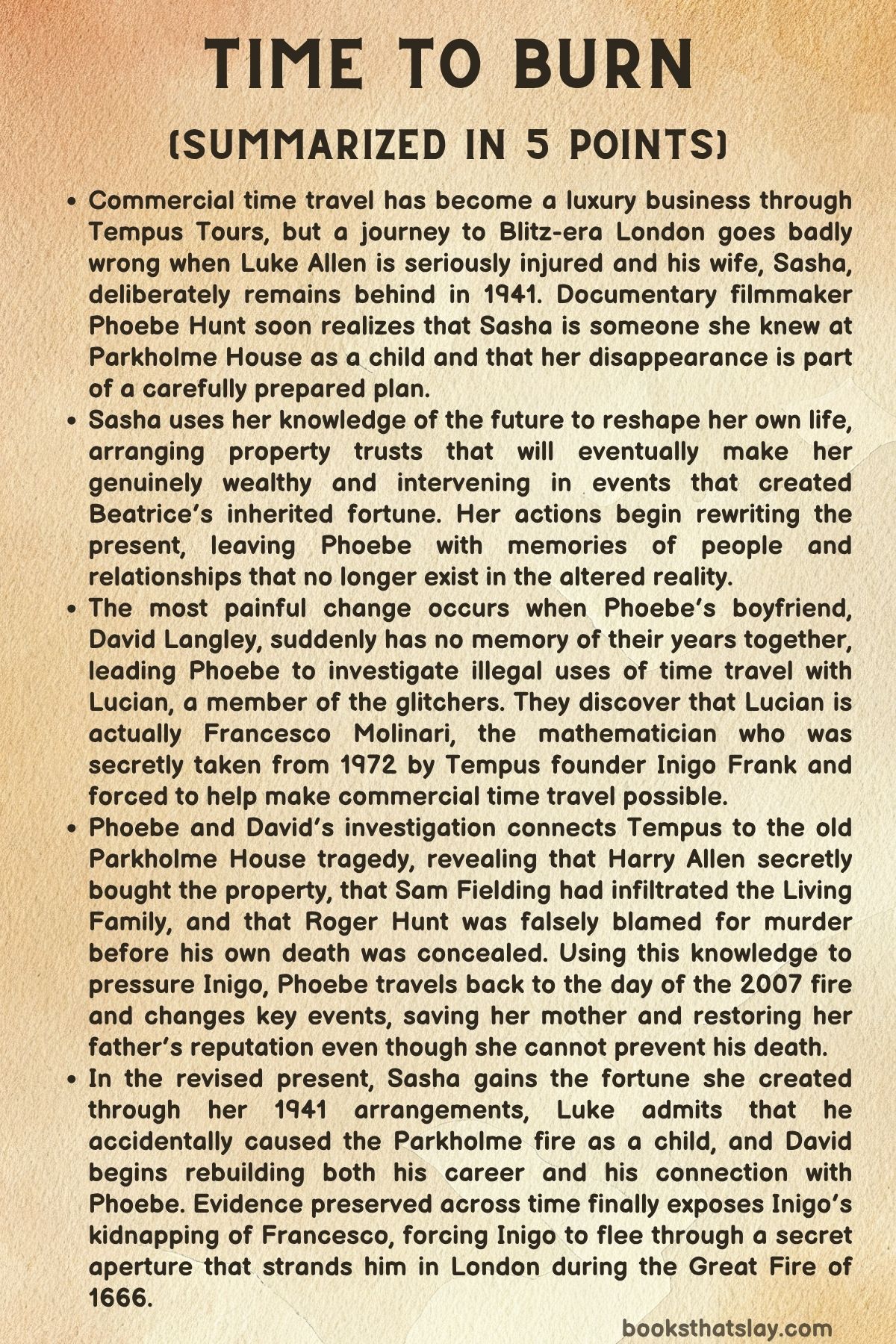
Summary
The story begins in 1972 with Professor Francesco Molinari, a brilliant young mathematician whose theories suggest that time travel may one day become possible. Hoping to test whether people from the future can reach him, Francesco plans to leave an invitation in one of his notebooks, but before he can even write it, a mysterious armed visitor from the future appears at his door.
Decades later, commercial time travel has become a reality through Tempus Tours, a company founded and publicly represented by the charismatic Inigo Frank. Tempus sells carefully controlled historical journeys to extremely wealthy clients, promising experiences that ordinary tourism could never provide while insisting that travellers must never interfere with history.
One such journey takes billionaire property developer Harry Allen, his son Luke, Luke’s wife Sasha, and Harry’s girlfriend Beatrice to London during the Blitz. Their guide, Tom Walker, escorts them through a city under bombardment, using historical records to navigate supposedly predictable dangers while emphasizing that they must not warn people who are about to die or interfere with events.
The supposedly controlled excursion becomes a disaster when Luke is badly injured by flying glass. The group struggles toward the time aperture that will return them home, but as everyone rushes through, Sasha deliberately separates herself from them and remains behind in 1941.
Documentary filmmaker Phoebe Hunt happens to be filming Inigo and Tempus when the survivors return. She watches Luke arrive critically injured and quickly senses that Sasha’s disappearance may be more complicated than Tempus initially believes.
Phoebe has a reason for recognizing that complexity because Sasha is not simply the glamorous wealthy woman she has presented herself as. The two women knew each other as children at Parkholme House, home of the unconventional communal group known as the Living Family, founded by Phoebe’s father, Roger Hunt.
Sasha’s childhood was marked by instability, social exclusion, and a difficult relationship with the communal environment. Her mother, Lulu Fraser, had once come from privilege but later struggled financially and psychologically after Sasha’s father disappeared, eventually bringing her daughter to Parkholme House.
Phoebe carries considerable guilt about how Sasha was treated there. As a child, she participated in excluding Sasha and, in one especially cruel incident, stole an attic key and locked Sasha upstairs.
That act became much more serious when Parkholme House later caught fire. Sasha escaped through a window, but Phoebe’s mother Mary died during the disaster, Sam Fielding was discovered shot inside Roger’s safe, and Roger himself disappeared, leading police to conclude that he had probably murdered Sam, set the fire, stolen valuables, and fled.
In 1941, meanwhile, Sasha has no intention of waiting passively for Tempus to retrieve her. She has secretly prepared for her extended stay and begins carrying out a carefully designed plan that uses her knowledge of future events to reconstruct the life she had previously invented for herself.
One of her first targets is the origin of Beatrice’s inherited fortune. Sasha knows that Beatrice’s grandfather, Albert Downing, will steal charity money, use it for a successful bet, and eventually build a property fortune, so Sasha prevents the theft and thereby removes the financial foundation on which Beatrice’s future depends.
The effect in the present is immediate and terrifying. Phoebe remembers Beatrice, but everyone else now believes that Harry travelled with a different girlfriend named Eleanor, while photographs and recordings have changed to support the new version of reality.
This experience introduces Phoebe to what Lucian, a member of a group known as the glitchers, calls ghost memories. According to Lucian, changes to history can cause reality to rewrite itself while leaving a small number of people with memories of events, relationships, or lives that no longer officially happened.
Sasha continues with a much larger intervention. Using an old family connection and legal assistance from Wilson & Watkins, she arranges for valuable London properties to be placed in trusts benefiting the future descendants of her grandmother.
Because Sasha herself will eventually become the relevant descendant, those properties will belong to her in the present. Her fabricated identity as an enormously wealthy property heiress will therefore become reality once history adjusts around the transactions.
Her motivation is not purely greed. Before the Tempus trip, Lulu had suffered another serious psychological collapse, and Sasha discovered that her mother had accumulated enormous debts and embezzled more than £400,000 from her employer, leaving Sasha desperate to find enough money to protect her.
Sasha also uses her visit to 1941 to address unfinished business from Parkholme House. She hides a warning for Sam Fielding beneath the floorboards of the summer house, hoping that he will discover it decades later and avoid the death awaiting him during the 2007 fire.
As Sasha’s infected hand worsens, she leaves clues telling Tempus where and when to rescue her. Tom, tormented by guilt over losing a client, volunteers to return, finds Sasha dangerously ill in the abandoned station, and carries her through the aperture shortly before it closes.
Inigo turns the successful rescue into a media triumph. He presents Tempus as an organization capable of protecting its clients even under extraordinary circumstances, while Phoebe becomes increasingly suspicious that the company’s polished public image conceals much larger secrets.
The consequences of Sasha’s alterations soon become brutally personal for Phoebe. David Langley, the Financial Times journalist with whom she had been in a long-term relationship, suddenly has no idea who she is.
Before reality changed, David had been preparing to propose, and Phoebe had begun confronting her fear of conventional commitment. Now their years together have vanished from David’s history, even though Phoebe still remembers them.
Lucian explains that even her surviving memories may eventually weaken as the revised timeline replaces them. Phoebe starts experiencing competing recollections, discovering that history does not merely alter public facts but can overwrite emotional lives, careers, relationships, and identities.
The mystery deepens when Phoebe and Lucian investigate David’s altered career. In the original version of events, David had earned a position on the newspaper’s investigations desk shortly before meeting Phoebe, but in the revised reality he had failed the crucial interview after apparently behaving as though he were drunk.
David remembers being struck by a cyclist on his way to the interview. The cyclist gave him bottled water, after which he became disoriented, leading Phoebe and Lucian to suspect that someone travelled illegally into the recent past, drugged him, and deliberately destroyed his career.
The discovery suggests that Tempus has been conducting unauthorized journeys outside its regulated programme. Lucian explains that opening an aperture creates detectable disturbances in the electrical grid, and the glitchers believe some disturbances cannot be explained by officially recorded journeys.
Phoebe reconstructs the investigation David had been conducting before history was altered. His research concerned Parkholme House, hidden property ownership, and a man named Glynn Hasker who had performed covert work for Harry Allen.
Hasker eventually reveals that Harry secretly purchased Parkholme House through offshore arrangements while trying to conceal assets during a divorce. Sam Fielding had been hired to infiltrate the Living Family and gather information, meaning his presence in the community had never been accidental.
More shocking is Hasker’s revelation that Roger Hunt’s body was eventually found during redevelopment of the Parkholme estate. Roger had been shot and dumped in a pond, but Harry had the discovery concealed because he did not want a murder investigation delaying his property project.
Roger therefore had not murdered Sam and escaped. Somebody else killed him, while powerful people benefited from allowing the world to believe he was guilty.
Phoebe realizes that David had been close to exposing this story in the original reality. Harry therefore had a motive for using illegal time travel to sabotage David years earlier, preventing him from becoming the investigative journalist who would uncover the truth.
The investigation also exposes Inigo’s own secret. Lucian is actually Francesco Molinari, the mathematician supposedly recorded as having died in 1972.
Inigo was the armed visitor who appeared at Francesco’s flat decades earlier. He told Francesco that he was destined to die of undiagnosed cancer and offered him modern treatment, but he also forced him to write a suicide note and transported him into the future, where Francesco’s knowledge became essential to solving Tempus’s technological problems.
Phoebe now possesses enough evidence to threaten Inigo’s entire empire. Rather than demanding money or simply exposing him immediately, she forces him to provide an illegal journey to 11 June 2007, the day Parkholme House burned.
Her purpose is deeply personal but not limited to restoring David. Phoebe wants to learn what truly happened, prevent her mother’s death if possible, and free her family from the false story that destroyed Roger’s reputation.
Returning to Parkholme House before the fire, Phoebe sees her childhood world still functioning around her. She retrieves the attic key she once discarded, places a mattress beneath the window to make Sasha’s escape safer, and investigates Sam’s activities.
She discovers the tobacco tin Sasha placed beneath the summer house floorboards in 1941. The warning was meant to save Sam, but it had shifted out of reach and was never found in the original timeline.
Phoebe then witnesses the arrival of a younger Harry Allen and discovers the true conflict inside Parkholme House. Harry has learned that wealthy people are exploiting the Living Family’s communal arrangements to conceal assets during divorces, and he threatens Roger into selling the property.
Roger’s brother Stuart is actually responsible for the financial scheme. Once Stuart realizes that Sam has been investigating the group for Harry, he attempts to murder him using the old Webley pistol.
Phoebe has already removed the bullets, so Stuart’s attempt fails. He beats Sam unconscious, forces Roger to sign the property documents by threatening Sam’s life, and locks both men inside the safe.
Phoebe frees them, preventing the murders from unfolding as they originally did. Yet history refuses to become completely manageable, because her changes create new circumstances during the fire.
A child named Jake enters the burning building after finding the attic key and looking for Sasha. Roger goes back inside and rescues him, suffering injuries that eventually kill him.
Phoebe therefore cannot save her father, but she transforms the meaning of his death. Instead of disappearing as an accused murderer, Roger dies openly after saving a child, surrounded by people who know what he actually did.
Before returning to the present, Phoebe secretly places a letter among young Sasha’s possessions. The letter creates another carefully planned alteration whose effects will become visible only after Phoebe returns.
The revised present is radically different. Mary survived the Parkholme fire, giving Phoebe decades of new memories involving her mother, while Roger is publicly remembered as a hero.
Stuart’s crimes were exposed, and he was imprisoned for fraud and attempted murder. Phoebe’s documentary no longer presents her father as a mysterious fugitive but instead records the destruction created by conflict between two brothers.
David still does not remember the relationship he once shared with Phoebe. However, the two begin getting to know each other again, while his work exposing the Tempus scandal finally earns him a place on the investigations desk.
Sasha’s financial scheme also succeeds. The properties established through the 1941 trusts belong to her, allowing her to resolve Lulu’s debts and secure the wealth she had once only pretended to possess.
Luke eventually admits another crucial truth: as a child, he accidentally caused the Parkholme fire while tampering with the boiler in an attempt to impress Harry. His confession explains how the catastrophe began and reveals another connection between the Allen family and the tragedy that shaped Phoebe and Sasha.
Beatrice’s rewritten life also remains changed. Without the fortune that would have originated with Albert Downing’s theft, she works at the Café de Paris and appears more content than the wealthy woman Phoebe remembers.
Phoebe’s final intervention depends on the letter she left for Sasha in 2007. Following Phoebe’s instructions, Sasha had Wilson & Watkins arrange for a young Glynn Hasker to photograph Inigo escorting Francesco from his flat at gunpoint in 1972.
The photographs remain hidden until David retrieves them decades later. They provide physical evidence that survives the altered timeline and directly proves that Inigo kidnapped Francesco and used illegal time travel.
Police raid Tempus headquarters, but Inigo refuses to surrender. He enters the secret shadow aperture, erases its destination data, and randomizes his journey so nobody can follow him.
Inigo survives the passage, but he arrives beside the River Fleet in seventeenth-century London as smoke fills the city. He slowly realizes that the technology he exploited to control other people’s histories has deposited him in London during the Great Fire of 1666, leaving him trapped inside one of history’s most destructive moments.
Characters
Phoebe Hunt
Phoebe Hunt is the emotional and investigative center of Time to Burn, beginning as a successful documentary filmmaker who believes she is making a film about Inigo Frank and gradually becoming the person capable of exposing the foundations of his empire. Her professional instinct is to observe, record, and question, but the crisis involving Sasha forces her to stop standing behind the camera and become personally involved in events.
Her childhood at Parkholme House explains much of her emotional reserve. Growing up within the Living Family taught her to distrust conventional structures, and that experience later affects her relationship with David, particularly her discomfort with marriage, shared domestic life, and other traditional forms of commitment.
Phoebe is also defined by guilt. Her decision as a child to lock Sasha in the attic was motivated by jealousy and cruelty rather than any intention to cause serious harm, yet the later fire transforms the incident into something she cannot dismiss as ordinary childhood behavior.
That guilt initially shapes the way she understands Sasha. She can recognize the manipulation behind Sasha’s actions while simultaneously understanding that Sasha’s choices emerged from financial desperation, childhood exclusion, concern for Lulu, and unresolved damage connected to Parkholme.
Phoebe’s strongest development comes when she gains access to time travel herself. Instead of using the opportunity purely to restore David, she chooses to confront the central wound in her family’s history, accepting that changing the past should not simply become a method for recovering everything she personally wants.
Even her successful intervention has limits. She saves Mary and restores Roger’s reputation but cannot keep Roger alive, demonstrating that Phoebe eventually learns to distinguish between repairing an injustice and demanding a perfect version of reality.
Sasha
Sasha is one of the most morally complex figures in Time to Burn because she is simultaneously victim, strategist, deceiver, daughter, survivor, and active manipulator of history. Her decision to remain in 1941 initially appears mysterious, but the later revelation of her financial plan shows that almost every detail of her Tempus journey has been prepared in advance.
Her fabricated identity is central to understanding her psychology. Sasha has spent years presenting herself as the daughter of a fabulously wealthy Belarusian oligarch, creating a persona that gives her access to social circles from which her real upbringing would have excluded her.
Time travel offers her the astonishing opportunity to transform that lie into truth. By arranging property trusts in 1941, she does not merely steal money from the future but creates a legal historical structure through which the wealth she claimed to possess will genuinely become hers.
Her motivation makes the scheme more complicated than simple greed. Lulu’s debts and embezzlement place Sasha in an impossible position, and her determination to protect her mother reveals a loyalty powerful enough to justify, in Sasha’s mind, manipulating generations of history.
Sasha also acts against Beatrice’s inherited wealth, showing that her goals include an element of judgment about privilege. She resents wealthy people who treat historical suffering as entertainment, yet her own willingness to decide who deserves wealth exposes an uncomfortable contradiction in her morality.
Her attempt to save Sam proves that Sasha’s actions are not exclusively self-serving. She uses her time in 1941 to place a warning that might prevent his death, suggesting that beneath her calculated exterior she remains emotionally connected to the trauma of Parkholme and wants to undo at least part of its damage.
Inigo Frank
Inigo Frank is the principal embodiment of ambition without adequate restraint in Time to Burn. Publicly, he is brilliant, charismatic, confident, and skilled at turning Tempus into both a technological miracle and a luxury brand, while privately he has built that success on coercion, secrecy, illegal journeys, and the exploitation of another man’s genius.
His charisma is one of his most important qualities. Inigo understands how to reassure frightened employees, impress journalists, control a media narrative, and convert disaster into publicity, making his influence depend as much on personality as on technology.
The revelation about Francesco completely changes the meaning of Inigo’s public mythology. Rather than independently overcoming the greatest scientific barriers to commercial time travel, he kidnaps the mathematician whose work makes those breakthroughs possible and removes him from his own era under the cover of a supposed suicide.
Inigo justifies control through the assumption that he understands consequences better than everyone around him. That belief allows him to treat people and historical events as components within a system he believes he can manage.
His greatest weakness is therefore not ignorance but certainty. Even after multiple changes demonstrate that time travel produces unstable and unpredictable effects, he continues using secret apertures because surrendering control would also mean surrendering the identity and power he has constructed.
His final escape is especially appropriate to his characterization. After spending years choosing destinations and manipulating history for private purposes, he randomizes his own journey and is delivered into the Great Fire of London, facing history without the control on which his entire life depended.
David Langley
David is one of the emotional anchors of Time to Burn, although much of his importance comes from what happens when his relationship with Phoebe is erased. Before the timeline changes, he is patient with Phoebe’s reluctance to marry and responds to her discovery of his engagement ring by placing it on a chain rather than demanding an immediate decision.
That gesture captures David’s basic emotional character. He wants a future with Phoebe but understands that intimacy cannot be forced, making his relationship with her fundamentally different from the controlling relationships that dominate many other parts of the story.
His altered career also makes him essential to the investigation. Someone considered his original work dangerous enough to sabotage his interview through illegal time travel, which demonstrates that journalism represented a genuine threat to the people profiting from hidden historical manipulation.
The revised David initially has no conscious reason to trust Phoebe’s extraordinary claims. His willingness to listen nevertheless allows fragments of his erased life to surface, turning him into an example of how identity may persist imperfectly even after history has been rewritten.
By the conclusion, David does not simply regain the old relationship as though nothing happened. Instead, he and Phoebe begin again, allowing their connection to develop without pretending that the erased years can be restored exactly.
Francesco Molinari / Lucian
Francesco Molinari is the hidden intellectual foundation of Time to Burn and one of its clearest examples of a person whose life has been stolen through manipulation of history. His original 1972 experiment is motivated by scientific curiosity, yet the visitor he hoped might confirm his theories turns out to be Inigo, who arrives not as a collaborator but as someone prepared to control his future.
Inigo’s offer contains both rescue and coercion. Francesco may genuinely have been facing an early death from cancer, but being offered treatment does not erase the fact that he is forced to abandon his own time, write a false suicide note, and become essential to a project over which Inigo holds greater public authority.
As Lucian, he responds by becoming deeply cautious about temporal interference. His work with the glitchers reflects a scientist who has seen the consequences of turning a theoretical breakthrough into a private commercial system.
Francesco’s understanding of ghost memories gives Phoebe a language for experiences that otherwise appear impossible. He also provides the ethical counterweight to Inigo by insisting that the ability to change history does not equal the ability to predict or contain what follows.
His survival itself is a paradoxical form of loss. He receives decades of additional life, yet those years are built on separation from the identity, historical place, and personal freedom that should originally have been his.
Tom Walker
Tom is a fundamentally conscientious character whose faith in Tempus is damaged by the reality of what the company does. As a guide, he has extensive historical knowledge and follows strict procedures, but experiencing the Blitz directly makes him understand that knowing where bombs will fall is completely different from standing among people who are about to die.
His guilt after Sasha remains behind demonstrates how seriously he accepts responsibility for his clients. Even though Sasha deliberately escapes, Tom assumes he has failed and becomes emotionally consumed by the idea that he lost someone under his protection.
Returning to 1941 gives him a chance to act rather than remain trapped in that guilt. His rescue of the dangerously ill Sasha is courageous precisely because there is little glamour in it: he has only minutes to locate her, physically carry her, and reach an unstable aperture.
Tom also contrasts with Inigo. Where Inigo treats crises as opportunities for reputation management, Tom experiences them as moral responsibilities involving actual people.
Luke Allen
Luke is introduced as Harry Allen’s privileged but dissatisfied son, yet his position inside the Allen family is more insecure than his wealth initially suggests. He resents his father’s control and recognizes that access to money does not necessarily mean independence when Harry remains the source of that money.
That resentment makes Sasha’s proposal attractive. She offers him a route toward wealth that does not depend on his father, and their marriage becomes a strategic arrangement in which each person possesses something the other needs.
Luke’s childhood connection to Parkholme is crucial. Sasha remembers seeing him there with Harry, and the eventual revelation that Luke caused the fire while tampering with the boiler shows how deeply the Allen family has been connected to the tragedy all along.
His confession near the end indicates an important change. Instead of continuing the culture of concealment represented by Harry, Luke acknowledges responsibility and begins considering how his newly created wealth might be used to compensate those harmed by the disaster.
Harry Allen
Harry is a powerful property developer whose money allows him to treat both people and history as things that can be purchased. His enthusiasm for visiting the Blitz reveals an appetite for danger when he believes the danger has been converted into an exclusive experience designed for his entertainment.
His relationship with Luke is similarly shaped by control. Harry provides wealth but also uses it to maintain authority over his son, contributing directly to Luke’s willingness to enter Sasha’s scheme.
Harry’s involvement with Parkholme reveals a much darker use of power. He secretly buys the property, employs intermediaries such as Glynn Hasker, uses Sam to infiltrate the Living Family, and later suppresses the discovery of Roger’s corpse in order to prevent a murder investigation from interfering with redevelopment.
His willingness to alter David’s past takes that mentality even further. Rather than confronting an investigation in the present, Harry apparently uses illegal time travel to prevent the journalist from acquiring the career that would allow him to expose the truth.
Harry therefore represents the extension of ordinary financial power into temporal power. Once history itself becomes accessible, the same instinct that lets him conceal ownership and manipulate people allows him to treat the past as another asset.
Beatrice
Beatrice initially appears to be a younger wealthy woman attached to Harry’s extravagant lifestyle, but she becomes one of the clearest demonstrations of how a seemingly small historical alteration can reconstruct an entire human life. Her inherited wealth depends on Albert Downing’s theft and subsequent investment decisions, meaning that Sasha can remove Beatrice’s privileged future by preventing one act in 1941.
Phoebe’s memory of Beatrice survives even after everyone else recognizes Eleanor as Harry’s girlfriend. Beatrice therefore becomes the first unmistakable proof that ghost memories are real rather than merely theoretical.
Her changed future complicates any simple assumption that preserving the original timeline must automatically produce the happier life. In the revised reality she works at the Café de Paris and appears more content, raising uncomfortable questions about whether losing inherited wealth necessarily means losing well-being.
Eleanor
Eleanor exists in the revised timeline as Harry’s girlfriend after Sasha prevents the event that created Beatrice’s fortune. Her significance comes less from an independent personal arc than from the disturbing normality with which everyone except Phoebe accepts her presence.
To everyone else, Eleanor has always been there. Photographs, conversations, and memories support her existence in Harry’s life, showing how completely revised history can replace the former version of events.
She therefore functions as evidence that the altered timeline does not feel altered to most people. Reality supplies continuity around her, making Phoebe’s memories of Beatrice appear impossible even though the reader knows they were once true.
Roger Hunt
Roger is a visionary whose idealism produces both genuine community and serious vulnerabilities. By founding the Living Family, he attempts to reject conventional ownership and parenting structures, but the community’s openness unintentionally creates opportunities for bullying, financial abuse, and exploitation.
After the Parkholme fire, Roger becomes defined by an accusation he cannot answer because he is presumed to have fled. The apparent evidence against him turns him into a suspected murderer whose disappearance damages both his family and his public legacy.
The truth is very different. Roger has been manipulated by Stuart’s fraud, pressured by Harry, and ultimately killed, while his hidden body allows the false version of events to survive.
Phoebe’s intervention cannot save his life, but it restores his moral identity. His final act of entering the burning house to save Jake ensures that he dies publicly as the person his daughter believed him to be rather than disappearing beneath the crimes of others.
Mary Hunt
Mary is Phoebe’s mother and one of the greatest personal losses produced by the original Parkholme fire. Her death occurs because she reenters the burning house believing Sasha is still trapped inside, making her fate closely connected to Phoebe’s childhood act of locking Sasha in the attic.
Mary’s death therefore becomes central to Phoebe’s guilt. Phoebe cannot easily separate the fire itself from the possibility that her cruelty toward Sasha helped create the circumstances that sent her mother back into danger.
When Phoebe alters the past, Mary survives. The result is not simply that Phoebe sees her mother again; reality supplies decades of shared birthdays, conversations, holidays, and ordinary experiences that Phoebe simultaneously acquires as memories.
Mary’s survival demonstrates the enormous emotional temptation built into time travel. The technology does not merely offer the possibility of preventing catastrophe but of creating entire histories of love and family that previously never existed.
Lulu Fraser
Lulu is Sasha’s mother and a major force behind her daughter’s decision to manipulate the past. Once connected to privilege, she loses family support after becoming pregnant and eventually enters the Living Family while struggling with financial and psychological instability.
Her later crisis pushes Sasha toward increasingly desperate choices. Lulu’s uncontrolled spending and embezzlement leave her facing debts exceeding £400,000 and possible prosecution, creating the immediate problem Sasha hopes to solve through historical property ownership.
Sasha’s loyalty to Lulu reveals an important emotional dimension beneath her calculated behavior. Much of what appears to be ruthless ambition is also an attempt to rescue a parent whose instability has shaped Sasha’s life since childhood.
Lulu therefore represents the way family responsibility can become entangled with moral compromise. Sasha may be creating wealth for herself, but she repeatedly frames that wealth as a means of preventing her mother’s collapse from becoming a legal and financial catastrophe.
Sam Fielding
Sam arrives at Parkholme appearing to be a young drifter but is eventually revealed to have been a former police officer with a troubled professional history. His concealed identity makes him one of several characters whose public presentation differs sharply from his actual purpose.
He has been inserted into the Living Family through the network surrounding Harry and Glynn Hasker. His role is to gather information, placing him directly inside the conflict over Parkholme’s ownership and hidden financial activities.
Sasha remembers Sam with enough concern to attempt to save him decades in advance. Her warning fails in the original history only because the tobacco tin shifts beneath the floorboards, demonstrating how even carefully planned interventions can be defeated by ordinary physical chance.
Phoebe’s later actions succeed where Sasha’s failed. By removing the bullets from the Webley and freeing Sam from the safe, she prevents the murder that once provided the foundation for the accusation against Roger.
Stuart Hunt
Stuart is the hidden architect of much of the corruption surrounding Parkholme House. While Roger publicly promotes communal ownership and idealistic principles, Stuart exploits those structures to help wealthy people conceal assets.
His conduct turns the ideals of the Living Family into cover for financial wrongdoing. Because the property and ownership arrangements are unconventional, he can manipulate systems that were designed around trust.
When threatened with exposure, Stuart becomes violent. He attempts to kill Sam, coerces Roger into signing documents, and locks both men inside the safe, actions that eventually allow Roger to be falsely blamed for the entire disaster.
Stuart is therefore important because he shows that the destruction of Parkholme does not come only from outsiders such as Harry. The community is also betrayed from within by someone who understands its values well enough to exploit them.
Glynn Hasker
Glynn Hasker operates at the edge of respectable business, performing tasks that powerful men prefer not to connect directly to themselves. His association with Harry makes him an important bridge between legitimate property development and the covert methods used to protect Harry’s interests.
Years later, Hasker provides Phoebe and David with essential information about Parkholme. His testimony reveals both the secret purchase of the estate and the discovery and suppression of Roger’s body.
His importance extends into Phoebe’s final plan. Through Sasha’s historical instructions, a younger Hasker photographs Inigo taking Francesco from his flat at gunpoint, creating evidence capable of surviving for decades.
Hasker therefore occupies an unusual position as both participant in concealment and eventual source of exposure. His actions help maintain Harry’s secrets, yet his knowledge and photographs later contribute to destroying the secrecy surrounding Tempus.
Peter Tyler
Peter Tyler is Phoebe’s filmmaking mentor and one of the people whose recollections help reconstruct the history of the Living Family. His memories of Roger as an essentially idealistic and gentle man clash with the official accusation that Roger suddenly became a murderer and fugitive.
That contradiction matters because it encourages the possibility that the accepted version of the Parkholme tragedy is incomplete. Peter’s perspective does not prove Roger’s innocence by itself, but it preserves a human image of him that police evidence and public suspicion had obscured.
Peter also represents the value of documentary memory. Before time travel becomes central to Phoebe’s investigation, interviews and recorded testimony already provide a method for challenging simplified versions of the past.
Albert Downing
Albert Downing appears only briefly but has enormous importance because one impulsive crime determines the wealth of later generations. His plan to steal charity money, place a successful bet, and invest the winnings ultimately creates the fortune inherited by Beatrice.
Sasha recognizes this vulnerable point in history and stops him before the theft occurs. Albert demonstrates how immense social consequences can grow from a single act that initially appears limited and private.
His role also illustrates the unpredictability of historical intervention. Sasha prevents a theft, an action that might appear morally straightforward, yet doing so reconstructs Beatrice’s entire future and even changes who occupies Harry’s life.
Jake
Jake is a child at Parkholme whose actions become significant only after Phoebe interferes with the original timeline. He finds the attic key and enters the burning house searching for Sasha, creating a danger that did not unfold in exactly the same way before Phoebe’s arrival.
Roger returns to save Jake and receives the injuries that kill him. Jake therefore embodies the central problem with controlled intervention: preventing one danger can generate another event that nobody predicted.
His rescue also transforms Roger’s legacy. Although Phoebe loses the chance to save her father, Jake’s survival ensures that Roger’s final act is publicly witnessed as one of courage.
Themes
The Moral Cost of Changing History
Time to Burn repeatedly challenges the assumption that changing a harmful event automatically produces a morally better world. Sasha prevents Albert Downing from stealing charity money, an act that appears unquestionably positive in isolation, yet the intervention erases Beatrice’s inherited wealth, removes her from Harry’s life, and contributes to a chain of historical changes that eventually destroys Phoebe and David’s relationship.
The novel therefore treats causation as far larger than intention. Sasha may understand the immediate result she wants, but she cannot know every marriage, friendship, career, purchase, movement, or decision that will follow from altering one person’s circumstances.
Phoebe later confronts the same danger when she travels to 2007. Unlike Sasha, she enters the past already aware of the damage that uncontrolled changes can produce, so she tries to make the smallest interventions possible.
Even this caution cannot guarantee predictable results. Jake enters the burning building because circumstances have changed, forcing Roger to rescue him and demonstrating that history does not remain passive while someone edits selected details.
The ethical question is therefore not simply whether a traveller has good intentions. The deeper issue is whether anyone can possess enough knowledge to claim authority over the lives that will be rewritten as a consequence.
Wealth, Privilege, and the Ownership of Opportunity
Money determines who can experience time travel, who can hide wrongdoing, who can shape public narratives, and who has access to systems capable of rewriting history. Tempus presents the past as an exclusive luxury product, allowing clients such as Harry to stand beside real suffering while remaining protected by technology, money, and professional guides.
Harry’s entire life demonstrates how wealth extends beyond consumption into control. He can purchase Parkholme through hidden arrangements, employ intermediaries, suppress the discovery of Roger’s corpse, and apparently finance illegal time travel to prevent David from becoming a threat.
Sasha’s response complicates the novel’s treatment of inequality. She has spent much of her life excluded from the security possessed by people around her, so she uses time travel to manufacture generational wealth by positioning property in trusts before its value rises.
Yet the method she uses resembles the very structures that produced the privilege she resents. She does not eliminate inherited advantage but rearranges history so that she becomes its beneficiary.
The novel consequently presents wealth as both material power and control over possibility. Characters with money do not simply own more objects; they possess more opportunities to shape what other people are allowed to become.
Memory, Identity, and the Reality of Lost Lives
The idea of ghost memories turns personal identity into one of the story’s most unsettling subjects. When history changes, most people accept the revised reality completely, while a small number retain fragments of relationships and experiences that technically never occurred.
Phoebe’s loss of David shows the emotional consequences most clearly. She remembers years of love, arguments, intimacy, uncertainty, and future plans, while David experiences her as a stranger.
This creates a form of grief for something that has no public evidence. Phoebe cannot simply show David their shared past because photographs, digital records, and other forms of proof have adjusted themselves to the altered timeline.
The gradual fading of her memories makes the situation even more disturbing. If Phoebe eventually forgets David as he once was, the relationship will not merely be over; it will become almost impossible to establish that it ever existed.
At the same time, the story suggests that identity may not be completely erased. David experiences faint recognition, and altered lives sometimes move toward circumstances resembling what existed before.
Memory therefore functions both as vulnerability and resistance. History may rewrite the official world, but human consciousness can temporarily preserve evidence that another version of life was once real.
Guilt, Responsibility, and the Desire to Repair the Past
Personal guilt motivates many of the most consequential actions in Time to Burn. Phoebe carries guilt over locking Sasha in the attic, Tom blames himself for Sasha remaining in 1941, Sasha tries to rescue people connected to the Parkholme tragedy, and Luke eventually admits that his childhood attempt to impress Harry caused the fire.
The story distinguishes guilt from responsibility by showing that feeling responsible does not always mean someone actually caused the entire outcome. Phoebe behaved cruelly toward Sasha, but she did not start the fire, kill Sam, murder Roger, or create Stuart’s fraud.
Her journey into 2007 becomes meaningful because she eventually acts on what she can genuinely change rather than trying to erase every source of pain. She protects Sasha’s escape, prevents Stuart from shooting Sam, exposes what happened to Roger, and saves Mary, but she cannot create a version of history in which nobody suffers.
Luke reaches a similar point when he admits his role in the fire. His confession cannot undo the past, but acknowledging it allows responsibility to become the beginning of restitution rather than another secret.
The novel ultimately presents repair as different from perfection. People may be able to correct lies, acknowledge harm, restore reputations, and prevent some losses, but the desire to remove every painful consequence risks becoming another attempt to control lives that belong to others.