Time Travel for Beginners Summary, Characters and Themes
Time Travel for Beginners by Jaclyn Moriarty is a warm, inventive novel about regret, family, friendship, grief, romantic disappointment and the dangerous desire to repair what has already happened. Its time-travel premise begins with comic absurdity but gradually becomes an emotional examination of why people keep looking backward when the present feels painful.
At the centre are Anna, Teddy and Jade, three adults carrying different forms of unfinished history. Their lives eventually connect through Katya Nastevski’s extraordinary Time Travel Agency, where journeys into the past reveal that understanding what happened is often more valuable than trying to erase it.
Summary
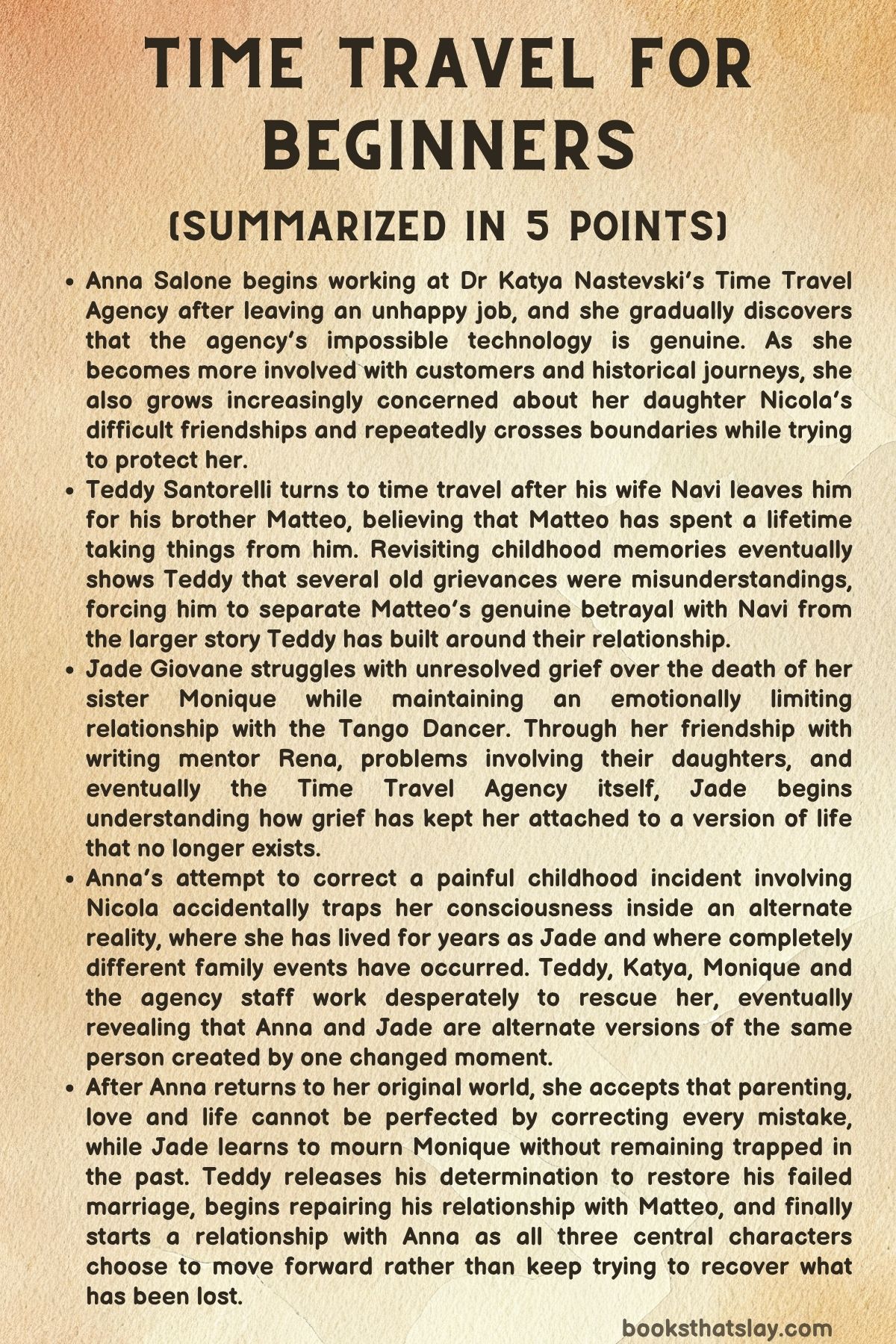
Anna Salone is a Sydney mother raising her thirteen-year-old daughter Nicola when an accident unexpectedly changes the direction of her life. While rushing to work at the Nut Bar, she is hit by a car driven by an attractive blue-eyed man with a Scottish accent, but she refuses to exchange contact information and insists that she is fine.
The accident leaves Anna bruised and concussed, while her boss Trisha responds with more concern about staffing than Anna’s wellbeing. Frustrated by years of feeling undervalued, Anna resigns and accepts an unexpected job with Dr Katya Nastevski, the eccentric scientist behind a local Time Travel Agency.
Anna meets Paisley, Roberto and Joon, who treat travelling into the past as an ordinary professional service. Customers can revisit historical periods or moments from their own lives, although altering the past supposedly cannot change the traveller’s original present.
Anna initially assumes the technology must be some extremely sophisticated simulation. Her certainty begins to weaken after she experiences historical environments whose physical detail and emotional intensity seem impossible to fake.
One of the agency’s customers is Teddy Santorelli, whose marriage has collapsed after his wife Navi leaves him for his brother Matteo. Teddy is devastated, spending weeks barely functioning before his closest friends, Bollocky Bill and Ribbons, persuade him to re-enter ordinary life.
Teddy begins writing anonymously to the agency under the name Sir Chewbacca, asking whether travelling into the past could help him understand his failed marriage. Anna answers him with unusual personal warmth, suggesting that honesty may matter more than revisiting old events.
Neither initially realises how important their correspondence will become. Teddy also begins visiting the agency in person, where he immediately catches Anna’s attention.
Rather than travelling directly into his marriage, Teddy becomes increasingly focused on Matteo. He remembers childhood incidents in which Matteo apparently took things from him, including toys, possessions and spaces Teddy considered his own.
Time travel allows Teddy to observe these events without changing them. At first, each journey appears to confirm his belief that Matteo has spent a lifetime taking what belongs to him, culminating in the ultimate betrayal involving Navi.
Yet the journeys also expose Teddy’s own tendency to remain silent. As a child, he frequently failed to protest when Matteo claimed something, and Teddy slowly begins asking whether he has transformed uncertainty and childhood passivity into a lifelong narrative of victimhood.
Anna and Teddy grow closer through conversations, emails and shared trips. Teddy eventually reveals that he is Sir Chewbacca, collapsing the distinction between the emotionally vulnerable man Anna has been advising online and the charismatic customer she enjoys seeing in person.
Their attraction becomes increasingly difficult to ignore. Anna, however, knows Teddy still believes his marriage might be repaired and refuses to imagine herself as a replacement for Navi.
Anna’s own family life becomes increasingly difficult at the same time. Nicola has entered high school and joined a new group of friends, including her longtime friend Elena, but Anna becomes worried that her gentle daughter may be changing herself to gain acceptance.
When Nicola receives detention after joining other students in defending a classmate, Anna contacts the school without her daughter’s permission. Her intervention embarrasses Nicola, and Anna immediately recognises that concern has crossed into intrusion.
She nevertheless repeats the pattern. When Nicola seems socially uncomfortable and later begins being excluded by members of the friendship group, Anna searches her daughter’s phone and sends screenshots of private messages to the school welfare officer.
Nicola eventually discovers what her mother has done and feels profoundly betrayed. What Anna sees as protection increasingly looks to Nicola like surveillance and a refusal to trust her judgment.
Running alongside Anna and Teddy’s stories is the journal of Jade Giovane, a successful finance professional who has entered a writing mentorship with Anna’s friend Rena. Jade claims she has lost her creativity, but the real problem is grief she has refused to face.
Years earlier, Jade’s sister Monique died unexpectedly after becoming seriously ill. Jade has spent years mentally replaying the decisions surrounding the death, assigning blame to herself, Monique and others while never truly accepting that nothing can restore the lost life.
Jade also remains emotionally attached to a man she calls the Tango Dancer. Their romance ended long ago, but they continue sleeping together casually, allowing Jade to maintain a connection to the period before grief transformed her life.
Rena encourages Jade to write about the relationship. Through the resulting project, Jade begins recognising that she is not merely attached to the man; she is attached to the version of herself and the world that he represents.
Their daughters create another connection. Jade’s daughter Holly, Rena’s daughter Elena and Nicola become part of the same school friendship group, whose apparently ordinary adolescent conflicts gradually become more damaging.
The girls receive detentions and later accidentally start a fire in the school art room while attempting to perform a ritual intended to support another friend. Their parents initially debate discipline, loyalty and whether good intentions should lessen consequences.
Eventually a more serious problem emerges. Elena is gradually pushed out of the friendship group, and Holly played a significant role in encouraging the exclusion.
Jade initially cannot accept the school’s description of Holly as involved in bullying because it conflicts with her understanding of her daughter as fundamentally kind. Once she learns the details, however, she recognises that cruelty does not require openly hateful intentions.
Holly explains that Jade herself had repeatedly worried about Elena being influenced by the group and about maintaining her friendship with Rena. Trying to solve what she believed was her mother’s problem, Holly subtly encouraged the others to reject Elena.
The discovery forces Jade to recognise how parental anxiety can travel indirectly into children’s relationships. Anna is confronting the same lesson from another direction: her interventions intended to protect Nicola have contributed to Nicola’s social humiliation and distance from Elena.
Meanwhile, Teddy’s marriage reaches another turning point when Navi and Matteo end their affair. Teddy initially assumes this means reconciliation with Navi is possible.
His friends are more cautious, especially because Teddy is clearly attracted to Anna. Teddy continues insisting attraction means nothing and that restoring his marriage remains his goal.
Joon eventually challenges Teddy’s reasoning. If the marriage is the true focus, why has Teddy spent so much time revisiting Matteo instead of exploring his relationship with Navi?
Teddy returns to the night he first met Navi and discovers something he had forgotten. Navi and Matteo were already attracted to each other before Teddy became involved.
The discovery does not excuse their later affair, but it changes the story Teddy has told himself about his marriage. He begins to understand that his pursuit of Navi may itself have contained an element of competition with Matteo.
When Teddy meets Navi again, he realises he no longer wants their marriage restored. His anger has faded enough for him to distinguish grief for what the relationship represented from genuine desire to resume it.
He also begins reconsidering his childhood grievances against Matteo. Eventually the brothers revisit several disputed memories and discover that many events were less deliberate than Teddy believed: some possessions were surrendered voluntarily, some exchanges were misunderstood and some incidents were ordinary childhood selfishness.
Matteo remains responsible for the affair, but Teddy no longer needs to interpret every earlier interaction as evidence of a lifelong pattern. He begins creating boundaries without requiring hatred to sustain them.
The Time Travel Agency itself then reveals a far more dangerous secret. An older version of its technology allowed travellers to alter events, enter alternate presents and repeatedly return to those new worlds.
Some users became so emotionally attached to happier alternate lives that their consciousness settled there while their original bodies deteriorated. The agency discontinued the system, yet Paisley and others secretly revived it for selected grieving customers.
One woman, Bethany, used the system to change events surrounding her child’s death and murdered her husband in an alternate timeline. The alternate Bethany, who had committed no crime herself, was left imprisoned for an act performed by another version of her.
The moral consequences horrify Anna. Alternate worlds are not harmless fantasies if real versions of people must suffer inside them.
Soon afterward Nicola discovers that Anna has again contacted the school and announces that she will not come home. Anna panics and uses time travel to locate her daughter, eventually learning that Nicola is safe with Monique.
Monique explains that Anna’s repeated interference contributed to Nicola’s growing social problems. Elena had begun drawing attention to Nicola’s awkward habits, and Nicola had exhausted herself trying to remain accepted by the group.
Devastated, Anna becomes convinced that Nicola would be better off without her. She returns to the old travel system and revisits a moment from years earlier when young Nicola had been mistreated in a park.
Something goes disastrously wrong. Anna enters her younger self, changes the event and becomes absorbed into the alternate timeline created by that decision.
Her body remains unconscious in the original world while her consciousness lives for eight years inside the alternate life. In that world she is no longer Anna as everyone knows her but Jade Giovane.
The novel now reveals that Anna and Jade are alternate versions of the same woman. By changing Nicola’s childhood experience, Anna created an entire chain of different events: Nicola became Holly, Monique died rather than surviving, Anna followed a different professional path and her personality developed differently.
Teddy, Katya and the others initially think Anna is trapped between universes. After repeated rescue attempts fail, they realise she has assimilated completely into her alternate self.
Teddy travels into the alternate present to persuade Jade to return. His explanation sounds insane to her, especially when he claims another version of her is dying elsewhere.
Jade refuses him and sends him away. The agency then turns to Anna’s family.
Nicola persuades Monique to attempt the journey. Monique enters the alternate world and appears at Jade’s door, creating the reunion Jade has spent years wishing were possible.
For Jade, seeing her dead sister alive is almost unbearable in its happiness. Monique explains what happened and helps Jade understand that the alternate world is not a repaired version of reality; it is simply another reality containing different losses.
Monique also challenges Jade about the Tango Dancer. Jade has been using him as a passage back toward the emotional world that existed before her sister died.
Together they go to the alternate Time Travel Agency. Jade enters the booth, allowing Anna’s consciousness to return to its original universe.
Anna wakes in hospital beside Nicola and Monique. After eight subjective years in a world where Monique was dead and her family relationships were different, their existence feels miraculous.
Jade remains in her own world, where Monique disappears again. This second loss finally breaks through the emotional defences Jade has maintained for years.
Instead of hiding her grief, she cries openly while Holly witnesses the depth of her pain. Over time, Jade begins rebuilding her life rather than repeatedly trying to recreate what existed before Monique’s death.
She ends the relationship with the Tango Dancer, recognising that continuing it has kept her emotionally stationary. She begins writing seriously, studies English literature and rebuilds her friendship with Rena.
Holly and Elena also begin repairing their relationship. Jade comes to understand that grief can remain part of her life without becoming its organising principle.
Anna similarly learns to accept the limitations of parenting. She cannot prevent Nicola from being hurt, choose her friendships or control the consequences of every decision.
Teddy resolves much of his conflict with Matteo without pretending the affair never happened. Forgiveness becomes compatible with boundaries rather than requiring a complete restoration of the old relationship.
His attraction to Anna can now be acknowledged honestly. He takes her on a quiet journey to a beach where dolphins appear in the distance, deliberately choosing an ordinary moment over one of Anna’s spectacular historical tours.
Teddy explains that he wants their first kiss to belong to their actual present rather than to a borrowed moment from history. Anna understands, and they finally kiss.
Later, as Anna waits for Teddy before a wedding, she reflects on everything she once wanted to correct. Nicola is forming new friendships and discovering new abilities, while Anna is learning that parenthood consists partly of making mistakes and continuing to love anyway.
Teddy arrives carrying what appears to be a cello, replacing an instrument Anna lost long ago. The gesture symbolically restores something from her past without requiring her to live there.
By the end of Time Travel for Beginners, the characters have not solved life by controlling time. They have learned something harder: the future becomes possible only when the past is allowed to remain past.
Characters
Anna Salone
Anna is the emotional centre of Time Travel for Beginners, a generous, impulsive woman whose strongest virtue and greatest weakness come from the same source: she cannot tolerate seeing people she loves suffer. Her instinct is always to intervene, comfort, advise or protect, even when another person may need space to make independent decisions.
Her relationship with Nicola exposes the danger within that instinct. Anna genuinely understands her daughter’s sensitivity and wants to prevent cruelty from damaging her, yet repeated contact with the school becomes a form of control that humiliates Nicola and contributes to the social isolation Anna hoped to prevent.
Anna’s time-travel crisis becomes an extreme expression of the same desire. Unable to accept that she once failed to protect Nicola, she enters the past and makes one different decision, accidentally producing an entire alternate existence.
Her experience as Jade teaches her that a corrected moment cannot create a painless life. Every altered choice simply produces a different network of joy, grief, love and unintended consequences.
Romantically, Anna undergoes another form of growth. She is initially drawn to both the mysterious Tango Dancer and Teddy, but by the end she stops treating possibility as something located elsewhere and chooses the relationship developing naturally in front of her.
Teddy Santorelli
Teddy begins Time Travel for Beginners convinced that his marriage ended because his brother has always taken what belongs to him. His pain is real, but he converts that pain into a story in which childhood grievances, adult rivalry and Navi’s affair become parts of one continuous pattern.
Time travel initially seems to validate his interpretation. Yet repeated observation makes Teddy confront the unreliability of memory and the role his own silence played in past conflicts.
He gradually understands that he has sometimes treated unspoken expectations as though they were agreements other people knowingly violated. This does not absolve Matteo of sleeping with Navi, but it prevents Teddy from transforming one serious betrayal into proof that every childhood frustration was intentional theft.
Teddy’s relationship with Anna also tests his honesty. While attempting to restore his marriage, he hides his knowledge of the Tango Dancer because he does not want Anna pursuing another man, demonstrating that his refusal to acknowledge attraction can itself produce dishonest behaviour.
Eventually Teddy stops trying to recover the marriage simply because losing it feels unbearable. His decision to kiss Anna in an ordinary present-day moment shows that he has stopped confusing emotional value with what can be recovered from the past.
Jade Giovane
Jade is one of the most psychologically important figures in Time Travel for Beginners because she is both an independent character and the alternate life produced by Anna’s intervention. Her confident, cynical voice hides a life structured around unresolved grief.
The death of Monique has become the hidden centre of Jade’s emotional world. She repeatedly revisits the circumstances mentally, imagining different decisions that could have prevented the loss and allowing guilt to substitute for acceptance.
Her relationship with the Tango Dancer operates in a similar way. Although their romance ended, continuing a sexual relationship with him preserves access to the emotional period before Monique’s death and prevents Jade from fully acknowledging that both the relationship and that version of her life are gone.
Rena’s mentorship gradually returns Jade to creativity because writing forces her to describe what she has avoided naming. Her eventual reunion with Monique does not repair her grief; instead it proves that even getting exactly what she wants for a few hours cannot allow her to live permanently outside her own reality.
Jade’s final growth occurs when she allows grief to exist without treating it as an instruction to stop living. Ending the Tango Dancer arrangement, beginning serious writing and pursuing further study show that she has begun moving forward without pretending Monique no longer matters.
Nicola
Nicola is central to Time Travel for Beginners because so many of Anna’s decisions are motivated by fear for her daughter. Sensitive, imaginative and initially somewhat socially uncertain, Nicola wants belonging without losing the unusual qualities that make her herself.
Her high-school experiences reveal how exhausting adolescence can become when social acceptance feels unstable. Nicola adapts herself to the group, tolerates embarrassment and conceals exclusion because admitting that her friendships are failing would force her to acknowledge how vulnerable she feels.
Her conflict with Anna is therefore not simple teenage rebellion. Nicola wants her mother’s love but also needs privacy, dignity and the freedom to make mistakes without every difficulty becoming an adult-managed emergency.
The alternate timeline demonstrates how much personality can be influenced by small experiences. Yet the similarities between Nicola and Holly also suggest that circumstances shape a person without completely determining who that person is.
By the end, Nicola is rebuilding her social world and discovering an unexpected talent for discus. Her progress shows Anna that parenting cannot consist of engineering a perfect path; sometimes support means allowing a child to discover a new path independently.
Monique
Monique carries enormous emotional significance across Time Travel for Beginners because her survival in Anna’s world and death in Jade’s world create one of the clearest demonstrations of the novel’s alternate-reality logic. She represents both ordinary sisterhood and the supposedly impossible gift of having someone back.
In Anna’s life, Monique is practical, supportive and willing to challenge her sister. When Nicola seeks refuge with her, Monique refuses to flatter Anna and explains how Anna’s behaviour has contributed to the problem.
Her journey into Jade’s universe demonstrates remarkable courage. Despite doubting Katya’s explanations, she risks becoming trapped because Anna’s survival and Nicola’s desperation matter more than her skepticism.
For Jade, Monique’s temporary return provides both joy and a painful form of closure. Monique refuses to become a fantasy figure who tells Jade everything can be repaired; she insists that Jade stop using the Tango Dancer to remain emotionally attached to an earlier life.
Monique ultimately represents the difference between loving someone and refusing their absence. Jade can continue loving her sister, but she must stop organising her entire existence around reversing the fact of loss.
Dr Katya Nastevski
Katya is an eccentric scientist whose impossible invention drives the events of the novel, yet she is far more than a convenient provider of technology. Her casual confidence about time travel creates much of the story’s humour while her eventual choices reveal the enormous ethical responsibility attached to scientific discovery.
Katya genuinely believes knowledge should expand human possibility. She is delighted by theoretical problems and often approaches extraordinary events with the excitement of someone solving a difficult puzzle.
However, the old software forces her to confront what technological possibility looks like when human grief becomes part of the equation. A system capable of creating alternate worlds cannot remain morally neutral when people use those worlds to escape bereavement, commit crimes or abandon their original lives.
Katya’s conversations with Jade show her deeper wisdom. Although she can offer access to another version of Monique, she understands that another universe cannot perform the emotional work of accepting loss in this one.
Her final response is neither to reject time travel nor to pretend its dangers can be eliminated. She chooses responsibility, safeguards and continued learning, reflecting the novel’s broader argument that knowledge requires ethical judgment rather than blind enthusiasm.
Matteo Santorelli
Matteo is initially presented almost entirely through Teddy’s resentment. Because he has had an affair with his brother’s wife, readers have good reason to distrust him, and Teddy’s childhood memories seem to establish a lifelong pattern of appropriation.
The later journeys complicate that interpretation. Matteo was sometimes selfish as a child, but several supposedly deliberate acts of theft were misunderstandings, voluntary exchanges or incidents whose meaning Teddy reconstructed years later.
His affair with Navi remains an unmistakable betrayal. The book never requires Teddy to reinterpret that event as harmless simply because his earlier accusations were exaggerated.
Matteo’s willingness to revisit the memories and apologise for the affair allows the brothers to begin creating a different relationship. Their partial reconciliation shows that responsibility becomes more meaningful when separated from exaggerated accusations.
Navi
Navi is mostly encountered through Teddy’s memories and emotional reactions, yet she plays a major role in exposing the instability of his assumptions about love. Teddy initially idealises forgiveness and imagines that loving Navi means eventually accepting any mistake she makes.
Her affair with Matteo destroys that comforting theory. Teddy tries to distinguish the Navi he loved from the person capable of betraying him, insisting that the betrayal was somehow unlike her.
Learning that Navi and Matteo were attracted to each other before Teddy began dating her changes Teddy’s understanding of their origin. It does not make the affair inevitable, but it helps him recognise that the marriage was never the perfectly secure structure he imagined.
Navi eventually apologises and encourages Teddy to forgive Matteo. Her role becomes less about whether she deserves restoration and more about Teddy recognising that forgiveness does not require restarting a relationship whose emotional life has ended.
Rena Kappas
Rena initially appears as Jade’s writing mentor but gradually becomes one of her closest friends. She understands that Jade’s creative block cannot be solved by clever exercises alone because the deeper problem is emotional avoidance.
Her greatest strength is the ability to listen without immediately demanding disclosure. When Jade first speaks about painful loss, Rena’s restraint allows trust to develop naturally.
Rena is not presented as endlessly patient or perfectly objective. When Elena is excluded from the friendship group, Rena becomes hurt and distant, showing how quickly professional calm can disappear when one’s own child is suffering.
Her friendship with Jade survives because both women eventually acknowledge uncomfortable truths. By the end, Rena is part of Jade’s new life rather than simply the person assigned to teach her how to write.
Holly
Holly is confident, athletic, witty and far more socially dominant than Nicola or Elena. Jade initially views these qualities almost entirely positively, making it difficult for her to imagine Holly participating in cruelty.
Holly’s treatment of Elena demonstrates how harm can emerge from ordinary social behaviour rather than obvious malice. She does not think of herself as a bully because she never sets out to terrorise anyone, yet she deliberately draws attention to Elena’s awkwardness until the group begins excluding her.
Her explanation is particularly important because she believed she was responding to Jade’s anxieties. Holly interprets her mother’s concern about Elena and Rena as a problem she should solve, revealing how children may act on adult signals more literally than parents expect.
Holly eventually recognises the pain she caused. Her gradual reconnection with Elena suggests that accountability does not require reducing a young person permanently to the worst thing she has done.
Elena
Elena begins as Nicola’s longtime friend and later becomes connected to Holly’s wider social circle. Her desire for belonging makes her vulnerable because acceptance by the new group appears especially meaningful to her.
As social dynamics change, Elena distances herself from Nicola and participates in drawing attention to Nicola’s unusual habits. Later, Elena herself becomes the person excluded by Holly and the others.
This reversal prevents the story from dividing the girls neatly into aggressors and victims. Elena can participate in another girl’s isolation while later suffering the same kind of treatment herself.
Her eventual presence with Holly near the end suggests cautious repair. The novel does not erase the harm between them but allows adolescence to remain a period in which people can learn from social failures.
Joon
Joon combines humour, experience and moral seriousness. His own history with time travel gives him a particularly clear understanding of how easily compassion can become obsession.
He once repeatedly travelled back to save the kidnapped Lindbergh baby, even though each rescue created only another timeline and did nothing for the child in his original world. The experience taught him that a successful intervention can still become psychologically destructive when the traveller uses it to escape the limits of reality.
Joon becomes especially important to Teddy. Rather than merely validating Teddy’s grievances, he asks the questions Teddy avoids, including why a man supposedly trying to repair his marriage spends so much time investigating his brother.
His role is often to redirect attention away from the most comforting interpretation. He understands that time travel provides information, but the traveller still has to decide what that information means.
Paisley
Paisley is warm, knowledgeable and deeply compassionate toward the agency’s customers. That compassion eventually leads her into one of the book’s most ethically troubling decisions.
Unable to accept that grieving people should be permanently denied access to better alternate worlds, she helps revive the discontinued software. Her motives are sympathetic because she wants people like Bethany to experience loved ones who have died.
The consequences reveal the limits of good intentions. Bethany’s alternate self is imprisoned for a murder she never committed, proving that compassion toward one person can become injustice toward another.
Paisley therefore mirrors Anna in an important way. Both act because they cannot tolerate another person’s pain, and both discover that intervention without sufficient respect for consequences can create new suffering.
Roberto
Roberto contributes much of the agency’s humour while also representing its practical side. His stories about bizarre customers show how extraordinary technology quickly becomes entangled with ordinary human foolishness, curiosity and selfishness.
He is generally less emotionally driven than Paisley and becomes increasingly alarmed by the old software. When its consequences become undeniable, Roberto is prepared to consider abandoning the experiment rather than defending it because the original intention was compassionate.
His position reinforces the need for limits. Wonder alone is not enough to justify every possible use of time travel.
William “Bollocky Bill” Chang
Bollocky is one of Teddy’s most loyal friends and often provides comic bluntness during Teddy’s emotional collapse. His exaggerated confidence, teasing and running joke about Anna looking like a cellist prevent Teddy’s storyline from becoming entirely consumed by betrayal.
Behind the jokes, Bollocky is protective. He gives Teddy a home when Teddy cannot tolerate his own apartment and repeatedly challenges explanations that allow Teddy to avoid confronting his feelings for Anna.
His friendship with Teddy demonstrates a form of care based on presence rather than perfect advice. Bollocky can be ridiculous, intrusive and perceptive in rapid succession, which makes his support feel convincingly human.
Onkwani “Ribbons” James
Ribbons is the more measured voice within Teddy’s friendship group. Where Bollocky often responds immediately and emotionally, Ribbons tends to question Teddy’s assumptions and consider the wider psychological picture.
He is particularly cautious about Teddy pursuing Anna while remaining attached to Navi. His concerns are not designed to stop Teddy from finding happiness but to prevent Anna from becoming an emotional escape from unresolved marital grief.
Ribbons also helps Teddy interpret his reactions after the breakup as part of a process rather than proof that nothing is changing. His steady presence gives Teddy space to reach conclusions that neither friend can make for him.
Trisha
Trisha initially represents almost everything Anna dislikes about rigid parenting and unsympathetic management. At the Nut Bar, she treats Anna’s accident as an inconvenience and frequently insists that children should experience the consequences of their mistakes.
Yet Trisha becomes more complicated when Nicola disappears. She reveals that she once used time travel to discover who was supplying drugs to one of her sons because there are situations in which parental noninterference becomes irresponsibility.
Her advice helps Anna distinguish between controlling a child’s ordinary social life and responding to genuine danger. Trisha therefore becomes an unexpected reminder that principles require context rather than absolute application.
Gus
Gus provides Jade and Holly with a quiet form of continuity. As the best friend of Holly’s deceased father, he gives Holly access to stories and connections she otherwise could not have.
Jade initially fails to appreciate the scale of Gus’s own grief because she sees loss primarily through her personal experience. Rena helps her realise that Gus also lost someone central to his life and carried that loss while continuing to support others.
His presence during Jade’s breakdown shows his reliability. The suggestion of a possible future between them remains deliberately understated because Jade’s growth depends first on learning that she can have a future at all.
The Tango Dancer
The Tango Dancer is less important as an individual romantic partner than as the emotional meaning Jade assigns to him. Their relationship once contained genuine attraction, intellectual excitement and the possibility of domestic intimacy.
After the romance ends, their casual sexual arrangement allows Jade to keep returning to that earlier emotional world. Each encounter temporarily reassures her that something from the life before Monique’s death still exists.
His repeated reminders that Jade should manage her expectations expose the unequal emotional structure of their connection. He is willing to continue the arrangement, but he does not promise the future Jade secretly wants.
When Jade finally ends the relationship, she is not declaring that everything between them was worthless. She is accepting that genuine affection can still belong to a relationship that prevents someone from moving forward.
Themes
The Past Cannot Be Corrected Without Creating New Consequences
Time travel initially appears to offer the ultimate answer to regret: return to the decisive moment, act differently and remove the source of pain. Time Travel for Beginners steadily dismantles that fantasy by showing that changing one event does not produce a perfected version of the same life.
Anna’s attempt to protect Nicola in the park creates an entirely different universe. Nicola becomes Holly, Monique dies, Anna becomes Jade and countless relationships develop along new paths, demonstrating that even a compassionate correction carries consequences that cannot be calculated in advance.
The same principle appears in the agency’s historical experiments. Saving the Titanic creates questions about future laws, technology and lives that might develop differently, while saving individuals in alternate timelines does nothing to restore them in the traveller’s original world.
Bethany’s case provides the darkest example. Her attempt to escape the grief of her child’s death leaves an innocent alternate version of herself imprisoned for murder.
The novel therefore rejects the idea that regret can be solved through perfect decision-making. Every choice closes some possibilities and opens others, while the consequences extend far beyond the person making the choice.
What matters is not discovering the flawless past but accepting responsibility within the imperfect present that actually exists.
Grief, Memory and the Desire to Return
Grief repeatedly turns memory into a place the characters want to inhabit rather than merely remember. Jade’s life after Monique’s death demonstrates how easily mourning can become an attempt to remain emotionally located before the loss occurred.
Her attachment to the Tango Dancer is central to this pattern. He represents a period when Monique was alive and Jade still experienced herself as someone whose future felt open.
Teddy behaves similarly after Navi leaves him. Instead of immediately asking whether the marriage should continue, he reconstructs childhood memories involving Matteo, searching for an explanation capable of converting emotional chaos into a coherent story.
Anna’s regret about Nicola becomes even more dangerous. She does not merely remember a moment when she failed to protect her daughter; she enters that moment and changes it, becoming trapped inside the life produced by her refusal to accept what already happened.
The story distinguishes continuing love from emotional imprisonment. Jade does not need to stop loving Monique, and Teddy does not need to pretend his marriage meant nothing.
Healing begins when memory is allowed to accompany life rather than replace it. The past remains meaningful, but it cannot become the only place where meaning is permitted to exist.
Parenting, Protection and Control
Parents throughout the novel struggle to determine when helping a child becomes controlling that child. Anna’s relationship with Nicola provides the clearest example because her interventions always begin with real love and understandable fear.
She sees Nicola being excluded and wants to stop the pain immediately. Yet contacting the school, reading private messages and managing social problems without Nicola’s consent communicate something Anna does not intend: that Nicola cannot be trusted to navigate her own life.
Jade influences Holly in a subtler way. She worries about Elena, Rena and the consequences of the girls’ behaviour, and Holly interprets those anxieties as instructions to solve the problem by pushing Elena out of the group.
Neither mother deliberately creates the harm that follows. Their mistakes demonstrate how parental fears can become powerful forces in children’s lives even when those fears are expressed casually.
Trisha adds useful complexity because complete nonintervention is also shown to be inadequate. When genuine danger exists, protecting a child may require crossing boundaries that would be inappropriate in an ordinary disagreement.
The challenge is therefore not choosing between intervention and freedom. It is recognising that parenting requires constant judgment, humility and willingness to admit mistakes.
Anna’s eventual insight is that children cannot be protected from every humiliation, wrong friendship or painful consequence. Loving Nicola means remaining available without trying to author every page of her life.
Choosing the Present
The deepest movement in Time Travel for Beginners is away from lives organised around what might have happened and toward lives built from what is happening now. Nearly every central character begins by believing that happiness exists somewhere behind them.
Teddy wants the marriage he had before betrayal. Jade wants the emotional world that existed before Monique died, while Anna wants the chance to become the mother who never failed Nicola.
Time travel literalises these desires and reveals their limits. Another universe can contain the missing person, repaired accident or altered decision, but entering that universe does not erase the obligations and relationships of the world left behind.
Anna ultimately chooses Nicola, Monique and the imperfect family she actually has. Jade chooses writing, education, Holly and new relationships rather than continuing to use the Tango Dancer as a route backward.
Teddy’s decision to kiss Anna beside an ordinary beach rather than during one of her spectacular historical journeys expresses the same idea romantically. He wants the beginning of their relationship to belong to the world where they genuinely live.
The present is not portrayed as superior because it is painless. It contains grief, embarrassment, uncertainty, damaged friendships and irreversible mistakes.
Its value comes from being unfinished. Unlike the past, it still contains choices, relationships and possibilities that have not yet been decided.