To Dance With Death Summary, Characters and Themes
To Dance With Death by Brittney Arena is a romantic fantasy about memory, mortality, power, and the difficult work of choosing love when certainty has been taken away.
Vasalie begins the story trying to save Anton after Moranya has rewritten his memories and transformed those he loved into supposed betrayers, but her mission soon expands into a struggle involving political war, the structure of the afterlife, and powers governing life and death. At its center is Vasalie’s attempt to reclaim ownership of herself after years of abuse while Anton must decide whether fear will continue controlling his choices. It’s the 2nd book in the Edge of Glass series by the author.
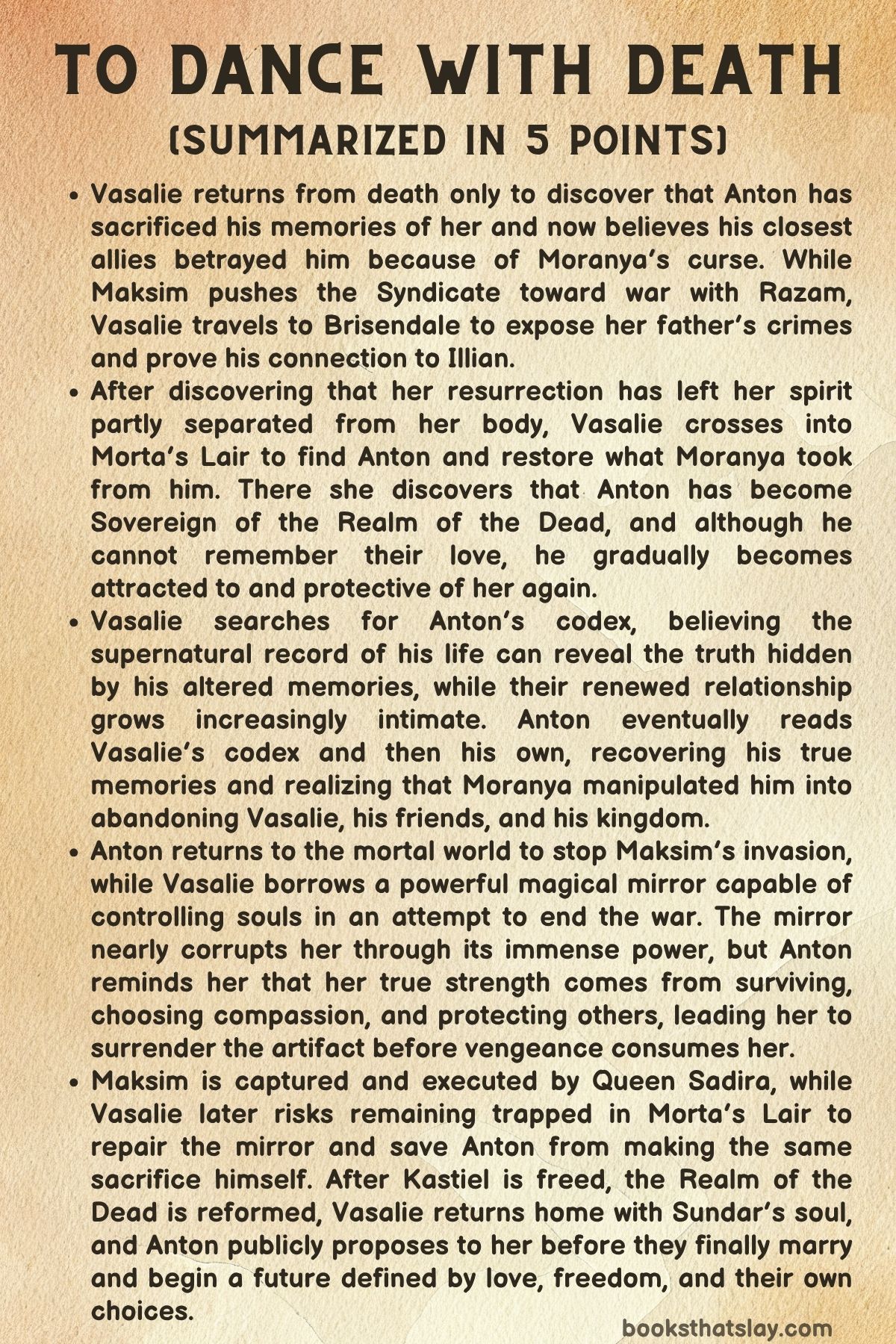
Summary
Vasalie has returned from death, but the miracle carries a brutal price. Anton sacrificed his memories of her and of the people closest to him in order to restore her life, and Moranya has replaced those memories with versions in which Gustav, Queen Sadira, Basile, and others betrayed him.
Unable to tell Anton the truth because of Moranya’s curse, Vasalie leaves Razam and travels with Prince Sundar and Copelan to Brisendale. Maksim Stova, Vasalie’s father, has been pushing the Syndicate toward war following King Rurik’s death, and Vasalie intends to expose the conspiracy connecting Maksim and Illian.
At the Fortress of Sira, Gustav presents photographic evidence showing Maksim secretly meeting Illian and participating in forged documents. Vasalie then publicly accuses her father of murder, including the killing of Emilia, but Maksim counters by presenting her as traumatized and manipulated.
The Syndicate accepts much of the evidence against Illian but hesitates to condemn Maksim without Anton appearing personally. Anton is given thirty days to attend a hearing in Ansa; otherwise, Brisendale will be permitted to retaliate against Razam.
Vasalie is placed in Maksim’s custody while Sundar and Copelan remain near her. At the same time, Anton has withdrawn from mortal life and is increasingly drawn into Moranya’s domain, where she offers him something far greater than the throne he believes his former allies stole from him: sovereignty over the Realm of the Dead.
Strange changes caused by Vasalie’s resurrection soon become impossible to ignore. She begins seeing the dead Illian in reflective surfaces and discovers that powerful emotion can loosen the connection between her body and spirit, allowing her to pass through physical objects.
Illian claims this unstable state will allow her to enter Morta’s Lair without dying. Although Vasalie has every reason to distrust him, the approaching deadline and Anton’s condition leave her unwilling to ignore the possibility.
She finds a weak point between worlds and crosses into Morta’s Lair. Instead of a simple resting place for souls, she discovers an enormous civilization governed by rank, privilege, judgment, punishment, and rigid distinctions between the Exalted, Shadows, and other classes.
Vasalie soon learns about codices, supernatural records preserving the complete lives of both the living and the dead. Since Moranya has changed Anton’s memories, Vasalie realizes his codex could preserve the truth that his mind no longer contains.
She eventually finds Anton ruling as Sovereign of the realm. He remembers her only as a mysterious woman associated with the people he distrusts, yet he remains immediately curious about her.
Vasalie cannot reveal her true mission, so she claims she came seeking Emilia. Anton agrees to conceal the fact that she is mortal and allows her to remain, but in exchange she must dance at his gatherings.
Life around Anton reveals both how much he has changed and how much remains the same. He surrounds himself with pleasure and admirers and pretends attachment means nothing to him, yet Vasalie repeatedly sees signs of compassion, curiosity, responsibility, and restraint beneath the performance.
Her search becomes more urgent when Sundar suddenly appears among the dead. Maksim had arranged an attack after Sundar and Copelan left Sira, and Sundar deliberately sacrificed himself in the hope of preventing his death or capture from being used to justify further aggression.
Sundar immediately helps Vasalie search the codices. He also becomes convinced that Anton’s emotions have survived the destruction of his memories and encourages Vasalie to stop believing that everything between her and Anton depends upon restoring their past.
Anton begins demonstrating precisely what Sundar suspects. He becomes jealous of Vasalie’s closeness with Sundar, moves her into his private apartments, follows her when she withdraws from him, and increasingly seeks her company for reasons that have nothing to do with their bargain.
Their conversations expose Anton’s deeper wounds. Long before Moranya changed his memories, he feared abandonment and learned to hide vulnerable parts of himself behind humor, arrogance, charm, and carefully controlled versions of the truth.
Vasalie also realizes she is no longer trying merely to recover the Anton she remembers. She is falling in love with the man standing before her now, even without the shared history that once defined their relationship.
Her condition, however, is rapidly deteriorating because her mortal body cannot remain indefinitely in Morta’s Lair. After Rurik attacks her and other souls discover that she is alive, Illian explains that her body and displaced spirit are beginning to reject one another.
Vasalie nevertheless tries to continue dancing and collapses with a severe fever. Anton immediately abandons his cultivated indifference, catches her, carries her away, and tends to her himself.
During her delirium, Vasalie kisses him and tries to take the encounter further, but Anton stops when he realizes she is too ill to make decisions he completely trusts. His restraint convinces Vasalie that the essential qualities she loved in him survived Moranya’s manipulation.
With the deadline almost over, Vasalie follows Anton to Moranya’s hidden residence. There she discovers broken magical mirrors and evidence that Moranya has spent centuries attempting to repair one extraordinary object.
Anton discovers her intrusion and helps her escape through a stained-glass portal. They emerge beneath a mountain in the mortal world and eventually return secretly to Ansa.
Being back in his city affects Anton profoundly. He shows Vasalie his workshop, inventions, architecture, waterways, and public spaces, revealing how deeply his identity remains connected to the kingdom he claims to have abandoned.
Anton also speaks about Ademi and admits how fear once kept him from showing her his entire self. Vasalie recognizes that Moranya’s false memories succeeded partly because they reinforced a fear Anton already possessed: the belief that anyone who truly knows him may eventually leave.
During their time in Ansa, Vasalie freely kisses Anton and acknowledges that she wants a moment belonging to who they are now rather than an imitation of their forgotten past. Their relationship becomes intimate, and Anton admits that holding her produces the strange feeling that something lost has been restored to him.
They also discover the origin of Moranya’s realm. Moranya was once Mercy, a mortal woman loved by Kastiel, the Fate of Dominion.
Kastiel created a mirror capable of containing a Fate’s power, and Mercy attempted to use it so human souls would no longer disappear after death. The attempt trapped Kastiel inside the broken mirror and left Mercy holding part of his power, eventually turning her into the Fate who governed Morta’s Lair.
Meanwhile, Maksim takes advantage of Anton’s disappearance to destabilize Miridran. He publicly challenges Gustav and encourages the court to believe Anton is dead or imprisoned.
Seeing the consequences finally forces Vasalie to confront Anton directly. She tells him his fear is allowing other people to determine the fate of his kingdom and shocks him by proposing marriage.
Vasalie admits that she loves him and would accept even a political marriage if it gave him a reason to reclaim his throne. Anton cannot immediately accept what she asks and returns her to Morta’s Lair.
Vasalie is devastated, but Sundar convinces her that Anton’s actions reveal feelings he has not yet accepted. She finds Anton again and kisses him without bargaining, illness, manipulation, or expectation.
Anton responds with equal sincerity. Yet unknown to Vasalie, he has also been investigating her past through her codex.
Reading it reveals Illian’s abuse, the true Gathering, Vasalie’s history, and contradictions that prove Anton’s own memories are false. Furious, he confronts Moranya.
Moranya finally gives Anton his own codex, allowing him to recover everything she removed. His restored memories return his love, friendships, political responsibilities, and understanding of what Vasalie risked to reach him.
Anton immediately returns to Miridran, only to discover that the Syndicate deadline has passed and Maksim has already been authorized to attack Razam. He reclaims command of his court, reconciles with those Moranya made him distrust, and leads available soldiers toward the conflict.
Vasalie remains in the Realm of the Dead long enough to discover how badly Anton will be outnumbered. She persuades Moranya to lend her Kastiel’s mirror, whose power can control the separation between bodies and souls.
The agreement carries an enormous risk. Moranya can preserve Morta’s Lair without the mirror for only one day, meaning Vasalie must stop the war and return the artifact before the realm begins failing.
On the battlefield, the mirror gives Vasalie terrifying power. She can pull souls from living bodies and even destroy them completely.
Years of helplessness suddenly give way to overwhelming control, and Vasalie begins confusing revenge with strength. When people she loves are endangered, she uses the mirror with increasing brutality.
Anton reaches her before she completely loses herself. He tells her that her survival, compassion, courage, and determination already proved her strength long before she possessed supernatural power.
When he tells her he loves her, Vasalie finally releases the mirror. Maksim is captured shortly afterward.
Vasalie is given the opportunity to determine her father’s fate. Rather than kill him herself and carry another death inside her memory, she gives Anton’s sword to Queen Sadira.
Sadira formally condemns Maksim for his murders, manipulation, invasion, and destruction of lives across the Syndicate before executing him. For Vasalie, choosing not to deliver the killing blow becomes an important act of self-control rather than weakness.
The mirror must still be repaired and returned. Anton reconstructs it but realizes that whoever inserts the final piece in Morta’s Lair may be unable to return once Kastiel is released.
Anton intends to make the sacrifice himself. Vasalie secretly recruits Basile to stop him and enters the realm in Anton’s place.
She repairs the mirror and frees Kastiel. Instead of seeking vengeance against Mercy, Kastiel reveals that he heard her throughout his imprisonment and understands the grief that drove her actions.
The two agree that the dead should no longer be ruled by one absolute authority. Vasalie proposes a Court of the Just composed of genuinely selfless souls, while Kastiel and Mercy will become guardians rather than unquestioned rulers.
The restoration of the realm also frees souls trapped within its supernatural aurora, including Emilia. Vasalie finally reunites with the woman whose murder shaped so much of her suffering.
Residual power in the repaired mirror unexpectedly provides one final portal home. Vasalie also receives permission to carry Sundar’s soul with her in the hope that his preserved body can be restored.
Before leaving, she finally releases her emotional connection to Illian and Maksim by accepting that their judgment belongs to others. She no longer needs to define herself through what either man did to her.
Vasalie returns to Ansa expecting uncertainty but instead finds Anton overwhelmed with relief. Before the assembled court, he acknowledges what she has done for him and his kingdom and asks her to marry him as his wife, confidante, love, and equal.
Three weeks later, Vasalie prepares for both marriage and coronation. Sundar has successfully returned to life, her surviving companions are rebuilding their futures, and Anton’s relationships with Gustav and Basile have been restored.
Vasalie and Anton marry after repeatedly losing one another to death, memory, fear, and sacrifice. Their future is significant not because every wound has disappeared, but because they have finally learned to choose one another without surrendering themselves.
Characters
Vasalie Stova
Vasalie is the emotional and moral center of To Dance With Death, and her development is built around the difference between possessing power and possessing agency. Much of her life has been shaped by Maksim’s ambition, Illian’s abuse, Emilia’s murder, political coercion, and circumstances in which other people determined what would happen to her.
Her willingness to enter Morta’s Lair demonstrates extraordinary loyalty, but her journey is not merely about rescuing Anton. It becomes a test of whether she can love someone without losing her identity inside that love.
Vasalie’s supernatural ability to move between physical and spiritual states mirrors her unstable sense of belonging. She has returned from death but does not completely belong among the living, while the dead can see that she does not belong among them either.
Her greatest crisis occurs when she wields Kastiel’s mirror. For someone who spent years unable to protect herself, the ability to remove souls creates the seductive illusion that total control equals freedom.
Anton’s intervention reminds her that her real strength has always existed in endurance, compassion, choice, and the refusal to become identical to those who harmed her. Her decision not to execute Maksim herself is therefore one of her strongest acts.
By the ending, Vasalie no longer defines herself primarily as Maksim’s daughter, Illian’s victim, Emilia’s grieving child, or Anton’s beloved. She can accept love, queenship, friendship, and family because these roles now belong to a self she has consciously chosen.
Anton
Anton’s role in To Dance With Death examines what remains of a person when memory is stripped away. Moranya destroys the narrative through which Anton understands his closest relationships, but she cannot completely erase his generosity, intelligence, creativity, humor, protective instincts, or capacity to love.
His behavior as Sovereign initially appears careless and self-indulgent. He surrounds himself with pleasure because detachment allows him to pretend betrayal no longer matters.
Vasalie gradually reveals how false that indifference is. Anton becomes protective of her, jealous of Sundar, attentive to her illness, fascinated by her opinions, and increasingly unwilling to imagine her leaving.
His refusal to continue their physical encounter while she is feverish is especially important because it demonstrates that his moral instincts do not depend upon memory. Even without knowing their history, he remains someone who values her safety and consent.
Anton’s deeper conflict is fear. He has spent much of his life believing that revealing himself completely creates the possibility of abandonment, and Moranya’s fabricated betrayals transform that old insecurity into something nearly absolute.
His eventual return is therefore more meaningful than simple memory restoration. Once his memories return, Anton recognizes that hiding from a prophecy and abandoning responsibility helped produce the instability he feared.
By reclaiming his throne, repairing his friendships, confronting Moranya, and openly declaring his love for Vasalie, he chooses vulnerability over defensive isolation. His final proposal establishes partnership rather than possession as the future he wants.
Moranya / Mercy
Moranya is one of the most morally complicated figures in To Dance With Death because her destructive choices originate in an intention that was once compassionate. As Mercy, she wanted to prevent human souls from vanishing after death, but her attempt to use Kastiel’s power created consequences she could neither reverse nor fully control.
Centuries of grief transform a compassionate project into a rigid and unequal system. Morta’s Lair preserves souls, yet its hierarchy demonstrates how easily protection can become domination when one person controls judgment indefinitely.
Her manipulation of Anton is particularly severe. She rewrites his emotional history, destroys his trust in those he loves, and pushes him toward ruling the dead because she needs his expertise with glass.
Moranya nevertheless understands Anton and Vasalie well enough to predict that their connection will survive her interference. Her reliance on Vasalie to reach him shows that even Moranya recognizes love cannot be reduced entirely to remembered facts.
When Kastiel is finally released, Mercy loses the authority that defined her for centuries. His refusal to punish her creates an opportunity for responsibility without endless retaliation.
Her agreement to replace individual rule with a broader court represents the beginning of a different moral order. Mercy cannot undo what she caused, but she can finally stop building the future around her private grief.
Sundar
Sundar provides loyalty, humor, political awareness, and emotional clarity throughout To Dance With Death. He supports Vasalie without trying to control her, making him one of the strongest contrasts to Maksim and Illian.
His death demonstrates the seriousness of Maksim’s campaign. Sundar deliberately accepts a fatal blow because he believes his sacrifice may prevent Maksim from gaining another excuse for immediate war.
Death does not change his priorities. Once he reaches Morta’s Lair, he immediately begins helping Vasalie search the codices and studying ways to restore Anton.
Sundar is also unusually perceptive about Anton’s feelings. While Vasalie constantly questions whether Anton’s attraction is meaningful, Sundar recognizes that jealousy, irritation, curiosity, and protectiveness are signs of an attachment Anton has not yet accepted.
His friendship with Anton survives even Moranya’s altered memories. Through jokes, shared experiences, and familiar emotional rhythms, Sundar helps prove that relationships leave traces beyond factual recollection.
His eventual restoration to life provides an important reversal of his sacrifice. He is rewarded not because death was meaningless, but because the people he protected refuse to treat his loss as inevitable.
Maksim Stova
Maksim is the primary mortal antagonist of To Dance With Death, representing ambition stripped of familial loyalty or moral restraint. He views people primarily according to their usefulness to his political designs, including his own daughter.
His treatment of Vasalie reveals the personal foundation beneath his political cruelty. He attempts to control her marriage, disregards her suffering, uses confinement and intimidation, and repeatedly manipulates public perception to weaken her credibility.
Maksim is especially dangerous because he rarely depends solely on open violence. Forgery, alliances, legal structures, propaganda, accomplices, and uncertainty are all tools he uses to achieve goals while maintaining enough distance to deny responsibility.
His campaign against Razam and Miridran follows the same method. Rather than simply attack Anton directly, he exploits Anton’s disappearance, destabilizes Gustav’s authority, encourages internal division, and waits until the Syndicate provides legal permission for war.
His final defeat exposes the weakness behind his obsession with control. Once evidence, alliances, and fear stop protecting him, he has little genuine loyalty surrounding him.
Vasalie’s refusal to execute him herself is especially significant because Maksim has spent years forcing other people to behave according to his design. In the end, his daughter defeats that control by refusing to let even his death dictate who she becomes.
Illian
Illian is an intensely personal antagonist whose presence continues after death. His abuse of Vasalie was based not on love but on possession, and his claim that his obsession proves the depth of his feelings demonstrates how thoroughly he confuses desire with entitlement.
Even as a spirit, Illian knows how to locate Vasalie’s insecurities. His comments about Anton’s possible loss of interest are calculated to make her believe that obsession is more dependable than healthy affection.
Yet Illian occupies a strange position after death because he also provides information that Vasalie needs. He teaches her about the instability between her soul and body and helps direct her toward the path into Morta’s Lair.
His occasional assistance does not erase his history. Instead, it complicates Vasalie’s task of separating useful information from emotional manipulation.
By the end, she no longer needs to defeat Illian personally. Leaving his judgment to the reformed afterlife and to those with legitimate authority demonstrates that she has stopped allowing him to occupy the center of her emotional life.
Emilia
Emilia’s physical absence shapes much of the story because her death represents the moment when Maksim and Illian’s control produced irreversible consequences. Vasalie carries grief and guilt connected to Emilia for much of her journey.
Emilia represents the protective love Vasalie should have received from her family. She attempted to protect Vasalie from the marriage arranged by Maksim and paid for that defiance with her life.
Her murder therefore becomes both personal tragedy and evidence of Maksim’s willingness to sacrifice anyone who interferes with his ambitions. Vasalie’s determination to expose him is inseparable from her desire to give Emilia justice.
The eventual reunion in Morta’s Lair allows Vasalie to speak to Emilia after believing that possibility had been lost forever. More importantly, Emilia’s return helps transform memory from a source of pain into part of a larger, continuing relationship.
Queen Sadira
Queen Sadira combines political authority with genuine maternal loyalty. She refuses to let Vasalie reduce herself to the things she did under coercion and repeatedly emphasizes the difference between responsibility and self-destruction.
Her relationship with Anton also gives the novel an important parental dimension. She recognizes both his brilliance and his tendency to respond to fear by isolating himself.
Sadira’s grief over Sundar gives her final confrontation with Maksim enormous emotional weight. When Vasalie gives her Anton’s sword, Sadira becomes the person who formally carries out the judgment Vasalie chooses not to execute herself.
The execution is therefore not random revenge. Sadira publicly names Maksim’s crimes and acts as both ruler and mother, bringing political accountability and personal loss into the same moment.
Gustav
Gustav represents loyalty tested by impossible circumstances. He attempts to protect Anton’s kingdom while Anton is absent, even though the king he serves has been made to believe Gustav betrayed him.
His presentation of Anton’s photographic stills demonstrates both courage and faith in evidence. Even when the Syndicate doubts him, Gustav continues trying to establish the conspiracy rather than abandoning Anton’s cause.
Later, he becomes increasingly isolated as Maksim manipulates the Miridranian court. Nobles blame Gustav for Anton’s absence and question his legitimacy, leaving him responsible for a kingdom that is beginning to fracture.
Anton’s return validates Gustav’s loyalty but also exposes the terrible personal cost of that loyalty. Their reconciliation restores one of the relationships Moranya tried hardest to destroy.
Basile
Basile’s relationship with Anton is defined by deep loyalty rather than simple obedience. He remains connected to Anton even while Moranya’s curse makes Anton interpret that loyalty as betrayal.
Once Anton recovers his memories, their reunion makes visible how much both men lost during the separation. Basile’s importance becomes even clearer during the final mirror crisis.
When Vasalie asks him to restrain Anton so she can enter Morta’s Lair in his place, Basile knowingly violates Anton’s wishes. His decision shows that genuine loyalty sometimes requires refusing a command when obedience would allow someone to destroy himself.
Basile accepts that Anton may never forgive him because Anton’s survival matters more than preserving their immediate relationship. That willingness makes his loyalty active and morally independent.
Copelan
Copelan carries one of the story’s clearest burdens of guilt. His earlier betrayal of Vasalie contributed to Illian gaining power over her, and that history prevents him from treating his later loyalty as something that automatically cancels the past.
He accompanies Vasalie back into danger and remains willing to help despite knowing that forgiveness cannot be demanded. After Sundar’s death, surviving places another emotional burden upon him.
Vasalie’s eventual reconciliation with Copelan is deliberately forward-looking. She does not pretend his betrayal never happened; instead, she asks him to use what he learned to treat other dancers with greater humanity.
His decision to work at Laurent’s theater gives him the opportunity to turn regret into changed behavior. Forgiveness therefore becomes connected to responsibility rather than forgetting.
Sofya Kosarev
Sofya begins from a position of understandable uncertainty. As Rurik’s sister, she has no reason to accept Vasalie’s accusations automatically, especially when the political situation is filled with conflicting claims.
Her strength is her willingness to investigate rather than simply protect family or political allegiance. Maksim’s behavior gradually convinces her that Vasalie’s claims deserve serious consideration.
Sofya’s intervention regarding Sundar and Copelan also demonstrates that institutional power can be used responsibly. Her actions force Maksim to respond to scrutiny even though he continues plotting violence afterward.
She later supports the possibility of formally trying Maksim under Brisendali law. Her presence provides an alternative to rulers who treat justice as personal revenge.
Aesir
Aesir’s fate demonstrates that Maksim’s violence extends far beyond the crimes Vasalie already knows. After failing to produce an heir, she is murdered by Maksim, who pushes her down the stairs.
In death, Aesir becomes a Shadow, adding another example of how Moranya’s hierarchy does not necessarily correspond cleanly with the reader’s understanding of justice. Her testimony also exposes Lord Dameron’s long involvement with Maksim.
Aesir consequently serves two purposes: she provides crucial political information and gives another voice to the women whose lives Maksim treated as disposable.
Lord Dameron
Lord Dameron initially appears to be a neutral observer connected to the Syndicate proceedings, but Aesir later exposes him as one of Maksim’s longtime collaborators. His willingness to remain at Sira therefore gains a more sinister explanation.
He represents the kind of complicity that allows powerful abusers to operate for years. Maksim’s schemes require not only his own ambition but people willing to provide legitimacy, information, silence, or assistance.
Dameron’s role reinforces the story’s broader argument that corruption is rarely sustained by one person alone.
Kastiel
Kastiel, the Fate of Dominion, initially exists mostly as a mysterious danger trapped within the broken mirror. Anton reasonably fears that releasing a being with enormous control over life and death could endanger both mortal and supernatural worlds.
The revelation of Kastiel’s history changes that expectation. He created the mirror from love and fear, intending it as protection for Mercy, but the object ultimately became the source of centuries of suffering.
Once freed, Kastiel refuses vengeance. His first priority is repairing the realm and reconnecting with Mercy rather than punishing her.
That response distinguishes power from domination. Kastiel possesses extraordinary authority, yet his willingness to share responsibility with a Court of the Just makes him an important contrast to both Moranya’s previous absolute rule and Vasalie’s temporary intoxication with the mirror.
Rurik
Rurik’s murder becomes one of the political catalysts of the story because Maksim uses his death to justify aggression against Razam. Vasalie knows the situation is more complicated because she personally killed Rurik while under Illian’s coercion.
After death, Rurik retains anger toward Vasalie and attacks her in Morta’s Lair. His reaction emphasizes that death does not automatically produce wisdom, forgiveness, or moral clarity.
Rurik also embodies Vasalie’s unresolved guilt. His presence forces her to confront a victim of actions she committed without reducing the circumstances surrounding those actions to something simple.
Sorrell and Dahlia
Sorrell and Dahlia reveal the hypocrisy within the social order of Morta’s Lair. Despite belonging to the Exalted, they can be cruel, jealous, territorial, and willing to threaten Vasalie once they learn she is mortal.
Their behavior undermines the assumption that Moranya’s classifications provide unquestionable moral truth. Status in the afterlife is shown to be an administrative judgment rather than proof that a soul has become virtuous.
They also increase the danger surrounding Vasalie by demonstrating how vulnerable she remains even within Anton’s palace.
Maia
Maia belongs to Anton’s privileged social environment in Morta’s Lair and helps establish the atmosphere surrounding the Exalted. Through characters such as Maia, Vasalie sees that death has preserved many of the same habits of comparison, luxury, social positioning, and desire that exist among the living.
Her presence contributes to Vasalie’s growing skepticism toward Moranya’s claim to administer a perfectly ordered afterlife.
Arjuna
Arjuna is one of the allies who fights alongside Anton during the campaign against Maksim. His presence places Anton within a network of people willing to follow him once he chooses to resume responsibility.
Although less central emotionally than Basile or Sundar, Arjuna contributes to the sense that Anton’s return is not simply personal. It restores leadership to a wider political and military community.
Ishu
Ishu functions as one of Anton’s most recognizable companions and a surviving connection between different versions of Anton’s life. His appearance in Morta’s Lair immediately signals to Vasalie that Anton is nearby.
Sundar also uses memories involving Ishu when attempting to provoke emotional recognition in Anton. The animal therefore becomes a small but meaningful bridge between remembered history and feelings that continue beneath the altered memories.
Laurent
Laurent represents the family Vasalie acquires through trust rather than blood. His theater is connected to the world of performance, but unlike Illian and Maksim, Laurent does not treat Vasalie’s talent or body as something he owns.
His presence after her return from Morta’s Lair reinforces the fact that Vasalie has built relationships outside the structures that once imprisoned her. Copelan’s eventual work at Laurent’s theater also makes Laurent part of the story’s movement toward repair.
Marian and Brigitte
Marian and Brigitte represent stability, affection, and chosen family. Vasalie’s request that they remain with her permanently after she becomes queen reveals how profoundly her understanding of home has changed.
She no longer imagines belonging solely through marriage, bloodline, or royal identity. Her future includes the people who supported her and helped her become herself.
Ademi
Ademi appears primarily through Anton’s memories, but her role is important for understanding his emotional defenses. Anton admits that he allowed her to know only carefully selected parts of himself because he feared complete honesty would cause rejection.
The relationship establishes that Anton’s fear of abandonment existed long before Moranya altered his memories. Moranya’s curse succeeds partly because it strengthens a wound that was already present rather than creating one from nothing.
Mantrin
Mantrin appears most significantly during the battlefield crisis, when his injury contributes to Vasalie’s loss of control while using the mirror. Seeing someone she cares about threatened transforms an already dangerous emotional situation into overwhelming rage.
His role illustrates how the mirror exploits protective instincts as easily as hatred. Vasalie does not begin using its worst power because she wants conquest; she begins losing control while trying to prevent further harm.
Themes
Love Beyond Memory
To Dance With Death repeatedly asks whether love exists only because people remember the experiences that created it. Moranya’s curse provides the most extreme possible test by removing Anton’s memories of Vasalie and replacing affection for his closest companions with manufactured betrayal.
What survives is not factual recollection but emotional tendency. Anton is drawn to Vasalie again, becomes protective of her, respects her boundaries, reacts to Sundar with jealousy, and experiences unexplained familiarity when they touch or dance.
Vasalie’s own development is equally important because she initially treats memory restoration as the only possible path back to the relationship she lost. Over time, she realizes that she loves the present Anton as much as the man she remembers.
That realization changes the meaning of her mission. She no longer needs Anton to recover his past in order to prove that their relationship mattered.
The codices ultimately restore the factual history, but by then the story has already demonstrated that identity is more than remembered information. Character, instinct, emotional patterns, values, and repeated choices survive beneath Moranya’s manipulation.
Love therefore becomes an active decision rather than the passive result of shared history. Anton and Vasalie reach one another twice, suggesting that memory can explain love but does not entirely create it.
Power, Control, and True Strength
Questions of power shape almost every major conflict in To Dance With Death. Maksim uses political authority, parental control, intimidation, propaganda, and violence, while Illian uses obsession and psychological domination to reduce Vasalie’s freedom.
Moranya controls memories and the fate of souls. Even Anton initially uses royal and supernatural authority to determine the terms under which Vasalie can remain near him, although he gradually becomes more conscious of the ethical limits of that authority.
Vasalie’s encounter with the mirror brings this theme directly into her own character. After spending years controlled by stronger people, she suddenly possesses the ability to remove souls with almost no effort.
The sensation initially feels like liberation because nobody can threaten, imprison, or silence her while she possesses that power. Yet the mirror quickly demonstrates that domination can reproduce the same structures she has spent her life resisting.
Anton’s intervention provides the central distinction between strength and control. He reminds Vasalie that she survived abuse, entered death voluntarily, crossed worlds, protected others, and repeatedly chose compassion before she ever possessed supernatural power.
Her decision to surrender the mirror and later refuse to execute Maksim completes that lesson. True strength is presented as the ability to choose one’s actions even when rage, fear, or authority make cruelty easy.
Fear, Prophecy, and Choice
Fear repeatedly becomes dangerous when characters allow it to make decisions in their place. Anton’s prophecy convinces him that isolation may protect others, but withdrawing from his kingdom creates precisely the instability that Maksim needs.
Moranya also acts from fear. Mercy fears the disappearance of human souls, later fears permanently losing Kastiel, and eventually becomes willing to manipulate countless people because she cannot accept the possibility that the mirror will remain broken.
Anton’s history with Ademi reveals a smaller but related pattern. He conceals vulnerable parts of himself because he assumes honesty may produce rejection, sacrificing genuine intimacy in an attempt to prevent emotional pain.
Vasalie gradually rejects this logic. Her proposal to Anton is partly an argument that trying to avoid a feared future can become the mechanism that creates it.
The story therefore treats prophecy as pressure rather than absolute command. Anton cannot control whether the prophecy exists, but he can control whether fear of it determines how he behaves.
His eventual decision to return to Miridran represents acceptance of uncertainty. He chooses responsibility without receiving any guarantee that disaster will never happen.
Freedom in the story is not the removal of danger. It is the willingness to act according to values even when the consequences cannot be fully predicted.
Justice, Revenge, and Breaking Cycles of Harm
Justice is repeatedly contrasted with retaliation. Vasalie has legitimate reasons to hate Maksim and Illian, yet the story constantly asks whether personally destroying the people who harmed her would actually give her freedom.
The mirror makes that question literal. Vasalie can punish enemies instantly, but each destroyed soul moves her further from the person she wants to remain.
Her final treatment of Maksim demonstrates a different approach. She does not excuse him, forgive his crimes, or prevent punishment.
Instead, she refuses to make his execution another defining memory in her own life. By transferring judgment to Sadira and the political order Maksim violated, she separates accountability from personal vengeance.
The reform of Morta’s Lair expands the same idea into the supernatural realm. Moranya’s centuries of individual judgment have created hierarchy, inconsistency, and suffering because no single person should possess unquestioned authority over every soul.
The proposed Court of the Just replaces solitary judgment with shared responsibility. Kastiel likewise refuses to answer Mercy’s disastrous mistake with endless punishment.
These choices do not erase consequences. They suggest that justice becomes more humane when punishment is separated from the desire to dominate, possess, or prolong suffering.
Vasalie’s final freedom comes when she accepts that she does not need to carry Maksim and Illian forever. Their judgment can belong to others, while her future belongs to her.