Things That Break Us Summary, Characters and Themes
Things That Break Us by Michelle Heard is a contemporary romance centered on grief, domestic abuse, recovery, family, and the difficult work of trusting love after violence.
Nova Allen arrives in California expecting to support her dying best friend, Rachel, but the visit permanently changes every part of her life. Alongside Rachel’s brother Easton and daughter Lainey, Nova faces a devastating loss while slowly discovering the stability she has never experienced before. The book places romantic love beside friendship, parenthood, bereavement, and trauma recovery, showing how people can carry lasting wounds while still creating a safer and more hopeful future.
Summary
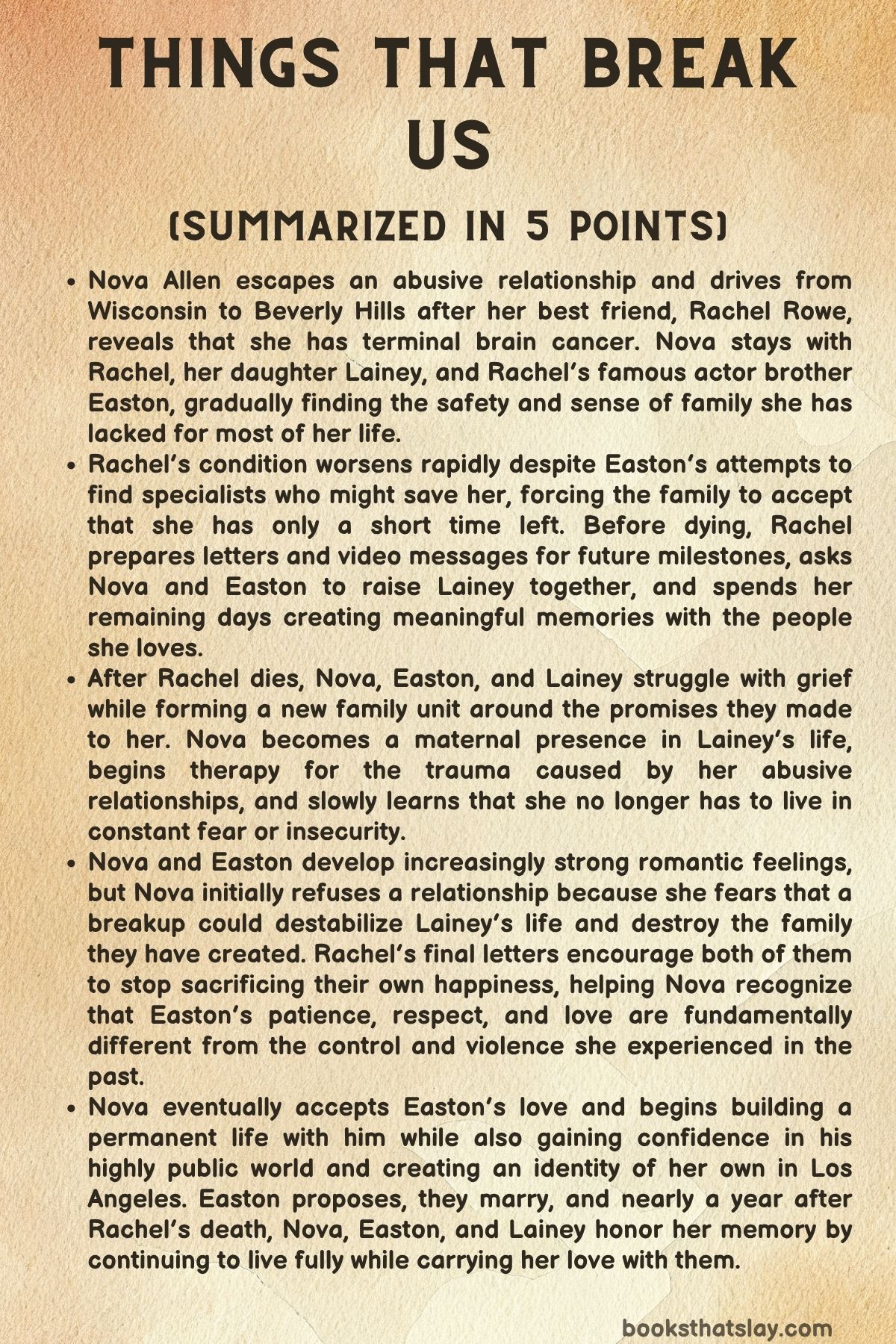
Twenty-eight-year-old Nova Allen finally escapes Trent, her abusive boyfriend, after another violent attack leaves her bruised, frightened, and nearly broke. Hiding in a cheap motel in Wisconsin, she receives an urgent call from her lifelong best friend Rachel Rowe, who asks her to come immediately to Beverly Hills, and Nova abandons her struggling pet-grooming job and begins the long drive west.
The journey brings back memories of Nova’s adolescence with Rachel and Rachel’s older brother, Easton, whom Nova has secretly loved since she was fourteen. Easton moved to Los Angeles with Rachel years earlier and eventually became a famous actor, but Nova has never forgotten him despite building an entirely separate life in Verona.
When Nova reaches Easton’s mansion, Rachel reveals why she called: she has glioblastoma, an aggressive brain tumor that doctors cannot successfully operate on or treat. She may have only weeks to live, and Nova immediately promises to stay beside her for whatever time remains.
Rachel is especially afraid of leaving behind her ten-year-old daughter Lainey and of telling Easton that nothing can save her. Nova convinces her to call Easton home from New Zealand, while privately confronting the fact that Rachel has been the closest thing to a true family Nova has ever possessed.
Nova also confesses that she has finally left Trent, although she initially hides the full extent of his violence. When Rachel notices her injuries, Nova admits the truth, revealing that Trent is not the first man who has abused her and that fear has become deeply rooted in the way she responds to relationships.
Easton returns and is devastated by Rachel’s diagnosis. Refusing to accept that nothing can be done, he uses his money and professional connections to have Rachel’s medical records reviewed by Professor Anthony Fox, hoping that another specialist might offer a solution.
Fox confirms the earlier diagnosis: the tumor is too advanced and aggressive, and attempted treatment would probably reduce Rachel’s quality of life without changing the outcome. Easton is therefore forced to confront something his wealth, fame, and determination cannot repair.
During these first difficult days, Nova becomes increasingly involved with Lainey. Their outings around Los Angeles reveal that Easton’s celebrity affects the child as well, because classmates, parents, strangers, fans, and photographers sometimes approach Lainey primarily because they want access to her famous uncle.
Nova reassures Lainey that real friendship should never depend on celebrity or social advantage. Their closeness grows naturally, and Nova begins imagining that California might become more than a temporary refuge from Trent.
At the same time, Easton starts seeing Nova as the adult woman she has become rather than merely his younger sister’s shy childhood friend. Her loyalty to Rachel, devotion to Lainey, lack of interest in his fame, and quiet ability to understand his grief increasingly draw him toward her.
Rachel asks Easton and Nova, who are both Lainey’s godparents, to raise her daughter together after she dies. Nova also suggests that Rachel record videos and write letters for future occasions so that Lainey can continue receiving messages from her mother during birthdays, dating, prom, marriage, and other milestones.
The family begins organizing medication, hospice arrangements, legal matters, recordings, and responsibilities. Their preparations make Rachel’s approaching death increasingly real, even while they deliberately create ordinary moments of cooking, laughter, school activities, and family time.
Easton soon learns about Nova’s abusive relationships, and her behavior begins making sense to him. He recognizes why sudden anger, unexpected movements, physical restraint, or a threatening expression can trigger automatic fear in her, and he resolves to treat her with patience rather than expecting her trauma to disappear simply because Trent is gone.
Nova eventually admits to Rachel that she has loved Easton since adolescence. Rachel is pleased rather than surprised, but she warns both of them separately that any relationship must be taken seriously because Nova is emotionally vulnerable and Lainey has already endured enough instability.
Before romance can fully develop, Rachel’s health rapidly deteriorates. During a school fundraiser she collapses and suffers a seizure, forcing Easton and Nova to tell Lainey that her mother has cancer and will die.
Tests show that the tumor has progressed dramatically, leaving Rachel with impaired speech, weakness, and vision problems. She chooses to return home under hospice care rather than spend her remaining days in the hospital.
Rachel carefully describes the memorial she wants after her death, asking to be cremated and have her ashes incorporated into fireworks. She also asks for one final day involving the things she loves: Easton’s cooking, good wine, the beach, and watching Lainey build a sandcastle.
The family gives Rachel that day before she becomes too weak to leave home. At the beach, Nova and Easton grow physically and emotionally closer, while Rachel openly tells Nova that she believes Nova belongs with Easton and Lainey.
Nine days later, Rachel awakens during a family movie and quietly lets them know that she is dying. Nova, Lainey, and Easton gather around her bed, tell her how much they love her, and remain with her until she takes her final breath.
Easton initially handles the practical arrangements but collapses once Rachel’s body has been taken away. Nova holds him through his grief, and Easton admits that he needs her now more than ever; she promises that neither he nor Lainey will lose her too.
Three days later, they hold Rachel’s private memorial in the garden. They watch her farewell video and then see fireworks carrying her ashes explode across the sky, creating a ceremony that reflects Rachel’s playful personality while allowing the survivors to say goodbye.
After the funeral, Nova, Easton, and Lainey begin learning how to function as a new family. Easton arranges counseling for Lainey and encourages Nova to begin therapy as well, discovering that Rachel had already selected information for a therapist before her death.
Easton’s romantic feelings continue growing, but he deliberately avoids pressuring Nova. When they finally kiss after he teasingly offers to show her how movie kisses work, Nova responds passionately before retreating because she fears that a failed relationship could destroy the family structure Lainey desperately needs.
Easton accepts her decision while making it clear that his feelings are genuine. Nova begins therapy with Regina, who helps her address grief, abuse, anxiety, and her habit of trying to predict every possible future disaster rather than living through the present.
Outside pressures soon complicate their lives. Tabloids portray Nova as a gold digger, accuse Easton of neglecting Rachel, and invent stories about Lainey, giving Nova her first direct experience with the cruelty that can accompany Easton’s celebrity.
Despite the stories, Easton refuses to distance himself from Nova. His professional situation also improves when the director who behaved callously during Rachel’s illness is removed and the production is reorganized so Easton can work largely in Los Angeles and remain close to Lainey.
Nova gradually begins taking over some of the responsibilities and traditions Rachel once maintained. She joins school activities, replaces flowers in the house, participates in Lainey’s daily life, and starts recognizing that she has become a maternal presence without attempting to erase or replace Rachel.
A decisive change occurs when Nova sorts through Rachel’s belongings and discovers a letter written specifically for her. Rachel warns Nova against sacrificing her entire future for Lainey and tells her directly to admit that she loves Easton instead of using fear as an excuse to deny herself happiness.
Rachel leaves Easton a similar message and reveals that Nova has loved him for years. With the truth finally exposed, both Nova and Easton understand that her rejection was motivated not by lack of love but by fear.
After another nightmare, Nova wakes screaming for Easton, and he comforts her until she feels safe again. This time Nova initiates their kiss, and their growing intimacy is defined by Easton repeatedly respecting her choices and making certain that she wants each step.
They finally confess their love openly. Easton addresses Nova’s fears about conflict, jealousy, celebrity, abuse, and Lainey, explaining that disagreement does not have to become violence and that commitment does not require Nova to surrender her independence.
Nova agrees to give their relationship a real chance. As the relationship develops, she becomes more comfortable accepting affection, financial security, and a permanent place in Easton’s home without interpreting those things as tools of control.
Her progress is tested when a worker on Easton’s film set grabs her after mistaking her for an intrusive fan. The physical restraint triggers a severe flashback, but Easton immediately intervenes and helps her return to the present, while Nova recognizes that his protectiveness differs fundamentally from Trent’s possessiveness.
Their relationship also becomes emotionally reciprocal. Nova watches Easton use his memories of Rachel while filming an emotional scene and later comforts him when the performance reopens his grief, giving him a place where he does not have to remain the strong celebrity or family protector.
A trip back to Verona creates another challenge when Nova’s elderly grandfather Bill is found wandering in a confused state. Easton accompanies Nova, helps arrange assisted living for Bill, and ensures that she does not have to handle the situation alone.
During the trip, Nova unexpectedly encounters Trent. He confronts her aggressively, but this time Nova is surrounded by people willing to protect her, and Deputy Stone eventually arrests him after Easton punches him during the confrontation.
Returning to Los Angeles confirms how much Nova’s life has changed. Verona and Trent no longer define her future, and she prepares to enter Easton’s public world openly rather than hiding because of fear or shame.
At a major convention, Easton introduces Nova publicly as his girlfriend. Nova handles questions about their childhood connection, Lainey, and her long-standing feelings with increasing confidence, even joking that Easton will have to propose if he wants to discover whether she will marry him.
Nova also creates a life that is not limited to Easton and Lainey by joining the school fundraising committee and continuing some of Rachel’s charitable work. She responds calmly when another mother treats her with jealousy, demonstrating how much confidence she has gained since arriving in California.
Easton eventually arranges an elaborate proposal at the studio, recreating an action-style rooftop stunt before asking Nova to become his partner for life and the mother of his future children. Once safely on the ground, he kneels with a ring and promises to keep choosing her every day, and Nova accepts.
Nearly a year later, Nova and Easton are married, having wed on New Year’s Day and honeymooned in Bali. Easton still works as an actor and occasionally travels, but he deliberately protects the family life that has become more important than professional success.
On the first anniversary of Rachel’s death, Nova, Easton, and Lainey watch the recording Rachel prepared for them. Rachel encourages them to laugh, swim, eat, celebrate, and continue living instead of allowing grief to become the defining force of their lives.
Nova recognizes that they have fulfilled Rachel’s deepest hope. Lainey is growing up surrounded by love, Easton and Nova have finally built the relationship they denied themselves for years, and Rachel remains part of their family through memories, recordings, traditions, and the choices they continue making in her honor.
Characters
Nova Allen
Nova is the emotional center of Things That Break Us, and much of her development concerns the difference between surviving danger and actually learning how to live after it. When she first appears, she has escaped Trent physically, but her mind and behavior remain governed by years of fear, financial insecurity, abandonment, and repeated abuse.
Her childhood established the emotional conditions that later made unhealthy relationships difficult for her to recognize and leave. She never knew her father, her mother abandoned her, and her grandfather provided little emotional warmth, leaving Rachel as the first person who consistently made Nova feel loved and wanted.
That history explains why Rachel’s terminal illness threatens Nova at such a fundamental level. Rachel is not simply her closest friend but the person who gave her an experience of family, so losing her means confronting both present grief and the older fear that everyone capable of loving Nova eventually disappears.
Nova’s trauma appears through physical and psychological reactions rather than only through memories. Raised voices, angry expressions, sudden movements, unwanted restraint, and even innocent contact can trigger panic because her body continues responding as though violence is imminent.
Her relationship with Easton therefore becomes meaningful primarily because he allows her to maintain control over herself. He apologizes when he frightens her, pays attention to her reactions, gives her time, respects rejection, and repeatedly demonstrates that affection does not create entitlement to her body or decisions.
Nova also develops into a maternal figure for Lainey without trying to replace Rachel. She recognizes that loving the child means preserving Rachel’s memory while also creating reliable daily routines, providing comfort during unpredictable waves of grief, and remaining present when Lainey needs someone.
Her greatest internal obstacle is her tendency to mistake self-denial for responsibility. She initially rejects Easton because she believes sacrificing her romantic happiness will protect Lainey, until Rachel’s letter and Regina’s therapy help her understand that fear-based sacrifice can also prevent a healthy family from developing.
By the conclusion, Nova has not erased her past but has stopped letting it make every decision for her. Her marriage, involvement in school and charity work, comfort within Easton’s public world, and continuing relationship with Lainey show that recovery is represented as building a broader identity rather than merely finding a romantic partner.
Easton Rowe
Easton serves as both romantic lead and family protector in Things That Break Us, but his development requires him to discover the limits of protection itself. Fame, wealth, physical strength, professional influence, and determination have taught him that problems can usually be solved if he applies enough resources, making Rachel’s terminal cancer especially devastating.
His immediate response to the diagnosis is action. He contacts specialists, spends whatever is necessary, changes professional commitments, organizes care, and searches for possibilities because accepting helplessness is much harder for him than taking responsibility.
Rachel’s illness forces Easton to recognize that loving someone does not always mean rescuing them. Once treatment is impossible, his responsibility becomes giving Rachel comfort, honoring her wishes, supporting Lainey, and eventually accepting grief rather than treating death as a failure he should have prevented.
His relationship with Nova reveals another side of this lesson. Easton naturally wants to defend her, particularly after discovering what Trent did, but genuine care requires him to distinguish protection from control.
He therefore learns to watch Nova’s boundaries closely. Even when he desperately wants a relationship, he accepts her initial rejection and chooses to demonstrate consistency instead of using pressure, money, celebrity, or emotional guilt to change her mind.
Easton is also more emotionally vulnerable than his public image suggests. The actor known to millions must frequently perform confidence, but Rachel’s death leaves him needing someone with whom he can collapse, cry, and admit that he cannot remain strong indefinitely.
Nova gradually becomes that person. Their relationship succeeds because emotional support moves in both directions: he provides safety while she gives him permission to grieve without performing the role of protector.
Fatherhood is another defining element of Easton’s identity. He has already functioned as a father figure to Lainey before Rachel’s death, and afterward his choices about work, travel, relationships, and home increasingly center on providing stability for her.
By the end, Easton has not abandoned acting but has reordered his priorities. Career success becomes something that must fit around family rather than the force determining the structure of his life, completing his shift from a man who tries to control circumstances to one capable of accepting uncertainty while remaining dependable.
Rachel Rowe
Rachel is the character whose approaching death shapes nearly every major emotional decision in Things That Break Us. Although she dies relatively early in the wider future represented by the novel, her influence continues through letters, videos, memories, relationships, and the responsibilities she deliberately leaves behind.
Rachel’s defining quality is her commitment to preparing the people she loves for a world in which she will no longer be physically present. She is frightened of dying, but she refuses to allow that fear to stop her from organizing Lainey’s future or expressing what she wants for Easton and Nova.
Her recordings are particularly important because they transform memory into an active form of parenting. She records messages for future birthdays, relationships, marriage, motherhood, anniversaries, and private moments so Lainey will continue receiving guidance from her long after her death.
Rachel shows the same foresight with Nova. Understanding her friend’s tendency to sacrifice herself, she leaves a letter specifically designed to challenge Nova when grief and fear inevitably tempt her to make Lainey her entire identity.
She also understands Easton exceptionally well. Rachel recognizes his attraction to Nova before he fully admits what it means, but rather than simply encouraging romance, she warns him that Nova’s trauma and Lainey’s emotional condition make careless experimentation unacceptable.
Her friendship with Nova is one of the novel’s most important relationships. Rachel gave Nova a sense of family when both biological parents and romantic partners failed her, which explains why Nova treats Rachel’s daughter with a devotion that extends far beyond ordinary friendship.
Even Rachel’s memorial reflects her determination to influence how others experience her death. Choosing fireworks containing her ashes rejects a solemn, conventional farewell in favor of something energetic, memorable, and personally recognizable.
Rachel ultimately becomes a continuing presence rather than an absence. Her final anniversary recording makes clear that she does not want love for her to become permanent misery, and the surviving family honors her most fully when they continue living rather than organizing their identities around loss.
Lainey
Lainey gives Things That Break Us much of its emotional urgency because the adults constantly evaluate their decisions according to what a ten-year-old child can withstand after losing her mother. Her grief also prevents the story from treating bereavement as something resolved once a funeral has taken place.
Before learning about Rachel’s cancer, Lainey is lively, affectionate, observant, and increasingly aware of the strange social conditions created by Easton’s fame. She understands that some classmates and parents show interest in her because of her uncle, giving her an unexpectedly mature awareness of the difference between genuine friendship and social advantage.
Her relationship with Nova forms quickly because Nova treats her as a person rather than an extension of Easton’s celebrity. Their conversations about friendship, crushes, shopping, food, school, and ordinary daily life create a bond before Nova formally assumes a parental role.
Rachel’s death forces Lainey into experiences no child should have to process easily. She moves between crying, laughter, normal activities, sudden emotional collapses, and repeated desire to watch Rachel’s recordings, showing the unpredictability of childhood grief.
Nova understands that Lainey does not need a replacement mother. Instead, she promises to love her fully while preserving Rachel’s identity and place within the family, which allows their relationship to develop without requiring Lainey to transfer loyalty from her dead mother to another woman.
Lainey also becomes the central reason Nova initially refuses Easton. Nova fears that a romantic breakup would effectively make Lainey lose another parental figure, showing how strongly the child’s emotional welfare governs Nova’s thinking.
Yet Lainey ultimately benefits from Nova and Easton choosing each other rather than suppressing their feelings. By the epilogue, she lives within a stable family that continues speaking openly about Rachel, demonstrating that adapting after bereavement does not require forgetting the person who died.
Trent
Trent represents the destructive form of intimacy against which healthy love is measured throughout Things That Break Us. His relationship with Nova has trained her to associate romantic attachment with surveillance, financial pressure, humiliation, unpredictable anger, physical violence, and the constant need to anticipate another person’s mood.
The memory of him attacking Nova after returning home drunk demonstrates how completely ordinary mistakes could become excuses for cruelty. A broken glass or unfinished dinner becomes justification for verbal degradation, twisting an injured wrist, and kicking her, establishing that Nova lived in an environment where no amount of obedience could actually guarantee safety.
After Nova leaves, Trent continues attempting control through messages that alternate between threats, apologies, accusations, demands, and promises. The contradiction is revealing because his apparent remorse is not accompanied by respect for Nova’s decision to end the relationship.
Even when physically absent, Trent continues influencing Nova through conditioned fear. Easton’s anger, unexpected touch, confrontation, or changes in facial expression sometimes cause Nova to react to the man standing before her as though he were Trent.
His later reappearance in Verona is therefore symbolically important. Trent attempts to confront Nova in the environment where he once held power over her, but she is no longer isolated, financially trapped, or convinced that she must manage him alone.
Easton’s intervention, Maggie’s support, and Deputy Stone’s arrival reverse the old pattern of secrecy surrounding abuse. Trent becomes the one removed from the situation, while Nova leaves surrounded by people who believe and protect her.
Sylvia
Sylvia is Easton’s manager and one of the major links between his private family life and his professional obligations. She is practical, efficient, and accustomed to solving problems associated with celebrity, yet Rachel’s illness forces her to manage circumstances that cannot be reduced to schedules, contracts, or publicity.
She helps Easton locate Professor Fox when he insists on another medical opinion and later deals with the consequences of his refusal to abandon Rachel for filming. When director Tim behaves callously, Sylvia becomes part of the effort to restructure Easton’s professional commitments rather than pressuring him to place the production above his family.
Sylvia also serves as a realistic voice regarding publicity. She warns Nova that remaining close to Easton will expose her to tabloid speculation and asks whether elements of Nova’s past could be distorted by the press, not because she disapproves of Nova but because managing public narratives is part of her job.
As Easton’s priorities change, Sylvia adapts instead of resisting. She recognizes his love for Nova, helps arrange public appearances, and assists Nova in entering an unfamiliar celebrity environment with greater preparation and confidence.
Harlow
Harlow is the hospice nurse who enters the Rowe household when Rachel’s illness reaches its final stage. Her presence marks an important transition from hoping for additional time to accepting that the remaining goal is comfort.
She gives the family practical guidance while also helping them understand how close Rachel is to death. When she explains that Rachel probably has only days remaining and is unlikely to leave the house again, she provides clarity at a moment when the family needs truth more than reassurance.
Harlow’s role after Rachel dies is equally significant. By handling the necessary arrangements, she allows the family to focus on saying goodbye and protects them from having to manage every medical and administrative detail during the first moments of bereavement.
Regina
Regina becomes an important figure in Nova’s recovery because therapy gives Nova a structured place to address experiences that romantic love alone cannot repair. Rachel repeatedly encourages Nova to seek professional help, and following through on that request becomes one of Nova’s most significant acts of self-care.
Regina helps Nova identify connections among grief, anxiety, domestic abuse, nightmares, panic responses, and her need to control future possibilities. Rather than encouraging Nova to make immediate permanent decisions, she teaches her breathing and mindfulness techniques and urges her to approach life one day at a time.
That advice directly affects Nova’s relationship with Easton. Nova gradually stops evaluating love solely through imagined worst-case outcomes and begins asking what she actually wants in the present, allowing her to make choices based on evidence and trust rather than automatic fear.
Eden
Eden is Lainey’s counselor and represents the importance of giving a grieving child specialized support beyond what loving relatives can provide. Easton and Nova are deeply committed to Lainey, but neither assumes that affection alone will resolve the psychological impact of losing her mother.
Eden reassures Lainey that unpredictable emotional reactions are normal and that grief does not follow a simple timetable. Her role reinforces the story’s broader understanding that recovery is gradual and that periods of laughter, routine, or apparent stability do not mean mourning has ended.
Bill
Bill is Nova’s elderly grandfather, the person with whom she lived after her mother abandoned her. His presence in Nova’s history is complicated because he provided a place to live without giving her the emotional security and affection she found with Rachel.
When Bill is later discovered wandering through Verona in a confused state, Nova must return to confront a responsibility connected to the life she left behind. His deteriorating living conditions, spoiled food, confusion, and threatening behavior with a shotgun make it clear that independent living is no longer safe.
Nova’s decision to place him in assisted living demonstrates maturity rather than revenge for an emotionally barren childhood. Easton’s willingness to accompany her and help finance the care also shows Nova that difficult family obligations no longer have to be carried alone.
Porsha
Porsha is Lainey’s friend and contributes to the ordinary childhood world that continues around the family’s grief. Her friendship allows Lainey opportunities for baking, sleepovers, school activities, and social experiences that are not entirely defined by Rachel’s illness or Easton’s fame.
Her presence is especially useful because the novel repeatedly contrasts major emotional crises with mundane routines. Lainey can be devastated by her mother’s death and still need friends, school events, cookies, sleepovers, and moments of fun, emphasizing that grief exists beside ordinary life rather than replacing it completely.
Charlotte
Charlotte, Porsha’s mother, helps Nova establish a social identity within Lainey’s school community. Unlike people who approach the Rowes primarily because of Easton’s fame, Charlotte treats Nova as someone capable of participating meaningfully in school and charitable activities.
She invites Nova to join the mothers involved in fundraisers, charity projects, and food drives. The invitation is important because it gives Nova a role connected to Rachel’s community while also helping her build friendships and responsibilities that exist independently of Easton.
Tim
Tim represents the most callous side of Easton’s professional environment. When production delays become inconvenient, he effectively suggests that Easton return to work and deal with Rachel’s death afterward, reducing an irreversible family crisis to an obstacle in a filming schedule.
Easton’s furious reaction shows how completely his priorities have changed. Tim’s eventual removal from the project validates Easton’s refusal to sacrifice Rachel’s final days for professional convenience and allows production to be reorganized around the family’s circumstances.
Professor Anthony Fox
Professor Anthony Fox is the specialist Easton consults because he cannot accept the initial medical verdict without exhausting every possibility. His importance comes from confirming that Rachel’s condition cannot be repaired even by elite medical expertise and unlimited financial resources.
Fox advises against aggressive treatment because it would reduce the quality of Rachel’s remaining time without offering meaningful benefit. His conclusion forces Easton to redirect his energy from trying to save Rachel toward helping her live her final days according to her wishes.
Deputy Stone
Deputy Stone connects Nova’s past in Verona with the more secure life she has begun building in California. He initially contacts her after Bill is found wandering through town, creating the circumstances that require Nova to return home and address her grandfather’s deteriorating condition.
He later arrives during the confrontation with Trent and arrests Nova’s former boyfriend. His presence gives institutional weight to the reversal taking place in Nova’s life: the man who once frightened and controlled her is now the person facing consequences while Nova is free to leave.
Maggie
Maggie, the innkeeper in Verona, has a small but meaningful role during Easton and Nova’s encounter with Trent. When the situation escalates, she supports Easton’s account by identifying Trent as the source of the trouble rather than allowing the confrontation to be interpreted without context.
Her intervention contributes to Nova’s experience of no longer being isolated. People around her are now willing to recognize threatening behavior and stand beside her, sharply contrasting with the secrecy and helplessness surrounding her earlier abuse.
Sean Russell
Sean Russell is one of Easton’s fellow actors and mainly functions as a light source of tension once Nova becomes more comfortable visiting the film set. His playful flirting with Nova provokes Easton’s jealousy, giving Nova an opportunity to observe possessiveness that is emotionally intense without becoming controlling.
The distinction matters because jealousy once could have signaled danger in Nova’s relationships. With Easton, she can joke about his reaction because he does not treat her as property or attempt to restrict whom she speaks to, helping her recognize another difference between healthy attachment and abusive control.
Mrs. Riley
Mrs. Riley illustrates the superficial social attention surrounding Easton’s celebrity. She initially treats Nova dismissively and assumes she is household staff while showing obvious interest in the Rowe family because of their connection to a famous actor.
Lainey’s immediate insistence that Nova is her favorite aunt rejects that social hierarchy. The incident also gives Nova an opportunity to teach Lainey that genuine friendship should be measured through affection and loyalty rather than status or access to Easton.
Jamie
Jamie appears after Nova begins participating in school fundraising and represents one of the smaller social challenges Nova faces while developing confidence in Los Angeles. Her jealousy and suggestion that the committee raffle off a date with Easton test whether Nova will shrink from confrontation or feel threatened by another woman’s interest in him.
Nova calmly refuses the idea and later answers questions about being Easton’s girlfriend without surrendering private information. Her response shows how far she has progressed from the frightened woman who once adjusted every action according to another person’s mood.
John
John is Nova’s earlier abusive boyfriend and is mentioned primarily through her history rather than as an active participant in the present storyline. His importance lies in showing that Trent was not an isolated incident and that Nova entered adulthood with an established pattern of relationships in which mistreatment became connected with intimacy.
Rachel’s horror at discovering that Nova has suffered abuse again reflects how serious that pattern has become. John’s place in Nova’s history therefore helps explain why simply leaving Trent cannot immediately restore her trust in men, relationships, or her own judgment.
Themes
Grief, Memory, and Continuing Bonds
Grief in Things That Break Us is presented as an experience that changes form rather than disappearing. Rachel’s approaching death creates anticipatory grief long before she actually dies, forcing Nova, Easton, and eventually Lainey to mourn while Rachel is still physically beside them.
This tension explains why ordinary family activities become so emotionally charged. Cooking breakfast, visiting the beach, baking cookies, drinking wine, watching movies, or building a sandcastle matter because everyone understands that these experiences are becoming final memories.
Rachel refuses to allow death to erase her role within the family. Her letters and recordings create a continuing relationship with Lainey by preserving advice for birthdays, dating, marriage, motherhood, anniversaries, and other moments Rachel knows she will never witness directly.
The fireworks memorial expresses the same idea in symbolic form. Rachel wants her death acknowledged without allowing mourning to reduce her personality to solemnity, so her ashes become part of a celebration that combines tears with color, memory, and affection.
Lainey’s grief also remains unpredictable after the memorial. She can participate happily in everyday activities and suddenly become overwhelmed by missing her mother, showing that recovery does not follow an orderly progression.
The final anniversary recording completes this understanding of remembrance. Rachel explicitly encourages the family to eat, swim, laugh, and continue living, suggesting that loyalty to the dead is expressed not through permanent suffering but through carrying their love forward while still accepting new happiness.
Abuse, Safety, and the Relearning of Trust
Nova’s escape from Trent removes the immediate source of violence but does not remove the fear that violence has created within her. Her body reacts to angry expressions, sudden contact, raised voices, physical restraint, and threatening situations before her rational mind can determine whether she is actually in danger.
The novel therefore distinguishes physical escape from psychological recovery. Nova is hundreds of miles away from Trent and surrounded by people who love her, yet she still apologizes instinctively, hides injuries, experiences nightmares, fears male anger, and behaves as though security might vanish without warning.
Easton becomes important because his actions repeatedly contradict what Nova learned from abusive relationships. When he frightens her, he apologizes; when she refuses romance, he accepts the answer; when intimacy develops, he checks her willingness instead of assuming access to her body.
These differences allow Nova to discover that strength and anger do not automatically lead to violence. Even Easton’s jealousy can eventually feel harmless because he does not convert emotion into control over her decisions.
Therapy prevents the romance from becoming an unrealistic cure for trauma. Regina gives Nova tools for managing anxiety and teaches her to approach the present without trying to guarantee that nothing painful can ever happen again.
The eventual encounter with Trent shows the distance Nova has traveled. She faces the man who once dominated her life while surrounded by people who believe her, and she leaves Verona knowing that fear no longer determines where she lives, whom she loves, or what future she is allowed to imagine.
Family as a Relationship Built Through Choice
Family in Things That Break Us is defined less by biology than by sustained acts of loyalty, care, responsibility, and presence. Nova’s biological family failed to give her the security she needed, while Rachel effectively became her sister through years of consistent friendship and affection.
That chosen bond explains why Nova responds to Rachel’s illness as a family member rather than an outsider. She abandons her previous life, stays through hospice and death, takes responsibility for Lainey, comforts Easton, and remains afterward when leaving would have been easier.
Rachel openly recognizes this reality when she tells Easton that Nova is family. Her decision to ask Nova and Easton to raise Lainey together formalizes a relationship that has already existed emotionally for years.
Nova’s developing bond with Lainey extends the same idea across generations. She promises never to replace Rachel, but she also promises to love Lainey as her own, demonstrating that a child can form a new parental attachment without diminishing the importance of the parent who died.
Easton’s choices similarly demonstrate that family is maintained through action. He reorganizes his career, prioritizes Lainey’s emotional needs, supports Nova’s therapy, accompanies her back to Verona, and creates a home where neither woman has to question whether she belongs.
By the epilogue, the household consists of people joined by several different forms of connection: blood, friendship, guardianship, marriage, memory, and conscious commitment. Rachel remains part of that family after death because the others continue practicing the values and relationships she spent her final weeks protecting.
Self-Sacrifice, Self-Worth, and the Right to Happiness
Nova repeatedly assumes that being a good person means wanting less for herself. Years of abandonment, poverty, and abuse have conditioned her to see security as temporary and to regard her own desires as less important than the needs of people she loves.
Her decision to reject Easton after their first kiss is the clearest example. She loves him and wants the relationship, but she convinces herself that refusing him is necessary because a possible breakup could hurt Lainey.
The reasoning sounds responsible but is ultimately controlled by fear. Nova is imagining the worst possible future and sacrificing a real opportunity for happiness in order to prevent a disaster that has not occurred.
Rachel understands this tendency and challenges it directly through the letter she leaves behind. She tells Nova not to turn caring for Lainey into her entire identity and refuses to let her friend use motherhood, grief, or loyalty as reasons to deny herself a personal future.
Nova’s growing comfort with money reflects the same struggle with self-worth. Easton’s generosity initially makes her uneasy because dependence once meant vulnerability, but she gradually learns that receiving support does not require surrendering autonomy when the person providing it does not demand control in return.
Her involvement with school fundraising is especially significant because it creates purpose beyond romance and parenting. She continues part of Rachel’s charitable legacy while building friendships and social confidence of her own.
The final engagement and marriage therefore represent more than romantic fulfillment. Nova’s deepest change is her acceptance that loving Lainey, honoring Rachel, protecting herself, pursuing individual purpose, and choosing Easton do not have to be competing goals; she can care deeply for others without treating her own happiness as something expendable.