Thirty Love by Tom Vellner Summary, Characters and Themes
Thirty Love by Tom Vellner is a contemporary sports romance centered on professional tennis player Leo Chambers, whose pursuit of a long-awaited Grand Slam title is complicated by family responsibility, sexuality, rivalry, and love.
Leo has spent most of his career measuring himself against expectations created by his father, the American tennis tradition, and his repeated failures against Gabriel Montoya, the opponent he has resented since adolescence. What begins as another difficult season gradually forces Leo to reconsider how he plays tennis, how he understands Gabe, and how much of himself he has sacrificed to fear.
Summary
Leo Chambers enters the 2023 US Open at twenty-nine as the highest-ranked American man in tennis and one of the country’s greatest hopes for ending its long wait for another male champion in New York. His ambition began when his father Johnny took him to the 2003 US Open final, where he watched Andy Roddick win the championship, and from that day Leo imagined eventually holding the same trophy himself.
The dream carries unusual emotional weight because Johnny is not simply Leo’s father but also his longtime coach. Johnny once reached a US Open final himself before multiple sclerosis shortened his playing career, and Leo has spent much of his life wanting to complete the achievement his father could not. Despite winning fifteen professional titles, however, Leo has never captured a Grand Slam and increasingly fears that time is running out.
His immediate problem is Gabriel Montoya, a Peruvian American player whom Leo has known since their teenage years at Break Point Tennis Academy. Gabe has defeated Leo in all ten of their professional meetings, and Leo treats him as the most irritating rival of his career, although his hostility has always concealed a powerful attraction that began when they were fifteen. When the US Open draw places them against each other in the opening round, Leo feels as though his worst possible scenario has become reality.
Their complicated history becomes impossible for Leo to ignore. As juniors, Gabe once called Leo’s shot out on match point during an important final, and Leo has spent years believing that Gabe knowingly made a dishonest call. Gabe also mocked Leo’s dependence on his father, turning an ordinary sporting dispute into a personal resentment that Leo carries into adulthood.
At the 2023 US Open, Gabe once again frustrates Leo by using slices, drop shots, changes of pace, and attacks at the net against Leo’s more predictable power game. A disputed point revives memories of their junior conflict, and Gabe ultimately wins, eliminating Leo in the first round. Leo leaves New York humiliated and increasingly uncertain about whether his established approach can ever produce the championship he wants.
The defeat is quickly overshadowed by something far more serious. Back in Florida, Johnny suffers a stroke, leaving Leo frightened that his father may never fully recover. Although rapid medical treatment improves the outlook, the experience changes Leo’s priorities, and he withdraws from the remainder of the fall season to stay home, help his parents, drive Johnny to therapy, and support his recovery.
Johnny’s illness also intensifies Leo’s private desperation. Leo wants to win the US Open while his father is still healthy enough to coach him, understand what is happening, and experience the victory beside him. Yet Johnny begins acknowledging that he may not have many seasons of constant travel left, forcing Leo to face a future in which the coaching partnership that has defined his entire career will end.
During this period Leo also struggles with a part of himself that almost nobody knows. He is gay, but he remains deeply closeted because professional men’s tennis has no openly gay active player and because he fears the judgment, attention, and possible professional consequences that public disclosure could bring. He has private encounters with men, but he avoids allowing sexuality to become part of his relationships with friends or family.
Everything shifts when Gabe publicly comes out as gay. He becomes the first openly queer active male player on the professional tour and immediately receives both support and vicious online abuse. Leo is stunned by Gabe’s courage because the announcement forces him to confront the exact fears that have kept him silent.
At the 2024 Australian Open, Brian Wilkins temporarily takes over Leo’s coaching because Johnny is not ready to travel. Brian encourages Leo to practice with Gabe precisely because Gabe’s unpredictable style has always exposed weaknesses in his game. Their sessions begin awkwardly, but Leo soon realizes that studying Gabe instead of simply resenting him can make him a more complete player.
The relationship between the two men changes at the same time. Their old insults become more playful, and Leo begins noticing that Gabe’s confident public persona hides a quieter man who enjoys reading and sometimes wants to escape attention. Leo also becomes increasingly disturbed by the homophobia Gabe encounters, particularly from Russian champion Sascha Volkov and from players who laugh at or tolerate Sascha’s remarks instead of challenging him.
After the Australian Open, Gabe finally admits that Leo had been correct about the disputed point at the previous US Open. The confession helps them abandon years of resentment and agree to a truce. Their friendship grows through practices, messages, tournament encounters, and increasingly personal conversations.
Leo’s tennis improves as well. Under Brian’s influence, he begins using drop shots, volleys, tactical variation, and greater patience rather than depending exclusively on baseline power. He reaches later rounds at several tournaments and begins understanding that adapting his game does not mean abandoning his identity as a player.
At Indian Wells, Gabe visits Leo’s hotel room and discovers Leo’s fondness for The Golden Girls, a series connected to memories of Leo’s grandmother. Their conversation moves beyond tennis as they discuss childhood resentment, Gabe’s coming-out experience, and the assumptions that prevented them from becoming friends earlier. Leo still cannot tell Gabe that he is gay, but he asks him to play doubles with him in Miami.
Their Miami partnership confirms how naturally they now fit together. Their opposing playing styles become complementary in doubles, while social events with Tess, Ollie, Gabe’s childhood friend Billie, and others allow Leo to encounter parts of Gabe’s personality he never knew during their years of rivalry.
Johnny then returns as Leo’s primary coach. Although grateful for Brian’s work, he quickly restores his authority and tells Leo that doubles and other distractions could interfere with their central objective of winning the US Open. Leo agrees, but the tension between Johnny’s traditional methods and Leo’s newly developing independence becomes harder to ignore.
During a game night at Leo’s condo, the emotional and physical attraction between Leo and Gabe finally becomes explicit. After an intimate conversation about Leo’s childhood and Gabe’s decision to come out, the two kiss. Leo initially responds passionately, but fear quickly overwhelms him.
Thinking about Johnny’s warning against distractions, his hidden sexuality, and the possible consequences of becoming involved with an openly gay player, Leo tells Gabe to leave. The rejection damages their new relationship, and the following months become miserable for Leo as he struggles both personally and professionally.
At Roland-Garros, Leo publicly defends Gabe when a reporter suggests that coming out has damaged Gabe’s career. Later, Leo’s mother Sheryl notices that her son seemed happier when Gabe was part of his life and encourages him not to abandon an important relationship simply because other people might disapprove. She connects her advice to her own decision to love Johnny despite people warning her about the complications of his MS.
Leo finally goes to Gabe’s hotel room in Paris and apologizes. He admits that fear caused him to push Gabe away and then, for the first time, tells someone he personally knows that he is gay. Gabe accepts the disclosure without making it dramatic and assures Leo that his secret is safe.
Leo then comes out to Tess, who immediately supports him. At a masked Paris party, Leo and Gabe reconcile romantically, and their relationship becomes real. Gabe understands that Leo is not ready to be publicly out and agrees that their relationship can remain private until Leo reaches that decision for himself.
By Wimbledon, the two are secretly together. Johnny warmly praises Gabe for coming out, making Leo hopeful but still unable to tell his father the truth. Leo also surprises Gabe by showing him the Wimbledon locker associated with Alex Olmedo Rodríguez, the Peruvian American champion Gabe has admired since childhood, demonstrating how carefully Leo has come to understand the man he once regarded only as an enemy.
Leo reaches the Wimbledon quarterfinals, while Gabe earns his best result there. Their relationship continues through the American summer, and Leo eventually recognizes that his feelings have become love.
When the 2024 US Open begins, Leo arrives with a more versatile game and a healthier coaching arrangement. Johnny has become more accepting of the changes Brian introduced, and Leo begins the tournament playing excellent tennis. He also pledges one thousand dollars to the National Multiple Sclerosis Society for every ace he hits.
Because of the intense media presence, Leo and Gabe keep their distance publicly. Instead, Leo writes coded messages on television cameras after victories, privately communicating with Gabe while appearing simply playful to everyone else.
Leo reaches the quarterfinals and discovers that his opponent will be Gabe. Their meeting is completely different from their earlier rivalry because Leo no longer sees Gabe as an opponent he hates but as the man he loves.
Leo wins a closely contested first set, finally proving that he can handle Gabe’s tactical variation without losing patience. Early in the second set, however, Gabe badly injures his ankle and is forced to retire, giving Leo the victory in a way neither man wanted. Leo responds with concern rather than celebration and writes a message wishing Gabe well on the camera.
Leo then defeats Jack Hughes in four sets to reach his first Grand Slam final. Afterward he writes another camera message, dedicating the victory to Gabe.
The day before the final, Leo’s private life is suddenly taken away from him. Paul Davis’s tennis gossip program publishes a photograph of Leo kissing Gabe outside their Paris hotel, publicly outing Leo without his consent.
Leo learns that Jesse originally took the photograph but deliberately refused to publish it because he understood what exposing it would mean. Paul later obtained and used the image, placing attention and entertainment above Leo’s right to reveal his sexuality in his own time.
Emotionally exhausted, Leo retreats to an empty Arthur Ashe Stadium. Johnny finds him there, and Leo finally tells his father that he is gay.
Johnny responds with love rather than disappointment. Drawing on his own experience of living with MS and being treated differently because of it, he assures Leo that being gay cannot change his love for him.
Father and son also finally address the problems in their coaching relationship. Johnny admits that he cannot continue indefinitely and announces that he intends to retire as Leo’s coach, allowing Brian to take over. Before leaving Leo to face the final, he repeats the advice he has given him since childhood: hold your own.
Leo faces Sascha in the US Open final carrying the pressure of a championship match, the shock of being publicly outed, and the knowledge that his father’s coaching career is ending. When he looks toward his player’s box, however, he sees Gabe, injured but present, holding a Pride flag and a sign repeating Johnny’s phrase.
Sascha wins the opening set, but Leo responds by taking the next two. Sascha forces a fifth set, leaving the championship dependent on Leo’s ability to remain composed under the greatest pressure of his career.
Rather than retreat to the predictable tennis that once defined him, Leo trusts the broader game he has developed throughout the season. He uses patience, tactical variation, confidence, and his own judgment to win the final set 7–5 and become US Open champion.
At the net, Leo reminds Sascha that he has just lost the US Open final to a gay man. He then embraces Johnny and Brian before publicly kissing Gabe, fully ending the secrecy that has governed so much of his adult life.
Gabe explains that Jesse used his platform to rally supportive spectators, turning a tool associated with Leo’s exposure into one that helped the crowd stand behind him. Leo tells Gabe that he loves him, and Gabe returns the declaration.
During the trophy ceremony, Leo openly speaks about being gay, thanks Johnny and Gabe, and celebrates winning the championship without hiding any part of himself. As blue confetti falls around him, echoing the childhood experience that first gave him his dream, Leo understands that the future he feared losing was never closed to him; he simply had to reach it as himself.
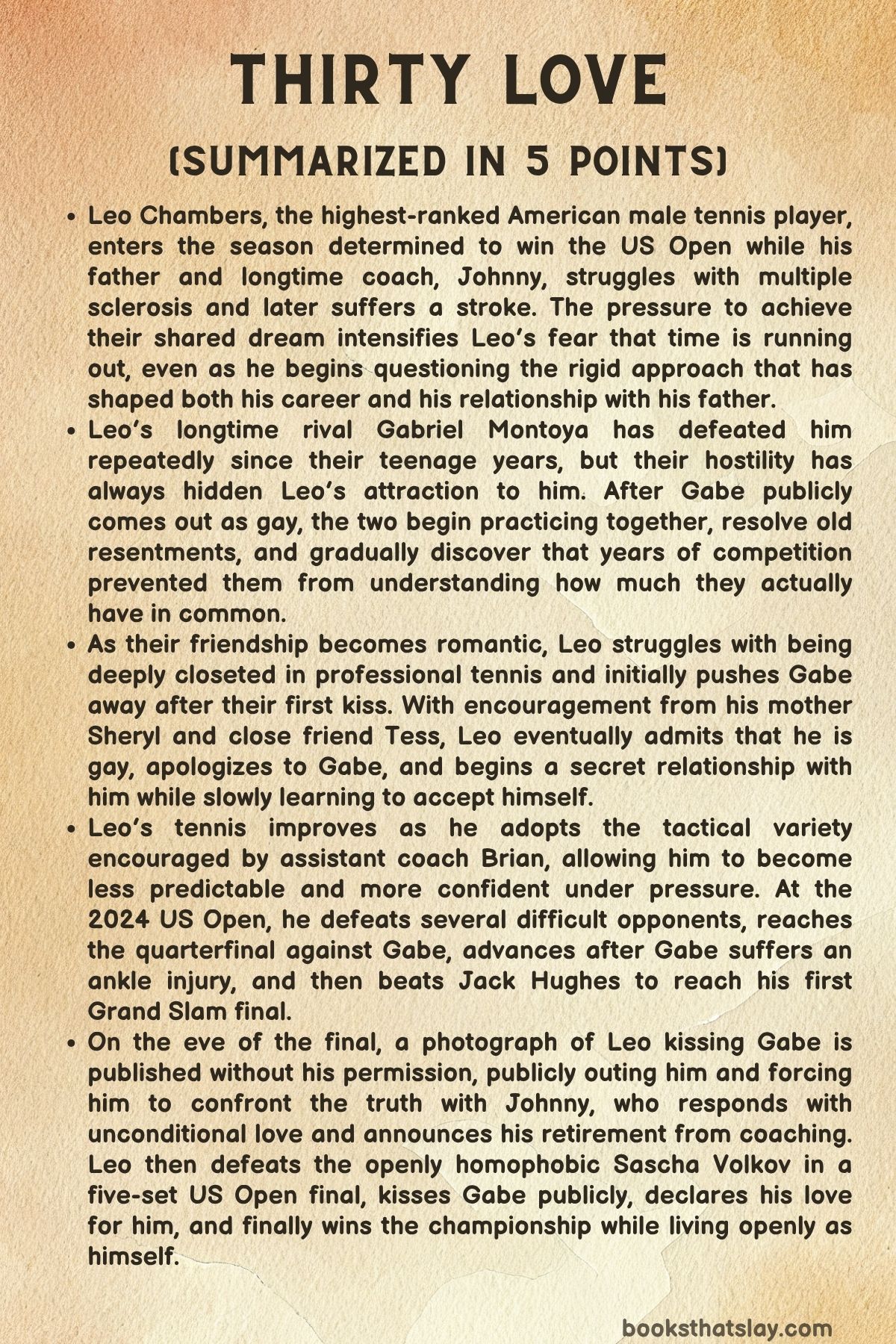
Characters
Leo Chambers
Leo Chambers is the emotional and narrative center of Thirty Love, a highly successful tennis player whose achievements have never been enough to free him from the belief that he is running out of time. At twenty-nine, he has won fifteen titles and become the highest-ranked American man, yet his lack of a Grand Slam makes him view his career through what remains missing rather than what he has already accomplished.
His relationship with tennis is inseparable from Johnny. Leo loves his father deeply and understands the sacrifices Johnny has made while living with multiple sclerosis, but this love gradually creates an unhealthy sense of obligation because Leo believes winning the US Open must happen while Johnny is still capable of coaching and remembering it.
Leo’s greatest internal conflict concerns his sexuality. He knows that he is gay and has privately been with men, but he has divided his life into carefully controlled sections so that his family, friends, sponsors, media, and fellow players never see the complete person.
This secrecy explains much of his initial response to Gabe. His intense fixation on Gabe begins with teenage attraction, but because Leo cannot comfortably acknowledge that attraction, he transforms it into hostility and competition.
His development as a player mirrors his development as a person. He begins with a powerful but predictable style, resisting variation much as he resists emotional uncertainty, whereas Brian’s influence and Gabe’s example gradually teach him to accept flexibility, patience, and risk.
Leo’s final championship therefore represents more than professional success. By the time he wins, he has confronted his father, accepted love, admitted his sexuality to people close to him, survived being outed, and chosen to enter the most important match of his career without returning to the emotional hiding place that once controlled him.
Gabriel Montoya
Gabriel Montoya initially appears in Thirty Love through Leo’s distorted perception of him as an arrogant rival who has spent years ruining important matches. As the story progresses, that image is dismantled, revealing a thoughtful, private, funny, and emotionally perceptive man who has also spent years interpreting Leo through incomplete assumptions.
Gabe’s playing style reflects his personality. He succeeds through variety, finesse, slices, drop shots, changes of pace, and tactical intelligence rather than relying purely on power, which is precisely why he has always been able to unsettle Leo.
His decision to come out publicly is one of the novel’s most significant acts of courage. Gabe knows that men’s professional tennis offers him little precedent for being an openly gay active player, yet he accepts the scrutiny even when homophobic comments, media expectations, and disappointing results turn every ordinary professional difficulty into a referendum on his identity.
Gabe is not presented as unaffected by that responsibility. He admits that people expect him to represent every gay athlete perfectly, showing that visibility can create pressure even when it also creates progress.
His treatment of Leo demonstrates considerable patience once their romantic relationship begins. Gabe never demands that Leo publicly come out simply because he has already done so himself, and he repeatedly recognizes that disclosure must happen according to Leo’s readiness rather than anyone else’s timetable.
His ankle injury in the US Open quarterfinal also shows how completely their relationship has changed. A match that once would have represented another chapter in their bitter rivalry becomes a moment of mutual care, and Gabe’s later decision to attend the final injured, carrying a Pride flag and Johnny’s message, confirms that supporting Leo matters more to him than the competitive history between them.
Johnny Chambers
Johnny Chambers gives Thirty Love much of its emotional tension because he is simultaneously Leo’s loving father, professional coach, childhood hero, and greatest source of pressure. A former US Open finalist whose career was shortened by multiple sclerosis, Johnny has transferred much of his competitive energy into helping Leo achieve the championship that remained beyond his own reach.
His influence on Leo is not malicious. Johnny genuinely believes that discipline, repetition, and concentration are necessary for elite success, and his phrase “hold your own” has supported Leo since childhood during moments of fear and uncertainty.
Nevertheless, Johnny has difficulty recognizing when his methods stop helping. He dismisses tactical changes, reasserts authority when returning after his stroke, and initially treats doubles and other parts of Leo’s developing life as distractions from the US Open goal.
His stroke forces both men to confront realities they have avoided. Leo must recognize that his father’s presence cannot be guaranteed forever, while Johnny eventually accepts that physical limitations and changing circumstances make permanent control of Leo’s career impossible.
Johnny’s reaction when Leo comes out confirms the distinction between professional pressure and parental love. Instead of treating Leo’s sexuality as a disappointment, Johnny places it beside his own experience of living with MS and understands the fear of being defined by something other people view as different.
His decision to retire from coaching is therefore an act of acceptance rather than defeat. By handing responsibility to Brian, he allows Leo to become professionally independent while remaining his father, transforming their bond from one structured around performance into one that can exist beyond tennis.
Brian Wilkins
Brian Wilkins functions as the coaching alternative Leo needs in Thirty Love, particularly after Johnny’s stroke temporarily removes him from the tour. Where Johnny often trusts established routines and Leo’s familiar strengths, Brian recognizes that Leo’s inability to adapt has become a weakness against players such as Gabe.
His most important decision is arranging practice between the two longtime rivals. Brian understands that avoiding the opponent who causes Leo the most trouble will never solve the underlying problem, so he encourages Leo to study Gabe’s patterns and learn from them.
Under Brian, Leo experiments with drop shots, volleys, changes of pace, and tactical variation. These adjustments do not replace his powerful natural game; instead, they expand it, allowing him to respond intelligently when opponents disrupt his preferred rhythm.
Brian is also important because his success exposes the limitations of Johnny’s authority. Leo begins to discover that respecting his father does not require treating every coaching decision as unquestionable.
By the final US Open, even Johnny has accepted many of Brian’s changes. Johnny’s eventual decision to retire and allow Brian to become Leo’s primary coach represents the natural next stage of Leo’s professional life and confirms that growth sometimes requires changing a relationship that once worked extremely well.
Tess Soriano
Tess Soriano is one of the strongest sources of friendship and emotional stability in Thirty Love. A highly ranked Filipino American player with her own professional pressures, she understands elite tennis well enough to challenge Leo without dismissing the demands that shape his choices.
Tess recognizes problems in Leo’s game and coaching relationship before he is prepared to confront them. She encourages him to vary his tennis and to speak more honestly with Johnny rather than continuing to accept every instruction simply because it comes from his father.
Her teasing about Gabe is lighthearted, but it also reflects how clearly she notices Leo’s emotional changes. Long before Leo admits the truth about their relationship, Tess sees that his interest in Gabe has become much more personal than an unusual new friendship.
When Leo finally comes out to her, her reaction is immediate acceptance. She neither dramatizes the disclosure nor makes Leo defend why he remained closeted for so long, instead encouraging him not to consider the years before his disclosure wasted.
Tess’s Wimbledon run also gives her an independent role beyond supporting Leo. Her speech after finishing runner-up emphasizes representation for women of color and young athletes who need to see people like themselves succeeding publicly, creating a parallel with Gabe and later Leo’s place within queer representation in men’s tennis.
Ollie Tremblay
Ollie Tremblay is Leo’s close friend and part of the dependable circle that exists beyond coaching, rankings, and public expectations. His presence becomes particularly meaningful after Johnny’s stroke, when he and Tess support Leo and his family during a frightening period.
Ollie also helps create social spaces where Leo can temporarily exist outside the narrow identity of professional athlete. Game nights, friendship, humor, and his connection with Pawsitive Futures give the story ordinary human moments against the constant pressure of tournament competition.
His animal rescue work also becomes the setting for Leo and Gabe to spend relaxed time together during the Miami Open. These scenes help their relationship develop through shared experiences rather than only through tennis matches or private attraction.
Ollie does not direct Leo’s major decisions, and that is part of his importance. He represents the kind of friendship that provides stability without demanding control, contrasting with the professional relationships in Leo’s life that constantly evaluate his choices according to results.
Sheryl Chambers
Sheryl Chambers is quieter than Johnny but becomes essential to Leo’s emotional progress. As Johnny’s wife, she has spent years living alongside the realities of multiple sclerosis and understands how illness, fear, and other people’s judgments can influence intimate relationships.
Johnny’s stroke reveals her vulnerability because Leo sees how frightened she is despite her efforts to remain composed. Her position also reminds Leo that his father’s illness affects an entire family rather than belonging only to the father-son coaching relationship.
Her most important conversation with Leo occurs in Paris after his relationship with Gabe has deteriorated. Sheryl recognizes that Leo seemed happier when Gabe was close to him and encourages him not to give up an important person simply because other people might disapprove.
She draws on her own history with Johnny, remembering how others once warned her against loving a man with MS. Without demanding that Leo explain his sexuality, she gives him permission to value love above anticipated judgment.
Sheryl therefore becomes one of the people who helps Leo move toward honesty before she even knows exactly what he is hiding. Her acceptance is communicated through understanding rather than interrogation.
Sascha Volkov
Sascha Volkov serves as both a sporting rival and a representation of the hostile attitudes Leo and Gabe must navigate within professional tennis. He is a celebrated Russian champion with a volatile personality whose repeated homophobic comments expose the cultural environment that contributes to Leo’s fear of coming out.
His behavior toward Gabe is particularly revealing because the harm does not come only from direct insults. Other players sometimes laugh or remain silent, showing how prejudice survives through group tolerance as well as through the person openly expressing it.
For Leo, Sascha becomes increasingly difficult to ignore. Early in the story, Leo is angry at offensive remarks but often says little, demonstrating how remaining closeted has taught him to protect himself through silence.
The final against Sascha therefore carries symbolic importance without ceasing to be a genuine sporting contest. Leo must defeat a player who has repeatedly embodied the attitudes he feared, but he does so after his sexuality has already been exposed to the world.
His comment at the net after winning reverses the power dynamic. Leo no longer needs to protect Sascha’s comfort or conceal himself, and the championship allows him to respond publicly as someone who has stopped accepting shame as the price of belonging.
Paul Davis
Paul Davis begins as a tennis media personality who interviews Leo and Johnny, but his role becomes increasingly critical as the story examines the difference between reporting on athletes and exploiting them. His podcast and gossip-oriented coverage turn players’ lives into material for public consumption, often without serious consideration for the consequences.
The clearest example comes when Paul publishes the photograph of Leo kissing Gabe. The image does not merely reveal a romance; it discloses Leo’s sexuality before he has chosen to do so himself.
Paul sees the photograph partly through the value it can bring his struggling show, which makes him representative of a media culture capable of prioritizing attention over consent. His actions force Leo into a public identity transition on the eve of the most important match of his career.
The confrontation with Paul also gives Leo an opportunity to state a broader principle. Athletes may be public figures, but visibility does not erase their right to control deeply personal information.
Jesse
Jesse initially appears connected to the tennis-media world, but the revelation that he runs Serving Looks complicates his position. He took the photograph of Leo and Gabe kissing in Paris, yet he deliberately chose not to publish it because he understood that doing so would out Leo without permission.
This choice distinguishes him sharply from Paul. Jesse participates in celebrity-oriented tennis coverage, but he recognizes that some information carries consequences that exceed ordinary gossip.
His apology after the photograph eventually becomes public shows that he understands his involvement still contributed to the situation. Later, however, he uses Serving Looks to help rally support for Leo before the final.
That action does not erase the violation Leo experienced, but it demonstrates Jesse’s attempt to use media reach responsibly. His character therefore illustrates that platforms themselves are not automatically harmful; their ethical value depends on how the people controlling them choose to treat the individuals they cover.
Billie
Billie is Gabe’s longtime friend and one of the people most protective of his emotional well-being. Through childhood stories and old photographs, she allows Leo to see parts of Gabe that years of professional rivalry had hidden from him.
Her reaction after Leo rejects Gabe following their first kiss is understandably hostile. Billie has watched Gabe deal with the pressure of publicly coming out, and she does not immediately trust someone who enters his life romantically and then retreats when fear becomes inconvenient.
Nevertheless, she eventually gives Leo Gabe’s hotel room number in Paris. The decision shows that her anger is motivated by loyalty rather than vindictiveness because she is willing to give Leo an opportunity to apologize when she believes reconciliation might genuinely help Gabe.
Billie therefore functions as a connection between Gabe’s private history and his professional present. She reminds Leo that Gabe existed as a full person long before their rivalry and romance became the center of Leo’s attention.
Liv
Liv belongs to the wider friendship circle surrounding Leo, Tess, Ollie, Gabe, and Billie. Her most revealing contribution comes when she discusses her previous relationship with Sascha and acknowledges that she tolerated troubling behavior while dealing with her own difficulties.
Her perspective adds complexity to the depiction of Sascha because it shows how harmful behavior can be overlooked within personal relationships as well as professional environments. Liv’s willingness to reconsider her past also supports the novel’s broader interest in people recognizing where fear, pain, or habit previously distorted their choices.
Although she does not influence Leo as directly as Tess or Sheryl, her presence helps create a social environment in which personal mistakes can be discussed honestly. She contributes to the contrast between relationships governed by control and those sustained through reflection and accountability.
Esme
Esme, Gabe’s agent, appears most significantly when she discovers the secret relationship between Gabe and Leo at Wimbledon. Her immediate concern is practical rather than judgmental because she understands how difficult it will be to keep a relationship between two famous players hidden from journalists, photographers, and people surrounding the tour.
Her warning anticipates exactly what later happens when the Paris photograph becomes public. Esme therefore represents the unavoidable logistical pressures surrounding celebrity relationships, especially when secrecy carries consequences far greater than ordinary romantic privacy.
She also highlights the unequal position Leo and Gabe occupy. Gabe is already publicly gay, while exposure of the relationship would simultaneously reveal Leo’s sexuality, meaning an ordinary photograph could change Leo’s life without his consent.
Chris Robinson
Chris Robinson represents the younger generation of American tennis and allows Leo to see his own career from a different angle. Leo first encounters him as a promising young player at Break Point and later faces him at the US Open when Chris is only sixteen.
During their fourth-round match, Chris plays with extraordinary energy and wins the opening set. Instead of responding with panic, Leo recognizes that the teenager cannot maintain the same intensity indefinitely and calmly changes his approach.
The encounter shows how far Leo has developed tactically. Earlier versions of him might have interpreted the lost set as evidence that another dream was slipping away, whereas the more mature Leo remains patient and solves the problem.
His encouragement toward Chris afterward also reveals generosity. Leo understands that elite competition does not require humiliating younger opponents, and his treatment of Chris suggests that he is becoming the kind of established player capable of helping the next generation rather than viewing every emerging talent as a threat.
Jack Hughes
Jack Hughes functions as an important measuring point for Leo’s progress because they meet at two very different stages of the season. Leo defeats him in the first round of the Australian Open while beginning his period under Brian, then faces him again in the US Open semifinal with a Grand Slam final at stake.
Their second match becomes far more demanding. Jack wins a set and forces Leo into several tense situations where returning to old, predictable patterns would have been easy.
Leo’s eventual four-set victory demonstrates the practical value of everything he has learned. He continues using variation and trusting his improved movement, serve, backhand, and tactical judgment rather than responding to pressure by becoming conservative.
Jack is therefore less important because of a personal relationship with Leo than because of what the rematch reveals. Beating him in New York confirms that Leo’s transformation is sustainable under championship pressure.
Themes
Identity, Visibility, and the Right to Choose
Much of Thirty Love is shaped by the difference between knowing one’s identity privately and deciding when that identity can safely become public. Leo has understood his sexuality for years, but professional men’s tennis has taught him to treat being gay as information requiring strict management, so every friendship, family conversation, locker-room encounter, sponsor obligation, and media appearance carries an invisible calculation.
Gabe provides a contrasting but connected experience because he chooses to come out publicly and immediately discovers that visibility brings both freedom and new burdens. Instead of simply being judged as a tennis player, he becomes expected to represent gay athletes generally, while poor results are interpreted by some reporters as evidence that coming out damaged his career.
The novel does not present public disclosure as a simple test of courage. Gabe repeatedly respects Leo’s refusal to come out because he understands that authenticity cannot be meaningful when another person dictates the timing.
That principle is violated when Paul’s program releases the photograph of Leo and Gabe kissing. The central harm is not that the photograph reveals something shameful but that Leo loses control over a deeply personal decision.
Leo’s final public openness therefore matters because it happens after the violation without allowing that violation to define him. He chooses to kiss Gabe, speak openly during the trophy ceremony, and identify himself before the world on terms that now belong to him rather than to the person who exposed him.
Love, Fear, and Emotional Honesty
Leo’s romantic relationship with Gabe repeatedly demonstrates how fear can distort genuine affection. Leo has wanted Gabe since adolescence, but because attraction feels dangerous, he spends years transforming fascination into hostility and using their tennis rivalry as a socially acceptable explanation for why Gabe occupies so much space in his thoughts.
Even after they become friends, Leo’s instinct remains defensive. Their first kiss produces happiness almost immediately followed by panic, and Leo sends Gabe away because he has learned to interpret emotional attachment as something capable of interfering with professional success.
The months that follow expose the flaw in that belief. Removing Gabe from his life does not make Leo more focused or successful; instead, he becomes unhappy and struggles professionally, suggesting that emotional suppression consumes energy rather than preserving it.
Sheryl’s advice becomes important because she recognizes the pattern without requiring Leo to explain everything. Her experience of choosing Johnny despite warnings about his illness teaches Leo that loving someone always involves uncertainties and that avoiding love because of anticipated difficulty does not protect a person from pain.
Gabe’s patience then gives Leo room to change. He accepts secrecy temporarily without treating himself as insignificant, while Leo gradually learns that commitment does not have to compete with ambition.
By the US Open final, love has become a source of stability rather than distraction. Gabe’s presence in the stands does not weaken Leo’s concentration; it helps him face the match as someone whose personal and professional lives no longer need to exist in opposition.
Parents, Expectations, and Independence
Leo’s relationship with Johnny shows how love can create pressure even when neither person intends harm. Johnny has coached Leo since childhood and built much of his own post-playing life around his son’s career, while Leo has responded by treating the US Open title as a shared obligation rather than merely a personal ambition.
Johnny’s multiple sclerosis intensifies this dynamic. Because Leo has watched his father’s body become less reliable over time, he develops a fear that every season may be their final opportunity to complete the dream together.
The stroke turns that anxiety into an immediate crisis. Leo stops competing to support his parents, but after Johnny returns, the fear of losing time makes their coaching relationship more rigid rather than healthier.
Brian’s success exposes the need for change. His willingness to encourage tactical experimentation demonstrates that Leo can respect what Johnny taught him while still developing beyond it.
The deeper conflict is therefore not between a good coach and a bad coach. Johnny’s methods helped create an elite player, but the relationship becomes limiting when past success is treated as proof that nothing should evolve.
Their conversation before the US Open final resolves the conflict because both men finally separate fatherhood from coaching. Johnny can retire without abandoning Leo, and Leo can accept Brian’s leadership without betraying his father.
“Hold your own” consequently gains a broader meaning. What began as Johnny’s instruction to a frightened child ultimately becomes permission for Leo to trust his own judgment, identity, relationships, and style of play.
Growth Through Change
Change repeatedly arrives in Thirty Love through situations Leo initially experiences as threats. Gabe’s tactical style threatens his confidence, Brian’s coaching threatens established habits, Johnny’s illness threatens their shared future, romantic attachment threatens Leo’s carefully controlled identity, and being outed threatens the privacy on which he has depended.
Leo’s early instinct is usually resistance. He tries to beat Gabe by repeating familiar patterns, obeys Johnny despite recognizing tactical problems, hides his sexuality, rejects Gabe after their first kiss, and treats the approaching age of thirty as evidence that opportunities are disappearing.
His progress begins when he stops assuming that change means losing what previously made him successful. Adding drop shots and volleys does not remove his powerful baseline game, accepting Brian’s ideas does not erase Johnny’s importance, and loving Gabe does not make him less committed to tennis.
The same principle applies to his identity. Living openly does not transform Leo into a completely different person; it removes the constant work required to keep existing parts of himself separated.
The US Open final brings these developments together. Under extreme pressure, Leo succeeds because he does not retreat into the habits that once felt safest.
He trusts tactical variety, accepts support from Johnny and Brian, draws strength from Gabe’s presence, and continues competing despite having been publicly exposed the previous day. Winning therefore becomes the result of adaptation rather than the reward for preserving everything exactly as it was.
The falling blue confetti completes this idea. Leo finally reaches the childhood dream that appeared to demand years of sacrifice, but he reaches it only after understanding that becoming more fully himself was never an obstacle to the dream; it was part of what allowed him to achieve it.