Tides of Fortune Summary, Characters and Themes
Tides of Fortune by Lauryn Hamilton Murray is a fantasy novel centered on Blaze Harglade as political conflict, forbidden histories, inherited magic, and unstable alliances reshape Ostacre.
Blaze’s search for the Eye of the Soul develops alongside Flint’s struggle with trauma, Elva’s divided loyalties, Hal’s threatened rule, and Fox’s attempt to stop King Balen from gaining greater power. The story expands the history of the Magi, the Rain Singers, the Demari, and House Castellion while repeatedly questioning whether identity is determined by blood, magic, family, or personal choice. It’s the 2nd book of the Storm Weaver series.
Summary
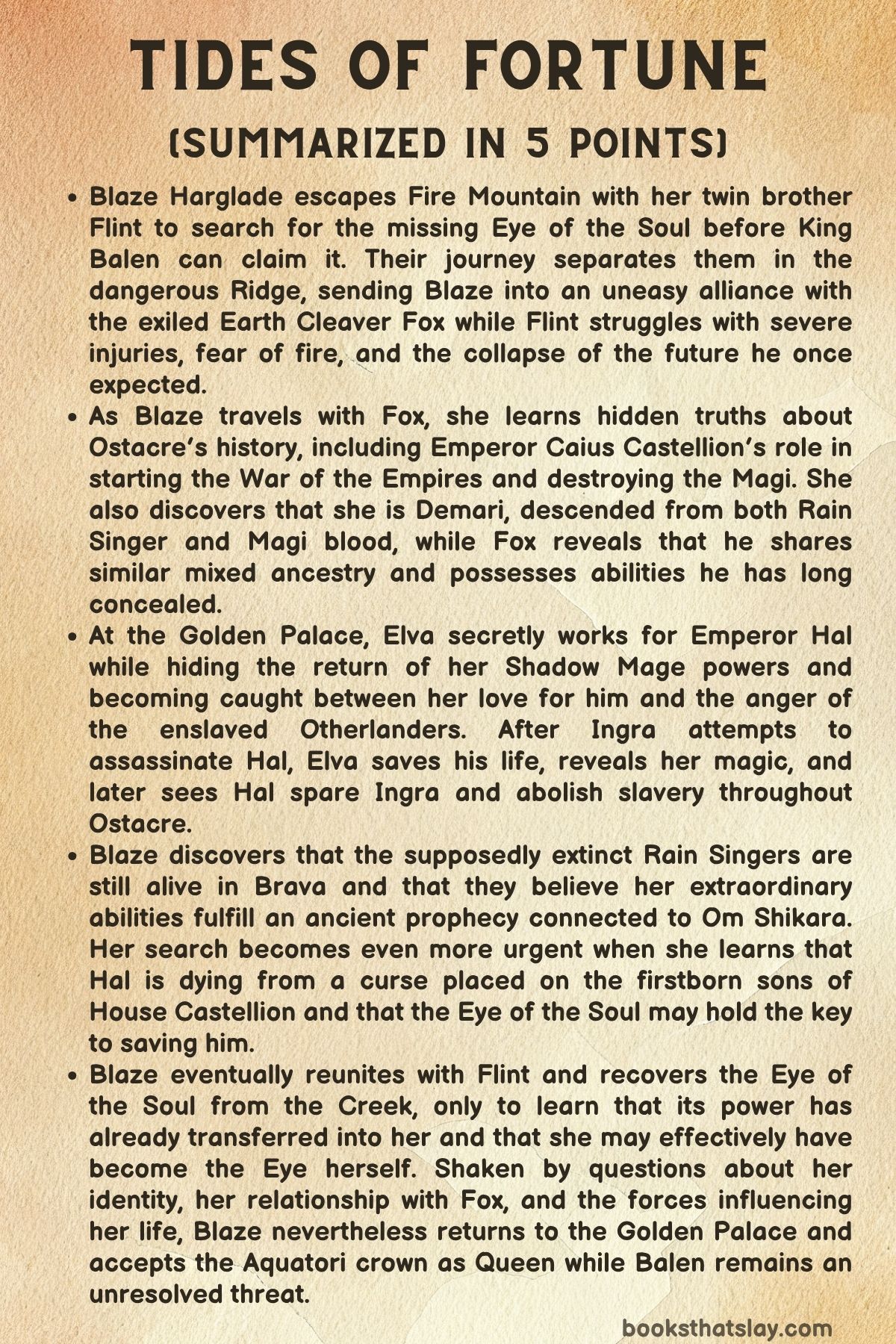
Tides of Fortune begins during Queen Yvainne’s funeral at Fire Mountain, where Blaze Harglade is already preparing to escape with her twin brother, Flint. Blaze fears King Balen is searching for the missing Eye of the Soul, and she believes she must recover it before taking the Aquatori crown that she earned during the Choosing.
The funeral suddenly becomes an attack when smoke is forced back into Fire Mountain and Balen’s voice reaches Blaze through the chaos. Flint finds her and leads her through hidden passages to the escape route they prepared, although Grandmother Leda tries desperately to stop them from leaving.
Blaze and Flint disguise themselves as ordinary Fidra and begin travelling toward the Lagoon, where Blaze suspects Queen Hydra may have sent the Eye. Their route takes them through Isolla and eventually into the Ridge, while Flint secretly struggles with the psychological consequences of the burns Ember inflicted upon him during the Choosing.
Inside the Ridge, they encounter a gigantic snake. Blaze is poisoned during the fight, and Flint is forced toward the fire magic he has been avoiding, but the enormous magical blast that kills the creature causes the cavern to collapse and separates the twins.
Blaze escapes the Ridge while hallucinating from venom and discovers Fox waiting on the Wildlands side. Fox treats her injuries and reveals that King Balen never possessed the true Eye of the Past because Fox replaced it with a false version before his exile.
Flint is eventually rescued by Spinner and Sheen, who help him escape the collapsed tunnels. Believing Blaze is heading toward the Waterlands, the three continue in that direction, while Flint hides his pain, fear of fire, and growing uncertainty about the future he once assumed would belong to him.
Blaze reluctantly accepts Fox as her travelling companion because he understands the Wildlands, possesses valuable knowledge, and shares her need to keep the enchanted Eyes away from Balen. Their relationship begins in distrust, but travelling together gradually exposes sides of each other that neither expected to respect.
Meanwhile, Elva remains in the Golden Palace with Emperor Haldyn, commonly called Hal. Her Shadow Mage abilities have unexpectedly returned, but she hides them even from Hal because she fears his Castellion upbringing may make him reject the kind of magic his ancestors once persecuted.
Hal’s political position worsens as Balen presents himself as the stronger alternative to the young emperor. Advisers question Hal’s judgement, public suspicion grows around Blaze, foreign rulers hesitate to commit themselves, and Hal’s planned marriage to Princess Mirade remains politically useful despite his love for Elva.
Hal also suspects that his own Imperial Eyes have been compromised. Because servants are often ignored by powerful courtiers, he recruits Elva to secretly observe them, search rooms, and identify possible supporters of Balen, unaware that the “shadow” he asks her to become is literally a Shadow Mage.
As Blaze travels with Fox, she experiences memories through the Eye of the Past and learns more about his years of travel and investigation. Their arguments increasingly reveal a fundamental difference between them: Fox expects people to repeat old betrayals, whereas Blaze still believes experiences can genuinely change a person.
Fox also begins training Blaze to survive without exposing her water magic. He teaches her to fight with Silverclaw, forcing her to become physically capable rather than relying entirely on powers that might reveal her identity to Balen’s followers.
Their journey eventually reveals the true origin of the War of the Empires. Through the Eye of the Past, Blaze sees Emperor Caius Castellion arrange the murder of Magi ambassadors, deliberately start the war, and force Syla to strip the Magi of their powers by threatening the life of her younger sister Senna.
The discovery changes Blaze’s understanding of Ostacre. What she once knew as history becomes evidence of calculated violence, conquest, slavery, and manipulation, while Fox explains that Balen has spent years seeking Demari, people of mixed Etheri and Magi ancestry whose abilities can develop in unexpected ways.
Flint, Spinner, and Sheen face their own dangers in the Greenwood. Flint is increasingly drawn toward Sheen despite their constant hostility, and an unexpected kiss forces him to reconsider assumptions about his attraction, his casual connection with Spinner, and the identity he constructed before his injuries.
The Greenwood also exploits Flint’s trauma. After eating enchanted fruit, he experiences a terrifying vision of the forest burning around him, and Sheen becomes the person who pulls him out of the hallucination before Spinner reappears and complicates the growing attraction between the two men.
Blaze and Fox’s relationship also crosses a decisive boundary. After they are captured while trying to free a wolf, Fox is forced into a brutal arena fight, and Blaze kills his opponent to save him before desperately treating Fox’s injuries and finally kissing him.
Soon afterward, Blaze secretly uses the Eye of the Past to investigate her own ancestry. She discovers that River and Grandmother Leda were once lovers, that River is her biological grandfather, and that her mother Analiese inherited mixed Rain Singer and Magi blood, making Blaze Demari.
Fox admits that he already knew part of the secret and then reveals that he is also Demari. His Magi-derived ability allows him to communicate mentally with animals, while the murder of his sister Freya appears connected to Balen’s long campaign to identify powerful mixed-blood families.
Fox then changes their destination against Blaze’s wishes and takes her to Brava, explaining that the Rain Singers were never completely destroyed. A hidden community has survived for generations, and when Blaze arrives, the Singers recognize the extraordinary scale of her power and identify her with the prophetic figure Om Shikara.
River confirms Blaze’s ancestry and explains that the Rain Singers may follow her regardless of whether she accepts their belief that she fulfills their prophecy. Blaze has spent most of her life thinking she was the last of her kind, so discovering an entire surviving community forces her to reconsider both her isolation and the kind of queen she may become.
Another revelation makes the search for the Eye urgent for personal reasons. Fox explains that Senna cursed the firstborn Castellion sons after Syla’s death, causing them to weaken and die young, and Hal is now suffering from that inherited curse.
At the Golden Palace, Elva faces a crisis of her own when she discovers that Ingra and other enslaved people intend to assassinate Hal. Elva understands their anger toward House Castellion but uses her Shadow Mage abilities to prevent Ingra from killing him, leaving her friend feeling completely betrayed.
Elva eventually tells Hal the truth about her magic. Although he accepts her as a Shadow Mage and insists that he still loves her, they separate when he initially refuses to spare Ingra, exposing the difference between private love and the political responsibilities of an emperor.
Hal later reverses course in a much larger way. At Ingra’s execution, he grants her mercy, acknowledges the violence inflicted by his dynasty, abolishes slavery throughout Ostacre, and declares every serf free, openly rejecting one of the foundations of Castellion rule.
Before Blaze can finish searching Brava, Balen attacks the Rain Singers with Ventalla soldiers and powerful Demari. River helps Blaze and Fox escape through a water portal, choosing survival over a battle designed to place Blaze directly in Balen’s hands.
Blaze guides the portal to Fox’s family cottage, where Flint, Spinner, and Sheen eventually arrive. The reunited group finally realizes that Queen Hydra’s instruction to follow the Creek was literal in a magical sense, and Blaze reaches into it to retrieve the missing Eye of the Soul.
Their victory immediately becomes something stranger. Fox proves that Blaze can perform the Eye’s magic even while holding the Eye of the Past, suggesting that Syla’s power transferred into Blaze when she first encountered the talisman and that the recovered Eye is now only an empty vessel.
Flint then admits that he did not produce the huge fire attack inside the Ridge because he has been unable to use fire since Ember burned him. Blaze therefore created Ignitia flame herself, strengthening Fox’s conclusion that the Eye’s powers have become part of her rather than remaining confined to an object.
The discovery devastates Blaze because it creates doubts about her own identity and even about her relationship with Fox. If magical forces drew them together, she wonders whether their attraction and affection belonged to them at all, and she isolates herself while trying to decide what remains genuinely hers.
Flint, Fox, Spinner, and Sheen return to the Golden Palace, where they exchange information with Hal and Elva. Fox and Hal establish a cautious reconciliation, Hal ends Fox’s exile, and preparations begin for a new Council even though Hal remains dangerously weakened by the curse.
Blaze eventually returns as well but keeps almost everyone at a distance while preparing for coronation. She is still angry about the secrets surrounding her birth and uncertain whether she can trust her feelings for Fox, yet she refuses to abandon the responsibility she fought to earn.
During the ceremony, Blaze considers every identity placed upon her: Storm Weaver, Rain Singer, Demari, living Eye, and possible figure of prophecy. None of those labels gives her certainty about the future, but when the Aquatori crown is finally placed on her head, she becomes Queen on her own terms as much as circumstances will allow.
Characters
Blaze Harglade
Blaze is the central figure of Tides of Fortune, and her development is built around a struggle for ownership of her identity. She begins determined to recover the Eye of the Soul and claim the Aquatori crown, believing that completing those goals will finally give her control over a life that has been managed by relatives, courts, fear, and political expectations.
Her greatest conflict is that every answer produces another identity she did not choose. She learns she is Demari, discovers that the supposedly extinct Rain Singers still exist, becomes associated with Om Shikara, and finally learns that the magical power of the Eye of the Soul may actually reside inside her body.
Blaze is also forced to develop beyond magical strength. Fox teaches her to fight physically, survive outside court, judge danger independently, and accept that receiving help does not automatically mean surrendering control.
Her relationship with Fox becomes important because it challenges her emotionally rather than politically. Blaze can handle hostility more easily than tenderness, and once she begins loving him, the possibility that magic influenced their attraction terrifies her because it threatens the one relationship she believed might have resulted from personal choice.
Her coronation therefore represents neither simple triumph nor complete resolution. Blaze becomes Queen while still uncertain about prophecy, power, family, and love, showing that maturity for her means accepting responsibility without pretending every question has already been answered.
Flint Harglade
Flint undergoes one of the strongest personal transformations in the novel. Once confident, attractive, humorous, magically gifted, and certain that he would become Ignitia king, he is now scarred, missing an eye, physically weakened, and deeply traumatized by Ember’s attack.
His fear of fire destroys the foundation of the identity he once relied upon. Flint continues joking and flirting because those behaviours allow him to imitate the person he used to be, but internally he believes the former Flameborn heir has effectively died.
His journey through the Ridge and Greenwood repeatedly removes the privileges that protected him. He becomes dependent on Spinner and Sheen, struggles with hunger and pain, confronts people who resent Etheri power, and begins reconsidering whether becoming king was ever truly his desire or simply a future chosen for him.
Sheen’s attraction creates another disruption. Flint has treated romance casually in the past, but his reaction to Sheen is unfamiliar enough to make him question the categories he previously used to understand himself.
Most importantly, Flint eventually admits that he cannot use fire. Speaking the truth removes the performance of confidence and allows his family to understand that his injuries are psychological as well as physical.
Fox
Fox begins Tides of Fortune as a dangerous exile whose intelligence, secrecy, and willingness to manipulate others make him difficult to trust. His possession of the real Eye of the Past immediately establishes that he has been planning against Balen with considerably more foresight than others understood.
His harsh exterior is gradually complicated by his abilities as a healer, traveller, researcher, fighter, and protector. Blaze discovers that the man associated with destruction also knows how to save lives, care for animals, survive in the wilderness, and preserve memories of people he has lost.
Fox’s greatest weakness is his belief that withholding information is acceptable when he thinks disclosure would cause harm. He hides Blaze’s ancestry, drugs her when he wants to redirect their journey, and repeatedly decides what truths other people are ready to hear.
His relationship with Blaze challenges that habit because she demands honesty as a condition of trust. He clearly grows to love her, yet even their connection becomes complicated when he admits that the enchanted Eyes may have influenced the attraction between them.
Fox is also defined by grief over Freya and resentment toward Balen. His belief that he is the person who “does the breaking” functions as both reputation and emotional defence, allowing him to avoid admitting how deeply his family losses continue to affect him.
Elva
Elva’s story centers on identity, freedom, and divided loyalty. She begins as a formerly enslaved woman secretly involved with Hal while concealing the return of her Shadow Mage powers because she fears that even the man who loves her may have inherited Castellion prejudice.
Her position allows her to see both the personal goodness in Hal and the political suffering created by his dynasty. That conflict becomes severe when Ingra joins a plot to assassinate him, because Elva understands exactly why formerly enslaved people might hate the Castellions even while knowing Hal as an individual.
Stopping the assassination makes Elva feel she has betrayed her own people. Revealing her Shadow Mage abilities then becomes another test, because she must decide whether love is meaningful if she can only preserve it by hiding part of herself.
Hal accepts her magic, but their disagreement over Ingra exposes the limits of romantic affection when one person possesses imperial power. Elva refuses to accept a relationship in which political injustice can simply be ignored for private happiness.
Her influence becomes especially significant when Hal eventually frees the serfs. She represents both a reminder of what the Castellions did and evidence that a different future requires confronting that history openly.
Emperor Haldyn
Hal is a young ruler struggling to distinguish his reign from the violent legacy of House Castellion. He inherits political instability, hostile advisers, Balen’s challenge, a threatened foreign alliance, slavery, and an inherited magical curse that is slowly killing him.
His greatest strength is his capacity to change when confronted with the moral consequences of inherited power. He initially believes his responsibilities as emperor prevent him from showing mercy to Ingra, but he later recognizes that enforcing the system created by his ancestors will only continue the violence they began.
His decision to abolish slavery becomes the clearest statement of his character. Hal risks weakening his political position during a conflict with Balen because he decides that preserving an unjust institution would make his reign morally indistinguishable from the dynasty he claims he wants to reform.
His relationship with Elva also humanizes him while testing his principles. Accepting her as a Shadow Mage proves that he can reject inherited prejudice personally, while freeing the serfs proves that he is willing to translate that rejection into law.
King Balen
Balen is the principal political antagonist and operates primarily through manipulation, intimidation, misinformation, and carefully prepared force. Rather than immediately seizing Hal’s throne, he cultivates the image of an experienced ruler who could provide stability while portraying Hal as weak and Blaze as dangerous.
His obsession with the enchanted Eyes and the Demari reveals a longer strategy. Balen has apparently spent years locating individuals with mixed blood and unusual powers, turning inherited differences into resources for his own ambitions.
He is especially dangerous because he understands that controlling public perception can be as effective as military victory. Rumours surrounding Blaze, divisions among Hal’s advisers, compromised spies, released prisoners, and black-feather warnings gradually weaken confidence in the emperor.
Balen also represents power without ethical restraint. His attack on the hidden Rain Singers demonstrates his willingness to endanger entire communities if doing so increases his chances of capturing Blaze or gaining access to greater magic.
Ember
Ember functions as both Flint’s personal antagonist and an example of ambition separated from compassion. Her public decision to light Queen Yvainne’s pyre before Grandmother shows her determination to claim authority visibly and immediately.
The physical damage she inflicted on Flint reaches far beyond his scars. By burning him and destroying his eye, Ember shattered his confidence in fire magic and therefore attacked the identity he had developed from childhood.
Her presence consequently continues affecting Flint even when she is absent. Every panic attack, avoidance of fire, and memory of losing his expected crown carries the psychological consequences of what she did.
Sheen
Sheen initially appears severe, controlled, and frequently irritated by Flint. His behaviour contrasts with Spinner’s warmth, making him seem emotionally distant even while he repeatedly protects Flint during the journey.
The kiss in the Greenwood reveals that much of his hostility has been covering an attraction he does not know how to manage. His immediate withdrawal afterward suggests that the feeling conflicts with his loyalties, his assumptions about Flint, or his concern for Spinner.
Sheen becomes important to Flint because he sees him at his weakest. He rescues Flint from false voices, magical dangers, and the hallucination created by the enchanted fruit, giving their relationship a foundation based on vulnerability rather than Flint’s usual charm.
His protective behaviour frequently says more than his words. Sheen may resist emotional openness, but his actions repeatedly show that Flint matters to him.
Spinner
Spinner provides warmth, familiarity, and emotional stability during Flint’s journey. She has an existing romantic history with him and is comfortable offering physical affection, humour, and reassurance when his injuries leave him vulnerable.
Her connection with Flint becomes more complicated once Sheen’s feelings emerge. Spinner represents a form of affection Flint already understands, whereas Sheen represents something unfamiliar that forces him to question himself.
She is also more capable than Flint initially gives her credit for. Her survival through the Wildlands and Greenwood, her connections with Fox and Sheen, and her role in finding Blaze all make her an active participant rather than simply a romantic companion.
River
River begins as a mysterious figure from Blaze’s past but eventually becomes central to her understanding of herself. The Eye of the Past reveals that he and Leda were once deeply in love and that their daughter Analiese became Blaze’s mother.
As a man with Rain Singer and Magi ancestry, River explains the mixed blood that eventually produced Blaze’s extraordinary abilities. His history turns what Blaze considered an unexplained magical abnormality into part of a hidden family lineage.
River also acts as a bridge between Blaze and the surviving Rain Singers. He understands their culture, their prophecy, and the political significance of their willingness to follow her.
His statement that his true home became Leda rather than a physical place gives him an emotional depth that parallels several other relationships in the story. Home, for River, is ultimately defined by attachment rather than geography.
Grandmother Leda
Leda is fiercely protective but repeatedly makes decisions for younger members of her family in the name of that protection. Her attempt to stop Blaze from escaping Fire Mountain reveals genuine fear for her granddaughter, yet she ultimately recognizes that Blaze cannot remain hidden forever.
Her past with River exposes the personal sacrifices beneath her authority. Social expectations and war separated them, and the secrecy surrounding their daughter eventually became a secrecy surrounding Blaze.
Leda’s central flaw is paternalism. She believes dangerous information can be withheld if doing so keeps someone safe, but Blaze experiences that protection as another form of control.
Her concealment of Blaze’s ancestry therefore damages the relationship precisely because her motives were not entirely selfish. The story shows how love can become destructive when one person assumes the right to decide what another is allowed to know.
Ingra
Ingra embodies the anger produced by generations of conquest and enslavement. She initially appears as Elva’s close friend and confidante, but her involvement in the assassination conspiracy reveals how differently the two women have come to imagine freedom.
To Ingra, Hal remains the representative of the dynasty responsible for her people’s suffering. His personal kindness does not erase the institution he inherited, and killing him appears to her as an act of resistance rather than simple murder.
Elva’s decision to stop her therefore feels like an unforgivable betrayal. Their prison confrontation is powerful because neither woman’s position can be reduced to simple selfishness.
Ingra’s eventual survival allows Hal to change the meaning of her rebellion. By granting mercy and abolishing slavery, he responds to her violence not by pretending it was justified but by addressing the system that produced it.
Cole
Cole represents a more personal form of abuse and entitlement within the Golden Palace. Elva notices Elaith’s bruises and eventually witnesses Cole drunkenly confronting her, confirming that their relationship is far more threatening than appearances suggest.
He also receives undeserved praise after Elva uses her Shadow Mage abilities to stop Ingra’s assassination attempt. His accidental role in concealing Elva’s secret is useful to her, but it also demonstrates how easily recognition can be assigned to the wrong person when existing assumptions determine what people expect to see.
Elaith
Elaith is one of the more sympathetic noble characters. She treats Elva with friendliness and requests her as an attendant, creating a safer position for Elva within a palace environment where servants are usually treated as invisible.
Her bruises gradually reveal that she is hiding mistreatment from Cole. Her attempts to dismiss the injuries as accidental suggest fear, embarrassment, or a belief that openly challenging him may create consequences she is not prepared to face.
Elaith therefore shows that social position does not automatically protect someone from private harm. Her experiences also sharpen Elva’s ability to recognize suffering hidden beneath courtly appearances.
Caius Castellion
Caius is the historical source of many of the conflicts affecting the present. Through the Eye of the Past, Blaze discovers that he arranged the murder of Magi ambassadors and deliberately provoked the War of the Empires while seeking the enchanted Eyes.
His cruelty becomes especially clear when he forces Syla to choose between protecting the Magi and saving Senna. By exploiting the sisters’ love, he creates the circumstances that eventually lead to the destruction of Magi power and the enslavement of their descendants.
His later appearance to Elva shows that his influence extends beyond history. He understands bloodlines, prophecy, Blaze’s importance, and the curse affecting the Castellions with an unsettling degree of certainty.
Caius therefore represents inherited wrongdoing in its purest form. Characters living generations later remain trapped inside consequences produced by his pursuit of power.
Syla
Syla is one of the most tragic figures in the historical storyline. Captured by Caius and forced to choose between the survival of the Magi and the life of her younger sister, she chooses Senna.
Her decision has catastrophic consequences, but the story presents it as an impossible moral choice rather than simple betrayal. Caius deliberately transforms love into a weapon, ensuring that every possible decision will cause suffering.
Syla’s connection to the Eye of the Soul eventually becomes crucial to Blaze. The possibility that the Eye’s magic has transferred into Blaze makes Syla’s legacy active in the present rather than merely historical.
Senna
Senna survives because Syla sacrifices the Magi’s power to save her. That survival eventually produces another consequence when Senna, herself Demari, develops the ability to create curses.
Her curse against the firstborn Castellion sons is an act of vengeance against Caius and his descendants. Although Caius committed the original crimes, later people such as Hal suffer for bloodline membership rather than personal guilt.
Senna therefore adds another layer to the novel’s examination of inherited punishment. Her suffering is understandable, but her revenge demonstrates how trauma can continue reproducing harm long after the original perpetrators are gone.
Freya
Freya is largely present through Fox’s memories, yet she is essential to understanding him. His memories of learning healing beside her expose a gentle, affectionate part of his childhood that contrasts sharply with the guarded man Blaze knows.
Fox believes Balen killed Freya because of their Demari bloodline. Her death therefore helps explain his hatred of his uncle, his obsession with secret histories, and his instinct to protect people through control rather than trust.
Freya’s absence has become part of Fox’s identity. His refusal to speak about her easily reveals that his reputation for emotional hardness is partly built around grief he never resolved.
Analiese
Analiese becomes important through the revelation of Blaze’s ancestry. She is the daughter of Leda and River, inheriting mixed Rain Singer and Magi blood even though she outwardly appeared connected to Ignitia.
Her unusually powerful fire was therefore not simply an unexplained Harglade gift. Her abilities represented the Demari heritage later inherited by Blaze.
Analiese’s history changes Blaze’s interpretation of her own birth. The catastrophic storm accompanying Blaze’s arrival is no longer evidence that she was some inexplicable magical mistake but part of a bloodline whose powers had deliberately been hidden.
Kestrel
Kestrel is Fox’s mother and another concealed link in the Demari bloodlines Balen has been seeking. Fox explains that she possesses mixed abilities that were deliberately hidden, helping him understand why his own powers extend beyond ordinary Terrathian magic.
Although she has limited direct involvement in the events described, her existence proves that mixed Etheri-Magi ancestry survived across multiple families. She therefore contributes to the larger collapse of the supposedly clear divisions between magical peoples.
Renly
Renly represents emotional safety for Blaze. During the snake venom hallucinations, the imagined sight of her younger brother helps motivate her to keep moving rather than surrender to death.
He later becomes one of the very few people Blaze allows close to her before coronation. His importance comes less from political power than from the fact that his presence connects Blaze to family without demanding that she perform as Storm Weaver, Demari, Eye, or Queen.
Queen Hydra
Queen Hydra continues influencing events even after her absence because Blaze interprets her past words as clues to the location of the Eye. Blaze initially assumes the Lagoon must be the destination because Hydra considered it a haven.
Her instruction about following the Creek eventually proves more important. Blaze realizes that she had misunderstood Hydra by thinking only geographically, and the clue ultimately leads her to recover the Eye of the Soul from the Creek itself.
Queen Yvainne
Queen Yvainne’s funeral provides the opening crisis of the novel. Her death brings the major political families together at Fire Mountain, giving Balen an opportunity to target Blaze and forcing Blaze and Flint to begin their escape earlier than normal circumstances might have allowed.
She also carries emotional significance because Fox later apologizes to Blaze for Yvainne’s death. Her loss remains part of the moral weight surrounding the destruction of the Crowned Council.
Princess Mirade
Mirade represents the political expectations attached to Hal’s role as emperor. His proposed marriage to her could strengthen his position when rulers such as King Merrick refuse to support him without proof that his reign is secure.
Her importance is therefore less romantic than structural. The possibility of marriage reminds both Hal and Elva that emperors are expected to treat personal relationships as political resources.
Scout and Cedar
Scout and Cedar reveal an unexpectedly gentle dimension of Fox. His connection with them is eventually explained by his Demari ability to communicate mentally with animals.
They also demonstrate that Fox’s protective instincts extend beyond people. His willingness to risk capture to free an abused wolf becomes far more understandable once Blaze learns that animals are not simply creatures he likes but beings with whom he can communicate directly.
Themes
Identity Versus the Identities Imposed by Others
Blaze’s struggle to define herself becomes the clearest expression of this theme in Tides of Fortune. She spends much of her life surrounded by labels created by other people: Storm Weaver, last Rain Singer, dangerous magical child, future queen, Demari, Om Shikara, and finally the living embodiment of the Eye of the Soul.
Each new revelation appears to explain Blaze while simultaneously making her feel less able to claim ownership of herself. Even the Aquatori crown, which she fought to win, threatens to become another role whose expectations restrict her freedom.
Flint experiences the same conflict differently. His old identity was based on being attractive, confident, Flameborn, and destined to become king, but Ember’s attack removes the physical and magical certainty on which that identity depended.
Elva likewise refuses to remain confined to the labels of serf, lover, servant, spy, or Mage. Her decision to reveal her Shadow Mage abilities to Hal demands that he either accept her complete identity or lose the version of their relationship built around concealment.
The novel ultimately treats identity as something inherited circumstances can influence but cannot fully determine. Blaze’s coronation matters because she accepts a public role without pretending that prophecy, ancestry, magical power, or other people’s expectations have finished defining who she will become.
Inherited Guilt, Historical Violence, and the Possibility of Change
The present political crisis exists because people are still living with decisions made generations earlier. Caius Castellion’s murder of Magi ambassadors, manipulation of Syla, destruction of the Otherlands, and enslavement of conquered peoples establish systems that continue harming people long after his own reign.
Senna’s curse extends the same pattern from the opposite direction. Her revenge targets firstborn Castellion sons, meaning Hal suffers for the crimes of an ancestor whose values he increasingly rejects.
Ingra’s assassination attempt emerges from this history as well. From her perspective, Hal inherits not merely a crown but a system created by conquest, and his private kindness cannot automatically erase the violence represented by that throne.
Hal’s eventual decision to free the serfs offers the strongest answer to the problem of inherited responsibility. He cannot undo what Caius did, and he cannot simply declare himself innocent because he did not personally establish slavery.
Instead, Hal accepts that inheriting power also means inheriting the responsibility to change the structures maintained by that power. The novel therefore distinguishes inherited guilt from inherited obligation: descendants do not automatically share the moral blame of their ancestors, but they become accountable for what they choose to preserve once they understand the consequences.
Freedom, Choice, and Control
Blaze’s desire for freedom appears almost immediately when escaping Fire Mountain gives her the rare experience of travelling without guards, court restrictions, or constant supervision. Yet physical freedom repeatedly proves incomplete because other people continue making decisions for her.
Grandmother hides her ancestry to protect her, Fox withholds information and eventually drugs her to redirect their journey, and the Rain Singers place religious expectations upon her. Even magical objects appear capable of influencing her life in ways she never knowingly accepted.
The resulting conflict makes consent and personal choice central to Blaze’s relationships. She can forgive mistakes more easily than she can accept someone deciding that she should not be allowed to choose for herself.
Elva faces the political version of the same issue. The abolition of slavery matters because Hal does more than improve conditions for the serfs; he gives them the right to decide whether they will leave Ostacre, return home, or remain as paid workers.
Flint also begins separating genuine desire from expectations imposed upon him. Once the Ignitia throne is no longer guaranteed, he finally asks whether becoming king was truly his ambition.
Freedom throughout the story is therefore presented not as simple escape from danger but as the ability to make meaningful decisions about one’s own future.
Love, Trust, and the Risk of Vulnerability
Love repeatedly forces characters into situations where emotional honesty is more difficult than physical danger. Blaze and Fox begin by distrusting one another, yet surviving together gradually replaces hostility with reliance, attraction, affection, and eventually love.
Their greatest problems arise not from enemies but from secrecy. Fox repeatedly withholds information because he believes he is protecting Blaze, while Blaze experiences those decisions as evidence that he still does not fully respect her ability to make choices.
The possibility that the Eyes influenced their attraction intensifies that conflict. Blaze can survive learning that she is Demari or becoming a vessel for extraordinary magic more easily than she can accept uncertainty about whether her feelings belong to her.
Elva and Hal face a parallel test. Their love survives the revelation that Elva is a Shadow Mage, proving that inherited prejudice does not completely control Hal, but their relationship nearly fails over Ingra because love cannot erase political disagreement.
Flint and Sheen provide another version of vulnerability. Their attraction emerges through hostility because both men find emotional openness more threatening than banter or conflict.
Across these relationships, love becomes meaningful only when characters accept uncertainty and allow another person to see parts of themselves that cannot be controlled, performed, or safely hidden.