To Drown a Witch Summary, Characters and Themes
To Drown a Witch by Lindsey Olsson is a dark fantasy novel built around forbidden magic, political fear, revenge, grief, and betrayal. At its center are Nes Deivana, a young woman with an extraordinary sensitivity to magic, and Toran Roada, a celebrated soldier ordered to hunt the mysterious Witch blamed for a series of violent attacks in Gadore.
Their reluctant partnership gradually becomes something more personal as they uncover corruption within the King’s Guard, learn the truth behind a massacre in the north, and discover that almost everyone around them is hiding something. What begins as a hunt for one dangerous woman eventually becomes a conflict over identity, trust, power, and survival.
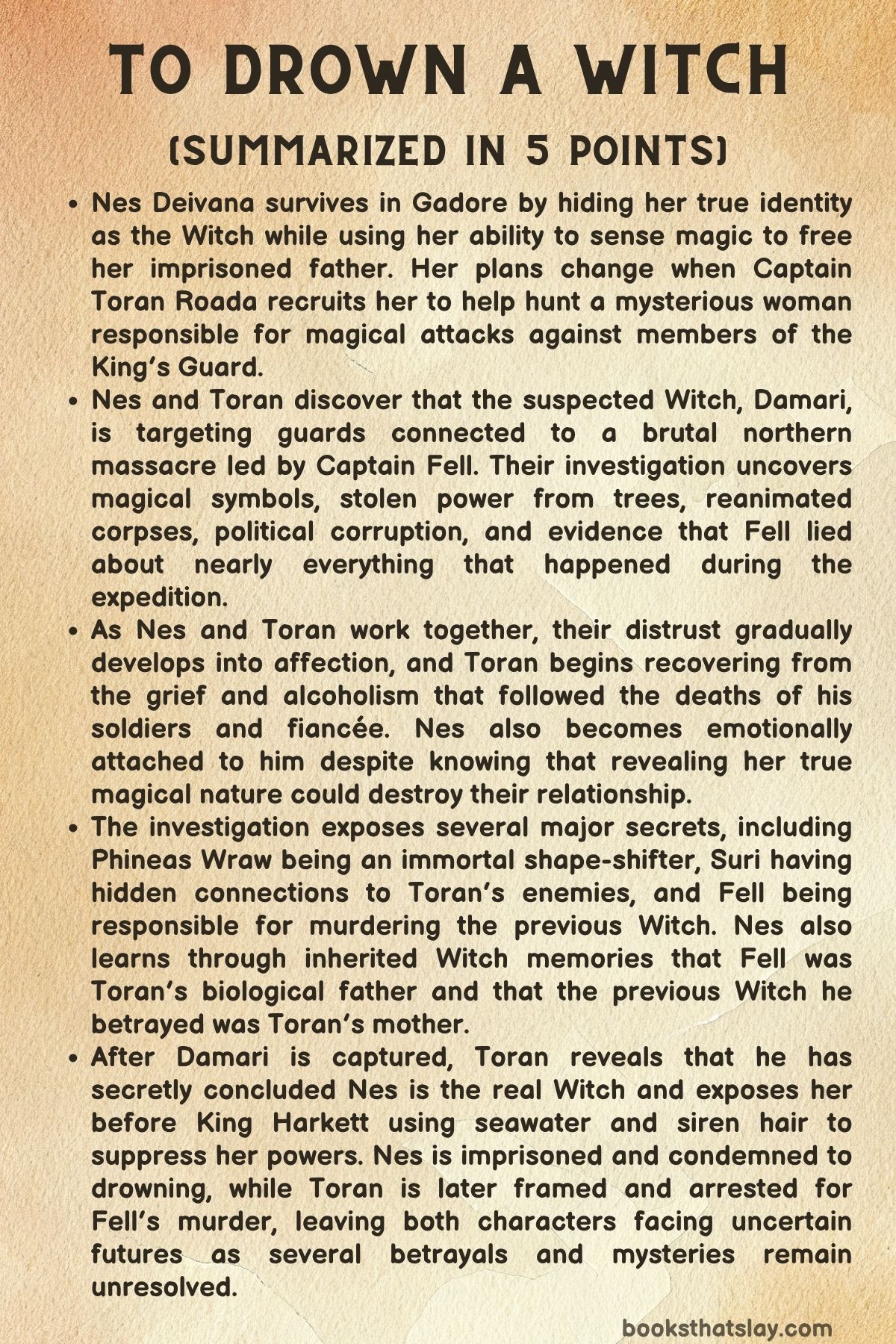
Summary
Nes Deivana survives in Gadore by working for Phineas Wraw, a powerful criminal who runs an underground magical brawlhouse beneath the Siren’s Hair. Nes can smell magic, making her exceptionally useful for finding people whose bodies react unusually when they consume diluted magical substances.
For two years, she serves Phineas because he has promised to secure the release of her imprisoned father, a former member of the King’s Guard who deserted to raise her after her mother died. When Nes finally brings Phineas a possible replacement named Marnie Sorphel, he refuses to let her leave and admits through his actions that he never intended to honor their bargain.
Nes walks away anyway, determined to free her father herself. Soon afterward, she visits the Walled Prison and witnesses Lieutenant Res Mikaud, a guard who has helped her communicate with her father, being murdered by a hooded figure using extraordinary magic.
Near Mikaud’s body, Nes finds a strange silver identification coin and notices unusually precise markings connected to the murder. The attack appears related to the Witch, a feared magical figure whom the authorities believe has returned to Gadore.
At the same time, Captain Toran Roada is summoned by King Harkett. Toran was once an exceptional soldier and remains Prince Kohen’s designated Crown, meaning that Kohen must eventually defeat him in formal combat to prove himself worthy of the throne.
Toran’s reputation has deteriorated since a catastrophic mission in Aeos left almost his entire legion dead. His fiancée Loriana later died at sea, and Toran has spent months drinking heavily because alcohol suppresses the visions of Loriana that appear whenever he becomes sober.
King Harkett orders Toran to find the Witch and bring her back alive. Toran reluctantly accepts after learning from Loriana’s recovered journal that she had secretly been investigating the Witch before her death and believed that siren hair could restrain her.
Fear spreads throughout Gadore as Captain Embley Fell oversees the drowning of women accused of being the Witch. Marnie becomes one of the victims after Phineas apparently betrays her to the authorities, leaving Nes horrified by the role she unknowingly played in placing the young woman in danger.
Immediately after Marnie’s death, Nes detects an enormous concentration of angry magic beneath Drowning Square. She warns Toran moments before a magical explosion destroys the execution platform and kills several guards.
The two survive together, and Nes finds another mysterious identification coin near the destruction. Toran becomes suspicious of the woman who somehow predicted the attack, while Nes gives him the false name Invy Grastol and tries to disappear.
Instead, she is arrested as a possible Witch. Fell intends to drown her, but Toran intervenes because he believes her magical sensitivity could make her useful to his investigation.
Toran secretly tests Nes with diluted magic and confirms that she can detect it immediately. He offers to free her father if she helps him locate the Witch, even giving her Loriana’s engagement ring as collateral.
Nes accepts after modifying the bargain so that her father must be released regardless of whether the hunt succeeds. Although neither trusts the other, their personal goals now depend on cooperation.
Their investigation soon leads them to the Holy Triad, where twelve guards have been killed simultaneously beneath twelve dead trees. Nes realizes that the magical power hidden inside the trees has been completely removed.
Symbols carved into the trees appear connected to those found at earlier crime scenes. Nes takes Toran to Phineas, believing the crime lord may know something about them.
After an elaborate visit to Phineas’s brawlhouse, which includes Nes throwing Toran into a magical fighting pit as part of a scheme to attract Phineas’s attention, they obtain an important name: Damari. Evidence also reveals that the mysterious identification coins belong to guards who served under Captain Fell during a recent northern expedition.
Toran and Nes confront Fell indirectly. He claims that his legion encountered nomads protecting the Witch and that she massacred almost everyone, but Nes immediately believes he is lying.
Their suspicions turn toward Sergeant Genna Rizzo, who had been associated with Fell but supposedly remained behind during the northern expedition. Genna also helps interpret the mysterious magical symbols and shows Toran and Nes ancient writing beneath Gadore’s castle declaring that its author still exists and cannot be killed.
During this investigation, Nes nearly drowns after falling from a boat. Toran saves her, and their emotional and physical attraction becomes increasingly difficult for either of them to ignore.
They also learn that seawater weakens magic and that genuine siren hair might restrain the Witch. These discoveries give Toran a possible means of fulfilling the King’s order without killing his target.
Nes then realizes that the attacker is harvesting the enormous magical reserves hidden inside living trees. At Phineas’s ruined distillery, she and Toran encounter an animated corpse whose body continues functioning even after being severely damaged.
Nes discovers that removing its magic-filled heart stops it. The corpse bears another symbol associated with Damari, proving that someone has learned how to keep magic inside dead flesh.
Toran himself soon develops a magical symbol on the back of his neck. Nes becomes terrified that the mark means he has been selected as another victim, and she begins secretly watching over him at night.
Their investigation is interrupted when Genna is accused of being the Witch and sentenced to drowning. Toran enters a freezing underground tunnel connected to the Witch’s Well and rescues her, nearly dying from hypothermia in the process.
Nes, with Suri’s help, pulls Toran and Genna from the water. She secretly releases a small amount of extraordinary power to strengthen the rope and later appears to help revive Genna, though no one fully understands what she has done.
Genna eventually reveals that Fell blackmailed her after discovering that diluted magic makes her body produce real coins. More importantly, she exposes what truly happened during the northern expedition.
Fell’s soldiers attacked peaceful nomads without justification. When the wounded began magically healing, Fell realized the Witch was among them and responded with uncontrolled violence, killing nomads and members of his own legion.
Damari’s attacks therefore originate in revenge. Her community was destroyed by Fell’s forces, and the guards now dying in Gadore are connected to that massacre.
Meanwhile, Nes uncovers another dangerous secret. Phineas is not an ordinary man but a Xell, an allegedly extinct immortal shape-shifter capable of altering his body, face, hair, and identity whenever he wishes.
Toran and Nes also grow much closer emotionally. Toran finally speaks openly about the soldiers he lost in Aeos and admits that he began drinking because grief became impossible for him to face.
Nes promises not to abandon him, and Toran pours away his alcohol. They finally give in to their attraction and spend the night together.
Their happiness is brief. When Nes admits that she might eventually love him, Toran becomes frightened by the possibility of moving beyond Loriana and tells Nes that he cannot give her the love she deserves.
Nes retreats emotionally and decides she will leave Gadore once her father is freed. Before she can do so, Fell attacks her in the Siren’s Hair and reveals that he knows the truth she has hidden for years.
Nes is the real Witch.
She has carried enormous magical power since childhood and has spent most of her life suppressing it because she fears how much she enjoys using it. She also possesses memories inherited from previous Witches.
Those memories reveal that the previous Witch loved Fell and trusted him before he betrayed and drowned her. Nes then discovers the shocking connection between that woman, Fell, and Toran: the murdered Witch was Toran’s mother, and Fell was Toran’s biological father.
Toran arrives without knowing this truth and kills Fell while saving Nes. He then notices that a severe wound on Nes’s throat heals almost instantly, deepening suspicions he has already been forming about her identity.
Nes chooses not to tell Toran the truth about his parents. Instead, she blackmails Phineas with her knowledge that he is a Xell and forces him to surrender magical supplies for a trap designed to capture Damari.
She also transfers legal ownership of the Siren’s Hair to Suri. With Genna producing magically generated coins, the group gathers hundreds of guards in one place so that the concentrated magical energy will attract Damari.
Before the trap begins, Toran apologizes to Nes. He admits that his feelings are real and asks her to remain in Gadore because he believes he could eventually love her.
Nes agrees, but their renewed hope collapses almost immediately when Damari infiltrates the Siren’s Hair disguised as a waitress, steals the magical energy, and escapes. Toran follows and is attacked by Damari and one of her reanimated dead companions.
Damari finally explains her objective. Fell’s massacre killed sixty-three members of her community, so she intends to kill sixty-three Orlonean guards in return.
She also explains that her magical symbols control different functions, allowing her to extract, bind, and redirect magical forces. When more animated corpses rise around the group, Nes faces a dangerous choice.
Rather than release her own destructive magic, Nes draws Damari’s magic out of the corpses and absorbs it into herself. The dead collapse, and Damari is finally captured.
Everyone believes the mission is over. Nes expects Toran to honor his bargain by releasing her father.
Instead, Toran takes Nes, Damari, Suri, Genna, and Quint through hidden tunnels to King Harkett. He then announces that Damari is not the true Witch.
Without warning, Toran cuts Nes with a seawater-coated sword so that her supernatural healing cannot close the wound. Genna pushes her into a saltwater pool, where the magic trapped inside her becomes a crushing force.
Toran has been investigating Nes secretly. Her sensitivity to magic, her rapid healing after Fell’s attack, her age, and her unusual actions eventually convinced him that she was the Witch.
Suri attempts to protect Nes by claiming that she is the Witch instead. Nes refuses to allow her friend to die for her and releases her power openly.
An enormous magical tree erupts through the cavern. Its uncontrolled growth injures Genna and Quint and destroys Loriana’s ghost, ending Toran’s supernatural connection to his dead fiancée.
Toran uses genuine siren hair to bind Nes and completely separate her from her magic. King Harkett orders Nes, Suri, and Damari imprisoned.
Nes asks Toran to honor his promise and release her father, but Toran refuses, declaring that Orlonea does not bargain with the Witch. He then asks the King to have Nes imprisoned and drowned.
The apparent triumph immediately begins collapsing around Toran. He remembers the Aeos attack clearly enough to recognize Suri as one of the enemy fighters who helped kill his soldiers, but Suri has already escaped.
Then Fell’s corpse appears at the castle gate with Loriana’s engagement ring around its neck. Fell’s murder weapon is discovered among Toran’s belongings, and an anonymous note directs investigators toward the evidence.
Toran is arrested for Fell’s murder while Nes waits for a public execution scheduled several days later. Their partnership ends not with victory but with both of them facing punishment, while Suri’s true loyalties, Phineas’s role in the betrayal, Nes’s fate, Toran’s parentage, and the larger mysteries surrounding the Witch remain unresolved.
Characters
Nes Deivana
Nes is the central figure of To Drown a Witch, and nearly every major conflict surrounding magic, trust, and identity eventually leads back to her. She initially appears to be an unusually capable young woman who can smell magic, but that ability is only the smallest visible part of a far more dangerous secret.
Her defining internal conflict is not simply that she is the Witch, but that she fears enjoying the power associated with that identity. She remembers killing a threatening man with magic when she was fourteen and being disturbed not only by what she had done but by the satisfaction she experienced while doing it.
Because of that fear, Nes treats self-control almost as a moral obligation. She would rather restrict herself, weaken herself, or live in hiding than risk becoming someone who uses limitless power without restraint.
Her devotion to her father also determines many of her choices. Working for Phineas, accepting Toran’s bargain, enduring danger, and considering leaving Gadore all originate in her determination to free the man who sacrificed his own life and career to raise her.
Nes also possesses a strong instinct to protect people even when she pretends otherwise. She cannot save Marnie, but Marnie’s death becomes a source of guilt that shapes her later determination to prevent more innocent women from being drowned as suspected Witches.
Her relationship with Toran reveals vulnerabilities she normally hides behind sarcasm, threats, and confidence. She begins by treating him as another powerful man whose promises may be worthless, yet gradually trusts him enough to share her fears, protect his sobriety, risk herself for his survival, and imagine a permanent future beside him.
The tragedy of Nes lies in the fact that much of her deception coexists with genuine affection. She lies about being the Witch, but her concern for Toran is real, making his eventual betrayal emotionally devastating even though his suspicions are understandable.
Toran Roada
Toran is the other central figure in To Drown a Witch, functioning at different points as Nes’s investigator, partner, protector, lover, and betrayer. His actions are shaped by military duty, grief, guilt, fear of abandonment, and an intense need to understand what truly happened to the people he lost.
Before the events of the story, Toran was admired as an exceptional warrior and selected as Prince Kohen’s Crown. The disastrous Aeos mission destroys much of that identity, leaving him convinced that he failed the soldiers who trusted him.
Loriana’s death compounds this guilt. Toran discovers that alcohol prevents her ghost from appearing, so drinking becomes less a source of pleasure than a method of avoiding both supernatural encounters and emotional pain.
His relationship with Nes slowly restores parts of the man he used to be. Her refusal to pity him, her willingness to challenge him, and her insistence that he can still choose what kind of person he wants to become help him imagine a future based on responsibility rather than survival.
At the same time, Toran never completely abandons the instincts of a soldier and investigator. Even while falling for Nes, he continues observing inconsistencies in her behavior, calculating her age, remembering her unnatural healing, and questioning why she can detect magic.
His eventual betrayal is therefore both strategic and personal. He believes that he is protecting Orlonea by exposing the Witch, but he also feels personally deceived because he interprets Nes’s hidden identity as evidence that their intimacy may have been manipulation.
The complexity of Toran comes from the gap between his emotions and his conclusions. He genuinely loves or is approaching love for Nes, yet persuades himself that duty demands her destruction, leaving him emotionally fractured even after completing the mission he was given.
Suri
Suri begins as Nes’s roommate, closest companion, and one of the few people who offers her a sense of ordinary friendship. She provides humor, practical support, and emotional familiarity within a life otherwise dominated by secrecy and danger.
Her loyalty frequently appears genuine. She rescues Nes from emotional collapse after Marnie’s drowning, helps pull Toran and Genna from the underground waterway, and later attempts to sacrifice herself by falsely claiming to be the Witch.
Yet Suri carries secrets of her own. She admits that Phineas ordered her to report Nes’s movements, although she claims to have withheld important information because she values their friendship more than his instructions.
Her history with a former fiancé also offers an important parallel to Nes. Suri explains that she left a man she loved because she knew he was falling for someone else, presenting emotional escape as a response to anticipated rejection.
The revelation that Suri fought with the Aeosch group responsible for Toran’s disastrous military defeat radically alters her role. Her escape from custody suggests that her friendship with Nes may coexist with loyalties and objectives that remain unresolved.
Phineas Wraw
Phineas is introduced as a criminal ruler who exercises control through magical commerce, gambling, intimidation, and carefully managed secrets. His relationship with Nes is especially possessive because her ability to locate magic makes her indispensable to his operations.
His promise to free Nes’s father is primarily a means of keeping her obedient. Once she realizes he never intended to release her, their relationship changes from dependence to open hostility.
Phineas is also much stranger than his public identity suggests. Nes discovers that he is a Xell, an immortal shape-shifter capable of assuming different appearances and identities.
That ability explains his apparent perfection, his changing physical features, and his unusual capacity to operate across different social spaces. It also means that almost every visible aspect of Phineas is deliberately manufactured.
Although selfish and manipulative, he cannot be reduced to a straightforward villain. He helps Damari enter Gadore and provides information useful to her, but later assists Nes once Damari begins harming his own interests.
His final involvement remains especially suspicious because Damari somehow learns about the trap at the Siren’s Hair. The framing of Toran with Fell’s corpse and Loriana’s ring also suggests that Phineas may have carried out the private task Nes gave him in a way that creates another dangerous conflict.
Damari
Damari is initially treated as the likely Witch because her attacks display a level of magical control almost no one understands. She kills guards, drains trees of magic, animates corpses, creates magical marks, and uses symbols to direct different forms of power.
Her motivation, however, is rooted in a genuine atrocity. Fell’s forces killed sixty-three members of her community during the northern massacre, and Damari responds by planning the deaths of sixty-three Orlonean guards.
This history makes her both victim and perpetrator. Her anger has a legitimate source, but she extends responsibility beyond Fell and targets individuals who may have had no role in the original crime.
Damari also represents an alternative relationship with magic. Unlike Nes, who has spent years believing magic must either be suppressed or released uncontrollably, Damari uses symbols to direct it with remarkable precision.
Her existence therefore challenges many of Nes’s assumptions about what magical power can become. Even while fighting her, Nes feels envy because Damari possesses the control Nes has always believed impossible.
Sergeant Genna Rizzo
Genna is an intelligent, ambitious, highly capable guard whose career has been restricted because other officers fear that a woman of her age could be the Witch. Her frustration reveals how the political panic surrounding magic damages ordinary lives even before anyone is formally accused.
Her reaction to diluted magic causes her body to generate genuine money. What might initially seem like a useful gift becomes the basis of Fell’s exploitation when he forces her to create wealth in exchange for limited professional opportunities.
Genna’s greatest importance comes through her testimony about the northern massacre. She witnessed Fell attack peaceful nomads and saw his obsession with finding the Witch turn into indiscriminate killing.
She also contributes scholarly knowledge that none of the other investigators possess. Her ability to interpret ancient symbols broadens the investigation beyond ordinary military assumptions and reveals that the history of magic is far older and stranger than Gadore’s authorities understand.
Genna repeatedly chooses cooperation despite having been abused by the institution she serves. Her survival after the Witch’s Well allows her to become one of the clearest examples of how persecution can target innocent people while actual corruption remains protected.
Quint
Quint is Toran’s lieutenant, closest friend, and one of his most dependable connections to the man he was before Aeos. He survives the disastrous mission alongside Toran and therefore understands much of the guilt that Toran carries.
He repeatedly tries to push Toran toward truths that Toran would rather avoid, particularly by encouraging him to read Loriana’s journal. Quint recognizes that avoiding grief has become destructive and refuses to support Toran’s efforts to remain emotionally numb forever.
His loyalty is practical as well as emotional. He researches methods of restraining the Witch, seeks information from Aeos, and ultimately acquires genuine siren hair from the Kono Islands.
During the final confrontation, Quint is wounded by the uncontrolled tree created through Nes’s magic but still gives Toran the siren hair necessary to stop her. His role consistently centers on loyalty, action, and the willingness to remain beside Toran even when circumstances become dangerous.
Captain Embley Fell
Fell is one of the book’s most destructive figures because his authority allows personal obsession to become institutional violence. He presents himself as an experienced Witch hunter and uses that reputation to justify the drowning of women whose guilt has not been proved.
His cruelty is not limited to suspected Witches. He blackmails Genna, forces her to generate money, imprisons her when she becomes inconvenient, and then arranges for her execution.
The northern massacre exposes the full scale of his corruption. Rather than encountering an attacking enemy, Fell leads an assault against peaceful nomads and reacts to evidence of magical healing by killing indiscriminately.
His relationship with the previous Witch makes his behavior even darker. She trusted and loved him, yet he betrayed her and participated in her death despite knowing her magic had not made her monstrous.
Fell is also Toran’s biological father, a truth Toran does not know when he kills him while protecting Nes. His death therefore carries an irony that neither Toran nor most of the other characters fully understand.
King Harkett
King Harkett occupies an uneasy position between personal affection and political authority. He has known Toran since childhood and treats him with something close to paternal concern, even acknowledging that he failed to recognize how badly Toran was suffering after Aeos.
His decision to assign Toran the Witch hunt partly reflects distrust of Fell’s extremism. He specifically wants the Witch captured alive rather than automatically executed.
Nevertheless, Harkett remains the ruler of a system that imprisons deserters, tolerates public drownings, and treats the Witch primarily as a threat to state stability. His willingness to imprison Nes, Suri, and Damari demonstrates that his caution has limits once supernatural power appears directly before him.
He is therefore more restrained than Fell but still represents a political order built on fear of magic. His final decision regarding Nes suggests that personal affection for Toran does not translate into broader compassion toward those designated as dangerous.
Loriana
Loriana exists largely through memory, her journal, and the ghost Toran repeatedly sees. Even in death, she shapes his emotional life and influences the investigation.
Her secret search for the Witch reveals that she was pursuing dangerous information without telling Toran. Her knowledge of siren hair eventually provides the clue that makes Nes’s magical restraint possible.
For Toran, Loriana becomes both a loved person and a symbol of unresolved grief. He idealizes his bond with her while also resenting the fact that she left after promising to wait for him.
Her ghost prevents him from moving easily into another relationship because every moment of happiness with Nes feels like a betrayal of the dead. When Nes’s uncontrolled magic destroys the apparition, Toran loses a supernatural connection that had also become a psychological prison.
Nes’s Father
Nes’s father is absent from much of the direct action, yet he is one of the strongest motivating forces behind his daughter’s decisions. Once a member of the King’s Guard, he deserts because raising Nes becomes more important to him than military duty.
He spends years traveling with her and protecting her before eventually being captured. Nes then devotes years of her own life to finding where he has been imprisoned.
His sacrifice becomes the standard against which Nes measures loyalty. She tolerates Phineas, bargains with Toran, and risks exposure largely because she refuses to abandon the man who once abandoned everything else for her.
Toran’s final refusal to honor the bargain involving his release therefore carries additional cruelty. It destroys not merely an agreement but the objective around which Nes has structured much of her adult life.
Marnie Sorphel
Marnie appears briefly but has major emotional importance. Nes brings her to Phineas because Marnie’s magical reaction could potentially make her a suitable replacement, allowing Nes to leave his service.
Instead, Marnie becomes collateral damage in the conflict between Nes and Phineas. After Nes leaves, Marnie is accused of magical wrongdoing and drowned as a suspected Witch.
Her death demonstrates the consequences of Gadore’s fear-driven justice. Possessing or consuming magic becomes enough to condemn someone even when there is no proof that she is the Witch.
Marnie’s fate also deepens Nes’s sense of responsibility. Nes understands that she unknowingly placed Marnie in Phineas’s reach, making her later determination to stop innocent drownings more personal.
Lieutenant Res Mikaud
Mikaud provides Nes with one of her few connections to her imprisoned father. Their relationship includes physical intimacy, but Nes also relies on him to carry letters and maintain contact across the prison walls.
His sudden murder introduces Nes directly to the larger magical threat. The impossible precision of his wounds and the identification coin left nearby become early clues connecting the attacks to guards with shared histories.
Mikaud’s death also establishes that the conflict is no longer confined to rumors surrounding the Witch. Someone is deliberately identifying and killing members of the Guard, turning Gadore’s fear into a genuine investigation.
Prince Kohen
Kohen is mostly important through Toran’s position as the Crown. To earn the throne legitimately, Kohen must eventually defeat Toran in the Crown Duel.
This arrangement means Toran exists as both protector and potential political rival. If Kohen loses, Toran could theoretically become king himself.
Although Kohen does not drive the immediate investigation, his future role influences how Toran thinks about power. Through conversations with Nes, Toran begins considering how political authority could be used to improve the Ditch and the lives of people ignored by the ruling class.
Kile Pinyak
Kile appears as part of Toran’s deliberate test of Nes’s ability. After consuming diluted magic, his body produces roses, giving Toran a controlled way to determine whether Nes can sense magical reactions without being told where they are.
His role is small but strategically important because the demonstration confirms that Nes possesses an ability far beyond ordinary perception. That knowledge becomes one of the foundations of Toran’s decision to recruit her.
Minot
Minot works within Phineas’s underground operation and functions as one of the crime lord’s trusted enforcers or attendants. He escorts Nes and Toran into Phineas’s office after the carefully manipulated brawlhouse fight.
His limited appearance helps reinforce the scale of Phineas’s organization. Phineas does not operate alone but maintains people capable of enforcing access, protecting secrets, and supporting his control over the Siren’s Hair.
Growlsabob the Impaler
Growlsabob is the champion fighter whom Toran faces after Nes deliberately throws him into the fighting pit. His magical reaction allows him to become intangible while defending and solid again when attacking.
Toran defeats him by recognizing the limitation within this ability and using the fighter’s own momentum against him. The encounter demonstrates that Toran remains a highly skilled warrior even after months of drinking and emotional collapse.
Keifer Harrow
Keifer Harrow becomes part of Nes’s attempt to understand Phineas’s hidden dealings. His fear is so severe that he speaks of encountering something monstrous before killing himself rather than explaining what he knows.
His death expands the mystery surrounding Phineas and suggests that the crime lord’s hidden identity inspires terror among people who have discovered too much. Harrow’s suicide also pushes Nes toward recognizing that Phineas’s appearance is not fixed.
Yonvere
Yonvere was one of Damari’s people killed during Fell’s attack and later becomes one of the corpses she animates through magic. His dead body is used to restrain and attack Toran.
His presence gives Damari’s revenge a disturbing emotional dimension. She is not simply using anonymous bodies but turning the remains of her own murdered community into weapons against those she blames for their deaths.
Yonvere therefore reflects how grief has distorted Damari’s relationship with the people she wants to avenge. Her refusal to release the dead becomes another form of violence against them.
Sir Kendrik
Sir Kendrik appears near the end when Toran is arrested for Fell’s murder. He explains that investigators were deliberately directed toward evidence linking Toran to the crime.
His role is primarily procedural, but his arrival confirms that the final attack on Toran has been carefully organized. The anonymous note, Fell’s corpse, Loriana’s ring, and the planted knife all point toward someone who understands both Toran’s actions and his personal history.
Themes
The Fear of Power and the Fear of the Self
Nes’s greatest struggle is not simply surviving in a society that wants the Witch dead. She is equally afraid of what may happen if she stops limiting herself, because her earliest experience with unrestricted magic taught her that power can feel pleasurable even when it causes death.
That fear shapes To Drown a Witch at nearly every level. Nes spends years believing moral safety depends on denying a fundamental part of herself, treating control as the complete absence of magical expression rather than the responsible use of it.
Damari complicates that belief by showing that magic can be directed through knowledge, symbols, and deliberate technique. Watching Damari control forces Nes believed uncontrollable forces her to reconsider whether suppression was ever the only possible path.
The final confrontation shows why Nes’s fear was never entirely irrational. When she releases her full power in the cavern, rage and enjoyment accompany it, and the resulting tree injures people she cares about.
Yet total suppression is also shown to be destructive. Nes has never been given a safe environment in which to understand herself, so her relationship with magic develops through secrecy, fear, persecution, and emergency rather than education.
The deeper question is therefore not whether power is good or bad. The story asks what happens when someone with immense potential is taught only to hate that potential, leaving no healthy middle ground between denial and catastrophe.
Grief, Guilt, and the Refusal to Move Forward
Toran’s life after Aeos demonstrates how grief can become an identity rather than an emotion. He does not simply mourn his dead soldiers and Loriana; he organizes his behavior around remaining connected to what he has lost.
Alcohol becomes his method of avoiding Loriana’s ghost and the memories attached to her. Because sobriety forces him to see what he wants to escape, drinking allows him to postpone the work of accepting that his former life cannot return.
His relationship with Nes briefly offers another possibility. She challenges the idea that surviving tragedy requires permanent punishment and encourages him to recognize that caring for someone new does not erase the person he lost.
Toran nevertheless continues interpreting happiness through guilt. When he wakes beside Nes and sees Loriana’s ghost, his immediate reaction is shame because he believes emotional movement toward another person may represent disloyalty.
Damari reflects a different version of the same problem. She responds to the destruction of her community by creating a numerical system of revenge in which sixty-three deaths must answer sixty-three deaths.
Both characters therefore allow the story to examine grief that has become action. Toran turns his suffering inward through alcohol and self-blame, while Damari turns hers outward through retaliation.
Neither approach restores what was lost. Their pain instead creates further harm, showing how grief becomes especially dangerous when a person treats suffering as a debt that must continually be paid.
Trust, Secrecy, and Betrayal
Nearly every important relationship depends on incomplete information. Nes hides that she is the Witch, Toran secretly investigates her, Suri conceals her connection to Aeos, Phineas hides his species and shifting identities, Loriana concealed her Witch investigation, Fell falsified the truth about the northern massacre, and Damari disguises herself to enter the Siren’s Hair.
Trust consequently becomes difficult to separate from risk. Nes and Toran know from the beginning that the other person is withholding information, yet they gradually build an emotional relationship because each starts believing that affection can exist despite secrecy.
Their eventual rupture shows the limits of that belief. Toran interprets Nes’s hidden identity as evidence that their entire relationship may have been constructed around manipulation.
Nes views the situation differently. Her feelings were genuine even though her identity was concealed, and she believes the private truth she protected does not erase the real choices she made for Toran.
The novel therefore distinguishes secrecy from emotional falseness without pretending that secrecy has no consequences. A person can love genuinely while lying about something fundamental, but the discovery of that lie may still destroy the other person’s ability to trust what was real.
The ending extends the pattern beyond Nes and Toran. Toran’s arrest depends on someone who possesses intimate knowledge of his actions, Loriana’s ring, Fell’s death, and the evidence necessary to incriminate him.
By the conclusion, betrayal is not presented as one isolated act. It has become the primary method through which power is gained, protected, and challenged.
Justice, Revenge, and Institutional Violence
Gadore’s treatment of suspected Witches demonstrates how fear can transform punishment into public ritual. Women are drowned with little meaningful proof, and the authorities allow suspicion, magical association, or social vulnerability to stand in place of evidence.
Marnie and Genna reveal the human cost of this system. Neither is the Witch, yet both become acceptable victims because the institution is more interested in appearing decisive than in determining the truth.
Fell represents the most extreme version of this corruption. His authority allows prejudice and personal obsession to become official action, from the public executions in Gadore to the massacre of nomads in the north.
Damari’s response creates a parallel form of injustice. Her community was genuinely attacked, but she converts legitimate anger into collective punishment by deciding that sixty-three Orlonean guards must die for sixty-three people lost.
Her revenge therefore reproduces the logic she condemns. Fell treated an entire community as acceptable casualties while pursuing the Witch, and Damari treats a larger category of guards as acceptable targets while pursuing compensation for the dead.
King Harkett appears more moderate than Fell, yet he remains part of the same political structure. His desire to capture rather than immediately kill the Witch offers restraint, but once Nes reveals her power, he still accepts imprisonment and a system built around fear.
The story repeatedly separates legal authority from moral justice. Characters with official power can commit atrocities, while characters labeled criminals or threats can act with compassion.
Justice becomes meaningful only when individuals are judged for their own actions rather than for the category, magical identity, uniform, community, or reputation assigned to them.