Twilight Tides Summary, Characters and Themes
Twilight Tides by Samantha Young is a contemporary romance centered on recovery, trust, family, and the difficult process of reclaiming control after abuse. London Wetherspoon has escaped a dangerous former partner and built a quieter life on the Scottish Isle of Glenvulin, but her security is threatened when her ex begins interfering with her immigration status.
A practical marriage to Murray Shaw offers both of them solutions to separate problems, yet their arrangement gradually becomes something neither expected. Alongside the romance, the book follows threats involving organized crime, custody struggles, family trauma, and London’s continuing effort to define a future chosen entirely for herself. It’s the 3rd book of the Scottish Isles series.
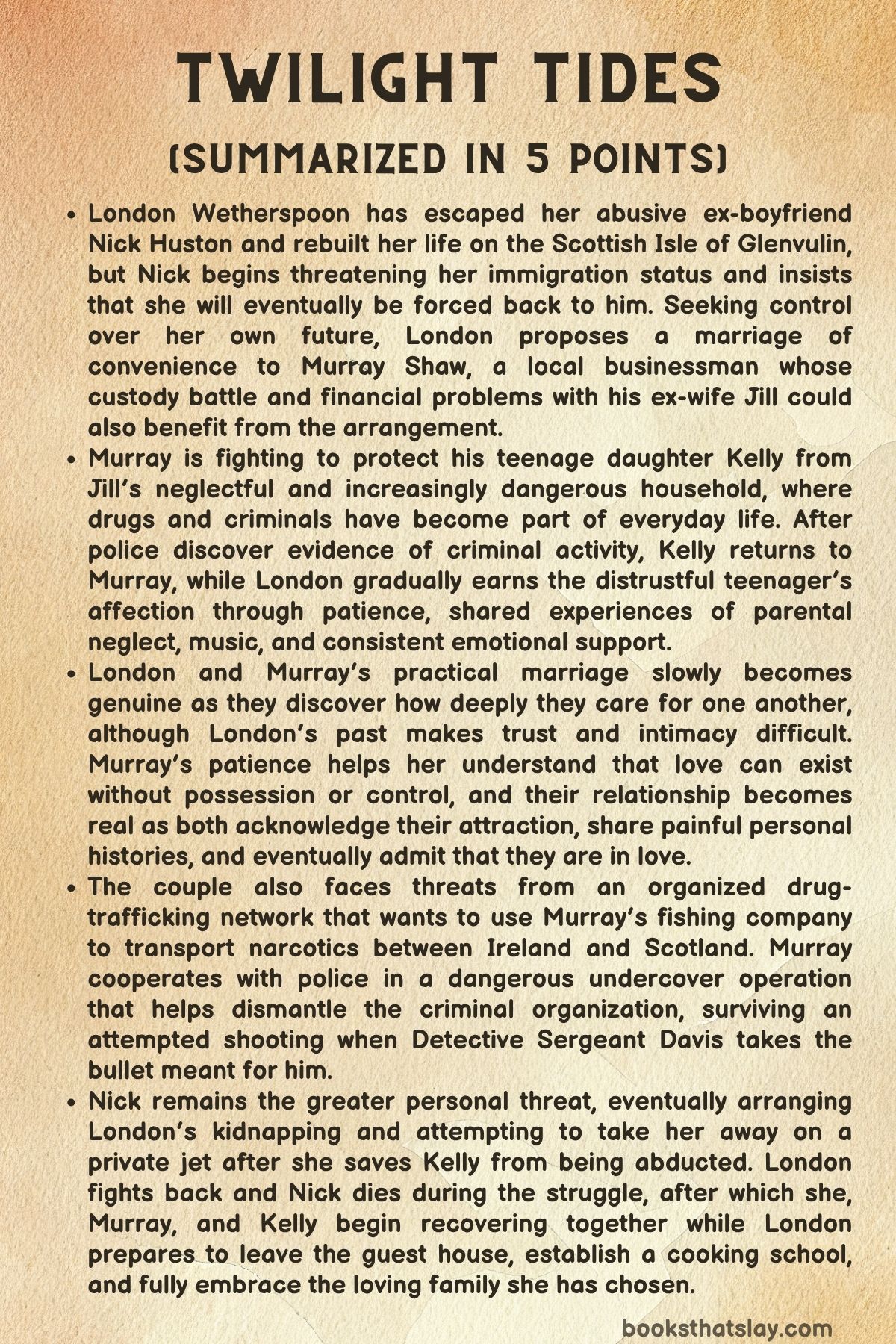
Summary
Eighteen months before the main events, London Wetherspoon is living in Manhattan with Nick Huston, a wealthy and increasingly abusive boyfriend. Nick controls her clothing, criticizes her background, isolates her from friends, pressures her to abandon her restaurant career, monitors her communications, and has already become physically violent.
London finally realizes the full extent of his manipulation when she learns that her best friend Tierney Silver has been stabbed in Scotland. Nick secretly intercepted messages from Tierney and Cammie and even warned Halston Cole about Tierney’s investigation, helping place her in danger. When London tries to leave him, Nick attacks her, confiscates her passport, and threatens to kill her if she escapes.
In the present, London has escaped New York and lives on the Isle of Glenvulin, where she works as the chef at Tierney’s Leth Sholas Guest House. Tierney and her husband Ramsay have helped her rebuild a stable life, but London remains uncertain whether she truly wants her job or simply feels indebted to the people who rescued her.
Dating has also become difficult. London wants companionship but finds herself searching every potential partner for signs of manipulation, because Nick taught her how easily charm can conceal danger.
Her fragile peace is disturbed when Nick unexpectedly contacts her. His insider-trading case has ended with house arrest rather than prison, and he claims his politically connected family can interfere with London’s visa and force her back to America.
The threat causes London to panic physically. Murray Shaw, a local businessman and single father whom London has quietly been attracted to, finds her and offers help, but London does not initially tell him the full story.
Murray has serious problems of his own. His fourteen-year-old daughter Kelly lives primarily with Murray’s ex-wife Jill, whose drinking, neglect, and increasingly dangerous social circle have made Kelly afraid to remain in her mother’s home.
Kelly tells Murray that Jill’s boyfriend Dorian and other men around the house make her uncomfortable. Murray desperately wants sole custody, but his lawyer Andrea warns him that he needs evidence before violating the existing arrangement.
Jill also continues receiving money from Murray’s fishing company because of an agreement from their marriage. Murray learns that remarrying would end Jill’s financial entitlement and could strengthen his image as a stable parent during a custody dispute.
After London tells Tierney and Ramsay about Nick’s threat, Ramsay begins investigating whether the Hustons can actually influence her immigration status. London appreciates the help but becomes increasingly frustrated by the feeling that everyone else is always rescuing her.
When London learns about Murray’s custody problems, she recognizes an unusual solution. She proposes that they marry each other.
The marriage would strengthen London’s position in Scotland while protecting Murray’s company from Jill and potentially helping his custody case. Murray points out that they would have to live together, behave publicly like spouses, and consider the emotional effect on Kelly if the arrangement later ended.
Despite those risks, they proceed. London signs an agreement giving up any claim to Murray’s fortune, and the two quietly marry in Oban.
Their first kiss at the ceremony immediately reveals that the arrangement may be more complicated than expected. Murray has long been attracted to London, while London is unsettled by how safe and natural the kiss feels.
Tierney initially reacts angrily because she believes the marriage could create unnecessary legal trouble. London insists that marrying Murray is important precisely because she wants to take an active role in protecting her future rather than waiting for others to solve her problems.
London moves into Murray’s coastal home, where she becomes increasingly aware of his devotion to Kelly. Small details, including the fairy lights he once placed around his daughter’s bed to comfort her childhood fear of darkness, show London the kind of attentive parenting she never experienced.
Living together intensifies London and Murray’s attraction, but Murray keeps pulling away because he knows about her abusive past and never wants her to feel pressured. London repeatedly interprets his caution as rejection.
Their emotional connection develops through music. London reveals that she once loved playing piano but abandoned that part of herself under pressure from emotionally distant parents who wanted her to become a doctor.
Murray encourages her to play again. His acceptance becomes important to London because he shows interest in the person she actually is rather than the person he wants her to become.
Meanwhile, Kelly’s situation deteriorates. During a party at Jill’s house, a man attempts to enter a bathroom where Kelly has locked herself, forcing her to call the police.
Authorities discover drugs, cash, and evidence of criminal activity in Jill’s home. Dorian Walsh is connected to an organized criminal group, and Kelly is finally removed from the unsafe environment and brought back to Murray.
The problem soon expands beyond custody. Murray discovers that Dorian’s organization appears interested in using Half-Light Harbor Fishing Company to transport drugs.
Employee Joshua Hughes attempts to recruit Murray into the operation and threatens Kelly, London, and Fiona when Murray refuses. Murray secretly records the conversation and brings the evidence to Ramsay, who has contacts capable of helping law enforcement address the criminal network.
London simultaneously receives increasingly violent messages from Nick. He threatens Murray and Kelly and claims that investigators will expose London’s marriage as fraudulent.
London initially hides these messages because she believes asking for help makes her a burden. Eventually she tells Ramsay, who reminds her that independence does not require facing danger alone.
Kelly is initially cold toward London because she does not want another maternal figure entering her life. London refuses to force closeness and instead patiently proves that she will continue showing up.
Their relationship changes through music and shared experiences. During a piano lesson, Kelly finally confesses how unsafe life with Jill became and describes the disturbing behavior of Dorian’s associates.
London reassures her that Jill’s failures are not evidence that Kelly is unworthy of love. She also shares her own experience of growing up with emotionally absent parents, allowing Kelly to recognize that London genuinely understands parental neglect.
Murray’s feelings for London deepen into love. London likewise realizes that her attraction is becoming something much stronger, but both remain frightened of making the marriage emotionally real.
Their misunderstanding finally ends when Murray performs at an open-mic night and dedicates a song to London. She understands that he is publicly telling her there is more between them than convenience and kisses him in front of the village.
London later explains how Nick damaged her confidence around physical intimacy. Murray promises that everything between them will happen at her pace and that her boundaries will always matter.
They eventually begin a physical relationship built on communication and choice. For London, the experience becomes part of reclaiming a side of herself that Nick made frightening.
Murray soon realizes without doubt that he loves her. Their domestic life also becomes increasingly natural, with London helping Kelly, contributing to family decisions, and gradually imagining that her place in the Shaw household could become permanent.
A mistake nearly damages everything. Murray tells Tierney that London is no longer happy working at the guest house, unintentionally revealing something London told him privately.
London reacts strongly because Nick repeatedly interfered with her choices and relationships. During an emotional argument, she compares Murray to Nick, deeply hurting him.
While away in Glasgow with Tierney, Taran, and Cammie, London learns the full context and recognizes that Murray acted imperfectly but not maliciously. She also admits to her friends that she loves him and decides she wants to tell him.
Before she can return home, a staged hotel emergency allows one of Nick’s associates to attack her. A man delivers a message from Nick and pushes London down a staircase, leaving her injured.
Murray is terrified when he learns she has been hospitalized. After London returns, they apologize to each other, acknowledge their mistakes, and finally confess that they are in love.
Kelly also accepts that their relationship is genuine. London assures her that loving Murray does not mean taking him away from his daughter, and Kelly begins welcoming London as part of the family.
Danger remains on two fronts. The Huston family is targeted by a major federal investigation, but Nick escapes custody after receiving help and disappears.
At the same time, Murray participates in an undercover operation against the Walsh criminal organization. His fishing company pretends to transport drugs so police can identify and arrest the people involved.
During the operation in Dublin, a criminal fires at Murray. Detective Sergeant Davis takes the bullet meant for him and survives, while the police successfully damage the trafficking network.
London and Murray return home believing one major danger has finally ended. Nick, however, remains missing.
Life becomes temporarily calmer. London begins thinking seriously about leaving the guest house and finding work that reflects her own ambitions.
After watching her teach Kelly and other children to cook, Murray suggests that she create a cooking school built around Glenvulin’s food and local ingredients. London likes the idea but remains determined to maintain financial independence.
The final crisis arrives during a shopping trip to Oban. A man attempts to abduct Kelly, and London immediately fights him.
She saves Kelly but is taken instead. Murray learns that Nick has been located near a private airstrip and realizes that he arranged the kidnapping.
At the airfield, London finds Nick waiting on a jet. He speaks as though she still belongs to him and intends to take her away before authorities can reach them.
Instead of waiting to be rescued, London acts. She attacks the pilot with a fire extinguisher, preventing the plane from leaving.
Nick attacks her, and London fights back. During the struggle, she takes a knife from one of his men, and Nick ultimately falls onto the blade while attacking her.
Nick dies from the wound. London runs from the plane as police and Murray arrive, only for Nick’s surviving accomplice to point a gun at her.
A police officer shoots the attacker before he can fire. London finally reaches Murray, physically injured but alive and permanently beyond Nick’s control.
The aftermath is emotionally difficult. London suffers nightmares and guilt over Nick’s death, while Kelly struggles after nearly being kidnapped and watching London sacrifice herself to protect her.
Tierney helps London by revealing her own experience of killing someone in self-defense. London gradually accepts that the relief she feels at Nick’s death does not make her cruel; she fought because she wanted to survive and return to the people she loves.
London then reassures Kelly that neither she nor Murray can promise a life without pain, but they can promise that Kelly will never face that pain without love and support. Their relationship begins healing alongside London’s own recovery.
At Taran and Quinn’s wedding, the future looks considerably brighter. Kelly is back at school, London is leaving the guest house, and plans for her cooking school are moving forward.
Murray provides one of his properties, while London finances the renovations herself, giving them a compromise between partnership and independence. Their once-convenient marriage has become a lasting family created not by obligation, fear, or rescue, but by repeated choices to trust and remain with one another.
Characters
London Wetherspoon
London is the emotional center of Twilight Tides, and her development is defined by the gradual recovery of agency after prolonged coercive abuse. Nick trained her to distrust her instincts, associate dependence with danger, and believe that accepting help meant surrendering control, so many of her later decisions are attempts to prove that she can protect herself without becoming dependent on anyone.
Her greatest growth comes from understanding that independence and isolation are not the same thing. She learns to accept Murray’s support while still making her own professional, emotional, and personal choices, and her willingness to fight for Kelly during the kidnapping shows how far she has moved from the frightened woman who once felt trapped in Manhattan.
Murray Shaw
Murray serves as both romantic partner and contrast to the forms of masculinity that have damaged London. In Twilight Tides, his strength is expressed through patience, responsibility, emotional openness, and a refusal to use love as a justification for ownership.
He is imperfect because his protective instincts sometimes lead him to decide what others should know, as seen when he withholds information or speaks to Tierney about London’s career. His willingness to recognize those mistakes is essential, however, because unlike Nick, Murray does not respond to disagreement by demanding obedience; he listens, apologizes, changes his behavior, and treats partnership as something negotiated between equals.
Kelly Shaw
Kelly begins the story as a frightened teenager who has learned that adults, particularly her mother, cannot always be trusted to protect her. Her experiences in Jill’s house force her into a maturity no fourteen-year-old should need, including barricading doors, monitoring dangerous adults, and thinking strategically about custody.
Her relationship with London becomes one of the novel’s strongest family bonds. Kelly initially rejects the idea of a stepmother because attachment feels dangerous, but London earns her trust through patience rather than authority, and their connection through music, cooking, and shared experiences of parental neglect eventually allows Kelly to imagine a family in which adults remain dependable.
Nick Huston
Nick represents coercion in its most direct form. His abuse of London is psychological, physical, social, and financial, and his greatest weapon is his determination to convince her that she belongs to him.
Even after London escapes, Nick continues trying to control her through immigration threats, surveillance, intimidation, hired attackers, and eventually kidnapping. His inability to understand London as an autonomous person makes his final confrontation inevitable, because he interprets her independence not as a decision he must respect but as an act of rebellion he believes he has the right to punish.
Tierney Silver
Tierney is London’s closest friend and one of the people who gives her a foundation after she escapes Nick. Her guest house provides London with employment and security, while Tierney herself offers emotional loyalty strong enough to survive disagreement.
Her relationship with London also exposes the complications of gratitude. London begins treating the job Tierney gave her as a permanent debt, but Tierney ultimately makes clear that helping a friend should not become another form of obligation, allowing London to imagine a future based on desire rather than repayment.
Ramsay
Ramsay is a calm, capable source of protection whose influence extends beyond ordinary village life. He uses his contacts to protect London’s immigration status, investigate Nick, and help Murray bring law-enforcement attention to the Walsh organization.
He is especially important because he repeatedly encourages people to accept assistance without surrendering agency. Ramsay protects London without treating her as helpless and advises Murray to support rather than manage her, making him one of the story’s clearest examples of protective behavior that respects personal autonomy.
Jill
Jill is both an antagonist and a damaged parent whose unresolved problems have destructive consequences for Kelly. Her drinking, neglect, resentment, and involvement with Dorian expose her daughter to unsafe people and situations.
The novel does not excuse Jill simply because she has experienced difficulties of her own. Murray acknowledges that she carries unresolved trauma, but her refusal to confront it causes that pain to spread outward, particularly toward Kelly, who suffers because her mother repeatedly prioritizes her own needs and unstable relationships over her daughter’s safety.
Fiona
Fiona is Murray’s mother and an important source of stability within the Shaw family. Her history of protecting Murray from his abusive father helps explain both Murray’s understanding of violence and his determination to parent Kelly differently.
She welcomes London while remaining clear-eyed about the dangers of emotional attachment. Her warning that London should not allow Murray and Kelly to become deeply attached if she intends to leave demonstrates Fiona’s loyalty to her family, while her later warmth shows that she genuinely accepts London once she recognizes the relationship is becoming permanent.
Taran
Taran is one of London’s closest friends and frequently challenges the negative beliefs London has developed about herself. When London calls herself a burden, Taran reminds her that relationships are reciprocal and that London has also provided care and support to other people.
Her role is especially valuable because she refuses to let London retreat whenever uncertainty becomes uncomfortable. Whether encouraging London professionally or forcing her to remain engaged during emotional conflict, Taran represents friendship that respects vulnerability without allowing fear to dictate every decision.
Cammie
Cammie brings humor and directness to London’s friendship group, but she also has a perceptive understanding of emotional avoidance. She recognizes attraction between London and Murray long before either of them is prepared to speak openly about it.
She also challenges Murray when his instinct to protect London becomes secrecy. Her argument that London needs people to trust her ability to handle difficult information helps Murray understand that excessive protection can unintentionally resemble exclusion.
Fraser
Fraser is Murray’s cousin and an important ally in both the fishing company and the confrontation with the Walsh organization. He understands the financial damage caused by Jill’s claims and therefore recognizes why Murray’s marriage has practical value.
His loyalty becomes more significant once organized criminals target the company. Fraser participates in dangerous meetings and the undercover operation beside Murray, showing that their business relationship is grounded in family trust rather than convenience alone.
Dorian Walsh
Dorian, also known as Crux, brings organized crime directly into Kelly and Murray’s lives. His relationship with Jill exposes Kelly to dangerous men, drugs, and an environment in which her safety is treated as secondary.
He also acts as the connection between Jill’s household and the criminal organization interested in Murray’s fishing company. His presence expands the conflict from a custody dispute into a broader threat involving trafficking, intimidation, and violence.
Joshua Hughes
Joshua Hughes functions as the organization’s direct representative inside Murray’s business world. His employment at Half-Light Harbor gives the criminals access to information and creates the possibility of turning legitimate fishing operations into a transportation network for drugs.
His meeting with Murray reveals the gang’s methods clearly. He combines financial temptation with threats against family members, assuming that fear will force Murray into cooperation, but instead his intimidation provides evidence that helps law enforcement build its operation.
Andrea Raisani
Andrea is Murray’s family lawyer and provides the legal realism that prevents him from acting solely on emotion. She repeatedly reminds him that protecting Kelly requires evidence and careful adherence to custody procedures.
Her advice frustrates Murray because it forces him to leave Kelly temporarily in an unsafe situation, yet Andrea understands that an impulsive violation of legal arrangements could ultimately damage his attempt to secure permanent custody. She therefore represents the difficult gap between immediate parental instinct and long-term legal strategy.
Forde
Forde is part of the wider Glenvulin friendship circle and contributes to the strong sense of community surrounding London and Murray. His increasingly unusual behavior around Cammie also suggests a separate developing romantic connection beyond the central couple.
Although his role is less central, his presence helps establish Glenvulin as a place where relationships overlap and people remain closely involved in one another’s lives. This community atmosphere contrasts sharply with London’s earlier isolation under Nick.
Quinn
Quinn appears mainly through his relationship with Taran and the wider social group. His eventual wedding to Taran provides the setting for the closing sequence of the story.
That celebration also allows Murray to reflect on his own unconventional marriage. Quinn and Taran therefore contribute to the novel’s broader consideration of commitment by providing a more traditional romantic path beside London and Murray’s unusual beginning.
Detective Sergeant Davis
Davis becomes important during the undercover operation against the trafficking network. When an armed criminal fires at Murray, Davis deliberately moves into the path of the bullet and saves his life.
His action reinforces the larger idea that courage often involves accepting risk for other people. Davis also recognizes that Murray has already taken comparable risks by participating in the operation to protect his employees, community, and family.
Shona McIver
Shona has a relatively minor role, but her interest in Murray exposes London’s jealousy before London is willing to admit the depth of her feelings. London’s emotional reaction to Shona becomes evidence that the marriage has stopped feeling purely practical.
Shona also contributes to the public pressure surrounding the sudden wedding. Her questioning reminds London and Murray that their arrangement must appear convincing to outsiders, increasing both their physical awkwardness and their awareness of genuine attraction.
Brian
Brian represents one of the practical pressures influencing London’s search for a new career. The popularity of her honesty-box baking causes him and his partner to worry that she intends to compete with their bakery.
His concern forces London to examine her own ambitions more seriously. Rather than simply continuing to bake casually while working at the guest house, she begins recognizing that other people see genuine professional value in something she has been treating as a side activity.
Dr. Stornoway
Dr. Stornoway appears as one of the community members encouraging London to enter the Glenvulin Fair’s baking competition. This encouragement contributes to London’s gradual realization that her abilities have value beyond the role she accepted after escaping Nick.
The character’s function is small but meaningful because London’s recovery depends partly on allowing herself to want things again. Support from people across the island helps her imagine a professional identity chosen from interest rather than fear, duty, or parental expectation.
Siobhan Cosway
Siobhan Cosway represents the organized criminal operation at the receiving end of the drug shipment in Dublin. Her involvement demonstrates that the threat facing Murray is much larger than Dorian or Joshua individually.
Her confidence during the transfer shows how established the trafficking system has become. The police operation surrounding her arrest therefore represents more than Murray saving his own company; it helps dismantle a wider organization capable of harming many communities.
Russo
Russo is one of the criminals involved in transferring cocaine from the Iris to Murray’s vessel. His search of Murray’s boat and threats against the crew underline how dangerous the undercover operation truly is.
He represents the physical enforcement behind the organization’s promises and threats. His presence confirms that Murray is dealing with people prepared to kill rather than merely intimidate.
Anna and Lucas
Anna and Lucas appear during the domestic scene in which London teaches them and Kelly how to prepare paella. Their role is brief, but the scene is crucial to Murray’s understanding of London’s potential future.
Watching London teach children with patience, confidence, and enthusiasm gives Murray the idea of a cooking school. Anna and Lucas therefore indirectly help transform London’s cooking from something associated with employment into a possible career shaped around teaching, creativity, and community.
Themes
Reclaiming Agency After Abuse
Recovery in Twilight Tides is presented less as a single escape than as a continuing process of relearning how to make choices without fear. London has physically left Nick long before the main story begins, yet his influence remains present in the way she dates, works, accepts help, interprets disagreement, and responds to intimacy.
Her progress is repeatedly measured through decisions. Proposing the marriage, choosing whether to remain at the guest house, establishing boundaries with Murray, defending Kelly, and fighting Nick at the airfield all show London becoming increasingly willing to act according to her own judgment.
The story also avoids presenting recovery as perfectly linear. London sometimes mistakes concern for control, hides danger from people who love her, experiences panic attacks, and questions whether accepting support makes her weak.
Those setbacks do not erase her progress. Instead, they demonstrate that personal agency involves recognizing when old survival responses are shaping present choices and then deciding whether those responses still serve a useful purpose.
By the end, London does not become independent by needing nobody. She becomes independent because she can choose whom to trust, what help to accept, what work to pursue, whom to love, and what kind of family she wants to build.
Love Without Ownership
The contrast between possession and partnership shapes nearly every stage of London’s relationships with Nick and Murray. Nick treats affection as a justification for control, believing that loving London gives him authority over her appearance, career, friendships, movements, communications, and body.
Murray gradually teaches London a different understanding of closeness. He wants her deeply, but his desire does not create entitlement, and his repeated attention to consent allows London to experience intimacy without feeling that surrendering control is the price of being loved.
The novel also shows that respectful love does not mean perfection. Murray occasionally makes decisions that cross London’s boundaries, particularly when he reveals information about her career to Tierney.
What distinguishes him from Nick is his response when challenged. He does not threaten, manipulate, or insist that his intentions excuse the effect of his actions; instead, he acknowledges the mistake and accepts London’s right to be angry.
Their relationship therefore becomes healthier not because conflict disappears but because disagreement does not destroy equality. London can say no, become angry, change her mind, ask for space, or demand honesty without fearing punishment.
Love eventually becomes something chosen repeatedly rather than something imposed. That distinction allows London to belong with another person without feeling that she belongs to him.
Family as a Chosen Relationship
Biological family repeatedly fails characters who most need safety. London’s parents provide material privilege but little emotional care, Kelly’s mother exposes her to danger, and Murray grows up with an abusive father whose behavior teaches him what he never wants to become.
Against those experiences, the story builds an alternative definition of family based on consistency. Tierney, Ramsay, Taran, Fiona, Murray, London, and eventually Kelly create relationships in which care is demonstrated through continued presence rather than assumed through blood.
London and Kelly are especially important to this theme. Neither trusts the relationship immediately, and London does not demand affection simply because she has legally become Kelly’s stepmother.
Instead, she earns trust through ordinary acts: listening, teaching piano, sharing painful memories, cooking together, keeping promises, and continuing to appear even when Kelly is distant. Kelly eventually accepts London because experience proves that she intends to stay.
The same process changes London. Someone who grew up without a dependable emotional home gradually realizes that family can be built deliberately.
Her marriage to Murray matters, but her bond with Kelly completes that transformation. The family they create is powerful precisely because none of them treats love as automatic; they repeatedly demonstrate it through action.
Independence, Support, and Interdependence
London initially treats independence as the opposite of receiving assistance. Because Nick weaponized dependence, she fears that needing another person will inevitably reduce her freedom.
That belief explains why she hides Nick’s messages, resists Murray’s financial help, feels guilty about what Tierney and Ramsay have done for her, and repeatedly describes herself as a burden. She assumes strength requires carrying every problem alone.
The people around her gradually challenge that definition. Taran reminds her that friendship is reciprocal, Ramsay explains that accepting protection does not erase courage, and Murray tries to show her that partnership can involve sharing burdens without taking control of them.
Murray must learn the same lesson from the opposite direction. His instinct is to protect the people he loves by withholding frightening information, but he comes to understand that protection without openness can deny another person the opportunity to make informed choices.
Their plans for London’s cooking school provide a practical final expression of this balance. Murray offers property and resources, while London insists on funding the renovations herself.
Neither person gets everything exactly as first imagined. Instead, they negotiate a form of support that respects London’s independence while allowing Murray to contribute, showing that healthy interdependence depends on communication, consent, and mutual adjustment rather than complete self-sufficiency.