To Kill a Badger Summary, Characters and Themes
To Kill a Badger by Shelly Laurenston is an action-comedy urban fantasy that blends shape-shifter politics, chaotic family ties, and razor-edged humor. Set in a hidden world where honey badger shifters coexist with tigers, wolves, and lions, the story follows Nelle Zhao—a disciplined, sharp-tongued badger—and Keane Malone, an irritable but loyal tiger athlete.
Together, they’re pulled into a global conflict involving warring animal clans, mafia-style lion families, and a network of cunning badger mercenaries. Packed with violent showdowns, irreverent dialogue, and tender moments of reluctant affection, the book explores loyalty, revenge, and the absurdity of family—especially when everyone has claws. It’s the 6th book in the Honey Badger Chronicles series by the author.
Summary
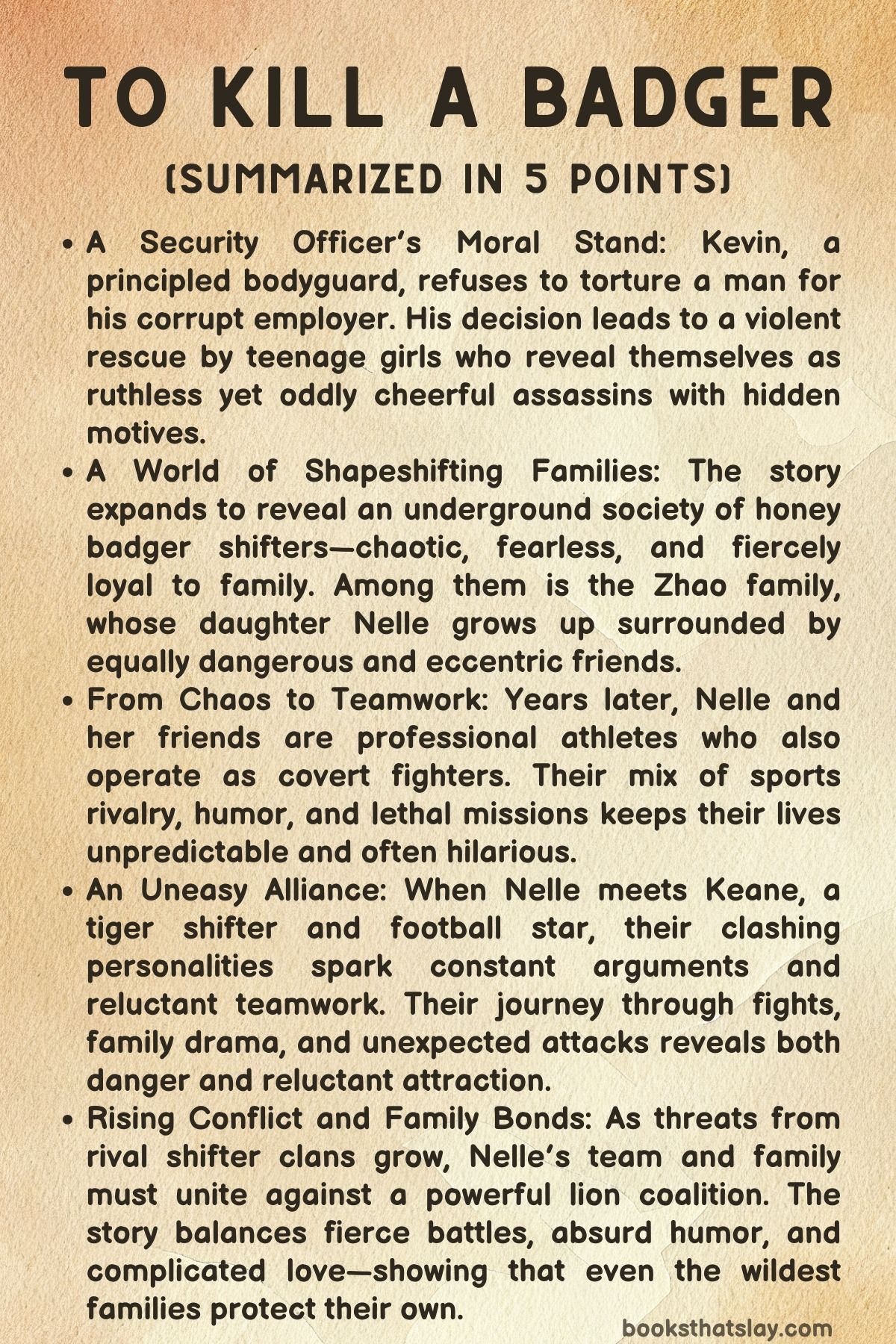
The story opens in the Singapore Strait, where Kevin, a loyal security chief for a French billionaire, is forced to witness his employer torturing a restrained man. When ordered to join in, Kevin refuses, and chaos follows as two teenage girls—deadly yet playful—attack the yacht.
They kill the guards, kidnap the Frenchman, and reveal their connection to the captive: an Asian man named Arthur Zhao. These girls, part of Arthur’s extended family, are members of a hidden species of honey badger shapeshifters, infamous for their combat skills and reckless disregard for normality.
Kevin escapes only because Zhao commands his daughters to spare him, instructing him to claim “pirates” were responsible. Moments later, the yacht explodes.
Years later, Arthur Zhao attends his daughter Nelle’s graduation in Wisconsin with his aristocratic wife, Lorraine. The ceremony becomes a social battlefield among the hidden badger clans—particularly when Lorraine clashes with other parents about the MacKilligan sisters, notorious for their unruly behavior.
Despite the hostility, Arthur’s calm humor defuses tension, though he knows peace among badgers never lasts long. The scene captures the strange balance between civility and violence that defines their families.
More than a decade passes. Nelle Zhao has become an adult, a professional basketball player, and part of a covert operations team made up of her childhood friends—Max, Mads, Cass, and Tock.
Together, they rescue kidnapped humans and fight criminal shapeshifters. During one brutal mission off the Boston coast, they take on a crew of Lithuanian bear shifters, aided by older honey badgers—veteran warriors who slaughter with gleeful brutality.
Amid the carnage, Nelle argues with her teammates about priorities, with Mads more concerned about missing basketball practice than surviving the fight. Their bickering, both absurd and affectionate, defines the group’s chaotic bond.
Meanwhile, Keane Malone, a professional tiger shifter football player, visits a medical clinic for a shoulder injury. There, he meets Nelle, bloodied from her recent battle yet nonchalantly calm as doctors stitch her up.
Her regenerative abilities make her nearly impossible to kill, and her lack of fear unsettles him. When Nelle offers to take Keane to her specialist, he agrees, though uncertain about her motives.
Their dynamic grows through snark-filled exchanges. Nelle, stylish and bossy, mocks Keane’s seriousness, while he criticizes her eccentricity.
Their conversation shifts from sarcasm to reluctant curiosity as they drive to Dr. Weng-Lee’s Chinatown clinic.
When armed men storm the place, Nelle and Keane’s chemistry ignites through violence—they take down the attackers with ruthless efficiency. Afterward, their uneasy partnership solidifies, though both remain infuriated by the other’s behavior.
In later scenes, the focus turns to older characters like Tracey Rutowski, CeCe Álvarez, Steph Yoon, and Ox—veteran badgers and allies who are attacked by assassins from the de Medici lion coalition, an organization determined to wipe out the honey badgers. Each woman fights back using her unique talents—artistic venom, advanced drones, trained attack dogs—and together they regroup, ready to retaliate.
Their reunion signals the beginning of an organized counterstrike.
At Charlie MacKilligan’s house, the extended badger network gathers. Charlie, her sisters Max and Stevie, and their allies, including the tiger brothers Keane, Shay, and Finn, prepare for the inevitable showdown.
Between chaotic pets, neighborhood bears, and ongoing squabbles, their home becomes a war room filled with sarcasm and weaponry. Keane’s tiger instincts almost spiral out of control, but Charlie effortlessly subdues him, proving her strength and authority among shifters.
Nelle and Keane’s relationship deepens as they’re dispatched to Europe to meet the influential Von Schäfer-Müller family, seeking allies against the de Medicis. Their journey—managed by Marti, a no-nonsense assistant—reveals both humor and tension.
On the flight, they argue, flirt, and discuss badger politics. Upon arrival, they’re ambushed by armed mercenaries and dragged to a remote château.
There, Nelle pleads for help from Johann Von Schäfer-Müller, who refuses. When his arrogance provokes Keane, the tiger shifts and nearly kills him before being stopped by Johann’s sister, Jules.
Jules, pragmatic and sly, agrees to support Nelle in exchange for help recovering a stolen ritual book from a human banker. Nelle reluctantly accepts the deal.
Back in New York, Charlie faces her own disaster when her con artist father, Freddy, fakes his death to escape gambling debts. Furious, she and her sisters nearly kill him before deciding to let the wolves handle him.
Meanwhile, the older badger women raid a Russian oligarch’s mansion for intel, uncovering the de Medicis’ European operations. The global network of honey badgers begins to mobilize for war.
The narrative then cuts between continents as alliances shift. In Italy, imprisoned lionesses are rescued by badger assassins, while in Europe, Nelle and Keane confront betrayal at the château.
Multiple factions collide in a massive battle involving badgers, tigers, lions, and bears. Nelle kills Johann, Ox claims vengeance for an old blood debt, and Jules turns from manipulator to desperate survivor.
Amid explosions and chaos, Nelle and Keane take down the polar bear enforcer Zeus in a vicious fight. Across the mansion, Charlie executes the de Medici patriarch, Paolo, with help from Stevie, who injects him with an experimental serum that forces a fatal transformation.
After the dust settles, the badgers have triumphed. Nelle FaceTimes her parents, discovering that news of the de Medicis’ collapse has already reached the family.
Lorraine disapproves of Nelle’s behavior, as usual, while Arthur quietly supports her. The surviving lion women and children are rescued and relocated, ending the long-standing blood feud.
Nelle and Keane finally admit their feelings and decide to live together, their constant bickering softening into affection.
The story closes with a darkly comic twist. Paolo de Medici wakes up in Africa, trapped in his lion form, only to be killed by a wild pride.
The global order of shifters begins to stabilize under new leadership. At Nelle’s sister’s wedding, chaos breaks out again as badgers and tigers clash with snobbish humans, confirming that peace is never permanent for these families.
Yet there’s triumph too—Nelle’s basketball team wins the championship, Arthur proudly watches from the stands, and Tracey Rutowski recruits Charlie to lead a global protection network for badger kind. A flashback reveals Tracey’s early life as a daring teenage spy, cementing her legacy as one of the fiercest defenders of her kin.
In the end, To Kill a Badger celebrates family—chosen or inherited—as both weapon and shield. Beneath the explosions, insults, and shapeshifting battles lies a story about trust, survival, and finding humor in the madness of bloodlines that refuse to be tamed.
Characters
Kevin
Kevin serves as the moral compass in To Kill a Badger, a man whose integrity stands out amid corruption and brutality. As head of security for a French billionaire, he begins the story torn between duty and conscience.
His refusal to torture a captive underlines his unwavering ethical standards—an act that places him in direct opposition to his employer and the violence surrounding him. Kevin’s courage is not the loud, brash kind; rather, it is quiet, principled, and deeply human.
When chaos erupts on the yacht and he witnesses the lethal efficiency of Zhao’s daughters, Kevin becomes both an observer and a symbol of the ordinary man confronting a supernatural, violent world. His decision to save Arthur Zhao, rather than flee or obey orders, cements him as a character defined by decency.
Later, when he reports the massacre as “pirates,” it shows his pragmatism—he understands that survival sometimes means reshaping truth, yet never abandoning morality.
Arthur Zhao
Arthur Zhao is a fascinating blend of calm intellect, quiet menace, and fatherly affection. Introduced as a prisoner, his composure during the yacht’s chaos immediately marks him as someone accustomed to power and danger.
He is not a victim but a man in control, even when tied up and surrounded by death. His later appearance as a devoted father at Nelle’s graduation reveals another layer—beneath his stoicism lies warmth and deep familial loyalty.
Arthur embodies the old-world elegance and cunning typical of the honey badger shifter dynasties: cultured, calculating, and willing to let chaos unfold when it serves a purpose. His interactions with his aristocratic wife and rebellious daughter display his ability to navigate the fine line between discipline and love.
Throughout the novel, Arthur acts as both stabilizing force and silent strategist, a patriarch whose calm belies a lifetime of lethal experience.
Lorraine Zhao
Lorraine Zhao represents the old guard of honey badger society—refined, elitist, and preoccupied with appearances. Her disdain for her daughter’s wild friends exposes her obsession with social hierarchy and purity of bloodline.
She is the perfect foil to Arthur’s quiet acceptance and Nelle’s chaotic independence. Yet Lorraine is not a caricature; beneath her snobbery lies genuine fear of losing control over a world she cannot comprehend.
Her hostility toward the MacKilligan sisters and other “common” badgers comes from anxiety—the fear that their unruly energy will drag her noble family into scandal. Lorraine’s sharp tongue, constant disapproval, and fragile dignity make her both humorous and tragic.
She cannot understand that in the honey badger world, strength is measured not by breeding but by survival. Her rigidity isolates her, turning her into an observer of a family that thrives in chaos she cannot control.
Nelle Zhao
Nelle Zhao is the heart of To Kill a Badger, a fierce, volatile, and compelling heroine whose journey defines the book’s emotional arc. From her teenage years among unruly badger friends to her adulthood as a professional athlete and operative, Nelle embodies the contradictions of strength and vulnerability.
She is intelligent, sharp-tongued, and ruthlessly efficient in combat, yet capable of humor and deep loyalty. Her constant bickering with her teammates and eventual partnership with Keane Malone reveal her complex personality—one driven by pride, passion, and an unspoken desire for belonging.
Nelle’s relationship with her parents mirrors her internal conflict: she carries Arthur’s composure and Lorraine’s pride but channels them through the chaotic energy of a honey badger warrior. In every scene, Nelle stands as both weapon and protector, embodying Shelly Laurenston’s signature blend of ferocity and wit.
Max MacKilligan
Max is a whirlwind of mischief and violence—a “bubbly sociopath” whose charm lies in her unpredictability. From the first attack on the yacht to her adult life as part of Nelle’s basketball and operations team, Max thrives in chaos.
She is fearless, funny, and utterly unfiltered, often using humor as a weapon. Max’s relationship with Nelle oscillates between sibling-like affection and violent rivalry, yet their bond is unbreakable.
Beneath her manic energy lies deep loyalty and emotional intelligence; she understands Nelle’s struggles better than anyone. Her mischief, constant teasing, and gleeful disregard for social norms make her a source of comic relief, but her ferocity in combat reminds readers that she is also a deadly predator.
Max personifies the wild heart of the honey badger sisterhood—a creature who laughs at fear and bites harder when cornered.
Mads Rutowski
Mads is the team’s brutal pragmatist, a fighter who balances rage with fierce protectiveness. Descended from the legendary Tracey Rutowski, Mads embodies inherited ferocity—she is a soldier with an athlete’s discipline.
Her obsession with basketball championships mirrors her desire for control in a world of chaos. Mads acts as the emotional anchor within her team, the one who channels fury into focus, though her temper often explodes when provoked.
Her dynamic with Max and Nelle reflects a blend of exasperation and deep sisterly love. Mads’s loyalty to her aunt Tracey and her badger teammates defines her character more than any personal ambition.
She symbolizes generational strength—the bridge between the reckless youth of the badger clan and the seasoned lethality of their elders.
Tracey Rutowski
Tracey Rutowski stands as one of the book’s most formidable figures—a retired spy, mother, and relentless protector. Her scenes are charged with dark humor and ruthless efficiency.
Tracey’s violent grace, her quickness with weapons, and her ability to lead even among equals make her a matriarchal force. Yet beneath the carnage lies deep affection for her family and friends.
She operates on instinct and experience, always one step ahead, always ready to kill to preserve her people. Through her, the story explores legacy—the way strength, trauma, and defiance pass through generations of badgers.
Tracey’s presence commands respect; she is both mentor and avenger, the embodiment of the book’s central theme that loyalty among the wild is the truest form of love.
Keane Malone
Keane Malone, the Amur tiger shifter, is both foil and partner to Nelle Zhao. His stoic, grounded masculinity contrasts with Nelle’s fiery intensity, creating a chemistry built on tension and reluctant respect.
Keane is intelligent, self-controlled, and capable of immense violence when provoked, yet he often serves as the voice of reason amidst badger chaos. His evolving relationship with Nelle—from irritation to affection—forms one of the book’s emotional cores.
Keane’s patience is tested repeatedly, but he adapts, learning that love among honey badgers means embracing madness rather than resisting it. His eventual acceptance of Nelle’s world—and her declaration of love—cements him not only as her equal but as her stabilizing partner.
Through Keane, Laurenston explores the theme of coexistence: how two predators from different worlds can find balance in shared chaos.
Charlie MacKilligan
Charlie MacKilligan represents the older generation’s strength and the moral center of the extended honey badger family. She is disciplined, pragmatic, and protective, qualities that contrast sharply with the younger badgers’ impulsive ferocity.
As a leader, she acts decisively in crisis, whether calming transformed tigers or executing strategic attacks. Her household, perpetually filled with chaos, mirrors her life—a constant balancing act between family, morality, and survival.
Charlie’s loyalty to her sisters and her sense of justice drive her actions throughout the story. She symbolizes the grounded side of the badger clan: the one who plans while others destroy.
In a novel defined by mayhem, Charlie’s composure and quiet ruthlessness make her one of the few characters who can command both respect and fear in equal measure.
Stevie MacKilligan
Stevie is the youngest and most complex of the MacKilligan sisters—a genius scientist trapped between brilliance and instability. Her mind operates at terrifying speed, capable of designing biochemical weapons and antidotes, yet her emotional fragility makes her vulnerable.
Stevie’s trauma, born of abandonment and fear, is balanced by her deep love for her sisters and her partner Shen. Her scientific curiosity often puts her in moral conflict, especially when her “mistake formula” threatens catastrophic consequences.
Through Stevie, the narrative explores the cost of intelligence in a world ruled by instinct. She is proof that even among predators, the greatest battles are fought within the mind.
Jules Kopanski-Müller
Jules Kopanski-Müller emerges as one of the story’s most intriguing antagonists—charming, ruthless, and manipulative. She wields power through intellect rather than brute strength, running a lucrative cult while maintaining the facade of aristocratic respectability.
Jules represents the evolution of villainy in the badger world: refined, strategic, and emotionally detached. Her interaction with Nelle reveals mutual respect beneath their enmity; both women understand power, loyalty, and survival.
Jules’s pragmatic alliance with Nelle—trading political influence for mercenary aid—shows that even in opposition, badgers share an unspoken code. She personifies moral ambiguity, a reminder that in To Kill a Badger, no character is purely hero or villain.
Paolo de Medici
Paolo de Medici stands as the embodiment of the old predator order—a lion who believes dominance ensures survival. Arrogant and ruthless, he sees himself as untouchable until the honey badgers dismantle his empire.
His downfall, culminating in a grotesque death among wild lions, symbolizes the end of an era where power relied on lineage and fear. Paolo’s cruelty mirrors Lorraine Zhao’s elitism but without her restraint; he thrives on control and pain.
Yet, through his demise, the book celebrates poetic justice: those who underestimate the underestimated—the chaotic, unpredictable honey badgers—are inevitably destroyed. Paolo’s death is not just vengeance but the restoration of balance in a world ruled by strength, wit, and family loyalty.
Themes
Morality and the Boundaries of Violence
From its opening scene, To Kill a Badger confronts questions of morality through the actions of Kevin, the security chief who refuses to torture a captive despite his employer’s orders. His defiance sets a tone that contrasts human ethics with the amorality of the shifter world that later dominates the story.
The novel challenges traditional notions of good and evil by presenting violence as both horrific and necessary. Characters like Nelle, Max, and Arthur Zhao engage in acts of brutal combat, yet their violence functions as a defense mechanism in a world ruled by predation and power.
The honey badger shifters operate according to their own ethical code—one built on loyalty, retribution, and protection of kin rather than adherence to law. Their morality rejects passivity; to them, inaction in the face of injustice is a greater sin than aggression.
This paradox defines much of the narrative’s tone, oscillating between grotesque humor and deep seriousness. By the time the lions of the de Medici coalition are destroyed, the reader recognizes that violence is not just survival—it is identity.
Yet Laurenston injects irony by showing that characters like Kevin and Keane, who question this endless cycle, are the ones who humanize the chaos. Their discomfort with brutality provides the only moral balance in a universe that laughs at restraint.
Family, Loyalty, and the Construction of Kinship
Family in To Kill a Badger is less about blood than about chosen allegiance. The Zhao household, fractured by Lorraine’s obsession with status and Arthur’s quiet pragmatism, stands in sharp contrast to the wild solidarity of the MacKilligans and their allies.
Nelle’s upbringing between these worlds exposes her to both the tyranny of aristocratic expectation and the fierce inclusivity of found family. Across generations, honey badgers form clans defined by shared danger and irreverent love.
Their loyalty is absolute; disagreements may erupt into physical fights, but betrayal is unforgivable. This sense of communal identity extends even to interspecies friendships—tigers, wolves, and bears are folded into their web of trust when they prove worthy.
The narrative repeatedly tests these bonds through crises: assassination attempts, kidnappings, and moral dilemmas. What emerges is a portrait of kinship as both armor and burden.
Family demands sacrifice, but it also redeems the characters’ brutality. When Nelle and Keane choose to live together after the war, their union symbolizes the merging of species, temperaments, and moral codes under the broader idea of chosen kin.
The closing scenes, where alliances across clans coalesce into a global protection network, suggest that family—once chaotic and violent—can evolve into organized, purposeful solidarity.
Power, Gender, and Female Agency
Shelly Laurenston crafts a world where female power is not metaphorical but literal, embodied in women who dominate physically, intellectually, and emotionally. In To Kill a Badger, every major conflict is driven or resolved by women who refuse submission.
From Nelle’s battlefield ferocity to Tracey Rutowski’s command of espionage and CeCe Álvarez’s venomous artistry, the book celebrates an unapologetically violent femininity that dismantles patriarchal tropes. The men, even those as formidable as Keane, often act as stabilizing foils rather than saviors.
This inversion of gender norms is reinforced by the novel’s humor: the women are chaotic, vulgar, and fearless, while male characters are often bewildered or exasperated observers. Yet Laurenston avoids one-dimensional empowerment; her heroines are burdened by trauma, loneliness, and social alienation.
Their aggression is both liberation and armor. The recurring tension between Nelle’s cultivated elegance and her feral instincts captures this duality—she can discuss literature in a limousine one moment and kill a lion with her bare hands the next.
Through such extremes, the novel redefines agency not as calm authority but as the freedom to be complex, contradictory, and dangerous.
Identity, Secrecy, and the Dual Nature of Existence
The shifter premise of To Kill a Badger serves as an extended metaphor for duality—human and animal, civilized and savage, visible and hidden. The badger characters navigate a perpetual disguise, living among humans while concealing their true selves.
This secrecy breeds both humor and tragedy: a graduation ceremony becomes a battlefield of manners because the human world cannot contain their ferocity, while a wedding threatens exposure that could shatter lives. For Nelle and her peers, identity is an unstable construct constantly negotiated between instinct and expectation.
Her mother’s obsession with refinement contrasts with her father’s acceptance of their feral nature, encapsulating the tension between repression and authenticity. The novel suggests that freedom lies not in hiding one side but in reconciling both.
When Nelle and Keane embrace their violent heritage without apology, they also reclaim emotional honesty. The book’s recurring motif of transformation—healing wounds, shifting forms, rebuilding alliances—mirrors this inner reconciliation.
In the end, identity in Laurenston’s world is less about the mask one wears and more about the courage to live unmasked, even when that self terrifies others.
Humor, Chaos, and the Absurdity of Survival
While steeped in violence and power struggles, To Kill a Badger thrives on humor as its emotional engine. Chaos is not merely background noise; it is a survival mechanism, a way for characters to remain sane amid constant bloodshed.
Laurenston infuses the narrative with comedic dissonance—gunfights interrupted by petty arguments, death threats paired with dinner plans, and life-or-death battles followed by jokes about shoes or social media. This absurdity reflects how trauma and levity coexist in the same breath for those who live perpetually on edge.
The badgers’ laughter is not carelessness but defiance; it mocks danger itself. Even in the most violent scenes, humor bridges the gap between horror and humanity.
When Nelle’s teammates tease her about wedding chaos or celebrate a basketball victory after warfare, the novel underscores the resilience of spirit that humor provides. It is laughter that transforms survival into living.
By the conclusion, when the characters joke over diner food after toppling empires, the tone affirms that in this universe, chaos is not the opposite of order but its only honest form.