Try Me Summary, Characters and Themes | Adriana Locke
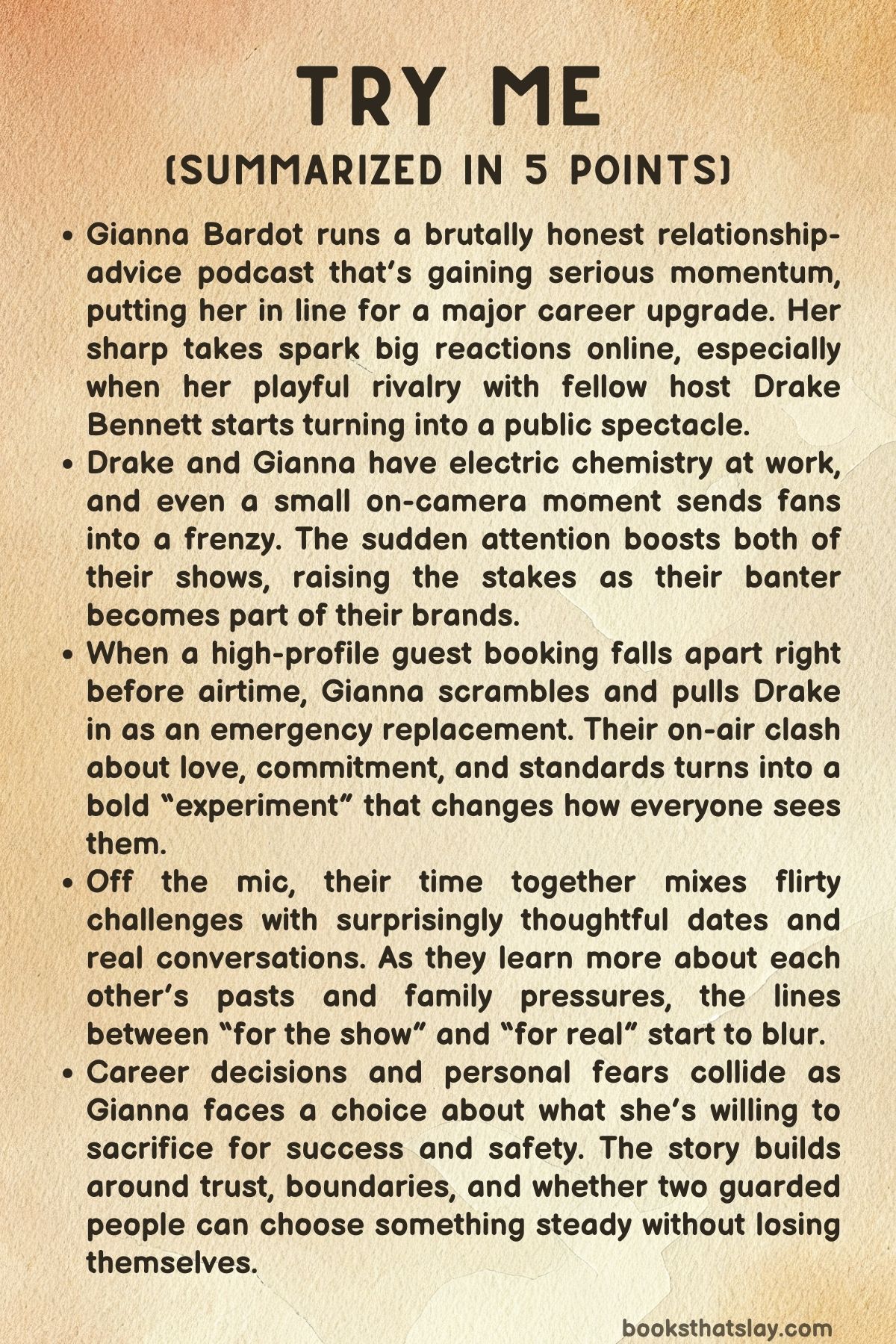
Try Me by Adriana Locke is a contemporary romance set in the high-volume world of podcasting and online fame. Gianna Bardot runs a live advice show where she’s known for sharp takes on love and zero patience for wishful thinking.
Drake Bennett, her charismatic coworker and on-air rival, is exactly the kind of man who should be “off-limits”—and exactly the one who gets under her skin. When a booking disaster forces them to improvise, they make a bold on-air decision that turns their professional rivalry into a very public experiment: six weeks of real dating, with rules, boundaries, and a whole lot to lose. It’s the 2nd book of the Play Me series.
Summary
Gianna Bardot is the unapologetic host of a live-streamed relationship advice podcast, famous for telling callers what they need to hear rather than what they want. On one episode, she jokes about revenge and then gives a hard truth to a caller who’s unsure whether the man she’s seeing is committed: if you’re constantly questioning it, he’s probably not.
Gianna frames love as a choice and pushes people to judge relationships by what’s actually happening, not by hope. Off-air, she’s her usual whirlwind—misplacing keys, juggling art projects, and keeping plans with her best friends Astrid and Audrey.
Her producer, Francine, shares exciting news: Gianna’s numbers are strong enough that she could be considered for a coveted prime time slot at Canoodle Media. The catch is that her main competition is Drake Bennett, a confident, popular host with a sports show—and a habit of trading flirty jabs with Gianna every chance he gets.
Drake and Gianna’s chemistry is obvious to everyone around them, including their audience. When Francine books a major interview with Mercy Malone, drummer for the band Wildfire, Gianna hypes it online.
Drake joins the banter from his own account, and the audience immediately starts speculating that the two hosts are together. Gianna insists they aren’t, but the rumor catches fire.
At dinner with Astrid and Audrey, Gianna admits the prime slot is within reach, but so is Drake, which makes the race personal in a way she won’t say out loud.
Away from the studio, Drake’s life is more complicated than his public persona suggests. He visits his parents and sees the strain his mother is under as she cares for his father, Big Ed, whose dementia is progressing.
Drake tries to be the steady one—helpful, patient, and calm—while watching his dad swing between warmth and confusion. Big Ed’s moments of clarity hit Drake hard, especially when he talks about falling in love with Drake’s mother and tells Drake he’ll one day meet a woman who changes everything.
Drake already knows who that woman is, but he doesn’t trust the feeling. Gianna is exciting, messy, and unpredictable—the opposite of safe.
Back at work, Gianna rejects a sponsorship offer that doesn’t align with her message, showing she won’t compromise her brand for money. She goes live to promote the Mercy episode, but Drake walks into her office holding the keys she lost, not realizing she’s broadcasting.
Gianna pulls him into the live moment rather than ending it, and their playful argument becomes instant content. The comments explode.
Drake is quick, charming, and completely unfazed in front of the camera. Gianna tries to shut down the dating rumors, but the audience is already choosing sides, chanting Drake’s name, and turning their banter into a ship.
Gianna tries to focus, but she can’t ignore how Drake rattles her. The next day, she’s home preparing for the big Mercy interview, proud of the house she worked hard to buy and the independence it represents.
Her sister Lucia drops by with food and a jar of sourdough starter like it’s a serious responsibility. Lucia also notices Drake texting Gianna and immediately reads the situation: Gianna’s pretending it’s casual, but it’s not.
Meanwhile, Drake sees a spike in his own show’s engagement and realizes being linked to Gianna brings a whole new audience. He tells himself it’s professional.
His body doesn’t agree.
Then everything goes sideways. Just before Gianna goes live with Mercy, Francine rushes in with a crisis: Mercy was in a car accident and can’t make the interview.
Gianna is told she can’t mention the accident on air. With minutes left, Francine suggests using old clips, but Gianna spots Drake nearby and makes a snap decision—get him in the studio, now.
Drake doesn’t hesitate. On-air, they lean into their existing momentum: joking about their viral moment, teasing each other, and taking a call from a listener worried about a boyfriend’s wealthy family.
Drake suggests communication and clarity. Gianna insists the caller should judge the boyfriend by his actions and walk away if he’s dismissive.
Their disagreement exposes the core difference between them: Drake believes in working through things; Gianna believes in leaving before you get hurt.
Drake challenges her in the most public way possible. He proposes they date for six weeks as an experiment—part content, part proof that Gianna’s cynicism isn’t the only way.
Gianna, cornered on-air and fueled by pride, accepts. They end the episode announcing Drake is her new boyfriend.
The audience loses its mind. Gianna immediately goes offline to avoid the chaos, while Drake faces teasing from friends and family who know he’s not faking anything.
He tells himself six weeks is contained, controlled, and temporary. It’s a way to be near Gianna without promising forever.
They set rules through flirty texts, and their first real date begins with Drake showing up early and Gianna dressing to feel powerful. He takes her to a tapas place, introduces her as his girlfriend, and insists they actually talk—not just perform.
The chemistry is loud, but Drake keeps steering them toward connection. Gianna is surprised by how much she enjoys being seen without having to fight for attention.
Gianna’s confidence cracks in quieter moments. A casual phrase triggers a deep irritation that ties back to her childhood, when affection was scarce and criticism was easy.
She remembers acting out as a teen, chasing danger because it felt like control. She texts Lucia, who confirms what Gianna has always known: their parents were strict, distant, and hard to please.
Even after their parents died in a car accident when Gianna was nineteen, the old wounds stayed. Gianna built her adult life around independence, sharp humor, and staying one step ahead of disappointment.
Drake, meanwhile, refuses to rush physical intimacy even though the desire between them is obvious. Gianna can’t tell if he’s playing a game or holding back for a reason.
During a long negotiation with Pearl Jenkins—an older woman selling Gianna an antique coat tree—Gianna vents about her “kind of” boyfriend who won’t sleep with her. Pearl, blunt and unexpectedly wise, suggests Drake might be slowing things down to break Gianna’s patterns and earn trust.
The idea lands. Gianna buys the coat tree at a generous price and feels lighter, as if she’s made a choice to stop treating everything like a fight.
Drake plans another date that meets Gianna where she is: playful, creative, and specific. Over dinner, they share real parts of themselves.
Drake tells her about his father’s dementia and the fear of watching someone disappear in pieces. Gianna reveals she lost her parents suddenly and still doesn’t know what to do with the ache.
The night ends with a glassblowing class chosen for its obvious joke, and the laughter becomes a kind of relief. Still, Gianna wants more than laughter.
She decides to force the issue by “forgetting” her phone in Drake’s car, changing into something tempting, and making sure he has to come back.
It works. They finally give in, and afterward they linger in the tenderness of what they’ve started.
But the softness doesn’t last long. Drake gets a late call from his mother, overwhelmed by another hard night with Big Ed.
Drake has to go help, and he asks Gianna to come with him. She agrees, nervous but willing.
At Drake’s parents’ house, his mother welcomes Gianna instantly, feeding her and treating her like she belongs. Gianna sees the reality of Drake’s life: the exhaustion, the love, the patience it takes to care for someone who can’t always recognize the present.
As the six-week “experiment” continues, the line between performance and truth disappears. Drake begins to imagine a future that includes Gianna, stability, and possibly kids.
Gianna panics at the direction of the conversation. When Drake visits her and they talk about family, she tries to end things before she gets in too deep.
She reminds him it was supposed to be temporary. Drake is confused until she admits what really set her off: he said he loved her in his sleep.
To Gianna, love feels like a trap—an expectation she can’t meet, a promise she’ll fail. She’s convinced she doesn’t fit into Drake’s world or his future.
Drake refuses to accept the breakup as final. He tells her he’ll give her space, but he won’t stop caring.
He leaves, holding himself together until he’s alone.
For days, Drake keeps texting her—steady, gentle, consistent. Gianna replies with distance at first, then with small openings, then with warmth she can’t hide.
Meanwhile, Drake takes Big Ed to doctor appointments and learns more about what’s coming. He practices not correcting his father, choosing calm over truth when truth only causes distress.
Big Ed mentions Gianna by name, reminding Drake that his father feels her importance even through the fog.
Gianna finally goes to the cemetery and visits her parents’ grave for the first time in a long while. She cries, talks out loud, and admits she ran because she doesn’t know how to receive love without bracing for pain.
She decides she doesn’t want to live that way anymore. She chooses forgiveness—not to excuse what hurt, but to stop carrying it.
She leaves knowing she wants Drake, a home filled with affection, and a future she once told herself she didn’t deserve.
That resolve is tested immediately in a high-stakes meeting with Canoodle executives. Drake arrives too, and they sit across from the people who control their careers.
The execs announce Drake’s sports show will take the open Thursday slot—then pivot to Gianna with a different offer: they want to “upgrade” her brand into a scripted daily show controlled by their team. Gianna realizes they want her face and audience but not her voice.
When they imply they can end her contract if she refuses, she chooses to walk away, protecting her identity and her work. The executives threaten security and demand she clear out.
Drake stands up and quits on the spot, refusing to work for a company that tries to steamroll her. He tells them to speak to his attorney.
Gianna runs to him, overwhelmed by what he’s done and what it means. She apologizes for pushing him away and finally says she loves him.
He kisses her like it’s the only answer that matters.
They return to Gianna’s house, where she worries aloud about her mess and chaos. Drake tells her to stop apologizing for being herself.
They reconnect—physically, emotionally, and with a new honesty. Gianna invites Drake to move into her home because it fits their lives better, and he accepts, talking about learning her art and building something that isn’t temporary.
A week later, they celebrate with friends, joking about what comes next and letting the future be theirs to choose—together.
Characters
Gianna Bardot
Gianna is the loud, fearless center of Try Me. On the surface she’s a blunt relationship-advice personality who thrives on provocation, control, and the adrenaline of telling people the truth they don’t want to hear.
Underneath, her “truth” is also a shield: she has trained herself to read abandonment early and declare endings before they can be done to her. That instinct shows up in how she frames love as a “choice” and treats uncertainty as a verdict, because certainty feels like safety and safety has rarely been guaranteed in her life.
Her chaotic creativity—dumpster-dived cans turned into butterfly art, the obsession with odd finds like the coat tree—works like emotional translation: she takes discarded or overlooked things and makes them beautiful, which mirrors how she secretly wants to be seen. As Drake pushes her toward patience, tenderness, and real vulnerability, Gianna’s core conflict becomes clear: she wants connection, but she’s terrified that connection will cost her autonomy or expose her to disappointment.
The arc of her character is learning that control is not the same as protection, and that choosing love doesn’t require shrinking herself or becoming “less messy,” only becoming more honest.
Drake Bennett
Drake is the charming rival who looks effortless on-air, but his depth comes from what he carries off-camera. He’s confident, witty, and built for public performance, yet his life is grounded in responsibility—especially the emotional weight of his father’s dementia and the quiet devotion he shows to his family.
That steadiness is what makes him such a disruptive force in Gianna’s world: he doesn’t chase her chaos for fun, and he doesn’t punish her for it either; he simply holds his own line. Drake’s attraction isn’t just physical—he’s drawn to her spark and intelligence, but he also recognizes the way she uses sharpness as armor, and instead of retreating, he meets her with patience and deliberate care.
The “six-week dating experiment” starts as an on-air stunt and a challenge, but it quickly reveals what Drake actually wants: a real relationship built on intention, not games. Even when Gianna panics and tries to end things, Drake’s defining trait is emotional bravery—he refuses to pretend he doesn’t feel what he feels, and he won’t accept a version of love that’s conditional on being convenient or risk-free.
Francine
Francine functions as both Gianna’s professional anchor and an engine of plot momentum. She’s the producer who understands the value of Gianna’s voice and brand, and she protects that voice by balancing the pressures of ratings, sponsorships, and network politics against Gianna’s integrity.
Her teasing familiarity—like the story of the runaway kitten chaos—signals that she’s seen Gianna at her messiest and still respects her, which matters because Gianna isn’t used to being valued without conditions. Francine’s importance peaks when she’s forced to triage real crises, like the Mercy accident, and she becomes the pragmatic counterpart to Gianna’s improvisational instincts.
She represents the adult reality behind “media magic”: success is built on logistics, taste, and timing, and Francine is the person who makes the show’s world function.
Astrid
Astrid is Gianna’s best-friend mirror for what stability can look like without becoming dull. She’s warm, grounded, and candid, and she has enough backbone to banter with Gianna rather than be steamrolled by her energy.
Her life in Sugar Creek with Gray gives her a foothold in small-town expectations, which she can poke fun at while still being shaped by them. Astrid’s role in the friend trio is the one who offers common-sense perspective but never in a judgmental way; she understands how Gianna’s intensity is both charm and coping mechanism.
The later teaser moment at the gas station highlights Astrid’s defining trait—she refuses to be bullied—while also revealing her growth edge: learning when to disengage, not because she’s weak, but because winning every conflict isn’t the same as protecting your peace.
Audrey
Audrey is the quiet counterweight in the friend group, and her restraint is as much character texture as it is protective strategy. She’s intellectually oriented, teaching philosophy, and she tends to observe rather than perform—an approach that makes her the safest person to have around when emotions get loud.
Gianna pushes her to “loosen up,” but the story treats Audrey’s reserve as a valid identity, not a flaw, which makes her presence feel stabilizing rather than merely comedic. Audrey’s support shows in small, practical intimacy—helping clean up the coat tree, showing up in the background without needing attention—which reinforces the theme that love and care can be quiet and consistent.
She also acts as a subtle contrast to Gianna: where Gianna externalizes everything, Audrey internalizes, and together they show different survival styles.
Lucia
Lucia is Gianna’s sister and an emotional translator between past wounds and present choices. She knows the family history well enough to name it plainly—scarce affection, hard parenting, lasting impact—without turning the conversation into melodrama.
That clarity matters because Gianna tends to cope through humor, rebellion, or control, and Lucia meets her with truth plus warmth, the exact combination Gianna is missing when she spirals. Lucia’s stability doesn’t read as perfection; it reads as intentionality, which becomes a quiet challenge to Gianna’s fear that she’s just “going through the motions.” The sourdough starter gift is also a perfect Lucia detail: nurturing, slightly bossy in an affectionate way, and symbolic of growth that requires patience—exactly the lesson Gianna is struggling to accept.
Barb Bennett
Barb is the emotional center of Drake’s family life and the clearest window into what Drake has learned about love. She’s exhausted, devoted, and managing a heartbreaking reality with as much dignity as she can, which makes her warmth toward Gianna especially meaningful.
When Barb welcomes Gianna in the middle of a hard night, it’s not performative hospitality; it’s relief at being seen and supported, and it signals that Gianna is being folded into something real. Barb also exposes the cost of caretaking—the fear, strain, and loneliness—without making it a martyr story.
Through her, the book shows love as action: feeding people, making space, holding on when life gets frightening.
Big Ed Bennett
Big Ed’s dementia storyline adds gravity and tenderness to the romance, because it forces Drake—and later Gianna—into a world where control is impossible. His moments of confusion, anger, and sudden clarity make him unpredictable, but not villainous; he’s portrayed as a man still present in flashes, still capable of warmth, even as his mind betrays him.
Big Ed’s brief lucidity when he talks about falling in love gives Drake a template of wholehearted devotion, and it becomes emotionally ironic later when Drake is the one offering love that Gianna doesn’t know how to receive. He also acts as a narrative pressure point: the future is real, time is limited, and the people you love can change in ways you didn’t consent to.
That reality deepens Drake’s urgency to choose love clearly, not vaguely.
Elodie
Elodie, Drake’s older sister, shows Drake’s role as the family emotional stabilizer in a lighter, more relatable way. Her baby panic is comedic, but it also reveals how the family is collectively stressed by their father’s decline—small anxieties flare because the big anxiety is always humming in the background.
Elodie trusts Drake enough to melt down honestly, which suggests he’s long been the dependable one, the person people call when they need grounding. She adds warmth and texture to Drake’s world and reinforces that his steadiness isn’t a romance pose; it’s a lifelong pattern.
Evie
Evie is the sister who brings playful interrogation and pushes Drake to admit what he’s feeling. Where Elodie seeks comfort, Evie seeks details, and her teasing functions like a truth serum that nudges Drake out of his guardedness.
She helps highlight how extraordinary Gianna is in Drake’s emotional landscape, because Drake’s responses to Evie’s ribbing show he can’t entirely hide what’s happening. Evie’s presence also reinforces the theme that love is communal—relationships don’t exist in isolation; they ripple through siblings, friends, and family dynamics.
Mario
Mario is Drake’s producer and an important lens on how public perception can reshape private realities. He’s the one who names the spike in engagement as “the Gianna Effect,” which underscores Gianna’s influence and the way the audience treats their chemistry as entertainment currency.
Mario’s role is partly comic and partly structural—he represents the machine around Drake, the constant measurement of attention, and the temptation to turn intimacy into strategy. Even when he’s not driving the emotional plot, he sharpens the book’s tension between authenticity and performance.
Ron Jeffries
Ron is Drake’s on-air foil, creating conflict, energy, and a sense of Drake’s professional persona. Their arguments are performative in the way sports media often is—competitive, loud, and designed to hook listeners—which makes Ron less about personal depth and more about context.
His presence matters because it shows Drake’s skill at controlled conflict: he can spar publicly without losing himself, which contrasts with how Gianna’s conflict style tends to be personal and defensive. Ron also helps establish Drake as a credible figure in his own arena, not merely a romantic accessory to Gianna’s story.
Mercy Malone
Mercy is a catalyst character whose importance is less about page time and more about what her presence triggers. As the drummer for Wildfire and a fan of Gianna’s, she symbolizes professional validation—Gianna’s platform is big enough to attract real cultural figures.
Her accident becomes the crisis that forces Gianna and Drake into their first true partnership, because it removes the safety of planning and demands trust, improvisation, and mutual rescue. Mercy also underscores a recurring truth in the story: life interrupts your scripts, and the way you respond reveals who you are.
Gray
Gray appears mostly through Astrid’s references, but he still serves a clear function: he represents the path of rooted, chosen stability. He’s part of the “Sugar Creek” world that comes with expectations, community scrutiny, and a slower rhythm, which helps define Astrid’s identity and provides a contrast to Gianna’s urban, media-driven chaos.
Even in the background, Gray symbolizes the idea that commitment can be ordinary, not dramatic—an idea Gianna struggles to accept until she starts wanting a future that isn’t fueled by adrenaline.
Jory
Jory is Drake’s friend and a small but meaningful marker of Drake’s off-air life. The basketball hangout shows Drake has outlets for stress and companionship that aren’t romantic, which makes him feel like a full person with a support system.
Jory’s presence also provides a masculine friendship space that contrasts with the emotional caretaking Drake does with family, reminding the reader that Drake carries a lot and needs moments where he can simply exist without being responsible for someone else’s crisis.
Pearl Jenkins
Pearl begins as a comic nuisance—an older woman haggling aggressively over a coat tree—but she grows into an unexpectedly tender truth-teller for Gianna. Pearl’s bluntness matches Gianna’s, which is why she can slip past Gianna’s defenses; she can call things out without sounding like a therapist or a critic.
Her motivations—fear of being forgotten, resentment toward ungrateful kids, a hunger to spend what’s hers on joy—give her surprising emotional weight and make her feel like a fully alive person rather than a gag. Most importantly, Pearl offers Gianna a new interpretation of Drake’s restraint: that going slow can be devotion, not rejection.
That reframing helps Gianna see intimacy as something built, not seized, and it nudges her toward hope without forcing her to abandon her edge.
Jason Brewer
Jason is a brief but intentional introduction that signals a larger social world beyond Gianna and Drake. His connection to the Brewer family and ownership of Brewer Air positions him as a status-inflected presence—handsome, notable, and potentially meaningful later.
In the current story space, he functions as a spark of possibility and a reminder that Astrid’s life may be headed toward new complications or new attention. Jason’s minimal interaction is the point: he’s a door left slightly open, suggesting future romantic or plot tension without needing immediate payoff.
Juni
Juni is a workplace texture character who adds humor, gossip, and warmth to the media setting. She’s tuned in to the office energy—scheduling segments, showing up at inconveniently perfect times, and later revealing she bet on Gianna and Drake lasting “until forever.” That detail makes her feel like an audience surrogate inside the story: she reacts the way the public reacts, but with the intimacy of someone who actually knows them.
Juni also reinforces the theme that relationships are witnessed; even when Gianna tries to control the narrative, people around her see what’s real.
Brooke
Brooke arrives as a pivot into a new storyline, and her characterization is immediately defined by coping through strategy. She doesn’t seek romance for romance’s sake; she seeks a “situationship” and a fake boyfriend as social armor against family drama, especially the stress of an ex-husband and messy interpersonal history.
That impulse mirrors Gianna in an interesting way—both women try to manage vulnerability by designing a plan—but Brooke’s tone is more anxious and defensive than defiant. Even in her brief introduction, she reads as someone whose choices are shaped by being cornered by social expectations, and she’s poised to explore how pretending can slide into wanting the real thing.
Jovie
Jovie is Brooke’s best friend and the immediate voice of caution, signaling that she plays the grounded-counterpart role in Brooke’s world. Her skepticism isn’t just negativity; it suggests she understands how messy “fake” arrangements become once feelings and consequences show up.
By pushing back, Jovie also reveals that Brooke is persuasive and stubborn—someone who will do what she thinks she must, even if she knows it’s risky. Jovie’s presence sets up a friendship dynamic similar to Gianna’s support system: a friend who argues because she cares, not because she wants control.
Moss
Moss enters as an abrupt disruption, and the lack of detail is part of his function: he’s tension embodied. His appearance in Brooke’s office suggests unfinished business, conflict, or a complication that Brooke didn’t plan for—exactly the kind of intrusion that exposes a character’s true motivations.
The introduction frames him as someone who can destabilize Brooke’s carefully constructed defenses, which makes him narratively powerful even before his full personality is revealed. In that way, Moss is positioned as the catalyst who will test whether Brooke’s “fake boyfriend” plan is a shield she can hold or a spark that will ignite something bigger.
Themes
Performance, Persona, and the Cost of Being “On”
In Try Me, Gianna’s career is built on speaking with authority about relationships while keeping her own emotional life tightly managed. The live-streamed format, the constant comments, and the rapid feedback loops make her advice feel like public entertainment rather than private care, and that pressure shapes how she speaks.
She has a style that rewards certainty: a clean verdict, a sharp line, a quick prescription. That works for listeners who want clarity, but it also trains Gianna to treat ambiguity as weakness and longing as something to outgrow.
The theme becomes sharper whenever her brand meets real life. A single accidental moment on a livestream turns into a story the audience claims as their own, and suddenly she is managing a narrative instead of living an experience.
The crowd’s obsession with her and Drake turns intimacy into a spectator sport, where even a harmless poll becomes evidence in a public romance trial. What looks like fun publicity creates a trap: once a persona becomes profitable, every personal reaction risks becoming content, and every private boundary becomes a potential headline.
Gianna’s irritation at the “Drake chant” is not only jealousy over attention; it’s anxiety over losing authorship of her own life. The novel shows how exhausting it is to be constantly interpreted, constantly watched, constantly turned into a symbol, and it asks what authenticity even means when a career depends on performance.
Gianna’s eventual choices suggest that control over her voice matters more than visibility, and that being “on” all the time can make a person forget how to be emotionally present when the cameras are off.
Agency, Boundaries, and Choosing Yourself When Power Pushes Back
The tension with Canoodle executives turns a romance-centered story into a broader conflict about who owns a person’s work, image, and future. Gianna repeatedly demonstrates that her brand is not just a job but an extension of her values: she refuses sponsorships that dilute her message, she curates her public tone, and she understands that her credibility depends on consistency.
When the company offers a shiny “upgrade” that actually removes her creative control, the theme of agency becomes unavoidable. The proposal is framed as opportunity, but it reads like extraction: they want her audience, her voice, her recognizability, and her labor, without granting her authority over what she says.
The threat of contract clauses and forced removal from the building makes the imbalance explicit. Gianna’s decision to walk is not impulsive bravado; it’s an act of self-definition.
She chooses uncertainty over being packaged, and that choice is especially significant because her background includes emotional environments where affection was scarce and control was a weapon. Walking away becomes a corrective experience: she refuses to repeat the pattern of accepting what powerful people offer while shrinking herself to fit.
Drake quitting alongside her deepens the theme without turning it into rescue. His action matters because it matches her values rather than overriding them; he is not “saving” her career, he is rejecting a system that disrespects her autonomy.
The story treats boundaries as more than romantic rules; boundaries become the backbone of identity, the line that protects meaning from being negotiated away.
Fear of Commitment, Emotional Safety, and Relearning What Love Can Be
Gianna’s confidence on-air contrasts with her panic when love becomes personal and irreversible. Her worldview has been shaped by neglect, criticism, and loss, and those experiences teach her to treat attachment as a risk that must be managed.
She can talk about love as a choice, but when Drake’s feelings become undeniable, she experiences love as a threat to control. The “six weeks” arrangement seems playful, but it also gives her a built-in exit ramp.
She can enjoy connection while telling herself it has an end date, and that structure protects her from confronting what she wants. Drake disrupts that strategy because his affection is consistent and patient rather than chaotic.
He slows down physically, not to manipulate, but to build trust and differentiate himself from the kind of attention Gianna learned to chase when she was younger. Her history of seeking dangerous older men as a teenager isn’t included for shock; it explains a learned pattern where intensity substitutes for care and rebellion substitutes for being seen.
When Drake offers steadiness, her instincts misread it as confinement. The moment she tries to end things after realizing he loves her shows how fear can disguise itself as logic: she claims she doesn’t belong in his life or future, she predicts disappointment, and she frames withdrawal as mercy.
The book treats this as a psychological defense rather than mere stubbornness. Gianna isn’t rejecting Drake so much as rejecting the vulnerability that comes with being chosen.
Her later decision at the cemetery marks a shift from survival thinking to desire: she admits what she wants, confronts her grief, and allows herself to imagine a life that includes warmth and family. Love becomes less about persuasion and more about safety, repetition, and the courage to stay when leaving would feel easier.
Grief, Memory, and Living With the Unfinished
Loss is not a background detail in Try Me; it is a living force that shapes how the characters interpret the present. Gianna lost her parents young, and the result is not only sadness but a complicated emotional inheritance: she carries unmet needs, unresolved anger, and a lasting suspicion that stability can disappear without warning.
Her avoidance of the cemetery signals how grief can freeze into avoidance, where the mind tries to keep pain contained by refusing the places and rituals that make it real. When she finally goes, the scene functions as a private reckoning: she speaks honestly, admits fear, and decides to forgive.
That forgiveness is not presented as excusing harm; it is a decision to stop living in reaction to the past. Drake’s family storyline mirrors this from a different angle.
Dementia introduces a type of grief where the person is still alive but continuously slipping away, creating repeated small losses rather than one clear ending. His mother’s exhaustion and his father’s moments of clarity show how love becomes practical labor: managing confusion, preserving dignity, adjusting expectations, and learning new ways to communicate.
Drake practicing not correcting his father illustrates a painful emotional discipline—choosing calm over accuracy for the sake of peace. These parallel forms of grief create a shared language between Gianna and Drake.
They understand each other not because they experienced the same event, but because both know what it means to live with something that cannot be fixed. The theme pushes the story toward maturity: healing is not a single breakthrough, it is a set of daily choices—returning a text, showing up at a late-night call, staying present even when pain is inconvenient.
Public Opinion, Parasocial Pressure, and Romance Under a Microscope
Because both Gianna and Drake have audiences, their relationship is never fully private. Fans treat every interaction as evidence, and the internet behaves like a jury that has already decided the outcome.
This creates a unique strain: they are not only learning each other, they are also managing a crowd’s assumptions. The story shows how parasocial attention distorts reality.
People demand access to a relationship they are not in, cheer for intimacy as if it’s a reward, and interpret boundaries as obstacles to entertainment. Gianna’s attempt to “control the narrative” on a livestream is revealing: she understands that silence becomes a story anyway, so she tries to shape what the public believes.
Yet the more she clarifies, the more attention she fuels. The theme highlights a modern tension where visibility is profitable but intimacy is fragile.
Drake benefits from the “Gianna Effect” in his metrics, which complicates his motives even if his feelings are genuine. The book doesn’t accuse him of using her; instead, it shows how even sincere affection can become entangled with incentives.
Their six-week dating proposal begins as content and becomes real, illustrating how performative beginnings do not prevent authentic outcomes, but they do create additional risks. Every conflict threatens to become spectacle, every tender moment can be clipped and replayed, and the line between playful banter and emotional truth gets harder to protect.
The resolution suggests that the only sustainable answer is alignment: choosing each other in ways that cannot be reduced to engagement numbers, and building a life where the relationship is lived first and explained second.