Vice and Violet Summary, Characters and Themes
Vice and Violet by Sarah A. Bailey is a profound and emotional exploration of love, grief, and self-healing. The story revolves around Violet, who is struggling with the fallout from a fractured relationship with Elena, her once-close friend.
The narrative delves into the personal journeys of the characters as they try to reconcile their past traumas, unspoken feelings, and the emotional weight of loss. Set in the coastal town of Pacific Shores, the story captures the raw, intimate moments between Violet, Elena, and their families, showcasing the complexities of relationships, particularly in the face of overwhelming grief and unresolved emotions. With its rich characters and poignant themes, Vice and Violet paints a vivid portrait of human connection and healing.
Summary
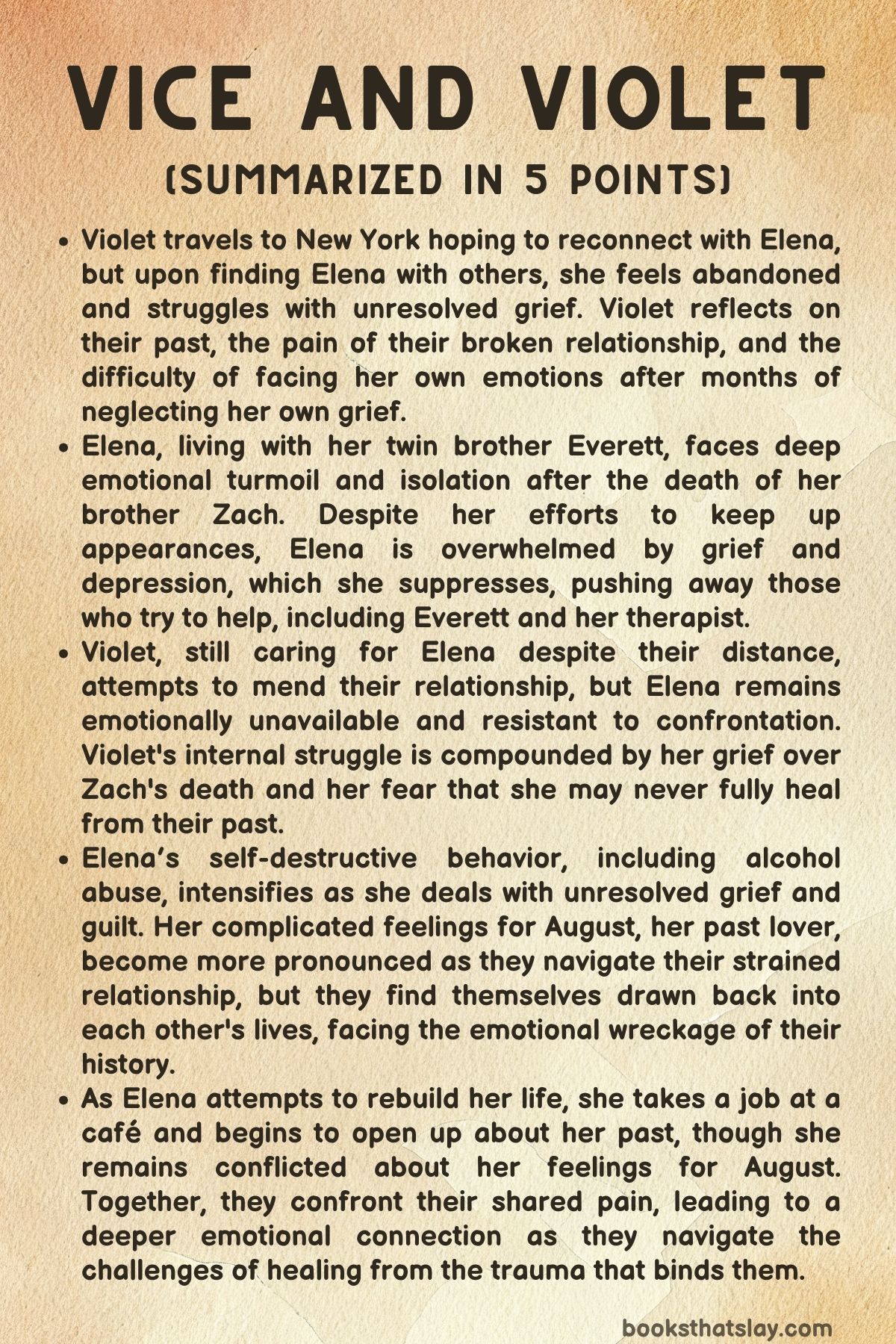
Four years ago, Violet traveled to New York in hopes of reconciling with Elena, who had withdrawn from everyone after a traumatic event. Violet, wanting closure and a chance to repair their broken relationship, waited outside Elena’s apartment, hoping for a reunion.
However, when Elena finally returned, she was with a group of people, laughing and enjoying their company, including a man. This sight deeply unsettled Violet, who had spent months trying to connect with Elena, only to find her seemingly moving on without her.
Violet felt abandoned and left behind, grappling with the overwhelming sense of loss.
As Violet waited, her mind wandered to their past, remembering the bond they once shared. Despite her anger and fear of rejection, Violet longed for closure and hoped to heal the deep emotional wound caused by their estrangement.
She realized that her own grief, which had been overshadowed by Elena’s, had gone unaddressed for months. Seeing Elena so carefree with others forced Violet to confront the pain she had been avoiding for so long.
She felt torn between her love for Elena and the emptiness that had taken root in her own heart.
Elena, in the present day, was living with her twin brother Everett in California, trying to escape her past. She had become increasingly isolated, avoiding her family and anyone who might remind her of the pain she was hiding.
The loss of her brother, Zach, had left her emotionally wrecked, and she was unable to process the grief. Despite the encouragement of her therapist to confront her emotions, Elena chose to suppress her feelings, further compounding her emotional burden.
Elena’s isolation was palpable, and her attempts to move forward were stifled by her own emotional blockages. She had been avoiding facing the trauma of Zach’s death, as well as the unresolved issues with her family.
Everett, concerned for her well-being, tried to reach out, offering opportunities for her to get involved in activities or support her creatively. However, Elena rejected all his efforts, unable to overcome the weight of her own grief.
Meanwhile, Violet, despite her own pain, still cared for Elena and wanted to mend what had been broken between them. Violet’s longing for connection was met with resistance, as Elena’s emotional walls were too high for anyone to break down.
Violet’s attempts to re-enter Elena’s life felt futile, leaving her unsure of how to heal their fractured relationship.
As Elena continued to struggle with her grief and isolation, she was faced with the unresolved tension between her and August, a figure from her past. August had been a close friend, and their history was fraught with emotional turmoil.
Elena sought refuge in August’s tattoo shop after a disturbing encounter with a man named Elliot. Their interaction was tense, with August expressing his deep hurt over how Elena had treated him.
The conversation revealed the complicated nature of their relationship, and Elena’s unwillingness to confront her emotions became clear.
August’s concern for Elena grew as he found himself torn between helping her and protecting her from further harm. However, Elena’s resistance to accepting help made their connection even more strained.
She continued to spiral, resorting to alcohol and unhealthy relationships as a way of numbing her pain. Despite the emotional distance between them, August remained a figure of stability in Elena’s life, although both of them struggled to navigate their feelings for each other.
Elena’s emotional state continued to worsen as she faced physical pain and emotional distress, which intensified the tension between her and August. He offered her care and comfort, but Elena’s guilt and unresolved grief made it difficult for her to accept help.
Their shared history became a source of both solace and discomfort, and their relationship continued to be fraught with complicated emotions.
As Elena continued to navigate her grief, she took a job at a café owned by Dahlia, Everett’s wife, as a step toward independence. However, her unresolved feelings for August lingered, creating an undercurrent of tension between them.
Elena tried to move forward, but the past refused to let go of her. The emotional scars of her relationship with August, coupled with the trauma of losing Zach, made it difficult for her to find peace.
Elena’s emotional journey was complicated by her relationship with her family. As she lived with August and struggled with her grief, she found herself at a crossroads, unsure of whether she could heal from her past or if she was doomed to be trapped by it.
Despite the deep connection between her and August, she was haunted by guilt and fear, unsure of how to move forward.
August and Elena’s relationship, despite the pain and turmoil, remained a source of support for both of them. They found solace in each other’s company, even as they confronted the emotional wreckage of their shared history.
The love between them was undeniable, but so were the emotional scars that had yet to be healed.
The family dynamic remained tense, particularly with Elena’s brothers, who struggled to understand her relationship with August. However, over time, they began to come to terms with their past and, slowly, acceptance started to take root.
August and Elena’s future, though uncertain, was filled with possibilities as they continued to navigate the complexities of their relationship, their grief, and their healing.
By the end of the story, Elena and August had found a way to balance their past with their present. Their love had grown stronger, and despite the challenges they faced, they found a sense of peace and understanding.
Elena’s journey toward healing continued, but with August by her side, the future seemed a little brighter. As they looked forward to building a life together, their bond had become the foundation for their healing process, and the support of their family, though hard-earned, was a step toward renewal.
Characters
Violet
Violet is a deeply introspective and emotional character who is dealing with the aftermath of a complex and painful relationship with Elena. Over the course of the narrative, her emotional vulnerability is palpable, especially when she reflects on her relationship with Elena.
She spent years trying to be there for Elena during her darkest times, often at the expense of her own well-being. Her grief and pain are compounded by the abandonment she feels when Elena distances herself from her, leaving Violet feeling lost and broken.
Despite the overwhelming sense of rejection, Violet holds on to the belief that there is still hope for healing their rift. Her inability to fully let go of Elena is evident when she attempts to reconnect with her, despite Elena’s emotional walls.
Violet’s journey through grief and loss is marked by a deep yearning for closure and the emotional toll of unresolved feelings. Her inner turmoil showcases her complexity as she navigates her need for closure, love, and healing from past wounds.
Elena
Elena is a character torn between her grief, guilt, and self-destructive behaviors. After the traumatic death of her brother Zach, Elena retreats into isolation, struggling to cope with her emotions.
She distances herself from everyone, including her family and Violet, making it difficult for those who care about her to reach her. Elena is complex in her emotional struggles; she feels unworthy of love, which fuels her spiraling behavior.
Throughout the story, Elena experiences immense internal conflict, caught between a desire for connection and an overwhelming sense of shame and guilt over her past. Her relationships with her family, particularly her brothers and August, are complicated by these unresolved feelings.
Although she yearns for comfort and healing, she resists help, keeping her pain buried. As the story unfolds, Elena begins to confront her grief, and her complicated relationship with August becomes a focal point in her journey.
She continues to grapple with self-destructive tendencies, including turning to alcohol and volatile relationships to numb her pain, but her evolving relationship with August offers a glimmer of hope for her emotional healing.
August
August is a character who embodies both strength and vulnerability, caught in the emotional fallout of his past. As Elena’s childhood friend turned lover, August is deeply invested in her healing, even as their shared past presents numerous challenges.
He struggles with his own grief, particularly tied to the death of his brother Zach, and feels responsible for the pain that both he and Elena are enduring. August’s relationship with Elena is marked by emotional complexity, as they both navigate their feelings of guilt, love, and loss.
Despite the weight of their shared history and the unresolved issues between them, August demonstrates unwavering care and concern for Elena, often stepping in to support her even when she resists. His emotional depth is evident in his moments of introspection and his attempts to maintain emotional detachment from the situation, even though his feelings for Elena remain strong.
August is also depicted as someone trying to heal from his own familial struggles, especially with his distant relationship with his parents after Zach’s death. His dynamic with Elena is an emotional rollercoaster, but his commitment to her growth and healing is a testament to his depth as a character.
Everett
Everett is a character who is protective and deeply concerned about his sister Elena’s well-being. As Elena’s brother, he feels a strong sense of responsibility for her, particularly after the trauma of losing Zach.
Everett’s efforts to intervene in Elena’s life are driven by his genuine concern, but his frustration with her resistance to help creates tension. He sees Elena’s self-destructive behaviors and is deeply worried about the toll her grief and isolation are taking on her.
While Everett cares for Elena, his protective nature can sometimes be overwhelming, as he struggles to balance his desire to help with respecting her autonomy. His own grief is somewhat overshadowed by Elena’s, but it’s clear that he, too, is trying to navigate the pain of losing Zach.
Throughout the story, Everett’s role as a concerned sibling is vital, but his emotional conflict becomes evident as he deals with the complexity of Elena’s actions and the difficulty of supporting her without pushing too hard.
Zach
Though Zach’s presence in the narrative is primarily through his death and the impact it had on his family, he plays a significant role in shaping the emotional landscape of the characters. His death serves as a pivotal event that catalyzes Elena’s emotional unraveling and her retreat into isolation.
Zach’s loss creates a ripple effect in the lives of everyone around him, particularly August and Elena, who both struggle with unresolved grief and guilt. Zach’s character, while not physically present, represents the emotional void left behind and serves as a catalyst for the characters’ emotional growth and reconciliation.
The trauma of his death lingers throughout the story, shaping the way the characters relate to each other and themselves. His memory continues to haunt Elena and August, impacting their decisions, their relationships, and their attempts to heal.
Leo
Leo, as a supportive yet distant presence in the story, plays a key role in the family dynamic, particularly in relation to his siblings, Elena and Everett. Though not as central to the emotional journey as Elena or August, Leo’s role as a brother adds another layer to the familial relationships explored in the book.
His relationship with Elena is marked by protective love, but there is an undercurrent of tension as he tries to understand her decisions and emotional turmoil. Leo’s own personal growth and the anticipation of a new addition to his family signal a sense of hope and renewal amidst the heavier emotional themes of the story.
His character, along with his wife Darby, represents the possibility of healing and new beginnings within the family.
Themes
Grief and Healing
Grief in Vice and Violet is not a singular experience but a complex journey that shapes the characters’ lives. Elena’s grief over the death of her brother, Zach, deeply impacts her emotional state, coloring her relationships and her ability to function.
The loss manifests in her emotional withdrawal, substance abuse, and an inability to process her feelings in a healthy way. She chooses isolation over seeking support, which makes her grief even more suffocating.
This process of repression is a central theme in the narrative, showing how unaddressed grief can have long-lasting effects on one’s mental and emotional health. Elena’s pain is mirrored in the struggles of Violet, who has her own unresolved emotions tied to the loss of Zach.
The tension in their fractured relationship is rooted in both of their inability to fully face their grief, and their struggles to support one another through it.
Violet’s attempt to reconnect with Elena is a reflection of her own desire for healing, not just for Elena, but for herself as well. This theme explores the difficulty of finding closure and the struggle of moving on when one cannot confront their past.
Similarly, August’s grief over the death of his brother, Zach, and his struggle with guilt show another layer of how grief manifests differently in each person. The healing process for each character is slow and often painful, but as they begin to open up and share their feelings, they start to create space for emotional recovery.
Ultimately, Vice and Violet is a story of learning to heal after immense loss and the various ways people navigate the weight of grief, whether through isolation, denial, or gradual reconnection with those they love.
Family and Relationships
Family dynamics are at the heart of Vice and Violet, with the characters’ complicated relationships reflecting the tension between personal desires and familial expectations. The strained relationship between Elena and her family is evident as she distances herself from them, preferring solitude to the pressure of confronting her emotions.
Her family, particularly her brother Everett, continues to worry about her and tries to intervene, but their efforts often meet with resistance. The story also explores how grief affects the way family members relate to one another, with each character processing their pain in different ways.
The role of family in the healing process is vital, as it provides both a source of support and a source of conflict. The complexity of love within families is portrayed through Elena’s relationship with her brothers and her conflicted feelings toward August.
Even though they deeply care for her, their emotional distance and misunderstandings make it hard for Elena to feel the support she desperately needs.
The relationship between August and Elena represents another facet of family dynamics, particularly the tension between love and guilt. Their history, marked by trauma and unresolved emotions, makes it difficult for them to reconnect fully, but also creates a powerful bond that neither can ignore.
As they navigate their shared past, the characters are forced to confront the ways in which familial love both sustains and complicates their lives. The family’s journey toward reconciliation, especially in terms of accepting and supporting Elena’s relationship with August, is slow and fraught with tension.
Over time, however, they begin to understand and support one another, signaling the importance of familial love and acceptance in overcoming personal struggles.
Self-Discovery and Identity
The theme of self-discovery runs throughout Vice and Violet, particularly in how the characters come to terms with who they are in the face of trauma. Elena’s journey of self-discovery is intertwined with her grief and the relationships around her.
As she confronts the loss of her brother and her fractured connection with her family, she must also reckon with her own identity and sense of worth. Elena has long defined herself in relation to those around her, but as her grief isolates her, she is forced to face the question of who she is outside of those relationships.
This process of self-discovery is painful, as she grapples with feelings of unworthiness and guilt. Her decision to take a job at a café and start working toward independence is a small but significant step in reclaiming her sense of self.
For August, the struggle is somewhat different. His identity is heavily tied to his brother’s death and the guilt he feels as a result.
As he navigates his complex feelings for Elena, he must also figure out who he is outside of his past mistakes. Both August and Elena must learn to reconcile their pasts with their present identities.
The narrative reflects how trauma and loss can distort one’s sense of self, and the journey to reclaim that identity is often painful but ultimately empowering. The theme of self-discovery is shown not just through individual struggles, but through the way characters interact with one another, learn from their mistakes, and grow in understanding of who they are.
Redemption and Forgiveness
Redemption and forgiveness are central to the emotional arc of Vice and Violet, both in terms of personal redemption and the redemption of relationships. The characters struggle with feelings of guilt, particularly Elena and August, as they each carry their own burdens related to the death of Zach.
August’s journey is marked by his search for redemption, not just for his role in Zach’s death, but also for his inability to fully support Elena during her time of need. Similarly, Elena’s need for forgiveness is evident as she grapples with the mistakes she’s made and the ways she’s distanced herself from those who care about her.
Her struggle with forgiveness is not only internal, but also external, as she must learn to forgive herself before she can fully reconnect with the people around her.
The theme of redemption is also explored through the characters’ relationships. The slow but steady process of rebuilding trust between Elena and August is a key part of the story, as they learn to forgive each other for the pain they have caused.
The tension between love and forgiveness is a powerful force in the narrative, and the characters’ eventual willingness to let go of their guilt and mistakes signals their emotional growth. In the end, Vice and Violet shows that redemption is not a one-time event but a continuous process, where both self-forgiveness and the forgiveness of others are necessary for healing and moving forward.
The Complexity of Love
Love is portrayed in a multifaceted way in Vice and Violet, capturing both its beauty and its complications. The romantic tension between Elena and August is a key element of the story, and their relationship is marked by both passion and pain.
Their deep connection is undeniable, yet their past and the trauma they both carry create barriers that prevent them from fully embracing their love. This love is complicated by guilt, grief, and unresolved emotions, which makes it difficult for them to move forward.
Their relationship is not just about romantic desire but about the need for emotional healing and understanding.
The book also highlights the complexity of familial love, especially between Elena and her brothers. Their love for her is evident, but it is often expressed in ways that feel suffocating or intrusive to Elena, as she struggles to accept their concern without feeling judged or controlled.
The tension between love and control is a major part of the family dynamics, and the story shows how love can sometimes manifest as a source of pressure, especially when grief and trauma are involved. Despite these complexities, love ultimately acts as a catalyst for change in Vice and Violet.
The characters’ ability to open up to one another and face their pasts is driven by the love they share, even if that love is sometimes difficult to understand or accept.