Voidwalker Summary, Characters and Themes
Voidwalker by S.A. Maclean is a richly imagined fantasy set across parallel worlds known as the Planes, where mortals and immortals coexist under uneasy truces sealed with blood and sacrifice. The story follows Fionamara “Fi” Kolbeck, a smuggler with the rare power to walk through the Void that links these worlds.
What begins as an illegal job quickly turns into a clash between gods and mortals, as Fi becomes entangled in the politics of the immortal daeyari—creatures who once defied death itself. Through her journey, the novel explores freedom, power, and the cost of survival in a fractured, magical universe.
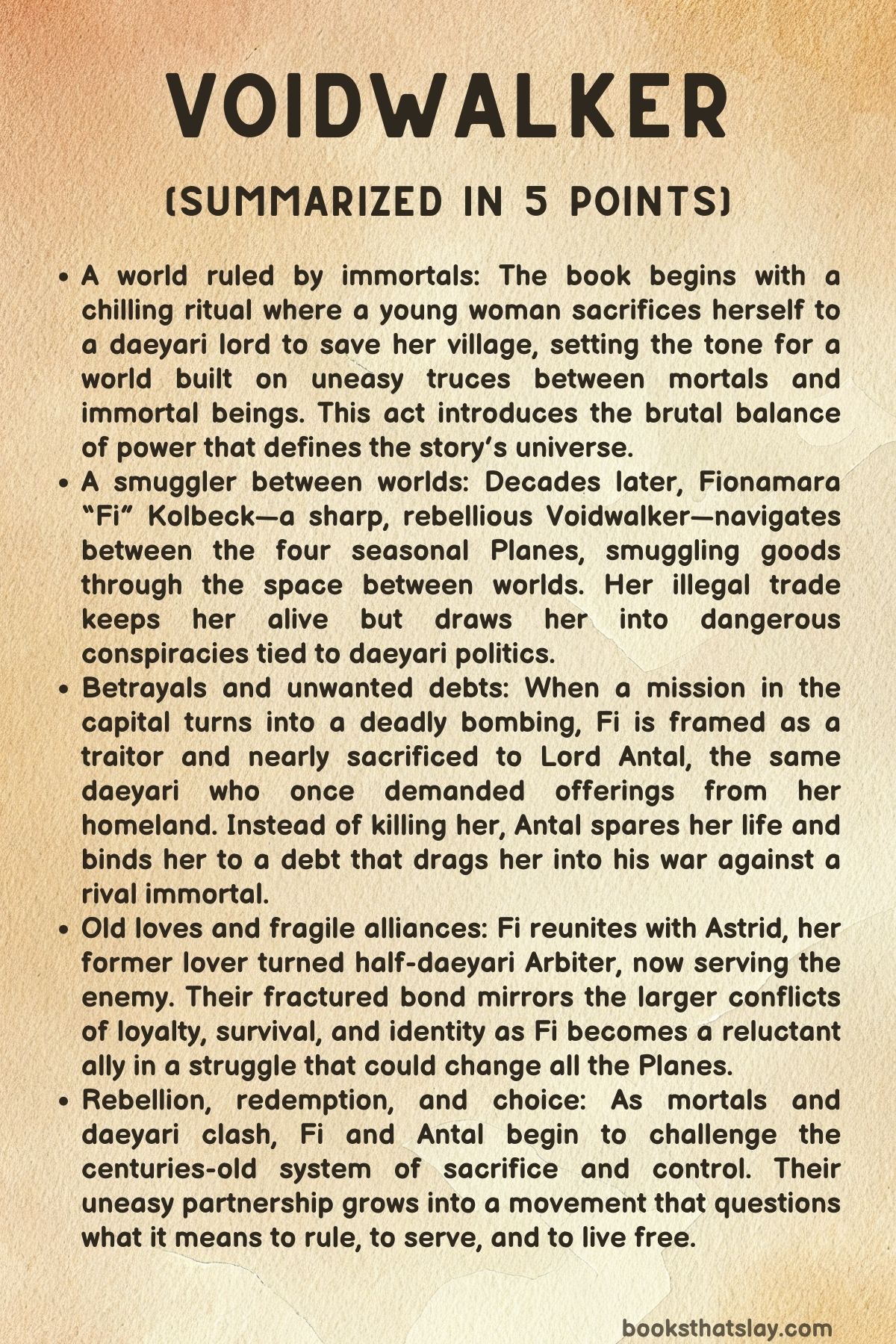
Summary
The tale begins with a chilling ritual: a young woman is sent to die as a sacrifice for the immortal daeyari, Lord Antal. Her death is serene and cold, a pact renewed between humans and an immortal who feeds on their blood in exchange for protection.
This grim tradition sets the tone for a world where peace is bought with death.
Decades later, Fionamara Kolbeck—known as Fi—is introduced as a Voidwalker, someone who can cross between the elemental Planes: Winter, Spring, Summer, and Autumn. After a near-death experience as a child, Fi gained the rare ability to see and open “Curtains,” invisible rifts that connect the worlds through the dangerous Void.
Now, she uses her power for smuggling contraband between Planes, a risky but profitable trade. Her life on the fringes of law and magic is shaped by her sharp wit, resourcefulness, and a refusal to bow to any authority—mortal or divine.
During one of her deals on the Autumn Plane, Fi meets a pompous client named Cardigan, who hides his real cargo—volatile energy capsules charged with daeyari power. The payment offered is equally dangerous: crimson-glowing chips infused with immortal energy.
Despite suspecting a trap, Fi accepts the job to transport the goods to the Winter Plane’s capital, Thomaskweld. The transaction turns violent when wardens ambush the group.
Fi escapes through a Curtain with her Void horse, Aisinay, barely surviving the crossing.
Upon returning to her home village of Nyskya in the frozen Winter Plane, Fi reconnects with her brother Boden, the town’s mayor. Together they examine her cargo and discover that the capsules could be used as weapons.
Despite Boden’s protests, Fi insists on completing her delivery. She gives him part of her payment—daeyari energy chips—to help power the village through the winter, a gesture that reveals her lingering loyalty to her people despite her outlaw life.
Two days later, Fi travels to Thomaskweld to finalize her smuggling deal. The city, vibrant yet grim, is ruled from afar by daeyari lords.
There she meets new contacts, Milana and Erik, who reveal that her previous delivery was only a test for a larger mission: smuggling energy capsules directly into the capitol. Reluctant, Fi is drawn in when Astrid—her former lover and now a daeyari half-blood serving as an Arbiter for Lord Verne—appears.
Their reunion reopens old wounds. Astrid, once Fi’s companion in rebellion, has become hardened and loyal to her immortal master.
Torn between mistrust and desire, Fi agrees to join the operation.
Inside the capitol, Fi disguises herself as a daeyari attendant. The mission goes awry when Lord Antal himself returns unexpectedly.
Milana’s true motives are revealed—she plans to assassinate Antal and others in a coordinated bombing. Explosions rip through the building, and Fi barely escapes through the chaos.
Drugged and betrayed, she is later offered as a sacrifice to Antal by Milana and Erik. Before losing consciousness, Fi orders him to kill them.
Amused by her defiance, Antal spares her life, slays her betrayers, and takes her prisoner.
Fi awakens in Antal’s fortress, bound by a magical debt: since he granted her wish, she must now serve him. He reveals that multiple cities in his territory were bombed, killing his mortal administrators.
Believing Verne—the rival daeyari—was behind it, he forces Fi to aid his investigation. Their uneasy alliance takes them to Verne’s chateau, where they are greeted by Astrid, now Verne’s Arbiter.
In the confrontation that follows, Verne admits orchestrating the attacks to destabilize Antal’s rule. Old tensions between the immortals erupt into open hostility, leaving Fi trapped between two beings who consider mortals expendable.
Back in Nyskya, Fi and Antal uncover signs that Verne has been sabotaging the town’s energy systems. Despite fear and distrust, the townspeople agree to meet Antal face to face.
At the council, he admits that daeyari have long suppressed human progress to maintain control, creating a cycle of dependency sustained through fear and sacrifice. Challenged by Fi, he agrees to end the old system if they help him reclaim his territory.
Fi proposes a radical new pact—one based on voluntary corpse donations after death instead of live sacrifices. The townsfolk agree, forging a fragile alliance between human and immortal for the first time in centuries.
Over the following days, Fi and Antal begin to work together, their partnership evolving into mutual respect and growing intimacy. Antal’s alien detachment softens as he reveals his fascination with mortal music and memory.
They share laughter, quiet moments, and eventually, love—though both know their worlds stand on the brink of war. Together they plan a daring heist on a trans-Plane train to steal materials needed to arm their rebellion.
The mission is interrupted by Astrid, who confronts Fi with rage and heartbreak over her abandonment years before. Their fight ends only when a monstrous creature—a derived daeyari Beast—attacks the train.
Fi and Antal barely escape, leaving Astrid behind in anguish.
As the final battle approaches, Fi leads a small force to confront Verne and the Beast that murdered her brother. The mortals and Antal fight side by side in the snow.
During the battle, Astrid reappears, revealing the Beast’s name—Navek—and pleading that he is a victim, enslaved and tormented by Verne. Fi’s rage falters, but the confrontation escalates when Verne herself arrives, wielding her deadly energy whip.
Astrid pretends to betray Fi but secretly arms her, and together they strike Verne. Though injured, Verne teleports away with Antal, forcing Fi to follow through the Void for a final showdown.
In Verne’s chateau, Fi and Antal fight as one. Fi drives her blade through Verne’s heart, while Astrid arrives with Navek to deliver the killing blow.
With Verne dead, her reign of terror ends. Astrid departs with Navek into exile, leaving Fi and Antal to rebuild what remains of the Winter Plane.
In the aftermath, Fi and Antal forge a new order. They promise to end the sacrifice system and replace fear with cooperation.
Letters from other daeyari lords arrive—some threatening, some offering uneasy truces. Antal’s father condemns him for killing Verne, but Fi stands firm beside him.
The pair return to Thomaskweld, where the people watch in cautious hope as an immortal and a mortal walk hand in hand through the dawn-lit city. Together, they vow to build a future grounded not in domination or debt, but in shared power—and, for the first time in history, equality between gods and humankind.
Characters
Fionamara (Fi) Kolbeck
Fionamara Kolbeck stands at the heart of Voidwalker, embodying defiance, trauma, and the unrelenting will to survive. A Voidwalker and smuggler by trade, Fi’s ability to traverse between Planes grants her both freedom and exile—a gift born of near-death and a curse that distances her from any sense of belonging.
Her personality is a mix of wit, weariness, and vulnerability; she hides her pain behind sarcasm, never allowing others to glimpse how deeply she has been shaped by loss and betrayal. Beneath the hardened exterior lies a woman constantly negotiating her own humanity in a world ruled by immortal beings.
Her smuggling career mirrors her emotional landscape—full of hidden risks, secret crossings, and boundaries constantly blurred.
Fi’s relationships drive her evolution: with her brother Boden, she clings to the remnants of familial warmth and loyalty; with Astrid, she grapples with love corroded by betrayal; with Lord Antal, she learns the complexity of compassion and power. Through Antal, Fi confronts her hatred of daeyari and the trauma of being nearly sacrificed to one as a child.
Her journey from fugitive to revolutionary marks a reclamation of agency—not only against immortal oppressors but also against the ghosts of her past. By the story’s end, Fi transforms from a reckless survivor into a leader who redefines the pact between mortals and immortals, turning blood sacrifice into a symbol of renewal rather than despair.
Lord Antal
Lord Antal, the daeyari ruler of the Winter Plane, embodies both monstrosity and melancholy. His appearance—a pale, antlered figure with crimson eyes—reflects his alien nature, but his soul carries the burden of memory and guilt.
Unlike other daeyari who revel in dominance, Antal wrestles with conscience, his immortality tainted by centuries of predation. The ritualistic consumption of human life haunts him; every sacrifice feeds his existence while eroding his empathy.
Yet, through Fi, he begins to rediscover the humanity buried beneath immortality.
Antal’s character arc traces the tension between divinity and decay. Initially an enigma—cold, calculating, and detached—he gradually reveals vulnerability: the yearning to be more than a relic of violence.
His intellect, restraint, and capacity for remorse distinguish him from his peers. When he allies with Fi and her village, Antal steps beyond the boundaries of daeyari tradition, risking his power to create a new order grounded in mutual respect rather than domination.
His bond with Fi evolves into a fragile romance that humanizes him, culminating in a shared vision to rebuild Thomaskweld as a place where mortal and immortal coexist without bloodshed. Antal’s journey thus mirrors Fi’s—each reshaping the other in defiance of the cycle of sacrifice.
Astrid
Astrid serves as both Fi’s lost love and her living mirror—a reminder of what happens when survival demands surrender. Once a passionate rebel, Astrid becomes Verne’s Arbiter, a half-daeyari enforcer who bridges two worlds yet belongs to neither.
Her transformation from idealist to weapon is tragic; she sacrifices freedom and love for power and survival. Astrid’s demeanor is marked by icy control, masking deep emotional conflict and residual affection for Fi.
Every encounter between them crackles with tension—desire intertwined with betrayal, anger braided with grief.
Despite her hardened surface, Astrid’s choices reveal profound loyalty and pain. She carries guilt for her complicity in Verne’s cruelty but cannot undo what she’s become.
Her final act—defying Verne and helping Fi and Antal defeat her master—redeems her partially, reclaiming a fragment of the woman she once was. Yet, Astrid chooses exile, aware that reconciliation with Fi is impossible.
Her departure with the derived daeyari Beast, Navek, symbolizes both freedom and loneliness—a poignant reminder that love, once fractured by power and fear, cannot always heal, but it can still inspire mercy.
Verne
Verne personifies the darkest potential of immortality in Voidwalker. A daeyari of supreme elegance and cruelty, she rules through fear and manipulation, embodying the corruption of endless life.
Her demeanor is regal, her words honeyed and venomous. Verne’s philosophy—that control is the only safeguard against chaos—exposes the inherent decay of power untempered by empathy.
She treats mortals as expendable resources, enforcing the sacrifice system with aesthetic detachment, seeing beauty even in destruction.
Her rivalry with Antal is more than territorial; it’s ideological. Where he seeks renewal, she clings to dominance.
Verne’s mastery of daeyari magic and manipulation extends even to her subordinates, particularly Astrid, whose loyalty she exploits as both weapon and chain. Yet, beneath the cruelty lies fear—the terror of fading relevance, of losing divinity’s illusion of permanence.
Her death at Fi and Antal’s hands is not merely a victory but a liberation, an end to an era of divine tyranny. Verne’s fall underscores the novel’s central theme: immortality without morality is rot masquerading as power.
Boden Kolbeck
Boden, Fi’s older brother, grounds Voidwalker in the mortal world’s fragile resilience. As Nyskya’s mayor, he represents the practical conscience of humanity—responsible, protective, and perpetually burdened.
Where Fi operates in shadows, Boden lives in duty’s light, embodying the sacrifices demanded by leadership without supernatural aid. His relationship with Fi is complex: he loves her fiercely but resents the risks she takes.
Their interactions balance humor and heartbreak, revealing deep familial love tinged with mutual guilt.
Boden’s skepticism of daeyari reflects both moral conviction and lived trauma. He fears what Antal represents but cannot deny the desperate need for his help.
His death at the hands of Verne’s Beast shatters Fi’s emotional armor, catalyzing her final transformation from rogue to revolutionary. Through Boden, the novel reminds readers that even in a world ruled by gods and monsters, mortal courage—quiet, steadfast, and human—remains the truest form of power.
Kashvi
Kashvi stands as the voice of anger and resistance among the mortals. Once a victim of daeyari cruelty—her sister sacrificed to Antal—she channels grief into defiance.
Her fierce distrust of immortals adds moral tension to the alliance with Antal. Though she despises him, she fights alongside him for the sake of her people, demonstrating the strength to separate vengeance from justice.
Kashvi’s silver sickness and sharp temper make her both vulnerable and formidable, embodying the raw, unhealed rage of generations exploited by daeyari rule.
Her interactions with Fi reveal grudging respect and shared determination. Kashvi’s eventual acceptance of the reformed system—a pact built on consent rather than coercion—marks her evolution from vengeance to pragmatism.
She never forgives Antal, but she helps shape the new order, ensuring that the sacrifices of the past are not repeated. In her, Voidwalker captures the fierce human will to hold power accountable, even when it wears a divine face.
Navek
Navek, the derived daeyari Beast, encapsulates the tragedy of corrupted creation. Once a sentient being, he is reduced to a weapon by Verne’s experiments—a creature of immense strength but shattered mind.
His bond with Astrid reveals flickers of awareness, suggesting that remnants of his former self survive beneath the monstrous shell. Through him, the novel explores the cost of immortality’s hubris: the destruction of identity in pursuit of control.
Navek’s arc—from mindless enforcer to defiant protector—culminates in Verne’s death, where he turns on his creator to save Astrid and Fi. His actions elevate him from beast to martyr, a symbol of resistance against divine corruption.
In a world where even immortals can lose their souls, Navek’s final defiance serves as one of the story’s most haunting acts of redemption.
Themes
Power and Sacrifice
The world of Voidwalker is sustained by a brutal exchange—mortal life traded for immortal protection—and this foundational structure of sacrifice becomes the novel’s first and most haunting meditation on power. From the opening ritual, where an unnamed woman willingly gives her life to Lord Antal, the story establishes that dominance in this world is not enforced only through strength but through dependency and ritualized surrender.
Power here is cyclical: mortals consent to their own oppression in exchange for survival, while immortals justify their consumption of human lives as necessity. As Fi’s journey unfolds, this inherited system of sacrifice is confronted and dismantled.
Her role as a Voidwalker, capable of crossing between worlds, gives her an outsider’s view of these power dynamics—she moves between planes, borders, and hierarchies with rare autonomy. The daeyari, beings who defied death and reconstituted themselves through the Void, reflect the extremes of this theme: they are the ultimate manifestation of power corrupted by the fear of loss.
Yet Antal’s evolution—from a detached predator to a ruler seeking redemption—illustrates the potential for transformation within systems built on cruelty. The later bargain that replaces human sacrifices with voluntary corpse donation marks the first genuine act of balance between the mortal and the divine.
In this moment, the story reframes power as mutual responsibility rather than dominance. Sacrifice, once coerced, becomes choice; protection becomes partnership.
The novel thus shifts from examining how the strong consume the weak to exploring how shared power can emerge from compassion and accountability.
Love and Betrayal
At its emotional center, Voidwalker examines the fragility of love when burdened by history, loyalty, and guilt. Fi’s relationship with Astrid embodies the ache of betrayal that lingers beyond separation.
Once lovers bound by survival, they now stand on opposite sides of moral and political divides—Fi a fugitive smuggler, Astrid an Arbiter serving the same immortal tyranny that once demanded Fi’s life. Their reunion is electric with resentment and longing, demonstrating how affection can survive even after trust has died.
Astrid’s choice to align with Verne, and later her conflicted attempts to protect Fi, reveals how love is reshaped under coercion and trauma. Fi’s connection with Antal evolves in striking contrast: it begins with fear and revulsion but transforms into intimacy built on recognition of shared loneliness.
Both are haunted by the voids left by others—Antal by the centuries of isolation as an immortal, Fi by the betrayals that taught her to love cautiously. Their union represents not redemption through passion but the understanding that love can coexist with pain and imperfection.
The novel never romanticizes forgiveness; instead, it portrays emotional connection as an act of courage in a world defined by loss. Betrayal, whether personal or systemic, becomes the crucible through which genuine affection is tested.
By the end, love is not a sanctuary but a choice—an insistence on trust despite centuries of reasons to abandon it.
Mortality and Defiance
Defying death is both the origin and curse of the daeyari, and through them, Voidwalker questions what it truly means to live. The immortals’ existence is sustained through consuming mortal vitality, turning eternal life into a parasitic condition.
They are neither alive nor dead, caught between decay and preservation, feeding on others to maintain permanence. Fi’s relationship to death stands as their inversion: her power as a Voidwalker was born from nearly drowning as a child, a moment that granted her passage through the liminal space between worlds.
For her, mortality is not something to escape but to understand. Each time she crosses the Void, she touches oblivion and returns changed, reaffirming that to live is to accept impermanence.
The story positions death as a necessary counterbalance to creation—when Verne clings to power through endless consumption, her downfall becomes inevitable. Antal’s final acceptance of a future where daeyari rely on the dead rather than the living marks his surrender to the natural cycle he once rejected.
In doing so, the novel argues that mortality gives meaning to existence, while immortality without restraint breeds stagnation and cruelty. Fi’s defiance—her refusal to be sacrificed, her survival through every betrayal—becomes a reclamation of life itself.
Mortality, in her hands, is not a weakness but a form of freedom the immortals can never reclaim.
Autonomy and Rebellion
Throughout Voidwalker, freedom is portrayed as the rarest form of power. Fi’s smuggling, her irreverent humor, and her defiance of authority all express a hunger for control over her own fate in a world ruled by immortal beings.
The daeyari maintain order through dependency: they provide energy, stability, and protection, but at the cost of obedience. This manipulation is not unlike a feudal system extended into the metaphysical, where gods have replaced kings but still demand tribute.
Fi’s rebellion begins in small acts—mocking clients, crossing forbidden Curtains, smuggling contraband—but evolves into a systemic challenge against the entire structure of daeyari rule. Her proposal for a new covenant between mortals and immortals is revolutionary not because it destroys the old system but because it replaces coercion with choice.
Her defiance redefines rebellion as creation rather than destruction. Even Antal’s transformation is an act of rebellion against the expectations of his kind; by choosing empathy over dominance, he undermines the logic of his immortality.
The novel thus reframes freedom as relational—it is not merely escape from control but the establishment of boundaries that respect mutual will. In the end, when Fi and Antal step into Thomaskweld “side by side,” their partnership symbolizes a world where autonomy no longer isolates but connects, where rebellion gives birth to community rather than chaos.
Guilt and Redemption
Guilt in Voidwalker is omnipresent, shaping choices and defining relationships long after the deeds themselves have faded. Fi carries the weight of her past—running from Verne, leaving Astrid behind, surviving where others were sacrificed.
Her sharp tongue and reckless confidence serve as armor against the quiet knowledge that she has abandoned people she once loved. Antal’s guilt is older, colder, the residue of centuries of predation.
When Kashvi confronts him for consuming her sister, he does not deny it; instead, he confesses that learning a victim’s name makes it impossible for him to feed. This small admission crystallizes his yearning for redemption.
Redemption, however, is not granted easily in this world. It demands confrontation with the full cost of survival.
For Fi, redemption arrives not through atonement but through transformation—channeling her guilt into a vision for a new order. For Antal, it emerges through vulnerability, through his willingness to be judged and to change his rule.
Even Astrid seeks her own redemption when she helps Fi kill Verne, sacrificing her allegiance for a final act of loyalty. The narrative suggests that guilt is both poison and compass: it corrodes, yet it also guides characters toward moral awakening.
Redemption, when achieved, is not absolution but recognition—a willingness to face what cannot be undone and still choose to build something better. In this way, guilt becomes the most human of emotions, binding even the immortal to the possibility of grace.