We Had A Hunch Summary, Characters and Themes
We Had A Hunch by Tom Ryan is a thrilling and suspenseful mystery novel that explores the dark undercurrents of a small town plagued by the shadows of past crimes. Twin sisters Sam and Alice Van Dyne, who were once involved in solving a serial killer case, are once again thrust into the middle of another investigation when a new murder occurs.
The novel delves into the complexities of family secrets, the haunting presence of a notorious killer, and the quest for justice that leads to unexpected revelations. As the plot unravels, the line between the past and present blurs, pulling the characters into a tangled web of deception, betrayal, and the pursuit of truth.
Summary
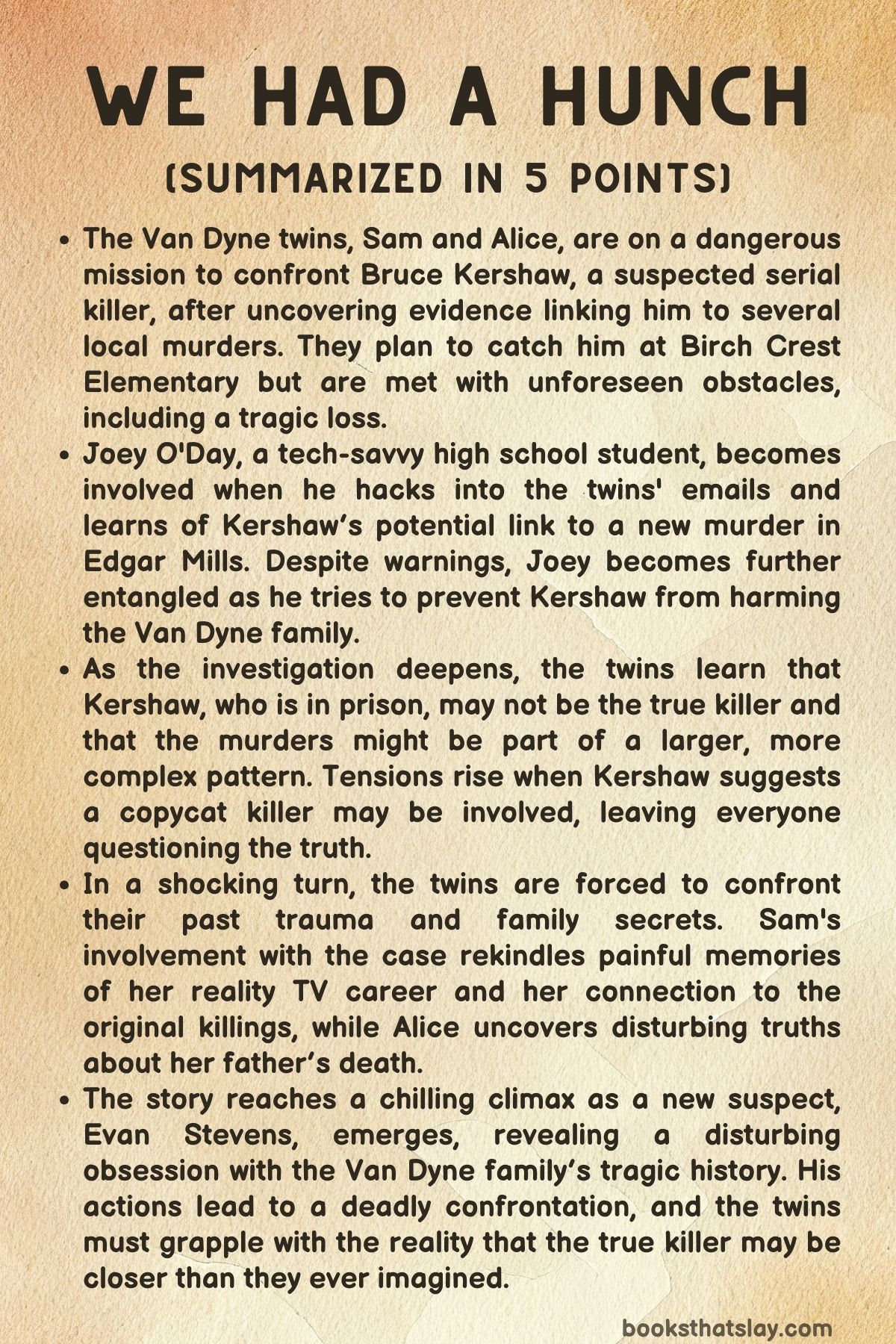
Sam and Alice Van Dyne, twin sisters, find themselves embroiled in a dangerous investigation as they attempt to uncover the truth behind the murders committed in their town, Edgar Mills. Their primary suspect is Bruce Kershaw, the town janitor, who was believed to be a serial killer in the past.
The sisters have spent months collecting evidence that links Kershaw to several killings, and now they plan to confront him at Birch Crest Elementary, a school they suspect he has been using as a hideout.
As they approach the school, Sam is armed with a handgun for protection, and although Alice is nervous, Sam reassures her that they are in control. They meet with two boys, Levon and Levi Brakes, who are positioned to assist them in the plan.
The group enters the school stealthily, checking their plan one last time before proceeding. The suspense is palpable as they prepare for the confrontation.
Meanwhile, Joey O’Day, a high school student and tech-savvy individual, gets involved in the investigation after hacking into the twins’ emails. He uncovers their plan to confront Kershaw and becomes concerned when he learns that Kershaw is heading to the Van Dyne house, where their father, the police chief, resides.
Joey warns Levi, and after calling the police, he hopes to prevent any harm to the Van Dyne family.
Back at Birch Crest Elementary, the twins discover that Kershaw has already been there, stealing the critical evidence they had collected—a backpack with items linking him to the murders. The sisters prepare to face Kershaw, but their plan is interrupted when Joey and Levi arrive, revealing that Kershaw is heading to the Van Dyne house.
After a brief moment of confusion, the group decides to rush to the house.
As the group moves toward the gymnasium in the school, they are startled to find the lifeless body of Levon, confirming their worst fears that Kershaw has already claimed another victim. Alice is devastated by the discovery, and the group must now figure out what to do next in the face of this tragedy.
The tension escalates as they realize that the danger is far greater than they initially thought.
Joey is at dinner with his husband, Austin, when the topic of adoption comes up. Austin is eager to revisit the idea, having waited months for Joey to be ready.
Joey is hesitant, but he agrees to meet with a representative from an adoption agency. As they sit in the restaurant, Joey hears about a new murder in Edgar Mills, which triggers memories of his past involvement in the town’s previous tragedies, including the serial killer Bruce Kershaw.
The next day, Sam wakes up next to a man named Alex, who she quickly sends away. At a café later, she is confronted by two women who bring up her past as a reality TV star and the case involving Kershaw.
Sam is shocked to learn that Kershaw’s case is being revisited, and a TikTok account is posting videos about it, dredging up painful memories. Alice, meanwhile, receives disturbing news from the police about a recent murder in Edgar Mills.
The police seek the twins’ help, given their prior involvement in the investigation of the Janitor killings.
Sam and Alice head to Edgar Mills, where they meet with Joey, who has also been contacted by the police. They learn that the new murder shares similarities with Kershaw’s previous killings, but there’s a twist: Kershaw is in prison, and the police are unsure whether the new murder is related to him.
In an unexpected turn, Kershaw requests to meet with the Van Dyne twins and claims that the murder might be the work of a copycat killer.
The twins, along with Joey, decide to meet with Kershaw in prison. In the meeting, Kershaw acts strangely and manipulates the group, hinting that he did not commit all of the murders attributed to him and suggesting there may be a larger conspiracy.
His cryptic words leave the group unsettled, and the police remain skeptical. Joey, however, begins to entertain the possibility that Kershaw might be telling the truth.
As the investigation deepens, Sam, Alice, and Joey face emotional challenges as they deal with their own personal struggles. The police are growing more desperate, and the group realizes that they must continue their investigation, even as they begin to question the true nature of the case.
Sam and Alice also confront their mother, who has been suffering from PTSD, and tensions run high during the visit.
The case takes another dark turn when the twins discover new evidence that suggests Kershaw may be innocent in some of the murders attributed to him. The sisters, determined to uncover the truth, are led to explore other suspects, including their former music teacher and a close family friend.
As they dig deeper, they are confronted by Doug Shiftley, a man connected to their family, who may hold key information about the case.
As the investigation intensifies, the group uncovers shocking secrets about their father’s death and their own involvement in past tragedies. The suspense builds as Sam and Alice realize that the true identity of the killer may be someone much closer to them than they ever imagined.
In the final twist, it is revealed that Evan Stevens, a teenager obsessed with serial killers and the Janitor case, is behind the murders. Evan manipulates everyone around him, including his own family, in an effort to frame others and claim the fame he desires.
After a tense confrontation at Birch Crest Elementary, Evan’s dark motivations are exposed. He confesses to committing multiple murders, including the death of Justin Beagle and the manipulation of the Van Dyne family.
As Sam, Alice, and Joey struggle to process the shocking revelations, they must come to terms with the fact that their mother, Joanna, was the original “Janitor.” She confesses to committing several murders, including those of DJ Cartwright and Mary Ellen Spakalitis. The truth about their father’s death is also revealed, and the devastating impact of the family’s secrets is fully realized.
In the end, Sam decides to return to Edgar Mills to be closer to Alice, and the investigation is far from over. Evan, still at large, continues to release disturbing videos, hinting that the story is not finished yet and that more twists and turns are in store.
The case that started as a quest for justice becomes an exploration of deep family trauma, as the twins must confront the darkest parts of their past while seeking closure in a town haunted by secrets.
Characters
Sam Van Dyne
Sam Van Dyne, one of the twin sisters at the center of the investigation in We Had A Hunch, is a complex character shaped by her traumatic past and strained family dynamics. Initially, Sam seems tough, determined, and pragmatic, traits that she carries with her as she embarks on the dangerous mission to confront Bruce Kershaw, the serial killer suspect.
She’s prepared, taking precautions like carrying a handgun, and her relationship with her sister Alice is one of mutual support, despite the underlying tensions. Sam’s past in reality TV has left her feeling disconnected from her former life, and she struggles with the public perception of her family’s involvement in the past crimes.
As the investigation unfolds, Sam’s layers are peeled back to reveal vulnerability and deep-seated emotional trauma, especially when she’s forced to confront painful memories and family secrets, including her estranged relationship with her mother, Joanna. Her ability to compartmentalize is tested, and while she’s reluctant to delve too deeply into personal emotions, Sam is driven by a need for justice and closure, particularly when the case resurfaces in connection to her family.
Her determination grows stronger as the investigation takes darker turns, revealing her resilience in the face of mounting danger and uncertainty.
Alice Van Dyne
Alice Van Dyne, the other half of the Van Dyne twins, shares a deep emotional bond with her sister Sam, but her response to the traumatic events surrounding the murders contrasts with Sam’s more pragmatic approach. Alice is more emotionally vulnerable and deeply affected by the violence and horror that unfolds around her, often struggling with anxiety and fear.
Throughout We Had A Hunch, Alice is portrayed as the more cautious twin, often seeking reassurance from Sam, especially as the investigation escalates. Her emotional struggles are magnified when she uncovers troubling family secrets, such as her father’s death and her mother’s potential involvement in the crimes.
Alice is devastated by Levon’s death, and her inability to process the loss and the betrayal she feels from those around her contributes to her growing sense of helplessness. Despite her fears, Alice’s loyalty to her sister and her determination to uncover the truth keep her moving forward.
Her personal journey involves confronting painful memories and reconciling her perception of her family with the darker truths that emerge during the investigation. Alice’s vulnerability makes her a sympathetic character, and her eventual realization about her mother’s role in the murders is a pivotal moment that forces her to grapple with her identity and sense of justice.
Joey O’Day
Joey O’Day plays a crucial role in the investigation, though his involvement is initially reluctant. A high school student with a knack for technology, Joey becomes an unexpected ally for the Van Dyne twins after he inadvertently uncovers details about the murder investigation.
Joey is portrayed as tech-savvy, introspective, and somewhat hesitant to get too deeply involved in the case, particularly when it begins to reopen old wounds from his own past. He has a strained relationship with his husband, Austin, and his reluctance to consider fatherhood adds an emotional layer to his character.
However, Joey’s sense of justice eventually overrides his reluctance, and he becomes deeply engaged in the investigation, uncovering crucial information about the murder victims and their connections to the Janitor case. His involvement in the investigation also forces him to confront unresolved feelings about his past, especially the trauma linked to the murders in Edgar Mills.
Joey’s character is marked by his deep moral compass and emotional depth, particularly when he starts questioning whether Kershaw’s claims about a copycat killer might have some truth. His ultimate role in unmasking Evan as the true killer is a testament to his intellectual prowess and emotional maturity.
Bruce Philip Kershaw
Bruce Philip Kershaw, known as the Janitor, is the notorious serial killer at the heart of We Had A Hunch. Kershaw’s role in the story is pivotal, as he has haunted the town of Edgar Mills for years, his crimes shadowing the lives of the Van Dyne twins and the entire community.
Initially, Kershaw is presumed to be the perpetrator of several murders, but as the story progresses, it becomes clear that his true involvement is more complicated than it first appears. He is manipulative and bizarre in his interactions with the investigation team, offering cryptic statements that lead the characters to question whether he truly committed all the murders attributed to him.
Kershaw’s sinister presence looms over the story, even while he remains in prison. His character serves as a catalyst for the unfolding mystery, as his twisted psychology and refusal to provide concrete answers drive the characters deeper into the investigation.
Kershaw’s claim that the murders may have been committed by a copycat killer raises doubts in the minds of the investigators, forcing them to reconsider everything they thought they knew about the case. His eventual confession about his limited involvement in the murders adds another layer of intrigue, as it complicates the investigation and points toward an even darker truth.
Levi Brakes
Levi Brakes is a character defined by his internal conflict and emotional struggles. As a key player in the investigation, Levi is initially portrayed as a somewhat reluctant participant, yet he is integral to the unfolding events.
His complex relationship with Alice, whom he has a deep emotional connection with, complicates his role in the investigation. Levi is torn between his loyalty to Alice and his own desire to protect her from the harsh realities of the investigation.
His sense of guilt over Levon’s death, which he inadvertently caused by persuading him to follow through on a dangerous plan, weighs heavily on him throughout the story. Levi’s character arc is one of self-doubt and guilt, as he grapples with the consequences of his actions.
His emotional journey becomes a key part of the narrative, as he tries to make amends for his role in the tragedy. As the investigation continues, Levi’s role shifts from passive observer to active participant, and his internal conflict is further complicated when his past lies and actions come to light.
His character reflects the themes of redemption, guilt, and the complexities of personal relationships, making him one of the more emotionally layered characters in the story.
Evan Stevens
Evan Stevens is a chilling and manipulative character who plays a central role in the story’s final revelations. As an obsessed true crime enthusiast, Evan’s fascination with the Janitor case drives him to move to Edgar Mills and attach himself to the Van Dyne family’s tragic legacy.
His character is driven by an obsessive need to be connected to the past, and he goes to extreme lengths to insert himself into the investigation, even framing himself as a victim to draw the characters into his web. Evan’s manipulation and cunning nature are evident in his ability to control those around him, including his own family, whom he coerces into helping him carry out his twisted plans.
His delusions of grandeur and desire for attention manifest in his decision to record his crimes and broadcast them on TikTok, which adds a modern layer to his villainy. Evan’s ultimate revelation as the true killer of several individuals, including his own parents, adds a shocking twist to the story.
His emotional detachment and lack of empathy make him a truly disturbing character, and his manipulative actions serve as the catalyst for the final unraveling of the mystery.
Joanna Lemire
Joanna Lemire, the mother of Sam and Alice, is a complex character whose involvement in the murders is gradually revealed throughout We Had A Hunch. Initially, Joanna is portrayed as a broken woman suffering from PTSD, unable to fully engage with her daughters due to the trauma of her past actions.
However, as the investigation progresses, it becomes clear that Joanna’s past is far more sinister than anyone could have imagined. Her role as the original “Janitor” is one of the most shocking revelations in the story, as it is revealed that she was responsible for the murders attributed to Bruce Kershaw.
Her confession, forced out by Evan’s manipulation, uncovers a deep layer of family betrayal and guilt. Joanna’s emotional struggles are evident as she contemplates the pain she caused her family, particularly when faced with the truth about her own actions.
Her complex character is defined by her guilt, shame, and the destructive influence of her past on her family’s present. Ultimately, Joanna’s role in the murders and her complicated relationship with her children make her a tragic figure, caught between her past mistakes and the painful reality of the consequences.
Themes
Justice and the Pursuit of Truth
The theme of justice is central to the story of We Had A Hunch, with characters relentlessly pursuing the truth behind a series of murders that have haunted their small town of Edgar Mills. The Van Dyne twins, Sam and Alice, along with their friends and family, are driven by a deep sense of duty to uncover what happened in the past and ensure that justice is served.
Their determination to expose the real killers and clear the name of Bruce Kershaw, a man wrongly imprisoned for crimes he didn’t commit, fuels much of the narrative. The quest for justice is further complicated by the discovery that the truth is not as straightforward as it appears.
The pursuit of justice is not just about solving the case, but also about reconciling with the trauma and moral compromises that come with confronting painful truths about one’s own family. As the characters uncover more information, they realize that the search for justice is not always clear-cut, and sometimes it requires confronting uncomfortable and difficult realities, such as the involvement of those close to them.
The tension between seeking justice for the victims and understanding the personal stakes of uncovering the truth is a constant undercurrent in the narrative, highlighting the complexities of justice in both a legal and emotional sense.
Trauma and Its Long-Lasting Effects
The impact of past trauma is another key theme in We Had A Hunch, influencing many of the characters’ actions and motivations throughout the book. Sam and Alice Van Dyne, in particular, are deeply affected by their family’s involvement in the investigation of the serial murders years ago, especially as they uncover new information that forces them to confront the possibility that their own mother, Joanna, may have been involved in the crimes.
The trauma they experience is not just personal but generational, as the legacy of violence and deception continues to affect their family’s dynamics. The book explores how trauma can distort perceptions of reality and justice, as characters grapple with their own emotional scars and the weight of past events.
The unresolved grief, guilt, and fear that linger in the characters’ lives drive their actions, particularly Sam’s attempt to move on from her past and Alice’s struggle with her perception of her father’s death. The psychological scars left by the murders and the tension between truth and family loyalty create a complex emotional landscape for the characters to navigate, demonstrating how deeply trauma can affect one’s identity, relationships, and future decisions.
Obsession and Its Consequences
In We Had A Hunch, the theme of obsession is explored through several characters, most notably Evan Stevens, whose unhealthy fixation on serial killers, particularly the infamous “Janitor” case, drives him to commit horrific acts. His obsession becomes a twisted catalyst for the events of the novel, as he manipulates and coerces those around him, including his family and the Van Dyne twins, in an attempt to maintain his control over the narrative of the murders.
Evan’s obsession with the Janitor case and the twisted desire for fame through social media and TikTok underscore the dangers of unchecked obsession. The novel portrays how obsession can cloud judgment, leading individuals to make dangerous and morally reprehensible decisions.
It also serves as a commentary on the modern obsession with true crime, social media fame, and the voyeuristic consumption of violence, where the line between empathy and exploitation is often blurred. The consequences of Evan’s obsession are far-reaching, affecting not just his own life but the lives of everyone around him, showing the destructive potential of an unchecked fixation on the past and the desire for recognition.
The Complexity of Family and Loyalty
Family dynamics and loyalty are crucial themes in We Had A Hunch, with the Van Dyne sisters grappling with complex feelings toward their parents and the darker secrets buried within their family history. The theme of loyalty is tested in various ways, particularly as the twins uncover the truth about their mother’s involvement in the murders.
Their loyalty to each other, their father, and their mother is continuously challenged as the investigation reveals uncomfortable truths. Alice’s belief in her father’s righteousness, for example, is shattered as the layers of family secrets are peeled away, forcing her to question her understanding of both her father and her mother.
Loyalty to family members who may have committed heinous acts creates a moral dilemma for the characters, one that forces them to balance love, justice, and truth. This theme is reflected not only in the Van Dyne family but also in the relationships between other characters, such as Joey and his husband Austin, whose own desires to start a family are complicated by Joey’s past ties to Edgar Mills and the unresolved mysteries that continue to haunt him.
The book highlights the tension between familial loyalty and the moral imperative to seek the truth, illustrating that loyalty is not always a simple or easy path, especially when it collides with deeply unsettling realities.
The Role of Technology and Social Media in Modern Investigations
Another significant theme in We Had A Hunch is the role that technology and social media play in modern investigations and the public’s relationship to crime. Joey’s tech-savvy background and his involvement in the digital side of the investigation showcase how technology can be both a tool for uncovering the truth and a source of complicating the case.
The obsession with true crime, amplified by social media platforms like TikTok, becomes a vehicle for both solving and exploiting the mysteries of the murders. The rise of online investigations and the public’s thirst for crime-related content highlight how modern audiences engage with crime in a way that can often blur the lines between entertainment and reality.
Evan Stevens’ manipulation of social media to share videos of the murders he commits is a chilling example of how technology can be used to amplify violence and perpetuate obsession. This theme raises questions about the ethical implications of using social media to expose the gruesome details of real-life crimes and how public attention can shift from solving the crime to seeking thrills and notoriety.
It serves as a critique of how media and technology can shape public perception and complicate the pursuit of justice, especially when personal motives and the desire for fame are intertwined with the quest for truth.