We Used to Live Here Summary, Characters and Themes
We Used to Live Here by Marcus Kliewer is a horror novel that blends psychological unease, shifting reality, and the fear of losing your place in your own life. The story begins with a simple act of politeness and slowly turns into something far stranger and more threatening.
Set around an isolated old house in the Pacific Northwest, the book follows Eve as small details stop making sense and ordinary explanations begin to fail. It plays with memory, identity, paranoia, and the idea that a place can hold its own disturbing power.
The result is an unsettling story about invasion, erasure, and surviving the impossible.
Summary
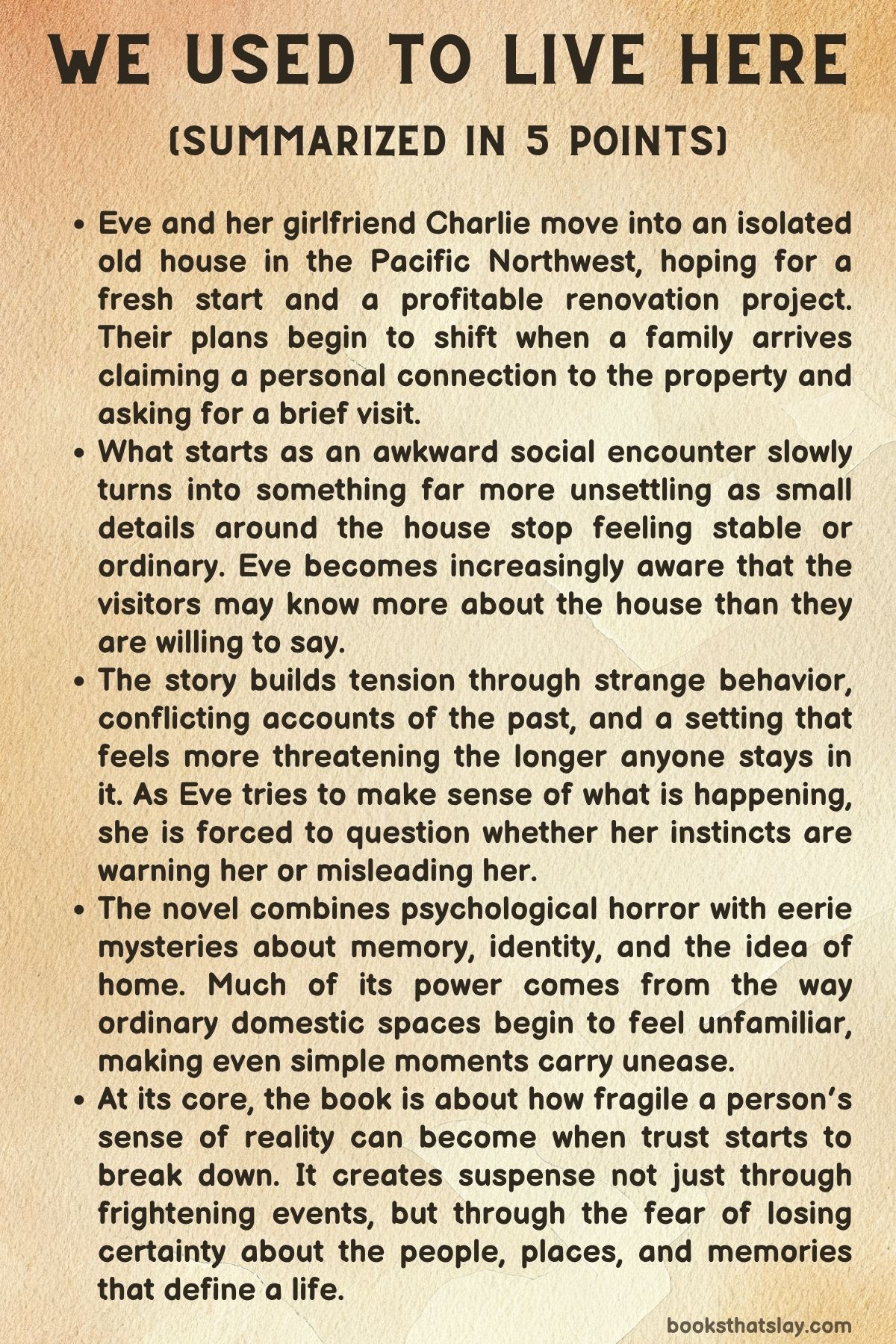
Eve Palmer and her girlfriend Charlie have recently moved into an old Victorian house deep in the Pacific Northwest. They bought it cheaply with plans to renovate and resell it, even though Eve never felt comfortable there.
The place has an unsettling presence, especially the basement, which she avoids. One night, while Charlie is away, a family appears at the door.
Thomas Faust says he grew up in the house and asks if he can show it to his wife and children. Eve is suspicious from the beginning.
Their arrival feels wrong, and yet she gives in and lets them enter.
As Thomas walks through the house, he points out details from his childhood and speaks with familiarity about hidden features and old decorations. His wife, Paige, seems tense, and their children behave in ways that make Eve uneasy, especially Jenny, who is curious and difficult to control.
Thomas mentions symbols his sister once drew around the house to ward off bad luck. He also asks whether Eve has noticed anything strange since moving in, but he stops short of explaining himself.
When Jenny disappears, Thomas believes she has gone into the basement through a hidden passage. Eve reluctantly follows him below.
The basement is larger and more maze-like than she expected, full of narrow passages, strange rooms, and a sense that something is watching. There, Thomas behaves oddly, freezing for a moment as if in a trance.
Eve leaves with even more doubts.
Charlie eventually comes home and, unlike Eve, welcomes the family warmly. Because a storm has closed the only bridge out of the area, the guests end up staying the night.
Over dinner, Eve notices more strange details. Paige has a scar that suggests the removal of a tattoo resembling the same symbol found in the house.
Thomas speaks vaguely about his sister Alison, who once believed the house was changing reality around her. According to him, Alison became convinced that rooms shifted, colors changed, and familiar people were being replaced by impostors.
Their parents treated her fears as madness or evil, and she marked the house with symbols in an attempt to protect herself.
That night, Eve has disturbing dreams and wakes shaken. She later sees something near the basement that looks like Jenny but then becomes monstrously tall and unnatural.
Charlie dismisses it as a hallucination. The next morning, Charlie is gone, and the family is still in the house as if they belong there.
Eve cannot find her phone. She notices Charlie’s locket hanging where it should not be, and the normal order of the house seems subtly altered.
Panicked, she leaves with the dog, Shylo, and goes to a neighboring house for help.
There she meets Heather, an older woman who knows Thomas’s past. Heather reveals that Alison was not really Thomas’s sister but a foster child who appeared mysteriously from the woods with no clear origin.
Alison later attacked Thomas violently, convinced he did not belong in her life and had somehow replaced what was real. This deeply unsettles Eve because it clashes with Thomas’s story and suggests that the house has a longer and stranger history than she knew.
Heather’s home also contains a toy nearly identical to one from Eve’s childhood, a detail that strengthens Eve’s fear that reality itself is unstable.
On her way back, Eve follows signs into the woods and discovers an old cabin filled with maps, notes, and records about the house. The material suggests that the property is not simply haunted but connected to distortions in space, time, and identity.
Reports mention impossible architecture, species appearing where they should not exist, and people becoming trapped after living there too long. A frightened old man warns Eve that the family in her house is not what it seems and urges her to drive them out immediately.
When Eve returns, the house continues to shift in alarming ways. In the attic she finds Charlie’s old belongings and a message warning her not to forget which house she is in.
She also sees a terrifying figure, perhaps Alison, perhaps something else. Later, she wakes injured and disoriented, and a fight over a phone convinces her the family has crossed into her life in a deeper way.
Small features of the house begin changing, including a stained-glass window that vanishes and is replaced by an ordinary one. Charlie still searches for rational explanations, but even she begins to notice that some changes cannot be explained.
Eve and Charlie try to leave and spend the night at a motel. By now Eve feels a growing distance from Charlie, as if even she may not be the same person.
Then Charlie’s phone rings, and the voice on the line seems to be the real Charlie calling from somewhere else. Convinced the woman beside her is an impostor, Eve steals the truck and returns alone to the house.
A police officer briefly stops her on the road, and she nearly hits a strange girl before reaching the property again.
Back inside, the house has become fully hostile. The power is out, the doors and windows trap her in place, and the rooms seem to lead to impossible spaces.
Following cries for help, Eve finds herself in a hidden area filled with paintings and photographs. These reveal another version of the Faust family history: Alison was the true daughter, and Thomas appears in family images as if inserted later.
Eve finds a note Alison wrote to herself, reminding herself of her own name and life and stating that Thomas came from the woods and replaced her. Alison believed that if she destroyed him, she could restore what was stolen from her.
Eve then enters a deeper layer of the house, one that resembles a hospital corridor. There she finds the toy from her childhood and sees Charlie in a horrifying altered state, ancient and barely human, overrun by swarming ants yet still able to warn Eve that she should not be there yet.
Alison appears again, and Eve experiences flashes of Alison’s life, confirming that Thomas replaced her and that Alison was punished for resisting him. Eve hides, survives another encounter, and arms herself with a hammer.
When she finally comes upstairs, the house has been remade into another reality. The family acts as though Eve is someone else entirely: Emma, Thomas’s unstable sister.
Thomas treats the house as his own and frames Eve as a dangerous intruder. Even Shylo seems loyal to him.
At dinner, Jenny notices that Eve is missing a tattoo she supposedly once had, hinting that not everyone in the family fully fits the false reality. When Paige opens Charlie’s locket, it is empty.
This pushes Eve beyond endurance. She takes Paige hostage and demands answers about Charlie and her own identity.
Violence follows. Paige stabs Eve, and Eve kills Paige in return.
Thomas attacks her, and in the struggle he speaks not as one man but as something collective and ancient, claiming responsibility for life itself. He also calls her Evelyn, not Emma, revealing that he knows more than he has admitted.
Eve fights back with a hammer and tire chains, nearly killing him before police arrive. To the authorities, Eve is a murderer and a delusional woman who attacked an innocent family.
Evidence of her former life is gone. Her parents do not know her.
Charlie is now Charlotte, an ex who remembers a different story. Eve is arrested and trapped in a reality where Thomas’s version has won.
She ends up in a psychiatric hospital, heavily medicated but still holding onto the memory of her real life. She uses her limited internet access to investigate strange disappearances, impossible spaces, and alternate realities, gathering the scattered evidence that appears throughout the story.
Over time she tries to accept that she may never escape, but one day Thomas visits her. Before leaving, he gives her Charlie’s locket, and inside is the photograph of Eve that should not exist if her old life were only delusion.
The gift confirms that her past was real and that somewhere beyond the false world imposed on her, Charlie remembers too. In the final note from Charlie, she says Eve vanished and that when she returned to their house, it was boarded up as though they had never lived there at all.
That ending leaves both women stranded on opposite sides of a broken reality, each knowing the truth and unable to make anyone else believe it.
Characters
Eve Palmer
Eve Palmer is the emotional and psychological center of We Used to Live Here, and nearly everything in the novel is filtered through her unstable but intensely observant perspective. She is a person who notices small disturbances before anyone else does, and that sensitivity makes her both vulnerable and valuable.
From the beginning, she is uneasy in the house, uneasy around strangers, and uneasy even with her own instincts because she has spent so long being made to doubt them. Her anxiety shapes the way she reads the world, but the novel refuses to make that anxiety meaningless.
Instead, it becomes one of the story’s central tensions: Eve may be frightened, suspicious, and reactive, yet she is also often correct. That makes her a compelling protagonist because the reader is forced to ask not whether she is afraid, but whether fear is the only sane response to what she is facing.
One of the strongest aspects of Eve’s characterization is the way she lives in constant negotiation with herself. She wants to be polite, reasonable, and accommodating, but another part of her is always scanning for danger.
This split is visible the moment Thomas and his family arrive. She senses that something is wrong, yet she still invites them in.
That decision says a great deal about her. Eve is not reckless in a conventional sense; rather, she is someone whose guilt and self-doubt can override her judgment.
She has learned to question her own perceptions, and that makes her easy to trap. The horror of her situation grows partly from the fact that she keeps trying to act like a normal person in a reality that is no longer behaving normally.
Her relationship with Charlie also deepens her character. Eve loves Charlie and depends on her, but she is not fully secure in that dependence.
Charlie represents comfort, normalcy, and a life Eve has chosen for herself, away from the fear and religious guilt of her past. At the same time, Charlie’s skepticism leaves Eve emotionally exposed.
Eve wants to be believed by the person closest to her, and when that belief does not come, her isolation becomes much sharper. As the reality around her begins to shift, the possible loss of Charlie becomes even more devastating than the physical danger.
Eve is not only fighting to survive but also fighting to preserve the emotional truth of her life.
Eve’s past matters because it explains why the house can work on her so effectively. She carries old fears, especially fears shaped by religion, punishment, and unseen evil.
She does not enter the story as a blank slate. She already has a mind trained to anticipate catastrophe, and the house turns that tendency into a weapon.
Yet this is also what gives her endurance. She is used to surviving inner pressure.
Even when reality is stripped away from her, even when other people deny her identity, she keeps trying to hold on to memory. By the end, what defines her most is not certainty but resistance.
She remains determined to remember who she is even when every structure around her is designed to erase that knowledge.
Charlie
Charlie begins as Eve’s anchor in ordinary life. She is practical, grounded, and far more willing to treat strange events as misunderstandings rather than threats.
That makes her an important contrast to Eve. Where Eve watches for cracks in reality, Charlie looks for explanations that keep life coherent.
She is not careless or unfeeling; rather, she believes in stability, evidence, and calm. In the early part of the story, this makes her seem like the reasonable one.
She welcomes the visiting family more easily, brushes aside the more alarming incidents, and assumes there must be some harmless answer to what Eve is experiencing. Her realism is believable, and that is part of what makes the novel’s tension effective.
Charlie reacts the way many people probably would.
At the same time, Charlie’s skepticism is not entirely comforting. It has a limit, and that limit is her inability to fully enter Eve’s fear.
She often responds to distress by trying to reduce it, explain it away, or move past it. While that may come from love and practicality, it leaves Eve increasingly alone.
Charlie becomes a painful example of how disbelief can wound even when it is not cruel. She does not intend to betray Eve, but her refusal to trust Eve’s experience creates space for the horror to grow.
In that sense, Charlie is central not because she causes the problem but because she cannot recognize its scale until it is too late.
Charlie also represents a life that Eve has built through choice rather than inheritance. Their relationship suggests intimacy, shared plans, and a future shaped by mutual effort.
The old house is supposed to be part of that future, a financial and practical project, not a trap. Because of this, Charlie stands for the normal domestic life the story slowly destroys.
When Eve begins to suspect that Charlie herself may have been replaced, the fear lands with unusual force because Charlie is not just another person in danger. She is the embodiment of home, trust, and emotional certainty.
To lose confidence in Charlie is, for Eve, to lose confidence in the structure of reality itself.
As the story progresses, Charlie becomes more mysterious because she exists in more than one version at once. She is the skeptical partner, the absent voice on the phone, the altered figure in the deeper reaches of the house, and finally the person who remembers Eve from outside the false reality.
That layering gives Charlie a haunting role in the narrative. She is both loved person and threatened memory.
By the end, she becomes proof that Eve’s life was real, but she is also unreachable. Her final function is tragic because she confirms truth without being able to restore it.
She survives in memory, testimony, and grief, making her one of the most emotionally important characters in the novel.
Thomas Faust
Thomas Faust is the most disturbing figure in the story because he arrives wearing the mask of normalcy. He appears polite, nostalgic, apologetic, and even vulnerable.
He is a former resident bringing his family to see the house where he grew up. That premise is plausible enough to disarm both Eve and the reader, at least briefly.
Thomas’s menace comes from the fact that he does not begin as an obvious monster. He begins as a man who knows too much, speaks too carefully, and carries an air of buried history.
His quietness is more unsettling than open aggression because it suggests control. He reveals just enough to keep others uncertain, and uncertainty is one of his strongest tools.
A major part of Thomas’s power lies in how he manages the truth. He does not invent random lies; he reshapes reality by mixing confession, memory, and concealment.
He speaks about Alison, the strange symbols in the house, and the unsettling events of his childhood in a way that invites sympathy. He positions himself as someone who also suffered.
This gives him emotional credibility and allows him to occupy the role of witness rather than invader. Yet as the story unfolds, it becomes clear that Thomas’s self-presentation is strategic.
He tells stories that guide others toward certain conclusions while hiding the deeper horror of what he is.
Thomas is also frightening because he seems to be both person and presence. At first he appears to be a damaged man with traumatic memories, perhaps even someone overwhelmed by returning to the place that shaped him.
Later, that reading becomes impossible to sustain. Evidence accumulates that he is not merely deceptive but fundamentally wrong, a being that inserts itself into lives, families, and identities.
Alison’s writings and Eve’s visions suggest that Thomas did not belong to the household he claimed as his own but took that place by force. This transforms him from a suspicious guest into something much larger: an agent of replacement, a figure who can overwrite human relationships and occupy the center of other people’s realities.
His use of family is significant. Thomas does not act alone, and the presence of Paige and the children helps him appear stable, respectable, and socially legible.
Family becomes part of his disguise. At the same time, the family unit around him never feels entirely natural.
There are moments of strain, oddness, and emotional discontinuity that suggest they are participating in something larger than ordinary domestic life. Thomas sits at the center of that arrangement like a false patriarch, using familiar roles to secure power.
He does not simply want shelter; he wants ownership, narrative control, and submission.
By the end, Thomas speaks in a voice that exceeds human identity. He refers to himself in collective terms and presents himself as ancient and foundational.
Whether this is read literally, supernaturally, or through the warped logic of the house, the effect is the same: Thomas becomes the face of a force that feeds on fear and erasure. He is terrifying not only because he harms people but because he can make the world confirm his version of events.
That ability to rewrite belonging makes him the novel’s central antagonist and one of its most memorable characters.
Paige
Paige is one of the more quietly unsettling figures in We Used to Live Here because she is harder to read than Thomas. She does not dominate scenes in the same way he does, yet her presence carries a constant note of tension.
From the beginning, she seems watchful, guarded, and emotionally contained. She is not simply the passive wife standing beside a more powerful man.
There are signs that she knows more than she says, and her discomfort often feels deeper than surface irritation. Her religious language, her scar from tattoo removal, and her tightly controlled manner all suggest a past shaped by shame, obedience, or survival.
One of Paige’s key functions is to give the family a moral surface. She performs normalcy through domestic and social rituals: prayer, politeness, motherhood, order.
Yet those rituals do not feel reassuring. They feel heavy, rehearsed, and sometimes coercive.
Her prayer at dinner is especially revealing because it is earnest, deliberate, and charged with more meaning than a routine blessing should have. Paige seems like someone who needs structures of belief not just for comfort but for containment.
Religion, in her case, may be a way of managing fear, guilt, or complicity.
Her relationship with Thomas is also important. There are moments when she appears angry with him, moments when she challenges him, and moments when she seems resigned to his authority.
This ambiguity makes her interesting. She can be read as someone trapped within his reality, someone who once made choices that bound her to him, or someone who participates willingly in what he is doing.
The novel never reduces her to a simple victim or a simple accomplice. Instead, she exists in a morally murky space where loyalty, fear, and self-preservation overlap.
Paige’s questions to Eve about sexuality, relationships, and religion also reveal her as a character shaped by judgment and boundaries. She seems interested in how other people live, but that interest carries discomfort rather than openness.
She is not presented as warm or welcoming. Even when she is outwardly calm, she gives the impression of someone measuring others against standards she may not fully believe in but still enforces.
This makes her a subtle agent of pressure in the story. She helps create an atmosphere in which Eve is being examined and assessed.
Her final arc confirms that Paige is not merely decorative in the narrative. When the false domestic scene reaches its breaking point, Paige becomes part of the violent struggle over identity and control.
Her death is shocking not only because it is brutal but because it exposes how unstable the family performance always was. Beneath the appearance of order, Paige was part of a structure sustained by repression and menace.
She embodies the threat hidden inside conventional roles and rituals, making her one of the novel’s most effective secondary characters.
Jenny
Jenny is one of the most intriguing members of the visiting family because she often seems to stand at an angle to the reality the others are maintaining. She is curious, observant, and less socially polished than the adults around her.
While the parents try to manage appearances, Jenny asks questions, wanders off, and notices details. This makes her especially unsettling in a story where noticing is dangerous.
She behaves like a child in some scenes, but in other moments she feels older, stranger, or somehow out of sync with the role she is playing.
Her disappearance into hidden spaces early in the story establishes her as a figure connected to the house in a more direct way than the adults admit. She moves toward the basement, the dumbwaiter, and concealed passages as if she is drawn to them.
Whether this comes from curiosity, instinct, or familiarity is never fully settled, and that uncertainty gives her a spectral quality. She does not merely explore; she seems able to slip toward the deeper layers of the place with unusual ease.
This makes her feel less like an ordinary child and more like someone partly aligned with the house’s hidden logic.
Jenny is also important because she occasionally notices fractures in the false reality. During the final domestic inversion, she remarks on an inconsistency in Eve’s identity, specifically the absence of a tattoo she appears to remember.
That moment matters because it suggests Jenny is not fully contained by the version of events Thomas is enforcing. She can detect difference, even if she cannot explain it.
This gives her a peculiar role as a child witness whose perception may be more flexible or less disciplined than the adults’. She is one of the few characters who seems capable of sensing that something does not line up.
At the same time, Jenny is never turned into a heroic truth-teller. She remains eerie, unpredictable, and difficult to place emotionally.
Her silence and curiosity make her unnerving rather than reassuring. The novel uses her well because children in horror often expose what adults suppress, and Jenny fulfills that function without becoming sentimental.
She is a reminder that the structure around Thomas is not seamless and that even within the false family, there are signs of instability.
Kai
Kai contributes to the family’s threatening atmosphere through aggression, restlessness, and a sense of entitlement within the house. He does not receive as much depth as the central figures, but his behavior adds to the impression that the family is testing boundaries from the moment they arrive.
He fights with his sibling, handles objects that do not belong to him, and helps create a domestic occupation of Eve and Charlie’s home. He feels less uncanny than Jenny and less symbolically loaded than Thomas or Paige, but he plays an important supporting role in the family’s pressure campaign.
His conflict with Eve over the phone is especially revealing. That scene captures the way reality has begun to slip.
The exchange is chaotic, physical, and disorienting, and Kai’s possession of the damaged phone contributes to the confusion over what belongs to whom. He becomes part of the mechanism by which Eve’s sense of order is scrambled.
The fact that Shylo attacks him also matters, because animals in the novel often register danger before people fully understand it. Kai may not be the source of the horror, but he is close enough to it that even the dog reacts violently.
Kai’s presence helps make the family feel materially invasive. The adults bring unease, but the children make the occupation harder to control.
They move through rooms, touch objects, alter the flow of the house, and create noise and distraction. Kai represents that active disruption.
He is less a psychologically deep figure than a force of friction. He helps show how ordinary family behavior can become sinister when it occurs inside a situation built on trespass and hidden intent.
Newton
Newton is a quieter figure, but his relative lack of emphasis is itself useful. In a novel where some characters are sharply individualized and others feel vaguely misaligned, a quieter child can contribute to the sense of incomplete or unstable family identity.
Newton appears within the group dynamic rather than as a fully independent presence, and that makes him feel almost like part of the family’s collective shape rather than a separate emotional center.
His role is mostly atmospheric. He helps the visitors appear normal, helps fill out the image of a traveling family, and reinforces the domestic cover that makes their intrusion initially acceptable.
At the same time, the fact that he remains less distinct than Jenny or Kai adds to the family’s uncanny quality. Not every member of the group needs a dramatic role; some function by making the whole arrangement feel slightly off.
Newton contributes to that effect by being present without ever becoming fully knowable.
Alison
Alison is one of the most tragic and important figures in the novel because she exists as both person and warning. For much of the story, she is presented through stories told by others, and those stories are partial, misleading, or false.
At first she appears to be a troubled girl whose grip on reality failed inside a strange house. Later, she emerges as someone who may have understood the truth before anyone else did.
This reversal is central to the novel’s structure. Alison begins as a cautionary tale about instability and ends as evidence that what looks like madness may actually be testimony.
Her isolation is one of the most painful aspects of her character. She perceives change, replacement, and distortion, but the adults around her interpret those perceptions as illness, danger, or evil.
That means Alison not only suffers the horror itself but also suffers the destruction of credibility. Her attempts to defend herself are pathologized.
The symbols she carves become signs of obsession rather than acts of protection. Her violence toward Thomas is treated as proof of her instability, but later information suggests that it may have been an act of resistance against an invader who had already displaced her life.
Alison’s fragmented presence throughout the story also gives her a ghostly power. She appears in writings, memories, rumors, and terrifying glimpses.
She is both absent and active, dead and not dead, victim and avenger. When Eve encounters her in the deeper layers of the house, Alison no longer feels like a mere figure from the past.
She feels like someone trapped in an unfinished struggle. Her repeated warnings to hide suggest that even after all she has suffered, she is still trying to help someone else survive what consumed her.
Symbolically, Alison represents the cost of recognizing the truth too early. She is what happens to a person who sees the falsehood before the world is willing to admit it.
Her life shows how reality can be stolen not only by supernatural force but by social systems that dismiss, confine, and rewrite. In that way, she mirrors Eve, but as a darker predecessor.
She is the one who came before, the one who resisted and was erased, and the one whose story Eve must piece together in order to understand her own fate.
Heather
Heather appears briefly compared with the major characters, but her role is crucial because she carries local memory and counters Thomas’s version of events. She is lonely, talkative, and at first somewhat ordinary, which makes the information she reveals even more effective.
She is not introduced as a dramatic truth-bearer. Instead, she seems like an elderly neighbor with time to spare.
That plainness allows her to function as a bridge between domestic realism and the deeper horror surrounding the property.
Her importance lies in what she knows and how she knows it. Heather remembers Thomas from childhood and recalls Alison differently from the way Thomas describes her.
She strips away his clean family narrative and replaces it with something stranger and sadder. Through Heather, the reader learns that local history is fragmented and that the house has always distorted records, memory, and explanation.
She is one of the few characters who offers information not already filtered through Thomas or Eve’s immediate fear.
Heather’s home also contains the almost-familiar toy that unsettles Eve so deeply. This detail makes Heather more than a simple exposition device.
She becomes part of the novel’s broader pattern of misaligned memory and repeated objects. Her house is safer than Eve’s, but not entirely outside the reach of the uncanny.
Heather stands close to the edge of the mystery without fully entering it, which makes her feel believable and vulnerable at once.
Shylo
Shylo, Eve’s dog, serves as more than a companion animal. She is an instinctive barometer for danger and one of the few presences in the story not shaped by social performance.
While human characters rationalize, doubt, lie, or misremember, Shylo reacts. Her attention to doors, sounds, strangers, and hidden spaces gives emotional weight to scenes before the human characters fully understand them.
Because dogs in fiction often symbolize loyalty and intuitive knowledge, Shylo becomes a quiet but important source of truth.
Her bond with Eve also adds tenderness to an otherwise increasingly hostile story. As Eve loses certainty about the house, the family, Charlie, and even herself, Shylo remains one of the few steady emotional connections she has.
That is why moments when Shylo’s behavior becomes confusing are so effective. If even the dog appears displaced, doubled, or temporarily aligned with the wrong people, then the reader feels that reality is breaking at a deeper level.
Shylo’s actions during key confrontations also matter. She growls at danger, bites Kai during the struggle over the phone, and repeatedly guides Eve toward things she would not otherwise find.
In a novel full of altered memories and unreliable appearances, Shylo represents a kind of bodily truth. She cannot explain what is wrong, but she can respond to it.
That makes her one of the story’s most quietly meaningful characters.
Mo
Mo is not a conventional character in the same sense as the others, but the inner voice associated with Eve’s childhood toy becomes an important psychological presence. It represents intuition, fear, memory, and self-protection all at once.
Sometimes Mo sounds like anxiety given form. At other times, Mo feels almost like a survival mechanism that speaks more clearly than Eve can when under pressure.
This ambiguity is what makes the presence effective. It may be internal, supernatural, or something in between, but it is always connected to Eve’s deepest instincts.
Mo also links Eve’s adult terror to childhood vulnerability. The toy belongs to an earlier emotional world, and its return in different forms throughout the story suggests that Eve’s past is not separate from her present danger.
The house attacks identity through memory, and Mo becomes one of the fragments Eve clings to when everything else starts shifting. Whether understood as imagination or warning, Mo helps externalize the battle taking place inside Eve’s mind.
Themes
Reality, Memory, and the Fear of Being Replaced
Reality in We Used to Live Here is never presented as something fixed and dependable. Instead, it becomes unstable in small, frightening ways before collapsing on a much larger scale.
Objects move, details change, rooms seem different, stories conflict, and people begin to feel unfamiliar even when they look the same. What makes this theme so effective is that the novel does not treat reality as a grand philosophical question in an abstract sense.
It shows reality breaking inside everyday life. A house, a relationship, a family history, and even a name become uncertain.
That gradual breakdown creates a powerful kind of fear because it attacks the structures people usually rely on to know who they are and where they belong.
Memory becomes the only defense against that collapse, but memory is also fragile. Eve keeps trying to hold onto details that prove her life is real, yet she is surrounded by people and systems that deny her version of events.
This makes memory feel both precious and vulnerable. It is not enough to remember something; the world has to allow that memory to matter.
The novel shows how terrifying it is when private knowledge cannot be verified by anyone else. In that situation, memory turns into a form of resistance.
Eve’s determination to remember Charlie, their life together, and the truth of what happened becomes an act of survival.
The fear of replacement gives this theme its sharpest edge. The horror is not only that something false has entered reality, but that it can take the place of what was true and make the false version seem normal.
Thomas’s role in the story embodies that fear, but the idea extends beyond him. Charlie may be replaced.
Eve may be renamed and recast. Alison’s life was overtaken before Eve’s.
The novel turns replacement into a violation of identity itself. What is being stolen is not just presence, but legitimacy.
Someone else gets to inhabit your place, claim your history, and convince the world that you never belonged there at all.
That is why this theme feels larger than supernatural horror. It speaks to the dread of being erased while still alive.
The story suggests that reality is not only what exists, but what others accept as true. Once that consensus is broken, the self becomes exposed.
The deepest terror here is not death. It is the possibility that your life can be overwritten and that you will remain conscious enough to know it happened.
Home as a Site of Invasion and Corruption
Home is usually imagined as a place of refuge, privacy, and emotional safety, but the novel turns that idea inside out. The house Eve and Charlie buy is meant to be a shared project and a step toward a better future.
It should represent stability, ambition, and partnership. Instead, it becomes the place where control slips away from them.
The horror works so well because it begins with hospitality. Eve opens the door and allows the family inside.
That simple social gesture becomes the first stage of invasion. The house is not stormed violently from the outside; it is entered through politeness, uncertainty, and the pressure to seem accommodating.
That choice matters because it shows how domestic space can be lost gradually, without a clear moment when safety officially ends.
Once the visitors are inside, the meaning of home starts changing. The family walks through rooms with the confidence of ownership.
Thomas speaks about the place as if his past gives him a stronger claim to it than Eve and Charlie’s present. Over time, the house stops functioning as Eve’s home at all.
It becomes a place where she is watched, doubted, displaced, and eventually treated as an intruder. This reversal is central to the novel’s unease.
A home is not only a building. It is the space where identity is affirmed.
When that space begins to reject its inhabitant, the result is a specific kind of horror that feels intimate and humiliating.
The physical corruption of the house also mirrors the emotional one. Hidden passages, shifting rooms, altered windows, and impossible spaces make the building feel alive in a hostile way.
The house is not simply haunted by the past; it actively reshapes the present. It absorbs conflict, distorts memory, and weakens the distinction between inner and outer threat.
The basement and attic are especially significant because they represent the buried and the neglected, the parts of a home that are hardest to control and easiest to fear. As Eve moves deeper into those spaces, the house becomes less like architecture and more like a system designed to trap and alter whoever lives within it.
By turning home into a place of exposure rather than comfort, the novel suggests that belonging is never guaranteed by ownership alone. A deed, a relationship, and even daily occupation do not secure a person’s place if something more powerful can claim the space on different terms.
This makes the corruption of the house emotionally devastating. Eve is not merely chased through a scary setting.
She is expelled from the very place that was supposed to shelter her, and that expulsion becomes a metaphor for the loss of reality, trust, and selfhood.
Gaslighting, Credibility, and the Violence of Not Being Believed
The novel is deeply concerned with what happens when a person accurately perceives danger but cannot persuade others that the danger is real. Eve’s experience is frightening not only because strange things happen around her, but because nearly every attempt to explain what she sees is met with doubt, dismissal, or reinterpretation.
This dynamic creates a sustained pattern of gaslighting, whether it comes from specific manipulation, social habit, or institutional power. The effect is cumulative.
Eve is not broken by one single denial. She is worn down by repeated moments in which her fear is treated as overreaction, confusion, or instability.
Charlie’s role is especially painful in this regard. She does not set out to harm Eve, but her practical skepticism keeps placing Eve in the position of having to defend her own perceptions.
That emotional gap matters because disbelief from strangers is one thing, but disbelief from someone intimate strikes much deeper. Eve is left alone inside experiences that are already difficult to process.
The result is a devastating kind of isolation. She begins to question not only what she sees but whether she deserves to trust herself at all.
The novel captures how gaslighting does not need to be theatrical to be destructive. It can happen through tone, patience, rational explanation, and the insistence that there must be a simpler answer.
This theme becomes even darker when it expands beyond personal relationships into official systems. Once police, medical authorities, and legal structures accept the wrong narrative, Eve’s truth becomes almost impossible to defend.
Her memories are reframed as symptoms. Her terror becomes evidence against her.
Her resistance becomes pathology. This shift shows how credibility is not distributed equally or fairly.
Reality, in practical terms, is often determined by who has the power to name events and whose version gets recorded. The novel is sharp in showing that once institutional language closes around a person, that person can be trapped inside someone else’s interpretation of her life.
The story also connects disbelief to gender, emotion, and mental vulnerability without reducing Eve to any one category. She is anxious, observant, fearful, and often unsure of herself, and those traits make it easy for others to dismiss her.
Yet the novel insists that sensitivity is not the opposite of truth. In fact, Eve’s vulnerability often allows her to perceive what more confident people ignore.
That tension gives the theme much of its force. The danger is not just supernatural manipulation.
The danger is that the social world is already prepared to mistrust someone like Eve. The horror gains power because it enters a structure of disbelief that was already waiting for her.
Identity as Something Fragile, Contested, and Hard-Won
Identity in this novel is not treated as a stable essence that remains untouched no matter what happens. It is shown as something that depends on memory, recognition, relationship, and continuity.
A person knows who they are partly because the world reflects that identity back to them. Once those reflections begin to distort, identity becomes difficult to hold together.
Eve’s struggle is not only to survive physically but to remain Eve in a world that starts calling her by another name, assigning her another history, and offering her another role. This is what makes the novel’s horror so psychologically intense.
It is not content with threatening the body. It threatens the narrative through which a person understands herself.
Names matter greatly in this process. When Eve is called Emma, the moment carries more than confusion.
It is an attempt to rewrite personhood. The same is true of Charlie becoming Charlotte in a different configuration of reality.
These shifts are not random details. They show that identity can be altered through language as well as through memory.
If enough people use the wrong name, accept the wrong story, and behave as though the false version is true, the self begins to lose social footing. The novel understands that identity is both internal and relational.
You can know who you are, but if every surrounding structure insists otherwise, that knowledge becomes harder to defend.
Alison’s story strengthens this theme by offering a parallel case of identity under attack. She too experiences replacement, disbelief, and institutional punishment.
Her attempt to preserve herself is interpreted as madness, which suggests that identity is not merely fragile in a supernatural sense but politically fragile as well. Those who resist an imposed narrative can be isolated, diagnosed, and erased.
Eve’s path echoes Alison’s, turning personal horror into a repeating pattern. This repetition suggests that the house does not simply trap individuals.
It attacks the continuity through which a self remains legible across time.
Yet the theme is not entirely hopeless. Identity may be fragile, but the novel also shows it as something worth fighting for even when victory is uncertain.
Eve’s refusal to forget, her attachment to Charlie’s photograph, and Charlie’s own insistence that Eve truly existed all suggest that identity can persist through witness and memory. It may be damaged, denied, or buried, but not fully destroyed.
That final note matters because it keeps the novel from becoming empty despair. The self is vulnerable, but it is also stubborn.
Even when the world has been rearranged to deny her, Eve continues to assert that her life was real, and that assertion becomes the last form of freedom left to her.